

|
시장보고서
상품코드
2099925
젖소용 사료 첨가물 시장 : 점유율 분석, 업계 동향 및 통계, 성장 예측(2026-2031년)Dairy Cattle Feed Additives - Market Share Analysis, Industry Trends & Statistics, Growth Forecasts (2026 - 2031) |
||||||
 Mordor Intelligence
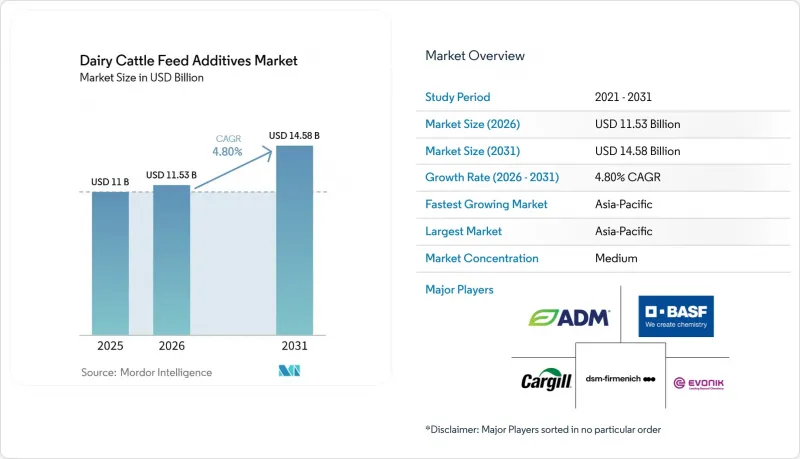
Mordor Intelligence에 의하면, 젖소용 사료 첨가물 시장 규모는 2025년에 110억 달러가 되어, 2026년에는 115억 3,000만 달러에 이르고, 2031년까지 145억 8,000만 달러로 확대되어 2026년부터 2031년까지 CAGR 4.8%를 나타낼 것으로 예측됩니다.
본 보고서는 첨가물별(산미료, 아미노산, 항생제, 항산화제, 결합제, 효소, 향료·감미료, 미네랄, 미코톡신 해독제 등) 및 지역별(북미, 남미, 유럽, 아시아태평양, 중동 및 아프리카)로 분류되어 있습니다. 시장 전망은 금액(달러) 및 수량(메트릭 톤)으로 제시되어 있습니다.
전 세계 젖소용 사료 첨가물 시장 동향 및 인사이트
우유 생산량 증가 및 사료 효율 향상에 대한 수요 증가
상업적 낙농 농장에서는 사료 비용을 절감하면서 두당 우유 생산량을 높이는 데 점점 더 주력하고 있으며, 이에 따라 사료 효율과 가축 생산성을 높이는 기술에 대한 수요가 증가하고 있습니다. 2026년 4월 Novonesis A/S의 보고서에 따르면, 상업적 낙농 시스템의 총 우유 생산 비용 중 사료비가 60%에서 70%를 차지하고 있어, 생산성이 소폭 향상되는 것만으로도 사료 첨가물 사용이 정당화되는 이유가 부각되고 있습니다. 이는 고에너지 TMR(토탈 믹스 레이션)을 사용하는 집약적인 가축 사육 군에서 특히 중요하며, 이러한 경우 루멘 활성 제품은 거친 사료의 품질이나 사료 원료 비용이 변동하더라도 생산성을 유지하는 데 도움이 됩니다. 그 결과, 우유 생산량, 사료 전환율 또는 유성분에서 측정 가능한 개선을 가져오는 첨가물는 낙농 사료 공급 프로그램에서 점점 더 중요해지고 있습니다. 공급업체가 실험실 결과에만 의존하지 않고, 기술 지원, 현장 시험 데이터, 그리고 상업적 농장 조건에서 얻은 실증 데이터를 제공함으로써 이러한 제품의 경쟁력은 더욱 높아집니다.
루멘 건강 최적화 솔루션의 활용 확대
고생산성 젖소 군은 사료에 발효성 에너지가 과다하게 포함되어 있을 경우 루멘 불안정화에 특히 취약하므로, 소화 효율과 동물 건강을 지원하는 영양 전략에 대한 관심이 높아지고 있습니다. 그 결과, 사료 첨가물 프로그램에서는 단순히 시정 조치에만 의존하는 것이 아니라, 생효모, 프로바이오틱스, 효소 기술을 기반으로 한 일상적인 예방적 접근 방식이 점점 더 중요시되고 있습니다. 라레만드 애니멀 뉴트리션(Lalemand Animal Nutrition)에 따르면, 이 회사는 2025년 10월, 생 루멘 효모, 바실러스 속 균을 기반으로 한 하부 장관 성분, 그리고 효모 세포벽 유래 포스트바이오틱스를 결합한 다성분 솔루션 ‘LEVUCELL Trivantage’를 미국에서 출시했습니다. 이 제품의 출시는 가축 생산성의 여러 측면을 동시에 개선하도록 설계된 통합형 첨가물 플랫폼으로의 광범위한 추세를 반영합니다. 이러한 접근 방식은 배합 및 모니터링을 간소화하는 동시에, 우유 생산량, 사료 섭취량의 안정성, 그리고 장 건강에 대한 보다 종합적인 관리를 지원합니다. 그 결과, 여러 생산성 지표에 걸쳐 일관된 효과를 입증할 수 있는 공급업체는 젖소용 사료 첨가물 시장에서 경쟁력을 강화할 가능성이 높을 것으로 보입니다.
중소규모 낙농장의 가격 민감도
생산자가 우유 수입 증가나 우군 생산성 향상을 통해 치솟은 사료 비용을 회수하지 못할 경우, 사료 첨가물 도입은 지연되는 경향이 있습니다. 이 과제는 소규모 및 중규모 낙농 시스템에서 특히 두드러지는데, 이러한 시스템에서는 우유 가격 구조상 유성분 개선, 가축 건강, 또는 사료 효율 향상에 대한 인센티브가 제한적인 경우가 많기 때문입니다. 그 결과, 장벽이 되는 것은 투자에 대한 소극성뿐만 아니라, 고품질 제품 제공과 발전 단계에 있는 상업 낙농 시스템의 현금 흐름 실태 간의 불일치이기도 합니다. 이러한 시장에서는 가공업체의 인센티브, 우유 품질 프리미엄, 협동조합을 통한 공동 구매 체계가 충분히 정비되어 있지 않은 경우, 기술적으로 유효한 첨가물라 하더라도 도입 속도가 느려질 가능성이 있습니다. 그 결과, 많은 신흥 시장에서 1두당 실제 사료 첨가물 사용량은 낙농 부문이 지닌 광범위한 성장 잠재력을 따라가지 못하는 경우가 많습니다.
부문 분석
2025년, 아미노산은 젖소용 사료 첨가물 시장 점유율의 18%를 차지했으며, 루멘 보호형 메티오닌 및 리신이 상업적인 젖소용 배합 사료 프로그램의 핵심으로 자리매김함에 따라 가장 큰 첨가물 카테고리가 되었습니다. 미네랄은 우유 합성 및 전해질 균형에서 수행하는 역할에 힘입어 두 번째로 큰 지출 분야를 형성했습니다. 한편, 킬레이트화된 미량 미네랄은 유럽의 사료 첨가 상한 규제 하에서 점유율을 확대했습니다. 효소와 비타민 또한 상업적인 낙농 시스템에서 소화율, 인의 이용 효율, 전환기의 건강 상태 및 번식 성적을 개선하기 위해 계속해서 중요한 역할을 수행했습니다. 산성화제는 사일리지 및 배합 사료에 첨가되어 사료 보존 및 반추위 pH 관리를 수행함으로써, 젖소용 사료 첨가물 시장에서 안정적인 역할을 계속 유지했습니다.
프로바이오틱스 분야는 가장 빠르게 성장하는 카테고리이며, 항생제 감축을 위한 노력이 미생물 제제의 보급을 뒷받침하고 있어, 2026년부터 2031년까지 젖소용 사료 첨가물 시장에서 프로바이오틱스 시장 규모는 연평균 성장률(CAGR) 9.1%로 확대될 것으로 예측됩니다. 마이코톡신 해독제는 2026년 1분기 모니터링 데이터에서도 입증된 바와 같이, 기존의 점토계 제품으로는 효과적으로 제어할 수 없는 푸사리움 독소에 대응하는 바이오트랜스포머 솔루션이 등장함에 따라 우선순위 분야로 부상하고 있습니다. 생산자들이 장내 환경 건강 증진, 면역 지원 및 미생물 군집 관리를 위한 더 강력한 수단을 모색함에 따라, 피토제닉스, 프리바이오틱스 및 효모의 상업적 중요성도 높아지고 있습니다. 한편, 규제가 엄격한 지역에서는 수의 당국의 감시가 강화되고 항생제 사용이 제한됨에 따라, 젖소용 사료 첨가물 시장의 항생제 부문은 구조적인 압박에 직면하고 있습니다.
지역별 분석
아시아태평양은 2025년 전 세계 매출의 28%를 차지하며, 젖소용 사료 첨가물 시장에서 가장 큰 기여를 한 지역이 되었습니다. 또한, 이 지역은 2026년부터 2031년까지 7.6%라는 가장 높은 연평균 성장률(CAGR)을 나타낼 전망입니다. 『Xu Mu Shou Yi Za Zhi』 지에 게재된 2025년 연구에 따르면, 0.2% 배합된 복합 효소 제제는 분만 전후의 젖소에서 루멘 발효 매개변수와 미생물 다양성을 개선한 것으로 나타났으며, 이는 해당 지역에서 첨단 사료 첨가물에 대한 과학적 근거가 강화되고 있음을 여실히 보여주었습니다. 2026년 2월, 카길(Cargill)은 인도 펀자브주 와지라바드에 3,600만 달러를 투자해 두 번째 젖소용 사료 공장을 가동했으며, 이를 남아시아 최대 규모의 젖소용 사료 공장이라고 설명했습니다. DSM-Firmenich AG에 따르면, 일본은 2024년 11월 ‘MIDORI’ 전략의 일환으로 젖소 및 육우용 ‘Bovaer’를 승인했습니다. 이는 규제 대상인 아시아 시장이 기본적인 비타민 및 미네랄 수요를 넘어 확장되고 있음을 보여줍니다.
유럽과 북미는 확립된 정밀 영양 관리 관행, 사료 공장, 자문 네트워크 및 규정 준수 체계를 바탕으로, 두당 지출액이 가장 높은 지역 중 하나로 자리매김하고 있습니다. 북미에서는 농장에서 사료 배합 설계와 가축 군 모니터링 및 생산성 관리 소프트웨어의 연동이 진전되고 있어, 아미노산, 루멘 안정제, 미량 미네랄 및 보다 광범위한 복합 첨가물 프로그램에 대한 지속적인 수요를 뒷받침하고 있습니다. 이 지역들은 다른 지역에서 더 빠른 성장률이 나타나더라도, 고부가가치 첨가물 전략의 주요 시험장이 될 가능성이 높습니다.
남미, 중동 및 아프리카는 시장 규모는 작지만, 고유한 수요 패턴을 가지고 있어 전략적으로 중요한 위치를 계속 차지하고 있습니다. 남미에서는 곡물 기반 사료 공급 시스템과 고온 다습한 저장 조건으로 인해 오염 위험이 높아지고 있어, 독소 대책 및 사료 보호에 대한 수요가 활발합니다. 아프리카에서는 소규모 농가 중심의 생산에서 보다 상업적인 낙농 시스템으로 점차 전환되고 있지만, 가격에 대한 민감성이 여전히 프리미엄 제품의 광범위한 보급을 제한하고 있습니다. 『Discover Applied Sciences』지에 게재된 2025년 연구에 따르면, 에티오피아의 낙농용 사료에서 아플라톡신 B1 오염이 확인되어, 아프리카 시장에서 결합제 제품 및 사료 안전 솔루션의 중요성이 여전히 높다는 점이 부각되고 있습니다. 중동에서는 생산 품질과 식량 안보에 중점을 둔 기술 집약형 낙농 시스템에 의한 수요가 뒷받침되고 있습니다. 이 지역들은 장기적으로 큰 기회를 내포하고 있지만, 도입 속도는 앞으로도 합리적인 가격, 현지 실증, 그리고 공급망 정비에 계속해서 좌우될 것입니다.
기타 혜택:
- 엑셀 형식 시장 예측(ME) 시트
- 3개월간의 애널리스트 지원
자주 묻는 질문
목차
제1장 서론
제2장 조사 방법
제3장 주요 요약
제4장 시장 구도
제5장 시장 규모와 성장 예측
제6장 경쟁 구도
제7장 시장 기회와 향후 전망
JHS 26.08.11According to Mordor Intelligence, the dairy cattle feed additives market size is USD 11 billion in 2025 and projected to reach USD 11.53 billion in 2026, expanding to USD 14.58 billion by 2031, registering a CAGR of 4.8% during 2026-2031.
This report is Segmented by Additive (Acidifiers, Amino Acids, Antibiotics, Antioxidants, Binders, Enzymes, Flavors and Sweeteners, Minerals, Mycotoxin Detoxifiers, and More), and by Geography (North America, South America, Europe, Asia-Pacific, Middle East, and Africa). The Market Forecasts are Provided in Terms of Value (USD) and Volume (Metric Tons)
Global Dairy Cattle Feed Additives Market Trends and Insights
Rising Demand for Higher Milk Yield and Feed Efficiency
Commercial dairy farms are increasingly focused on improving milk output per cow while controlling feed costs, creating stronger demand for technologies that enhance feed efficiency and animal performance. According to Novonesis A/S in April 2026, feed costs account for 60% to 70% of total milk production expenses in commercial dairy systems, highlighting why even modest improvements in productivity can justify the use of feed additives. This is particularly relevant in intensive herds using high-energy total mixed rations, where rumen-active products can help maintain performance when forage quality or feed ingredient costs fluctuate. As a result, additives that deliver measurable improvements in milk yield, feed conversion, or milk composition are becoming increasingly important within dairy feeding programs. The competitive value of these products is further strengthened when suppliers provide technical support, local trial data, and evidence generated under commercial farm conditions rather than relying solely on laboratory results.
Expanding Use of Rumen Health Optimization Solutions
High-yielding dairy herds are particularly vulnerable to rumen instability when diets contain elevated levels of fermentable energy, which has increased interest in nutritional strategies that support digestive efficiency and animal health. As a result, feed additive programs are increasingly emphasizing daily preventive approaches based on live yeast, probiotics, and enzyme technologies rather than relying solely on corrective interventions. According to Lallemand Animal Nutrition, in October 2025, the company launched LEVUCELL Trivantage in the United States, a multi-component solution combining live rumen yeast, a Bacillus-based lower-gut component, and a yeast cell wall postbiotic. The introduction reflects the broader trend toward integrated additive platforms designed to address multiple aspects of animal performance simultaneously. Such approaches simplify inclusion and monitoring while supporting more comprehensive management of milk production, feed intake stability, and gut health. Consequently, suppliers capable of demonstrating consistent benefits across several performance parameters are likely to strengthen their competitive position in the dairy cattle feed additives market.
Price Sensitivity Among Small and Mid-Sized Dairy Farms
The adoption of feed additives tends to be slower when producers are unable to recover higher feed costs through improved milk revenue or stronger herd performance. This challenge is particularly evident in smallholder and mid-scale dairy systems, where milk pricing structures often provide limited incentives for improvements in composition, animal health, or feed efficiency. As a result, the barrier is not solely a reluctance to invest, but also a mismatch between premium product offerings and the cash flow realities of developing commercial dairy systems. In these markets, even technically effective additives may experience slower adoption when processor incentives, milk quality premiums, and cooperative purchasing mechanisms are underdeveloped. Consequently, actual feed additive usage per cow often lags behind the broader growth potential of the dairy sector in many emerging markets.
Other drivers and restraints analyzed in the detailed report include:
- Growing Adoption of Precision Nutrition in Commercial Dairy Farms
- Strong Shift Toward Antibiotic Reduction in Dairy Herd Management
- Uneven Farm-Level Proof of Return on Investment Across Additive Classes
For complete list of drivers and restraints, kindly check the Table Of Contents.
Segment Analysis
Amino acids held 18% of the dairy cattle feed additives market share in 2025, making them the largest additive category as rumen-protected methionine and lysine remained central to commercial dairy ration programs. Minerals formed the next major spending block, supported by their roles in milk synthesis and electrolyte balance, while chelated trace minerals gained ground under European feed inclusion limits. Enzymes and vitamins also remained important because they improved digestibility, phosphorus efficiency, transition health, and reproductive outcomes in commercial dairy systems. Acidifiers continued to hold a steady role in the dairy cattle feed additives market through feed preservation and rumen pH management across silage and in-ration use.
The probiotics segment is the fastest-growing category, and the dairy cattle feed additives market size for probiotics is projected to expand at 9.1% CAGR from 2026 to 2031 as antibiotic reduction efforts support wider microbial adoption. Mycotoxin detoxifiers have become a priority area because biotransformer solutions address Fusarium toxins that traditional clay-based products cannot effectively control, supported by Q1 2026 monitoring data. Phytogenics, prebiotics, and yeast are also gaining commercial relevance as producers look for stronger gut health, immune support, and microbiota management tools. At the same time, the antibiotics segment faces structural pressure in the dairy cattle feed additives market as its use narrows under tighter veterinary oversight in regulated regions.
Complete Report Scope:
- By Additive
- Acidifiers
- By Sub Additive
- Fumaric Acid
- Lactic Acid
- Propionic Acid
- Other Acidifiers
- By Sub Additive
- Amino Acids
- By Sub Additive
- Lysine
- Methionine
- Threonine
- Tryptophan
- Other Amino Acids
- By Sub Additive
- Antibiotics
- By Sub Additive
- Bacitracin
- Penicillins
- Tetracyclines
- Tylosin
- Other Antibiotics
- By Sub Additive
- Antioxidants
- By Sub Additive
- Butylated Hydroxyanisole (BHA)
- Butylated Hydroxytoluene (BHT)
- Citric Acid
- Ethoxyquin
- Propyl Gallate
- Tocopherols
- Other Antioxidants
- By Sub Additive
- Binders
- By Sub Additive
- Natural Binders
- Synthetic Binders
- By Sub Additive
- Enzymes
- By Sub Additive
- Carbohydrases
- Phytases
- Other Enzymes
- By Sub Additive
- Flavors and Sweeteners
- By Sub Additive
- Flavors
- Sweeteners
- By Sub Additive
- Minerals
- By Sub Additive
- Macrominerals
- Microminerals
- By Sub Additive
- Mycotoxin Detoxifiers
- By Sub Additive
- Binders
- Biotransformers
- By Sub Additive
- Phytogenics
- By Sub Additive
- Essential Oil
- Herbs and Spices
- Other Phytogenics
- By Sub Additive
- Pigments
- By Sub Additive
- Carotenoids
- Curcumin and Spirulina
- By Sub Additive
- Prebiotics
- By Sub Additive
- Fructo Oligosaccharides
- Galacto Oligosaccharides
- Inulin
- Lactulose
- Mannan Oligosaccharides
- Xylo Oligosaccharides
- Other Prebiotics
- By Sub Additive
- Probiotics
- By Sub Additive
- Bifidobacteria
- Enterococcus
- Lactobacilli
- Pediococcus
- Streptococcus
- Other Probiotics
- By Sub Additive
- Vitamins
- By Sub Additive
- Vitamin A
- Vitamin B
- Vitamin C
- Vitamin E
- Other Vitamins
- By Sub Additive
- Yeast
- By Sub Additive
- Live Yeast
- Selenium Yeast
- Spent Yeast
- Torula Dried Yeast
- Whey Yeast
- Yeast Derivatives
- By Sub Additive
- Acidifiers
- By Geography
- North America
- United States
- Canada
- Rest of North America
- South America
- Brazil
- Argentina
- Rest of South America
- Europe
- Germany
- France
- United Kingdom
- Italy
- Spain
- Russia
- Rest of Europe
- Asia-Pacific
- China
- India
- Japan
- Australia
- New Zealand
- Rest of Asia-Pacific
- Middle East
- Saudi Arabia
- United Arab Emirates
- Turkey
- Rest of Middle East
- Africa
- South Africa
- Egypt
- Kenya
- Rest of Africa
- North America
Geography Analysis
Asia-Pacific held 28% of global revenue in 2025, making it the largest regional contributor to the dairy cattle feed additives market. The region is also projected to register the fastest CAGR of 7.6% during 2026-2031. According to a 2025 study published in Xu Mu Shou Yi Za Zhi, compound enzyme preparations included at 0.2% improved rumen fermentation parameters and microbial diversity in periparturient dairy cows, highlighting growing scientific support for advanced feed additives in the region. In February 2026, Cargill, Incorporated commissioned its second dairy feed plant in Wazirabad, Punjab, India, with an investment of USD 36 million and described it as the largest dairy feed plant in South Asia. According to dsm-firmenich AG, Japan authorized Bovaer for dairy and beef cattle under the MIDORI strategy in November 2024, demonstrating that regulated Asian markets are expanding beyond basic vitamin and mineral demand.
Europe and North America remain among the highest-spending regions per cow, supported by established precision nutrition practices, feed mills, advisory networks, and compliance systems. In North America, farms are increasingly linking ration formulation with herd monitoring and productivity software, supporting sustained demand for amino acids, rumen stabilizers, trace minerals, and broader multi-additive programs. These regions are likely to remain the principal test beds for high-value additive strategies even as faster percentage growth emerges elsewhere.
South America, the Middle East, and Africa are smaller in market size but remain strategically important due to their distinct demand patterns. South America exhibits strong demand for toxin control and feed protection, with grain-based feeding systems and warm storage conditions increasing contamination risks. Africa is gradually transitioning from smallholder production toward more commercial dairy systems, although price sensitivity continues to limit widespread adoption of premium products. According to a 2025 study published in Discover Applied Sciences, aflatoxin B1 contamination was identified in dairy feeds in Ethiopia, highlighting the continued importance of binder products and feed safety solutions in African markets. The Middle East supports demand from technology-intensive dairy systems focused on output quality and food security. These regions offer significant long-term opportunities, although the pace of adoption will continue to depend on affordability, local validation, and supply chain development.
- Cargill, Incorporated
- Archer Daniels Midland Company
- dsm-firmenich AG
- BASF SE
- Evonik Industries AG
- Alltech, Inc.
- Kemin Industries, Inc.
- Adisseo
- Nutreco N.V.
- Phibro Animal Health Corporation
- Novus International, Inc.
- Elanco Animal Health Incorporated
- Novonesis A/S
- Lallemand Inc.
- AB Vista Ltd.
- Denkavit Feed Ingredients
Additional Benefits:
- The market estimate (ME) sheet in Excel format
- 3 months of analyst support
TABLE OF CONTENTS
1 INTRODUCTION
- 1.1 Study Assumptions and Market Definition
- 1.2 Scope of the Study
2 RESEARCH METHODOLOGY
3 EXECUTIVE SUMMARY
4 MARKET LANDSCAPE
- 4.1 Market Overview
- 4.2 Market Drivers
- 4.2.1 Rising Demand for Higher Milk Yield and Feed Efficiency
- 4.2.2 Expanding Use of Rumen Health Optimization Solutions
- 4.2.3 Growing Adoption of Precision Nutrition in Commercial Dairy Farms
- 4.2.4 Strong Shift Toward Antibiotic Reduction in Dairy Herd Management
- 4.2.5 Higher Need for Mycotoxin Risk Control in Stored Feed Ingredients
- 4.2.6 Rising Demand for Residue-Conscious and Clean Label Dairy Production
- 4.3 Market Restraints
- 4.3.1 Price Sensitivity Among Small and Mid-Sized Dairy Farms
- 4.3.2 Uneven Farm-Level Proof of Return on Investment Across Additive Classes
- 4.3.3 Regulatory Scrutiny on Functional Claims and Microbial Ingredients
- 4.3.4 Formulation Complexity Across Forage Quality, Breed, and Lactation Stage
- 4.4 Regulatory Landscape
- 4.5 Technological Outlook
- 4.6 Porter's Five Forces Analysis
- 4.6.1 Threat of New Entrants
- 4.6.2 Bargaining Power of Suppliers
- 4.6.3 Bargaining Power of Buyers
- 4.6.4 Threat of Substitutes
- 4.6.5 Intensity of Competitive Rivalry
5 MARKET SIZE AND GROWTH FORECASTS (VALUE AND VOLUME)
- 5.1 By Additive
- 5.1.1 Acidifiers
- 5.1.1.1 By Sub Additive
- 5.1.1.1.1 Fumaric Acid
- 5.1.1.1.2 Lactic Acid
- 5.1.1.1.3 Propionic Acid
- 5.1.1.1.4 Other Acidifiers
- 5.1.1.1 By Sub Additive
- 5.1.2 Amino Acids
- 5.1.2.1 By Sub Additive
- 5.1.2.1.1 Lysine
- 5.1.2.1.2 Methionine
- 5.1.2.1.3 Threonine
- 5.1.2.1.4 Tryptophan
- 5.1.2.1.5 Other Amino Acids
- 5.1.2.1 By Sub Additive
- 5.1.3 Antibiotics
- 5.1.3.1 By Sub Additive
- 5.1.3.1.1 Bacitracin
- 5.1.3.1.2 Penicillins
- 5.1.3.1.3 Tetracyclines
- 5.1.3.1.4 Tylosin
- 5.1.3.1.5 Other Antibiotics
- 5.1.3.1 By Sub Additive
- 5.1.4 Antioxidants
- 5.1.4.1 By Sub Additive
- 5.1.4.1.1 Butylated Hydroxyanisole (BHA)
- 5.1.4.1.2 Butylated Hydroxytoluene (BHT)
- 5.1.4.1.3 Citric Acid
- 5.1.4.1.4 Ethoxyquin
- 5.1.4.1.5 Propyl Gallate
- 5.1.4.1.6 Tocopherols
- 5.1.4.1.7 Other Antioxidants
- 5.1.4.1 By Sub Additive
- 5.1.5 Binders
- 5.1.5.1 By Sub Additive
- 5.1.5.1.1 Natural Binders
- 5.1.5.1.2 Synthetic Binders
- 5.1.5.1 By Sub Additive
- 5.1.6 Enzymes
- 5.1.6.1 By Sub Additive
- 5.1.6.1.1 Carbohydrases
- 5.1.6.1.2 Phytases
- 5.1.6.1.3 Other Enzymes
- 5.1.6.1 By Sub Additive
- 5.1.7 Flavors and Sweeteners
- 5.1.7.1 By Sub Additive
- 5.1.7.1.1 Flavors
- 5.1.7.1.2 Sweeteners
- 5.1.7.1 By Sub Additive
- 5.1.8 Minerals
- 5.1.8.1 By Sub Additive
- 5.1.8.1.1 Macrominerals
- 5.1.8.1.2 Microminerals
- 5.1.8.1 By Sub Additive
- 5.1.9 Mycotoxin Detoxifiers
- 5.1.9.1 By Sub Additive
- 5.1.9.1.1 Binders
- 5.1.9.1.2 Biotransformers
- 5.1.9.1 By Sub Additive
- 5.1.10 Phytogenics
- 5.1.10.1 By Sub Additive
- 5.1.10.1.1 Essential Oil
- 5.1.10.1.2 Herbs and Spices
- 5.1.10.1.3 Other Phytogenics
- 5.1.10.1 By Sub Additive
- 5.1.11 Pigments
- 5.1.11.1 By Sub Additive
- 5.1.11.1.1 Carotenoids
- 5.1.11.1.2 Curcumin and Spirulina
- 5.1.11.1 By Sub Additive
- 5.1.12 Prebiotics
- 5.1.12.1 By Sub Additive
- 5.1.12.1.1 Fructo Oligosaccharides
- 5.1.12.1.2 Galacto Oligosaccharides
- 5.1.12.1.3 Inulin
- 5.1.12.1.4 Lactulose
- 5.1.12.1.5 Mannan Oligosaccharides
- 5.1.12.1.6 Xylo Oligosaccharides
- 5.1.12.1.7 Other Prebiotics
- 5.1.12.1 By Sub Additive
- 5.1.13 Probiotics
- 5.1.13.1 By Sub Additive
- 5.1.13.1.1 Bifidobacteria
- 5.1.13.1.2 Enterococcus
- 5.1.13.1.3 Lactobacilli
- 5.1.13.1.4 Pediococcus
- 5.1.13.1.5 Streptococcus
- 5.1.13.1.6 Other Probiotics
- 5.1.13.1 By Sub Additive
- 5.1.14 Vitamins
- 5.1.14.1 By Sub Additive
- 5.1.14.1.1 Vitamin A
- 5.1.14.1.2 Vitamin B
- 5.1.14.1.3 Vitamin C
- 5.1.14.1.4 Vitamin E
- 5.1.14.1.5 Other Vitamins
- 5.1.14.1 By Sub Additive
- 5.1.15 Yeast
- 5.1.15.1 By Sub Additive
- 5.1.15.1.1 Live Yeast
- 5.1.15.1.2 Selenium Yeast
- 5.1.15.1.3 Spent Yeast
- 5.1.15.1.4 Torula Dried Yeast
- 5.1.15.1.5 Whey Yeast
- 5.1.15.1.6 Yeast Derivatives
- 5.1.15.1 By Sub Additive
- 5.1.1 Acidifiers
- 5.2 By Geography
- 5.2.1 North America
- 5.2.1.1 United States
- 5.2.1.2 Canada
- 5.2.1.3 Rest of North America
- 5.2.2 South America
- 5.2.2.1 Brazil
- 5.2.2.2 Argentina
- 5.2.2.3 Rest of South America
- 5.2.3 Europe
- 5.2.3.1 Germany
- 5.2.3.2 France
- 5.2.3.3 United Kingdom
- 5.2.3.4 Italy
- 5.2.3.5 Spain
- 5.2.3.6 Russia
- 5.2.3.7 Rest of Europe
- 5.2.4 Asia-Pacific
- 5.2.4.1 China
- 5.2.4.2 India
- 5.2.4.3 Japan
- 5.2.4.4 Australia
- 5.2.4.5 New Zealand
- 5.2.4.6 Rest of Asia-Pacific
- 5.2.5 Middle East
- 5.2.5.1 Saudi Arabia
- 5.2.5.2 United Arab Emirates
- 5.2.5.3 Turkey
- 5.2.5.4 Rest of Middle East
- 5.2.6 Africa
- 5.2.6.1 South Africa
- 5.2.6.2 Egypt
- 5.2.6.3 Kenya
- 5.2.6.4 Rest of Africa
- 5.2.1 North America
6 COMPETITIVE LANDSCAPE
- 6.1 Market Concentration
- 6.2 Strategic Moves
- 6.3 Market Share Analysis
- 6.4 Company Profiles (Includes Global Level Overview, Market Level Overview, Core Segments, Financials as Available, Strategic Information, Market Rank/Share, Products and Services, Recent Developments)
- 6.4.1 Cargill, Incorporated
- 6.4.2 Archer Daniels Midland Company
- 6.4.3 dsm-firmenich AG
- 6.4.4 BASF SE
- 6.4.5 Evonik Industries AG
- 6.4.6 Alltech, Inc.
- 6.4.7 Kemin Industries, Inc.
- 6.4.8 Adisseo
- 6.4.9 Nutreco N.V.
- 6.4.10 Phibro Animal Health Corporation
- 6.4.11 Novus International, Inc.
- 6.4.12 Elanco Animal Health Incorporated
- 6.4.13 Novonesis A/S
- 6.4.14 Lallemand Inc.
- 6.4.15 AB Vista Ltd.
- 6.4.16 Denkavit Feed Ingredients


