

|
시장보고서
상품코드
2099984
베트남의 농업용 생물제제 시장 : 시장 점유율 분석, 업계 동향 및 통계, 성장 예측(2026-2031년)Vietnam Agricultural Biologicals - Market Share Analysis, Industry Trends & Statistics, Growth Forecasts (2026 - 2031) |
||||||
 Mordor Intelligence
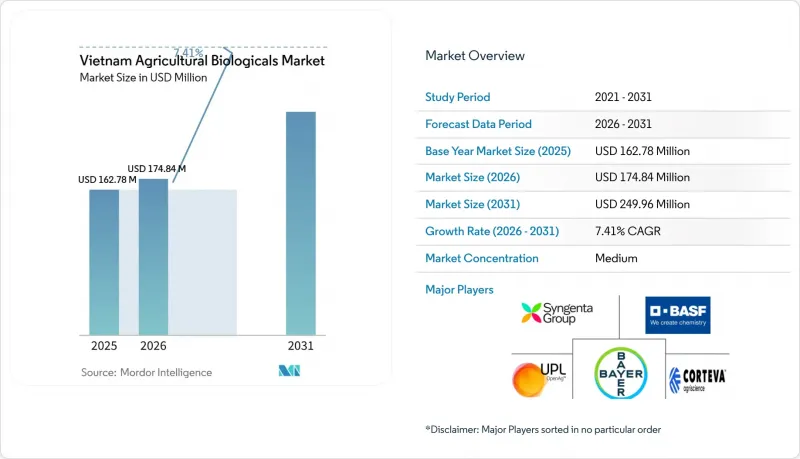
베트남의 농업용 생물제제 시장 규모는 2025년 1억 6,278만 달러로 평가되었고, 2026년 1억 7,484만 달러에서 2031년까지 2억 4,996만 달러로 확대될 것으로 예측되며, 2026-2031년 연평균 복합 성장률(CAGR)은 7.41%를 나타낼 전망입니다.
본 보고서는 기능별(작물 영양 및 작물 보호) 및 작물 유형별(밭작물, 원예작물, 현금작물)로 분류되어 있습니다. 시장 전망은 금액(달러) 및 수량(메트릭 톤)으로 제시되어 있습니다.
베트남의 농업용 생물제제 시장 동향 및 인사이트
잔류물 제로 수출용 작물의 채택 확대
수출 규제를 준수하는 것은 베트남의 농업용 생물제제 시장에서 여전히 가장 뚜렷한 단기 성장 요인으로 작용하고 있습니다. 베트남의 과일 및 채소 공급망은 수출 경로에서 더욱 엄격한 잔류물 검사에 직면해 있으며, 용과, 고추, 오크라의 경우 유럽 시장에서 이미 검사 빈도가 높아졌습니다. 잔류물 기록이 단순한 기술적 준수를 넘어 상업적 시장 접근에도 영향을 미치게 되면서, 이러한 압박이 생산자들을 바이오 농약 및 생물학적 방제책으로 이끌고 있습니다. 2025년, 농업환경부는 유엔 식량농업기구(FAO)와 협력하여 베트남의 바이오 농약 솔루션 및 자연 기반 해충 관리 도입 역량을 강화하기 위한 프로젝트를 시작했습니다. 이와 병행하여, 동부는 승인된 식물 보호 제품의 국가 등록부를 갱신하여 승인된 바이오 농약의 상용화를 촉진하는 한편, 지속 가능한 작물 보호 기술의 보다 광범위한 도입을 지원하고 있습니다. 그 결과, 베트남의 농업용 생물제제 시장에서는 수출의 지속가능성을 뒷받침할 수 있는 추적 가능성을 확보한 투입재 프로그램을 필요로 하는 생산자들 수요가 증가하고 있습니다.
저탄소 쌀 및 기후 스마트 농업에 대한 정부의 지원
베트남의 농업용 생물제제 시장은 국가 주도의 벼 재배 탈탄소화 노력에 힘입어 성장하고 있습니다. 메콩 델타 지역의 시범 사업에서는 종자 사용량 감축과 합성 비료·농약 사용량 감축을 통해 2024년부터 2025년에 걸쳐 생산 비용이 8.2%에서 24.2%까지 절감되었습니다. 2025년 11월, 농업환경부는 30만 헥타르에 달하는 고품질 쌀 생산지에서 측정·보고·검증(MRV) 프로토콜을 시행하기 위한 로드맵에 합의했습니다. 이를 통해 모니터링 대상 재배 시스템에서 생물 유래 자재의 보다 광범위한 활용이 촉진될 전망입니다. 이 프로그램이 중요한 이유는 생물 유래 자재가 구매자나 정책 프로그램이 추적 가능한 형태로 농장의 합성 자재 사용량 감소를 입증하는 데 도움이 되기 때문입니다. 이러한 상황에서 베트남의 농업용 생물 자재 시장은 고립된 포장 시험이 아닌 공식적인 생산 모델과 연계되어 있습니다.
합성 대체재와 비교한 높은 초기 비용
높은 초기 제품 비용은 베트남의 농업용 생물제제 시장에서 여전히 가장 뿌리 깊은 도입 장벽으로 남아 있습니다. 많은 베트남 농장이 소규모 농지에서 운영되고 있기 때문에 생산자들은 여러 시즌에 걸쳐 평가하기보다는 단일 재배 주기 내에서 투입 자재의 경제성을 판단하는 경향이 있습니다. 이러한 상황에서는 비록 생물 유래 제품이 장기적으로 규정 준수 향상이나 토양 회복에 기여하더라도 비용이 높게 보일 수 있습니다. 또한, 생물 유래 제품은 적절한 시기에 사용 및 취급하고 전문적인 조언을 통한 지원이 필요한 경우가 많아, 기술 지원이 부족한 생산자에게는 간접적인 비용 증가로 이어집니다. 이 때문에 베트남의 농업용 생물 유래 제품 시장은 여전히 상업적인 농장이나 조직화된 협동조합 구조 내에서 가장 빠르게 확대되고 있습니다.
부문 분석
작물 보호는 가장 큰 기능 분야로, 2025년 베트남 농업용 생물제제 시장의 67.6%를 차지했습니다. 이러한 위상은 수출 지향적인 원예 분야와 잔류물에 대한 감시가 강화되고 있는 벼 재배 시스템에서 바이오 농약에 대한 강력한 수요를 반영합니다. 베트남의 바이오 농약 시장에는 등록된 다양한 상품명이 존재합니다. 베트남의 농업용 생물제제 시장은 국가 식물보호 목록에서 생물 유래 유효 성분의 중요성을 높인 규제 체계의 혜택을 받고 있습니다. 이러한 규제적 지원으로 인해 생물학적 솔루션의 채택이 촉진되고, 지속 가능한 농업 관행이 조성되며, 화학 투입재에 대한 의존도가 감소하고 있습니다. 또한, 국가 식물 보호 목록에 생물학적 제품이 포함됨에 따라 농가에서의 접근성과 수용성이 높아져 시장 성장을 더욱 뒷받침하고 있습니다.
이 부문을 주도하고 있는 것은 바실러스 튜링겐시스(Bacillus thuringiensis), 보베리아 바시아나(Beauveria bassiana), 메타리지움 아니소플리아에(Metarhizium anisopliae), 트리코데르마 속(Trichoderma species) 등 미생물 유래의 바이오 농약이며, 이들은 이미 상업 시장에서 확고한 입지를 다지고 있습니다. 생물학적 방제제는 여전히 판매량이 적은 편이지만, 보호 재배, 재배 지원, 추적성 기준이 이미 마련된 분야에서는 그 사용이 증가하고 있습니다. '작물 영양'은 가장 빠르게 성장하는 부문으로, 베트남 농업용 생물제제 시장에서 이 부문의 규모는 2026년부터 2031년까지 연평균 성장률(CAGR) 9.4%로 확대될 것으로 예측됩니다. 이러한 성장은 토양 황폐화에 대한 우려, 저배출형 벼 재배 프로그램, 그리고 합성 비료에 대한 의존도를 낮추기 위한 생장 촉진제 및 바이오 비료에 대한 수요에 힘입고 있습니다.
기타 혜택 :
- 엑셀 형식 시장 예측(ME) 시트
- 3개월간의 애널리스트 지원
자주 묻는 질문
목차
제1장 서론
제2장 조사 방법
제3장 주요 요약 및 주요 조사 결과
제4장 시장 구도 및 주요 업계 동향
제5장 시장 규모 및 성장 예측
제6장 경쟁 구도
제7장 농업 생물 분야 이해관계자에게 있어서 중요 전략적 과제
AJY 26.08.11According to Mordor Intelligence, the Vietnam agricultural biologicals market size is projected to expand from USD 162.78 million in 2025 and USD 174.84 million in 2026 to USD 249.96 million by 2031, registering a CAGR of 7.41% between 2026 to 2031.
This report is Segmented by Function (Crop Nutrition and Crop Protection), and by Crop Type (Row Crops, Horticultural Crops, and Cash Crops). The Market Forecasts are Provided in Value (USD) and Volume (Metric Tons).
Vietnam Agricultural Biologicals Market Trends and Insights
Rising Adoption of Residue-Free Export Crops
Export compliance remains the clearest near-term growth driver in the Vietnam agricultural biologicals market. Vietnamese fruit and vegetable supply chains are facing stricter residue checks in export channels, and dragon fruit, chili peppers, and okra have already been subject to elevated inspection frequencies in the European market. That pressure is pushing growers toward biological pesticides and biological control measures because residue records now affect commercial access, not just technical compliance. In 2025, the Ministry of Agriculture and Environment, in collaboration with the Food and Agriculture Organization (FAO), launched a project to strengthen Vietnam's capacity to adopt biological plant protection solutions and nature-based pest management. In parallel, the Ministry updated the national register of permitted plant protection products, facilitating the commercialization of approved biological pesticides and supporting wider adoption of sustainable crop protection technologies. As a result, the Vietnam agricultural biologicals market is gaining demand from growers who need traceable input programs that can support export continuity.
Government Support for Low-Carbon Rice and Climate-Smart Farming
The Vietnam agricultural biologicals market is also being supported by state-led rice decarbonization efforts. Pilot models in the Mekong Delta recorded production-cost reductions of 8.2% to 24.2% between 2024 and 2025, supported by lower seed use and reduced applications of synthetic fertilizers and pesticides. In November 2025, the Ministry of Agriculture and Environment has already agreed on a roadmap to implement Measurement, Reporting, and Verification (MRV) protocols across 300,000 hectares of high-quality rice, which will support the wider use of biological inputs in monitored cultivation systems. This program matters because biologicals help farms show lower synthetic input intensity in a format that buyers and policy programs can track. In this setting, the Vietnam agricultural biologicals market is tied to a formal production model rather than to isolated field trials.
Higher Upfront Cost Versus Synthetic Alternatives
Higher upfront product cost remains the most persistent adoption restraint in the Vietnam agricultural biologicals market. Many Vietnamese farms operate on small landholdings, so growers tend to judge input economics within a single crop cycle instead of across several seasons. In that setting, a biological program can appear expensive even when it supports better compliance or soil recovery over time. Biological products also often require better timing, handling, and advisory support, which adds indirect cost for growers who lack technical assistance. This means the Vietnam agricultural biologicals market still expands fastest among more commercial farms and organized cooperative structures.
Other drivers and restraints analyzed in the detailed report include:
- Soil Health Degradation Across Intensive Cropping Zones
- Expansion of Integrated Pest Management in High-Value Horticulture
- Limited Local Fermentation Scale and Cold-Chain Reach
For complete list of drivers and restraints, kindly check the Table Of Contents.
Segment Analysis
Crop Protection is the largest function, accounting for 67.6% of the Vietnam agricultural biologicals market in 2025. This position reflects strong demand for biopesticides in export-oriented horticulture and in rice systems, where scrutiny of residues is rising. Vietnam's biological crop protection market encompasses a diverse array of registered trade names. The agricultural biologicals market in Vietnam benefits from a regulatory framework that has elevated the prominence of biological active ingredients within the national plant protection list. This regulatory support has encouraged the adoption of biological solutions, fostering sustainable agricultural practices and reducing dependency on chemical inputs. Additionally, the inclusion of biological products in the national plant protection list has enhanced their accessibility and acceptance among farmers, further driving market growth.
The segment is led by microbial-based biopesticides, such as Bacillus thuringiensis, Beauveria bassiana, Metarhizium anisopliae, and Trichoderma species, which are already well established in the commercial market. Biocontrol agents still represent a smaller volume base, but their use is increasing where protected horticulture, training support, and traceability standards are already in place. Crop Nutrition is the fastest-growing segment, and the Vietnam agricultural biologicals market size for this segment is projected to expand at a 9.4% CAGR between 2026 to 2031. That growth is being supported by concerns about soil degradation, low-emission rice programs, and demand for biostimulants and biofertilizers to help reduce dependence on synthetic nutrient programs.
Complete Report Scope:
- By Function
- Crop Nutrition
- Organic Fertilizers
- Biofertilizers
- Biostimulants
- Crop Protection
- Biopesticides
- Biocontrol Agents
- Crop Nutrition
- By Crop Type
- Row Crops
- Horticultural Crops
- Cash Crops
List of Companies Covered in this Report:
- Bayer AG
- BASF SE
- Syngenta Group
- Corteva, Inc.
- UPL Limited
- FMC Corporation
- Rovensa Next
- Koppert B.V.
- Biobest Group NV
- Novonesis
- Lallemand Inc.
- Certis Biologicals
- Valagro S.p.A.
- T. Stanes and Company Limited
- PI Industries Limited
Additional Benefits:
- The market estimate (ME) sheet in Excel format
- 3 months of analyst support
TABLE OF CONTENTS
1 INTRODUCTION
- 1.1 Study Assumptions and Market Definition
- 1.2 Scope of the Study
2 RESEARCH METHODOLOGY
3 EXECUTIVE SUMMARY AND KEY FINDINGS
4 MARKET LANDSCAPE AND KEY INDUSTRY TRENDS
- 4.1 Area Under Organic Cultivation
- 4.2 Per Capita Spending On Organic Products
- 4.3 Regulatory Framework
- 4.3.1 Vietnam
- 4.4 Value Chain And Distribution Channel Annalysis
- 4.5 Market Drivers
- 4.5.1 Rising adoption of residue-free export crops
- 4.5.2 Government support for low-carbon rice and climate-smart farming
- 4.5.3 Soil health degradation across intensive cropping zones
- 4.5.4 Expansion of integrated pest management in high-value horticulture
- 4.5.5 Climate stress, salinity, and crop resilience needs
- 4.5.6 Digital agri-advisory improves product targeting and trial adoption
- 4.6 Market Restraints
- 4.6.1 Higher upfront cost versus synthetic alternatives
- 4.6.2 Limited local fermentation scale and cold-chain reach
- 4.6.3 Inconsistent product quality and farmer trust gaps
- 4.6.4 Slow registration and fragmented product acceptance
- 4.7 Technological Outlook
- 4.8 Porter's Five Forces
- 4.8.1 Threat of New Entrants
- 4.8.2 Bargaining Power of Suppliers
- 4.8.3 Bargaining Power of Buyers
- 4.8.4 Threat of Substitutes
- 4.8.5 Intensity of Competitive Rivalry
5 MARKET SIZE AND GROWTH FORECASTS (VALUE AND VOLUME)
- 5.1 By Function
- 5.1.1 Crop Nutrition
- 5.1.1.1 Organic Fertilizers
- 5.1.1.2 Biofertilizers
- 5.1.1.3 Biostimulants
- 5.1.2 Crop Protection
- 5.1.2.1 Biopesticides
- 5.1.2.2 Biocontrol Agents
- 5.1.1 Crop Nutrition
- 5.2 By Crop Type
- 5.2.1 Row Crops
- 5.2.2 Horticultural Crops
- 5.2.3 Cash Crops
6 COMPETITIVE LANDSCAPE
- 6.1 Key Strategic Moves
- 6.2 Market Share Analysis
- 6.3 Company Landscape
- 6.4 Company Profiles (Includes Global Overview, Market Overview, Core Segments, Financials, Strategic Information, Market Rank/Share, Products And Services, and Recent Developments)
- 6.4.1 Bayer AG
- 6.4.2 BASF SE
- 6.4.3 Syngenta Group
- 6.4.4 Corteva, Inc.
- 6.4.5 UPL Limited
- 6.4.6 FMC Corporation
- 6.4.7 Rovensa Next
- 6.4.8 Koppert B.V.
- 6.4.9 Biobest Group NV
- 6.4.10 Novonesis
- 6.4.11 Lallemand Inc.
- 6.4.12 Certis Biologicals
- 6.4.13 Valagro S.p.A.
- 6.4.14 T. Stanes and Company Limited
- 6.4.15 PI Industries Limited


