

|
시장보고서
상품코드
2100563
탄소섬유 시장 : 점유율 분석, 업계 동향 및 통계, 성장 예측(2026-2031년)Carbon Fiber - Market Share Analysis, Industry Trends & Statistics, Growth Forecasts (2026 - 2031) |
||||||
 Mordor Intelligence
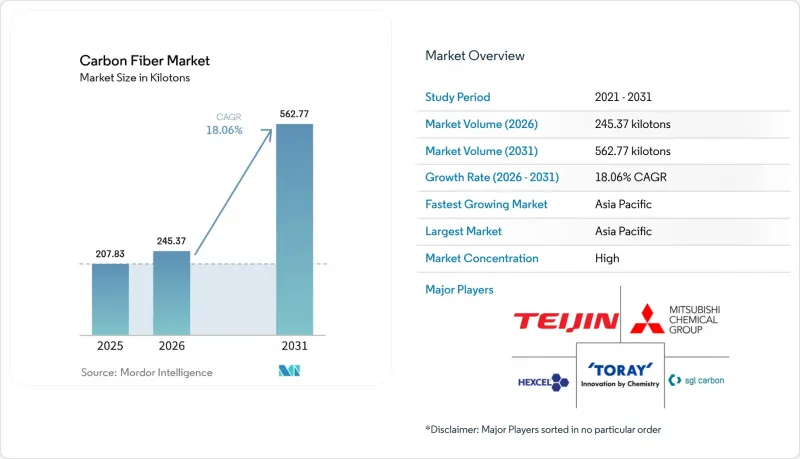
탄소섬유 시장 규모는 2025년 207.83 킬로톤에서 2026년에는 245.37 킬로톤으로 확대되어 2026년부터 2031년까지 CAGR 18.06%로 성장을 지속하여, 2031년에는 562.77 킬로톤에 이를 것으로 예측됩니다.
본 보고서는 원재료(폴리아크릴로니트릴, 석유 피치, 레이온), 섬유 유형(버진 탄소섬유, 재생 탄소섬유, 기타), 용도(복합재료, 섬유 제품 등), 최종 사용자 산업(항공우주 및 방위, 대체 에너지 등), 지역(아시아태평양, 북미 등)별로 분류되어 있습니다. 시장 전망은 수량(톤) 기준으로 제시되어 있습니다.
세계 탄소섬유 시장 동향 및 인사이트
상용 모빌리티용 수소 및 CNG 압력 용기 생산 증가
폴리머 라이너를 탄소섬유로 감싼 유형 IV 실린더는 현재 연료전지 트럭, 버스, 열차용 700바 저장 기준으로 자리 잡았으며, 탄소섬유 시장 점유율 확대에 기여하고 있습니다. 포이트(Voith)사의 ‘Carbon4Tank’는 1,050바를 초과하는 UNECE 규정 134의 파열 압력 시험을 통과하여, 유럽의 대형 차량용 양산 공급이 시작되었습니다. 미국 에너지부의 추산에 따르면, 필라멘트 와인딩의 자동화와 프리커서 가격 안정화로 인해 경제성이 향상된 결과, 2024년 비용은 2020년의 18달러에서 12.7달러/kW시로 하락할 것으로 전망됩니다. 럭스퍼(Luxfer)와 헥사곤 퓨라스(Hexagon Puras)는 북미 및 유럽 내 제조 거점을 확대했습니다. 각 탱크에는 25-30kg의 섬유가 내장되어 있어, 강철 실린더에 비해 적재량이 8-12% 향상되었습니다. 15,000사이클을 초과하는 ISO 11119 및 DOT FMVSS 304 피로 시험 요건은 알루미늄 라이닝이 적용된 대체 제품에 비해 신뢰성 면에서 우위를 입증하고 있습니다. 차량 운영 사업자의 경우, 탱크의 경량화로 인해 수명 주기 비용이 절감되므로 장거리 운송 노선에서의 상업적 도입이 가속화되고 있습니다.
고강도 블레이드가 필요한 해상 풍력 터빈의 급속한 도입
11-22 MW급 차세대 터빈에는 4,800 MPa를 초과하는 스파 캡 인장 강도가 필요한 100-143 m 길이의 블레이드가 채택되고 있습니다. 지멘스 가메사(Siemens Gamesa)의 B108은 탄소섬유 스퍼를 통합함으로써 블레이드 질량을 20% 줄여, 타워 상단에 가해지는 하중과 설치 비용을 절감하고 있습니다. 밍양 스마트 에너지(Mingyang Smart Energy)의 18MW 플랫폼용 143m 블레이드에는 15-18톤의 섬유가 사용되고 있으며, 이는 해상용 블레이드만으로도 연간 약 5만 톤 수요에 해당합니다. 유럽에서는 2024년에 4.2GW의 해상 발전 용량이 추가되었으며, 블레이드의 탄소섬유 함유율은 2020년 15%에서 25-30%로 상승했습니다. 대만과 일본에서는 태풍이 빈번하게 발생하는 해역에 부유식 플랫폼이 도입되어 있으며, 이곳에서는 탄소 복합재료가 유리 섬유보다 30-40% 뛰어난 주기적 피로 저항성을 발휘합니다. 이러한 요인들로 인해 아시아 및 유럽의 연안 지역에서 구조용 복합재료에 대한 수요가 향후 수년간 견조한 추세를 보일 것으로 확실시되고 있습니다.
에너지 집약적인 산화·탄화 공정
섬유 1Kg을 생산하는 데 50-100kWh의 전력을 소비하며, 20-30kg의 CO2를 배출합니다. 이는 알루미늄 압출 성형의 최대 5배에 달하며, 탄소섬유 업계에 있어 큰 과제가 되고 있습니다. 2024-2025년 유럽의 전력 비용(1kWh당 0.15-0.25유로)으로 인해 제조 비용은 1kg당 5-8달러 상승했으며, 저비용 석탄을 동력원으로 사용하는 아시아 공급업체와의 격차가 확대되었습니다. 도레이는 헝가리 사업장에서 재생에너지와 폐열 회수를 활용하여 2030년까지 배출량을 절대값 기준으로 30% 감축하는 것을 목표로 하고 있으나, 탄화로의 에너지 소비량은 여전히 높은 수준을 유지하고 있습니다. 미쓰비시 화학은 에너지 소비를 15-20% 절감하는 저온 PAN의 시험 생산을 진행하고 있지만, 상용화까지는 앞으로 2-3년이 더 소요될 전망입니다. 현재 고객사들은 ISO 14025에 기반한 환경 제품 선언(EPD) 제출을 요구하고 있으며, 섬유 제조업체들은 2030년까지 섬유 1kg당 15kg 미만의 CO₂ 배출량이라는 목표를 달성하기 위해 약 5억 달러를 투자해야 합니다.
부문 분석
폴리아크릴로니트릴(PAN)은 2025년 생산량의 95.18%를 차지하고 있으며, 예측 기간 동안 연평균 성장률(CAGR) 18.91%로 성장할 것으로 전망됩니다. 높은 탄소 수율 덕분에 에너지 추가 요금이 부과된 후에도 평균 비용은 1kg당 12-14달러 전후로 유지되고 있으며, 이는 탄소섬유 시장이 열가소성 수지로의 대체 압력을 견뎌내는 데 한몫하고 있습니다. 2024년부터 2025년에 걸친 공급 부족으로 인해 PAN의 현물 가격은 1kg당 8-10달러까지 상승했으며, 일부 가공업체들은 자동차 관련 계약에서 불가항력 조항을 발동할 수밖에 없었습니다. 중국의 지린케미칼(Jilin Chemical)과 블루스타(Bluestar)가 전 세계 프리커서 생산 능력의 최대 70%를 장악하고 있어, 이로 인해 아시아태평양은 세계 가격 책정에서 우위를 점하고 있습니다.
마이크로파 보조 산화 파일럿 프로그램에서는 사이클 시간이 25-30% 단축되고 에너지 사용량이 15-20% 감소하는 것으로 나타났으며, 2028년 이후에는 구조적인 비용 절감이 예상됩니다. 피치와 레이온은 여전히 틈새 시장으로 남아 있지만, 800 GPa를 초과하는 탄성률이 필요한 초고탄성률 우주 구조물이나 열차단재에는 필수적입니다. 효성의 4,000톤 규모 생산 능력 확대 및 바이오 유래 아크릴로니트릴 사업은 수명 주기 배출량을 30-40% 감축할 전망이며, 이는 각 OEM 기업의 넷제로 목표와 부합합니다. PAN 계열 등급의 탄소섬유 시장 규모는 아크릴로니트릴공급 상황에 연동되어 추이할 것으로 예측됩니다. 산둥성이나 장쑤성에서 장기간의 생산 중단이 발생할 경우, 9개월 이내에 전체 밸류체인에 파급될 가능성이 있습니다.
2025년에도 버진 등급은 62.95%의 점유율을 유지하며, 로트 추적성 및 엄격한 기계적 공차가 요구되는 항공우주 및 방위 프로그램을 주요 용도로 삼아 탄소섬유 시장에서 가장 큰 점유율을 차지하고 있습니다. 재활용 제품공급량은 자동차 및 풍력 발전 분야 수요를 배경으로 2031년까지 연평균 성장률(CAGR) 19.87%로 확대될 것으로 예상되지만, 주요 구조 부재로서의 인증 획득은 2026년 계획 기간 내에는 기대되지 않습니다.
ELG Carbon Fibre사는 항공우주 분야의 스크랩에서 버진 소재 강도의 90-95%를 회수하고 있으며, 이를 통해 시트 프레임이나 머리 위 수납 선반을 30-50% 저렴한 비용으로 제조할 수 있게 되었습니다. Karborek사의 용매 분해법으로는 80mm 이상의 섬유를 유지할 수 있지만, 용매 폐기물 처리가 필요하며, 이것이 운영 비용 상승 요인이 되고 있습니다. Gen 2 Carbon사는 열가소성 플라스틱 부품의 순환형 재활용을 실현하고 있으며, 전기차용 배터리 트레이의 생산량이 증가하는 가운데, 이것이 중요한 차별화 요인이 되고 있습니다. 2027년 이후, 풍력 발전용 블레이드의 철거가 가속화되고 안정적인 원료 공급원이 확보된다면, 재활용 등급 탄소섬유 시장 점유율은 더욱 확대될 전망입니다.
지역별 분석
아시아태평양은 2025년에 44.89%의 점유율로 탄소섬유 시장을 주도하며, 2031년까지 연평균 성장률(CAGR) 20.75%로 성장할 전망입니다. 중국의 전구체에서 섬유에 이르는 수직 통합형 공급망, 일본의 항공우주 등급 특수 제품, 그리고 인도의 오프셋 정책이 견조한 지역 수요를 보장하고 있습니다. 대만의 4.5GW 해상 풍력 발전 설비와 한국의 자동차 부품 공급업체 역시 추가적인 성장의 원동력이 되고 있습니다. 낮은 전력 가격과 아크릴로니트릴의 자체 공급 체제가 이 지역의 비용 우위를 공고히 하고 있습니다.
북미는 생산량 기준 2위를 차지하고 있으며, 미국의 탄소섬유 시장은 보잉(Boeing)과 록히드 마틴(Lockheed Martin), 그리고 ‘인플레이션 억제법(Inflation Reduction Act)’의 우대 조치와 연계된 전기차(BEV) 관련 노력에 힘입어 성장하고 있습니다. 도레이의 사우스캐롤라이나주에 위치한 5,000톤 규모의 생산 라인은 자동차용 등급을 생산하는 한편, 헥셀(Hexcel)사의 솔트레이크시티 확장 프로젝트는 787기종 및 A350기종의 주익 스퍼를 지원합니다. 워싱턴주와 메인주의 재활용 섬유 네트워크는 1차 자동차 내장 부품에 원자재를 공급함으로써 국내 순환형 경제를 확대하고 지역 탄소섬유 산업을 강화하고 있습니다.
유럽에서는 해상 풍력 발전, 엄격한 자동차 배기가스 규제, 에어버스사의 항공기 구조 부품이 맞물려 에너지 가격 변동에도 불구하고 높은 가동률을 유지하고 있습니다. 지멘스 가메사(Siemens Gamesa)의 블레이드에는 질량을 20% 줄여주는 탄소섬유 스파 캡이 적용되어 있습니다. 독일의 각 자동차 제조업체들은 95 g/km의 CO₂ 배출 목표를 달성하기 위해 SGL 카본(SGL Carbon)의 마이팅겐 공장에서 생산하는 열가소성 복합재료에 의존하고 있습니다. EU의 ‘중요 원자재법’은 국내 생산 능력 강화를 촉진하고 있으며, 도레이의 헝가리 거점은 현재 재생에너지에서 생산된 전력을 조달하여 수명 주기 배출량을 30% 감축하고, 지역 탄소섬유 산업을 뒷받침하고 있습니다.
기타 혜택:
- 엑셀 형식 시장 예측(ME) 시트
- 3개월간의 애널리스트 지원
자주 묻는 질문
목차
제1장 서론
제2장 조사 방법
제3장 주요 요약
제4장 시장 구도
제5장 시장 규모와 성장 예측
제6장 경쟁 구도
제7장 시장 기회와 향후 전망
JHS 26.08.11According to Mordor Intelligence, the carbon fiber market size is expected to grow from 207.83 kilotons in 2025 to 245.37 kilotons in 2026 and is forecast to reach 562.77 kilotons by 2031 at 18.06% CAGR over 2026-2031.
This report is Segmented by Raw Material (Polyacrylonitrile, and Petroleum Pitch and Rayon), Fiber Type (Virgin Carbon Fiber, Recycled Carbon Fiber, and Others), Application (Composite Materials, Textiles, and More), End-User Industry (Aerospace and Defense, Alternative Energy, and More), and Geography (Asia-Pacific, North America, and More). The Market Forecasts are Provided in Terms of Volume (tons).
Global Carbon Fiber Market Trends and Insights
Rising Production of Hydrogen and CNG Pressure Vessels for Commercial Mobility
Type IV cylinders that wrap polymer liners with carbon fiber now define the 700-bar storage standard for fuel-cell trucks, buses, and trains, contributing to carbon fiber market share growth. Voith's Carbon4Tank cleared UNECE Regulation 134 burst-pressure tests above 1,050 bar, opening series supply to European heavy-duty fleets. The U.S. Department of Energy calculated a cost of USD 12.7 per kilowatt-hour in 2024, down from USD 18 in 2020, as filament-winding automation and precursor price stability improved economics. Luxfer and Hexagon Purus enlarged North American and European manufacturing footprints, each tank incorporating 25-30 kg of fiber and delivering 8-12% higher payload versus steel cylinders. ISO 11119 and DOT FMVSS 304 fatigue requirements over 15,000 cycles reinforce the reliability edge against aluminum-lined alternatives. Fleet operators see lower lifetime cost from lighter tanks, which accelerates commercial adoption in long-haul corridors.
Rapid Deployment of Offshore Wind Turbines Requiring High-Strength Blades
Next-generation turbines in the 11-22 MW class employ 100-143 m blades that need spar-cap tensile strength exceeding 4,800 MPa. Siemens Gamesa's B108 integrates carbon-fiber spars to shave 20% blade mass, lowering tower-top loads and installation cost. Mingyang Smart Energy's 143 m blade for an 18 MW platform consumes 15-18 tons of fiber, translating to roughly 50,000 tons of annual demand for offshore blades alone. Europe added 4.2 GW of offshore capacity in 2024, and blade carbon-fiber content climbed to 25-30% of mass, up from 15% in 2020. Taiwan and Japan deploy floating platforms in typhoon-prone waters, where carbon composites withstand cyclic fatigue 30-40% better than glass fiber. These factors secure a multiyear pull for structural composites across Asian and European coastlines.
Energy-Intensive Oxidation and Carbonization
Producing one kilogram of fiber consumes 50-100 kWh and emits 20-30 kg of CO2, up to five times more than aluminum extrusion, posing a major challenge for the carbon fiber industry. European electricity costs of EUR 0.15-0.25 per kWh in 2024-2025 raised manufacturing costs by USD 5-8 per kg, widening the gap with Asian suppliers powered by low-cost coal. Toray targets a 30% absolute emissions cut by 2030 via renewable electricity and waste-heat recovery at its Hungary site, yet carbonization furnaces still lock in high intensity. Mitsubishi Chemical pilots lower-temperature PAN that trims energy 15-20%, but commercial rollout is two to three years away. Customers now request Environmental Product Declarations under ISO 14025, so fiber makers must invest an estimated USD 500 million to reach the 2030 target of below 15 kg CO2 per kg of fiber.
Other drivers and restraints analyzed in the detailed report include:
- Adoption of Battery-Pack Enclosures and Lightweighting in EV Platforms
- 3D Automated Fiber-Placement Lines Slashing Composite Cycle Times
- Supply-Chain Risks for Recycled Carbon Fiber Feedstock
For complete list of drivers and restraints, kindly check the Table Of Contents.
Segment Analysis
Polyacrylonitrile captured 95.18% of the 2025 volume and is anticipated to grow with a CAGR of 18.91% during the forecast period. Its strong carbon yield keeps average cost near USD 12-14 per kg even after energy surcharges, helping the carbon fiber market defend against thermoplastic substitution. Tight supply in 2024-2025 lifted spot PAN to USD 8-10 per kg, forcing some converters to invoke force-majeure clauses on automotive contracts. China's Jilin Chemical and Bluestar control up to 70% of global precursor capacity, giving Asia-Pacific leverage over global pricing.
Pilot programs for microwave-assisted oxidation show 25-30% faster cycle time and 15-20% lower energy use, pointing to a structural cost decline after 2028. Pitch and rayon remain niche but vital for ultra-high-modulus spacecraft structures and thermal barriers that demand modulus above 800 GPa. Hyosung's 4,000-ton expansion and bio-based acrylonitrile initiatives promise a 30-40% lifecycle-emission cut, aligning with OEM net-zero targets. The carbon fiber market size for PAN-based grades is projected to move in lockstep with acrylonitrile availability; any prolonged outage in Shandong or Jiangsu could ripple through the value chain within nine months.
Virgin grades kept 62.95% share in 2025, accounting for the largest carbon fiber market share mainly serving aerospace and defense programs that require lot-traceability and tight mechanical tolerances. Recycled volumes are anticipated to grow with a CAGR of 19.87% through 2031 on the back of automotive and wind energy pull, yet certification for primary structures remains outside the 2026 planning horizon.
ELG Carbon Fibre recovers 90-95% of virgin strength from aerospace scrap, enabling seat frames and overhead bins at 30-50% lower cost. Karborek's solvolysis route retains fibers above 80 mm but must manage solvent waste streams that raise operating costs. Gen 2 Carbon closes the loop on thermoplastic parts, a key differentiator as EV battery-tray volumes rise. The carbon fiber market share for recycled grades is poised to widen further once wind-blade decommissioning accelerates after 2027, providing a stable feedstock base.
Complete Report Scope:
- By Raw Material
- Polyacrylonitrile (PAN)
- Petroleum Pitch and Rayon
- By Fiber Type
- Virgin Carbon Fiber (VCF)
- Recycled Carbon Fiber (RCF)
- Others
- By Application
- Composite Materials
- Textiles
- Micro-Electrodes
- Catalysis
- By End-User Industry
- Aerospace and Defense
- Alternative Energy
- Automotive
- Construction and Infrastructure
- Sporting Goods
- Other End-user Industries
- By Geography
- Asia-Pacific
- China
- Japan
- India
- South Korea
- Rest of Asia-Pacific
- North America
- United States
- Canada
- Mexico
- Europe
- Germany
- United Kingdom
- France
- Italy
- Rest of Europe
- South America
- Brazil
- Argentina
- Rest of South America
- Middle-East and Africa
- Saudi Arabia
- United Arab Emirates
- South Africa
- Egypt
- Rest of Middle-East and Africa
- Asia-Pacific
Geography Analysis
Asia-Pacific led the carbon fiber market with 44.89% share in 2025 and is set to grow at a 20.75% CAGR through 2031. China's vertically integrated precursor-to-fiber chains, Japan's aerospace-grade specialties, and India's offset policies guarantee strong local pull. Taiwan's 4.5 GW offshore wind fleet and South Korea's automotive suppliers add further upside. Low electricity prices and captive acrylonitrile supply cement the region's cost advantage.
North America ranks second by volume, with the United States carbon fiber market boosted by Boeing, Lockheed Martin, and battery-electric vehicle initiatives tied to the Inflation Reduction Act incentives. Toray's 5,000 ton South Carolina line will cover automotive grades, while Hexcel's Salt Lake City expansion supports 787 and A350 wing spars. Recycled-fiber networks in Washington and Maine supply Tier 1 automotive interiors, expanding domestic circularity, strengthening the regional carbon fiber industry.
Europe combines offshore wind, strict vehicle emissions rules, and Airbus aerostructures to maintain high utilization despite energy-price volatility. Siemens Gamesa blades integrate carbon-fiber spar caps that reduce mass by 20%. Germany's automakers rely on thermoplastic composites from SGL Carbon's Meitingen plant to meet the 95 g/km CO2 target. The EU Critical Raw Materials Act encourages domestic capacity, and Toray's Hungary site now sources renewable electricity to cut lifecycle emissions 30%, supporting the regional carbon fiber industry.
- AandP Technology, Inc.
- Anshan Senoda Carbon Fiber Co., Ltd.
- DowAksa
- Formosa Plastics Group
- Hexcel Corporation
- HS HYOSUNG ADVANCED MATERIALS
- Jiangsu Hengshen Co.,Ltd
- KUREHA CORPORATION
- Mitsubishi Chemical Group Corporation
- Nippon Graphite Fiber Co., Ltd.
- Rock West Composites, Inc.
- SGL Carbon
- Sigmatex (UK) Limited
- Solvay
- Taekwang Industrial Co., Ltd.
- Teijin Limited
- TORAY INDUSTRIES, INC.
- UMATEX
- Zhongfu Shenying Carbon Fiber Co., Ltd.
Additional Benefits:
- The market estimate (ME) sheet in Excel format
- 3 months of analyst support
TABLE OF CONTENTS
1 Introduction
- 1.1 Study Assumptions and Market Definition
- 1.2 Scope of the Study
2 Research Methodology
3 Executive Summary
4 Market Landscape
- 4.1 Market Overview
- 4.2 Market Drivers
- 4.2.1 Rising production of hydrogen and CNG pressure vessels for commercial mobility
- 4.2.2 Rapid deployment offshore wind turbines requiring high-strength blades
- 4.2.3 Adoption of battery-pack enclosures and lightweighting in EV platforms
- 4.2.4 3-D automated fiber-placement lines slashing composite cycle times
- 4.2.5 Local-content mandates in India and MENA aerospace offset programs
- 4.3 Market Restraints
- 4.3.1 Energy-intensive oxidation and carbonization
- 4.3.2 Supply-chain risks for recycled carbon fiber feedstock
- 4.3.3 Competition from high-performance thermoplastics in sporting goods
- 4.4 Value Chain Analysis
- 4.5 Technological Outlook
- 4.6 Porter's Five Forces
- 4.6.1 Bargaining Power of Suppliers
- 4.6.2 Bargaining Power of Buyers
- 4.6.3 Threat of New Entrants
- 4.6.4 Threat of Substitutes
- 4.6.5 Degree of Competition
5 Market Size and Growth Forecasts (Value and Volume)
- 5.1 By Raw Material
- 5.1.1 Polyacrylonitrile (PAN)
- 5.1.2 Petroleum Pitch and Rayon
- 5.2 By Fiber Type
- 5.2.1 Virgin Carbon Fiber (VCF)
- 5.2.2 Recycled Carbon Fiber (RCF)
- 5.2.3 Others
- 5.3 By Application
- 5.3.1 Composite Materials
- 5.3.2 Textiles
- 5.3.3 Micro-Electrodes
- 5.3.4 Catalysis
- 5.4 By End-User Industry
- 5.4.1 Aerospace and Defense
- 5.4.2 Alternative Energy
- 5.4.3 Automotive
- 5.4.4 Construction and Infrastructure
- 5.4.5 Sporting Goods
- 5.4.6 Other End-user Industries
- 5.5 By Geography
- 5.5.1 Asia-Pacific
- 5.5.1.1 China
- 5.5.1.2 Japan
- 5.5.1.3 India
- 5.5.1.4 South Korea
- 5.5.1.5 Rest of Asia-Pacific
- 5.5.2 North America
- 5.5.2.1 United States
- 5.5.2.2 Canada
- 5.5.2.3 Mexico
- 5.5.3 Europe
- 5.5.3.1 Germany
- 5.5.3.2 United Kingdom
- 5.5.3.3 France
- 5.5.3.4 Italy
- 5.5.3.5 Rest of Europe
- 5.5.4 South America
- 5.5.4.1 Brazil
- 5.5.4.2 Argentina
- 5.5.4.3 Rest of South America
- 5.5.5 Middle-East and Africa
- 5.5.5.1 Saudi Arabia
- 5.5.5.2 United Arab Emirates
- 5.5.5.3 South Africa
- 5.5.5.4 Egypt
- 5.5.5.5 Rest of Middle-East and Africa
- 5.5.1 Asia-Pacific
6 Competitive Landscape
- 6.1 Market Concentration
- 6.2 Strategic Moves
- 6.3 Market Share(%)/Ranking Analysis
- 6.4 Company Profiles (includes Global level Overview, Market level overview, Core Segments, Financials as available, Strategic Information, Market Rank/Share for key companies, Products and Services, and Recent Developments)
- 6.4.1 AandP Technology, Inc.
- 6.4.2 Anshan Senoda Carbon Fiber Co., Ltd.
- 6.4.3 DowAksa
- 6.4.4 Formosa Plastics Group
- 6.4.5 Hexcel Corporation
- 6.4.6 HS HYOSUNG ADVANCED MATERIALS
- 6.4.7 Jiangsu Hengshen Co.,Ltd
- 6.4.8 KUREHA CORPORATION
- 6.4.9 Mitsubishi Chemical Group Corporation
- 6.4.10 Nippon Graphite Fiber Co., Ltd.
- 6.4.11 Rock West Composites, Inc.
- 6.4.12 SGL Carbon
- 6.4.13 Sigmatex (UK) Limited
- 6.4.14 Solvay
- 6.4.15 Taekwang Industrial Co., Ltd.
- 6.4.16 Teijin Limited
- 6.4.17 TORAY INDUSTRIES, INC.
- 6.4.18 UMATEX
- 6.4.19 Zhongfu Shenying Carbon Fiber Co., Ltd.
7 Market Opportunities and Future Outlook
- 7.1 White-Space and Unmet-Need Assessment
- 7.2 Emphasis on Lignin-based Raw Materials for Carbon Fiber


