

|
시장보고서
상품코드
2100667
의약품 포장기계 시장 : 점유율 분석, 업계 동향 및 통계, 성장 예측(2026-2031년)Pharmaceutical Packaging Machinery - Market Share Analysis, Industry Trends & Statistics, Growth Forecasts (2026 - 2031) |
||||||
 Mordor Intelligence
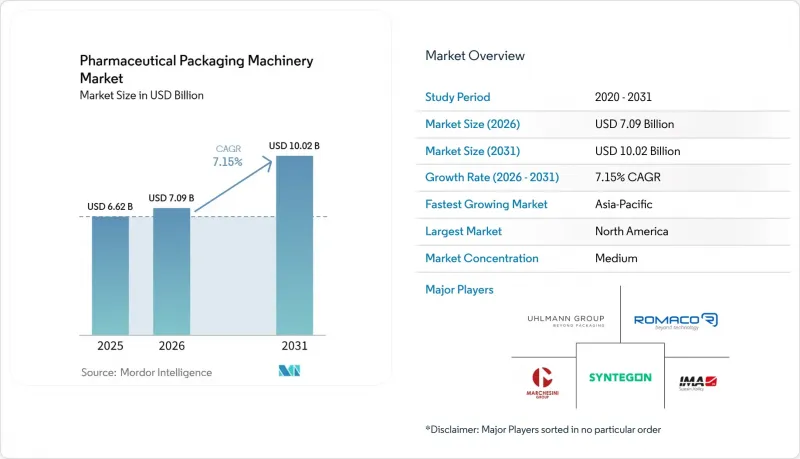
Mordor Intelligence에 의하면, 의약품 포장기계 시장 규모는 2025년에 66억 2,000만 달러로 평가되었고 2026년 70억 9,000만 달러에서 2031년까지 100억 2,000만 달러에 이를 것으로 예측되며, 예측 기간(2026-2031년) CAGR은 7.15%를 나타낼 전망입니다.
본 보고서는 기계 유형(1차 포장, 2차 포장, 라벨링 및 일련번호 부여, 3차 포장), 자동화 수준(수동, 반자동, 자동), 포장 형태(블리스터, 병/바이알, 소포장 및 스틱팩, 카트닝 및 케이스 포장), 용도(고형, 액체, 반고형, 비경구 제제), 그리고 지역별로 분류되어 있습니다. 시장 전망은 금액(달러) 기준으로 제시되어 있습니다.
세계 의약품 포장기계 시장 동향 및 인사이트
엄격한 일련번호 부여 및 추적·추적성 규정
의약품 추적성 관련 법률에서는 단위 수준의 식별자 및 블리스터 캐비티부터 팔레트에 이르는 집계 의무가 규정되어 있으며, 이에 따라 포장기계는 규정 준수에 필수적인 인프라로 변모하고 있습니다. 미국 DSCSA(의약품 안전 추적법)는 2023년 11월까지 완전한 상호 운용성을 갖춘 추적성을 의무화했으며, 2024년 말까지 국내 시설의 70% 이상이 일련번호 부여 모듈을 도입했으나, 케이스 단위 집계에는 여전히 과제가 남아 있습니다. 유럽 지침에서는 고유 식별자와 위변조 방지 기능이 있는 밀봉 장치가 의무화되어 있으며, 이에 따라 기존의 블리스터 포장 라인 및 병 충전 라인 전반에 걸쳐 개조 작업이 진행되고 있습니다. 중국은 수입 의약품에 대한 기한을 2025년까지 연장함에 따라, 유럽 및 미국 시장을 대상으로 서비스를 제공하는 수탁 제조업체(CMO)들은 설비 구매를 서둘러 진행하고 있습니다. 현재 공급업체의 소프트웨어에는 지역별 규정 준수 대응 템플릿이 포함되어 있으나, 이러한 지역화로 인해 의약품 포장기계 시장의 총 소유 비용(TCO)과 검증 소요 기간이 길어지고 있습니다. ISO 15378은 사실상 입찰 요건이 되었으며, 장비 사양서를 우수 제조 기준(GMP) 기록과 일치시킬 수 있는 기업으로만 공급업체 후보가 제한되고 있습니다.
생물학적 제제 및 주사제의 급속한 성장
2024년에 판매된 상위 10대 치료제 중 8개는 바이알, 주사기 또는 자동 주사기에 포장된 바이오의약품으로, 이들은 ISO 클래스 5 환경과 정밀한 유리 제품 취급을 필요로 합니다. FDA는 2024년에 입자 오염과 관련하여 47건의 경고장을 발부하여 결함 제로 의무를 강화하는 한편, 자동 시각 검사 카메라의 도입을 촉진했습니다. 유전자 치료 및 세포 치료는 배치 규모가 작아 기존의 고속 충전기로는 수익성을 확보하기 어려우므로, 30분 내에 포맷 변경이 가능한 모듈식 기계가 선호되고 있습니다. 유럽의약품청(EMA)은 2024년에 92종의 생물학적 제제를 승인했으나, 각각 전용 포장 검증 시험이 필요하여 많은 기업이 이를 유연한 위탁 개발·제조(CDMO) 파트너에게 외주하고 있습니다. 공급업체들은 이에 대응하여 무균성을 유지하면서도 세척 주기를 단축하는 서보 구동식 정량 펌프나 일회용 유로 시스템을 제공합니다.
첨단 기계 설비에 대한 막대한 설비 투자
아이솔레이터, 시리얼화 모듈, 인라인 입자 검사 기능을 통합한 무균 충전 라인의 비용은 800만 달러를 초과하기도 하여, 많은 제네릭 의약품 제조업체들이 노후화된 설비에 얽매이게 하고 있습니다. 신흥 지역의 공장 중 40%에서는 15년 이상 경과한 설비가 가동되고 있는 반면, 북미에서는 그 비율이 12%에 그치고 있어, 이러한 규정 준수 격차의 확대가 수출 승인을 가로막고 있습니다. 리스 모델이 등장하고 있지만, 데이터 공유 조항으로 인해 지적 재산권에 대한 우려가 제기되고 있습니다. 유럽투자은행(EIB) 등 공적 금융기관은 2024년 동유럽의 설비 갱신을 지원하기 위해 5억 유로(5억 6,500만 달러)의 대출을 제공했으며, 민간 대출 비용이 높은 수준을 유지하고 있는 상황에서 외부 자금 조달이 필수적임을 시사하고 있습니다.
부문 분석
2025년 의약품 포장기계 시장에서 1차 설비가 54.18%를 차지하며, 용기의 완전성과 무균성을 확보하는 데 있어 극히 중요한 역할을 담당하고 있음이 부각되었습니다. 그러나 전 세계 출하에서 케이스 및 팔레트 단위의 집약이 의무화됨에 따라, 2차 라인은 연평균 성장률(CAGR) 8.05%라는 더 빠른 속도로 확대될 전망입니다. 2차 포장 장비 시장 규모는 비전 검사 카메라 및 2차원 코드 프린터를 통합한 개조 수요에 힘입어 2031년까지 34억 4,000만 달러에 달할 것으로 예측됩니다. 안타레스 비전(Antares Vision)은 아시아태평양에서 일련번호 부여 모듈 수주가 22% 급증했다고 보고했는데, 이는 수출 지향적인 제네릭 의약품 제조업체들이 전체 라인 교체보다는 다운스트림 공정의 업그레이드를 우선시하고 있는 실태를 여실히 보여줍니다.
라벨링 및 일련번호 부여 장비는 분당 400팩 이상으로 가동되는 고속 잉크젯 및 레이저 코더가 의약품 포장기계 시장에서 점유율을 확대하고 있는 데 힘입어 가장 빠르게 성장하는 틈새 시장을 형성하고 있습니다. 기업들이 복약 순응도 향상을 위해 병에서 1회 투여 팩으로 전환함에 따라 블리스터 포장 플랫폼에 대한 투자가 다시 활발해지고 있는 반면, 카트너는 가변 데이터 인쇄 및 위조 방지 씰을 통합함으로써 밸류체인의 업스트림로 이동하고 있습니다. Uhlmann사의 2024년형 모듈식 카트너는 공구 없이도 택 엔드 방식과 접착 씰 방식을 원활하게 전환할 수 있어, 전문 의약품 분야의 SKU 급증에 대응하고 있습니다.
2025년 도입 대수에서 자동 시스템이 차지하는 비율은 64.12%를 나타낼 것으로 예측되며, 이는 인건비 상승과 결함 없는 포장에 필요한 정밀도를 반영한 결과입니다. 의약품 포장기계 시장에서 자동 설비의 성장을 주도하고 있는 것은 생산 라인을 중단하지 않고 신속한 설비 전환을 가능하게 하는 협동 로봇입니다. 인도와 중국에서는 2019년부터 2024년까지 제조업 임금이 연평균 8% 상승하여, 과거 수작업을 정당화하던 노동 비용 격차가 줄어들고 있습니다.
반자동 기계는 처리 능력보다 제품의 다양성이 중시되는 임상시험 시설이나 신흥 시장의 공장에서 여전히 수요가 있습니다. 로마코(Romaco)사의 보고에 따르면, 이 회사의 신흥 시장 매출의 35%를 반자동 유닛이 차지하고 있으며, 이는 완전 자동화로 가는 디딤돌이 되고 있습니다. 2024년에 도입된 마르케지니사의 협업형 카트닝 셀은 전환 시간을 45분에서 12분으로 대폭 단축했으며, 숙련된 메카트로닉스 기술자 인재 풀이 성숙해질 때까지 인간과 로봇이 협업하는 하이브리드 셀이 어떻게 역량 격차를 메울 수 있는지를 보여주고 있습니다.
지역별 분석
북미는 최대의 지역 거점이며, DSCSA 시행, 리쇼어링 장려 정책, 그리고 노스캐롤라이나주와 매사추세츠주 등에서 무균 충전 프로젝트에 대한 설비 투자를 지원하는 세액 공제 덕분에 2025년 매출의 39.10%를 차지하고 있습니다. 디지털 트윈 및 에너지 모니터링에 대한 투자는 시운전 시간 단축과 운영 비용 절감을 목표로 하고 있습니다. 미국의 수탁 제조업체들 사이에서는 FDA의 전자 기록 기준을 사전에 준수한 검증 문서를 갖춘 턴키 솔루션에 대한 수요가 증가하고 있으며, 이를 통해 시장 출시 기간이 단축되고 있습니다.
아시아태평양은 미국 및 유럽연합(EU) 수출 규격을 충족하려는 인도와 중국의 공장에 힘입어 연평균 성장률(CAGR) 9.30%로 가장 빠른 성장세를 보이고 있습니다. 인도는 2024 회계연도에 279억 달러 상당의 완제 의약품을 수출했으며, 이러한 수출 의존도가 높다는 점이 기업들로 하여금 유럽 규격의 일련번호 부여 시스템 및 비전 시스템 도입을 촉진하고 있습니다. 중국 당국이 수입품에 대한 일련번호 관리 규정 준수 기한을 2025년까지 연장함에 따라, 수출 지향적인 수탁 제조업체(CMO)들 사이에서 단기적인 설비 조달 붐이 일고 있습니다.
유럽에서는 공장 확장이라기보다는 설비 갱신 주기에 연동된 안정적인 수요가 유지되고 있습니다. 각 제조업체는 2024년에 완전 시행될 것으로 예상되는 EU 지침을 준수하기 위해, 병, 블리스터, 바이알 생산 라인에 집약용 카메라를 도입하여 개조를 진행하고 있습니다. 또한, 에너지 효율 향상을 통해 지역적으로 높은 전력 비용을 억제하고 있습니다. 독일, 이탈리아, 스위스는 여전히 세계 엔지니어링의 거점이며, Syntegon, IMA, Marchesini와 같은 기업들이 거점을 두고 있습니다. 이를 통해 다국적 의약품 기업이 설비 파트너를 선정할 때 선호하는 긴밀한 서비스 네트워크가 형성되어 있습니다.
남미, 중동 및 아프리카 시장 점유율은 작지만, 각국의 국내 생산 정책과 연계된 특정 비즈니스 기회를 제공합니다. 브라질과 아르헨티나에서는 DSCSA를 모델로 한 일련번호 부여 규제가 도입되어, 잉크젯 코더나 케이스 어그리게이터의 구매가 촉진되고 있습니다. 걸프협력회의(GCC) 회원국에서는 경제 다각화 프레임워크 하에 현지 백신 충전·완제 공장의 구축이 진행되고 있으며, 교육 및 검증 지원을 패키지로 제공하는 공급업체는 이러한 신흥 시장에서 선점 우위를 확보하고 있습니다.
기타 혜택:
- 엑셀 형식 시장 예측(ME) 시트
- 3개월간의 애널리스트 지원
자주 묻는 질문
목차
제1장 서론
제2장 조사 방법
제3장 주요 요약
제4장 시장 구도
제5장 시장 규모와 성장 예측
제6장 경쟁 구도
제7장 시장 기회와 향후 전망
JHS 26.08.11According to Mordor Intelligence, the pharmaceutical packaging machinery market size was valued at USD 6.62 billion in 2025 and estimated to grow from USD 7.09 billion in 2026 to reach USD 10.02 billion by 2031, at a CAGR of 7.15% during the forecast period (2026-2031).
This report is Segmented by Machinery Type (Primary, Secondary, Labelling and Serialization, and Tertiary), Automation Level (Manual, Semi-Automatic, and Automatic), Packaging Format (Blister, Bottle/Vial, Sachet and Stick Pack, and Cartoning and Case Packing), Application (Solid, Liquid, Semi-Solids, and Parenterals), and Geography. The Market Forecasts are Provided in Terms of Value (USD).
Global Pharmaceutical Packaging Machinery Market Trends and Insights
Stringent Serialization and Track and Trace Regulations
Drug traceability laws require unit-level identifiers and aggregation from blister cavity to pallet, converting packaging machinery into essential compliance infrastructure. The U.S. DSCSA mandated fully interoperable traceability by November 2023, and by late 2024, more than 70% of domestic sites had installed serialization modules; however, case-level aggregation gaps persist. Europe's directive enforces unique identifiers and tamper-evident closures, prompting retrofit cycles across legacy blister and bottle lines. China extended its deadline to 2025 for import drugs, spurring contract manufacturers that serve Western markets to fast-track equipment purchases. Supplier software now ships with region-specific compliance templates; however, this localization increases the total cost of ownership and validation timelines in the pharmaceutical packaging machinery market. ISO 15378 has become a de facto tender prerequisite, narrowing vendor pools to firms that can align equipment files with Good Manufacturing Practice records.
Rapid Growth of Biologics and Injectable Drugs
Eight of the top 10 therapies sold in 2024 were biologics packaged in vials, syringes, or autoinjectors that require ISO Class 5 environments and precise glass handling. The FDA issued 47 warning letters in 2024 for particulate contamination, reinforcing the zero-defect mandate and driving the installation of automated visual inspection cameras. Small batch sizes of gene and cell therapies make high-speed legacy fillers uneconomic, so modular machines capable of 30-minute format changes are preferred. The European Medicines Agency cleared 92 biologics in 2024, each requiring dedicated packaging validation runs that many firms outsource to flexible contract development and manufacturing partners. Suppliers respond with servo-driven dosing pumps and single-use flow paths that maintain sterility and shorten cleaning cycles.
High Capital Expenditure for Advanced Machinery
Aseptic lines incorporating isolators, serialization modules, and in-line particle inspection can top USD 8 million, locking many generic manufacturers into aging assets. Forty percent of plants in emerging regions operate equipment that is more than 15 years old, compared with 12% in North America, widening a compliance gap that hinders export approvals. Leasing models have emerged, yet data-sharing clauses raise concerns about intellectual property. Public lenders, such as the European Investment Bank, offered EUR 500 million (USD 565 million) in loans in 2024 to support Eastern European upgrades, signaling that external financing is essential where private credit costs remain elevated.
Other drivers and restraints analyzed in the detailed report include:
- Increasing Demand for Automation and Industry 4.0 Integration
- Rise of Personalized Small-Batch Manufacturing Workflows
- Stringent Validation and Compliance Complexity
For complete list of drivers and restraints, kindly check the Table Of Contents.
Segment Analysis
Primary equipment accounted for 54.18% of the pharmaceutical packaging machinery market in 2025, underscoring its mission-critical role in ensuring container integrity and sterility. However, secondary lines will expand at a faster rate of 8.05% CAGR because case- and pallet-level aggregation has become mandatory for global shipments. The pharmaceutical packaging machinery market size for secondary equipment is forecast to reach USD 3.44 billion by 2031, driven by retrofits that incorporate vision-inspection cameras and two-dimensional code printers. Antares Vision logged a 22% order spike for serialization modules in the Asia-Pacific region, revealing how export-oriented generic manufacturers prioritize downstream upgrades over full-line replacements.
Labeling and serialization machines form the fastest-moving niche, aided by the pharmaceutical packaging machinery market share gains of high-speed inkjet and laser coders operating at more than 400 packs per minute. Blister platforms are experiencing renewed investment as companies shift from bottles to unit-dose packs to enhance adherence, while cartoners are moving up the value chain by integrating variable data printing and tamper-evident sealing. Uhlmann's 2024 modular cartoner allows for seamless switching between tuck-end and glue-seal formats without the need for tools, aligning with the high SKU proliferation of specialty drugs.
Automatic systems accounted for 64.12% of installations in 2025, reflecting wage inflation and the precision needed for zero-defect packaging. The pharmaceutical packaging machinery market growth for automatic equipment is driven by collaborative robots that enable rapid changeovers without interrupting production lines. In India and China, manufacturing wages increased by 8% annually from 2019 to 2024, narrowing the labor arbitrage that once justified manual operations.
Semi-automatic machines still appeal to clinical-trial sites and emerging-market factories where product diversity outweighs throughput. Romaco reports that 35% of its emerging-market sales are semi-automatic units, serving as stepping-stones toward full automation. Marchesini's collaborative cartoning cells, deployed in 2024, slash changeover times from 45 to 12 minutes, demonstrating how hybrid human-robot cells bridge capability gaps until skilled mechatronics labor pools mature.
Complete Report Scope:
- By Machinery Type
- Primary Packaging Equipment
- Secondary Packaging Equipment
- Labelling and Serialization Equipment
- Tertiary Packaging Equipment
- By Automation Level
- Manual
- Semi-Automatic
- Automatic
- By Packaging Format
- Blister Packaging
- Bottle/Vial Packaging
- Sachet and Stick Pack
- Cartoning and Case Packing
- By Application
- Solids (Tablets/Capsules)
- Liquids
- Semi-Solids
- Parenterals (Injectables)
- By Geography
- North America
- United States
- Canada
- Mexico
- South America
- Brazil
- Argentina
- Chile
- Rest of South America
- Europe
- United Kingdom
- Germany
- France
- Italy
- Spain
- Rest of Europe
- Asia-Pacific
- China
- Japan
- India
- South Korea
- Australia and New Zealand
- Rest of Asia-Pacific
- Middle East and Africa
- Middle East
- United Arab Emirates
- Saudi Arabia
- Turkey
- Rest of Middle East
- Africa
- South Africa
- Kenya
- Nigeria
- Rest of Africa
- Middle East
- North America
Geography Analysis
North America represents the largest regional base, accounting for 39.10% of 2025 revenue, thanks to DSCSA enforcement, reshoring incentives, and tax credits that subsidize capital outlays for sterile-fill projects in states such as North Carolina and Massachusetts. Investments in digital twins and energy monitoring aim to reduce commissioning time and operating expenses. Contract manufacturers in the United States are increasingly requiring turnkey solutions with validation documentation pre-aligned to FDA electronic record standards, thereby shortening the time to market.
The Asia-Pacific region exhibits the fastest trajectory, forecast at a 9.30% CAGR, driven by Indian and Chinese factories that seek to meet export specifications for the United States and the European Union. India shipped USD 27.9 billion in finished drugs in fiscal 2024, and this export dependency motivates firms to install European-grade serialization and vision systems. Chinese authorities have extended the serialization compliance deadline for imports to 2025, creating a short-term equipment procurement boom among export-oriented contract manufacturers.
Europe maintains a steady demand tied to replacement cycles rather than plant expansions. Manufacturers retrofit bottle, blister, and vial lines with aggregation cameras to comply with the EU directive's full enforcement, which is expected to be reached in 2024, while energy-efficiency upgrades mitigate regionally high electricity costs. Germany, Italy, and Switzerland remain global engineering hubs, home to Syntegon, IMA, and Marchesini, which creates a dense service network that multinational drugmakers favor when sourcing equipment partners.
South America and the Middle East, and Africa contribute smaller shares but offer targeted opportunities tied to domestic production policies. Brazil and Argentina introduced serialization regulations modeled after the DSCSA, stimulating the purchase of inkjet coders and case aggregators. Gulf Cooperation Council states are promoting local vaccine fill-finish plants under economic diversification frameworks, and suppliers who bundle training and validation support gain an early-mover advantage in these nascent markets.
- Syntegon Technology GmbH
- IMA S.p.A.
- Marchesini Group S.p.A.
- Uhlmann Group
- Romaco Holding GmbH
- Optima Packaging Group GmbH
- MULTIVAC Group
- Korber AG (Medipak Systems)
- Antares Vision Group S.p.A.
- Coesia S.p.A.
- Bausch + Strobel Maschinenfabrik Ilshofen GmbH + Co. KG
- ACG Packaging Private Limited
- Ishida Co. Ltd.
- PAC Machinery Group Inc.
- Accutek Packaging Equipment Companies Inc.
- Vanguard Pharmaceutical Machinery Inc.
- MG2 s.r.l.
- Becton Dickinson and Company
- SSI SCHAFER Group
- Herma GmbH
- Videojet Technologies Inc.
Additional Benefits:
- The market estimate (ME) sheet in Excel format
- 3 months of analyst support
TABLE OF CONTENTS
1 INTRODUCTION
- 1.1 Study Assumptions and Market Definition
- 1.2 Scope of the Study
2 RESEARCH METHODOLOGY
3 EXECUTIVE SUMMARY
4 MARKET LANDSCAPE
- 4.1 Market Overview
- 4.2 Market Drivers
- 4.2.1 Stringent Serialization and Track and Trace Regulations
- 4.2.2 Rapid Growth of Biologics and Injectable Drugs
- 4.2.3 Increasing Demand for Automation and Industry 4.0 Integration
- 4.2.4 Rise of Personalized Small-Batch Manufacturing Workflows
- 4.2.5 Reshoring and Nearshoring of Pharma Supply Chains in Response to Geopolitical Strains
- 4.2.6 Energy-Efficient Machinery Becoming a Procurement Criterion Amid ESG Targets
- 4.3 Market Restraints
- 4.3.1 High Capital Expenditure for Advanced Machinery
- 4.3.2 Stringent Validation and Compliance Complexity
- 4.3.3 Semiconductor and Servo Drive Shortages Disrupting Equipment Lead Times
- 4.3.4 Limited Availability of Skilled Mechatronics Talent for Line Integration
- 4.4 Industry Value Chain Analysis
- 4.5 Impact of Macroeconomic Factors on the Market
- 4.6 Regulatory Landscape
- 4.7 Technological Outlook
- 4.8 Porter's Five Forces Analysis
- 4.8.1 Threat of New Entrants
- 4.8.2 Bargaining Power of Buyers
- 4.8.3 Bargaining Power of Suppliers
- 4.8.4 Threat of Substitute Products
- 4.8.5 Intensity of Competitive Rivalry
5 MARKET SIZE AND GROWTH FORECASTS (VALUE)
- 5.1 By Machinery Type
- 5.1.1 Primary Packaging Equipment
- 5.1.2 Secondary Packaging Equipment
- 5.1.3 Labelling and Serialization Equipment
- 5.1.4 Tertiary Packaging Equipment
- 5.2 By Automation Level
- 5.2.1 Manual
- 5.2.2 Semi-Automatic
- 5.2.3 Automatic
- 5.3 By Packaging Format
- 5.3.1 Blister Packaging
- 5.3.2 Bottle/Vial Packaging
- 5.3.3 Sachet and Stick Pack
- 5.3.4 Cartoning and Case Packing
- 5.4 By Application
- 5.4.1 Solids (Tablets/Capsules)
- 5.4.2 Liquids
- 5.4.3 Semi-Solids
- 5.4.4 Parenterals (Injectables)
- 5.5 By Geography
- 5.5.1 North America
- 5.5.1.1 United States
- 5.5.1.2 Canada
- 5.5.1.3 Mexico
- 5.5.2 South America
- 5.5.2.1 Brazil
- 5.5.2.2 Argentina
- 5.5.2.3 Chile
- 5.5.2.4 Rest of South America
- 5.5.3 Europe
- 5.5.3.1 United Kingdom
- 5.5.3.2 Germany
- 5.5.3.3 France
- 5.5.3.4 Italy
- 5.5.3.5 Spain
- 5.5.3.6 Rest of Europe
- 5.5.4 Asia-Pacific
- 5.5.4.1 China
- 5.5.4.2 Japan
- 5.5.4.3 India
- 5.5.4.4 South Korea
- 5.5.4.5 Australia and New Zealand
- 5.5.4.6 Rest of Asia-Pacific
- 5.5.5 Middle East and Africa
- 5.5.5.1 Middle East
- 5.5.5.1.1 United Arab Emirates
- 5.5.5.1.2 Saudi Arabia
- 5.5.5.1.3 Turkey
- 5.5.5.1.4 Rest of Middle East
- 5.5.5.2 Africa
- 5.5.5.2.1 South Africa
- 5.5.5.2.2 Kenya
- 5.5.5.2.3 Nigeria
- 5.5.5.2.4 Rest of Africa
- 5.5.5.1 Middle East
- 5.5.1 North America
6 COMPETITIVE LANDSCAPE
- 6.1 Market Concentration
- 6.2 Strategic Moves
- 6.3 Market Share Analysis
- 6.4 Company Profiles (includes Global level Overview, Market level overview, Core Segments, Financials as available, Strategic Information, Market Rank/Share for key companies, Products and Services, and Recent Developments)
- 6.4.1 Syntegon Technology GmbH
- 6.4.2 IMA S.p.A.
- 6.4.3 Marchesini Group S.p.A.
- 6.4.4 Uhlmann Group
- 6.4.5 Romaco Holding GmbH
- 6.4.6 Optima Packaging Group GmbH
- 6.4.7 MULTIVAC Group
- 6.4.8 Korber AG (Medipak Systems)
- 6.4.9 Antares Vision Group S.p.A.
- 6.4.10 Coesia S.p.A.
- 6.4.11 Bausch + Strobel Maschinenfabrik Ilshofen GmbH + Co. KG
- 6.4.12 ACG Packaging Private Limited
- 6.4.13 Ishida Co. Ltd.
- 6.4.14 PAC Machinery Group Inc.
- 6.4.15 Accutek Packaging Equipment Companies Inc.
- 6.4.16 Vanguard Pharmaceutical Machinery Inc.
- 6.4.17 MG2 s.r.l.
- 6.4.18 Becton Dickinson and Company
- 6.4.19 SSI SCHAFER Group
- 6.4.20 Herma GmbH
- 6.4.21 Videojet Technologies Inc.
7 MARKET OPPORTUNITIES AND FUTURE OUTLOOK
- 7.1 White-Space and Unmet-Need Assessment


