

|
시장보고서
상품코드
2100668
UPS 시장 : 점유율 분석, 업계 동향 및 통계, 성장 예측(2026-2031년)Uninterruptible Power Supply (UPS) - Market Share Analysis, Industry Trends & Statistics, Growth Forecasts (2026 - 2031) |
||||||
 Mordor Intelligence
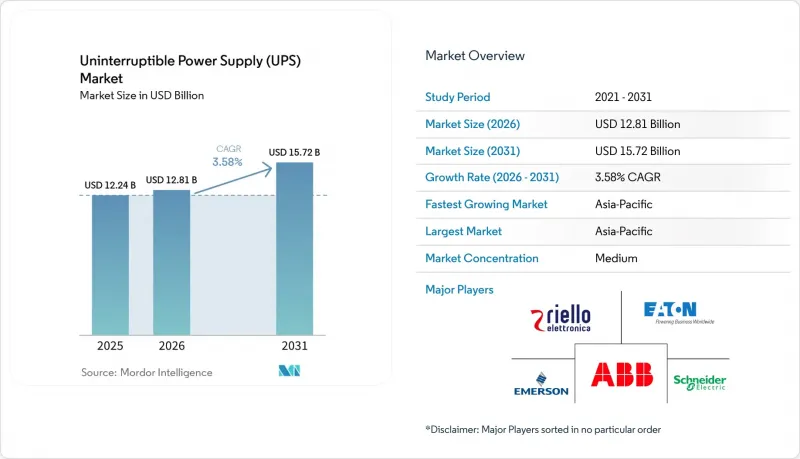
Mordor Intelligence에 의하면, UPS 시장 규모는 2025년 122억 4,000만 달러에서 2026년에는 128억 1,000만 달러로 확대되어 2031년까지 157억 2,000만 달러에 이를 것으로 예상되고 있어 2026년부터 2031년까지 CAGR 3.58%로 성장할 전망입니다.
본 보고서는 용량(10 KVA 미만, 10-100 KVA, 100 KVA 이상), 유형(스탠바이형, 라인 인터랙티브형, 온라인/더블 컨버전형), 용도(데이터센터, 통신, 의료, 산업 제조, 상업·소매, 주거), 지역(북미, 유럽, 아시아태평양, 남미, 중동 및 아프리카)별로 분류되어 있습니다.
전 세계 무정전 전원 공급 장치(UPS) 시장 동향 및 인사이트
데이터센터용량 확대 및 하이퍼스케일 시설 건설
하이퍼스케일 사업자들은 2025년에 2.8 GW의 신규 용량을 가동했으며, 그 증가분의 63%를 AWS, 마이크로소프트, 구글이 차지했습니다. 버지니아주 북부, 프랑크푸르트, 싱가포르, 뭄바이의 출하 클러스터가 대형 시스템 수주의 42%를 차지하여, 1 MW를 초과하는 모듈에 대한 지역 공급망에 부담이 가중되고 있습니다. 클라우드 SLA에서는 다운타임 발생 시 분당 1만 달러의 위약금이 부과되게 되면서, 1메가와트당 UPS 설치 면적이 2배가 되는 ‘2N’ 및 ‘2N+1’ 토폴로지의 도입이 확대되고 있습니다. 모듈형 UPS 플랫폼을 통해 단계적 도입이 가능해져, 10년 동안 유휴 자본을 18% 절감할 수 있습니다. 조립식 전기실 도입으로 현장 건설 기간이 14개월에서 7개월로 단축되어, 인력 부족으로 인한 병목 현상이 완화되었습니다. EU 에너지 효율 지침에 따른 분기별 PUE 보고 요건으로 인해, 조달 동향은 고효율 온라인 더블 컨버전 방식의 유닛으로 더욱 기울고 있습니다.
30kW를 초과하는 AI 서버 랙의 밀도가 리튬 이온 UPS 도입을 촉진
NVIDIA H100/H200 GPU 랙은 35kW를 초과하여 기존 서버 부하의 3배에 달하기 때문에 VRLA(납산 축전지) 대체품에 비해 에너지 밀도가 3배 높은 리튬 이온 배터리로의 전환이 진행되고 있습니다. 사업자들은 배터리실의 바닥 면적을 40% 줄이고, 1메가와트당 8kW의 HVAC 부하를 감축함으로써 연간 7만 5,000달러의 냉각 비용 절감을 실현하고 있습니다. 안전에 대한 우려는 여전히 남아 있습니다. 2024년에는 유럽의 코로케이션 시설에서 3건의 리튬 이온 배터리 화재가 발생했으며, 이에 따라 보험사는 UPS 용량이 5 MWh를 초과하는 시설에 대해 보험료를 22% 인상했습니다. IEC 62619 및 UL 1973 준수는 현재 하이퍼스케일러의 입찰에서 필수 요건이 되었습니다. 셀 수준의 온도 센서와 에어로졸 소화 시스템은 시스템 비용을 1kWh당 120달러 증가시키지만, 열 폭주 위험을 억제하는 데 도움이 됩니다.
IGBT 및 파워 반도체 공급 부족
2025년에는 전기차(EV) 및 인버터 수요가 생산 능력의 68%를 차지함에 따라 1200V IGBT의 리드타임이 26주로 늘어났습니다. SiC MOSFET 공급은 여전히 40주 할당 상태가 지속되고 있으며, 신규 공장 가동은 2027년 하반기로 연기되었습니다. 600A 모듈의 현물 가격은 전년 대비 34% 급등하여 중견 공급업체의 이익률을 압박하고 있습니다. Vertiv와 Eaton은 현재 IGBT 또는 SiC 모듈 중 어느 쪽에도 대응할 수 있는 플랫폼을 설계 중이며, 연속성을 확보하기 위해 3%의 효율 저하를 용인하고 있습니다. 중국공급업체인 Kehua Tech와 INVT Power는 BYD Semiconductor의 국내 IGBT 생산 라인의 혜택을 받고 있지만, 유럽의 시스템 통합사업자들은 1200V를 초과하는 디바이스에 대한 수출 규제에 직면해 있습니다.
부문 분석
2025년에는 10kVA 미만의 출하량이 47.47%를 차지하며 주류를 이루었습니다. 이는 간편한 플러그 앤 플레이 방식의 장치를 선호하는 에지 오피스 및 스마트 소매 거점 수요를 반영한 것입니다. 중규모인 10-100kVA 시스템은 중소기업 및 통신 허브를 대상으로 제공되고 있으나, 거시경제적 불확실성으로 인해 2025년 지출은 억제되었습니다. 100kVA 초과 부문은 하이퍼스케일 캠퍼스가 병렬 중복 구성의 1 MW 모듈을 채택함에 따라 2031년까지 연평균 성장률(CAGR) 4.43%로 성장할 전망입니다. 모듈식 도입을 통해 사업자는 250 kW 단위의 블록을 단계적으로 도입할 수 있으며, 10년 동안의 투자 수익률(ROI)을 14% 개선할 수 있습니다.
2025년에는 100kVA 초과 출하 대수의 62%를 리튬 이온 배터리가 차지했으나, 10kVA 미만 유닛에서는 고작 8%에 그쳤습니다. 이는 경부하 용도에서 kWh당 400달러라는 높은 가격이 정당화되지 않기 때문입니다. SiC MOSFET을 채택한 플랫폼은 50% 부하에서 98%의 효율을 달성하고, MW당 120 kW에 해당하는 냉각 부하를 줄임으로써 12랙 분량의 추가 설치 공간을 확보하며, 하이퍼스케일러가 현재 요구하는 VFI-SS-111 규격을 충족합니다. 10-100kVA 대의 랙 레벨 UPS는 구리 사용량을 30% 줄이고 고장 원인을 신속하게 파악할 수 있어, 중앙 집중식 플랜트 도입의 근거를 약화시키고 있습니다.
지역별 분석
아시아태평양은 2025년 매출의 34.39%를 차지하며, 중국의 제조업 성장 동력과 인도의 ‘디지털 인디아’ 구상에 힘입어 연평균 성장률(CAGR) 3.96%로 성장할 전망입니다. 중국의 국내 공급업체들은 수직 통합된 IGBT 공급망을 활용하여 국내 시장 점유율의 28%를 차지하고 있으며, 유럽 및 미국의 경쟁사보다 18% 저렴한 가격을 책정하고 있습니다. 인도의 데이터센터용량은 2030년까지 2,850 MW로 3배 확대될 전망이며, 이는 1 MW를 초과하는 모듈형 UPS에 대한 지속적인 수요를 창출할 것입니다. 일본에서는 0.6g 기준을 충족하기 위해 내진 보강 공사가 이루어지고 있으며, 이로 인해kVA당 80달러의 추가 비용이 발생합니다. 아세안(ASEAN)은 2025년에 데이터센터 분야에서 42억 달러의 외국인 직접 투자(FDI)를 유치했습니다. 토지가 제한적인 싱가포르가, 고도의 냉각 및 전력 공급이 필요한 고밀도 구축에서 주도적인 역할을 하고 있습니다. 호주의 도매 수요 대응 제도에서는 계통 서비스 수입으로 1MWh당 45호주달러를 얻을 수 있어, 이로 인해 UPS의 경제성이 6% 향상되었습니다.
북미 시장은 버지니아주 북부, 댈러스-포트워스, 실리콘밸리에서 가동 중인 6.2GW의 하이퍼스케일 용량이 중심을 이루고 있습니다. 미국 데이터센터에서는 2N+1 중복 구성이 채택되어 있으며, 다운타임으로 인한 손실이 분당 1만 달러에 달하기 때문에 1메가와트당 UPS 설치 면적이 3배로 확대되었습니다. 캐나다의 수력 발전이 풍부한 주들은 50-200 MW 규모의 UPS 블록이 필요한 AI 클러스터를 유치하고 있으며, kWh당 0.04달러 미만의 전력 요금이 더블 컨버전 방식의 비효율성을 상쇄하고 있습니다. 멕시코에서의 니어쇼어링을 통해 단계적인 IMMEX 생산에 힘입어, 2025년에는 산업용 UPS 수요가 340 MW 증가했습니다. 캘리포니아주의 ‘타이틀 24’에 따른 실시간 PUE 공개는 구매자들을 효율 99%의 에코 모드가 탑재된 제품으로 유도하고 있습니다.
유럽 시장은 독일, 영국, 프랑스가 주도하고 있으며, 출하량의 62%를 차지하고 있습니다. 북유럽 국가들은 재생에너지와 추운 기후를 활용하여, -20°C에서 작동하는 UPS를 kVA당 50달러의 추가 비용으로 도입하고 있습니다. EU가 2027년까지 PUE를 1.3 미만으로 억제하겠다는 목표를 제시함에 따라, SiC 기반의 효율 98% 시스템에 대한 수요가 가속화되고 있습니다. 제재의 영향을 받은 러시아 시장에서는 첨단 파워 반도체 조달에 어려움을 겪고 있어, 효율 향상 노력에 제동이 걸리고 있습니다. 남유럽에서는 V2G(Vehicle-to-Grid) 프로그램이 시범 도입되고 있으며, 이로 인해 소용량 UPS 수요가 잠식될 가능성이 있습니다.
남미 시장은 브라질이 중심을 이루고 있으며, 이 나라에서는 빈번하게 발생하는 전압 저하를 해결하기 위해 라인 인터랙티브형 UPS가 보급되고 있습니다. 아르헨티나에서는 통화 변동과 35%의 수입 관세를 배경으로 하이브리드 발전기 솔루션에 대한 의존도가 높아지고 있습니다. 콜롬비아에서는 8,200곳의 신규 5G 기지국이 안데스 산맥의 오지에 이르기까지 서비스 네트워크를 확장하고 있습니다. 중동 및 아프리카 시장에서는 사우디아라비아의 NEOM이 1.5GW 규모의 UPS 도입을 목표로 하고 있으며, 남아프리카공화국에서는 200일에 달하는 계획 정전 위기로 인해 높은 관세에도 불구하고 UPS가 필수 불가결한 요소로 자리 잡고 있습니다.
기타 혜택:
- 엑셀 형식 시장 예측(ME) 시트
- 3개월간의 애널리스트 지원
자주 묻는 질문
목차
제1장 서론
제2장 조사 방법
제3장 주요 요약
제4장 시장 구도
제5장 시장 규모와 성장 예측
제6장 경쟁 구도
제7장 시장 기회와 향후 전망
JHS 26.08.11According to Mordor Intelligence, the uninterruptible power supply market size is expected to increase from USD 12.24 billion in 2025 to USD 12.81 billion in 2026 and reach USD 15.72 billion by 2031, growing at a CAGR of 3.58% over 2026-2031.
This report is Segmented by Capacity (Less Than 10 KVA, 10 To 100 KVA, and Above 100 KVA), Type (Standby, Line-Interactive, and Online/Double-conversion), Application (Data Centers, Telecommunications, Healthcare, Industrial Manufacturing, Commercial and Retail, and Residential), and Geography (North America, Europe, Asia-Pacific, South America, and Middle East and Africa).
Global Uninterruptible Power Supply (UPS) Market Trends and Insights
Data-Center Capacity Boom & Hyperscale Build-Outs
Hyperscale operators commissioned 2.8 GW of new capacity in 2025, with AWS, Microsoft, and Google accounting for 63% of additions. Shipment clusters in Northern Virginia, Frankfurt, Singapore, and Mumbai absorbed 42% of large-system orders, stressing regional supply chains for >1 MW modules. Cloud SLAs now penalize downtime at USD 10,000 per minute, pushing the adoption of 2N and 2N+1 topologies that double UPS footprint per megawatt. Modular UPS platforms allow phased deployment, reducing stranded capital by 18% across a 10-year horizon. Prefabricated electrical rooms trimmed on-site build time from 14 months to 7 months, easing labor bottlenecks. The EU Energy Efficiency Directive's quarterly PUE reporting requirement further tilts procurement toward high-efficiency online double-conversion units.
AI Server Rack Densities >30 kW Driving Lithium-Ion UPS Adoption
NVIDIA H100/H200 GPU racks exceed 35 kW, tripling legacy server loads and prompting a pivot to lithium-ion batteries that deliver triple the energy density of VRLA alternatives. Operators reclaim 40% of battery-room floor space and cut HVAC load by 8 kW per megawatt, translating to USD 75,000 annual cooling savings. Safety concerns persist: three lithium-ion fires hit European colocation sites in 2024, leading insurers to lift premiums 22% for facilities with >5 MWh UPS capacity. Compliance with IEC 62619 and UL 1973 is now a must-have gate in hyperscaler tenders. Cell-level thermal sensors and aerosol suppression add USD 120 per kWh to system cost, but help contain thermal-runaway risk.
Supply-Chain Tightness in IGBTs & Power Semiconductors
Lead times for 1200 V IGBTs stretched to 26 weeks in 2025 as EV and inverter demand soaked up 68% of capacity. SiC MOSFET supply remains on 40-week allocations, with new fabs delayed until late 2027. Spot prices for 600 A modules leapt 34% year over year, compressing mid-tier vendor margins. Vertiv and Eaton now design platforms that accept either IGBT or SiC modules, trading 3% efficiency to ensure continuity. Chinese suppliers Kehua Tech and INVT Power benefit from domestic IGBT lines by BYD Semiconductor, while European integrators face export controls on >1200 V devices.
Other drivers and restraints analyzed in the detailed report include:
- Edge Computing Roll-Outs in 5G & Industry 4.0
- Battery-as-a-Service Contracts Lowering Capex Barriers
- High Capex/Opex Versus Generator Alternatives
For complete list of drivers and restraints, kindly check the Table Of Contents.
Segment Analysis
Shipments below 10 kVA dominated with 47.47% in 2025, reflecting edge offices and smart-retail nodes that favor easy plug-and-play units. Mid-tier 10-100 kVA systems serve small and medium enterprises and telecom hubs, yet macro uncertainty muted spend in 2025. The >100 kVA cohort will rise at a 4.43% CAGR through 2031 as hyperscale campuses adopt parallel-redundant 1 MW modules. Modular rollout lets operators stage 250 kW blocks, improving 10-year ROI by 14%.
Lithium-ion commanded 62% of >100 kVA shipments in 2025 but only 8% of sub-10 kVA units because its USD 400 per kWh premium is unjustified for light-duty loads. SiC MOSFET-enabled platforms hit 98% efficiency at 50% load, freeing 120 kW of cooling per MW, room for 12 extra racks, and meeting VFI-SS-111 specs that hyperscalers now demand. Rack-level UPS in the 10-100 kVA band saves 30% copper and isolates faults faster, eroding the case for centralized plant.
Complete Report Scope:
- By Capacity
- Less than 10 kVA
- 10 to 100 kVA
- Above 100 kVA
- By Type
- Standby
- Line-interactive
- Online/Double-conversion
- By Application
- Data Centers
- Telecommunications
- Healthcare
- Industrial Manufacturing
- Commercial and Retail
- Residential
- By Geography
- North America
- United States
- Canada
- Mexico
- Europe
- Germany
- United Kingdom
- France
- Italy
- Spain
- NORDIC Countries
- Russia
- Rest of Europe
- Asia-Pacific
- China
- India
- Japan
- South Korea
- ASEAN Countries
- Australia and New Zealand
- Rest of Asia-Pacific
- South America
- Brazil
- Argentina
- Colombia
- Rest of South America
- Middle East and Africa
- Saudi Arabia
- United Arab Emirates
- South Africa
- Egypt
- Rest of Middle East and Africa
- North America
Geography Analysis
Asia-Pacific delivered 34.39% of 2025 revenue and will expand at a 3.96% CAGR, buoyed by China's manufacturing engine and India's Digital India mandate. Domestic suppliers hold a 28% Chinese share by leveraging vertically integrated IGBT supply, underselling Western peers by 18%. India's data-center capacity is set to triple to 2,850 MW by 2030, creating a sustained pull for >1 MW modular UPS. Japan adds seismic reinforcement, costing an extra USD 80 per kVA, to meet 0.6 g standards. ASEAN attracted USD 4.2 billion FDI into data centers in 2025; land-constrained Singapore leads with high-density builds demanding advanced cooling and power. Australia's wholesale demand response garners AUD 45 per MWh in grid-services revenue, improving UPS economics by 6%.
North America market is centered on 6.2 GW of commissioned hyperscale capacity in Northern Virginia, Dallas-Fort Worth, and Silicon Valley. U.S. data centers employ 2N+1 redundancy, which is tripling UPS footprint per megawatt as downtime penalties hit USD 10,000 per minute. Canada's hydro-rich provinces attract AI clusters needing 50-200 MW UPS blocks, with sub-USD 0.04 per kWh electricity offsetting double-conversion inefficiency. Near-shoring in Mexico added 340 MW of industrial UPS demand in 2025 under phased IMMEX production. California Title 24's real-time PUE disclosure nudges buyers toward 99%-efficient eco-mode units.
The European market is led by Germany, the U.K., and France, which account for 62% of shipments. Nordic countries exploit renewable power and cool climates, installing UPS qualified for -20 °C operation at a USD 50 per kVA premium. The EU's sub-1.3 PUE target by 2027 accelerates demand for SiC-based 98%-efficient systems. Russia's sanctions-hit market struggles for advanced power semiconductors, capping efficiency upgrades. Southern Europe pilots vehicle-to-grid programs that could erode small-capacity UPS demand.
South America is anchored by Brazi,l where line-interactive UPScountersr frequent voltage sags. Argentina leans on hybrid generator solutions amid currency volatility and 35% import tariffs. Colombia's 8,200 new 5G sites stretch service networks across remote Andes. The Middle East and Africa market; Saudi Arabia's NEOM targets 1.5 GW UPS installs, and South Africa's 200-day load-shedding crisis makes UPS indispensable despite high duties.
- ABB
- Eaton
- Schneider Electric
- Vertiv
- Emerson (Vertiv legacy)
- Riello UPS
- Delta Electronics
- Mitsubishi Electric
- Hitachi Energy
- Huawei Digital Power
- Toshiba Infrastructure
- Socomec
- AEG Power Solutions
- CyberPower
- Kehua Tech
- Fuji Electric
- Piller Power Systems
- Tripp Lite (Eaton)
- INVT Power
- Legrand
Additional Benefits:
- The market estimate (ME) sheet in Excel format
- 3 months of analyst support
TABLE OF CONTENTS
1 Introduction
- 1.1 Study Assumptions & Market Definition
- 1.2 Scope of the Study
2 Research Methodology
3 Executive Summary
4 Market Landscape
- 4.1 Market Overview
- 4.2 Market Drivers
- 4.2.1 Data-center capacity boom & hyperscale build-outs
- 4.2.2 Edge computing roll-outs in 5G & Industry 4.0
- 4.2.3 Backup mandates for mission-critical healthcare facilities
- 4.2.4 Surge in modular UPS retrofits for brownfield sites
- 4.2.5 AI server rack densities >30 kW driving lithium-ion UPS adoption
- 4.2.6 Battery-as-a-Service (BaaS) contracts lowering capex barriers
- 4.3 Market Restraints
- 4.3.1 High capex/opex versus generator alternatives
- 4.3.2 Supply-chain tightness in IGBTs & power semiconductors
- 4.3.3 Grid-connected energy-storage regulations delaying deployments
- 4.3.4 Thermal run-away risks in high-density Li-ion racks
- 4.4 Supply-Chain Analysis
- 4.5 Regulatory Landscape
- 4.6 Technological Outlook (SiC MOSFETs, Li-ion, flywheel, fuel-cell UPS)
- 4.7 Porter's Five Forces
- 4.7.1 Bargaining Power of Suppliers
- 4.7.2 Bargaining Power of Buyers
- 4.7.3 Threat of New Entrants
- 4.7.4 Threat of Substitutes
- 4.7.5 Intensity of Rivalry
5 Market Size & Growth Forecasts
- 5.1 By Capacity
- 5.1.1 Less than 10 kVA
- 5.1.2 10 to 100 kVA
- 5.1.3 Above 100 kVA
- 5.2 By Type
- 5.2.1 Standby
- 5.2.2 Line-interactive
- 5.2.3 Online/Double-conversion
- 5.3 By Application
- 5.3.1 Data Centers
- 5.3.2 Telecommunications
- 5.3.3 Healthcare
- 5.3.4 Industrial Manufacturing
- 5.3.5 Commercial and Retail
- 5.3.6 Residential
- 5.4 By Geography
- 5.4.1 North America
- 5.4.1.1 United States
- 5.4.1.2 Canada
- 5.4.1.3 Mexico
- 5.4.2 Europe
- 5.4.2.1 Germany
- 5.4.2.2 United Kingdom
- 5.4.2.3 France
- 5.4.2.4 Italy
- 5.4.2.5 Spain
- 5.4.2.6 NORDIC Countries
- 5.4.2.7 Russia
- 5.4.2.8 Rest of Europe
- 5.4.3 Asia-Pacific
- 5.4.3.1 China
- 5.4.3.2 India
- 5.4.3.3 Japan
- 5.4.3.4 South Korea
- 5.4.3.5 ASEAN Countries
- 5.4.3.6 Australia and New Zealand
- 5.4.3.7 Rest of Asia-Pacific
- 5.4.4 South America
- 5.4.4.1 Brazil
- 5.4.4.2 Argentina
- 5.4.4.3 Colombia
- 5.4.4.4 Rest of South America
- 5.4.5 Middle East and Africa
- 5.4.5.1 Saudi Arabia
- 5.4.5.2 United Arab Emirates
- 5.4.5.3 South Africa
- 5.4.5.4 Egypt
- 5.4.5.5 Rest of Middle East and Africa
- 5.4.1 North America
6 Competitive Landscape
- 6.1 Market Concentration
- 6.2 Strategic Moves (M&A, Partnerships, PPAs)
- 6.3 Market Share Analysis (Market Rank/Share for key companies)
- 6.4 Company Profiles (includes Global level Overview, Market level overview, Core Segments, Financials as available, Strategic Information, Products & Services, and Recent Developments)
- 6.4.1 ABB
- 6.4.2 Eaton
- 6.4.3 Schneider Electric
- 6.4.4 Vertiv
- 6.4.5 Emerson (Vertiv legacy)
- 6.4.6 Riello UPS
- 6.4.7 Delta Electronics
- 6.4.8 Mitsubishi Electric
- 6.4.9 Hitachi Energy
- 6.4.10 Huawei Digital Power
- 6.4.11 Toshiba Infrastructure
- 6.4.12 Socomec
- 6.4.13 AEG Power Solutions
- 6.4.14 CyberPower
- 6.4.15 Kehua Tech
- 6.4.16 Fuji Electric
- 6.4.17 Piller Power Systems
- 6.4.18 Tripp Lite (Eaton)
- 6.4.19 INVT Power
- 6.4.20 Legrand
7 Market Opportunities & Future Outlook
- 7.1 White-space & Unmet-need Assessment


