

|
시장보고서
상품코드
2113245
아시아태평양의 타이어 공기압 모니터링 시스템(TPMS) : 시장 점유율 분석, 업계 동향과 통계, 성장 예측(2026-2031년)Asia-Pacific Tire Pressure Monitoring System (TPMS) - Market Share Analysis, Industry Trends & Statistics, Growth Forecasts (2026 - 2031) |
||||||
 Mordor Intelligence
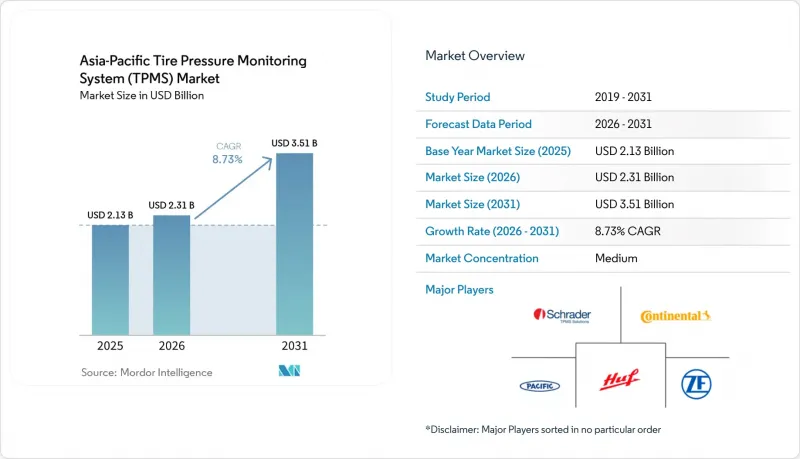
Mordor Intelligence에 의하면, 아시아태평양의 타이어 공기압 모니터링 시스템 시장은 2025년에 21억 3,000만 달러에 이르고, 2026년에는 23억 1,000만 달러, 2031년까지 35억 1,000만 달러에 달할 것으로 예측되며, 2026-2031년 CAGR은 8.73%를 나타낼 전망입니다.
본 보고서는 시스템 유형(직접, 간접 등), 센서 기술(MEMS 정전용량식, 스트레인 게이지 등), 장착 방식(밸브 스템, 밴드/림 장착 등), 주파수 대역(315 MHz, 433 MHz, 기타), 차종(승용차, 상용차, 기타), 판매 채널 및 국가별로 분류되어 있습니다. 시장 예측은 금액(미 달러)으로 표시되어 있습니다.
아시아태평양 타이어 공기압 모니터링 시스템(TPMS) 시장 동향 및 인사이트
중국, 인도, 아세안(ASEAN)의 TPMS 의무화 규제
아시아태평양의 타이어 공기압 모니터링 시스템 시장은 일시적인 수요 급증이라기보다는 점진적인 규제 확대 과정에 있습니다. 중국에서는 2020년 1월부터 카테고리 M 승용차에 TPMS 장착을 의무화하는 GB 26149-2017이 시행되어 이미 대규모 장착 기반이 형성되었으며, 이를 통해 장기적인 OEM 주도 수요와 확대되는 교체 주기가 확립되었습니다. 이어 인도에서는 주요 자동차 시장에서 2025년 11월부터 선택적 장착에서 의무화로 전환되며, 이에 따라 2026년에는 해당 지역에 새로운 규제에 기반한 수요가 추가될 예정입니다. 이 순서는 중요합니다. 왜냐하면 중국 시장을 위해 저비용 센서 아키텍처를 구축하는 노하우를 습득한 공급업체들은 여전히 엄격한 비용 목표에 직면해 있는 인도의 OEM 프로그램에서 더 유리한 입장에서 경쟁할 수 있게 되었기 때문입니다. 일본은 2025년에 433 MHz 대역 조정을 실시하고, 2026년에 완전한 시행을 완료했습니다. 반면, 한국에서는 이미 확립된 장비 체계가 유지되고 있으며, 이러한 조합이 동북아시아 전역의 조달 표준화를 뒷받침하고 있습니다. 아세안(ASEAN) 국가들은 정책 주기의 초기 단계에 있지만, 차량 안전 목표와 대규모 차량 보유 대수로 인해 향후 장비 확대를 뒷받침하는 규제 수립 방향성이 유지되고 있습니다.
연비 효율 및 전기차(EV) 주행 거리 최적화에 대한 OEM 수요
아시아태평양의 타이어 공기압 모니터링 시스템(TPMS) 시장에서 각 OEM 업체들은 TPMS를 단순한 안전 장비라는 좁은 틀이 아닌, 효율성을 높이는 구성 요소로 인식하는 경향이 강해지고 있습니다. 이러한 변화는 배터리식 전기차(BEV)에서 가장 두드러집니다. 이는 공기압 부족이 구름 저항을 높여 실제 주행 거리에 직접적인 영향을 미치기 때문에 공기압의 가시화가 자동차 제조업체와 운전자 모두에게 운영상 중요한 지표가 되고 있기 때문입니다. 2024년 6월, 콘티넨탈은 방갈로르 공장에서 2세대 모듈을 출시하며 현지 생산 능력을 연간 330만 휠 유닛으로 확대했습니다. 또한, 공기압, 온도, 움직임 감지 기능을 스마트폰 기반 데이터 표시와 연동함으로써, 이 제품이 단순한 경고등이 아닌 커넥티드 기능으로 자리매김하고 있음을 보여줍니다. 또한, 소프트웨어 정의 차량(SDV) 프로그램에서도 타이어 데이터를 섀시 제어 로직, 진단 도구, 유지보수 알림에 추가적인 하드웨어 부하를 거의 주지 않고 통합할 수 있기 때문에 그 가치 제안은 더욱 높아지고 있습니다. 따라서 주행 거리 성능과 소프트웨어 통합이 이미 옵션 구성에 영향을 미치고 있는 승용차 플랫폼에서는 프리미엄 직접 시스템이 계속해서 선호되고 있습니다. 그 결과, 중국, 인도, 일본, 한국, 특히 신형 EV 모델에서 더 높은 부가가치를 지닌 TPMS 사양의 도입이 강력하게 요구되고 있습니다.
이륜차 및 보급형 차량의 가격 민감도
아시아태평양에서는 타이어 공기압 모니터링 시스템(TPMS)이 특히 이륜차 및 저가형 승용차에서 합리적인 가격이라는 과제에 직면해 있습니다. 이 문제는 인도에서 가장 두드러집니다. 예를 들어, TVS 모터 컴퍼니는 프리미엄 다이내믹 키트를 통해서만 TPMS를 도입했으나, 이로 인해 이 기능은 일반 오토바이 구매자들에게는 손이 닿지 않는 것이 되어버렸습니다. 이륜차가 일반적으로 보급형 가격대에서 판매되는 대중 시장에서는 TPMS 패키지 도입을 정당화하기 어렵습니다. 규제에 의한 뒷받침이나 보다 명확한 운영상의 이점이 없다면, 많은 소비자들은 도입을 주저하게 됩니다. 그 결과, 이 지역에서는 일부 국가에서 자동차에 비해 이륜차 판매 대수가 많음에도 불구하고, 이륜차에서의 TPMS 보급률은 승용차에 비해 크게 뒤처져 있습니다. 이러한 상황은 전동 이륜차의 경우 다소 다릅니다. 전기 이륜차의 경우, 주행 거리에 대한 민감성 때문에 타이어 공기압 모니터링은 경제적으로 매우 중요합니다. 이러한 중요성 덕분에, 기존 내연기관 모델에서는 그다지 중시되지 않았던 저비용 BLE 캡 센서를 활용한 시범 프로젝트의 매력이 높아지고 있습니다. 그러나 합리적인 가격이라는 근본적인 과제로 인해, 기술의 성장에 비해 대상 시장의 확대는 여전히 더딘 상태입니다.
부문 분석
2025년, 아시아태평양의 타이어 공기압 모니터링 시스템 시장에서 직접형 TPMS는 68.55%의 점유율을 차지했습니다. 이는 해당 지역에서 휠 내 데이터 및 타이어 위치의 정확성이 중시되고 있으며, 승용차 프로그램에서 규제 준수가 더욱 철저히 이루어지고 있음을 반영한 것입니다. 중국은 이러한 추세의 중심적인 역할을 계속하고 있으며, 그 이유는 규제 대상인 대규모 승용차 기반에서 휠 수준에서 지속적인 공기압 및 온도 정보를 제공할 수 있는 시스템이 선호되기 때문입니다. 또한, 직접 방식은 OEM이 주행 거리 관리, 진단 및 소프트웨어 정의 제어 기능과 연동 가능한, 신뢰성 높은 실시간 데이터를 요구하는 배터리식 전기차(BEV) 프로그램에도 적합합니다. 반면, 간접식 TPMS는 ABS의 휠 속도 신호를 활용하고 휠 내부의 추가 하드웨어가 필요하지 않아 엔트리 모델의 부품 원가를 절감할 수 있기 때문에 비용 효율을 중시하는 차량 프로그램에서 여전히 일정한 입지를 유지하고 있습니다. NIRA Dynamics와 같은 소프트웨어 제공업체들은 기존 차량 플랫폼상의 알고리즘을 통해 공기압 추정을 어떻게 처리할 수 있는지 보여줌으로써 이러한 가치 제안을 뒷받침하고 있습니다.
하이브리드형 TPMS는 2031년까지 연평균 성장률(CAGR) 11.02%를 나타낼 것으로 예측되며, 이 시스템 분류에서 가장 빠르게 성장하는 아키텍처입니다. 그 매력은 간접식 시스템의 낮은 하드웨어 부담과 직접 감지에 따른 정확도의 이점을 모두 갖추고 있다는 점에 있으며, 배터리 및 파워 일렉트로닉스 비용으로 인해 이미 예산이 빠듯한 EV 플랫폼에서 유용합니다. 차세대 펑크 경고 개념에서는 직접 방식이나 하이브리드 방식이 밀리초 단위로 섀시 컨트롤러에 데이터를 전송할 수 있음이 밝혀졌으며, 그 역할은 대시보드상의 경고에 그치지 않습니다. 이는 고급차 프로그램에서 타이어 공기압 감지 기능이 차량 안정화 로직 및 첨단 운전자 보조 시스템(ADAS) 기능을 지원하기 시작했다는 점에서 중요한 의미를 지닙니다. ADAS 인터페이스 요구 사항에 대해 직접 또는 하이브리드 출력 인증을 획득할 수 있는 공급업체는 기본적인 규정 준수 제품으로만 제한된 공급업체보다 평균 판매 가격을 높일 수 있는 명확한 로드맵을 가지고 있습니다. 간접 시스템은 저가 차량에서 여전히 중요하지만, 제품 계층 구조는 더 풍부한 데이터와 우수한 통합을 실현할 수 있는 아키텍처로 전환되고 있습니다.
MEMS 정전용량식 센서는 2025년에 매출의 52.61%를 차지하고, 2031년까지의 예측 연평균 성장률(CAGR)도 9.12%로 가장 높은 성장세를 보이며, 아시아태평양의 타이어 공기압 모니터링 시스템 시장에서 규모 면에서의 리더십과 가장 강력한 성장 프로파일을 모두 확립했습니다. 이러한 이중 우위는 중국과 일본의 지역 공장이 생산량을 늘리고 비용 격차를 줄임으로써, 국내 OEM 각사가 대량 생산되는 차종 라인 전체에 걸쳐 MEMS 설계를 표준화하기 쉬워졌음을 반영합니다. 이러한 공급망이 성숙해짐에 따라, 이 기술은 프리미엄 옵션에서 주류 승용차용 직접 TPMS 프로그램의 보다 일반적인 사양으로 전환되었습니다. 특히 웨이퍼의 현지 생산, 모듈 조립, 그리고 차량에 대한 최종 장착이 동일한 지역 조달 생태계 내에서 이루어지는 경우, 경제성은 매우 뛰어납니다. 이러한 현지 규모의 우위는 과거 브랜드 프리미엄을 누리던 수입 센서 설계에도 압박을 가하고 있으며, 현재는 더욱 강력한 국내 대체품과 경쟁하고 있습니다.
차세대 전기차 및 커넥티드카 용도에서 센서의 성능, 전력 소비, 패키지 크기는 여전히 중요하므로, 투자 근거는 여전히 유효합니다. ST마이크로일렉트로닉스는 2025년 12월에 개최된 ‘대만 테크 데이’에서 자동차용 센싱과 관련된 MEMS의 진화에 대해 개괄적으로 설명했습니다. 이는 저전력화 및 타이어 내장 기능의 업그레이드가 여전히 제품 파이프라인을 통해 진행되고 있음을 시사합니다. 스트레인 게이지와 압전 센서는 매출 규모 면에서는 여전히 훨씬 작지만, 에너지 수확, 진동 응답, 혹은 대체적인 측정 방식이 검토되고 있는 특수한 이용 사례에서는 여전히 중요한 역할을 하고 있습니다. 압전 기술의 개념은 배터리 없는 제품 구현 로드맵과 특히 관련성이 높지만, 아시아태평양 전체에서의 상용화는 아직 초기 단계에 있습니다. ‘기타’ 범주(광학식이나 SAW(표면탄성파) 방식 등)는 여전히 틈새 분야에 머물러 있으며, 주로 규모에 따른 비용 절감보다는 특수한 성능을 중시하는 프로그램과 관련이 있습니다. 현재로서는 MEMS 정전용량 방식이 여전히 명확한 중심적 위치를 차지하고 있는데, 이는 지역의 제조 강점과 가장 광범위한 OEM 수요가 일치하기 때문입니다.
기타 혜택:
- 엑셀 형식 시장 예측(ME) 시트
- 3개월간의 애널리스트 지원
자주 묻는 질문
목차
제1장 서론
제2장 조사 방법
제3장 주요 요약
제4장 시장 구도
제5장 시장 규모와 성장 예측
제6장 경쟁 구도
제7장 시장 기회와 향후 전망
LSH 26.08.24According to Mordor Intelligence, the Asia-Pacific tire pressure monitoring system market was valued at USD 2.13 billion in 2025 and is expected to reach USD 2.31 billion in 2026 and USD 3.51 billion by 2031, at an 8.73% CAGR over 2026-2031.
This report is Segmented by System Type (Direct, Indirect, and More), Sensor Technology (MEMS Capacitive, Strain-Gauge, and More), Fitting Method (Valve-Stem, Band/Rim-Mounted, and More), Frequency Band (315 MHz, 433 MHz, and More), Vehicle Type (Passenger Cars, Commercial Vehicles, and More), Sales Channel, and Country. Market Forecasts are Provided in Value (USD).
Asia-Pacific Tire Pressure Monitoring System (TPMS) Market Trends and Insights
Mandatory TPMS Regulations Across China, India, and ASEAN
The Asia-Pacific tire pressure monitoring system market is moving through a staged regulatory expansion rather than a one-time jump in demand. China already created a large fitted base when GB 26149-2017 required TPMS on Category M passenger vehicles from January 2020, which established long-run OEM pull and a growing replacement cycle. India then shifted a major vehicle market from voluntary installation to mandatory compliance from November 2025, which added a fresh layer of rule-based demand to the region in 2026. This sequencing matters because suppliers that learned to build low-cost sensor architectures for China are now better placed to compete for Indian OEM programs that still face tight cost targets. Japan aligned the 433 MHz band in 2025, with full implementation completed in 2026, while South Korea already maintains an established fitment regime, and that combination is helping standardize sourcing across Northeast Asia. ASEAN remains earlier in the policy cycle, yet vehicle safety goals and larger fleets keep the rulemaking direction supportive for future fitment growth.
OEM Demand for Fuel Efficiency and EV Range Optimization
In the Asia-Pacific tire pressure monitoring system market, OEMs increasingly treat TPMS as an efficiency component rather than a narrow safety item. This shift is strongest in battery electric vehicles because under-inflation raises rolling resistance and directly affects usable range, which turns pressure visibility into an operating input for both automakers and drivers. Continental's second-generation module launch from its Bangalore plant in June 2024 expanded local production to 3.3 million wheel units per year and tied pressure, temperature, and motion sensing to smartphone-based data display, which shows how the product is being packaged as a connected function rather than a simple warning lamp. The value proposition also rises in software-defined vehicle programs because tire data can be routed into chassis-control logic, diagnostic tools, and maintenance alerts with little additional hardware burden. That is why premium direct systems continue to gain preference in passenger vehicle platforms where range performance and software integration already influence the option mix. The result is a stronger case for higher-value TPMS specifications across China, India, Japan, and South Korea, especially in new EV nameplates.
Price Sensitivity in Two-Wheelers and Entry-Level Cars
In the Asia-Pacific region, tire pressure monitoring systems (TPMS) face affordability challenges, particularly in two-wheelers and budget-friendly passenger vehicles. This issue is most pronounced in India. For instance, TVS Motor Company introduced TPMS exclusively through a premium dynamic kit, which positioned the feature beyond the reach of mainstream motorcycle buyers. In the mass market, where two-wheelers are typically priced at entry-level ranges, a TPMS package proves hard to justify. Without regulatory support or a clearer operational benefit, many consumers hesitate. Consequently, despite the region's higher sales of two-wheelers compared to cars in several countries, TPMS adoption in two-wheelers lags significantly behind that in passenger cars. The scenario shifts slightly with electric two-wheelers. Here, the sensitivity to range makes tire pressure monitoring economically vital. This relevance boosts the appeal of low-cost BLE cap-sensor pilots, a feature less emphasized in traditional internal combustion models. Yet, the overarching challenge of affordability continues to slow the expansion of the addressable market relative to the technology's growth.
Other drivers and restraints analyzed in the detailed report include:
- BLE-Enabled Battery-Less TPMS for Fast-Growing EV Segment
- Fleet-Telematics Integration for Predictive Maintenance
- High Replacement-Battery Cost in Aftermarket
For complete list of drivers and restraints, kindly check the Table Of Contents.
Segment Analysis
Direct TPMS held 68.55% of the Asia-Pacific tire pressure monitoring system market share in 2025, which reflected the region's preference for in-wheel data, tire-position accuracy, and stronger compliance alignment in passenger vehicle programs. China remained central to that pattern because its large regulated passenger-car base favored systems that could provide continuous pressure and temperature information at the wheel level. The direct format also fits better with battery electric vehicle programs where OEMs want reliable real-time data that can be tied to range management, diagnostics, and software-defined control functions. Indirect TPMS still kept a place in cost-sensitive vehicle programs because it uses ABS wheel-speed signals and avoids extra in-wheel hardware, which lowers the bill of materials for entry models. Software providers such as NIRA Dynamics support that value case by showing how pressure estimation can be handled through algorithms on existing vehicle platforms.
Hybrid TPMS is projected to grow at 11.02% CAGR through 2031, which makes it the fastest-rising architecture in this system split. Its appeal comes from balancing the low hardware burden of indirect systems with the accuracy benefits of direct sensing, which is useful in EV platforms already stretched by battery and power electronics cost. New-generation blowout-warning concepts also show how direct and hybrid layouts can push data to chassis controllers within milliseconds, which expands their role beyond dashboard alerts. That matters because pressure sensing is beginning to support stabilization logic and advanced driver-assistance functions in higher-end vehicle programs. Suppliers that can qualify direct or hybrid output against ADAS interface needs have a clearer path to higher average selling prices than suppliers limited to basic compliance products. Indirect systems will still remain relevant in lower-priced vehicles, but the product hierarchy is shifting toward architectures that can deliver richer data and better integration.
MEMS capacitive sensors captured 52.61% of revenue in 2025 and also posted the fastest projected CAGR at 9.12% through 2031, which gave them both scale leadership and the strongest growth profile in the Asia-Pacific tire pressure monitoring system market. That double position reflects how regional fabs in China and Japan have improved output, narrowed cost gaps, and made MEMS designs easier for domestic OEMs to standardize across high-volume vehicle lines. As those supply chains matured, the technology moved from a premium option into a more routine specification for direct TPMS programs in mainstream passenger vehicles. The economics are especially favorable when local wafer production, module assembly, and final vehicle integration take place within the same regional sourcing ecosystem. That local scale advantage also puts pressure on imported sensor designs that historically carried a brand premium but now face stronger domestic alternatives.
The investment case remains active because sensor performance, power use, and package size still matter in next-generation EV and connected-vehicle applications. STMicroelectronics used its Taiwan Tech Day in December 2025 to outline MEMS evolution relevant to automotive sensing, which signaled that low-power and in-tire capability upgrades are still moving through the product pipeline . Strain-gauge and piezoelectric sensors remain much smaller in revenue terms, but they still matter in specialized use cases where energy harvesting, vibration response, or alternative measurement formats are under evaluation. Piezoelectric concepts are particularly relevant to battery-less roadmaps, although commercial adoption across Asia-Pacific is still at an early stage. The "Others" category, including optical and SAW approaches, remains niche and is mainly tied to programs that value specialized performance more than scale cost. For now, MEMS capacitive remains the clear center of gravity because it matches regional manufacturing strength with the broadest OEM demand.
Complete Report Scope:
- By System Type
- Direct
- Indirect
- Hybrid
- By Sensor Technology
- MEMS Capacitive
- Strain-Gauge
- Piezoelectric
- Others (Optical, SAW, etc.)
- By Fitting Method
- Valve-Stem (Snap-In and Clamp-In)
- Band / Rim-Mounted
- Embedded-Tire Module
- By Frequency Band
- 315 MHz
- 433 MHz
- >=2.4 and UWB
- By Vehicle Type
- Passenger Cars
- Commercial Vehicles
- Two-Wheelers
- By Sales Channel
- OEM Factory-Fit
- Aftermarket Retrofit
- By Country
- China
- Japan
- India
- South Korea
- Australia
- Rest of Asia-Pacific
List of Companies Covered in this Report:
- Schrader TPMS Solutions (Sensata Technologies)
- Continental AG
- Pacific Industrial Co., Ltd.
- Huf Hulsbeck & Furst GmbH & Co. KG
- ZF Friedrichshafen AG
- Denso Corporation
- Robert Bosch GmbH
- Valeo SA
- Shanghai Baolong Automotive Corporation
- CUB Elecparts Inc.
- Steelmate Co., Ltd
- Orange Electronic Co., Ltd.
- Manatec Mobility
Additional Benefits:
- The market estimate (ME) sheet in Excel format
- 3 months of analyst support
TABLE OF CONTENTS
1 Introduction
2 Research Methodology
3 Executive Summary
4 Market Landscape
- 4.1 Market Overview
- 4.2 Market Drivers
- 4.2.1 Mandatory TPMS Regulations Across China, India, and ASEAN
- 4.2.2 OEM Demand for Fuel Efficiency and EV Range Optimization
- 4.2.3 BLE-Enabled Battery-Less TPMS for Fast-Growing EV Segment
- 4.2.4 Fleet-Telematics Integration for Predictive Maintenance
- 4.2.5 Shift to 433 MHz Harmonization in Japan
- 4.2.6 Localized MEMS Sensor Production Lowering ASPs
- 4.3 Market Restraints
- 4.3.1 Price Sensitivity in Two-Wheelers and Entry-Level Cars
- 4.3.2 High Replacement-Battery Cost in Aftermarket
- 4.3.3 Chip-Supply Volatility for Automotive-Grade Semis
- 4.3.4 RF-Hacking and Cyber-Security Vulnerabilities
- 4.4 Regulatory Landscape
- 4.5 Value / Supply-Chain Analysis
- 4.6 Technological Outlook
- 4.7 Porter's Five Forces
- 4.7.1 Threat of New Entrants
- 4.7.2 Bargaining Power of Suppliers
- 4.7.3 Bargaining Power of Buyers
- 4.7.4 Threat of Substitutes
- 4.7.5 Competitive Rivalry
5 Market Size & Growth Forecasts (Value, USD)
- 5.1 By System Type
- 5.1.1 Direct
- 5.1.2 Indirect
- 5.1.3 Hybrid
- 5.2 By Sensor Technology
- 5.2.1 MEMS Capacitive
- 5.2.2 Strain-Gauge
- 5.2.3 Piezoelectric
- 5.2.4 Others (Optical, SAW, etc.)
- 5.3 By Fitting Method
- 5.3.1 Valve-Stem (Snap-In and Clamp-In)
- 5.3.2 Band / Rim-Mounted
- 5.3.3 Embedded-Tire Module
- 5.4 By Frequency Band
- 5.4.1 315 MHz
- 5.4.2 433 MHz
- 5.4.3 >=2.4 and UWB
- 5.5 By Vehicle Type
- 5.5.1 Passenger Cars
- 5.5.2 Commercial Vehicles
- 5.5.3 Two-Wheelers
- 5.6 By Sales Channel
- 5.6.1 OEM Factory-Fit
- 5.6.2 Aftermarket Retrofit
- 5.7 By Country
- 5.7.1 China
- 5.7.2 Japan
- 5.7.3 India
- 5.7.4 South Korea
- 5.7.5 Australia
- 5.7.6 Rest of Asia-Pacific
6 Competitive Landscape
- 6.1 Market Concentration
- 6.2 Strategic Moves
- 6.3 Market Share Analysis
- 6.4 Company Profiles (includes Global Level Overview, Market Level Overview, Core Segments, Financials as Available, Strategic Information, Market Rank/Share for Key Companies, Products and Services, SWOT Analysis, and Recent Developments)
- 6.4.1 Schrader TPMS Solutions (Sensata Technologies)
- 6.4.2 Continental AG
- 6.4.3 Pacific Industrial Co., Ltd.
- 6.4.4 Huf Hulsbeck & Furst GmbH & Co. KG
- 6.4.5 ZF Friedrichshafen AG
- 6.4.6 Denso Corporation
- 6.4.7 Robert Bosch GmbH
- 6.4.8 Valeo SA
- 6.4.9 Shanghai Baolong Automotive Corporation
- 6.4.10 CUB Elecparts Inc.
- 6.4.11 Steelmate Co., Ltd
- 6.4.12 Orange Electronic Co., Ltd.
- 6.4.13 Manatec Mobility
7 Market Opportunities & Future Outlook
- 7.1 White-space & Unmet-Need Assessment


