
|
시장보고서
상품코드
2121913
자동차용 TPMS : 시장 점유율 분석, 업계 동향과 통계, 성장 예측(2026-2031년)Automotive TPMS - Market Share Analysis, Industry Trends & Statistics, Growth Forecasts (2026 - 2031) |
||||||
 Mordor Intelligence
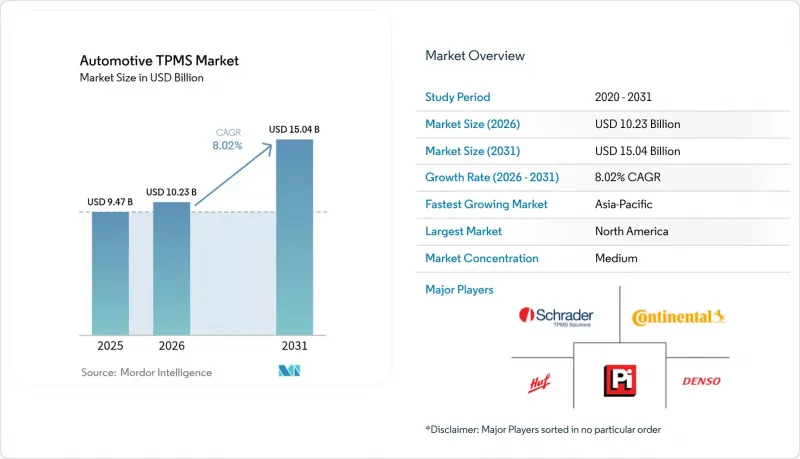
Mordor Intelligence에 의하면, 자동차용 TPMS 시장 규모는 2025년 94억 7,000만 달러, 2026년 102억 3,000만 달러에서 2031년까지 150억 4,000만 달러에 이르고, 2026-2031년 연평균 복합 성장률(CAGR)은 8.02%를 기록할 전망입니다.
본 보고서는 시스템 유형(직접, 간접, 하이브리드), 센서 기술(MEMS 정전용량식, 스트레인 게이지 등), 장착 방식(밸브 스템형, 밴드/림 장착형, 타이어 내장형), 주파수 대역(315 MHz 이상),차종(승용차 등), 판매 채널(OEM 공장 장착 및 애프터마켓 사후 장착), 지역별로 분류되어 있습니다. 시장 예측은 금액(달러)으로 표시되어 있습니다.
전 세계 자동차용 TPMS 시장 동향 및 인사이트
신차 안전 규제에 따른 TPMS 탑재 의무화
세계 각국의 법규에 따라 TPMS는 선택 사양에서 형식 인증의 필수 항목으로 계속 전환되고 있습니다. 규제 확대는 승용차에 그치지 않고 트럭, 버스, 트레일러로도 확대되고 있으며, 2024년 7월부터는 EU의 일반 안전 규정(General Safety Regulation)에 따라 의무화됩니다. 미국에서는 FMVSS 138에 기반한 규정에 따라 1만 파운드 미만의 모든 경차가 대상 범위에 포함되며, 1대당 장착 비용은 48.44-69.89달러인 것으로 나타났습니다. 한편, 중국의 GB 26149 개정으로 오토바이와 전기 스쿠터도 적용 범위에 포함되었습니다. 인도의 AIS 141 초안에서는 이륜차에 대한 직접 측정이 수년에 걸쳐 단계적으로 도입될 예정입니다. 이러한 규정의 일관성으로 인해 기초적인 수요가 보장되고, 자동차용 TPMS 시장은 단기적인 경제 변동의 영향을 덜 받게 되어, 센서 공급업체들은 조기에 생산 능력을 확대하도록 촉구받고 있습니다.
ADAS 및 커넥티드카의 텔레매틱스 플랫폼과의 통합이 진전되고 있습니다.
신차의 중앙 집중형 컴퓨팅 도메인은 현재 경로 계획, 운전자 알림 및 차량 관리 대시보드를 위해 TPMS의 텔레메트리 데이터를 수집하고 있습니다. IAA 2024에서 발표된 콘티넨탈의 ‘ContiConnect Pro’는 공기압, 온도, 트레드 데이터를 클라우드 분석 시스템으로 스트리밍하고, 이를 바탕으로 정비 작업 지시를 발행합니다. 이러한 통합으로 인해 센서에는 이더넷 게이트웨이 및 보안 펌웨어 지원이 요구되게 되었으며, 자동차용 TPMS 시장은 더 높은 대역폭을 지원하는 설계로 나아가고 있습니다. 북미의 차량 함대가 도입을 주도하고 있지만, 유럽의 물류 사업자들도 타이어 데이터를 마일당 비용 계산 알고리즘에 빠르게 통합하기 시작했습니다.
엔트리 레벨 부문의 센서 및 교정 비용 부담
엔트리 레벨 승용차 및 이륜차의 경우, 센서 가격과 장착 비용이 예산을 압박하고 있어 제조업체가 비용 대비 효과가 높은 솔루션을 제공하기가 어려워지고 있습니다. 간접적인 알고리즘은 저렴하지만, 안전성과 신뢰성을 확보하기 위해 다양한 지역에서 점점 더 엄격해지고 있는 현재 표준이 된 정확도 요건을 충족할 수 없습니다. 반도체 미세화 기술의 발전으로 단가는 서서히 하락하고 있지만, 간접적인 시스템과의 비용 균형을 달성하는 것은 여전히 장기적인 목표로 남아 있습니다. 이러한 지연은 가격에 민감한 시장, 특히 소비자의 구매 결정에 있어 합리적인 가격이 중요한 요소로 작용하는 인도 농촌 지역이나 아프리카 일부 지역에서 이 기술의 보급을 계속해서 저해하고 있습니다.
부문 분석
직접 방식은 2025년에 매출의 63.11%를 차지할 것이며, 정확한 타이어 공기압 측정과 규제 당국의 승인을 바탕으로 2031년까지 연평균 성장률(CAGR) 8.17%로 성장을 이어갈 전망입니다. 직접식 센서는 엄격한 오차 허용 범위를 충족하기 때문에 유럽, 북미, 중국의 승용차에서 표준 사양으로 자리 잡고 있습니다. 간접 방식은 저가 차량에 계속해서 채택되고 있지만, 모든 바퀴의 공기압 부족을 동시에 감지할 수는 없습니다. 직접 센서와 간접 알고리즘을 결합한 하이브리드 구성은 적재량 변동에 대응해야 하는 비용 효율을 중시하는 상용차 차량군에서 선호되고 있습니다.
아시아태평양에서는 새로운 이륜차 규정에 따라 실시간 타이어 공기압 데이터 제공이 의무화되어, 이로 인해 직접 센서에 대한 수요가 크게 증가하고 있습니다. 안전성 향상과 진화하는 기준 준수에 대한 요구가 이러한 수요 급증을 주도하고 있습니다. 이러한 수요에 대응하기 위해 콘티넨탈은 엔트리 레벨 진단 도구인 ‘TPMS Go’를 출시했습니다. 이를 통해 애프터마켓 정비소는 센서 페어링을 효율적으로 수행할 수 있게 되어, 설치의 복잡성과 소요 시간을 줄일 수 있습니다. 센서 가격 하락에 따라 하이브리드 시스템의 채택은 안정화될 가능성이 있지만, 많은 대형 차량 운영자들은 특히 내구성이 중요한 장거리 노선에서 듀얼 모드 구성의 견고성과 신뢰성을 계속해서 중시하고 있습니다.
MEMS 정전용량식 장치는 저전력 소비와 CMOS 호환성이 높이 평가되어 2025년에는 51.62%의 점유율을 차지했습니다. 압전식 센서는 현재 주류는 아니지만, 극심한 열과 진동을 견딜 수 있어 대형 트럭에 최적이며, 연평균 성장률(CAGR) 8.23%로 가장 빠르게 성장할 것으로 예측됩니다. 스트레인 게이지 방식은 선형 출력이라는 장점 덕분에 과도기적인 선택지로 평가받고 있지만, 소비 전류가 크다는 과제를 안고 있습니다.
콘티넨탈의 방갈로르 생산 라인은 경차용으로 최적화된 MEMS 정전용량식 디바이스에 주력하고 있는 반면, 일본 공급업체들은 가혹한 작동 환경 수요에 부응하기 위해 압전 세라믹 생산 확대를 추진하고 있습니다. 반도체 공급 상황은 기술 선택을 결정하는 데 있어 매우 중요한 역할을 합니다. MEMS 소자는 확립된 8인치 웨이퍼 제조 공정의 혜택을 받고 있는 반면, 압전 스택은 특수한 세라믹 공급망에 의존하고 있습니다. 예측 기간 동안, 정전용량식과 압전 소자를 통합한 하이브리드 IC 패키지가 내구성과 정밀도의 균형을 갖춘 유망한 솔루션으로 부상할 것으로 예측됩니다.
지역별 분석
북미는 2025년 자동차용 TPMS 시장 매출의 36.81%를 차지할 것으로 예상되며, 이는 오랜 기간에 걸친 규제 정착과 높은 자동차 보유 대수를 반영한 것입니다. 이 지역의 성장은 현재 신형 승용차에의 신규 탑재보다는 텔레매틱스와의 번들링 및 상용차 차량군에의 채택에 의존하고 있습니다. 미국의 애프터마켓은 평균 차량 연식이 12년을 초과하는 것이 호재로 작용하고 있으며, 캐나다에서도 소형 트럭 부문에서 유사한 경향이 나타납니다. UNECE 155에 기반한 사이버 보안 규정은 미국 국내 모델에는 적용되지 않지만, 다국적 OEM 업체들은 수출 규정 준수를 간소화하기 위해 자발적으로 이를 준수하고 있습니다.
유럽도 이에 뒤따르고 있지만, 그 동향은 다릅니다. ‘일반 안전 규정(General Safety Regulation)’에 따라 2024년 7월 이후 TPMS의 적용 범위가 사실상 모든 신형 경차 및 대형 차량으로 확대되었습니다. 출고 시 센서가 장착되지 않은 2014년 이전에 등록된 승용차에서 사후 장착 수요가 급증하고 있습니다. 독일, 프랑스, 영국은 타이어 공기압의 적정 관리가 확인될 경우 보험료 할인이 적용되는 제도 덕분에 사후 장착 대수가 가장 많습니다. 또한, 이 지역은 순환형 타이어 관리 체계를 촉진하는 지속가능성 목표에 힘입어 내장형 센서의 시범 사업에서도 주도적인 역할을 하고 있습니다.
아시아태평양은 가장 빠르게 성장하는 시장으로, 2031년까지 연평균 성장률(CAGR) 8.35%로 확대되고 있습니다. 중국에서는 GB 26149 규격의 적용 범위가 오토바이와 전기 스쿠터로 확대됨에 따라 연간 수백만 대 규모 시장 기회가 창출되고 있습니다. 콘티넨탈의 방갈로르 공장은 급증하는 OEM 수요에 대응하고 한국으로의 수출을 위한 현지 거점 역할을 하고 있습니다. 일본과 한국은 모두 UNECE 규정을 준수하고 있으며, 사이버 보안 인증을 중시하기 때문에 ISO/SAE 21434 준수를 입증할 수 있는 공급업체가 우대받고 있습니다.
기타 혜택:
- 엑셀 형식 시장 예측(ME) 시트
- 3개월간의 애널리스트 지원
자주 묻는 질문
목차
제1장 서론
제2장 조사 방법
제3장 주요 요약
제4장 시장 구도
제5장 시장 규모와 성장 예측
제6장 경쟁 구도
제7장 시장 기회와 향후 전망
LSH 26.09.10According to Mordor Intelligence, the automotive TPMS market size is projected to expand from USD 9.47 billion in 2025 and USD 10.23 billion in 2026 to USD 15.04 billion by 2031, registering a CAGR of 8.02% between 2026 and 2031.

This report is Segmented by System Type (Direct, Indirect, and Hybrid), Sensor Technology (MEMS Capacitive, Strain-Gauge, and More), Fitting Method (Valve-Stem, Band/Rim-Mounted, and Embedded-Tire Module), Frequency Band (315 MHz and More), Vehicle Type (Passenger Cars and More), Sales Channel (OEM Factory-Fit and Aftermarket Retrofit), and Geography. The Market Forecasts are Provided in Terms of Value (USD).
Global Automotive TPMS Market Trends and Insights
Mandated TPMS Fitment in New-Vehicle Safety Regulations
Global legislation continues to make TPMS an optional item into a compulsory homologation item. Regulatory expansion is widening beyond passenger cars into trucks, buses, and trailers, now mandated by the EU's General Safety Regulation from July 2024. In the United States, rules under FMVSS 138 keep all light vehicles under 10,000 lb within scope and have demonstrated fitment costs of USD 48.44-69.89 per unit. At the same time, China's GB 26149 revision brings motorcycles and electric scooters into scope. India's draft AIS 141 phases in direct measurement for two-wheelers over a multi-year window. These synchronized rules guarantee baseline demand, shielding the Automotive TPMS market from short economic swings and prompting sensor suppliers to scale capacity early.
Rising Integration with ADAS and Connected-Car Telematics Platforms
Centralized compute domains inside new vehicles now harvest TPMS telemetry for route planning, driver alerts, and fleet dashboards. Continental's ContiConnect Pro, launched at IAA 2024, streams pressure, temperature, and tread data to cloud analytics that trigger maintenance work orders. Such integrations compel sensors to support Ethernet gateways and secure firmware, nudging the Automotive TPMS market toward higher-bandwidth designs. North American fleets lead adoption, yet European logistics operators are rapidly embedding tire data into cost-per-mile algorithms.
High Sensor and Calibration Cost in Entry-Level Segments
Entry-level cars and two-wheelers feel the pinch as sensor prices, along with installation labor, stretch budgets, making it challenging for manufacturers to offer cost-effective solutions. Though cheaper, indirect algorithms fail to meet the now-standard accuracy requirements, which are increasingly being enforced across various regions to ensure safety and reliability. While advancements in semiconductor scaling are gradually reducing unit costs, achieving cost parity with indirect systems remains a long-term goal. This delay continues to hinder widespread adoption in price-sensitive markets, particularly in rural India and certain regions of Africa, where affordability is a critical factor for consumers.
Other drivers and restraints analyzed in the detailed report include:
- Electrification Increasing Weight-Sensitive Range Anxiety
- Shift Toward Smart-Tire Health-Analytics Ecosystems
- Wireless TPMS Cybersecurity Vulnerabilities
For complete list of drivers and restraints, kindly check the Table Of Contents.
Segment Analysis
Direct architectures accounted for 63.11% of revenue in 2025 and continue to expand at an 8.17% CAGR through 2031, driven by accurate in-tire pressure readings and regulatory endorsement. Direct sensors meet stringent error margins, making them the default for passenger cars in Europe, North America, and China. Indirect systems remain in low-cost vehicles but cannot detect simultaneous under-inflation across all wheels. Hybrid configurations, blending direct sensors with indirect algorithms, appeal to cost-sensitive commercial fleets that juggle payload variability.
In the Asia-Pacific region, new motorcycle regulations mandate real-time pressure data, significantly increasing the demand for direct sensors. The need for enhanced safety and compliance with evolving standards drives this surge. To address this demand, Continental has introduced its entry-level TPMS Go diagnostic tool, which allows aftermarket shops to efficiently pair sensors, thereby reducing installation complexities and time. While the adoption of hybrid systems might stabilize as sensor prices decline, many heavy-duty operators continue to favor the robustness and reliability of dual-mode setups, particularly for extended long-haul routes where durability is critical.
MEMS capacitive devices held 51.62% share in 2025, prized for low power draw and CMOS compatibility. Piezoelectric sensors, although currently less dominant, are set to grow the fastest, at an 8.23% CAGR, as they can withstand extreme heat and vibration, making them ideal for heavy trucks. Strain-gauge solutions serve as a transitional option, appreciated for their linear output, though they face higher current consumption.
Continental's Bangalore production line focuses on MEMS capacitive formats tailored for light vehicles, while Japanese suppliers are scaling up piezoelectric ceramics to meet the demands of harsh operating environments. Semiconductor availability plays a critical role in determining technology choice. MEMS devices benefit from established 8-inch wafer fabrication processes, whereas piezoelectric stacks rely on specialized ceramic supply chains. Over the forecast period, hybrid IC packages that integrate capacitive and piezoelectric elements are expected to emerge as a promising solution, offering a balance of resilience and accuracy.
Complete Report Scope:
- By System Type
- Direct
- Indirect
- Hybrid
- By Sensor Technology
- MEMS Capacitive
- Strain-Gauge
- Piezoelectric
- Others (Optical, SAW, etc.)
- By Fitting Method
- Valve-Stem (Snap-In & Clamp-In)
- Band / Rim-Mounted
- Embedded-Tire Module
- By Frequency Band
- 315 MHz
- 433 MHz
- More than or equal to 2.4 GHz & UWB
- By Vehicle Type
- Passenger Cars
- Commercial Vehicle
- Two-Wheelers
- By Sales Channel
- OEM Factory-Fit
- Aftermarket Retrofit
- Geography
- North America
- United States
- Canada
- Rest of North America
- South America
- Brazil
- Argentina
- Rest of South America
- Europe
- Germany
- United Kingdom
- France
- Italy
- Spain
- Russia
- Rest of Europe
- Asia-Pacific
- China
- Japan
- India
- South Korea
- Australia
- Rest of Asia-Pacific
- Middle East and Africa
- United Arab Emirates
- Saudi Arabia
- Turkey
- Egypt
- South Africa
- Rest of Middle East and Africa
- North America
Geography Analysis
North America retained 36.81% of the Automotive TPMS market revenue in 2025, reflecting an entrenched regulatory history and high vehicle ownership. Growth in the region now depends on telematics bundling and commercial-fleet adoption rather than new passenger-car fitment. The U.S. aftermarket is buoyed by an average vehicle age exceeding 12 years, while Canada shows parallel patterns in light-truck segments. Cybersecurity provisions under UNECE 155 do not bind U.S. domestic models, yet multinational OEMs voluntarily align to simplify export compliance.
Europe follows closely but with different dynamics. The General Safety Regulation broadened TPMS coverage to virtually every new light and heavy vehicle from July 2024. Retrofit demand spikes among cars registered before 2014 that lack factory sensors. Germany, France, and the United Kingdom rank highest in retrofit volumes, thanks to insurance rebates for verified tire pressure compliance. The region also leads in embedded-sensor pilots, motivated by sustainability targets that encourage circular tire-management schemes.
Asia-Pacific is the fastest-growing arena, advancing at an 8.35% CAGR through 2031. China's extension of GB 26149 to motorcycles and electric scooters creates a multi-million-unit annual opportunity. Continental's Bangalore line gives the company a local hub to meet surging OEM demand and export to South Korea. Japan and South Korea, both aligned with UNECE rules, emphasize cybersecurity certifications, rewarding vendors that can document ISO/SAE 21434 conformance.
- Continental AG
- Sensata Technologies / Schrader
- Pacific Industrial Co. Ltd.
- Huf Hulsbeck & Furst
- DENSO Corporation
- ZF Friedrichshafen AG (incl. TRW)
- Valeo SA
- ALLIGATOR Ventilfabrik GmbH
- Alps Alpine Co. Ltd.
- Delphi / Aptiv plc
- PressurePro Enterprises Inc.
- Steelmate Co. Ltd.
- Orange Electronic Co. Ltd.
- Bartec USA LLC
Additional Benefits:
- The market estimate (ME) sheet in Excel format
- 3 months of analyst support
TABLE OF CONTENTS
1 Introduction
- 1.1 Study Assumptions & Market Definition
- 1.2 Scope of the Study
2 Research Methodology
3 Executive Summary
4 Market Landscape
- 4.1 Market Overview
- 4.2 Market Drivers
- 4.2.1 Mandated TPMS Fitment in New-Vehicle Safety Regulations
- 4.2.2 Rising Integration with ADAS & Connected-Car Telematics Platforms
- 4.2.3 Electrification Increasing Weight-Sensitive Range Anxiety
- 4.2.4 Shift Toward Smart-Tire Health-Analytics Ecosystems
- 4.2.5 Proliferation of Low-Cost MEMS Sensors for Two-Wheelers
- 4.2.6 Insurance-Telematics Incentives for Tire-Pressure Compliance
- 4.3 Market Restraints
- 4.3.1 High Sensor & Calibration Cost in Entry-Level Segments
- 4.3.2 Wireless TPMS Cybersecurity Vulnerabilities
- 4.3.3 Aftermarket Installation Complexity & Maintenance Issues
- 4.3.4 Advent of Airless & Run-Flat Tire Technologies
- 4.4 Value / Supply-Chain Analysis
- 4.5 Regulatory Landscape
- 4.6 Technological Outlook
- 4.7 Porter's Five Forces Analysis
- 4.7.1 Bargaining Power of Suppliers
- 4.7.2 Bargaining Power of Buyers/Consumers
- 4.7.3 Threat of New Entrants
- 4.7.4 Threat of Substitute Products
- 4.7.5 Intensity of Competitive Rivalry
5 Market Size & Growth Forecasts (Value (USD))
- 5.1 By System Type
- 5.1.1 Direct
- 5.1.2 Indirect
- 5.1.3 Hybrid
- 5.2 By Sensor Technology
- 5.2.1 MEMS Capacitive
- 5.2.2 Strain-Gauge
- 5.2.3 Piezoelectric
- 5.2.4 Others (Optical, SAW, etc.)
- 5.3 By Fitting Method
- 5.3.1 Valve-Stem (Snap-In & Clamp-In)
- 5.3.2 Band / Rim-Mounted
- 5.3.3 Embedded-Tire Module
- 5.4 By Frequency Band
- 5.4.1 315 MHz
- 5.4.2 433 MHz
- 5.4.3 More than or equal to 2.4 GHz & UWB
- 5.5 By Vehicle Type
- 5.5.1 Passenger Cars
- 5.5.2 Commercial Vehicle
- 5.5.3 Two-Wheelers
- 5.6 By Sales Channel
- 5.6.1 OEM Factory-Fit
- 5.6.2 Aftermarket Retrofit
- 5.7 Geography
- 5.7.1 North America
- 5.7.1.1 United States
- 5.7.1.2 Canada
- 5.7.1.3 Rest of North America
- 5.7.2 South America
- 5.7.2.1 Brazil
- 5.7.2.2 Argentina
- 5.7.2.3 Rest of South America
- 5.7.3 Europe
- 5.7.3.1 Germany
- 5.7.3.2 United Kingdom
- 5.7.3.3 France
- 5.7.3.4 Italy
- 5.7.3.5 Spain
- 5.7.3.6 Russia
- 5.7.3.7 Rest of Europe
- 5.7.4 Asia-Pacific
- 5.7.4.1 China
- 5.7.4.2 Japan
- 5.7.4.3 India
- 5.7.4.4 South Korea
- 5.7.4.5 Australia
- 5.7.4.6 Rest of Asia-Pacific
- 5.7.5 Middle East and Africa
- 5.7.5.1 United Arab Emirates
- 5.7.5.2 Saudi Arabia
- 5.7.5.3 Turkey
- 5.7.5.4 Egypt
- 5.7.5.5 South Africa
- 5.7.5.6 Rest of Middle East and Africa
- 5.7.1 North America
6 Competitive Landscape
- 6.1 Market Concentration
- 6.2 Strategic Moves
- 6.3 Market Share Analysis
- 6.4 Company Profiles (includes Global Level Overview, Market Level Overview, Core Segments, Financials as Available, Strategic Information, Market Rank/Share for Key Companies, Products and Services, SWOT Analysis, and Recent Developments)
- 6.4.1 Continental AG
- 6.4.2 Sensata Technologies / Schrader
- 6.4.3 Pacific Industrial Co. Ltd.
- 6.4.4 Huf Hulsbeck & Furst
- 6.4.5 DENSO Corporation
- 6.4.6 ZF Friedrichshafen AG (incl. TRW)
- 6.4.7 Valeo SA
- 6.4.8 ALLIGATOR Ventilfabrik GmbH
- 6.4.9 Alps Alpine Co. Ltd.
- 6.4.10 Delphi / Aptiv plc
- 6.4.11 PressurePro Enterprises Inc.
- 6.4.12 Steelmate Co. Ltd.
- 6.4.13 Orange Electronic Co. Ltd.
- 6.4.14 Bartec USA LLC
7 Market Opportunities & Future Outlook
- 7.1 White-Space & Unmet-Need Assessment