

|
시장보고서
상품코드
2117399
애프터마켓 TPMS 시장 : 점유율 분석, 업계 동향과 통계, 성장 예측(2026-2031년)Aftermarket TPMS - Market Share Analysis, Industry Trends & Statistics, Growth Forecasts (2026 - 2031) |
||||||
 Mordor Intelligence
Mordor Intelligence에 의하면, 애프터마켓 TPMS 시장 규모는 2025년 32억 7,000만 달러에서 2026년에는 36억 2,000만 달러로 확대되어 2026년부터 2031년까지 CAGR 9.26%로 성장을 지속하여, 2031년에는 56억 3,000만 달러에 이를 것으로 예측됩니다.
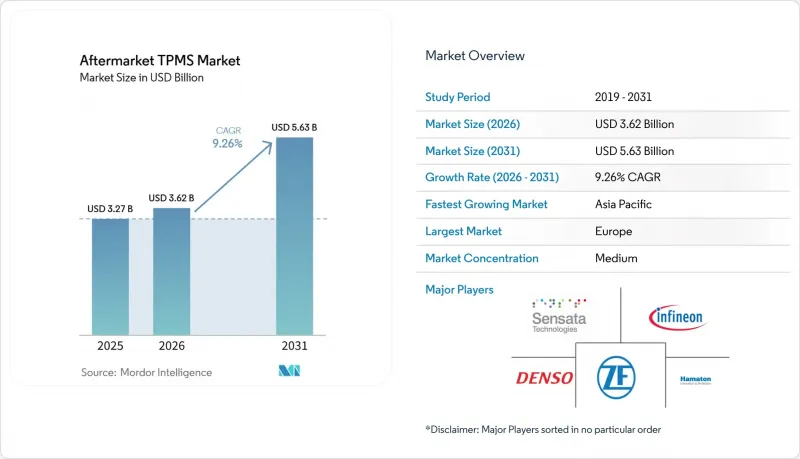
본 보고서는 유형(직접 TPMS, 간접 TPMS), 기술 통합(스탠드얼론형 TPMS 유닛, 스마트/커넥티드 TPMS), 차종(승용차, 상용차), 판매 채널(오프라인, 온라인) 및 지역(북미, 남미 등)별로 세분화되어 있습니다. 시장 전망은 금액(달러) 및 수량(대)으로 제시되어 있습니다.
세계 애프터마켓 TPMS 시장 동향 및 인사이트
스마트 TPMS를 가능하게 하는 커넥티드카 아키텍처의 급증
Doran Connect 360 및 Phillips Connect와 같은 클라우드 플랫폼은 현재 Bluetooth LE 및 셀룰러 칩이 탑재된 스마트 센서로부터 데이터를 수신하고 있으며, 애프터마켓 TPMS 시장을 예측형 서비스로 이끌고 있습니다. 인피니언의 XENSIV™ SP49는 하중 감지 분야에서 임베디드 프로세서의 가능성을 보여주고 있으며, 콘티넨탈의 HT 5 트레일러용 타이어는 실시간 분석을 위한 RFID 통합을 입증하고 있습니다.
TPMS 탑재에 관한 규제 요건
재판매 규정을 준수하고 벌칙을 피하기 위해 차량 소유자들은 차량 개조를 진행하고 있으며, 이는 애프터마켓 TPMS 시장 수요 급증을 부추기고 있습니다. 인도의 AIS-146과 중국의 GB/T 26149는 이러한 움직임의 최전선에 있습니다. 한편, 2024년에는 유럽이 UN R141의 적용 범위를 트럭과 버스까지 확대했습니다. 이와 병행하여 ISO 21750에 따라 이중 주파수 센서의 표준화가 진행되고 있어 지역 간 유통이 더욱 원활해지고 있습니다.
가격 주도형 지역에서 센서 및 서비스 비용에 대한 민감도
센서 교체에 드는 딜러 비용 때문에 남미, 중동 및 아프리카의 차량 소유자들은 수리를 미루거나 간접식 시스템을 선택하는 경향을 보이고 있습니다. 이러한 경향은 해당 지역의 애프터마켓 TPMS 시장 성장을 저해하고 있습니다. DIY 키트는 경제적 부담을 줄이는 데 도움이 되지만, 특히 규제가 완화된 지역에서는 TPMS가 ‘필수적이지 않다’는 인식이 여전히 널리 퍼져 있는 것이 확산을 저해하고 있습니다.
부문 분석
직접 방식은 2025년 애프터마켓 TPMS 시장 매출의 82.35%를 차지하며, 규제에 따라 ±1 psi의 정확도가 의무화됨에 따라 연평균 성장률(CAGR) 9.83%로 간접 방식을 상회하는 성장이 예상됩니다. 직접식 센서의 애프터마켓 TPMS 시장 규모는 재고를 줄이면서 자동 위치 파악 기능을 추가한 프로그래밍 가능한 EZ-sensor(R) SKU의 보급으로 혜택을 보고 있습니다.
간접형 TPMS는 하드웨어에 대한 초기 투자가 필요 없습니다는 점이 정확도보다 우선시되는 비용 중심의 틈새 시장에서 여전히 중요성을 유지하고 있지만, 오감지나 여러 누출이 동시에 발생할 경우 감지 누락이 성장을 제한하고 있습니다. 더 많은 지역에서 ‘직접형 전용’ 요건이 공식적으로 제정됨에 따라, 간접형 시장 점유율은 축소될 것이며, 그 역할은 주로 구형 차량군이나 규제가 시행되지 않은 신흥 시장에 국한될 것입니다.
2025년에도 독립형 장치가 총 매출의 73.15%를 차지하고 있지만, 스마트/커넥티드형 장치는 연평균 성장률(CAGR) 13.17%로 확대되고 있으며, 이는 애프터마켓 TPMS 시장에서 텔레매틱스 채택이 확대되고 있음을 반영합니다. 보험 인센티브와 블루투스 칩 비용 감소로 인해 가격 차이가 줄어들고 있어, 2028년까지 전환점이 도래할 것으로 시사됩니다.
스마트 센서는 공기압, 온도, 배터리 상태를 클라우드 대시보드로 전송하여 예측 경고를 가능하게 함으로써 도로상의 고장을 줄이고, 구독 모델 도입을 정당화합니다. 커넥티드 하드웨어의 가격이 동등해지면, 판매업체들은 일회성 판매에서 벗어나 센서의 전체 수명 주기 동안 수익을 확보할 수 있는 서비스 번들로 전환해 나갈 것입니다.
지역별 분석
애프터마켓 TPMS 시장에서 2025년 매출의 39.26%를 유럽이 차지했습니다. 이는 엄격한 차량 검사 기준과 성숙한 교체 주기에 힘입은 결과입니다. 독일, 영국, 프랑스, 이탈리아, 스페인이 수요를 주도하고 있으며, 기술 검사에서 고장 난 센서는 기준 미달로 간주될 뿐만 아니라, 2024년 7월 유엔 규정 R141의 적용 확대로 인해 트럭의 사후 개조 붐이 일고 있습니다. 네덜란드와 스페인은 커넥티드 TPMS 도입에서 선도적인 위치를 차지하고 있으며, 이는 물류 회랑이 밀집해 있고 차량 가동률이 높다는 점을 반영합니다.
아시아태평양은 2031년까지 14.33%라는 가장 높은 연평균 성장률(CAGR)을 나타낼 전망입니다. 이는 인도의 AIS-146 시행과 자동차 업계의 양상을 일변시키고 있는 중국의 GB/T 26149 의무화가 견인하고 있습니다. 인도에서는 2025년 이전에 제조된 승용차에 필수 센서가 탑재되어 있지 않아, 애프터마켓 TPMS 시장에 있어 거대한 비즈니스 기회가 되고 있습니다. 중국에서는 차량 보유 대수가 많기 때문에 1세대 센서는 5-10년마다 사용 기한이 만료되어 안정적인 교체 수요를 창출하고 있습니다. 한편, 일본과 한국은 자발적인 도입이며 속도도 완만하지만, 물류용 차량을 대상으로 한 스마트 TPMS 도입을 중시하고 있습니다.
북미에서는 규제 도입 역사가 가장 길고 차량 노후화가 진행되고 있어 꾸준한 교체 수요가 나타나고 있습니다. 자동차 보급률이 높은 가운데, 보험 텔레매틱스를 통한 할인 혜택이 스마트 센서로 업그레이드하는 데 힘을 실어주고 있습니다. 캐나다에서는 혹독한 겨울로 인해 계절적인 서비스 수요가 급증하는 현상이 나타나며, 특히 대시보드에 타이어 공기압 경고가 표시되는 시기에는 이러한 경향이 두드러집니다. 남미는 중동 및 아프리카와 마찬가지로 이러한 진화의 초기 단계에 있습니다. 이곳에서는 규제가 없기 때문에 다국적 차량 보유 기업이나 보험사의 프로그램을 통해 비용 절감 효과가 입증되지 않는 한 구매가 미뤄지는 경우가 많습니다. 아랍에미리트(UAE)의 시범적인 할인 제도는 관심이 싹트고 있음을 시사하지만, 브라질과 아르헨티나의 정치적·경제적 변동이 표준화 노력을 저해하고 있어 애프터마켓 TPMS 시장의 현재 보급률을 제한하고 있습니다.
기타 혜택:
- 엑셀 형식 시장 예측(ME) 시트
- 3개월간의 애널리스트 지원
자주 묻는 질문
목차
제1장 서론
제2장 조사 방법
제3장 개요
제4장 시장 구도
제5장 시장 규모와 성장 예측
제6장 경쟁 구도
제7장 시장 기회와 향후 전망
JHS 26.09.01According to Mordor Intelligence, the aftermarket TPMS market size is expected to grow from USD 3.27 billion in 2025 to USD 3.62 billion in 2026 and is forecast to reach USD 5.63 billion by 2031 at a 9.26% CAGR over 2026-2031.
This report is Segmented by Type (Direct TPMS, Indirect TPMS), Technology Integration (Stand-Alone TPMS Units, Smart/Connected TPMS), Vehicle Type (Passenger Cars, Commercial Vehicles), Distribution Channel (Offline, Online), and Geography (North America, South America, and More). Market Forecasts are Provided in Terms of Value (USD) and Volume (Units).
Global Aftermarket TPMS Market Trends and Insights
Surge in Connected-Vehicle Architectures Enabling Smart TPMS
Cloud platforms like Doran Connect 360 and Phillips Connect are now receiving data from smart sensors equipped with Bluetooth LE or cellular chips, steering the Aftermarket TPMS market towards predictive services. Infineon's XENSIV(TM) SP49 demonstrates the potential of embedded processors in load detection, and Continental's HT 5 trailer tire showcases the integration of RFID for real-time analytics.
Regulatory Mandates for TPMS Fitment
In a bid to comply with resale regulations and sidestep penalties, vehicle owners are retrofitting vehicles, spurring a surge in demand for the Aftermarket TPMS market. India's AIS-146 and China's GB/T 26149 are at the forefront of this movement . Meanwhile, in 2024, Europe expanded UN R141 to encompass trucks and buses. Concurrently, ISO 21750 is standardizing dual-frequency sensors, facilitating smoother cross-regional distribution.
Sensor and Service Cost Sensitivity in Price-Driven Regions
Dealership costs for sensor replacements prompt vehicle owners in South America, the Middle East, and Africa to either postpone repairs or opt for indirect systems. This trend is hindering the growth of the Aftermarket TPMS market in these regions. While DIY kits help ease the financial burden, the perception of non-criticality, especially in areas with lax enforcement, continues to hinder widespread adoption.
Other drivers and restraints analyzed in the detailed report include:
- Rising Global Vehicle Parc and Average Vehicle Age
- Fleet Predictive-Maintenance Programs Using Retrofit TPMS
- Rapid Tech-Obsolescence with Vehicle-to-Cloud Tire Monitoring
For complete list of drivers and restraints, kindly check the Table Of Contents.
Segment Analysis
Direct systems delivered 82.35% of 2025 revenue for the Aftermarket TPMS market and will outpace indirect alternatives at a 9.83% CAGR as mandates codify +-1 psi accuracy. The Aftermarket TPMS market size for direct sensors benefits from programmable EZ-sensor(R) SKUs that collapse inventory while adding auto-location functions .
Indirect TPMS maintains relevance in cost-sensitive niches where zero hardware outlay trumps precision, but false positives and simultaneous-leak blind spots limit growth. As more regions formalize direct-only requirements, indirect share will erode, keeping its role largely confined to legacy fleets or emerging markets without enforcement.
Stand-alone units still anchored 73.15% of total revenue in 2025, yet smart/connected units are expanding at 13.17% CAGR, reflecting rising telematics adoption inside the Aftermarket TPMS market. Insurance incentives and falling Bluetooth chip costs narrow the price gap, signaling an inflection point by 2028.
Smart sensors transmit pressure, temperature, and battery status to cloud dashboards, enabling predictive alerts that drop roadside failures and justify subscription models. As connected hardware reaches price parity, distributors will pivot from one-off sales to service bundles that extend revenue capture across the sensor life cycle.
Complete Report Scope:
- By Type
- Direct TPMS
- Indirect TPMS
- By Technology Integration
- Stand-alone TPMS Units
- Smart/Connected TPMS
- By Vehicle Type
- Passenger Cars
- Hatchbacks
- Sedans
- Sports Utility Vehicles (SUVs) and Multi-purpose Utility Vehicles (MUVs)
- Commercial Vehicles
- Light Commercial Vehicles
- Medium and Heavy Commercial Vehicles
- Buses and Coaches
- Passenger Cars
- By Distribution Channel
- Offline - Parts Stores, Specialty Shops, Service Centers
- Online - OEM Sites/Apps, E-commerce Platforms
- By Geography
- North America
- United States
- Canada
- Rest of North America
- South America
- Brazil
- Argentina
- Rest of South America
- Europe
- Germany
- United Kingdom
- Spain
- Italy
- France
- Netherlands
- Rest of Europe
- Asia-Pacific
- India
- China
- Japan
- South Korea
- Indonesia
- Rest of Asia-Pacific
- Middle East and Africa
- United Arab Emirates
- Saudi Arabia
- Turkey
- Egypt
- South Africa
- Rest of Middle East and Africa
- North America
Geography Analysis
Europe contributed 39.26% of 2025 revenue in the Aftermarket TPMS market, anchored by strict roadworthiness tests and mature replacement cycles. Germany, the United Kingdom, France, Italy, and Spain dominate demand as technical inspections treat failed sensors as non-compliant, while the July 2024 UN R141 expansion has sparked a truck retrofit wave . The Netherlands and Spain are first movers on connected TPMS, reflecting dense logistics corridors and high fleet utilization.
Asia-Pacific posts the strongest 14.33% CAGR to 2031, led by India's AIS-146 enforcement and China's GB/T 26149 mandate, which is reshaping the automotive landscape. In India, cars manufactured before 2025 lack essential sensors, presenting a vast opportunity for the Aftermarket TPMS market. In China, with a large vehicle parc, first-generation sensors are cycled out of service every 5-10 years, generating consistent replacement revenue. Meanwhile, Japan and South Korea, though adopting voluntarily and at a slower pace, are emphasizing smart TPMS for their logistics fleets.
North America, boasting the longest history with mandates and an aging fleet, sees steady replacements. With widespread vehicle ownership, the allure of insurance-telematics discounts drives upgrades to smart sensors. In Canada, the harsh winters lead to seasonal service spikes, especially as dashboard pressure warnings emerge. South America, along with the Middle East and Africa, finds itself in the nascent stages of this evolution. Here, the lack of regulation often postpones purchases, unless savings are showcased by multinational fleets or insurer programs. While pilot discounts in the United Arab Emirates hint at budding interest, the political and economic fluctuations in Brazil and Argentina hinder standardization efforts, limiting the current penetration of the Aftermarket TPMS market.
- Continental AG
- Sensata Technologies, Inc. (Schrader)
- Pacific Industrial Co. Ltd.
- Huf Hulsbeck & Furst
- CUB Elecparts Inc
- DENSO Corporation
- ZF Friedrichshafen AG
- Steelmate Company Limited
- Shanghai Baolong Automotive Corporation
- Orange Electronic Co, Ltd.
- Valeo SA
- Alps Alpine Co., Ltd
- Autel Intelligent Technology Corp Ltd.
- PressurePro
- ATEQ TPMS
- Bartec Auto ID Limited
- Hamaton Automotive Technology Co., Ltd.
- Bendix Commercial Vehicle Systems
- Infineon Technologies AG
Additional Benefits:
- The market estimate (ME) sheet in Excel format
- 3 months of analyst support
TABLE OF CONTENTS
1 Introduction
- 1.1 Study Assumptions & Market Definition
- 1.2 Scope of the Study
2 Research Methodology
3 Executive Summary
4 Market Landscape
- 4.1 Market Overview
- 4.2 Market Drivers
- 4.2.1 Surge in Connected-Vehicle Architectures Enabling Smart TPMS
- 4.2.2 Regulatory Mandates for TPMS Fitment
- 4.2.3 Rising Global Vehicle Parc and Average Vehicle Age
- 4.2.4 Fleet Predictive-Maintenance Programs Using Retrofit TPMS
- 4.2.5 Growth of E-commerce Aftermarket Channels
- 4.2.6 Insurance-Telematics Discounts Tied to Real-Time Tire Data
- 4.3 Market Restraints
- 4.3.1 Sensor and Service Cost Sensitivity in Price-Driven Regions
- 4.3.2 Rapid Tech-Obsolescence with Vehicle-to-Cloud Tire Monitoring
- 4.3.3 Competition from Integrated Smart/Airless Tire Technologies
- 4.3.4 Cyber-Security and Data-Privacy Concerns Around Connected TPMS
- 4.4 Value/Supply-Chain Analysis
- 4.5 Regulatory Landscape
- 4.6 Technological Outlook
- 4.7 Porter's Five Forces
- 4.7.1 Threat of New Entrants
- 4.7.2 Bargaining Power of Suppliers
- 4.7.3 Bargaining Power of Buyers
- 4.7.4 Threat of Substitutes
- 4.7.5 Competitive Rivalry
5 Market Size & Growth Forecasts (Value (USD) and Volume (Units))
- 5.1 By Type
- 5.1.1 Direct TPMS
- 5.1.2 Indirect TPMS
- 5.2 By Technology Integration
- 5.2.1 Stand-alone TPMS Units
- 5.2.2 Smart/Connected TPMS
- 5.3 By Vehicle Type
- 5.3.1 Passenger Cars
- 5.3.1.1 Hatchbacks
- 5.3.1.2 Sedans
- 5.3.1.3 Sports Utility Vehicles (SUVs) and Multi-purpose Utility Vehicles (MUVs)
- 5.3.2 Commercial Vehicles
- 5.3.2.1 Light Commercial Vehicles
- 5.3.2.2 Medium and Heavy Commercial Vehicles
- 5.3.2.3 Buses and Coaches
- 5.3.1 Passenger Cars
- 5.4 By Distribution Channel
- 5.4.1 Offline - Parts Stores, Specialty Shops, Service Centers
- 5.4.2 Online - OEM Sites/Apps, E-commerce Platforms
- 5.5 By Geography
- 5.5.1 North America
- 5.5.1.1 United States
- 5.5.1.2 Canada
- 5.5.1.3 Rest of North America
- 5.5.2 South America
- 5.5.2.1 Brazil
- 5.5.2.2 Argentina
- 5.5.2.3 Rest of South America
- 5.5.3 Europe
- 5.5.3.1 Germany
- 5.5.3.2 United Kingdom
- 5.5.3.3 Spain
- 5.5.3.4 Italy
- 5.5.3.5 France
- 5.5.3.6 Netherlands
- 5.5.3.7 Rest of Europe
- 5.5.4 Asia-Pacific
- 5.5.4.1 India
- 5.5.4.2 China
- 5.5.4.3 Japan
- 5.5.4.4 South Korea
- 5.5.4.5 Indonesia
- 5.5.4.6 Rest of Asia-Pacific
- 5.5.5 Middle East and Africa
- 5.5.5.1 United Arab Emirates
- 5.5.5.2 Saudi Arabia
- 5.5.5.3 Turkey
- 5.5.5.4 Egypt
- 5.5.5.5 South Africa
- 5.5.5.6 Rest of Middle East and Africa
- 5.5.1 North America
6 Competitive Landscape
- 6.1 Market Concentration
- 6.2 Strategic Moves
- 6.3 Market Share Analysis
- 6.4 Company Profiles (Includes Global Level Overview, Market Level Overview, Core Segments, Financials as Available, Strategic Information, Market Rank/Share for Key Companies, Products and Services, SWOT Analysis, and Recent Developments)
- 6.4.1 Continental AG
- 6.4.2 Sensata Technologies, Inc. (Schrader)
- 6.4.3 Pacific Industrial Co. Ltd.
- 6.4.4 Huf Hulsbeck & Furst
- 6.4.5 CUB Elecparts Inc
- 6.4.6 DENSO Corporation
- 6.4.7 ZF Friedrichshafen AG
- 6.4.8 Steelmate Company Limited
- 6.4.9 Shanghai Baolong Automotive Corporation
- 6.4.10 Orange Electronic Co, Ltd.
- 6.4.11 Valeo SA
- 6.4.12 Alps Alpine Co., Ltd
- 6.4.13 Autel Intelligent Technology Corp Ltd.
- 6.4.14 PressurePro
- 6.4.15 ATEQ TPMS
- 6.4.16 Bartec Auto ID Limited
- 6.4.17 Hamaton Automotive Technology Co., Ltd.
- 6.4.18 Bendix Commercial Vehicle Systems
- 6.4.19 Infineon Technologies AG
7 Market Opportunities & Future Outlook
- 7.1 White-space & Unmet-Need Assessment


