

|
시장보고서
상품코드
2113262
유럽의 가스 터빈 : 시장 점유율 분석, 업계 동향과 통계, 성장 예측(2026-2031년)Europe Gas Turbine - Market Share Analysis, Industry Trends & Statistics, Growth Forecasts (2026 - 2031) |
||||||
 Mordor Intelligence
Mordor Intelligence에 의하면, 2026년 유럽의 가스 터빈 시장 규모는 76억 5,000만 달러로 추정되며, 2025년 72억 9,000만 달러에서 확대되어 2031년에는 97억 7,000만 달러에 달할 것으로 예측됩니다.2026년부터 2031년에 있어서는 CAGR5.0%를 기록할 전망입니다.
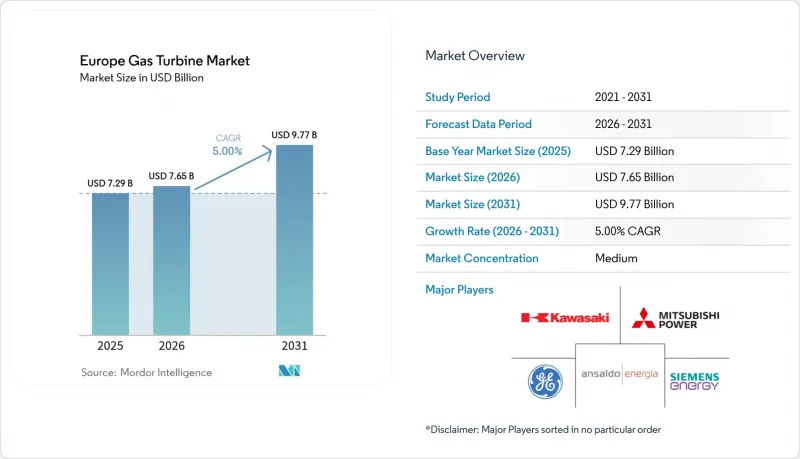
본 보고서는 출력(30MW 이하, 31-120MW, 120MW 초과), 운전 사이클(복합 사이클, 단순/개방 사이클, 열병합 발전/CHP),연료 유형(천연가스, 액체 연료, 기타 연료 유형), 최종 사용자 산업(전력, 석유 및 가스, 기타 최종 사용자 산업), 지역(영국, 독일, 프랑스, 이탈리아, 스페인, 러시아 및 기타 유럽)별로 분류되어 있습니다.
유럽 가스터빈 시장 동향 및 인사이트
노후화된 석탄 화력 및 원자력 발전소의 폐쇄로 인해 CCGT 건설이 가속화되고 있습니다.
유럽 내 구형 석탄 화력 및 원자력 발전소의 폐지에 따라, 수소 대응 CCGT 프로젝트에 대한 수요가 집중되고 있습니다. 독일의 EnBW사는 하일브론과 알트바흐/다이치자우에서석탄 화력 발전 설비를 1.34GW 규모의 가스 화력 발전 설비로 대체하기 위해 16억 유로(17억 3,000만 달러)를 배정하고 있으며, 이는 2030년 단계적 폐지 기한까지 베이스로드 부족을 보완해야 할 시급성을 여실히 보여주고 있습니다. 영국과 프랑스에서도 유사한 대체 계획이 진행 중이며, 이들 국가에서는 각각 노후화된 가스 화력 및 원자력 발전 설비에 대해 신속한 발전 용량 증강이 요구되고 있습니다. 이미 64%의 복합 사이클 효율을 입증한 최신 H-클러스터 터빈은 열효율에 더해 30분 미만의 시동 시간을 갖추고 있어, 치솟는 탄소 가격으로 인해 제약이 많은 투자 기간에도 적합합니다. 일정이 단축됨에 따라, 각 전력 회사는 2028년까지 수소 혼합 연료를 연소할 명확한 로드맵을 유지하면서도, 신흥 장기 저장 기술보다 실적이 입증된 가스 기술을 우선시해야 하는 상황에 직면해 있습니다.
재생에너지의 간헐성으로 인해 신속한 출력 조정이 가능한 가스 터빈의 필요성이 높아지고 있습니다.
2030년까지 재생에너지가 EU 발전 구성의 60% 이상을 차지할 것으로 전망됨에 따라, 계통 운영 사업자는 더욱 가파른 ‘덕 커브’로 인한 출력 변동과 정기적인 ‘둔켈플라우테(발전 정체기)’에 직면하게 될 것입니다. GE사의 LM2500과 같은 항공기 파생형 터빈은 10분 이내에 전 부하에 도달합니다. 마르바흐에 설치된 안살도 에너지아사의 AE94.3A는 최대 50 MW/분의 출력 급변율을 실현하고 있습니다. 현재 계통 운영 규칙에서는 기록적인 열효율보다 유연한 기동이 중시되고 있기 때문에 각 OEM 업체들은 가변식 흡기 가이드 베인 및 블로우오프 추출 기술에 투자하고 있으며, 이를 통해 배출 기준을 초과하지 않으면서 최소 부하를 19% 절감하고 있습니다. 유럽연합 집행위원회는 2030년까지 추가로 19GW의 고속 기동형 가스 발전 설비가 필요할 것으로 예측하고 있으며, 이 규모는 배터리가 보급되더라도 수주 잔고를 유지하기에 충분한 양입니다.
그리드 규모의 축전지 비용이 급격히 하락하면서 피크 발전소의 수익성이 악화되고 있습니다.
리튬 이온 축전 시스템은 현재 80-90%의 왕복 효율을 실현하고 있으며, 이는 오픈 사이클식 가스 피크 발전소의 35-45% 순효율보다 낮은 수치입니다. 이탈리아의 테르나(Terna)사는 2030년까지 71GWh 규모의 신규 축전 설비가 도입될 것으로 전망하고 있으며, 시뮬레이션 시나리오에 따르면 피크 발전소의 가동 시간이 15-20% 감소할 것으로 예측됩니다. 축전지는 1초 미만의 반응 속도로 주파수 응답 시장에 대응할 수 있기 때문에 과거에는 터빈에 한정되었던 수익 창출 기회가 축전 설비로 이동하고 있습니다. 각 OEM 업체들은 터빈과 축전지를 결합한 하이브리드 시스템을 패키지화하여 대응하고 있지만, 축전지 부분의 이익률은 낮은 임베디드니다.
부문별 분석
2025년, 정격 출력 120 MW를 초과하는 터빈은 유럽의 가스 터빈 시장 점유율의 39.40%를 차지하며, 재생에너지의 출력 변동 시 64%의 복합 사이클 효율과 조정 가능한 관성력을 제공하는 대형 H급 프레임에 대한 전력 회사의 의존도가 높아지고 있는 것으로 확인되었습니다. 이러한 규모의 우위 덕분에 장기적인 부대 서비스 수익이 확보되고, 탄소 비용이 내재화된 후에도 높은 설비 가동률이 유지되기 때문에 유럽의 가스 터빈 시장 규모의 상당 부분을 지탱하고 있습니다. 30-120 MW 중형급에 대한 수요는 견조한 추세를 보이고 있습니다. 이는 산업단지나 중규모 지자체에서 EU 산업 배출 지침을 준수하면서 전력과 증기의 부하 균형을 맞추는 열병합 발전 패키지의 표준화가 진행되고 있기 때문입니다. 프로젝트 발주사는 터빈, HRSG, 디지털 트윈을 패키지로 묶은 턴키 방식의 조달을 선호하고 있으며, 이를 통해 실행 기간을 24-30개월로 단축하고 자금 조달 승인을 원활하게 하고 있습니다.
30MW 미만 부문은 현재 시장 점유율이 낮지만, 데이터센터의 마이크로그리드, 지역 난방 시설 개보수, 그리고 고립된 제조 클러스터에 힘입어 2031년까지 연평균 성장률(CAGR) 5.4%로 확대되고 있으며, 이는 출력 범위 내에서 가장 빠른 성장률입니다. GE Vernova사의 LM2500XPRESS와 같은 항공기 파생형 터빈은 10분 만에 정격 출력에 도달하고, ISO 컨테이너 형태로 트럭에서 직접 반입할 수 있어 대규모 그린필드 건설을 가로막는 장기적인 토목 공사 기간을 피할 수 있습니다. 분산형 자원에 대한 인허가 절차의 원활화와 소규모 유닛에 대한 엄격한 계통 연계 규정이 없는 점도 개발 리스크를 더욱 낮추고 있습니다. 각 제조업체는 이러한 프레임에 건식 저배출 연소기를 탑재하고 있어, 물 분사 없이도 NOx 배출량을 25 ppm 미만으로 억제할 수 있으며, 이 특성은 도시 지역의 대기질 규제를 충족합니다. 유럽의 빅테크 부문이 2027년까지 서버 설치 면적을 두 배로 늘림에 따라, 마이크로그리드 수주는 단계적으로 계속 증가할 것이며, 유럽 가스터빈 시장의 이 고성장 분야 전체에서 부품 및 서비스 매출을 끌어올릴 것으로 예측됩니다.
2025년, 복합 사이클 발전소는 유럽의 가스 터빈 시장에서 60.40%라는 압도적인 점유율을 차지했습니다. 이는 30분 이내의 시동 능력과 60% 이상의 열효율이 석탄에서 가스로의 전환과 재생에너지의 균형 조정을 위한 유연성이라는 전력 회사의 두 가지 목표를 충족시키기 때문입니다. 영국의 용량 시장 입찰이나 독일의 ‘Kraftwerkstrategie(발전소 전략)’ 지침에서는 단기간 통지 시 4시간 동안 연속 출력을 유지할 수 있는 CCGT 자산에 대해 명시적으로 우대 조치를 취하고 있으며, 이러한 기준이 CCGT의 조달 우선순위를 확고히 하고 있습니다. 각 사업자들은 냉시동 시간을 5-10분 단축하기 위해 흡기 냉각 시스템 및 고속 램프 제어 밸브의 업그레이드를 추진하고 있으며, 급격히 하락하는 배터리 가격에 대해서도 경쟁력을 유지하고 있습니다. 유럽의 가스 터빈 시장에서 심플 사이클형 피크 발전기 시장 규모는 여전히 틈새 시장 수준이지만 견조한 추세를 보이고 있으며, 그 기반이 되는 것은 석유 및 가스전의 전력 공급 및 비상 블랙 스타트 임무입니다. 이러한 용도에서는 열효율보다 설비 투자(CAPEX)나 설치 면적이 우선시됩니다.
CHP(열전병급)로 분류되는 열병합 발전 및 지역 난방의 규모는 2031년까지 연평균 성장률(CAGR) 5.9%로 확대될 것으로 예측됩니다. 이는 연료 에너지의 80-90%를 공장이나 지역 열 공급망을 위한 유용한 출력으로 변환할 수 있는 능력을 반영한 것입니다. 덴마크, 핀란드, 폴란드에서는 CHP 자본 지출의 최대 30%를 지원하는 열 인프라 현대화 보조금을 이미 법제화했으며, 이로 인해 투자 경제성이 수입 바이오매스 보일러보다 현장 터빈 쪽으로 기울고 있습니다. EU 택소노미에 따른 고효율 열병합 발전 인증으로 우대 금융을 이용할 수 있게 되었으며, 화학, 펄프·제지, 음료 생산자들이 자체 발전을 활용하여 변동이 심한 전력 가격의 위험을 헤지하도록 장려되고 있습니다. 현재 경쟁 입찰에서는 응축식 재가열기, 흡수식 냉동기, 수소 대응 버너를 통합한 턴키 방식의 CHP 아일랜드를 공급업체에 제공해야 하며, 2040년까지의 규제 준수가 보장되고 있습니다. 이러한 기능 덕분에 첨단 CHP 패키지는 가동 주기 측면에서 유럽 가스터빈 시장에서 가장 빠르게 성장하는 부문이 되었습니다.
기타 혜택:
- 엑셀 형식 시장 예측(ME) 시트
- 3개월간의 애널리스트 지원
자주 묻는 질문
목차
제1장 서론
제2장 조사 방법
제3장 주요 요약
제4장 시장 구도
제5장 시장 규모와 성장 예측
제6장 경쟁 구도
제7장 시장 기회와 향후 전망
LSH 26.08.24According to Mordor Intelligence, Europe gas turbine market size in 2026 is estimated at USD 7.65 billion, growing from 2025 value of USD 7.29 billion with 2031 projections showing USD 9.77 billion, growing at 5.0% CAGR over 2026-2031.
This report is Segmented by Capacity (Up To 30 MW, 31 To 120 MW, Above 120 MW), Operating Cycle (Combined Cycle, Simple/Open Cycle, and Cogeneration/CHP), Fuel Type (Natural Gas, Liquid Fuels, and Other Fuel Types), End-User Industry (Power, Oil and Gas, and Other End-User Industries), and Geography (United Kingdom, Germany, France, Italy, Spain, Russia, and Rest of Europe).
Europe Gas Turbine Market Trends and Insights
Closure of ageing coal & nuclear fleets accelerates CCGT build-out
Europe's retirement of legacy coal and nuclear units is concentrating demand on hydrogen-ready CCGT projects. Germany's EnBW has allocated EUR 1.6 billion (USD 1.73 billion) to replace coal units with 1.34 GW of gas capacity across Heilbronn and Altbach/Deizisau, underlining the urgency to plug baseload gaps before 2030 phase-out deadlines. Similar replacement campaigns are unfolding in the UK and France, where ageing gas and nuclear fleets, respectively, require swift capacity injections. Modern H-class turbines, already proven at 64% combined-cycle efficiency, pair that thermal performance with sub-30-minute start times and therefore fit the constrained investment window created by high carbon prices. The compressed timeline is pushing utilities to favour proven gas technology over nascent long-duration storage options while maintaining a clear pathway to burn hydrogen blends as soon as 2028.
Renewables intermittency amplifies need for fast-ramping gas turbines
With renewables set to account for over 60% of the EU's generation mix by 2030, grid operators face sharper "duck-curve" ramp events and regular Dunkelflaute periods. Aero-derivative turbines, such as GE's LM2500, reach full load in under 10 minutes. Ansaldo Energia's AE94.3A, installed at Marbach, delivers up to 50 MW/minute ramp rates. Grid codes now value flexible starts over record thermal efficiency, so OEMs are investing in variable inlet guide vanes and blow-off extraction that trim minimum load by 19% without breaching emissions limits. The European Commission projects an additional 19 GW of fast-start gas assets will be required by 2030, a volume significant enough to sustain order books even as batteries proliferate.
Rapid cost declines in grid-scale batteries erode peaking-plant revenues
Lithium-ion storage now delivers 80-90% round-trip efficiency, undercutting the 35-45% net efficiency of open-cycle gas peakers. Italy's Terna expects 71 GWh of new storage by 2030, and, in modeling scenarios, peaker fleet run-hours fall by 15-20%. Because batteries can clear frequency-response markets with sub-second reaction, revenue stacking opportunities once reserved for turbines are migrating to storage. OEMs are responding by bundling turbine-plus-battery hybrids, but margins on the battery portion are slimmer.
Other drivers and restraints analyzed in the detailed report include:
- EU Industrial Emissions Directive tightening NOx limits drives upgrades
- Hydrogen-ready turbine retrofits qualify for green-finance taxonomy
- EU ETS carbon-price surpassing EUR 90/t raises CCGT dispatch costs
For complete list of drivers and restraints, kindly check the Table Of Contents.
Segment Analysis
Turbines rated above 120 MW captured 39.40% of the European gas turbine market share in 2025, confirming utilities' reliance on large H-class frames that deliver 64% combined-cycle efficiency and dispatchable inertia during renewable ramp events. This scale advantage secures long-term ancillary-service revenue and maintains high capacity factors even after carbon costs are internalized, thereby underpinning a sizable portion of the European gas turbine market size. Demand for the middle 30-120 MW class remains steady because industrial parks and mid-scale municipals continue to standardize cogeneration packages that balance electricity and steam loads while maintaining compliance with the EU Industrial Emissions Directive. Project sponsors favor turnkey procurement that bundles turbine, HRSG, and digital twin, shortening execution windows to 24-30 months and easing financing approval.
The sub-30 MW tier, although contributing a modest share today, is advancing at a 5.4% CAGR through 2031, the fastest within the capacity spectrum, driven by data center microgrids, district heating upgrades, and islanded manufacturing clusters. Aeroderivative machines, such as GE Vernova's LM2500XPRESS, reach full load in 10 minutes and are rolled off trucks as ISO containers, attributes that bypass the protracted civil works timelines plaguing large greenfield builds. Favorable permitting for distributed resources and the absence of stringent grid connection codes for small units further reduce development risk. Manufacturers are layering dry-low-emission combustors onto these frames, enabling emissions of < 25 ppm NOx without water injection, a feature that aligns with urban air-quality regulations. As Europe's Big Tech sector doubles its server footprint by 2027, incremental micro-grid orders are expected to compound, lifting both parts and service revenue across this high-growth slice of the European gas turbine market.
Combined-cycle plants held a commanding 60.40% share of the European gas turbine market in 2025, as their 30-minute start capability and thermal efficiency of over 60% meet utilities' twin goals of coal-to-gas replacement and renewable balancing flexibility. Capacity-market auctions in the UK and Germany's Kraftwerkstrategie guidelines explicitly reward CCGT assets that can sustain 4-hour continuous output at short notice, a criterion that entrenches their procurement priority. Operators are upgrading inlet-chilling and fast-ramp valve control to shave 5-10 minutes off cold-start curves, preserving competitiveness against rapidly falling battery prices. The European gas turbine market size for simple-cycle peakers remains niche yet persistent, anchored by oil-and-gas field power and emergency black-start duties, where capital expenditure (CAPEX) and footprint take precedence over thermal performance.
Cogeneration and district-heating configurations, clustered under CHP, are projected to expand at a 5.9% CAGR to 2031, reflecting their ability to convert 80-90% of fuel energy into useful output for factories and communal heat grids. Denmark, Finland, and Poland have already legislated heat infrastructure modernisation subsidies that reimburse up to 30% of CHP capital expenditure, tilting investment economics toward on-site turbines over imported biomass boilers. EU taxonomy recognition of high-efficiency cogeneration unlocks concessional debt, luring chemicals, pulp and paper, and beverage producers to hedge volatile power prices with embedded generation. Competitive procurement now asks vendors to deliver turnkey CHP islands that integrate condensing reheaters, absorption chillers,s, and hydrogen-ready burners, ensuring regulatory compliance through 2040. These features position advanced CHP packages as the fastest-growing segment within the European gas turbine market in terms of operating cycles.
Complete Report Scope:
- By Capacity
- Up to 30 MW
- 30 to 120 MW
- Above 120 MW
- By Operating Cycle
- Combined Cycle
- Simple/Open Cycle
- Cogeneration/CHP
- By Fuel Type
- Natural Gas
- Liquid Fuels (Diesel/Kerosene/LPG)
- Other Fuel Types (Hydrogen, Biogas)
- By End-User Industry
- Power Utilities
- Oil and Gas
- Other End-user Indutries (Industrial, Marine)
- By Country
- United Kingdom
- Germany
- France
- Italy
- Spain
- Russia
- Rest of Europe
List of Companies Covered in this Report:
- General Electric Co.
- Siemens Energy AG
- Mitsubishi Power Europe
- Kawasaki Heavy Industries Ltd.
- Solar Turbines Europe S.A.
- Ansaldo Energia S.p.A.
- Rolls-Royce plc (MTU Aero Engines / Vericor)
- MAN Energy Solutions SE
- Harbin Electric International Co.
- Bharat Heavy Electricals Ltd.
- Doosan Skoda Power
- Capstone Green Energy Corp.
- OPRA Turbines B.V.
- Shanghai Electric Group Co.
- Zorya-Mashproekt
- ALSTOM (legacy fleet services)
- Siemens Industrial Turbomachinery AB (Sweden)
- Dresser-Rand (Siemens)
- EthosEnergy Group
- Turboden S.p.A. (micro-turbines)
Additional Benefits:
- The market estimate (ME) sheet in Excel format
- 3 months of analyst support
TABLE OF CONTENTS
1 Introduction
- 1.1 Study Assumptions & Market Definition
- 1.2 Scope of the Study
2 Research Methodology
3 Executive Summary
4 Market Landscape
- 4.1 Market Overview
- 4.2 Market Drivers
- 4.2.1 Closure of ageing coal & nuclear fleets accelerates CCGT build-out
- 4.2.2 Renewables intermittency amplifies need for fast-ramping gas turbines
- 4.2.3 EU Industrial Emissions Directive tightening NOx limits drives upgrades
- 4.2.4 Hydrogen-ready turbine retrofits qualify for green-finance taxonomy
- 4.2.5 Data-centre micro-grids adopting aero-derivative turbines for resilience
- 4.2.6 Synthetic-methane pilots in Scandinavia create niche demand pockets
- 4.3 Market Restraints
- 4.3.1 Rapid cost declines in grid-scale batteries erode peaking-plant revenues
- 4.3.2 EU ETS carbon-price surpassing €90/t raises CCGT dispatch costs
- 4.3.3 Volatile LNG import prices compress OEM service-contract margins
- 4.3.4 Methane-leakage activism triggers permit delays for new gas pipes
- 4.4 Supply-Chain Analysis
- 4.5 Regulatory Landscape
- 4.6 Technological Outlook
- 4.7 Porter's Five Forces
- 4.7.1 Bargaining Power of Suppliers
- 4.7.2 Bargaining Power of Buyers
- 4.7.3 Threat of New Entrants
- 4.7.4 Threat of Substitutes
- 4.7.5 Competitive Rivalry
5 Market Size & Growth Forecasts
- 5.1 By Capacity
- 5.1.1 Up to 30 MW
- 5.1.2 30 to 120 MW
- 5.1.3 Above 120 MW
- 5.2 By Operating Cycle
- 5.2.1 Combined Cycle
- 5.2.2 Simple/Open Cycle
- 5.2.3 Cogeneration/CHP
- 5.3 By Fuel Type
- 5.3.1 Natural Gas
- 5.3.2 Liquid Fuels (Diesel/Kerosene/LPG)
- 5.3.3 Other Fuel Types (Hydrogen, Biogas)
- 5.4 By End-User Industry
- 5.4.1 Power Utilities
- 5.4.2 Oil and Gas
- 5.4.3 Other End-user Indutries (Industrial, Marine)
- 5.5 By Country
- 5.5.1 United Kingdom
- 5.5.2 Germany
- 5.5.3 France
- 5.5.4 Italy
- 5.5.5 Spain
- 5.5.6 Russia
- 5.5.7 Rest of Europe
6 Competitive Landscape
- 6.1 Market Concentration
- 6.2 Strategic Moves (M&A, Partnerships, PPAs)
- 6.3 Market Share Analysis (Market Rank/Share for key companies)
- 6.4 Company Profiles (includes Global level Overview, Market level overview, Core Segments, Financials as available, Strategic Information, Products & Services, and Recent Developments)
- 6.4.1 General Electric Co.
- 6.4.2 Siemens Energy AG
- 6.4.3 Mitsubishi Power Europe
- 6.4.4 Kawasaki Heavy Industries Ltd.
- 6.4.5 Solar Turbines Europe S.A.
- 6.4.6 Ansaldo Energia S.p.A.
- 6.4.7 Rolls-Royce plc (MTU Aero Engines / Vericor)
- 6.4.8 MAN Energy Solutions SE
- 6.4.9 Harbin Electric International Co.
- 6.4.10 Bharat Heavy Electricals Ltd.
- 6.4.11 Doosan Skoda Power
- 6.4.12 Capstone Green Energy Corp.
- 6.4.13 OPRA Turbines B.V.
- 6.4.14 Shanghai Electric Group Co.
- 6.4.15 Zorya-Mashproekt
- 6.4.16 ALSTOM (legacy fleet services)
- 6.4.17 Siemens Industrial Turbomachinery AB (Sweden)
- 6.4.18 Dresser-Rand (Siemens)
- 6.4.19 EthosEnergy Group
- 6.4.20 Turboden S.p.A. (micro-turbines)
7 Market Opportunities & Future Outlook
- 7.1 White-space & Unmet-Need Assessment


