
|
시장보고서
상품코드
2113337
미국의 차량 렌탈 : 시장 점유율 분석, 업계 동향과 통계, 성장 예측(2026-2031년)United States Vehicle Rental - Market Share Analysis, Industry Trends & Statistics, Growth Forecasts (2026 - 2031) |
||||||
 Mordor Intelligence
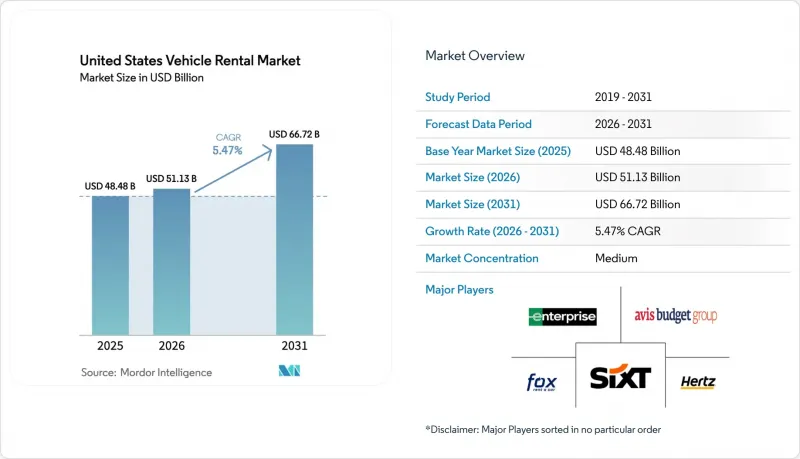
Mordor Intelligence에 따르면 미국의 렌터카 시장 규모는 2025년 484억 8,000만 달러에서 2026년에는 511억 3,000만 달러로 확대되고, 2026년부터 2031년까지 CAGR 5.47%를 기록하며 2031년까지 667억 2,000만 달러에 달할 것으로 예측됩니다.
본 보고서는 용도(레저·관광 및 비즈니스·법인), 차종(승용차, 소형 상용차, 중형·대형 상용차), 예약 채널(온라인 및 오프라인), 대여 기간(단기 및 장기), 구동 방식, 서비스 모델 및 지역별로 분류되어 있습니다. 시장 예측은 금액(달러) 기준으로 제시되어 있습니다.
미국 차량 렌탈 시장의 동향 및 인사이트
국내 로드트립 및 레저 수요의 급증
2025년, 미국 여행객들은 해외 여행보다 국립공원이나 해안가를 따라 드라이브하는 것을 선호함에 따라, 팬데믹 이전 수준에 비해 국내 여행객 수가 현저히 증가했습니다. 일일 렌탈 요금은 보합세를 보였으나, 평균 렌탈 기간이 길어짐에 따라 거래당 수익이 크게 증가했습니다. 레저 목적의 렌탈은 플로리다주, 캘리포니아주, 텍사스주 등 주요 주에 집중되었기 때문에 사업자들은 성수기에 선벨트 지역 공항으로 전략적으로 차량을 재배치했습니다. 일반적으로 수익성이 높은 SUV 및 미니밴에 대한 수요가 증가함에 따라 차량 구성의 수익성이 향상되었습니다. 그러나 이러한 재배치로 인해, 특히 이용률이 떨어지는 비수기에 계절적 변동이 발생했습니다. 이러한 과제를 해결하기 위해 각 기업은 동적 가격 책정 알고리즘과 지역 간 이동을 위한 실시간 텔레매틱스 기술 도입에 주력하고 있습니다.
온라인 및 모바일 예약 채널의 급속한 성장
2025년, 미국 렌터카 시장의 거래 대부분을 디지털 예약이 차지하며 전년 대비 현저한 증가세를 보였습니다. 이러한 성장은 엔터프라이즈 홀딩스 등의 모바일 앱 덕분이었으며, 이는 예약에 소요되는 시간을 대폭 단축하고 부가 수익의 현저한 증가를 가져왔습니다. 한편, 하츠(Hertz)가 우버(Uber) 앱 내에 렌터카 옵션을 통합한 전략적 조치는 우버 사용자의 상당 부분을 다일 렌탈로 유도하는 데 성공했으며, 플랫폼의 융합으로 인해 라이드셰어링과 렌터카의 경계가 점점 더 모호해지고 있음을 여실히 보여주고 있습니다. 디지털 채널을 통해 고객 확보 비용은 대폭 절감되었지만, 2024년 중견 기업에서 발생한 랜섬웨어 공격으로 인해 일시적으로 업무가 중단된 사례는 ISO 27001을 준수하는 견고한 사이버 보안 대책이 필수적임을 여실히 보여주고 있습니다.
신차 공급의 지속적인 제약과 높은 설비 투자(CAPEX)
2025년, 미국의 경차 생산 대수는 팬데믹 이전 수준에 비해 현저한 감소세를 보였습니다. 그 결과, 각 OEM 업체들은 소매 채널을 우선시하여, 플릿 판매에서 제공되는 할인에 비해 훨씬 높은 거래 가격을 실현했습니다. 하츠(Hertz)는 평균 취득 비용이 크게 증가했다고 보고했으며, 플릿의 평균 차량 연식이 늘어남에 따라 대당 월간 유지비도 현저히 상승했습니다. 한편, 2025년 5월 에이비스 버짓이 높은 금리로 사채를 발행한 것은 금리 상승 국면에서 플릿 갱신을 위한 자금 수요가 높아지고 있음을 여실히 보여주고 있습니다.
부문별 분석
2025년, 재택근무로 인해 가족들이 휴가를 연장할 수 있게 되면서 플로리다주와 캘리포니아주에서는 여름 이용률이 5분의 4를 넘어섰고, 레저 및 관광 부문이 미국 렌터카 시장의 56.71%를 차지했습니다. 비즈니스 및 법인 고객은 규모는 작지만, 기업이 차량 소유에서 유연한 렌탈로 전환하여 고정 차량 운영 비용을 4분의 1로 절감할 수 있기 때문에 연평균 성장률(CAGR) 5.49%로 레저 부문을 상회하는 성장이 예상됩니다. 이러한 전략은 비용 합리화로 이어질 뿐만 아니라 계절적 변동을 완화하는 효과도 있습니다. 레저 목적의 렌탈은 여름철에 정점을 찍는 반면, 법인 수요는 연초와 연말에 이용률을 끌어올립니다. 프리미엄 SUV나 컨버터블은 렌탈 요금이 높기 때문에 전년 대비 1일당 평균 수익을 높이는 요인이 됩니다.
에이비스 버젯에서는 특히 오스틴과 샌프란시스코의 대형 하이테크 기업들로부터 법인 대상 구독 계약이 대폭 증가했습니다. 이들 기업은 하이브리드 근무 체제를 정착시키고 있어, 그 결과 고객과의 계약 건수는 감소하는 반면 계약 기간은 장기화되고 있습니다. 또 다른 견고한 부문인 ‘보험 대체 차량’도 꾸준한 성장을 보였습니다. 이러한 성장은 차량 수리 기간이 길어지고 있는 데 기인하며, 사업자 측은 저비용 차량을 배정함으로써 정액제 계약의 이익률을 확보하고 있습니다. 전기자동차(EV)의 보급 현황에서는 뚜렷한 양극화가 관찰됩니다. 레저 이용자는 단거리 이동에서 전기자동차를 시험해 보는 경향이 훨씬 강한 반면, 법인 고객은 신속한 급유를 우선시하여 기존의 내연기관 차량을 선호하는 경향이 있습니다.
2025년, 승용차는 미국 렌터카 시장 규모의 63.37%를 차지했으며, 세단과 소형 SUV가 연비, 구매 비용, 공항 주차 요금의 균형을 잘 맞추고 있어 5.57%라는 업계 최고 수준의 연평균 성장률(CAGR)로 확대될 전망입니다. 소형 상용차는 E-Commerce 기업들이 큰 자본 지출 없이 유연한 라스트 마일 운송 능력을 확보하기 위해 밴이나 픽업 트럭을 렌트하고 있기 때문에 연간 소폭의 성장률을 보이고 있습니다. 엔터프라이즈(Enterprise)사는 계약업체의 수요에 대응하기 위해 2024년에 포드 F-150 1만 8,000대를 추가로 도입했습니다. 이로 인해 차량당 수익은 소폭 증가했으나, 감가상각 속도는 가속화되었습니다.
지역별 선호도에는 차이가 나타납니다. 연료비나 주차 공간 제약이 심각한 캘리포니아주나 북동부 지역에서는 소형 세단이 주류를 이루는 반면, 이동 거리가 길고 가족 단위로 이용하는 경우가 많은 텍사스주나 플로리다주에서는 픽업 트럭이나 풀사이즈 SUV가 주류를 이루고 있습니다. 상용차의 전기화는 더디게 진행되고 있어, 2024년 렌터카 밴 중 전기자동차 비중은 고작 3%에 그쳤지만, 인구 밀집 도시 지역의 노선에서 진행 중인 포드 ‘E-트랜짓’의 시범 운행은 점진적인 변화의 조짐을 보여주고 있습니다.
기타 혜택:
- 엑셀 형식의 시장 예측(ME) 시트
- 3개월간의 애널리스트 지원
자주 묻는 질문
목차
제1장 소개
제2장 조사 방법
제3장 주요 요약
제4장 시장 구도
제5장 시장 규모와 성장 예측
제6장 경쟁 구도
제7장 시장 기회와 향후 전망
KSM 26.08.25According to Mordor Intelligence, the United States vehicle rental market size is expected to grow from USD 48.48 billion in 2025 to USD 51.13 billion in 2026 and is forecast to reach USD 66.72 billion by 2031 at a 5.47% CAGR over 2026-2031.
This report is Segmented by Application (Leisure and Tourism and Business and Corporate), Vehicle Type (Passenger Cars, Light Commercial Vehicles, and Medium and Heavy-Duty Commercial Vehicles), Booking Channel (Online and Offline), Rental Duration (Short-Term and Long-Term), Propulsion, Service Model, and Geography. The Market Forecasts are Provided in Terms of Value (USD).
United States Vehicle Rental Market Trends and Insights
Surge in Domestic Road-Trip/Leisure Demand
In 2025, U.S. travelers, opting for national parks and coastal drives over international vacations, drove a notable increase in domestic person-trips compared to pre-pandemic levels . While daily rental rates remained steady, a longer average rental duration significantly boosted revenue per transaction. With a substantial share of leisure rentals concentrated in key states like Florida, California, and Texas, operators strategically shifted their inventory towards sunbelt airports during peak quarters. The growing preference for SUVs and minivans, which typically generate higher revenue, enhanced fleet mix economics. However, this shift introduced seasonal volatility, particularly during the less busy quarters when utilization rates dropped. To navigate these challenges, companies have turned to dynamic pricing algorithms and real-time telematics for cross-regional transfers.
Rapid Growth of Online & Mobile Booking Channels
In 2025, digital bookings constituted a significant majority of transactions in the U.S. car rental market, showing a notable increase from the previous year. This growth can be attributed to mobile apps, like those of Enterprise Holdings, which have significantly reduced booking times and driven a considerable rise in ancillary revenue . Meanwhile, Hertz's strategic move to integrate rental options within the Uber app has successfully converted a notable portion of Uber's users for multi-day rentals, highlighting the increasingly blurred lines between ride-hailing and car rentals due to platform convergence. While digital channels have substantially lowered customer acquisition costs, incidents such as a ransomware attack that temporarily disrupted operations for a mid-tier operator in 2024 emphasize the critical need for robust ISO 27001-grade cybersecurity defenses.
Persistent New-Vehicle Supply Constraints & High CAPEX
In 2025, U.S. light-vehicle production experienced a notable decline compared to pre-pandemic levels. As a result, OEMs prioritized retail channels, achieving significantly higher transaction prices compared to the discounts offered in fleet sales. Hertz reported a considerable increase in average acquisition costs, with the fleet's average age extending, leading to a noticeable rise in monthly maintenance expenses per vehicle. Meanwhile, Avis Budget's bond issuance in May 2025, set at a high-interest rate, highlights the intensified capital demands for fleet renewals amid rising interest rates.
Other drivers and restraints analyzed in the detailed report include:
- OEM-Backed Electrification of Rental Fleets
- Peer-to-Peer Supply Expansion & Price Discovery
- Modal Substitution by Ride-Hailing & Subscription MaaS
For complete list of drivers and restraints, kindly check the Table Of Contents.
Segment Analysis
Leisure and tourism captured 56.71% of the United States car rental market in 2025 as remote work let families extend vacations, pushing summer utilization above four-fifths in Florida and California. Business and corporate clients, though smaller, will outpace leisure at a 5.49% CAGR because firms are substituting ownership with flexible rentals that trim fixed fleet costs by one-fourth. Such a strategy not only streamlines expenses but also smooths out seasonal fluctuations: leisure rentals peak during the summer months, while corporate demand bolsters occupancy during the beginning and end of the year. Premium SUVs and convertibles command higher rental rates, pushing the average daily revenue upward compared to the previous year.
Avis Budget witnessed a significant surge in corporate subscriptions, especially from tech giants in Austin and San Francisco. These firms are consolidating their hybrid workforce, leading to fewer but extended client engagements. Another resilient segment, insurance replacements, saw steady growth. This growth comes as vehicle repair timelines are extended, prompting operators to allocate lower-cost fleets, ensuring margins on fixed-rate contracts. The landscape of EV adoption reveals a stark divide: leisure renters exhibit a much greater inclination to trial EVs for shorter trips. In contrast, corporate clients prefer traditional ICE vehicles, prioritizing the need for swift refueling.
Passenger cars held 63.37% of the United States car rental market size in 2025 and will expand at the leading 5.57% CAGR because sedans and compact SUVs balance fuel economy, acquisition cost, and airport space fees. Light commercial vehicles are growing at a minimal rate annually as e-commerce firms rent vans and pickups for flexible last-mile capacity without large capital outlays. Enterprise added 18,000 Ford F-150s in 2024 to meet contractor demand, realizing slightly higher revenue per vehicle but accepting faster depreciation.
Regional preferences diverge: compact sedans dominate in California and the Northeast, where fuel costs and parking constraints are acute, while pickups and full-size SUVs lead in Texas and Florida, where trip distances and family travel justify size premiums. Commercial electrification lags; only 3% of rented vans were EVs in 2024, but Ford E-Transit pilots in dense urban routes signal incremental change.
Complete Report Scope:
- By Application
- Leisure and Tourism
- Business and Corporate
- By Vehicle Type
- Passenger Cars
- Light Commercial Vehicles
- Medium and Heavy-duty Commercial Vehicles
- By Booking Channel
- Online
- Offline
- By Rental Duration
- Short-Term
- Long-Term
- By Propulsion
- ICE Vehicles
- Battery-Electric Vehicles
- Hybrid-Electric Vehicles
- By Service Model
- Traditional Corporate Fleets
- Peer-to-Peer Platforms
List of Companies Covered in this Report:
- Enterprise Holdings Inc.
- Hertz Global Holdings Inc.
- Avis Budget Group Inc.
- Sixt SE
- Fox Rent A Car
- Ace Rent A Car
- Advantage Rent A Car
- U-Save Car & Truck Rental
- Turo Inc.
- Getaround Inc.
- Kyte
- HyreCar Inc.
Additional Benefits:
- The market estimate (ME) sheet in Excel format
- 3 months of analyst support
TABLE OF CONTENTS
1 Introduction
- 1.1 Study Assumptions & Market Definition
- 1.2 Scope of the Study
2 Research Methodology
3 Executive Summary
4 Market Landscape
- 4.1 Market Overview
- 4.2 Market Drivers
- 4.2.1 Surge in Domestic Road-Trip/Leisure Demand
- 4.2.2 Rapid Growth of Online & Mobile Booking Channels
- 4.2.3 Flexible Fleet-Leasing Demand from Hybrid-Work Corporates
- 4.2.4 OEM-Backed Electrification of Rental Fleets
- 4.2.5 Peer-to-Peer Supply Expansion & Price Discovery
- 4.2.6 Telematics-Driven OPEX Optimisation
- 4.3 Market Restraints
- 4.3.1 Persistent New-Vehicle Supply Constraints & High CAPEX
- 4.3.2 Modal Substitution by Ride-Hailing & Subscription MaaS
- 4.3.3 Residual-Value Risk from Low-Priced Chinese EV Imports
- 4.3.4 Escalating Airport Concession & Local Taxation Costs
- 4.4 Value / Supply-Chain Analysis
- 4.5 Regulatory Landscape
- 4.6 Technological Outlook
- 4.7 Porter's Five Forces
- 4.7.1 Bargaining Power of Suppliers
- 4.7.2 Bargaining Power of Buyers
- 4.7.3 Threat of New Entrants
- 4.7.4 Threat of Substitutes
- 4.7.5 Competitive Rivalry
5 Market Size & Growth Forecasts (Value (USD))
- 5.1 By Application
- 5.1.1 Leisure and Tourism
- 5.1.2 Business and Corporate
- 5.2 By Vehicle Type
- 5.2.1 Passenger Cars
- 5.2.2 Light Commercial Vehicles
- 5.2.3 Medium and Heavy-duty Commercial Vehicles
- 5.3 By Booking Channel
- 5.3.1 Online
- 5.3.2 Offline
- 5.4 By Rental Duration
- 5.4.1 Short-Term
- 5.4.2 Long-Term
- 5.5 By Propulsion
- 5.5.1 ICE Vehicles
- 5.5.2 Battery-Electric Vehicles
- 5.5.3 Hybrid-Electric Vehicles
- 5.6 By Service Model
- 5.6.1 Traditional Corporate Fleets
- 5.6.2 Peer-to-Peer Platforms
6 Competitive Landscape
- 6.1 Market Concentration
- 6.2 Strategic Moves
- 6.3 Market Share Analysis
- 6.4 Company Profiles (includes Global Level Overview, Market Level Overview, Core Segments, Financials as Available, Strategic Information, Market Rank/Share for Key Companies, Products and Services, SWOT Analysis, and Recent Developments)
- 6.4.1 Enterprise Holdings Inc.
- 6.4.2 Hertz Global Holdings Inc.
- 6.4.3 Avis Budget Group Inc.
- 6.4.4 Sixt SE
- 6.4.5 Fox Rent A Car
- 6.4.6 Ace Rent A Car
- 6.4.7 Advantage Rent A Car
- 6.4.8 U-Save Car & Truck Rental
- 6.4.9 Turo Inc.
- 6.4.10 Getaround Inc.
- 6.4.11 Kyte
- 6.4.12 HyreCar Inc.
7 Market Opportunities & Future Outlook
- 7.1 White-space & Unmet-need Assessment