

|
시장보고서
상품코드
2116902
지게차 렌탈 : 시장 점유율 분석, 업계 동향과 통계, 성장 예측(2026-2031년)Forklift Rental - Market Share Analysis, Industry Trends & Statistics, Growth Forecasts (2026 - 2031) |
||||||
 Mordor Intelligence
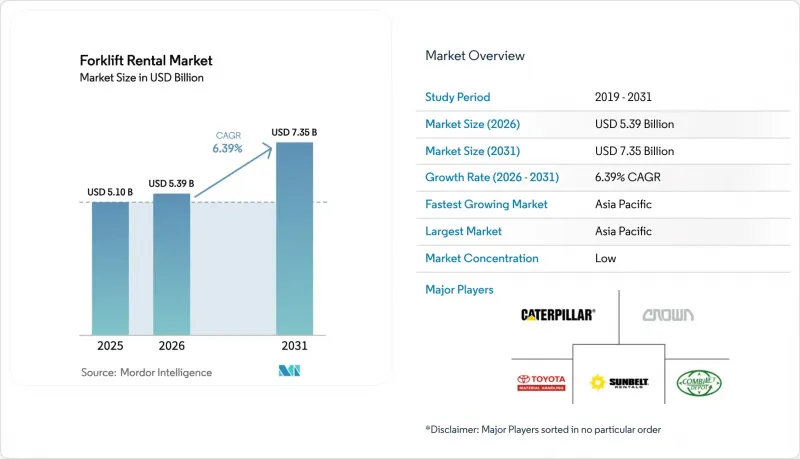
Mordor Intelligence에 따르면 지게차 렌탈 시장 규모는 2025년에 51억 달러로 평가되며, 2026년 53억 9,000만 달러에서 2031년까지 73억 5,000만 달러에 달할 것으로 예측되고 있으며, 예측 기간(2026-2031년)에 CAGR은 6.39%에 달할 전망입니다.
이 보고서는 적재 용량(3.5톤 미만, 3.6-10톤 및 그 이상), 대여 기간(단기 및 장기/계약),동력원(전기, 내연기관 및 기타), 트럭 등급(클래스 I-승용 전기 트럭, 클래스 II-협폭 통로용 트럭 및 기타), 최종 용도 산업(창고·물류, 건설 및 기타) 및 지역별로 분류되어 있습니다. 시장 예측은 금액(달러) 기준으로 제시되어 있습니다.
전 세계 지게차 임대 시장의 동향 및 인사이트
E-Commerce 주문 처리 붐
아마존의 광범위한 글로벌 풀필먼트 네트워크와 DHL의 자동화에 대한 막대한 투자가 성수기 동안 렌탈 차량의 확대를 촉진하고 있으며, 이로 인해 소유에 비해 변동비 기반의 계약이 더 유리해지고 있습니다. 아시아태평양에서는 신흥 시장의 뚜렷한 기여로 인해 창고 공간이 대폭 확대될 것으로 예상됩니다. 라스트 마일 허브의 소포 처리량 변동으로 인해 유연한 용량 솔루션에 대한 수요가 증가하고 있습니다. 렌탈 사업자들은 높은 적재 능력을 유지하면서도 좁은 통로에서도 효율적으로 작동할 수 있는 소형 전동 모델을 제공함으로써 이러한 과제에 대응하고 있습니다. E-Commerce의 급속한 성장은 계획 기간 내내 지게차 렌탈 시장의 발전을 지속적으로 견인하고 있습니다.
자재 운반 예산에서 자본 지출(Capex)에서 운영비(Opex)로의 전환
미국 장비 리스·금융 협회(ELFA)는 미국내 자재 취급 장비에 대한 금융 및 리스가 현저히 증가하고 있다고 지적하고 있으며, 이는 기존의 패턴에서 벗어나고 있음을 반영합니다. 재무 담당자들은 감가상각 및 잔존 가치와 관련된 위험을 완화하기 위해 점점 더 렌탈을 활용하고 있습니다. 이 전략을 통해 전기 구동이나 수소 구동과 같은 최신 기술이 구형 디젤 모델을 대체해 가는 가운데, 최신 기술에 대한 접근성이 확보됩니다. 자동차나 가전제품 등 일부 산업에서는 수주 주기가 예측 불가능하고 생산 일정이 빈번하게 변경되므로 소유는 많은 경우 비용 효율적인 해결책이라고 할 수 없습니다. 또한 렌탈 계약에서는 유지보수 책임이 임대인에게 넘어가므로 규제상의 재인증 요건을 준수할 수 있을 뿐만 아니라, 사업자의 경비 절감에도 기여합니다. 지게차 렌탈 시장은 일관된 요금과 서비스 품질을 보장하는 마스터 계약을 채택한, 여러 거점을 보유한 제3자 물류(3PL) 업체들에 의해 더욱 활성화되고 있습니다.
건설 지출의 경기 변동
건설 업계의 변동은 지게차 렌탈 수요에 직접적인 영향을 미치며, 렌탈 업체의 수익 흐름을 예측하기 어렵게 만드는 요인이 되고 있습니다. 최근 건설 기계 시장은 호불호가 엇갈리고 있으며, 한 대형 기업은 판매량 감소와 최종사용자에 대한 기계 판매 부진으로 인해 수익 감소를 보고하고 있습니다. 그러나 가까운 미래 전망으로는 경제 상황 개선과 금리 인하에 힘입어 건설 기계 판매가 회복될 가능성이 있는 것으로 나타났습니다. 또한 인프라 프로젝트에 대한 연방 정부의 대규모 투자가 안정성을 가져올 것으로 예상되며, 이미 많은 건설업체들이 이러한 사업에 참여하고 있습니다. 이러한 지원이 있음에도 불구하고 렌탈 업체들은 프로젝트 지연이나 자재비 급등과 같은 과제에 계속 직면하고 있으며, 이는 많은 기업에게 여전히 중대한 우려 사항으로 남아 있습니다. 건설 지출의 주기적인 특성으로 인해 렌탈 재고가 과잉되는 시기가 자주 발생하며, 이는 최근 렌탈 수익 성장 둔화에도 반영되어 지난 수년간 가장 부진한 실적 중 하나를 기록하고 있습니다.
부문별 분석
3.6-10톤 중량대는 2025년 매출의 45.37%를 차지하며, 생산, 물류, 건설 업무에 걸친 범용성을 입증하고 있습니다. 대조적으로, 3.5톤 미만의 지게차는 좁은 통로와 높은 랙이 시설 설계의 주류를 이루는 부지 면적이 제한된 도시의 수요에 힘입어, 2031년까지 연평균 성장률(CAGR) 10.67%를 기록할 전망입니다. 주요 도시 지역에서는 수직 방향의 보관 공간이 증가함에 따라 창고에서 소형 전동 지게차의 도입이 점점 더 확대되고 있습니다. 이러한 지게차는 높은 적재 높이를 실현하면서도 좁은 통로를 효율적으로 주행할 수 있도록 설계되었습니다. 또한 첨단 배터리 기술로 인해 렌탈 차량의 경제성이 향상되어 전체 수명 주기 비용 절감으로 이어지고 있습니다.
도시 지역의 인구 밀도가 높아짐에 따라 소형 지게차 렌탈 수요는 다른 카테고리에 비해 더 빠른 속도로 확대될 것으로 예상됩니다. 텔레매틱스 기술을 통해 리스 업체는 지게차의 순환 배치를 최적화하여, 수요가 낮은 지역에서의 효율적인 정비를 확보하는 동시에 수요가 높은 지역에서의 가동 체제를 유지할 수 있게 됩니다. 산업 시설 등의 2차 시장에서는 여전히 대형 기계가 선호되고 있으며, 특수한 설비를 보유해야 하므로 렌탈 도입은 제한적인 수준에 머물러 있습니다. 이러한 동향은 지게차 렌탈 시장이 기동성이 더 높고 친환경적인 자산으로 전환되고 있음을 여실히 보여주며, 소형 전동 모델이 이러한 변화를 주도하고 있습니다.
2025년에는 12개월 미만의 단기 렌탈이 수익의 64.73%를 차지했으며, 그 주요 요인은 건설업 및 계절적 물류 수요 때문이었습니다. 그러나 주요 3PL(제3자 물류 사업자)이 차량 사양 및 서비스 수준을 표준화하는 다중 거점 계약을 체결함에 따라 12개월을 초과하는 계약은 현재 연평균 성장률(CAGR) 8.50%를 기록하고 있습니다. 현재 자재 운반용 장비의 리스 계약 상당 부분이 더 장기적인 형태로 이루어지고 있습니다. 리스 기간의 장기화로 인해 리스 제공업체는 취득 비용을 더 오랜 기간에 걸쳐 상각할 수 있게 되어, 수익성을 해치지 않으면서 월 이용료를 인하할 수 있게 되었습니다.
유연한 임대 옵션을 통해 고객은 초기 기간 종료 후 짧은 통지 기간만으로 계약을 해지할 수 있으며, 예측 가능성과 기동성 간의 균형을 맞추고 있습니다. 마찬가지로 계약업체 역시 일괄 계약을 통해 청구 처리가 간소화되고 대량 할인 혜택이 적용됨에 따라 평균 임대 기간을 연장하고 있습니다. 그 결과, 프로젝트별 수요 피크 시에는 여전히 단기 수요가 필수적이지만, 장기 계약에 기인한 지게차 임대 시장의 규모는 계속해서 확대되고 있습니다.
지역별 분석
아시아태평양은 2025년에 전 세계 매출의 37.65%를 차지할 것으로 예상되며, 2031년까지 연평균 성장률(CAGR) 10.28%를 기록할 것으로 전망됩니다. 중국의 광범위한 창고 건설 계획과 인도의 물류 시설 준공이 이러한 급속한 성장을 주도하고 있습니다. 중국은 E-Commerce 보급률이 높아 주요 쇼핑 행사 기간 중 렌탈 차량 수가 크게 증가합니다. 일본에서는 새로운 자동화 공간 도입에 따라 협폭 통로용 전동 지게차와 텔레매틱스의 통합이 진행되고 있으며, 인력 부족 및 임금 상승에 대한 대응이 추진되고 있습니다.
미국이 주도하는 북미는 매출에 크게 기여하고 있습니다. 이 지역에서 제로 에미션 달성 기한 설정을 위한 노력이 전동화로의 전환을 가속화하며, 지게차 렌탈 시장의 성장을 지원하고 있습니다. 한편, 캐나다에서는 특히 주요 운송 회랑을 따라 안정적인 수요가 유지되고 있습니다.
유럽은 수익의 상당 부분을 차지하고 있으며, 주요 국가들이 시장을 주도하고 있습니다. 규제 변경으로 인해 기존 기종에 비해 비용이 높음에도 불구하고 렌탈 차량의 전동화가 진행되고 있습니다. 이 지역의 주요 기업은 광범위한 지점 네트워크를 활용하여 지역 전체의 고객에게 서비스를 제공하고 있습니다. 남미 및 중동 및 아프리카는 시장 점유율은 작지만, 눈에 띄는 성장을 달성하고 있습니다. 이는 항만 물류의 확대와 야심 찬 인프라 프로젝트에 힘입은 것으로, 이러한 요인들이 특수 임대 장비에 대한 수요를 끌어올리고 있습니다.
기타 혜택:
- 엑셀 형식의 시장 예측(ME) 시트
- 3개월간의 애널리스트 지원
자주 묻는 질문
목차
제1장 서론
제2장 조사 방법
제3장 개요
제4장 시장 구도
제5장 시장 규모와 성장 예측
제6장 경쟁 구도
제7장 시장 기회와 향후 전망
KSA 26.08.26According to Mordor Intelligence, the forklift rental market size was valued at USD 5.10 billion in 2025 and estimated to grow from USD 5.39 billion in 2026 to reach USD 7.35 billion by 2031, at a CAGR of 6.39% during the forecast period (2026-2031).
This report is Segmented by Load Capacity (Less Than 3. 5 T, 3. 6 To 10 T, and More), Rental Duration (Short-Term and Long-term/Contract), Power Source (Electric, Internal Combustion, and More), Truck Class (Class I - Electric Rider, Class II - Narrow-Aisle, and More), End-Use Industry (Warehousing and Logistics, Construction, and More), and Geography. The Market Forecasts are Provided in Terms of Value (USD).
Global Forklift Rental Market Trends and Insights
E-Commerce Fulfillment Boom
Amazon's extensive global fulfillment network and DHL's significant investment in automation are driving rental fleets to expand during peak periods, making variable-cost agreements more favorable compared to ownership . The Asia-Pacific region is expected to witness substantial growth in warehouse space, with notable contributions from emerging markets. Fluctuations in parcel volumes at last-mile hubs are increasing the demand for flexible capacity solutions. Rental operators are addressing this by offering compact electric models that can operate efficiently in narrow aisles while maintaining high lifting capabilities. The rapid growth of e-commerce continues to shape the development of the forklift rental market over the planning horizon.
Shift from Capex to Opex in Material-Handling Budgets
The Equipment Leasing and Finance Association noted a notable rise in the financing and leasing of material-handling equipment in the United States, reflecting a shift from traditional patterns. Finance leaders are increasingly turning to rentals to mitigate risks associated with depreciation and residual value. This strategy ensures access to the latest technology as advancements like electric and hydrogen drives replace older diesel models. In industries such as automotive and consumer electronics, where order cycles are unpredictable and production schedules frequently change, ownership is often not a cost-effective solution. Moreover, rental agreements transfer maintenance responsibilities to lessors, aligning with regulatory recertification requirements and helping operators reduce expenses. The forklift rental market is further bolstered by multi-site 3PLs adopting master agreements that ensure consistent rates and service quality.
Cyclical Construction Spending
Fluctuations in the construction industry directly influence the demand for forklift rentals, leading to unpredictable revenue streams for rental companies. Recently, the construction equipment market experienced mixed results, with a major player reporting a decline in revenue due to reduced sales volumes and a drop in equipment sales to end users. However, the outlook for the near future indicates a potential rebound in construction equipment sales, supported by improving economic conditions and easing interest rates. Additionally, significant federal investments in infrastructure projects are expected to provide stability, with a notable portion of contractors already engaged in these initiatives. Despite this support, rental companies continue to face challenges such as project delays and rising material costs, which remain a significant concern for many firms. The cyclical nature of construction spending often results in periods of surplus rental inventory, as reflected in the recent slowdown in rental revenue growth, marking one of the weakest performances in recent times.
Other drivers and restraints analyzed in the detailed report include:
- Emission Regulations Phasing-Out Class IV/V ICE Trucks
- AI-driven Fleet-Optimization Software Adoption
- OEM Direct-Leasing Cannibalizing Independent Rental Fleets
For complete list of drivers and restraints, kindly check the Table Of Contents.
Segment Analysis
The 3.6 to 10 ton bracket captured 45.37% of 2025 revenue, affirming its versatility across production, logistics, and construction operations. In contrast, sub-3.5-ton forklifts are on track for a 10.67% CAGR to 2031, supported by land-scarce cities where narrow aisles and high racks dominate facility design. In major urban centers, as vertical storage increases, warehouses are increasingly adopting compact electric forklifts. These forklifts are designed to achieve significant lift heights while efficiently navigating through narrow corridors. Additionally, advanced battery technologies enhance the economic viability for rental fleets, leading to lower overall lifecycle costs.
As urban areas become increasingly densely populated, the demand for compact forklift rentals is expected to grow at a faster pace compared to other categories. Telematics technology enables lessors to optimize forklift rotation, ensuring efficient servicing of quieter locations while maintaining readiness in high-demand areas. Secondary markets, including industrial facilities, still show a preference for larger machines, with rental adoption remaining limited due to the need for specialized equipment ownership. This trend highlights the forklift rental market's shift towards more agile and environmentally friendly assets, with compact electric models driving this transformation.
Short-term rentals with durations of less than 12 months accounted for 64.73% of revenue in 2025, primarily driven by construction and seasonal logistics. However, deals longer than 12 months now post an 8.50% CAGR as large 3PLs execute multi-site agreements that standardize fleet specs and service levels. A significant portion of material-handling leases now spans longer durations. Extended tenures enable lessors to amortize acquisition costs over a longer period, thereby reducing monthly rates without compromising returns.
Flexible rental options enable customers to exit with short notice after the initial period, striking a balance between predictability and agility. Contractors likewise stretch average rental periods as bundled deals simplify billing and unlock volume discounts. As a result, the forklift rental market size attributable to long-term contracts continues to expand, though short-term demand remains vital for project-specific peaks.
Complete Report Scope:
- By Load Capacity
- Less Than 3.5 T
- 3.6 to 10 T
- More Than 10 T
- By Rental Duration
- Short-term (Less Than 12 months)
- Long-term/Contract (More Than 12 months)
- By Power Source
- Electric
- Internal Combustion (Diesel/LPG)
- Hybrid/Hydrogen
- By Truck Class
- Class I - Electric Rider
- Class II - Narrow-Aisle
- Class III - Electric Hand
- Class IV - ICE Cushion
- Class V - ICE Pneumatic
- By End-use Industry
- Warehousing and Logistics
- Construction
- Automotive
- Food and Beverage
- Aerospace and Defense
- Others (Retail, Pharma, etc.)
- By Geography
- North America
- United States
- Canada
- Rest of North America
- South America
- Brazil
- Argentina
- Rest of South America
- Europe
- Germany
- United Kingdom
- France
- Italy
- Spain
- Russia
- Rest of Europe
- Asia-Pacific
- China
- Japan
- India
- South Korea
- Australia
- Rest of Asia-Pacific
- Middle East and Africa
- Saudi Arabia
- United Arab Emirates
- Egypt
- South Africa
- Rest of Middle East and Africa
- North America
Geography Analysis
The Asia-Pacific region commanded 37.65% of global revenue in 2025 and is expected to post a 10.28% CAGR through 2031. China's extensive warehouse pipeline and India's logistics completions are driving this surge. With high e-commerce penetration in China, rental fleets experience significant growth during major shopping events. Japan's introduction of new automated space highlights the integration of narrow-aisle electrics and telematics, addressing labor shortages and rising wages.
North America, led by the United States, contributes significantly to the revenue. The region's push for zero-emission deadlines is accelerating the shift to electric, supporting the growth of the forklift rental market. Meanwhile, Canada maintains a steady demand, particularly along key corridors.
Europe accounts for a substantial portion of the revenue, with leading countries driving the market. Regulatory changes are encouraging rental fleets to adopt electric options, despite the higher costs associated with them compared to traditional units. Dominant players in the region leverage extensive branch networks to serve pan-regional customers. South America and the combined areas of the Middle East and Africa, while contributing a smaller share, are experiencing notable growth. This is driven by expanding port logistics and ambitious infrastructure projects, which are boosting demand for specialty rentals.
- United Rentals Inc.
- Sunbelt Rentals (Ashtead Group)
- Toyota Industries Corp. (Toyota Material Handling)
- Caterpillar Inc. (Cat Rental)
- Herc Rentals Inc.
- Combillift Depot
- Crown Equipment Corp.
- Jungheinrich AG (Rental)
- Mitsubishi Logisnext
- KION Group (Linde, STILL)
- Speedy Hire Plc
- Loxam Group
- Coates Hire
- Boels Rental
- Riwal Holding Group
- BigRentz Inc.
- Sunstate Equipment
- Ahern Rentals
- Komatsu Ltd. (Rental)
Additional Benefits:
- The market estimate (ME) sheet in Excel format
- 3 months of analyst support
TABLE OF CONTENTS
1 Introduction
- 1.1 Study Assumptions and Market Definition
- 1.2 Scope of the Study
2 Research Methodology
3 Executive Summary
4 Market Landscape
- 4.1 Market Overview
- 4.2 Market Drivers
- 4.2.1 E-commerce Fulfilment Boom
- 4.2.2 Shift From Capex to Opex in Material-handling Budgets
- 4.2.3 Accelerated Warehouse Automation Roll-outs
- 4.2.4 Emission Regulations Phasing-out Class IV/V ICE Trucks
- 4.2.5 AI-driven Fleet-optimization Software Adoption
- 4.2.6 Original Equipment Manufacturer Subscription-based "Power-by-the-Hour" Models
- 4.3 Market Restraints
- 4.3.1 Cyclical Construction Spending
- 4.3.2 Tight Labor Pool of Certified Forklift Operators
- 4.3.3 Rising Lithium-ion Battery Raw-material Costs
- 4.3.4 Original Equipment Manufacturer Direct-leasing Cannibalizing Independent Rental Fleet
- 4.4 Value / Supply-Chain Analysis
- 4.5 Regulatory Landscape
- 4.6 Technological Outlook
- 4.7 Porter's Five Forces Analysis
- 4.7.1 Threat of New Entrants
- 4.7.2 Bargaining Power of Buyers
- 4.7.3 Bargaining Power of Suppliers
- 4.7.4 Threat of Substitutes
- 4.7.5 Intensity of Rivalry
5 Market Size and Growth Forecasts (Value, USD)
- 5.1 By Load Capacity
- 5.1.1 Less Than 3.5 T
- 5.1.2 3.6 to 10 T
- 5.1.3 More Than 10 T
- 5.2 By Rental Duration
- 5.2.1 Short-term (Less Than 12 months)
- 5.2.2 Long-term/Contract (More Than 12 months)
- 5.3 By Power Source
- 5.3.1 Electric
- 5.3.2 Internal Combustion (Diesel/LPG)
- 5.3.3 Hybrid/Hydrogen
- 5.4 By Truck Class
- 5.4.1 Class I - Electric Rider
- 5.4.2 Class II - Narrow-Aisle
- 5.4.3 Class III - Electric Hand
- 5.4.4 Class IV - ICE Cushion
- 5.4.5 Class V - ICE Pneumatic
- 5.5 By End-use Industry
- 5.5.1 Warehousing and Logistics
- 5.5.2 Construction
- 5.5.3 Automotive
- 5.5.4 Food and Beverage
- 5.5.5 Aerospace and Defense
- 5.5.6 Others (Retail, Pharma, etc.)
- 5.6 By Geography
- 5.6.1 North America
- 5.6.1.1 United States
- 5.6.1.2 Canada
- 5.6.1.3 Rest of North America
- 5.6.2 South America
- 5.6.2.1 Brazil
- 5.6.2.2 Argentina
- 5.6.2.3 Rest of South America
- 5.6.3 Europe
- 5.6.3.1 Germany
- 5.6.3.2 United Kingdom
- 5.6.3.3 France
- 5.6.3.4 Italy
- 5.6.3.5 Spain
- 5.6.3.6 Russia
- 5.6.3.7 Rest of Europe
- 5.6.4 Asia-Pacific
- 5.6.4.1 China
- 5.6.4.2 Japan
- 5.6.4.3 India
- 5.6.4.4 South Korea
- 5.6.4.5 Australia
- 5.6.4.6 Rest of Asia-Pacific
- 5.6.5 Middle East and Africa
- 5.6.5.1 Saudi Arabia
- 5.6.5.2 United Arab Emirates
- 5.6.5.3 Egypt
- 5.6.5.4 South Africa
- 5.6.5.5 Rest of Middle East and Africa
- 5.6.1 North America
6 Competitive Landscape
- 6.1 Market Concentration
- 6.2 Strategic Moves
- 6.3 Market Share Analysis
- 6.4 Company Profiles (Includes Global level Overview, Market level overview, Core Segments, Financials as available, Strategic Information, Market Rank/Share for key companies, Products and Services, and Recent Developments)
- 6.4.1 United Rentals Inc.
- 6.4.2 Sunbelt Rentals (Ashtead Group)
- 6.4.3 Toyota Industries Corp. (Toyota Material Handling)
- 6.4.4 Caterpillar Inc. (Cat Rental)
- 6.4.5 Herc Rentals Inc.
- 6.4.6 Combillift Depot
- 6.4.7 Crown Equipment Corp.
- 6.4.8 Jungheinrich AG (Rental)
- 6.4.9 Mitsubishi Logisnext
- 6.4.10 KION Group (Linde, STILL)
- 6.4.11 Speedy Hire Plc
- 6.4.12 Loxam Group
- 6.4.13 Coates Hire
- 6.4.14 Boels Rental
- 6.4.15 Riwal Holding Group
- 6.4.16 BigRentz Inc.
- 6.4.17 Sunstate Equipment
- 6.4.18 Ahern Rentals
- 6.4.19 Komatsu Ltd. (Rental)
7 Market Opportunities and Future Outlook
- 7.1 White-space and Unmet-need Assessment


