|
시장보고서
상품코드
2113373
중국의 농업기계 : 시장 점유율 분석, 업계 동향과 통계, 성장 예측(2026-2031년)China Agricultural Machinery - Market Share Analysis, Industry Trends & Statistics, Growth Forecasts (2026 - 2031) |
||||||
 Mordor Intelligence
Mordor Intelligence에 따르면 중국의 농업기계 시장 규모는 2025년에 220억 달러로 평가되며, 2026년 235억 1,000만 달러에서 2031년까지 327억 6,000만 달러에 달할 것으로 예측되며, 예측 기간(2026-2031년) 동안 CAGR은 6.85%가 될 전망입니다.
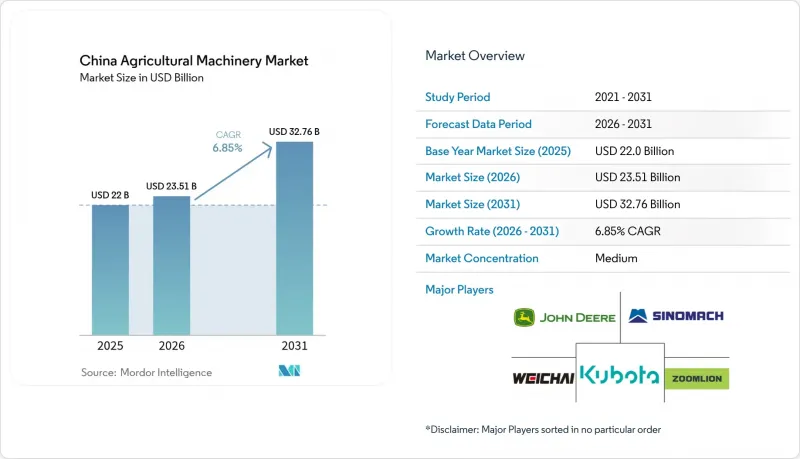
본 보고서는 기계 종류(트랙터, 농기구, 분무기, 수확기, 건초·사료용 기계, 기타 농업기계)별로 분류되어 있습니다. 시장 예측은 금액(달러) 기준으로 제시되어 있습니다.
중국 농업기계 시장의 동향 및 인사이트
농촌 지역 노동력 감소가 기계화를 가속화
중국의 농업 부문은 농촌에서 도시로의 인구 유출 및 농업 노동력 감소로 인해 기계화가 진행되고 있습니다. 중국의 도시화율은 2023년에 66.16%에 달하여 전년 대비 0.94% 상승했습니다. 이는 농촌 지역의 젊은 층 유출이 주요 요인입니다. 이러한 인구 동태의 변화로 인해 콤바인이나 정밀 파종기 등 자동화 기기에 대한 수요가 증가하고 있습니다. 정부가 지원하는 서비스 협동조합을 통해 소규모 농가도 공유 농기계를 이용할 수 있게 되었습니다. 이러한 기계화 추세는 도시화율이 높고 계절별 인건비도 비싼 연안 지역의 곡물 생산 지역에서 가장 두드러집니다.
고출력·스마트 트랙터에 대한 풍부한 보조금
정부의 프로그램에서는 기술 도입을 촉진하기 위해 고마력이며 정밀 농업에 대응할 수 있는 트랙터에 대해 알찬 보조금이 제공되고 있습니다. 이러한 노력은 농가들이 구식 저마력 기계를 최신 시스템으로 교체할 수 있도록 지원하는 것입니다. 트랙터 보상 판매 프로그램은 구매 비용을 절감해 주며, 특히 농업 외 고용이 활발한 지역에 혜택을 주고 있습니다. 이러한 정책 지원으로 인해 국내 제조업체의 시장 입지도 강화되고 있습니다.
높은 초기 비용과 불균등한 대출 접근성
첨단 농업기계의 비용은 소규모 농가에게 큰 과제가 되고 있습니다. 제한된 자금력과 농촌 지역의 불안정한 대출 접근성이 기계 구매를 방해하고 있습니다. 보험 제도를 통해 위험 평가는 개선되었으나, 농업 대출의 이용 가능성은 지역에 따라 다릅니다. 기계 아웃소싱 서비스는 대안 수단이 될 수 있지만, 오지나 산간 지역에서는 이용 범위가 제한적입니다. 종합적인 금융 솔루션의 부재가 여전히 경영의 현대화를 가로막고 있습니다.
부문 분석
2025년 중국 농업기계 시장에서 트랙터는 시장 점유율의 55.40%를 차지하고 있습니다. 농장 통합에 따라 대형 트랙터의 인기가 높아지고 있지만, 기존 차량군에서는 여전히 2륜 구동 모델이 주류를 이루고 있습니다. 정부의 인센티브에 힘입어 다기능 작업기에 대응하는 사륜구동 CVT 플랫폼으로의 전환이 촉진되고 있습니다. 트랙터 부문은 기술 통합을 통해 꾸준한 성장 가능성을 보이고 있지만, 소규모 제조업체들은 소프트웨어 요건을 충족하는 데 어려움을 겪고 있어 인수 대상이 될 가능성이 있습니다.
살포기는 환경 규제와 가변 살포 기술 도입을 배경으로 2031년까지 연평균 성장률(CAGR) 8.4%라는 가장 높은 매출 성장률을 보이고 있습니다. 국내 제조업체들은 화학 약품의 낭비를 최소화하기 위해 베이두(BeiDou) 내비게이션을 활용한 통합 제어 시스템과 지상 살포기를 결합하고 있습니다. 수확용 장비의 출하대수는 저마력 부문의 가격 압박에도 불구하고, 특히 밀 생산 지역에서 계속 증가하고 있습니다. 가이드 시스템, 텔레매틱스 및 예측 유지보수 기능은 모든 종류의 농업기계에 표준 사양으로 자리 잡고 있습니다.
기타 혜택:
- 엑셀 형식의 시장 예측(ME) 시트
- 3개월간의 애널리스트 지원
자주 묻는 질문
목차
제1장 소개
제2장 조사 방법
제3장 주요 요약
제4장 시장 구도
제5장 시장 규모와 성장 예측
제6장 경쟁 구도
제7장 시장 기회와 향후 전망
KSM 26.08.25According to Mordor Intelligence, the China agricultural machinery market size was valued at USD 22.0 billion in 2025 and estimated to grow from USD 23.51 billion in 2026 to reach USD 32.76 billion by 2031, at a CAGR of 6.85% during the forecast period (2026-2031).
This report is Segmented by Machinery Type (Tractors, Equipment, Sprayers, Harvesting Machinery, Haying and Forage Machinery, and Other Agricultural Machinery). The Market Forecasts are Provided in Terms of Value (USD).
China Agricultural Machinery Market Trends and Insights
Shrinking Rural Labor Pool Accelerating Mechanization
China's agricultural sector is undergoing mechanization due to rural-urban migration and a declining agricultural workforce. China's urbanization rate reached 66.16% in 2023, an increase of 0.94% from the previous year, driven by youth migration from rural areas. This demographic shift has increased demand for automated equipment, including combine harvesters and precision planters. Government-supported service cooperatives enable smallholder farmers to access shared machinery. The mechanization trend is most prominent in coastal grain-producing regions, which experience higher urbanization rates and seasonal labor costs.
Generous Subsidies for High-horsepower and Smart Tractors
Government programs offer enhanced subsidies for high-horsepower, precision-ready tractors to encourage technology adoption. These initiatives support farmers in upgrading from older, low-horsepower equipment to modern systems. Trade-in programs reduce purchase costs, particularly benefiting regions with significant off-farm employment. The policy support has also strengthened domestic manufacturers' market position.
High Upfront Cost and Uneven Credit Access
Advanced agricultural machinery costs present significant challenges for small-scale farmers. Limited financial resources and inconsistent rural credit access restrict equipment purchases. While insurance programs improve risk assessment, agricultural loan availability varies by region. Machinery outsourcing services provide an alternative but have limited reach in remote and mountainous areas. The lack of comprehensive financial solutions continues to impede operational upgrades.
Other drivers and restraints analyzed in the detailed report include:
- Rapid Technology Upgrades
- Food-security Push Raising Grain-output Targets
- Fragmented Farm Plots Lowering Operational Efficiency
For complete list of drivers and restraints, kindly check the Table Of Contents.
Segment Analysis
Tractors account for 55.40% of the China agricultural machinery market share in 2025. Large-frame units are increasing in popularity due to farm consolidation, while two-wheel-drive models remain predominant in existing fleets. Government incentives support the transition to four-wheel-drive CVT platforms that accommodate multi-function implements. The tractor segment shows steady growth potential through technology integration, though smaller manufacturers struggle to meet software requirements, making them potential acquisition targets.
Sprayers demonstrate the highest revenue growth at an 8.4% CAGR through 2031, driven by environmental regulations and variable-rate technology adoption. Domestic manufacturers are combining ground sprayers with unified control systems using BeiDou navigation to minimize chemical waste. Harvesting equipment volumes continue to increase, particularly in wheat-producing regions, despite pricing pressures in lower-horsepower segments. Guidance systems, telematics, and predictive maintenance capabilities are becoming standard features across machinery types.
Complete Report Scope:
- By Machinery Type
- Tractors
- 25-100 HP
- Above 100 HP
- Equipment
- Plows
- Harrows
- Rotovators and Cultivators
- Seed and Fertilizer Drills
- Fertilizer Spreaders
- Other Equipment
- Sprayers
- Field-crop Sprayers
- Orchard Sprayers
- Other Sprayers
- Harvesting Machinery
- Combine Harvesters
- Forage Harvesters
- Other Harvesting Machinery
- Haying and Forage Machinery
- Mowers and Conditioners
- Balers
- Other Haying and Forage Machinery
- Other Agricultural Machinery
- Tractors
List of Companies Covered in this Report:
- Sinomach-China National Machinery Industry Corporation (YTO Group Corporation)
- Zoomlion Heavy Industry Science and Technology Co., Ltd.
- Kubota Corporation
- Deere & Company
- Jiangsu Changfa Group
- Weichai Group (Shandong Heavy Industry Group Co., Ltd.)
- CNH Industrial N.V.
- AGCO Corporation
- CLAAS KGaA mbH
- Iseki & Co., Ltd.
- Jiangsu World Agriculture Machinery Co., Ltd (World Group)
- Taian Taishan Guotai Tractors Co., Ltd.
- LS Group
- Yanmar Holdings Co., Ltd.
- Hangzhou Donghua Chain Group Co., Ltd. (Changzhou Dongfeng Agricultural Machinery Group Co., Ltd.)
Additional Benefits:
- The market estimate (ME) sheet in Excel format
- 3 months of analyst support
TABLE OF CONTENTS
1 Introduction
- 1.1 Study Assumptions and Market Definition
- 1.2 Scope of the Study
2 Research Methodology
3 Executive Summary
4 Market Landscape
- 4.1 Market Overview
- 4.2 Market Drivers
- 4.2.1 Shrinking Rural Labor Pool Accelerating Mechanization
- 4.2.2 Generous Subsidies for High-horsepower and Smart Tractors
- 4.2.3 Rapid Technology Upgrades
- 4.2.4 Food-security Push Raising Grain-output Targets
- 4.2.5 AI-driven Predictive-maintenance Service Bundles
- 4.2.6 Adoption of Electric Power-trains
- 4.3 Market Restraints
- 4.3.1 High Upfront Cost and Uneven Credit Access
- 4.3.2 Fragmented Farm Plots Lowering Operational Efficiency
- 4.3.3 Volatile Raw-material and Battery Prices
- 4.3.4 Farmer Data-privacy and Cyber-security Concerns
- 4.4 Regulatory Landscape
- 4.5 Technological Outlook
- 4.6 Porter's Five Forces Analysis
- 4.6.1 Bargaining Power of Suppliers
- 4.6.2 Bargaining Power of Buyers
- 4.6.3 Threat of New Entrants
- 4.6.4 Threat of Substitute Products
- 4.6.5 Intensity of Competitive Rivalry
5 Market Size and Growth Forecasts (Value)
- 5.1 By Machinery Type
- 5.1.1 Tractors
- 5.1.1.1 25-100 HP
- 5.1.1.2 Above 100 HP
- 5.1.2 Equipment
- 5.1.2.1 Plows
- 5.1.2.2 Harrows
- 5.1.2.3 Rotovators and Cultivators
- 5.1.2.4 Seed and Fertilizer Drills
- 5.1.2.5 Fertilizer Spreaders
- 5.1.2.6 Other Equipment
- 5.1.3 Sprayers
- 5.1.3.1 Field-crop Sprayers
- 5.1.3.2 Orchard Sprayers
- 5.1.3.3 Other Sprayers
- 5.1.4 Harvesting Machinery
- 5.1.4.1 Combine Harvesters
- 5.1.4.2 Forage Harvesters
- 5.1.4.3 Other Harvesting Machinery
- 5.1.5 Haying and Forage Machinery
- 5.1.5.1 Mowers and Conditioners
- 5.1.5.2 Balers
- 5.1.5.3 Other Haying and Forage Machinery
- 5.1.6 Other Agricultural Machinery
- 5.1.1 Tractors
6 Competitive Landscape
- 6.1 Market Concentration
- 6.2 Strategic Moves
- 6.3 Market Share Analysis
- 6.4 Company Profiles (Includes Global-level Overview, Market-level Overview, Core Segments, Financials as Available, Strategic Information, Market Rank/Share, Products and Services, Recent Developments)
- 6.4.1 Sinomach-China National Machinery Industry Corporation (YTO Group Corporation)
- 6.4.2 Zoomlion Heavy Industry Science and Technology Co., Ltd.
- 6.4.3 Kubota Corporation
- 6.4.4 Deere & Company
- 6.4.5 Jiangsu Changfa Group
- 6.4.6 Weichai Group (Shandong Heavy Industry Group Co., Ltd.)
- 6.4.7 CNH Industrial N.V.
- 6.4.8 AGCO Corporation
- 6.4.9 CLAAS KGaA mbH
- 6.4.10 Iseki & Co., Ltd.
- 6.4.11 Jiangsu World Agriculture Machinery Co., Ltd (World Group)
- 6.4.12 Taian Taishan Guotai Tractors Co., Ltd.
- 6.4.13 LS Group
- 6.4.14 Yanmar Holdings Co., Ltd.
- 6.4.15 Hangzhou Donghua Chain Group Co., Ltd. (Changzhou Dongfeng Agricultural Machinery Group Co., Ltd.)