|
시장보고서
상품코드
2113550
아시아태평양의 농업기계 : 시장 점유율 분석, 업계 동향 및 통계, 성장 예측(2026-2031년)Asia-Pacific Agricultural Machinery - Market Share Analysis, Industry Trends & Statistics, Growth Forecasts (2026 - 2031) |
||||||
 Mordor Intelligence
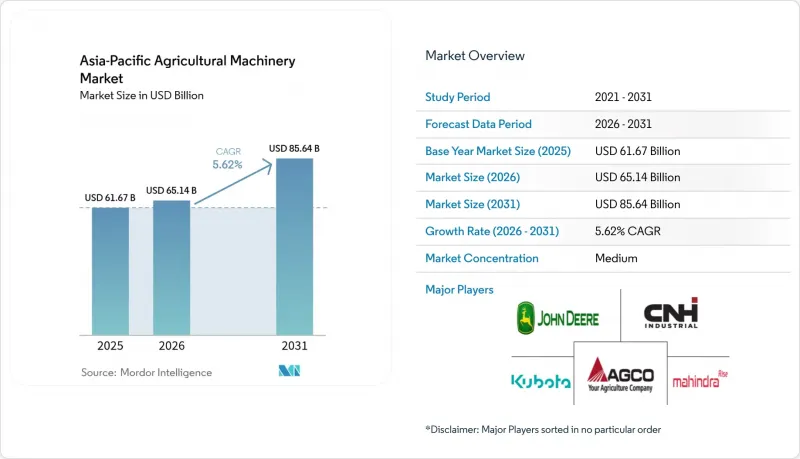
Mordor Intelligence에 의하면, 아시아태평양의 농업기계 시장 규모는 2025년 616억 7,000만 달러에서 2026년에는 651억 4,000만 달러에 이르고, 2026-2031년 CAGR 5.62%로 성장을 지속하여 2031년에는 856억 4,000만 달러에 달할 것으로 예측됩니다.
본 보고서는 제품 유형별(마력 및 유형별 트랙터, 경운·중경 기계, 파종 기계, 수확 기계, 건초·사료용 기계, 관개 기계, 기타) 및 지역별(중국, 인도, 일본, 호주, 기타 아시아태평양)로 분류되어 있습니다. 시장 예측은 금액(달러)으로 표시되어 있습니다.
아시아태평양 농업 기계 시장 동향 및 인사이트
농업 인력 부족이 기계화를 가속화
심각한 노동력 부족으로 인해 인력이 필요 없는 기계에 대한 수요가 증가하고 있습니다. 일본의 농림수산성은 자동화 보조금으로 10억 엔(750만 달러)을 편성했으며, 이에 따라 채소 생산자들은 노동 투입량을 50% 절감하는 자율형 수확기를 도입하고 있습니다. 말레이시아의 팜유 농장에서는 외국인 노동자 유입이 제한된 것을 보완하기 위해 자율주행 트럭과 드론 살포기가 도입되고 있습니다. 태국의 벼농가에서는 고속 모내기기가 도입되어 하루 모내기 능력이 5배로 향상되었습니다. 이러한 노력들이 맞물려 아시아태평양 농업 기계 시장 전체에서 장비 교체가 가속화되고 있습니다.
정밀 농업의 도입과 스마트 농기계
IoT 플랫폼, 가변 시비 컨트롤러, 그리고 UAV(무인 항공기)가 현장 작업에 점차 보급되고 있습니다. 쿠보타의 태국 농장 관리 용도는 100곳의 시험 포장에 도입되어, 토양 검사 결과와 시비 지도를 대조함으로써 수확량을 최대 30% 향상시켰습니다. 대만의 25년에 걸친 정밀 농업 프로그램에서는 현재 GIS, 멀티스펙트럼 드론, 클라우드 분석을 통합하여 관개 일정을 최적화하고 있습니다. 베이징 정부의 1조 4,000억 달러 규모의 디지털 인프라 투자 계획에 더해, 기후 변화 대응형 농업 실천을 위한 세계은행의 3억 2,000만 달러 대출이 향후 스마트 농기계의 보급을 뒷받침하고 있습니다. 이러한 노력 덕분에 아시아태평양의 농업 기계 시장에서 데이터 기반 장비의 잠재적 고객 기반이 확대되고 있습니다.
농가의 낮은 디지털 문해력
스마트폰 보급률과 통신 환경이 여전히 불안정한 지역에서는 데이터가 풍부한 플랫폼의 도입이 더딘 실정입니다. 태국의 ‘4.0 이니셔티브’에 포함된 교육 프로그램이나 중국의 농촌 지역 광대역망 확충을 통해 그 격차는 점차 줄어들고 있지만, 정밀 농업 기기의 가치를 극대화하기 위해서는 지속적인 사용자 역량 향상이 여전히 요구되고 있습니다. 정밀 농업 기술과 지속 가능한 농업 기법의 통합으로 시장은 상당한 성장이 예상되지만, 광범위한 보급을 실현하기 위해서는 인프라 및 교육과 관련된 과제를 해결해야 합니다.
부문 분석
2025년, 아시아태평양 농업 기계 시장 점유율의 57.15%를 트랙터가 차지했습니다. 이는 농가들이 토지 개간, 운반, 동력 인출(PTO) 작업에 트랙터를 의존하고 있기 때문입니다. 인도에서는 40 HP 미만의 모델이 판매를 주도하고 있으며, 호주의 대규모 농장에서는 50 HP 이상의 기종이 보급되고 있어 트랙터 시장은 2031년까지 꾸준히 확대될 것으로 예측됩니다. 다목적 트랙터는 그 범용성으로 두각을 나타내는 반면, 줄 심기용 트랙터는 정밀 농업을 위한 GPS 조향 및 가변 파종량 기능을 지원합니다. 대동(Daedong)사가 2025년 말까지 한국 최초의 레벨 4 자율 주행 트랙터를 도입할 계획은 경쟁의 도약을 보여주며, 구매자의 기대를 재정의할 가능성이 있습니다. 벼 재배 시스템에서는 효율적인 진흙 교반과 모상 준비가 요구되므로, 이에 대응하는 경운·중경용 작업기가 2위 카테고리를 형성하고 있습니다.
수확 기계에 대한 수요는 인건비 급등에 발맞추어 증가하고 있습니다. 콤바인은 벼 수확 기간을 7일에서 2일로 단축시켜 주는데, 이러한 장점은 2024년에 일급이 15%나 급등한 태국에서 특히 높이 평가되고 있습니다. 점적 관개 설비는 현재 매출 규모는 작지만 연평균 성장률(CAGR) 13.02%로 가장 빠르게 성장하고 있는 하위 부문이며, 이는 물 관리에 관한 규제 및 인센티브 제도의 강화를 반영하고 있습니다. 가뭄 발생으로 인해 중국 북부 평야와 인도 데칸 고원 전역에서 도입이 촉진됨에 따라, 미량 관개 관련 수요는 3배로 증가할 가능성이 있습니다. 펌프, 비료 관개 컨트롤러, 클라우드 분석을 세트로 제공하는 OEM 기업들은 새로운 교차 판매 기회를 포착할 수 있을 것입니다.
기타 혜택:
- 엑셀 형식 시장 예측(ME) 시트
- 3개월간의 애널리스트 지원
자주 묻는 질문
목차
제1장 서론
제2장 조사 방법
제3장 주요 요약
제4장 시장 구도
제5장 시장 규모와 성장 예측
제6장 경쟁 구도
제7장 시장 기회와 향후 전망
LSH 26.08.25According to Mordor Intelligence, the Asia-Pacific agricultural machinery market size is expected to grow from USD 61.67 billion in 2025 to USD 65.14 billion in 2026 and is forecast to reach USD 85.64 billion by 2031 at 5.62% CAGR over 2026-2031.
This report is Segmented by Product Type (Tractors by Horsepower and Type, Plowing and Cultivating Machinery, Planting Machinery, Harvesting Machinery, Haying and Forage Machinery, Irrigation Machinery, and Other Types) and Geography (China, India, Japan, Australia, and Rest of Asia-Pacific). The Market Forecasts are Provided in Terms of Value (USD).
Asia-Pacific Agricultural Machinery Market Trends and Insights
Farm-labor scarcity accelerating mechanization
Severe worker shortages lift demand for hands-free machinery. Japan's agriculture ministry earmarked JPY 1 billion (USD 7.5 million) for automation grants, leading vegetable growers to deploy autonomous harvesters that slash labor inputs by 50%. Malaysian palm estates now rely on self-driving trucks and drone sprayers to offset curtailed migrant inflows. Thai rice operations adopt high-speed transplanters, lifting daily planting capacity fivefold. Together, these responses accelerate equipment turnover across the Asia-Pacific agricultural machinery market.
Precision-farming adoption and smart implements
IoT platforms, variable-rate controllers, and UAVs are penetrating field operations. Kubota's Thai farm-management application logged 100 pilot plots, boosting yields up to 30% by matching soil tests to fertilizer maps. Taiwan's 25-year precision-agriculture program now integrates GIS, multispectral drones, and cloud analytics to refine irrigation scheduling. Beijing's USD 1.4 trillion digital-infrastructure pledge, alongside a USD 320 million World Bank loan for climate-smart practices, underwrites future smart-implement uptake. These initiatives widen the addressable base for data-driven devices within the Asia-Pacific agricultural machinery market.
Low digital literacy among farmers
Adoption of data-rich platforms lags where smartphone penetration and connectivity remain spotty. Training programs embedded in Thailand's 4.0 initiative and China's rural broadband rollout are narrowing the gap, yet consistent user-skill building is still required to unlock full value from precision equipment. The integration of precision farming technologies and sustainable practices positions the market for substantial growth, though infrastructure and training challenges need to be addressed for widespread adoption.
Other drivers and restraints analyzed in the detailed report include:
- Climate-linked yield-assurance incentives
- Ag-carbon credit monetization potential
- Fragmented land holdings limiting ROI
For complete list of drivers and restraints, kindly check the Table Of Contents.
Segment Analysis
Tractors represented 57.15% of the Asia-Pacific agricultural machinery market share in 2025 as growers rely on them for land preparation, transport, and power take-off tasks. The tractor market is projected to widen steadily through 2031 as below-40 HP models dominate Indian sales and above-50 HP units gain traction in Australian broad-acre farms. Utility tractors stand out for versatility, whereas row-crop variants support GPS steering and variable-rate seeding for precision agriculture. Daedong's plan to introduce Korea's first level-4 autonomous tractor by end-2025 signals a competitive leap that could reshape buyer expectations. Complementary plowing and cultivating implements form the second-largest category, as rice systems demand efficient puddling and seedbed preparation.
Demand for harvesting machinery follows labor-cost escalation. Combine harvesters cut rice reaping time from seven to two days, a gain valued in Thailand, where daily wages jumped 15% in 2024. Drip irrigation equipment, while currently smaller in revenue, is the fastest-growing sub-segment at 13.02% CAGR, reflecting intensified water-management mandates and incentive schemes. The attached to micro-irrigation could triple as drought episodes spur adoption across China's northern plains and India's Deccan plateau. OEMs offering bundled pumps, fertigation controllers, and cloud analytics stand to capture emerging cross-sell opportunities.
Complete Report Scope:
- By Product Type
- Tractors
- Horsepower
- Below 20 HP
- 21 - 30 HP
- 31 - 50 HP
- Above 50 HP
- Type
- Utility Tractor
- Row-Crop Tractor
- Compact Utility Tractor
- Other Types
- Horsepower
- Plowing and Cultivating Machinery
- Ploughs
- Harrows
- Cultivators and Tillers
- Other Ploughing and Cultivating Machinery
- Planting Machinery
- Seed Drills
- Planters
- Spreaders
- Other Planting Machinery
- Harvesting Machinery
- Combine Harvesters
- Forage Harvetsers
- Other Harvesting Machinery
- Haying and Forage Machinery
- Mowers
- Balers
- Other Haying and Forage Machinery
- Irrigation Machinery
- Sprinkler Irrigation
- Drip Irrigation
- Other Irrigation Machinery
- Other Types
- Tractors
- By Geography
- China
- India
- Japan
- Australia
- Rest of Asia-Pacific
List of Companies Covered in this Report:
- Deere & Company
- CLAAS KGaA mbH
- AGCO Corporation
- Kubota Corporation
- CNH Industrial N.V.
- Yanmar Co. Ltd.
- Same Deutz-Fahr (SDF Group)
- Lovol Heavy Industry (Weichai Group)
- Mahindra and Mahindra Ltd.
- Iseki & Co., Ltd.
- International Tractors Ltd. (Sonalika Group)
- Daedong Corporation
- Zoomlion Heavy Industry Science & Technology Co., Ltd.
Additional Benefits:
- The market estimate (ME) sheet in Excel format
- 3 months of analyst support
TABLE OF CONTENTS
1 Introduction
- 1.1 Study Assumptions and Market Definition
- 1.2 Scope of the Study
2 Research Methodology
3 Executive Summary
4 Market Landscape
- 4.1 Market Overview
- 4.2 Market Drivers
- 4.2.1 Farm-Labor Scarcity Accelerating Mechanization
- 4.2.2 Precision-Farming Adoption and Smart Implements
- 4.2.3 Climate-Linked Yield-Assurance Incentives
- 4.2.4 Government Credit Lines Targeting Smallholders
- 4.2.5 OEM "Power-as-a-Service" Subscription Models
- 4.2.6 Ag-Carbon Credit Monetization Potential
- 4.3 Market Restraints
- 4.3.1 High Up-Front Capital Costs
- 4.3.2 Fragmented Land Holdings Limiting ROI
- 4.3.3 Poor After-Sales Service Networks
- 4.3.4 Low Digital Literacy Among Farmers
- 4.4 Regulatory Landscape
- 4.5 Technological Outlook
- 4.6 Porter's Five Forces
- 4.6.1 Threat of New Entrants
- 4.6.2 Bargaining Power of Buyers
- 4.6.3 Bargaining Power of Suppliers
- 4.6.4 Threat of Substitutes
- 4.6.5 Intensity of Competitive Rivalry
5 Market Size and Growth Forecasts (Value)
- 5.1 By Product Type
- 5.1.1 Tractors
- 5.1.1.1 Horsepower
- 5.1.1.1.1 Below 20 HP
- 5.1.1.1.2 21 - 30 HP
- 5.1.1.1.3 31 - 50 HP
- 5.1.1.1.4 Above 50 HP
- 5.1.1.2 Type
- 5.1.1.2.1 Utility Tractor
- 5.1.1.2.2 Row-Crop Tractor
- 5.1.1.2.3 Compact Utility Tractor
- 5.1.1.2.4 Other Types
- 5.1.1.1 Horsepower
- 5.1.2 Plowing and Cultivating Machinery
- 5.1.2.1 Ploughs
- 5.1.2.2 Harrows
- 5.1.2.3 Cultivators and Tillers
- 5.1.2.4 Other Ploughing and Cultivating Machinery
- 5.1.3 Planting Machinery
- 5.1.3.1 Seed Drills
- 5.1.3.2 Planters
- 5.1.3.3 Spreaders
- 5.1.3.4 Other Planting Machinery
- 5.1.4 Harvesting Machinery
- 5.1.4.1 Combine Harvesters
- 5.1.4.2 Forage Harvetsers
- 5.1.4.3 Other Harvesting Machinery
- 5.1.5 Haying and Forage Machinery
- 5.1.5.1 Mowers
- 5.1.5.2 Balers
- 5.1.5.3 Other Haying and Forage Machinery
- 5.1.6 Irrigation Machinery
- 5.1.6.1 Sprinkler Irrigation
- 5.1.6.2 Drip Irrigation
- 5.1.6.3 Other Irrigation Machinery
- 5.1.7 Other Types
- 5.1.1 Tractors
- 5.2 By Geography
- 5.2.1 China
- 5.2.2 India
- 5.2.3 Japan
- 5.2.4 Australia
- 5.2.5 Rest of Asia-Pacific
6 Competitive Landscape
- 6.1 Market Concentration
- 6.2 Strategic Moves
- 6.3 Market Share Analysis
- 6.4 Company Profiles (Includes Global Level Overview, Market Level Overview, Core Segments, Financials As Available, Strategic Information, Market Rank/Share For Key Companies, Products And Services, And Recent Developments)
- 6.4.1 Deere & Company
- 6.4.2 CLAAS KGaA mbH
- 6.4.3 AGCO Corporation
- 6.4.4 Kubota Corporation
- 6.4.5 CNH Industrial N.V.
- 6.4.6 Yanmar Co. Ltd.
- 6.4.7 Same Deutz-Fahr (SDF Group)
- 6.4.8 Lovol Heavy Industry (Weichai Group)
- 6.4.9 Mahindra and Mahindra Ltd.
- 6.4.10 Iseki & Co., Ltd.
- 6.4.11 International Tractors Ltd. (Sonalika Group)
- 6.4.12 Daedong Corporation
- 6.4.13 Zoomlion Heavy Industry Science & Technology Co., Ltd.