

|
시장보고서
상품코드
2113379
말레이시아의 섬유 제조업 : 시장 점유율 분석, 업계 동향과 통계, 성장 예측(2026-2031년)Malaysia Textile Manufacturing - Market Share Analysis, Industry Trends & Statistics, Growth Forecasts (2026 - 2031) |
||||||
 Mordor Intelligence
Mordor Intelligence에 따르면 말레이시아의 섬유 제조업 시장 규모는 2025년에 35억 달러, 2026년에 36억 7,000만 달러에 달하고, 2031년까지 47억 1,000만 달러에 달할 것으로 예측되며, 2026년부터 2031년까지 CAGR 5.12%로 성장할 것으로 전망됩니다.
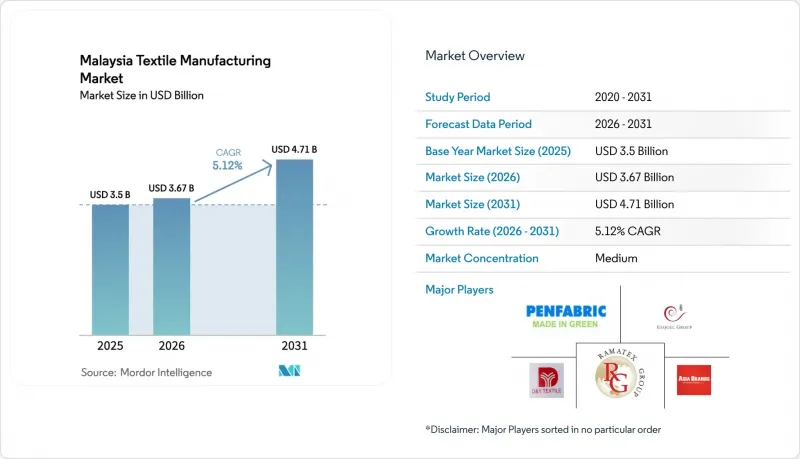
본 보고서는 용도별(패션·의류, 산업용·기술용, 기타), 원재료별(천연섬유, 합성섬유, 기타), 공정/기술별(직물, 니트,부직포, 3D 직물 및 스페이서 패브릭), 지역별(북부, 중부, 남부, 동부 해안, 동말레이시아)로 분류되어 있습니다. 시장 예측치는 금액(달러)으로 표시되어 있습니다.
말레이시아 섬유 제조업 시장의 동향 및 인사이트
RCEP에 따른 관세 철폐로 원사 수출 가속화
RCEP에 따른 특혜 접근으로 인해 중국, 일본, 한국, 호주에서 말레이시아산 원사의 관세가 인하되었으며, 요건을 충족하는 공급업체의 이익률은 5-8퍼센트 포인트 상승했습니다. 생산자는 원산지 자격을 상실하지 않고 호주산 울이나 중국산 폴리에스터 칩을 혼합할 수 있으며, 이러한 이점은 이미 페낭주와 케다주의 중규모 방적 업체들에 의해 활용되고 있습니다. 섬유 프로젝트에 대한 외국인 직접 투자 승인 건수는 2024년 말레이시아 제조업 총 승인 건수의 8%를 차지하며, 원사 수출 허브에 대한 신뢰가 높아지고 있음을 보여줍니다. 생산능력 확대에 따른 혜택은 자체적으로 방적을 수행하는 통합형 방적 공장에 특히 크게 미치고 있지만, 재단·봉제·마감 도급업체는 계약을 통해 가격 전가가 허용되는 경우에만 그 혜택을 누릴 수 있습니다. 2026년까지 관세 단계적 철폐가 지속됨에 따라 이러한 호재는 유지될 전망입니다.
E-Commerce에 힘입은 아세안(ASEAN) 지역의 패스트 패션 수요 회복
2024년, 아세안 지역의 온라인 마켓플레이스 총 상품 가치는 1,390억 달러에 달했으며, 의류는 2위 카테고리가 되었습니다. ‘Shopee’나 ‘Lazada’와 같은 플랫폼은 현재 말레이시아의 허브에서 소량 주문을 통합하고 있으며, 납기일을 21일로 단축함으로써 자동 재단 및 디지털 패턴 제작에 투자한 기동력 있는 니트 제조업체에 혜택을 주고 있습니다. ZALORA에서 ‘모데스트웨어’ 매출이 33% 급증한 것은 문화적 디자인 강점을 지닌 현지 바틱 및 저지 제조업체들에게 호재가 되고 있습니다. 그러나 베트남과 캄보디아의 조달 네트워크가 확대되고 있으므로, 말레이시아 기업들은 2027년까지 다년간의 플랫폼 계약을 확실히 체결해야 합니다.
2025년 외국인 근로자 할당량 규제가 강화되면서 숙련된 노동력 부족을 초래할 전망
2026년까지 외국인 노동자 할당 비율을 15%에서 10%로 단계적으로 낮추는 조치는 외국인 노동자 의존도가 40%를 넘는 공장에 위협이 되고 있습니다. 이미 35%의 섬유 공장에서 인력 부족이 발생하고 있으며, 2025년에는 작업자의 임금이 26.7% 상승해월 475달러에 달할 전망입니다. 대기업들은 자동화를 가속화하고 있습니다(라마텍스사는 이미 프로그래밍 가능한 봉제 모듈을 도입했으나), 중소기업들은 ITA(산업진흥법)의 지원 제도가 있음에도 불구하고 자금 조달에 어려움을 겪고 있습니다. 기술 연수 확대가 가속화되지 않는다면, 수주가 회복되더라도 노동력 부족이 생산량 증가를 억제하게 될 것입니다.
부문별 분석
2025년 매출액 중 패션·의류 용도가 54.1%를 차지하고 있어, 말레이시아 섬유 제조업 시장의 역사적인 핵심 분야임을 뒷받침하고 있습니다. 한편, 산업용·기술용 섬유는 PPE(개인보호구) 재고 보충과 프로톤 및 페로두아 차종용 자동차 내장재의 현지 생산화에 힘입어, 용도별 가장 높은 연평균 성장률(CAGR) 6.54%로 성장할 전망입니다. 이 부문의 견조한 성장세에 힘입어 2031년까지 의류 부문과의 시장 점유율 격차가 좁혀질 것으로 예상됩니다.
오션캐시 퍼시픽(Ocean Cash Pacific)사가 부직포 생산량을 두 배로 늘려 연간 1만 6,000톤으로 만들겠다는 계획은, 수술용 마스크 및 가운용 스펀본드 및 멜트블로운 원단으로의 생산능력 전환을 상징합니다. 자동차 내장 부품 공급업체인 초리 트레이딩 말레이시아는 난연성이면서 경량 소재가 필요한 전기자동차 프로그램에 대응하기 위해 셀랑고르주의 직물 생산 라인을 확장하고 있습니다. 가정용 섬유 제품은 말레이시아의 주택 착공 건수를 뒷받침으로 4.8%의 성장률을 보이고 있으나, 가격에 민감한 소비자들로 인해 중국 및 인도산 수입품이 여전히 경쟁력을 유지하고 있습니다.
기타 혜택:
- 엑셀 형식의 시장 예측(ME) 시트
- 3개월간의 애널리스트 지원
자주 묻는 질문
목차
제1장 소개
제2장 조사 방법
제3장 주요 요약
제4장 시장 구도
제5장 시장 규모와 성장 예측
제6장 경쟁 구도
제7장 시장 기회와 향후 전망
KSM 26.08.25According to Mordor Intelligence, the Malaysia textile manufacturing market size is projected to be USD 3.5 billion in 2025, USD 3.67 billion in 2026, and reach USD 4.71 billion by 2031, growing at a CAGR of 5.12% from 2026 to 2031.
This report is Segmented by Application (Fashion & Apparel, Industrial/Technical, Hand More), by Raw Material (Natural Fibers, Synthetic Fibers, and More), by Process (Woven, Knitted, Non-Woven, 3D Weaving & Spacer Fabrics), and by Geography (Northern, Central, Southern, East Coast, East Malaysia). Market Forecasts are Provided in Value (USD).
Malaysia Textile Manufacturing Market Trends and Insights
RCEP Tariff Eliminations Accelerating Yarn Exports
Preferential access under RCEP has lowered Malaysian yarn duties in China, Japan, South Korea, and Australia, lifting margins by 5-8 percentage points for compliant suppliers. Producers may combine Australian wool or Chinese polyester chips without losing origin status, a benefit already exploited by mid-scale spinners in Penang and Kedah. Foreign direct investment approvals for textile projects jumped 8% of Malaysia's 2024 manufacturing total, signaling confidence in a yarn-export hub. Capacity gains disproportionately reward integrated mills that spin in-house, though cut-make-trim contractors capture upside only if contracts allow pass-through pricing. Continued tariff phase-outs to 2026 keep this tailwind intact.
E-commerce-Driven Resurgence in ASEAN Fast-Fashion Demand
Regional gross merchandise value for online marketplaces touched USD 139 billion in 2024, with apparel as the second-largest category. Platforms such as Shopee and Lazada now aggregate small-lot orders in Malaysian hubs, cutting turnaround times to 21 days and rewarding agile knitters who invested in automated cutting and digital patterning. ZALORA's 33% jump in modest-wear sales benefits local batik and jersey makers that offer cultural design advantages. However, Vietnamese and Cambodian sourcing networks are expanding, so Malaysian firms must lock multi-year platform agreements before 2027.
Stricter 2025 Migrant-Worker Quota Causing Skilled-Labor Gaps
A phased cut from 15% to 10% foreign-labor allocation by 2026 threatens mills where migrant dependence exceeds 40%. Unfilled vacancies already affect 35% of textile plants, pushing operator wages up 26.7% to USD 475/month in 2025. Larger players accelerate automation - Ramatex has deployed programmable sewing modules - yet SMEs struggle with financing despite the ITA window. Without faster technical-training rollouts, labor scarcity will cap output growth even as orders rebound.
Other drivers and restraints analyzed in the detailed report include:
- Reinstated Textile Investment Tax Allowance (ITA) 2025
- PPE Stockpile Renewal Boosting Healthcare Textile Orders
- Escalating Natural-Gas Tariffs Under ICPT 2025 Review
For complete list of drivers and restraints, kindly check the Table Of Contents.
Segment Analysis
Fashion and apparel applications commanded 54.1% of 2025 revenue, underscoring the historical backbone of the Malaysia textile manufacturing market. Industrial and technical textiles, however, are set to grow at a 6.54% CAGR, the highest among applications, propelled by PPE restocking and automotive interior fabric localization for Proton and Perodua lines. The segment's robust trajectory positions it to narrow the share gap with apparel by 2031.
Oceancash Pacific's plan to double non-woven output to 16,000 tpa exemplifies capacity shifts toward spunbond and meltblown fabrics for surgical masks and gowns. Automotive interior supplier Chori Trading Malaysia is expanding its Selangor weaving lines to support electric-vehicle programs requiring flame-retardant, lightweight materials. Household textiles follow at a 4.8% pace, anchored by Malaysia's housing starts, yet price-sensitive consumers keep Chinese and Indian imports competitive.
Complete Report Scope:
- By Application
- Fashion & Apparel
- Industrial/Technical Textiles
- Household & Home Textiles
- Medical & Healthcare Textiles
- Automotive & Transport Textiles
- Others (Protective, Sports Textiles, etc.)
- By Raw Material
- Natural Fibers
- Cotton
- Wool
- Silk
- Synthetic Fibers
- Polyester
- Nylon
- Rayon / Viscose
- Acrylic
- Polypropylene
- Recycled Fibers
- Others (Speciality High-Performance Fibers (Aramid, Carbon, UHMWPE))
- Natural Fibers
- By Process / Technology
- Woven
- Knitted
- Non-woven
- Spunlaid (Spunbond / Melt-blown)
- Dry-laid Hydro-entangled
- Wet-Laid
- Needle-punched
- 3-D Weaving & Spacer Fabrics
- By Geography
- Northern (Penang, Kedah, Perlis, and Perak)
- Central (Selangor, Kuala Lumpur, Negeri Sembilan, and Putrajaya)
- Southern (Johor, Melaka)
- East Coast (Kelantan, Terengganu, Pahang, and Labuan)
- East Malaysia (Sabah, Sarawak)
List of Companies Covered in this Report:
- Ramatex Textiles Industrial Sdn Bhd
- Penfabric Sdn Berhad
- D&Y Textile (Malaysia) Sdn Bhd
- Esquel Malaysia Sdn Berhad
- Asia Brands Berhad
- Kamunting Spinning Industries Sdn Bhd
- KIB Textiles Bhd
- Vicmark Fashion Sdn Bhd
- San Miguel Yamamura Woven Products Sdn Bhd
- Manwira Manufacturing Sdn Bhd
- Kima Sdn Bhd
- Oceanic Fabric Mill Sdn Bhd
- Maxim Textile Technology Sdn Bhd
- Hytex Integrated Bhd
- Padini Holdings Berhad
- Furniweb Holdings Ltd
- Batek Malaysia Berhad
- Usha Yarns (Malaysia)
- Titan Petrochemicals (M) Sdn Bhd
- Skreen Fabric (M) Sdn Bhd
- Choon Giap Knitting Ind. Sdn Bhd
Additional Benefits:
- The market estimate (ME) sheet in Excel format
- 3 months of analyst support
TABLE OF CONTENTS
1 Introduction
- 1.1 Study Assumptions & Market Definition
- 1.2 Scope of the Study
2 Research Methodology
3 Executive Summary
4 Market Landscape
- 4.1 Market Overview
- 4.2 Market Drivers
- 4.2.1 RCEP tariff eliminations accelerating yarn exports
- 4.2.2 E-commerce-driven resurgence in ASEAN fast-fashion demand
- 4.2.3 Reinstated textile Investment Tax Allowance (ITA) 2025
- 4.2.4 PPE stockpile renewal boosting healthcare textile orders
- 4.2.5 Penang Circularity Industrial Park supplying recycled fibers
- 4.2.6 Early blockchain traceability adoption for EU Digital Product Passport
- 4.3 Market Restraints
- 4.3.1 Escalating natural-gas tariffs under ICPT 2025 review
- 4.3.2 Stricter 2025 migrant-worker quota causing skilled-labour gaps
- 4.3.3 Ringgit volatility raising imported fiber & dye costs
- 4.3.4 Logistics bottlenecks from delayed Johor Port textile upgrades
- 4.4 Value / Supply-Chain Analysis
- 4.5 Regulatory Landscape
- 4.6 Technological Outlook
- 4.7 Industry Attractiveness - Porter's Five Forces
- 4.7.1 Threat of New Entrants
- 4.7.2 Bargaining Power of Buyers
- 4.7.3 Bargaining Power of Suppliers
- 4.7.4 Threat of Substitutes
- 4.7.5 Intensity of Competitive Rivalry
5 Market Size & Growth Forecasts(Values, In USD Billion)
- 5.1 By Application
- 5.1.1 Fashion & Apparel
- 5.1.2 Industrial/Technical Textiles
- 5.1.3 Household & Home Textiles
- 5.1.4 Medical & Healthcare Textiles
- 5.1.5 Automotive & Transport Textiles
- 5.1.6 Others (Protective, Sports Textiles, etc.)
- 5.2 By Raw Material
- 5.2.1 Natural Fibers
- 5.2.1.1 Cotton
- 5.2.1.2 Wool
- 5.2.1.3 Silk
- 5.2.2 Synthetic Fibers
- 5.2.2.1 Polyester
- 5.2.2.2 Nylon
- 5.2.2.3 Rayon / Viscose
- 5.2.2.4 Acrylic
- 5.2.2.5 Polypropylene
- 5.2.3 Recycled Fibers
- 5.2.4 Others (Speciality High-Performance Fibers (Aramid, Carbon, UHMWPE))
- 5.2.1 Natural Fibers
- 5.3 By Process / Technology
- 5.3.1 Woven
- 5.3.2 Knitted
- 5.3.3 Non-woven
- 5.3.3.1 Spunlaid (Spunbond / Melt-blown)
- 5.3.3.2 Dry-laid Hydro-entangled
- 5.3.3.3 Wet-Laid
- 5.3.3.4 Needle-punched
- 5.3.4 3-D Weaving & Spacer Fabrics
- 5.4 By Geography
- 5.4.1 Northern (Penang, Kedah, Perlis, and Perak)
- 5.4.2 Central (Selangor, Kuala Lumpur, Negeri Sembilan, and Putrajaya)
- 5.4.3 Southern (Johor, Melaka)
- 5.4.4 East Coast (Kelantan, Terengganu, Pahang, and Labuan)
- 5.4.5 East Malaysia (Sabah, Sarawak)
6 Competitive Landscape
- 6.1 Market Concentration
- 6.2 Strategic Moves
- 6.3 Market Share Analysis
- 6.4 Company Profiles (includes Global level Overview, Market level overview, Core Segments, Financials as available, Strategic Information, Products & Services, Recent Developments)
- 6.4.1 Ramatex Textiles Industrial Sdn Bhd
- 6.4.2 Penfabric Sdn Berhad
- 6.4.3 D&Y Textile (Malaysia) Sdn Bhd
- 6.4.4 Esquel Malaysia Sdn Berhad
- 6.4.5 Asia Brands Berhad
- 6.4.6 Kamunting Spinning Industries Sdn Bhd
- 6.4.7 KIB Textiles Bhd
- 6.4.8 Vicmark Fashion Sdn Bhd
- 6.4.9 San Miguel Yamamura Woven Products Sdn Bhd
- 6.4.10 Manwira Manufacturing Sdn Bhd
- 6.4.11 Kima Sdn Bhd
- 6.4.12 Oceanic Fabric Mill Sdn Bhd
- 6.4.13 Maxim Textile Technology Sdn Bhd
- 6.4.14 Hytex Integrated Bhd
- 6.4.15 Padini Holdings Berhad
- 6.4.16 Furniweb Holdings Ltd
- 6.4.17 Batek Malaysia Berhad
- 6.4.18 Usha Yarns (Malaysia)
- 6.4.19 Titan Petrochemicals (M) Sdn Bhd
- 6.4.20 Skreen Fabric (M) Sdn Bhd
- 6.4.21 Choon Giap Knitting Ind. Sdn Bhd
7 Market Opportunities & Future Outlook
- 7.1 White-space & Unmet-need Assessment


