

|
시장보고서
상품코드
2113462
이탈리아의 섬유 제조업 : 시장 점유율 분석, 업계 동향과 통계, 성장 예측(2026-2031년)Italy Textile Manufacturing - Market Share Analysis, Industry Trends & Statistics, Growth Forecasts (2026 - 2031) |
||||||
 Mordor Intelligence
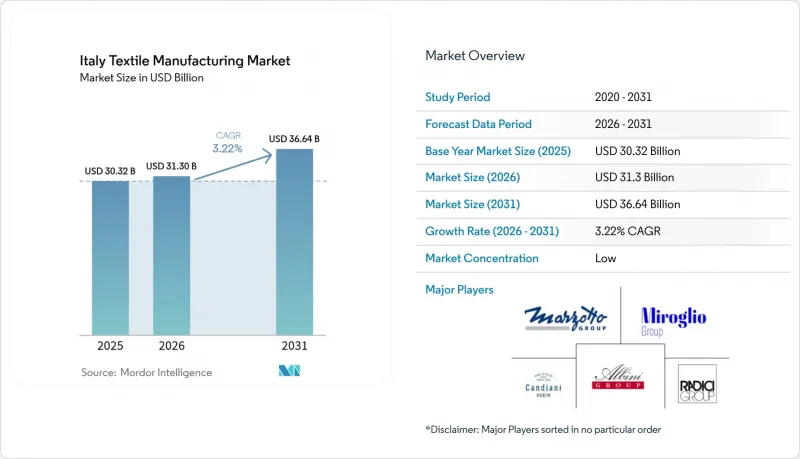
Mordor Intelligence에 따르면 이탈리아의 섬유 제조업 시장 규모는 2025년에 303억 2,000만 달러로 평가되며, 2026년 313억 달러에서 2031년까지 366억 4,000만 달러에 달할 것으로 예측되며, 예측 기간(2026-2031년) 동안 CAGR은 3.22%가 될 전망입니다.
본 보고서는 용도별(패션·의류, 산업용·기술용 섬유 등), 원료별(천연섬유, 합성섬유, 재생 섬유 등), 제조 공정·기술별(직물, 편물, 부직포 등), 및 지역별(북서부, 북동부,중부, 남부·섬 지역)별로 분류되어 있습니다. 시장 예측은 금액(달러) 기준으로 제시되어 있습니다.
이탈리아 섬유 제조업 시장의 동향 및 인사이트
산업용·기능성 섬유의 생산능력 급속한 확대
테크니컬 텍스타일은 이미 국내 생산량의 22%를 차지하며, 매출액은 40억 달러를 넘어 이탈리아는 세계 4위를 기록하고 있습니다. 분쟁으로 인한 수요 증가가 군용 및 응급 서비스용 출하를 끌어올리고 있어, 방호용 원단의 수출은 세계 시장 점유율의 6.5%를 차지하고 있습니다. M&A를 통해 성장이 가속화되고 있습니다. 콰드리비오(Quadrivio)사의 ‘인더스트리 4.0 펀드’는 폴리프로필렌 스펀본드 전문 기업인 소프트 N.W.사를 인수했습니다. 이 회사는 3,600만 달러의 매출을 올리고 있으며, 그 중 90%를 독일 및 중동유럽 국가로 수출하고 있습니다. 자동차 OEM 각사는 ‘MY-FI Horizon’ 프로그램 하에서 대시보드 및 시트백용 균사체 복합재의 시범 도입을 추진하고 있으며, 한편 여과재는 EU의 실내 공기질 지침을 준수하고 있습니다. ISO 14001 인증이 더 이상 필수 조건이 된 가운데, 이탈리아의 가공업체들은 단가보다 규정 준수 및 성능이 더 중요시되는 장기 계약을 확보함으로써, 저임금 경쟁사들에 대한 우위를 더욱 확대하고 있습니다.
고급 울·실크 원단의 수출 주도 회복
정장 시장의 선택적 회복에 힘입어 비에라의 울 방적 공장과 코모의 실크 가공업체들의 수주가 회복세를 보이고 있습니다. 레다(Reda)사는 경기 둔함에도 불구하고 2024년에 8,300만 달러의 매출을 기록했으며, 2025년 초 청구서를 통해 재고 최적화가 진행됨에 따라 북미의 수요가 더욱 안정화된 것으로 보입니다. 매출액 3억 9,800만 달러를 기록한 마르조트 그룹은 유럽 및 북아프리카 전역에 걸쳐 정련부터 마감까지를 아우르는 완전 통합형 공급망을 활용하여 품질과 납기를 확보하고 있습니다. 유서 깊은 브랜드들은 섬유의 원산지, 가공용 화학제품, 탄소발자국을 기록하는 블록체인 지원 QR 태그를 장인의 전문 기술과 결합함으로써 ‘디지털 제품 여권(Digital Product Passport)’ 요건을 충족하고 있습니다. 스파이버(Spiber)사와 공동 개발한 ‘Brewed Protein(TM)’ 블렌드는 드레이프성을 해치지 않으면서 바이오테크놀러지 섬유를 빗질 공정 라인에 통합하는 방법을 제시함으로써, 아시아 방적 공장들이 재현에 어려움을 겪고 있는 프리미엄 부문의 입지를 공고히 하고 있습니다. 원산지와 추적성 측면에서 지속적인 차별화를 통해, 전 세계 명품 소비가 정상화되더라도 수출 평균 판매 가격(ASP)은 견조한 추세를 보일 것으로 예상됩니다.
급등하는 에너지·가스 가격이 염색·마감 공정 이익률에 영향을 미침
2024년 가스 및 전력 비용은 전년 대비 28% 급등하여, 열병합 발전이나 PPA를 통한 헤지 수단이 없는 중소기업들을 괴롭히고 있습니다. 섬유 업계 온실가스(GHG) 배출량의 절반 이상을 차지하는 염색·가공 라인에서는 EBITDA가 최대 300베이시스포인트 축소되었으며, 베네토주에서는 일시 귀휴 시간이 91% 증가했습니다. 기계 공급업체의 보고에 따르면, 2024년 상반기 설비 가동률은 61%로 정체되어 있으며, 전력 선물 가격이 안정됨에 따라 소폭 상승할 것으로 예상될 뿐입니다. 이미 배출 제한 강화에 직면해 있는 물 소비량이 많은 폐수처리는 에너지 비용의 타격을 더욱 가중시키고 있습니다. Marchi &Fildi와 같은 대기업은 열 회수 및 막 여과를 통해 효율성을 높였지만, 소규모 마감 업체의 경우 보조금 지급이 지연되면 시장에서 철수할 위험에 직면할 수 있습니다. 단기적인 구제책은 전력망의 탈탄소화를 위한 보조금과 Industry 5.0의 신속한 도입에 달려 있습니다.
부문별 분석
2025년, 패션·의류 분야는 이탈리아 섬유 제조업 시장 점유율의 48.35%를 차지하며, 이탈리아가 명품 생산의 거점으로서의 전통을 입증하고 있습니다. 2024년에는 LVMH가 전년 대비 16억 달러의 매출 감소를 보고하는 등 매출이 부진했지만, 이 부문은 장인의 기술로 구현된 품질과 인증된 추적성을 통해 가격 결정력을 유지했습니다. 산업용/기술용 섬유는 성장의 견인차 역할을 하고 있으며, 자동차 제조사들이 경량 복합 소재를 찾고 국방 기관들이 방호 장비를 조달함에 따라 2031년까지 연평균 성장률(CAGR) 4.66%가 될 전망입니다. 자동차 내장재용 균사체 유래 바이오 가죽과 같은 신흥 크로스오버 제품은 기존의 경계를 모호하게 만들어, 패션 제조업체가 핵심 경쟁력을 포기하지 않으면서도 기술적 틈새 시장으로 사업을 전환할 수 있게 해줍니다.
항공우주용 고강도 아라미드 및 초고분자량 폴리에틸렌(UHMWPE) 원단, HVAC(난방·환기·공조) 개보수용 여과 펠트, 의료용 부직포 일회용 제품 등은 오트쿠튀르를 넘어 대상 시장을 확대하고 있습니다. MY-FI 컨소시엄에 가입한 스타트업 기업들은 폭스바겐 및 스텔란티스와 제휴를 맺고 있으며, 산업용 텍스타일이 이탈리아의 디자인 정신을 활용하여 고수익 계약을 확보하는 방법을 보여주고 있습니다. 대중 의류 시장은 아시아산 수입품의 압박을 받고 있지만, 럭셔리 제품 및 맞춤 제작 제품에 대한 수요는 견조한 추세를 보이고 있으며, 재량 지출 사이클이 회복되면 두 축을 통한 성장 여지가 확대될 것입니다.
기타 혜택:
- 엑셀 형식의 시장 예측(ME) 시트
- 3개월간의 애널리스트 지원
자주 묻는 질문
목차
제1장 소개
제2장 조사 방법
제3장 주요 요약
제4장 시장 구도
제5장 시장 규모와 성장 예측
제6장 경쟁 구도
제7장 시장 기회와 향후 전망
KSM 26.08.25According to Mordor Intelligence, the Italy textile manufacturing market size was valued at USD 30.32 billion in 2025 and estimated to grow from USD 31.3 billion in 2026 to reach USD 36.64 billion by 2031, at a CAGR of 3.22% during the forecast period (2026-2031).
This report is Segmented by Application (Fashion & Apparel, Industrial/Technical Textiles, and More), by Raw Material (Natural Fibers, Synthetic Fibers, Recycled Fibers, and More), by Process/Technology (Woven, Knitted, Non-Woven, and More), and by Geography (North-West, North-East, Central and South & Islands). The Market Forecasts are Provided in Terms of Value (USD).
Italy Textile Manufacturing Market Trends and Insights
Rapid Scale-Up Of Technical/Industrial Textiles Capacity
Technical textiles already form 22% of domestic output and exceed USD 4 billion in turnover, placing Italy fourth worldwide. Protective fabric exports capture 6.5% global share as conflict-driven demand lifts shipments for military and emergency services. Growth is redoubled through M&A; Quadrivio's Industry 4.0 Fund took over Soft N.W., a polypropylene spunbond specialist earning USD 36 million with 90% exports to Germany and CEE. Automotive OEMs are piloting mycelium composites for dashboards and seat backs under the MY-FI Horizon program, while filtration media fit into EU indoor-air directives. With ISO 14001 credentials now table stakes, Italian converters are winning long-cycle contracts where compliance and performance trump unit cost, extending their lead over low-wage rivals.
Export-Led Rebound In Premium Wool & Silk Fabrics
Selective recovery in formalwear is reviving order books for Biella's wool mills and Como's silk converters. Reda held USD 83 million in sales in 2024 despite a slowdown, and early-2025 invoices signal steadier North American demand as inventory rightsizing concludes. Marzotto Group, with a USD 398 million turnover, is leveraging fully integrated scouring-to-finishing chains across Europe and North Africa to protect quality and lead times. Heritage houses are complementing artisanal expertise with blockchain QR tags that document fiber origin, processing chemicals, and carbon footprint, thus meeting Digital Product Passport rules. Brewed Protein(TM) blends created with Spiber showcase how biotech fibers can be inserted into worsted lines without compromising drape, anchoring a premium tier that Asian mills struggle to replicate. Sustained differentiation on provenance and traceability is expected to keep export ASPs resilient even as global luxury consumption normalizes.
Surging Energy & Gas Prices Impacting Dyeing/Finishing Margins
Gas and electricity costs spiked 28% year-on-year in 2024, throttling SMEs that lack cogeneration or PPA hedges. Dyeing and finishing lines, responsible for over half of textile GHG emissions, saw EBITDA compress by up to 300 bps, prompting 91% more redundancy hours in Veneto. Machinery suppliers report capacity utilization stuck at 61% in H1 2024, with only a modest rise forecast as power futures ease. Water-intensive effluent treatment, already facing stricter discharge caps, magnifies the energy hit. Larger players like Marchi & Fildi captured efficiency gains via heat-recovery and membrane filtration, but micro-finishers risk exit if subsidies lag. Short-term relief hinges on grid decarbonization grants and faster Industry 5.0 rollout.
Other drivers and restraints analyzed in the detailed report include:
- EU Green Deal & Ecodesign Regulations Accelerating Re-Tooling
- National Recovery & Resilience Plan Funds For Circular Textile Hubs
- Competitive Pressure From Low-Cost Asian Imports Despite Tariffs
For complete list of drivers and restraints, kindly check the Table Of Contents.
Segment Analysis
Fashion & Apparel held 48.35% of Italy's textile manufacturing market share in 2025, underscoring the country's heritage as a luxury production hub. Sales suffered in 2024 as LVMH flagged USD 1.6 billion lower revenues year-over-year, yet the segment retained pricing power via artisanal quality and certified traceability. Industrial/Technical Textiles is the sprinter, poised to log a 4.66% CAGR through 2031 as automakers crave lightweight composites and defense agencies requisition protective gear. Emerging cross-overs like mycelium-based bio-leathers for car interiors blur classical boundaries, enabling fashion mills to pivot into technical niches without abandoning core competencies.
High-strength aramid and UHMWPE fabrics for aerospace, filtration felts for HVAC retrofits, and non-woven medical disposables are expanding addressable markets beyond couture. Startups under the MY-FI consortium collaborate with Volkswagen and Stellantis, demonstrating how industrial textiles piggy-back on Italy's design ethos to win high-margin contracts. Although mass-market apparel is squeezed by Asian imports, luxury and made-to-measure demand remains sticky, offering runway for dual-track growth once discretionary spending cycles recover.
Complete Report Scope:
- By Application
- Fashion & Apparel
- Industrial/Technical Textiles
- Household & Home Textiles
- Medical & Healthcare Textiles
- Automotive & Transport Textiles
- Others (Protective, Sports Textiles, etc.)
- By Raw Material
- Natural Fibers
- Cotton
- Wool
- Silk
- Synthetic Fibers
- Polyester
- Nylon
- Rayon / Viscose
- Acrylic
- Polypropylene
- Recycled Fibers
- Others (Speciality High-Performance Fibers (Aramid, Carbon, UHMWPE))
- Natural Fibers
- By Process / Technology
- Woven
- Knitted
- Non-woven
- Spunlaid (Spunbond / Melt-blown)
- Dry-laid Hydro-entangled
- Wet-Laid
- Needle-punched
- 3-D Weaving & Spacer Fabrics
- By Geography
- North-West (Lombardy, Piedmont, Liguria, Aosta)
- North-East (Veneto, Trentino-AA, Friuli-VG, Emilia-Romagna)
- Central (Tuscany, Marche, Umbria, Lazio)
- South & Islands (Campania, Apulia, Sicily, Sardinia, Others)
List of Companies Covered in this Report:
- Marzotto Group
- Albini Group
- Miroglio Group
- RadiciGroup
- Candiani Denim
- Ratti S.p.A.
- Carvico S.p.A.
- Eurojersey S.p.A.
- Pontetorto S.p.A.
- Beste S.p.A.
- Limonta S.p.A.
- Sitip S.p.A.
- Sinterama S.p.A.
- Tessitura Monti S.p.A.
- Gruppo Piacenza 1733
- Para Group
- Canclini 1925 S.p.A.
- Noyfil S.p.A.
- Manifattura Italiana Cucirini
- Gruppo Tessile Maglieria Benetton (manufacturing arm)
Additional Benefits:
- The market estimate (ME) sheet in Excel format
- 3 months of analyst support
TABLE OF CONTENTS
1 Introduction
- 1.1 Study Assumptions & Market Definition
- 1.2 Scope of the Study
2 Research Methodology
3 Executive Summary
4 Market Landscape
- 4.1 Market Overview
- 4.2 Market Drivers
- 4.2.1 Export-led rebound in premium wool & silk fabrics
- 4.2.2 Rapid scale-up of technical/industrial textiles capacity
- 4.2.3 National Recovery & Resilience Plan funds for circular textile hubs
- 4.2.4 Mycelium & bio-based fibre pilots (MY-FI, SMARTWASTE) reaching commercial scale
- 4.2.5 EU Green Deal & Ecodesign regulations accelerating re-tooling
- 4.2.6 Digital-ready textile machinery adoption (Industry 4.0 tax credits)
- 4.3 Market Restraints
- 4.3.1 Surging energy & gas prices impacting dyeing/finishing margins
- 4.3.2 Competitive pressure from low-cost Asian imports despite tariffs
- 4.3.3 Shortage of green-skilled technicians & ageing workforce
- 4.3.4 Increasing water-abstraction limits in northern districts
- 4.4 Value / Supply-Chain Analysis
- 4.5 Regulatory Landscape
- 4.6 Technological Outlook
- 4.7 Industry Attractiveness - Porter's Five Forces
- 4.7.1 Threat of New Entrants
- 4.7.2 Bargaining Power of Buyers
- 4.7.3 Bargaining Power of Suppliers
- 4.7.4 Threat of Substitutes
- 4.7.5 Intensity of Competitive Rivalry
5 Market Size & Growth Forecasts(Values, In USD Billion)
- 5.1 By Application
- 5.1.1 Fashion & Apparel
- 5.1.2 Industrial/Technical Textiles
- 5.1.3 Household & Home Textiles
- 5.1.4 Medical & Healthcare Textiles
- 5.1.5 Automotive & Transport Textiles
- 5.1.6 Others (Protective, Sports Textiles, etc.)
- 5.2 By Raw Material
- 5.2.1 Natural Fibers
- 5.2.1.1 Cotton
- 5.2.1.2 Wool
- 5.2.1.3 Silk
- 5.2.2 Synthetic Fibers
- 5.2.2.1 Polyester
- 5.2.2.2 Nylon
- 5.2.2.3 Rayon / Viscose
- 5.2.2.4 Acrylic
- 5.2.2.5 Polypropylene
- 5.2.3 Recycled Fibers
- 5.2.4 Others (Speciality High-Performance Fibers (Aramid, Carbon, UHMWPE))
- 5.2.1 Natural Fibers
- 5.3 By Process / Technology
- 5.3.1 Woven
- 5.3.2 Knitted
- 5.3.3 Non-woven
- 5.3.3.1 Spunlaid (Spunbond / Melt-blown)
- 5.3.3.2 Dry-laid Hydro-entangled
- 5.3.3.3 Wet-Laid
- 5.3.3.4 Needle-punched
- 5.3.4 3-D Weaving & Spacer Fabrics
- 5.4 By Geography
- 5.4.1 North-West (Lombardy, Piedmont, Liguria, Aosta)
- 5.4.2 North-East (Veneto, Trentino-AA, Friuli-VG, Emilia-Romagna)
- 5.4.3 Central (Tuscany, Marche, Umbria, Lazio)
- 5.4.4 South & Islands (Campania, Apulia, Sicily, Sardinia, Others)
6 Competitive Landscape
- 6.1 Market Concentration
- 6.2 Strategic Moves
- 6.3 Market Share Analysis
- 6.4 Company Profiles (includes Global level Overview, Market level overview, Core Segments, Financials as available, Strategic Information, Products & Services, and Recent Developments)
- 6.4.1 Marzotto Group
- 6.4.2 Albini Group
- 6.4.3 Miroglio Group
- 6.4.4 RadiciGroup
- 6.4.5 Candiani Denim
- 6.4.6 Ratti S.p.A.
- 6.4.7 Carvico S.p.A.
- 6.4.8 Eurojersey S.p.A.
- 6.4.9 Pontetorto S.p.A.
- 6.4.10 Beste S.p.A.
- 6.4.11 Limonta S.p.A.
- 6.4.12 Sitip S.p.A.
- 6.4.13 Sinterama S.p.A.
- 6.4.14 Tessitura Monti S.p.A.
- 6.4.15 Gruppo Piacenza 1733
- 6.4.16 Para Group
- 6.4.17 Canclini 1925 S.p.A.
- 6.4.18 Noyfil S.p.A.
- 6.4.19 Manifattura Italiana Cucirini
- 6.4.20 Gruppo Tessile Maglieria Benetton (manufacturing arm)
7 Market Opportunities & Future Outlook
- 7.1 White-space & Unmet-Need Assessment


