

|
시장보고서
상품코드
2113518
전동 파워스티어링 : 시장 점유율 분석, 업계 동향 및 통계, 성장 예측(2026-2031년)Electric Power Steering - Market Share Analysis, Industry Trends & Statistics, Growth Forecasts (2026 - 2031) |
||||||
 Mordor Intelligence
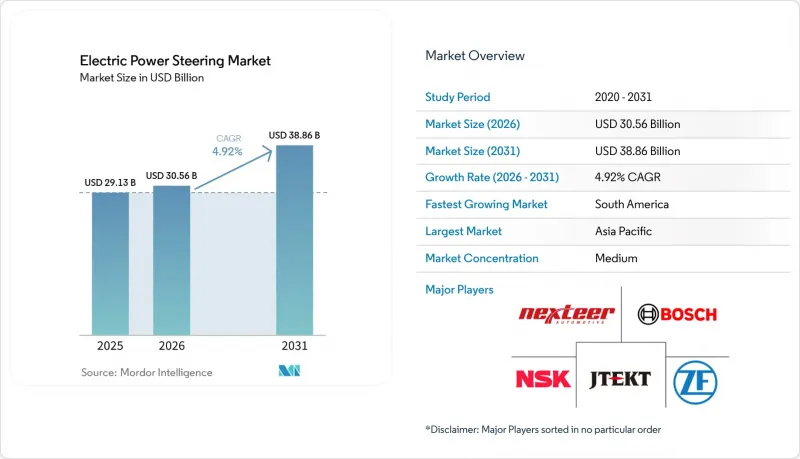
Mordor Intelligence에 의하면, 전동 파워스티어링 시장 규모는 2025년에 291억 3,000만 달러, 2026년 305억 6,000만 달러에서 2031년까지 388억 6,000만 달러에 이를 것으로 예측되며, 예측 기간(2026-2031년) CAGR은 4.92%를 기록할 전망입니다.
본 보고서는 유형별(컬럼형, 피니언형, 듀얼 피니언형), 구성품별(스티어링 랙/컬럼, 센서, 스티어링 모터 등), 차종별(승용차, 상용차), 구동 방식별(내연기관차, 배터리식 전기차 등) 및 지역별로 분류되어 있습니다. 시장 전망은 금액(달러) 및 수량(대수)으로 제시되어 있습니다.
세계 전동 파워 스티어링 시장 동향 및 인사이트
차량 플랫폼의 급속한 전동화
차량의 전동화는 내연기관의 출력을 소모하는 유압 시스템 고유의 기생 손실을 제거함으로써 EPS의 채택 패턴을 근본적으로 변화시키고 있습니다. 전기자동차에는 에너지 효율이 높은 조향 솔루션이 요구되며, 상용차 용도에서 하이브리드 EPS 시스템은 기존의 유압식 파워 스티어링에 비해 50% 이상의 에너지 소비 감소를 실현하고 있습니다. 자동차 제조업체들이 EPS를 회생 제동 통합 및 배터리 주행 거리 최적화에 필수적인 인프라로 인식함에 따라 이러한 전환은 가속화되고 있습니다. NHTSA(미국 도로교통안전국)가 정한 2027-2031년형 모델의 기업 평균 연비(CAFE) 기준에 따라 연간 2%의 연비 개선이 의무화되어 있으며, 이로 인해 내연기관 차량에서는 EPS의 채택이 경제적으로 불가피해지는 반면, 전기차(EV)에는 경쟁상의 우위를 가져다줍니다. 이러한 규제적 압력으로 인해, 기존 차량에서는 EPS가 규제 준수를 위한 수단이 되고, 전기 플랫폼에서는 성능 향상을 위한 수단이 되는 두 가지 시장 동향이 나타나고 있습니다.
연비 향상과 배기가스 감축에 대한 수요 증가
연비 효율에 관한 규제는 측정 가능한 소비량 감축 효과를 통해 EPS의 도입을 촉진하고 있습니다. 미국 국립연구위원회(NRC)의 조사에 따르면, 유압 시스템을 EPS로 대체함으로써 중형 차량에서는 1.3%, 대형 차량에서는 1.1%의 연료 소비 감축이 예상됩니다. 이러한 효율 향상 효과는 차량군 전체의 운용에 있어 시너지 효과를 발휘하므로, 급등하는 연료비와 탄소 가격 제도에 직면한 상용차 사업자에게 EPS는 경제적으로 매력적인 선택지가 되고 있습니다. 2024년 7월에 시행되는 유럽연합(EU)의 ‘일반 안전 규정 II’는 EPS 시스템과 원활하게 통합되는 첨단 안전 기술을 의무화하고 있어, 규제 측면에서의 시너지 효과를 창출하며 도입을 가속화하고 있습니다. 효율성 요건과 안전 기준의 융합으로 인해 EPS는 단순한 옵션 장비가 아닌 기반 기술로 자리매김하고 있습니다. 차량 운영 사업자들은 EPS를 즉각적인 운영 비용 절감을 실현함과 동시에, 미래의 자율주행 기능 구현을 가능하게 하는 인프라 투자로 점점 더 인식하고 있습니다.
저가 차량에서의 유압 시스템과의 단가 비교
가격에 민감한 시장 부문에서는 운영 효율이 낮음에도 불구하고 유압 시스템이 경제적 우위를 유지하고 있어, 비용 경쟁력 확보는 여전히 과제로 남아 있습니다. 인도의 자동차 제조업체들은 비용 관리에 대해 다양한 접근 방식을 보이고 있는데, 타타 모터스는 ‘하리어 EV’ 부품에서 80%의 현지 조달률을 달성한 반면, 오라 일렉트릭과 같은 기업은 희토류 소재에 대한 의존을 피하기 위해 자석을 사용하지 않는 모터를 개발하고 있습니다. 중국의 희토류 수출 규제가 공급망에 압박을 가하고 있는 가운데, 인도에서는 전기차 생산의 실행 가능성을 유지하기 위해 50%의 현지 조달 요건 완화가 검토되고 있어, 비용 격차는 더욱 두드러지고 있습니다. 양산 부문에서는 제조 규모에 따른 경제성 측면에서 기존 유압 시스템 공급업체가 우위를 점하고 있으며, 고급차에서는 EPS가 채택되는 반면, 경제형 부문에서는 전환에 대한 저항이 나타나는 등 시장의 양극화가 발생하고 있습니다. 상용차 용도의 경우, 초기 자본 비용이 차량 함대의 수익성에 직접적인 영향을 미치기 때문에 과제는 더욱 심각해지고 있으며, 높은 구매 가격을 정당화하기 위해서는 명확한 운영 비용 절감 효과를 입증해야 합니다.
부문 분석
컬럼형 EPS 시스템은 2025년에 53.65%의 시장 점유율을 차지할 것으로 예상되며, 이는 주류 차량 플랫폼에서 확립된 통합상의 이점과 비용 효율성을 반영한 것입니다. 그러나 자율주행 용도의 정밀도 요구 사항과 조향 응답 특성 개선에 힘입어 듀얼 피니언형 구성이 2031년까지 연평균 성장률(CAGR) 11.07%로 가장 빠르게 성장하는 부문으로 부상하고 있습니다. 피니언식 시스템은 비용과 성능의 균형이 뛰어나 중급 응용 분야에서 안정적인 시장 점유율을 유지하고 있습니다. 이 부문의 진화는 안전성이 극히 중요한 자율주행 기능에서 조향 정밀도가 필수적인 미래의 모빌리티 요구 사항을 염두에 둔 각 제조업체의 전략적 포지셔닝을 반영하고 있습니다.
ZF가 NIO의 ET9에 도입한 스티어-바이-와이어 기술은 첨단 아키텍처가 어떻게 새로운 스티어링 휠 설계와 조종성 향상을 가능하게 하며, 특히 전기차 플랫폼에 이점을 가져다주는지를 보여줍니다. 컬럼형 시스템은 사후 장착 용도이나 비용 중심의 부문에서 우위를 유지하고 있는 반면, 듀얼 피니언 구성은 차별화된 운전 경험을 추구하는 프리미엄 제조업체들의 관심을 끌고 있습니다. 기술의 진보에 따라 양산 부문에서는 실적이 입증된 컬럼형의 신뢰성이 우선시되는 반면, 성능을 중시하는 분야에서는 듀얼 피니언의 고정밀 성능으로 전환되는 등 시장의 양극화가 진행될 것으로 예측됩니다.
스티어링 랙/컬럼 부품은 2025년에 42.12%의 시장 점유율을 유지하며, 모든 차종에서 EPS 시스템의 기계적 기반이 되고 있습니다. 센서 부품은 2031년까지 연평균 성장률(CAGR) 9.86%로 가장 빠르게 성장하고 있으며, 이는 ADAS(첨단 운전자 보조 시스템) 통합에 필요한 피드백 메커니즘의 고도화가 진행되고 있음을 반영합니다. 스티어링 모터 부문은 주요 구동 부품으로서 안정적인 성능을 발휘하고 있는 반면, ‘기타 부품 유형’에는 사이버 보안 모듈이나 OTA(Over-the-Air) 업데이트 기능과 같은 신기술이 포함되어 있습니다. 구성 요소의 변화는 단순한 전동화를 넘어 지능형 시스템 아키텍처로 나아가는 시장의 성숙도를 보여줍니다.
센서의 성장 추세는 차량 안전 시스템 강화를 요구하는 규제 요건과 일치하며, 정밀한 피드백을 통해 긴급 상황 시 조향 개입 및 차선 유지 지원 기능이 실현됩니다. NSK가 스티어 바이 와이어 용도로 개발한 포스 피드백 액추에이터와 로드 휠 액추에이터는 차세대 스티어링 시스템에 요구되는 부품의 고도화를 상징합니다. 기존의 기계식 부품은 상품화 압력에 직면하고 있는 반면, 전자 부품은 높은 기능성을 바탕으로 프리미엄 가격을 유지하고 있어 공급업체의 가치 제안과 경쟁 구도를 재편하고 있습니다.
지역별 분석
2025년, 아시아태평양은 전동 파워 스티어링 시장 매출의 46.35%를 차지했습니다. 중국의 수직 통합형 EV 생태계는 국산 모터 컨트롤러, 차량 도메인, 스티어링 기어를 비용 경쟁력 있는 모듈로 패키징하여 국내 및 수출용 프로그램에 공급하고 있습니다. NIO가 ZF의 스티어 바이 와이어를 채택한 것은 중국이 첨단 아키텍처로 직접 도약할 준비가 되어 있음을 보여줍니다. 한편, 일본은 고정밀 베어링 및 각도 센서 분야에서 주도권을 지키고 있으며, 이를 통해 현지 공급업체들은 전 세계 Tier 1 공급업체에 중요한 하위 어셈블리를 판매할 수 있게 되었습니다. 탄소 중립을 향한 정부의 인센티브가 수요를 가속화하고 있으며, 지역 내 생산 능력을 통해 부품의 안정적인 공급이 확보되고 있습니다.
유럽은 성숙한 시장이지만, 규제가 주도하는 분야입니다. EU의 ‘일반 안전 규정 II(GSR II)’에 따라 각 OEM사는 EPS의 정밀도에 의존하는 차선 유지 기능 및 보행자 회피 기능의 탑재가 의무화되어 있습니다. 도입일이 확정되어 있어 공급업체는 안정적인 계획 주기의 혜택을 누리고 있습니다. 2020년대 중반에 도입될 사이버 보안 규제는 진입 장벽을 더욱 높일 것이며, 전담 소프트웨어 팀을 보유한 기업에 수주가 집중될 것입니다.
북미에서는 연비 효율 관련 규제가 주목받고 있습니다. NHTSA의 CAFE 기준에 따라 2031년까지 승용차 플릿에 대해 연평균 2%의 연비 개선이 의무화되어 있습니다. 브라질을 필두로 한 남미는 2031년까지 연평균 성장률(CAGR)이 8.94%로 가장 빠르게 성장하고 있는 지역입니다. 2024년에 전기차 판매 대수가 90% 급증한 것은 수입 배터리 모듈에 대한 세금이 면제됨에 따라 억제되었던 수요가 표면화되었음을 보여줍니다. 이어 스텔란티스는 듀얼 연료의 유연성을 실현하는 EPS를 통합한 바이오 하이브리드 파워트레인 개발에 56억 유로를 투자하겠다고 밝혔습니다. 이 지역의 성장은 유압식 시스템의 기득권을 뛰어넘는 기술적 도약을 보여줍니다.
기타 혜택:
- 엑셀 형식 시장 예측(ME) 시트
- 3개월간의 애널리스트 지원
자주 묻는 질문
목차
제1장 서론
제2장 조사 방법
제3장 주요 요약
제4장 시장 구도
제5장 시장 규모와 성장 예측
제6장 경쟁 구도
제7장 시장 기회와 향후 전망
LSH 26.08.25According to Mordor Intelligence, the electric power steering market size was valued at USD 29.13 billion in 2025 and estimated to grow from USD 30.56 billion in 2026 to reach USD 38.86 billion by 2031, at a CAGR of 4.92% during the forecast period (2026-2031).
This report is Segmented by Type (Column Type, Pinion Type, and Dual Pinion Type), Component Type (Steering Rack/Column, Sensor, Steering Motor, and More), Vehicle Type (Passenger Cars and Commercial Vehicles), Propulsion Type (Internal Combustion Engine Vehicles, Battery Electric Vehicles, and More), and Geography. The Market Forecasts are Provided in Terms of Value (USD) and Volume (Units).
Global Electric Power Steering Market Trends and Insights
Rapid Electrification of Vehicle Platforms
Vehicle electrification fundamentally reshapes EPS adoption patterns by eliminating the parasitic losses inherent in hydraulic systems that drain ICE engine power. Electric vehicles demand energy-efficient steering solutions, with hybrid EPS systems demonstrating over 50% energy consumption reduction compared to conventional hydraulic power steering in commercial vehicle applications. The transition accelerates as automakers recognize EPS as an essential infrastructure for regenerative braking integration and battery range optimization. NHTSA's Corporate Average Fuel Economy standards for model years 2027-2031 mandate 2% annual fuel efficiency improvements, making EPS adoption economically inevitable for ICE vehicles while providing competitive advantages for EVs. This regulatory pressure creates a dual-market dynamic where EPS becomes compliance-driven for traditional vehicles and performance-enhancing for electric platforms.
Increasing Demand for Fuel Efficiency and Emission Reduction
Fuel efficiency mandates drive EPS adoption through measurable consumption benefits, with National Research Council studies indicating 1.3% fuel reduction for midsize cars and 1.1% for large cars when replacing hydraulic systems. Efficiency gains compound across fleet operations, making EPS economically attractive for commercial vehicle operators facing rising fuel costs and carbon pricing mechanisms. European Union's General Safety Regulation II, effective July 2024, mandates advanced safety technologies that integrate seamlessly with EPS systems, creating regulatory synergies that accelerate adoption. The convergence of efficiency requirements and safety mandates EPS as a foundational technology rather than optional equipment. Fleet operators increasingly recognize EPS as an infrastructure investment that delivers immediate operational cost reductions while enabling future autonomous capabilities.
Higher Unit Cost vs. Hydraulic Systems in Low-Cost Cars
Cost competitiveness remains challenging in price-sensitive market segments where hydraulic systems maintain economic advantages despite operational inefficiencies. Indian automakers demonstrate varied approaches to cost management, with Tata Motors achieving 80% localization for Harrier EV components while companies like Ola Electric develop magnet-less motors to avoid rare-earth material dependencies. The cost differential becomes more pronounced as China's rare-earth export restrictions create supply chain pressures, with India considering the relaxation of 50% localization requirements to maintain EV manufacturing viability. Manufacturing scale economics favor established hydraulic system suppliers in volume segments, creating market bifurcation where premium vehicles adopt EPS while economy segments resist transition. The challenge intensifies in commercial vehicle applications where initial capital costs directly impact fleet profitability, requiring a clear operational savings demonstration to justify higher acquisition prices.
Other drivers and restraints analyzed in the detailed report include:
- Regulatory Mandates for ADAS Integration
- Steer-by-Wire R&D Breakthroughs
- Limited Steering Feel and Safety Concerns in Emerging Markets
For complete list of drivers and restraints, kindly check the Table Of Contents.
Segment Analysis
Column Type EPS systems commanded a 53.65% market share in 2025, reflecting their established integration advantages and cost-effectiveness for mainstream vehicle platforms. However, dual-pinion type configurations emerge as the fastest-growing segment at 11.07% CAGR through 2031, driven by precision requirements for autonomous driving applications and enhanced steering response characteristics. Pinion Type systems maintain a steady market presence in mid-range applications, offering balanced performance between cost and capability. The segment evolution reflects manufacturers' strategic positioning for future mobility requirements, where steering precision becomes critical for safety-critical autonomous functions.
ZF's steer-by-wire technology deployment in NIO's ET9 demonstrates how advanced architecture enables new steering wheel designs and improved maneuverability, particularly benefiting electric vehicle platforms. Column Type systems retain advantages in retrofit applications and cost-sensitive segments, while Dual Pinion configurations attract premium manufacturers seeking differentiated driving experiences. Technology progression suggests market bifurcation where volume segments prioritize proven Column Type reliability while performance-oriented applications migrate toward Dual Pinion precision capabilities.
Steering Rack/Column components maintained 42.12% market share in 2025, representing the mechanical foundation of EPS systems across all vehicle types. Sensor components accelerate fastest at 9.86% CAGR through 2031, reflecting the increasing sophistication of feedback mechanisms required for advanced driver assistance systems integration. Steering Motor segments provide consistent performance as the primary actuation component, while Other Component Types encompass emerging technologies like cybersecurity modules and OTA update capabilities. The component mix evolution indicates market maturation beyond basic electrification toward intelligent system architectures.
The sensor growth trajectory aligns with regulatory requirements for enhanced vehicle safety systems, where precise feedback enables emergency steering interventions and lane-keeping assistance functions. NSK's development of Force Feedback Actuators and Road Wheel Actuators for steer-by-wire applications exemplifies the component sophistication required for next-generation steering systems. Traditional mechanical components face commoditization pressure while electronic components command premium pricing through advanced functionality, reshaping supplier value propositions and competitive dynamics.
Complete Report Scope:
- By Type
- Column Type
- Pinion Type
- Dual Pinion Type
- By Component Type
- Steering Rack/Column
- Sensor
- Steering Motor
- Other Component Types
- By Vehicle Type
- Passenger Cars
- Commercial Vehicles
- By Propulsion Type
- Internal Combustion Engine Vehicles
- Hybrid Vehicles
- Battery Electric Vehicles
- By Geography
- North America
- United States
- Canada
- Rest of North America
- Europe
- Germany
- United Kingdom
- France
- Italy
- Russia
- Rest of Europe
- Asia-Pacific
- China
- Japan
- India
- South Korea
- Rest of Asia-Pacific
- Middle East and Africa
- United Arab Emirates
- Saudi Arabia
- Turkey
- South Africa
- Egypt
- Rest of Middle East and Africa
- South America
- Brazil
- Argentina
- Rest of South America
- North America
Geography Analysis
Asia-Pacific anchored 46.35% of the electric power steering market revenue in 2025. China's vertically integrated EV ecosystem packages domestic motor controllers, vehicle domains, and steering gears into cost-competitive modules serving local and export programs. NIO's adoption of steer-by-wire from ZF underscores China's readiness to leap directly into advanced architectures. Japan, meanwhile, protects leadership in high-precision bearings and angle sensors, enabling local suppliers to sell critical sub-assemblies to global Tier-1s. Government incentives for carbon neutrality accelerate demand, and regional capacity ensures component availability.
Europe represents a mature but regulation-driven arena. The EU General Safety Regulation II forces OEMs to fit lane-keeping and pedestrian-avoidance functions that rely on EPS precision. Suppliers gain from stable planning cycles as implementation dates are locked. Mid-decade cybersecurity rules further elevate barriers, consolidating volume among companies with dedicated software teams.
North America focuses on efficiency mandates. NHTSA's CAFE standards impose 2% annual gains for passenger fleets through 2031. South America, led by Brazil, is the fastest-expanding region with a 8.94% CAGR through 2031. A 90% spike in EV sales in 2024 demonstrated pent-up demand once taxes were waived for imported battery modules. Stellantis followed with a EUR 5.6 billion commitment to develop Bio-Hybrid powertrains that integrate EPS for dual-fuel flexibility. The region's growth illustrates tech leapfrogging, bypassing hydraulic incumbency.
- JTEKT Corporation
- Robert Bosch GmbH
- Nexteer Automotive
- ZF Friedrichshafen AG
- Denso Corporation
- NSK Ltd.
- Hyundai Mobis Co. Ltd.
- Mitsubishi Electric Corporation
- Hitachi Astemo Ltd.
- Thyssenkrupp Presta AG
- Mando Corporation
- Continental AG
Additional Benefits:
- The market estimate (ME) sheet in Excel format
- 3 months of analyst support
TABLE OF CONTENTS
1 Introduction
- 1.1 Study Assumptions and Market Definition
- 1.2 Scope of the Study
2 Research Methodology
3 Executive Summary
4 Market Landscape
- 4.1 Market Overview
- 4.2 Market Drivers
- 4.2.1 Rapid electrification of vehicle platforms
- 4.2.2 Increasing demand for fuel efficiency and emission reduction
- 4.2.3 Regulatory mandates for ADAS integration
- 4.2.4 Steer-by-wire RandD breakthroughs
- 4.2.5 Tier-1/2 collaboration on 48-V e-Powertrain modules
- 4.2.6 OTA software steering calibration for mass customisation
- 4.3 Market Restraints
- 4.3.1 Higher unit cost vs. hydraulic systems in low-cost cars
- 4.3.2 Limited steering feel and safety concerns in emerging markets
- 4.3.3 Semiconductor supply-chain volatility for motor controllers
- 4.3.4 Cyber-security risks in electronically actuated columns
- 4.4 Value / Supply-Chain Analysis
- 4.5 Regulatory Landscape
- 4.6 Technological Outlook
- 4.7 Porter's Five Forces
- 4.7.1 Threat of New Entrants
- 4.7.2 Bargaining Power of Buyers/Consumers
- 4.7.3 Bargaining Power of Suppliers
- 4.7.4 Threat of Substitute Products
- 4.7.5 Intensity of Competitive Rivalry
5 Market Size and Growth Forecasts (Value (USD) and Volume (Units))
- 5.1 By Type
- 5.1.1 Column Type
- 5.1.2 Pinion Type
- 5.1.3 Dual Pinion Type
- 5.2 By Component Type
- 5.2.1 Steering Rack/Column
- 5.2.2 Sensor
- 5.2.3 Steering Motor
- 5.2.4 Other Component Types
- 5.3 By Vehicle Type
- 5.3.1 Passenger Cars
- 5.3.2 Commercial Vehicles
- 5.4 By Propulsion Type
- 5.4.1 Internal Combustion Engine Vehicles
- 5.4.2 Hybrid Vehicles
- 5.4.3 Battery Electric Vehicles
- 5.5 By Geography
- 5.5.1 North America
- 5.5.1.1 United States
- 5.5.1.2 Canada
- 5.5.1.3 Rest of North America
- 5.5.2 Europe
- 5.5.2.1 Germany
- 5.5.2.2 United Kingdom
- 5.5.2.3 France
- 5.5.2.4 Italy
- 5.5.2.5 Russia
- 5.5.2.6 Rest of Europe
- 5.5.3 Asia-Pacific
- 5.5.3.1 China
- 5.5.3.2 Japan
- 5.5.3.3 India
- 5.5.3.4 South Korea
- 5.5.3.5 Rest of Asia-Pacific
- 5.5.4 Middle East and Africa
- 5.5.4.1 United Arab Emirates
- 5.5.4.2 Saudi Arabia
- 5.5.4.3 Turkey
- 5.5.4.4 South Africa
- 5.5.4.5 Egypt
- 5.5.4.6 Rest of Middle East and Africa
- 5.5.5 South America
- 5.5.5.1 Brazil
- 5.5.5.2 Argentina
- 5.5.5.3 Rest of South America
- 5.5.1 North America
6 Competitive Landscape
- 6.1 Market Concentration
- 6.2 Strategic Moves
- 6.3 Market Share Analysis
- 6.4 Company Profiles (Includes Global Level Overview, Market Level Overview, Core Segments, Financials as Available, Strategic Information, Market Rank/Share for Key Companies, Products and Services, SWOT Analysis, and Recent Developments)
- 6.4.1 JTEKT Corporation
- 6.4.2 Robert Bosch GmbH
- 6.4.3 Nexteer Automotive
- 6.4.4 ZF Friedrichshafen AG
- 6.4.5 Denso Corporation
- 6.4.6 NSK Ltd.
- 6.4.7 Hyundai Mobis Co. Ltd.
- 6.4.8 Mitsubishi Electric Corporation
- 6.4.9 Hitachi Astemo Ltd.
- 6.4.10 Thyssenkrupp Presta AG
- 6.4.11 Mando Corporation
- 6.4.12 Continental AG
7 Market Opportunities and Future Outlook
- 7.1 White-space and unmet-need assessment


