

|
시장보고서
상품코드
2113528
유럽의 자동차용 EPS : 시장 점유율 분석, 업계 동향 및 통계, 성장 예측(2026-2031년)Europe Automotive EPS - Market Share Analysis, Industry Trends & Statistics, Growth Forecasts (2026 - 2031) |
||||||
 Mordor Intelligence
Mordor Intelligence에 의하면, 유럽 자동차용 EPS 시장 규모는 2025년에 77억 6,000만 달러, 2026년 81억 6,000만 달러에서 2031년까지 107억 4,000만 달러에 이를 것으로 예측되며, 예측 기간(2026년-2031년) CAGR은 5.65%를 기록할 전망입니다.
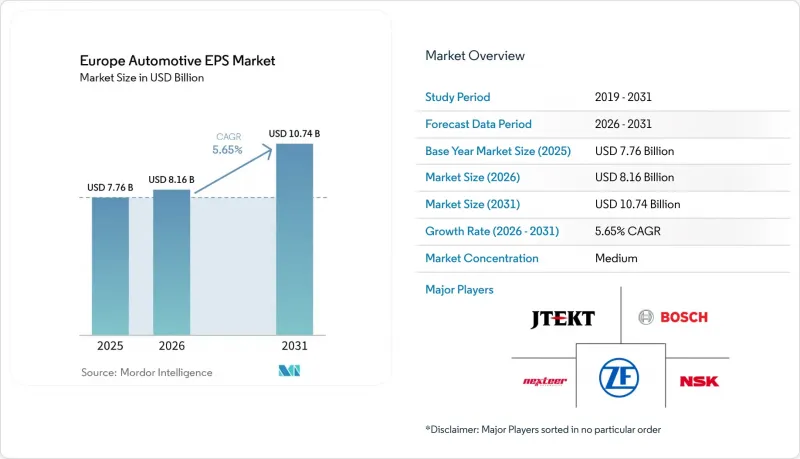
본 보고서는 유형별(컬럼식, 피니언식 등), 구성품별(스티어링 랙/컬럼, 센서 등), 차종별(승용차, 상용차), 구동 방식별(내연기관차, 하이브리드차 등), 국가별(독일, 영국 등)로 분류되어 있습니다. 시장 전망은 금액(달러) 및 수량(대수)으로 제시되어 있습니다.
유럽의 자동차용 EPS 시장 동향 및 인사이트
ADAS(첨단 운전자 보조 시스템) 도입 확대
ADAS(첨단 운전자 보조 시스템)는 유럽 내 자동차용 전동 파워 스티어링 수요의 주요 원천이 되고 있습니다. 차선 유지 보조, 보행자 회피, 정체 시 지원 기능에는 정확한 스티어링 보정과 전자적 피드백이 필요합니다. 유압식 스티어링은 이에 상응하는 폐쇄 루프 제어 능력을 제공할 수 없습니다. 규정(EU) 2019/2144는 신차 모델에 대해 특정 안전 시스템을 의무화하고 있으며, 이러한 기능을 지원하는 스티어링 아키텍처를 촉진하고 있습니다. Euro NCAP의 2026년 프로토콜에서는 차량 평가의 중점을 ‘안전 운전’, ‘충돌 회피’‘충돌 보호’, ‘충돌 후 안전성’에 두고 있으며, 자동 개입 기능에 대한 관심이 더욱 높아지고 있습니다. 이에 따라 각 제조업체는 ADAS 대응 스티어링을 중량산 플랫폼으로도 확대하고 있으며, 이를 통해 폐루프 스티어링 제어를 관리할 수 있는 시스템이 우위를 점하고 있습니다.
승용차 및 상용차의 전동화 진전
전동 파워트레인으로의 전환은 유럽의 자동차용 EPS 시장에 확고한 수요 기반을 제공합니다. 2026년 상반기, 배터리식 전기차 등록 대수는 전년 동기 대비 35% 증가하여 유럽 전체 신차 등록 대수의 22%를 차지했습니다. 전기 트럭과 버스는 승용차보다 더 높은 토크의 조향 시스템이 필요합니다. 이러한 용도에서는 여전히 유압식 조향이 일반적이기 때문에 전동 파워 스티어링의 채택은 아직 초기 단계에 머물러 있습니다. 따라서 상용차는 예측 기간 후반에 더 큰 기여를 할 것으로 보입니다.
유압식 및 전기유압식에 비해 높은 시스템 비용
동등한 토크 수준에서 전동 파워 스티어링은 유압식 스티어링보다 부품 원가가 높습니다. 이러한 차이는 가성비 중심 부문 차량의 이익률에 압박을 가할 가능성이 있으며, 일부 상용차 라인업의 전동화 전환을 지연시키는 요인이 될 수 있습니다. 특히 남유럽 및 동유럽에서는 소형이며 가격에 민감한 플랫폼이 중요한 역할을 하고 있습니다. 일부 제조업체는 초기 비용의 낮음이 완전 전기식 시스템의 운영상 이점을 상회하는 경우, 전기유압식 시스템을 계속 채택하고 있습니다. 또한, 전동식 스티어링의 토크 용량이 기존부터 제한적이었던 대형 상용차의 경우에도 여전히 전기유압식 스티어링이 채택되고 있습니다. ZF의 1억 대에 달하는 전동 파워 스티어링 시스템 생산 실적은 생산량이 단가 절감에 미치는 역할을 여실히 보여줍니다. 그러나 중복된 센서와 듀얼 채널 액추에이터의 존재로 인해 ADAS 등급 시스템에서는 여전히 높은 비용이 유지되고 있습니다.
부문 분석
2025년 시점에서 컬럼형 전동 파워 스티어링은 60.15%의 점유율을 차지했습니다. 이러한 위상은 전륜구동 차량의 패키징 적합성, 그리고 대량 생산 모델에서의 저비용 및 단순한 통합성 덕분입니다. 이러한 요인들은 스티어링 탑재가 이미 널리 보급된 유럽 승용차 시장에서 여전히 중요한 의미를 지니고 있습니다. 피니언형 시스템은 컬럼형 패키징이 적합하지 않은 중토크 용도에 대응합니다. 이러한 시스템은 대형 승용차 및 소형 상용차에 채택되고 있습니다. 유럽의 전동 파워 스티어링 시장에서는 차량 레이아웃이나 토크 요구 사항이 이를 필요로 하는 경우, 특히 제조업체가 양산차 프로그램에서 익숙한 패키징, 간소화된 조립 및 비용 관리를 우선시할 때 이 아키텍처가 계속해서 지지를 받고 있습니다.
듀얼 피니언 방식은 2026-2031년 연평균 성장률(CAGR) 9.48%를 나타낼 것으로 예측됩니다. 이 방식은 주 조향 토크와 이중화 조향 토크를 모두 제공할 수 있으므로, ASIL-D 규격을 준수하는 시스템이나 더 높은 수준의 차량 자동화를 지원합니다. 적극적인 자동화 프로그램을 전개하는 각 제조업체들은 향후 플랫폼 개발에서 중복 조향 설계를 채택하고 있습니다. 더 높은 자동화 수준을 요구하는 UNECE R79의 요건으로 인해, 고장 시에도 작동하는 조향 시스템의 중요성이 더욱 커지고 있습니다. ZF가 메르세데스-벤츠를 위해 양산하고 있는 스티어-바이-와이어 시스템은 유럽 내 프리미엄 스티어링에 대한 투자 방향을 보여주고 있습니다. 티센크루프 프레스타도 차세대 중복 시스템을 위해 전기 기계식 스티어링 액추에이터 및 컬럼 어셈블리를 개발하고 있습니다.
2025년에는 스티어링 랙/컬럼 부품이 40.33%를 차지했습니다. 이 점유율은 각 전동 파워 스티어링 유닛에서 기계식 액추에이터 어셈블리의 비용 비중을 반영하고 있습니다. 스티어링 모터는 기존의 브러시식 설계 대신 브러쉬리스 영구자석 설계가 채택됨에 따라 차별화가 더욱 진전되고 있습니다. 이러한 모터는 저소음과 높은 토크 밀도를 실현합니다. 또한, 희토류 자석 공급에 대한 의존도도 높아지고 있습니다. 나머지 부품 카테고리는 전자 제어 장치와 와이어 하네스로 구성되어 있습니다.
유럽의 전동 파워 스티어링 시장에서 센서 시장은 2026년부터 2031년까지 연평균 성장률(CAGR) 8.12%를 나타낼 것으로 예측됩니다. 토크, 각도, 노면 상태 감지는 단일 측정값에서 스티어링 제어와 ADAS 기능을 모두 지원하는 다축 데이터 세트로 전환되고 있습니다. Nexteer사의 MotionIQ 플랫폼은 센서 정보를 활용하여 노면 감지 및 핸들오버 감지를 수행합니다. 이를 통해 안전성이 중시되는 용도에서 센서와 소프트웨어의 조합 가치가 높아집니다. ISO 26262 인증을 획득한 센서 퓨전 소프트웨어를 보유한 공급업체는 하드웨어의 대중화로 인한 영향을 덜 받게 됩니다. 개별 센서 가격이 대량 생산으로 인해 하락하더라도, 중복성 요구 사항이 높아짐에 따라 대당 센서 수는 증가할 가능성이 있습니다.
기타 혜택:
- 엑셀 형식 시장 예측(ME) 시트
- 3개월간의 애널리스트 지원
자주 묻는 질문
목차
제1장 서론
제2장 조사 방법
제3장 주요 요약
제4장 시장 구도
제5장 시장 규모와 성장 예측
제6장 경쟁 구도
제7장 시장 기회와 향후 전망
LSH 26.08.25According to Mordor Intelligence, the European electric power steering market size was valued at USD 7.76 billion in 2025 and is estimated to grow from USD 8.16 billion in 2026 to reach USD 10.74 billion by 2031, at a CAGR of 5.65% during the forecast period (2026-2031).
This report is Segmented by Type (Column Type, Pinion Type, and More), Component Type (Steering Rack/Column, Sensor, and More), Vehicle Type (Passenger Cars, Commercial Vehicles), Propulsion Type (Internal Combustion Engine Vehicles, Hybrid Vehicles, and More), and Country (Germany, United Kingdom, and More). The Market Forecasts are Provided in Terms of Value (USD) and Volume (Units).
Europe Automotive EPS Market Trends and Insights
Rising Adoption of Advanced Driver-Assistance Systems
Advanced driver-assistance systems are a major source of demand for automotive electric power steering in Europe. Lane-keeping assist, pedestrian avoidance, and traffic-jam assist require precise steering corrections and electronic feedback. Hydraulic steering does not provide the same closed-loop control capability. Regulation (EU) 2019/2144 requires specified safety systems for new vehicle types, which supports steering architectures compatible with these functions. Euro NCAP's 2026 protocol places vehicle assessment around Safe Driving, Crash Avoidance, Crash Protection, and Post-Crash Safety, with greater attention to automated interventions . Manufacturers are therefore extending ADAS-ready steering to more mid-volume platforms, which favors systems capable of managing closed-loop steering control.
Increasing Electrification of Passenger and Commercial Vehicles
The move to electric powertrains provides a firm demand base for the European electric power steering market. In the first half of 2026, battery electric vehicle registrations grew 35% year over year and accounted for 22% of new vehicle registrations across Europe . Electric trucks and buses require higher-torque steering systems than passenger vehicles. Their adoption of electric power steering is still in its early stages because hydraulic steering remains common in those applications. This leaves commercial vehicles positioned to contribute more strongly during the later years of the forecast period.
High System Cost Compared With Hydraulic and Electrohydraulic Alternatives
Electric power steering has higher bill-of-materials costs than hydraulic steering at comparable torque levels. The difference can put pressure on margins for value-segment vehicles and delay conversion in some commercial vehicle lines. Smaller and price-sensitive platforms are particularly relevant in Southern and Eastern Europe. Some manufacturers retain electrohydraulic systems where a lower upfront cost outweighs the operating benefit of a fully electric system. Electrohydraulic steering also remains present in heavy commercial vehicles, where electric steering torque capacity was historically limited. ZF's production of 100 million electric power steering systems illustrates the role of volume in reducing unit costs. However, redundant sensors and dual-channel actuators preserve a cost premium for ADAS-grade systems.
Other drivers and restraints analyzed in the detailed report include:
- Stricter European Vehicle Safety and Emissions Requirements
- Growing Demand for Software-Defined Steering Functions
- Semiconductor, Sensor, and Rare-Earth Component Supply Exposure
For complete list of drivers and restraints, kindly check the Table Of Contents.
Segment Analysis
Column-type electric power steering held 60.15% in 2025. Its position reflects its fit with front-wheel-drive vehicle packaging and its lower cost and simpler integration for high-volume models. These factors remain relevant for European passenger vehicles where steering fitment is already widespread. Pinion-type systems serve mid-torque uses where column packaging is less suitable. They are used in larger passenger vehicles and light commercial applications. The European electric power steering market continues to support this architecture where vehicle layout and torque requirements call for it, particularly when manufacturers prioritize familiar packaging, simpler assembly, and cost control on high-volume vehicle programs.
The dual-pinion type is forecast to grow at a 9.48% CAGR from 2026 to 2031. It can provide primary and redundant steering torque, which supports ASIL-D-rated systems and higher levels of vehicle automation. Manufacturers with active automation programs are allocating future platform work to redundant steering designs. UNECE R79 requirements for higher automation levels make fail-operational steering more important. ZF's series-production steer-by-wire system for Mercedes-Benz shows the direction of premium steering investment in Europe. Thyssenkrupp Presta is also developing electromechanical steering actuators and column assemblies for next-generation redundant systems.
Steering Rack/Column components held 40.33% in 2025. Their share reflects the cost weight of the mechanical actuator assembly in each electric power steering unit. Steering motors are becoming more differentiated as brushless permanent-magnet designs replace earlier brushed designs. These motors offer lower noise and greater torque density. They also increase exposure to the rare-earth magnet supply. Electronic control units and wiring harnesses make up the remaining component categories.
Sensors are forecast to grow at an 8.12% CAGR from 2026 to 2031 within the European electric power steering market. Torque, angle, and road-surface sensing are moving from single measurements to multi-axis data sets that support both steering control and ADAS functions. Nexteer's MotionIQ platform uses sensor information for Road Surface Detection and Hands-Off Detection. This makes the sensor-software combination more valuable in safety-rated applications. Suppliers with sensor-fusion software certified to ISO 26262 can be less exposed to hardware commoditization. The number of sensors per unit can rise as redundancy requirements increase, even if individual sensor prices decline with volume.
Complete Report Scope:
- By Type
- Column Type
- Pinion Type
- Dual Pinion Type
- By Component Type
- Steering Rack/Column
- Sensor
- Steering Motor
- Other Component Types
- By Vehicle Type
- Passenger Cars
- Commercial Vehicles
- By Propulsion Type
- Internal Combustion Engine Vehicles
- Hybrid Vehicles
- Battery Electric Vehicles
- By Country
- Germany
- United Kingdom
- France
- Italy
- Russia
- Rest of Europe
List of Companies Covered in this Report:
- JTEKT Corporation
- Robert Bosch GmbH
- Nexteer Automotive
- ZF Friedrichshafen AG
- Denso Corporation
- NSK Ltd.
- Hyundai Mobis Co. Ltd.
- Thyssenkrupp Presta AG
- Continental AG
- Knorr-Bremse AG
- HL Mando Corporation
- Mitsubishi Electric Corporation
- Astemo Ltd.
Additional Benefits:
- The market estimate (ME) sheet in Excel format
- 3 months of analyst support
TABLE OF CONTENTS
1 Introduction
- 1.1 Study Assumptions and Market Definition
- 1.2 Scope of the Study
2 Research Methodology
3 Executive Summary
4 Market Landscape
- 4.1 Market Overview
- 4.2 Market Drivers
- 4.2.1 Rising Adoption of Advanced Driver-Assistance Systems
- 4.2.2 Increasing Electrification of Passenger and Commercial Vehicles
- 4.2.3 Stricter European Vehicle Safety and Emissions Requirements
- 4.2.4 Growing Demand for Software-Defined Steering Functions
- 4.2.5 Integration of Steering Systems With Vehicle Motion-Control Architectures
- 4.2.6 Increasing Deployment of Steer-by-Wire-Ready Architectures
- 4.3 Market Restraints
- 4.3.1 High System Cost Compared With Hydraulic and Electrohydraulic Alternatives
- 4.3.2 Semiconductor, Sensor, and Rare-Earth Component Supply Exposure
- 4.3.3 Functional-Safety and Cybersecurity Validation Complexity
- 4.3.4 Limited Repairability and High Replacement Costs After Electronic or Motor Failures
- 4.4 Value / Supply-Chain Analysis
- 4.5 Regulatory Landscape
- 4.6 Technological Outlook
- 4.7 Porter's Five Forces Analysis
- 4.7.1 Threat of New Entrants
- 4.7.2 Bargaining Power of Buyers/Consumers
- 4.7.3 Bargaining Power of Suppliers
- 4.7.4 Threat of Substitute Products
- 4.7.5 Intensity of Competitive Rivalry
5 Market Size and Growth Forecasts (Value (USD) and Volume (Units))
- 5.1 By Type
- 5.1.1 Column Type
- 5.1.2 Pinion Type
- 5.1.3 Dual Pinion Type
- 5.2 By Component Type
- 5.2.1 Steering Rack/Column
- 5.2.2 Sensor
- 5.2.3 Steering Motor
- 5.2.4 Other Component Types
- 5.3 By Vehicle Type
- 5.3.1 Passenger Cars
- 5.3.2 Commercial Vehicles
- 5.4 By Propulsion Type
- 5.4.1 Internal Combustion Engine Vehicles
- 5.4.2 Hybrid Vehicles
- 5.4.3 Battery Electric Vehicles
- 5.5 By Country
- 5.5.1 Germany
- 5.5.2 United Kingdom
- 5.5.3 France
- 5.5.4 Italy
- 5.5.5 Russia
- 5.5.6 Rest of Europe
6 Competitive Landscape
- 6.1 Market Concentration
- 6.2 Strategic Moves
- 6.3 Market Share Analysis
- 6.4 Company Profiles (includes Global Level Overview, Market Level Overview, Core Segments, Financials as Available, Strategic Information, Market Rank/Share for Key Companies, Products and Services, SWOT Analysis, and Recent Developments)
- 6.4.1 JTEKT Corporation
- 6.4.2 Robert Bosch GmbH
- 6.4.3 Nexteer Automotive
- 6.4.4 ZF Friedrichshafen AG
- 6.4.5 Denso Corporation
- 6.4.6 NSK Ltd.
- 6.4.7 Hyundai Mobis Co. Ltd.
- 6.4.8 Thyssenkrupp Presta AG
- 6.4.9 Continental AG
- 6.4.10 Knorr-Bremse AG
- 6.4.11 HL Mando Corporation
- 6.4.12 Mitsubishi Electric Corporation
- 6.4.13 Astemo Ltd.
7 Market Opportunities and Future Outlook
- 7.1 White-space and Unmet-need Assessment


