|
시장보고서
상품코드
2113631
장갑차 : 시장 점유율 분석, 업계 동향 및 통계, 성장 예측(2026-2031년)Armored Vehicles - Market Share Analysis, Industry Trends & Statistics, Growth Forecasts (2026 - 2031) |
||||||
 Mordor Intelligence
장갑차 시장 규모는 2025년 304억 2,000만 달러에서 2026년에는 321억 2,000만 달러에 이르고, 2026-2031년 CAGR 5.6%로 성장을 지속하여 2031년에는 421억 8,000만 달러에 달할 것으로 예측됩니다.
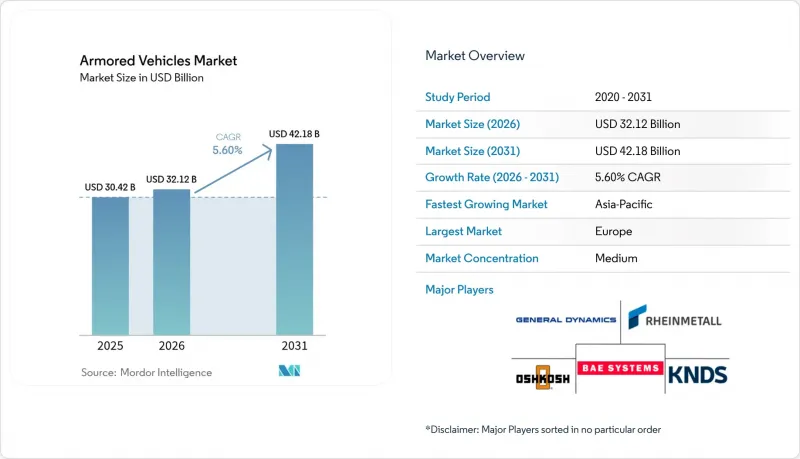
본 보고서는 플랫폼 유형(장갑병력수송차, 보병전투차, 지뢰·매복 공격 대책 차량, 주력 전차 등),이동 방식(바퀴식 및 트랙식), 추진 방식(기존 및 전기식), 최종 사용자(육군, 해병대/해군 보병 등), 그리고 지역(북미, 유럽, 아시아태평양 등)별로 분류되어 있습니다. 시장 예측은 금액(달러) 기준으로 제시되어 있습니다.
전 세계 장갑차 시장 동향 및 인사이트
NATO 및 아시아의 급속한 장비 현대화 프로그램
나토(NATO) 회원국들은 지난 30년간 이어져 온 장비 감축 추세를 뒤집고, 중장갑 차량 보유에 사상 최대 규모의 자금을 투입하고 있습니다. 독일은 국방비를 GDP의 5%로 인상하고, 수십억 달러 규모의 ‘복서(Boxer)’ 및 ‘파트리아(Patria)’ 차량을 발주하고 있어, 이로 인해 유럽의 전력 구조가 재편될 전망입니다. 폴란드는 기존의 서방 경로 이외의 납품을 신속히 진행하기 위해 한국산 K2 전차에 65억 달러를 투자했습니다. 네덜란드는 46대의 ‘레오파르트 2A8’로 구성된 전차 대대를 재조합하고 있으며, 한때 전차를 폐지했던 국가들조차 현재는 궤도식 장갑차를 필수적인 것으로 간주하고 있음이 부각되고 있습니다. 인도의 ‘퓨처 레디 컴뱃 비클(Future Ready Combat Vehicle)’ 계획에 따른 아시아 지역 1,770대의 조달 요청과 중국에서 진행 중인 99A형 전차 업그레이드 작업은 수요가 동시에 급증하고 있음을 보여줍니다. 이러한 동시적인 발주는 수년에 걸친 생산 붐을 뒷받침하고 있으며, OEM 각사는 전 세계 프로그램 전반에 걸쳐 새로운 용접 공장, 로봇 도장 라인, 모듈식 디지털 조립 공구에 대한 투자를 상각할 수 있게 됩니다.
우크라이나 분쟁 이후 지상전 수요 증가
우크라이나 전쟁은 대등한 세력 간의 전쟁에서 장갑차가 중심적인 역할을 한다는 사실을 재확인시켜 주었습니다. 키예프가 23,000대의 차량을 필요로 했다는 사실은 전장에서의 소모율이 극히 높음을 보여주었으며, NATO의 계획 담당자들은 재고를 면밀히 검토할 수밖에 없었고, 보충 주문을 가속화할 수밖에 없게 되었습니다. 생존성의 격차가 드러나고 실전에서의 유효성이 확인된 후, 미국의 브래들리 전차 부대를 대상으로 3,700만 달러 규모의 ‘아이언 피스트(Iron Fist)’ 능동 방어 시스템(APS) 계약이 체결되는 등 개량이 진행되고 있습니다. 한때 10-15년으로 여겨졌던 조달 주기가 3-5년으로 단축되면서, 주요 제조업체들은 생산 능력을 앞당겨 확보할 수밖에 없게 되었고, 각국 정부도 본격적인 생산 라인이 가동될 때까지 단계적인 업그레이드를 수용할 수밖에 없는 상황에 처해 있습니다.
급등하는 단가와逼迫하는 국방 예산
현대 장갑 플랫폼의 가격은 이미 8자리 수를 훌쩍 넘는 수준에 도달했습니다. M10 부커의 단가는 1대당 1,900만 달러까지 상승했으며, 독일의 레오파드 2A8 구매 총액은 105대로 29억 유로(33억 5,000만 달러)에 달하고,, 재정 여유가 있는 국가들조차 예산에 부담을 주고 있습니다. 미 육군의 2025년 부대 구성 재검토에서는 지출을 억제하기 위해 여러 차량 생산 라인이 중단되었고, 스트라이커의 수주량도 감축되었습니다. 소국들은 차량의 수명을 연장하거나, 모로코가 50대의 M-ATV를 도입한 것처럼 잉여 MRAP를 조달함으로써 신규 제조 대기 줄을 피하고 있습니다. 금리 상승과 인플레이션이 재정적 우려를 더욱 심화시키고 있어, 각국 국방부는 항공 전력, 드론, 지상 부대 장비 갱신 사이에서 절충안을 마련해야 하는 상황에 직면해 있습니다.
부문 분석
2025년, IFV(보병전투차)는 장갑차 시장의 34.12%를 차지하며 기계화 여단의 핵심 자산으로 남아 있습니다. 그 병력 수송 능력과 30-50mm 포의 균형은 발트해의 산림 지대에서 인도-태평양 연안 지역에 이르기까지 통합 병과 전술을 뒷받침하고 있습니다. 각국은 상황 인식 시스템과 무인 항공기 표적을 대응하기 위한 프로그래밍 가능한 공중 폭파탄을 도입하여 구형 차량의 현대화를 추진하고 있습니다. 레오나르도의 이베코 디펜스 인수 등 공급업체의 통합을 통해 포탑 통합이 효율화되면서, 장갑차 시장은 표준화된 디지털 기반으로 나아갈 것으로 예측됩니다.
우크라이나 전쟁의 교훈을 통해 화력보다 병력 보호가 더욱 중요시됨에 따라, 장갑병력수송차(APC) 시장은 연평균 성장률(CAGR) 6.95%로 확대되고 있습니다. V자형 차체와 폭발 충격 완화 시트를 갖춘 경량 MRAP(대지 공격 장갑차)가 경찰 특수작전부대의 장비로 도입되기 시작했으며, 이러한 파급 효과로 인해 방위성 이외의 분야에서도 수익원이 다양화되고 있습니다. 주력 전차(MBT)의 경우, 전차 수 증가보다는 현대화가 추진되고 있으며, 능동 방어 키트와 센서의 도입을 통해 플랫폼의 유용성이 유지되고 있습니다. 경정찰 차량은 신속한 공격 임무에 대한 틈새 수요를 흡수하고 있으며, AI를 활용한 승무원 지원 시스템을 통합함으로써 조작원의 작업 부담을 경감시키고 있습니다.
2025년에는 장갑차 시장의 72.63%를 바퀴식 차량이 차지할 것으로 예상되며, 이러한 우위는 전차 운반차 없이도 포장 도로망을 자력으로 주행할 수 있는 능력에 기인합니다. NATO의 신속 대응 여단은 고속도로 수준의 속도로 주행하면서 확장 가능한 장갑 패키지를 제공하는 8×8 섀시를 선호합니다. 장갑차 시장 동향에서는 다양한 지형을 주행하기 위해 독립 서스펜션, 런플랫 타이어, 중앙 집중식 타이어 공기압 조절 시스템이 중요시되고 있습니다.
트랙식 플랫폼은 그 수가 적긴 하지만, 군이 전지형 대응 능력과 탠덤 탄두에 의한 위협에 대한 강력한 전면 방어의 필요성을 재인식함에 따라 연평균 성장률(CAGR) 8.65%로 회복세를 보이고 있습니다. 최신 트랙에는 오프로드에서의 견인력을 유지하면서 포장 도로에서의 내구성을 높이는 부문화된 고무 복합 패드가 채택되고 있습니다. 이 두 가지 기동성을 병용함으로써 지휘관은 임무 부대를 유연하게 편성할 수 있게 되며, 이러한 유연성이 미래 작전 교리의 기반이 되고 있습니다.
지역별 분석
2025년 장갑차 시장 매출 중 42.41%를 유럽이 차지했습니다. 이는 독일의 ‘복서(Boxer)’ 및 ‘파트리아(Patria)’에 대한 사상 최대 규모의 수주에 더해, 북유럽 국가들의 컨소시엄을 통한 구매가 주도한 결과입니다. 동유럽 국가들은 GDP의 3% 이상을 국방비로 충당하고 있으며, 그 자금을 제5조에 근거한 억지력을 강화하기 위한 궤도식 차량 도입에 사용하고 있습니다. 서방 국가들은 역외 전개용으로 바퀴식 차량을 중시하고 있으며, 전략적 수송 능력의 경제성과 시가지에서의 기동성을 양립시키고 있습니다.
아시아태평양은 연평균 성장률(CAGR) 6.98%로 가장 빠르게 성장하고 있습니다. 인도의 1,750대, 6,000억 루피(72억 달러) 규모의 ‘차세대 보병전투차(FICV)’ 입찰과 중국의 99A식 단계적 업그레이드가 지역 시스템 통합사업자에 활력을 불어넣고 있습니다. 일본은 10식 전차 부대를 보완하기 위해 바퀴식 모듈형 섀시 도입을 검토하고 있으며, 호주는 ‘랜드 400 3단계’로 무게중심을 옮겨 보병의 근접 전투 능력을 강화하고 있습니다.
북미에서는 AI 미션 코어와 하이브리드 구동계를 탑재한 XM30 및 JLTV A2 프로그램을 중심으로 꾸준한 현대화 예산이 유지되고 있습니다. 캐나다는 LAV 6.0의 노후화로 인한 손실을 국산 모델로 보충하며, 공급망의 자립성을 확보하고 있습니다. 멕시코는 국내 치안 유지를 위해 개조된 MRAP에 투자하고 있으며, 이는 소규모이긴 하지만 안정적인 애프터마켓을 형성하고 있습니다.
중동에서는 2025년 사우디아라비아의 국방비로 780억 달러가 배정되었으며, 여기에는 사막전에 특화된 미래의 ‘AyM 2030’ 기갑 부대 구상도 포함되어 있습니다. 걸프 지역 구매자들은 모래 언덕에서의 기동성을 높이는 높은 출력 대 중량비와 능동 냉각 키트를 중요하게 여기고 있습니다. 아프리카에서는 미국으로부터의 잉여 방위 장비(EDA)나 개조 프로젝트를 통해 잉여 차량을 조달하는 등, 여전히 기회를 포착한 대응이 이어지고 있습니다.
기타 혜택:
- 엑셀 형식 시장 예측(ME) 시트
- 3개월간의 애널리스트 지원
자주 묻는 질문
목차
제1장 서론
제2장 조사 방법
제3장 주요 요약
제4장 시장 구도
제5장 시장 규모와 성장 예측
제6장 경쟁 구도
제7장 시장 기회와 향후 전망
LSH 26.08.25According to Mordor Intelligence, the armored vehicles market size is expected to grow from USD 30.42 billion in 2025 to USD 32.12 billion in 2026 and is forecast to reach USD 42.18 billion by 2031 at 5.6% CAGR over 2026-2031.
This report is Segmented by Platform Type (Armored Personnel Carrier, Infantry Fighting Vehicle, Mine-Resistant Ambush-Protected, Main Battle Tank, and More), Mobility (Wheeled and Tracked), Propulsion (Conventional and Electric), End-User (Army, Marine/Naval Infantry, and More), and Geography (North America, Europe, Asia-Pacific, and More). The Market Forecasts are Provided in Terms of Value (USD).
Global Armored Vehicles Market Trends and Insights
Rapid Recapitalization Programs in NATO and Asia
NATO members inject a record amount of funds into their heavy-armor fleets, reversing three decades of drawdowns. Germany increased its defense spending to 5% of GDP and placed multi-billion-dollar orders for Boxer and Patria vehicles, which will reshape the European force structure. Poland directed USD 6.5 billion toward K2 tanks from South Korea to speed deliveries outside traditional Western channels. The Netherlands reactivated a tank battalion with 46 Leopard 2A8 units, highlighting how even former post-tank nations now regard tracked armor as indispensable. India's Future Ready Combat Vehicle call for 1,770 platforms in Asia, combined with China's ongoing Type 99A upgrades, signals a parallel surge in demand. The synchronized orders underpin a multi-year production boom that allows OEMs to amortize new welding halls, robotic paint lines, and modular digital-assembly tooling across global programs.
Elevated Land-Warfare Demand Post-Ukraine Conflict
The Ukraine war has affirmed the centrality of armored vehicles in peer warfare. Kyiv's need for 23,000 vehicles demonstrated extreme battlefield burn rates, forcing NATO planners to audit inventories and accelerate backfill orders. Survivability gaps became clear, driving retrofits such as the USD 37 million Iron Fist APS award for US Bradley fleets after combat validation. Once set at 10-15 years, procurement cycles are collapsing to 3-5 years, compelling primes to front-load production capacity and governments to accept incremental upgrades while full-rate lines are ramping up.
Ballooning Unit Costs and Stretched Defense Budgets
Modern armor platforms now cost well into eight figures. The M10 Booker price has climbed to USD 19 million per unit, while Germany's Leopard 2A8 buy totals EUR 2.9 billion (USD 3.35 billion) for 105 tanks, squeezing even affluent treasuries. The US Army's 2025 force-structure reset cancelled multiple vehicle lines and trimmed Stryker orders to cap spending. Smaller nations are extending the service lives of their vehicles or sourcing surplus MRAPs, as Morocco did with 50 M-ATVs, thereby bypassing new-build queues. Rising interest rates and inflation compound affordability concerns, forcing ministries to trade off between airpower, drones, and ground-force recapitalization.
Other drivers and restraints analyzed in the detailed report include:
- Wheeled 8X8 Platforms Favored for Expeditionary Operations
- Battlefield Electrification and Silent-Watch Capability
- Industrial Supply-Chain Chokepoints in Armor Ceramics
For complete list of drivers and restraints, kindly check the Table Of Contents.
Segment Analysis
IFVs generated 34.12% of the armored vehicles market in 2025 and remain the centerpiece assets in mechanized brigades. Their balance of troop-carrying capacity and 30-50 mm cannons supports combined-arms tactics from the Baltic forests to the Indo-Pacific littorals. Nations are upgrading legacy fleets with situational-awareness suites and programmable airburst rounds that counter unmanned aerial targets. Supplier consolidation, such as Leonardo's takeover of Iveco Defence, is expected to streamline turret integration, steering the armored vehicle market toward a standard digital backbone.
APCs are expanding at a 6.95% CAGR, fueled by lessons from Ukraine that stress troop protection over firepower. Lightweight MRAP designs with V-hulls and blast-attenuating seats are entering police special-operations arsenals, a spillover that diversifies revenue beyond defense ministries. MBTs are undergoing modernization rather than fleet growth, with active-protection kits and sensors extending the platform's relevance. Light reconnaissance vehicles capture niche demand for rapid-strike missions, integrating AI-powered crew aids that reduce operator workload.
Wheeled designs held 72.63% of the armored vehicles market share in 2025, a dominance rooted in their ability to self-deploy over paved networks without tank transporters. NATO rapid-reaction brigades favor 8X8 chassis that cruise at highway speeds while offering scalable armor packages. The design trend in the armored vehicle market emphasizes independent suspension, run-flat tires, and central tire inflation to navigate mixed terrain.
Tracked platforms, though smaller in number, are rebounding at an 8.65% CAGR as armies relearn the need for cross-country mobility and heavy frontal protection against tandem-warhead threats. Modern tracks utilize segmented rubber composite pads that enhance road life while maintaining off-road traction. The hybrid fielding of both mobility types allows commanders to tailor task forces, a flexibility that underpins future doctrine.
Complete Report Scope:
- By Platform Type
- Armored Personnel Carriers (APCs)
- Infantry Fighting Vehicles (IFVs)
- Mine-Resistant Ambush-Protected (MRAP)
- Main Battle Tanks (MBTs)
- Light Protected/Recon Vehicles
- Others
- By Mobility
- Wheeled (4X4, 6X6, 8X8)
- Tracked
- By Propulsion
- Conventional
- Electric
- By End-User
- Army
- Marine/Naval Infantry
- Special Forces
- Homeland Security
- By Geography
- North America
- United States
- Canada
- Mexico
- Europe
- United Kingdom
- France
- Germany
- Russia
- Poland
- Rest of Europe
- Asia-Pacific
- China
- India
- Japan
- South Korea
- Australia
- Rest of Asia-Pacific
- South America
- Brazil
- Rest of South America
- Middle East and Africa
- Middle East
- Saudi Arabia
- United Arab Emirates
- Turkey
- Rest of Middle East
- Africa
- South Africa
- Rest of Africa
- Middle East
- North America
Geography Analysis
Europe accounted for 42.41% of the armored vehicles market revenue in 2025, driven by Germany's record orders for the Boxer and Patria, as well as purchases from Nordic consortiums. Eastern members allocate more than 3% of GDP to defense, channeling funds to tracked fleets that bolster Article 5 deterrence. Western states emphasize wheeled fleets for out-of-area deployments, blending strategic lift economy with urban maneuverability.
Asia-Pacific follows as the fastest climber at a 6.98% CAGR. India's Future Infantry Combat Vehicle tender for 1,750 units worth INR 600 billion (USD 7.2 billion) and China's Type 99A progressive upgrades energize regional integrators. Japan explores wheeled modular chassis to supplement its Type 10 tank fleet, and Australia pivots to Land 400 Phase 3, reinforcing its infantry close-combat edge.
North America maintains steady modernization budgets, anchored by the XM30 and JLTV A2 programs, which incorporate AI mission cores and hybrid drivetrains. Canada backfills LAV 6.0 attrition losses with domestically produced variants, ensuring supply-chain sovereignty. Mexico invests in refurbished MRAPs for internal security, representing a small but steady aftermarket.
The Middle East allocated USD 78 billion in Saudi defense outlays for 2025, including prospective AyM 2030 armored formations tailored for desert warfare. Gulf buyers prefer high power-to-weight ratios for dune mobility and active cooling kits. Africa remains opportunistic, sourcing surplus vehicles via US Excess Defense Articles and refurb projects.
- General Dynamics Corporation
- BAE Systems plc
- Rheinmetall AG
- KNDS N.V.
- Hanwha Systems Co., Ltd. (Hanwha Corporation)
- Oshkosh Corporation
- Textron Systems Corporation (Textron Inc.)
- Elbit Systems Ltd.
- Patria Group
- FNSS Savunma Sistemleri A.S.
- Otokar Otomotiv ve Savunma Sanayi A.S.
- Denel SOC Ltd.
- Saudi Arabian Military Industries
- Tata Advanced Systems Limited
- China North Industries Corporation (NORINCO)
- Singapore Technologies Engineering Ltd.
- Hyundai Rotem Company (Hyundai Motor Group)
- Mitsubishi Heavy Industries, Ltd.
- Paramount Group
- RTX Corporation
Additional Benefits:
- The market estimate (ME) sheet in Excel format
- 3 months of analyst support
TABLE OF CONTENTS
1 INTRODUCTION
- 1.1 Study Assumptions and Market Definition
- 1.2 Scope of the Study
2 RESEARCH METHODOLOGY
3 EXECUTIVE SUMMARY
4 MARKET LANDSCAPE
- 4.1 Market Overview
- 4.2 Market Drivers
- 4.2.1 Rapid recapitalization programs in NATO and Asia
- 4.2.2 Elevated land-warfare demand post-Ukraine conflict
- 4.2.3 Wheeled 8X8 platforms favored for expeditionary ops
- 4.2.4 Battlefield electrification and silent-watch capability
- 4.2.5 Modular active-protection system (APS) retrofits
- 4.2.6 IFV surge to modernize combined-arms doctrine
- 4.3 Market Restraints
- 4.3.1 Ballooning unit costs and stretched defense budgets
- 4.3.2 Industrial supply-chain chokepoints in armour ceramics
- 4.3.3 ESG pressure against heavy carbon-footprint fleets
- 4.3.4 Complex export-licensing/ITAR barriers
- 4.4 Value Chain Analysis
- 4.5 Regulatory Landscape
- 4.6 Technological Outlook
- 4.7 Porter's Five Forces Analysis
- 4.7.1 Threat of New Entrants
- 4.7.2 Bargaining Power of Buyers
- 4.7.3 Bargaining Power of Suppliers
- 4.7.4 Threat of Substitutes
- 4.7.5 Intensity of Competitive Rivalry
5 MARKET SIZE AND GROWTH FORECASTS (VALUE)
- 5.1 By Platform Type
- 5.1.1 Armored Personnel Carriers (APCs)
- 5.1.2 Infantry Fighting Vehicles (IFVs)
- 5.1.3 Mine-Resistant Ambush-Protected (MRAP)
- 5.1.4 Main Battle Tanks (MBTs)
- 5.1.5 Light Protected/Recon Vehicles
- 5.1.6 Others
- 5.2 By Mobility
- 5.2.1 Wheeled (4X4, 6X6, 8X8)
- 5.2.2 Tracked
- 5.3 By Propulsion
- 5.3.1 Conventional
- 5.3.2 Electric
- 5.4 By End-User
- 5.4.1 Army
- 5.4.2 Marine/Naval Infantry
- 5.4.3 Special Forces
- 5.4.4 Homeland Security
- 5.5 By Geography
- 5.5.1 North America
- 5.5.1.1 United States
- 5.5.1.2 Canada
- 5.5.1.3 Mexico
- 5.5.2 Europe
- 5.5.2.1 United Kingdom
- 5.5.2.2 France
- 5.5.2.3 Germany
- 5.5.2.4 Russia
- 5.5.2.5 Poland
- 5.5.2.6 Rest of Europe
- 5.5.3 Asia-Pacific
- 5.5.3.1 China
- 5.5.3.2 India
- 5.5.3.3 Japan
- 5.5.3.4 South Korea
- 5.5.3.5 Australia
- 5.5.3.6 Rest of Asia-Pacific
- 5.5.4 South America
- 5.5.4.1 Brazil
- 5.5.4.2 Rest of South America
- 5.5.5 Middle East and Africa
- 5.5.5.1 Middle East
- 5.5.5.1.1 Saudi Arabia
- 5.5.5.1.2 United Arab Emirates
- 5.5.5.1.3 Turkey
- 5.5.5.1.4 Rest of Middle East
- 5.5.5.2 Africa
- 5.5.5.2.1 South Africa
- 5.5.5.2.2 Rest of Africa
- 5.5.5.1 Middle East
- 5.5.1 North America
6 COMPETITIVE LANDSCAPE
- 6.1 Market Concentration
- 6.2 Strategic Moves
- 6.3 Market Share Analysis
- 6.4 Company Profiles (includes Global level Overview, Market level overview, Core Segments, Financials as available, Strategic Information, Market Rank/Share for key companies, Products and Services, and Recent Developments)
- 6.4.1 General Dynamics Corporation
- 6.4.2 BAE Systems plc
- 6.4.3 Rheinmetall AG
- 6.4.4 KNDS N.V.
- 6.4.5 Hanwha Systems Co., Ltd. (Hanwha Corporation)
- 6.4.6 Oshkosh Corporation
- 6.4.7 Textron Systems Corporation (Textron Inc.)
- 6.4.8 Elbit Systems Ltd.
- 6.4.9 Patria Group
- 6.4.10 FNSS Savunma Sistemleri A.S.
- 6.4.11 Otokar Otomotiv ve Savunma Sanayi A.S.
- 6.4.12 Denel SOC Ltd.
- 6.4.13 Saudi Arabian Military Industries
- 6.4.14 Tata Advanced Systems Limited
- 6.4.15 China North Industries Corporation (NORINCO)
- 6.4.16 Singapore Technologies Engineering Ltd.
- 6.4.17 Hyundai Rotem Company (Hyundai Motor Group)
- 6.4.18 Mitsubishi Heavy Industries, Ltd.
- 6.4.19 Paramount Group
- 6.4.20 RTX Corporation
7 MARKET OPPORTUNITIES AND FUTURE OUTLOOK
- 7.1 White-space and Unmet-Need Assessment