|
시장보고서
상품코드
2113696
태국의 석유 및 가스 업스트림 : 시장 점유율 분석, 업계 동향 및 통계, 성장 예측(2026-2031년)Thailand Oil And Gas Upstream - Market Share Analysis, Industry Trends & Statistics, Growth Forecasts (2026 - 2031) |
||||||
 Mordor Intelligence
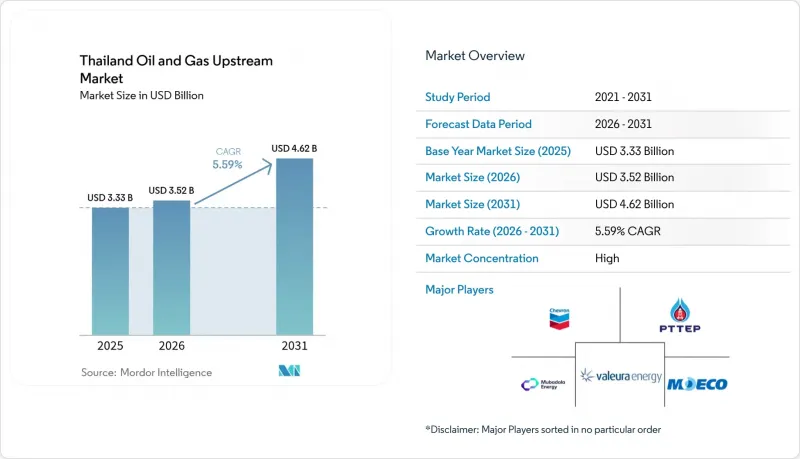
Mordor Intelligence에 의하면, 태국의 석유 및 가스 업스트림 시장 규모는 2025년에 33억 3,000만 달러로 평가되었습니다. 2026년 35억 2,000만 달러에서 2031년까지 46억 2,000만 달러에 이를 것으로 예상되며, 예측 기간(2026-2031년) CAGR은 5.59%를 나타낼 전망입니다.
본 보고서는 사업 지역(육상 및 해상), 자원 유형(원유·가스), 유정 유형(전통형 및 비전통형), 서비스(탐사, 개발·생산, 해체)별로 분류되어 있습니다. 시장 규모 및 전망은 금액(미 달러) 단위로 제시되어 있습니다.
태국의 석유 및 가스 업스트림 시장 동향 및 인사이트
에라완/본콧 가스 클러스터의 생산 확대
PTTEP는 2024년에 쉐브론의 국내 포트폴리오를 28억 달러에 인수하고, 즉시 시추 및 시설 개보수 작업을 시작했습니다. 이는 2026년까지 에라완 및 봉콧의 총 생산량을 800 MMSCFD로 끌어올리는 것을 목표로 하고 있습니다. 통합 관리를 통해 인접한 블록 간에 압축, 처리, 물류 자산을 공유함으로써 단위당 개발 비용을 추정치 기준 15-20% 절감했습니다. 태국의 ‘단일 풀 가스 가격’ 정책을 준수함으로써 예측 가능한 장기적인 수익률이 확보되었으며, 이를 통해 심층부 증산 기술을 도입할 수 있게 되어 유전 수명을 최대 10년까지 연장할 가능성이 있습니다. PTTEP의 AI·로보틱스·벤처 부문은 예측 유지보수용 드론과 엣지 분석 센서를 도입하여, 이를 통해 두 복합 시설에서 예기치 못한 가동 중단 시간을 이미 줄였습니다.
제24차 및 제25차 라이선싱 입찰과 생산분배계약(PSC)의 근본적인 재검토
2024년 규제 개혁을 통해 기존의 광구권에 더해 생산분배계약(PSC)이 도입되어, 국가 세수 확보와 투자자 이익 확대 간의 균형이 이루어졌습니다. 제24차 라운드에서 부여된 8개의 광구에는 21억 달러의 투자 확약이 모였으며, 제25차 라운드에서는 비전통적 기술에 특화된 16개의 육상 구역이 개방되었습니다. PSC의 구조는 가격이 급등할 때는 정부의 몫을 늘리면서, 침체기에는 사업자를 보호하는 것으로, 이러한 특징은 이익률이 낮고 수익성이 어려운 유전에 특히 매력적입니다. 환경 승인 절차가 합리화되고 표준화된 일정이 도입됨에 따라, 2024년 이전의 관행에 비해 탐사 개시까지의 평균 지연 기간이 40% 가까이 단축되었습니다.
성숙한 얕은 바다 유전에서의 생산량 감소
1980년부터 2010년 사이에 시추된 기존 유전의 경우, 저류층의 압력이 낮아짐에 따라 연간 8-12%의 감산율이 나타납니다. 수압 주입이나 압축 설비의 개량을 통해 감산 속도를 완화하는 것은 가능하지만, 공급량을 현 수준으로 유지하기 위해서만도 연간 200-300 MMCFD에 달하는 비용 대비 효과가 높은 대체 생산량이 필요합니다. 잔여 매장량은 더 조밀한 구역에 존재하며, 수평 시추나 선택적 자극 처리가 필요하지만, 현재 서비스 비용이 급등하는 상황에서는 이 모든 조치가 자본 집약적인 조치로 이어집니다.
부문별 분석
2025년 시점에서 태국의 석유 및 가스 업스트림 시장 규모의 89.10%를 해양 광구가 차지했으며, 2031년까지 연평균 성장률(CAGR) 5.78%를 나타낼 것으로 예측됩니다. 생산의 중심은 메콩만 연안 해역에 있으며, PTTEP사는 봉콧, 에라완, 알티트 각 광구를 광구 간 파이프라인과 공유 가스 처리 설비를 통해 통합함으로써 단위당 운영 비용(OPEX)을 절감하고 있습니다. 현재 평가 단계에 접어든 심해 유전으로 인해 태국의 석유 및 가스 업스트림 시장은 해저 완공 시스템 및 동적 위치 결정 시추 장비로 전환될 가능성이 있으며, 이에 따라 설비 투자(Capex) 수요는 증가할 것으로 보이며 자산의 수명은 연장될 전망입니다.
현재 생산량의 불과 10.90%를 차지하는 육상 광구는 새로운 생산분배계약(PSC)의 재정 제도의 혜택을 받고 있습니다. 탐사는 코랏 고원에 집중되어 있으며, 이 지역의 타이트 샌드층은 인근 국가들의 생산성이 높은 유사층과 유사합니다. 인프라는 연안 허브에 비해 뒤처져 있지만, 모듈식 처리 스키드와 트럭 운송을 통한 LNG가 파이프라인 연결성이 개선될 때까지 초기 상용화 단계의 공백을 메울 가능성이 있습니다.
2025년 공급량의 77.85%를 천연가스가 차지했습니다. 이는 전력 부문의 베이스로드 수요와 EGAT와의 확고한 인수 계약 덕분입니다. 동해안 전역에 걸친 가스 파이프라인 및 처리 플랜트의 장기적인 포화 상태로 인해, 경쟁 액체 연료의 가격 결정 요인으로서 천연가스의 입지가 확고해졌습니다. 원유의 연평균 성장률(CAGR) 5.66% 전망은 더 높은 원유 회수율을 자랑하는 심해 유전의 발견과, 총 액체 생산량을 향상시키기 위한 기존 유전의 2차 회수 프로그램에 기인합니다. 일부 심해 유망 지역의 높은 CO₂ 비율은 경제성을 복잡하게 만들고 있지만, 향후 가동 예정인 CCS 시설이 이러한 부정적 요인을 상쇄하고 새로운 자본을 유치할 가능성이 있습니다.
기타 혜택 :
- 엑셀 형식 시장 전망(ME) 시트
- 3개월간의 애널리스트 지원
자주 묻는 질문
목차
제1장 서론
제2장 조사 방법
제3장 주요 요약
제4장 시장 구도
제5장 시장 규모 및 성장 예측
제6장 경쟁 구도
제7장 시장 기회 및 향후 전망
KTH 26.08.26According to Mordor Intelligence, the Thailand oil and gas upstream market size was valued at USD 3.33 billion in 2025 and estimated to grow from USD 3.52 billion in 2026 to reach USD 4.62 billion by 2031, at a CAGR of 5.59% during the forecast period (2026-2031).
This report is Segmented by Location of Deployment (Onshore and Offshore), Resource Type (Crude Oil and Natural Gas), Well Type (Conventional and Unconventional), and Service (Exploration, Development and Production, and Decommissioning). The Market Sizes and Forecasts are Provided in Terms of Value (USD).
Thailand Oil And Gas Upstream Market Trends and Insights
Ramp-up of Erawan/Bongkot Gas Clusters
PTTEP closed its USD 2.8 billion acquisition of Chevron's domestic portfolio in 2024 and immediately began a drilling and facilities-upgrade campaign aimed at lifting combined output from Erawan and Bongkot to 800 MMSCFD by 2026. Integrated control has trimmed per-unit development costs an estimated 15-20% by sharing compression, processing, and logistics assets across neighboring blocks. Alignment with Thailand's Single Pool Gas Price policy secures predictable long-term margins, enabling enhanced recovery methods in deeper horizons that could stretch field life by up to 10 years. PTTEP's AI & Robotics Ventures unit deploys predictive-maintenance drones and edge-analytics sensors that have already reduced unplanned downtime across both complexes.
24th & 25th Licensing Rounds Plus PSC Overhaul
The 2024 regulatory reboot introduced production-sharing contracts beside legacy concessions, balancing state revenue capture with investor upside. Eight blocks awarded under the 24th round attracted USD 2.1 billion in committed spending, while the 25th round released 16 onshore areas tailored for unconventional techniques. The PSC construct raises government take during price peaks yet cushions operators during troughs, a feature that is especially attractive for tight-margin, marginal fields. Streamlined environmental approvals now include standardized timelines, reducing the average exploration start-up delay by almost 40% compared to the pre-2024 practice.
Declining Output from Mature Shallow-Water Fields
Legacy fields drilled between 1980 and 2010 are exhibiting annual decline rates of 8-12% as reservoir pressure drops. Although water-injection and compression upgrades can soften the descent, cost-effective replacement volumes of 200-300 MMCFD each year are still required merely to maintain a flat supply. Remaining reserves reside in tighter compartments, demanding horizontal wells and selective stimulation, both of which are capital-intensive under today's service-cost inflation.
Other drivers and restraints analyzed in the detailed report include:
- LNG-Price Volatility Pushing Domestic Upstream
- CCS/EGR Pilots Unlocking Stranded Reserves
- Lengthy EIA & Community-Consultation Cycles
For complete list of drivers and restraints, kindly check the Table Of Contents.
Segment Analysis
Offshore acreage accounted for 89.10% of Thailand's oil and gas upstream market size in 2025 and is expected to grow at a 5.78% CAGR through 2031. Production is anchored in shallow Gulf waters, where PTTEP integrates Bongkot, Erawan, and Arthit through cross-field pipelines and shared gas-processing trains, thereby driving down unit operating expenses (opex). Deeper plays now entering appraisal may tilt the Thailand oil and gas upstream market toward subsea completion systems and dynamic positioning rigs, lifting capex requirements yet lengthening asset life.
Onshore prospects, which account for just 10.90% of current output, benefit from the new PSC fiscal regime. Exploration focuses on the Khorat Plateau, where tight-sand formations mirror productive analogs in neighboring countries. While infrastructure lags coastal hubs, modular processing skids and trucked LNG could bridge early commercialization gaps until pipeline connectivity improves.
Natural gas supplied 77.85% of 2025 volumes thanks to power-sector baseload demand and firm offtake contracts with EGAT. The long-term saturation of gas pipelines and processing plants across the Eastern Seaboard solidifies gas as the price setter for competing liquid barrels. Crude's 5.66% CAGR outlook stems from deeper-water finds holding higher oil cuts and from brownfield secondary-recovery programs aimed at lifting aggregate liquids yield. High CO2 ratios in some deep prospects complicate economics, yet upcoming CCS facilities could neutralize these penalties and attract new capital.
Complete Report Scope:
- By Location of Deployment
- Onshore
- Offshore
- By Resource Type
- Crude Oil
- Natural Gas
- By Well Type
- Conventional
- Unconventional
- By Service
- Exploration
- Development and Production
- Decommissioning
List of Companies Covered in this Report:
- PTT Exploration & Production (PTTEP)
- Chevron Thailand E&P
- Valeura Energy
- Mitsui Oil Exploration (MOECO)
- Mubadala Energy Thailand
- Palang Sophon Ltd.
- KrisEnergy
- TotalEnergies SE
- Schlumberger (SLB)
- Halliburton
- Baker Hughes
- Weatherford
- Saipem
- TechnipFMC
- McDermott
- KBR
- Subsea 7
- EMAS Energy Services (Thailand)
- Bangchak Corp. (Upstream JV)
- PT Pertamina (Thai JDA partner)
Additional Benefits:
- The market estimate (ME) sheet in Excel format
- 3 months of analyst support
TABLE OF CONTENTS
1 Introduction
- 1.1 Study Assumptions & Market Definition
- 1.2 Scope of the Study
2 Research Methodology
3 Executive Summary
4 Market Landscape
- 4.1 Market Overview
- 4.2 Market Drivers
- 4.2.1 Ramp-up of Erawan/Bongkot gas clusters
- 4.2.2 24th & 25th Licensing Rounds plus PSC overhaul
- 4.2.3 LNG-price volatility pushing domestic upstream
- 4.2.4 CCS / EGR pilots unlocking stranded reserves
- 4.2.5 AI-augmented re-processing of legacy seismic
- 4.2.6 Modular tie-back of marginal gas pockets
- 4.3 Market Restraints
- 4.3.1 Declining output from mature shallow-water fields
- 4.3.2 Lengthy EIA & community-consultation cycles
- 4.3.3 High-CO2 content in new discoveries
- 4.3.4 Petroleum-engineering talent flight to renewables
- 4.4 Supply-Chain Analysis
- 4.5 Technological Outlook
- 4.6 Regulatory Landscape
- 4.7 Crude-Oil Production & Consumption Outlook
- 4.8 Natural-Gas Production & Consumption Outlook
- 4.9 Unconventional Resources CAPEX Outlook (tight oil, oil sands, deep-water)
- 4.10 Porter's Five Forces
- 4.10.1 Threat of New Entrants
- 4.10.2 Bargaining Power of Suppliers
- 4.10.3 Bargaining Power of Buyers
- 4.10.4 Threat of Substitutes
- 4.10.5 Competitive Rivalry
- 4.11 PESTLE Analysis
5 Market Size & Growth Forecasts
- 5.1 By Location of Deployment
- 5.1.1 Onshore
- 5.1.2 Offshore
- 5.2 By Resource Type
- 5.2.1 Crude Oil
- 5.2.2 Natural Gas
- 5.3 By Well Type
- 5.3.1 Conventional
- 5.3.2 Unconventional
- 5.4 By Service
- 5.4.1 Exploration
- 5.4.2 Development and Production
- 5.4.3 Decommissioning
6 Competitive Landscape
- 6.1 Market Concentration
- 6.2 Strategic Moves (M&A, Partnerships, PPAs)
- 6.3 Market Share Analysis (Market Rank/Share for key companies)
- 6.4 Company Profiles (includes Global level Overview, Market level overview, Core Segments, Financials as available, Strategic Information, Products & Services, and Recent Developments)
- 6.4.1 PTT Exploration & Production (PTTEP)
- 6.4.2 Chevron Thailand E&P
- 6.4.3 Valeura Energy
- 6.4.4 Mitsui Oil Exploration (MOECO)
- 6.4.5 Mubadala Energy Thailand
- 6.4.6 Palang Sophon Ltd.
- 6.4.7 KrisEnergy
- 6.4.8 TotalEnergies SE
- 6.4.9 Schlumberger (SLB)
- 6.4.10 Halliburton
- 6.4.11 Baker Hughes
- 6.4.12 Weatherford
- 6.4.13 Saipem
- 6.4.14 TechnipFMC
- 6.4.15 McDermott
- 6.4.16 KBR
- 6.4.17 Subsea 7
- 6.4.18 EMAS Energy Services (Thailand)
- 6.4.19 Bangchak Corp. (Upstream JV)
- 6.4.20 PT Pertamina (Thai JDA partner)
7 Market Opportunities & Future Outlook
- 7.1 White-space & Unmet-need Assessment