|
시장보고서
상품코드
2113926
석유 및 가스 분야 설비 투자(CAPEX) : 시장 점유율 분석, 업계 동향 및 통계, 성장 예측(2026-2031년)Oil And Gas CAPEX - Market Share Analysis, Industry Trends & Statistics, Growth Forecasts (2026 - 2031) |
||||||
 Mordor Intelligence
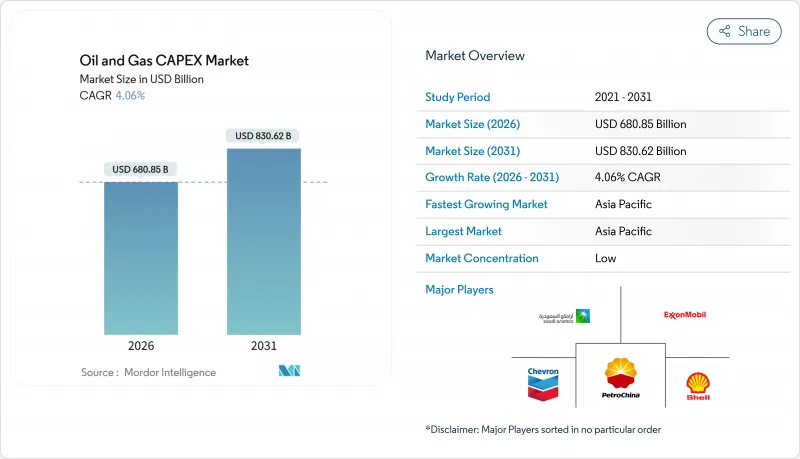
Mordor Intelligence에 의하면, 석유 및 가스 분야 설비 투자(CAPEX) 시장 규모는 2026년에 6,808억 5,000만 달러로 추정되고 예측 기간(2026-2031년) CAGR 4.06%로 확대되어 2031년에는 8,306억 2,000만 달러에 이를 전망입니다.
본 보고서는 부문별(업스트림 부문, 중류 부문, 하류 부문), 위치별(온쇼어, 오프쇼어), 자산 유형별(건설, 유지보수·턴어라운드, 해체), 지역별(북미, 유럽, 아시아태평양, 남미, 중동 및 아프리카)로 분류되어 있습니다. 시장 규모와 전망은 금액(달러)으로 표시되어 있습니다.
세계의 석유 및 가스 분야 설비 투자(CAPEX) 시장 동향 및 인사이트
LNG 대응 가스 인프라 확충
IEA는 2025년부터 2030년까지 계획된 연간 2,900억 입방미터의 신규 액화 능력을 추적하고 있으며, 이것이 중류 부문에 대한 투자 물결을 뒷받침하고 있습니다. 엑슨모빌(ExxonMobil)은 2026년에 모잠비크 LNG 프로젝트를 재개하기 위해 300억 달러를 재투자하기로 결정한 반면, 우드사이드(Woodside)는 2029년 가동이 예상되는 루이지애나주의 수출 시설에 175억 달러의 투자를 승인했습니다. 아시아의 구매자들은 계속해서 15-20년짜리 오프테이크 계약을 체결하고 있으며, 이를 통해 프로젝트 파이낸싱의 위험이 완화되고 부채 대 자기자본 비율이 70 대 30을 초과할 수 있게 되었습니다. 레이크 찰스 LNG는 2025년 말에 기계적 준공을 맞이하여 연간 1,650만 톤(mtpa)의 정격 생산 능력이 추가되었습니다. 플라크민스 LNG에서도 유사한 이정표가 달성되어, 세계 수급 균형이 타이트해지면서 2020년대 말까지 건설 수주 잔고가 유지될 전망입니다.
심해에서의 발견 증가가 FID를 뒷받침
수심 1,500미터를 초과하는 해역의 프로젝트에서는 2024-2025년에 걸쳐 회수 가능 매장량 150억 배럴에 상당하는 최종 투자 결정(FID)이 내려졌습니다. 페트로브라스는 부지오스 11호와 아타프 3호의 FPSO(부유식 생산·저장·하역 설비)를 승인했습니다. 이들 모두 하루 18만 배럴의 처리 능력을 갖추고 있으며, 표준화된 선체를 채택함으로써 제조 기간을 18개월 단축했습니다. 쉘(Shell)은 미국 멕시코만 ‘스파르타(Sparta)’ 프로젝트를 배럴당 35달러의 손익분기점으로 추진했으며, BP는 해저 부스팅 기술을 활용해 최대 생산 기간을 5년 연장하는 ‘카스키다(Cascida)’ 프로젝트를 승인했습니다. 토탈에너지의 앙골라 ‘카미뇨’ 프로젝트는 해저에서 육지로의 전력 공급을 통합하여 플랫폼 발전기로 인한 배출을 제거하고 있습니다. 가이아나의 ‘위프테일’과 ‘해머헤드’ FPSO는 2027년까지 해당국의 생산 능력을 하루 120만 배럴 이상으로 끌어올릴 전망입니다.
브렌트유 가격 변동이 장기 프로젝트의 제약 요인으로 작용
2024-2025년에 브렌트 원유는 배럴당 70-95달러 범위에서 거래되었으며, 이는 많은 프론티어 심해 광구의 손익분기점을 밑돌았기 때문에 사업자들은 80억-100억 배럴 규모의 잠재 자원 개발을 연기하게 되었습니다. 유정당 1억 5,000만 달러를 초과하는 시추 비용과 6-8년의 공사 기간은 선물 곡선이 평탄해질 때 최종 투자 결정(FID)을 주저하게 만드는 요인이 됩니다. 독립 E&P 기업의 경우, 차입 비용이 최대 200 베이시스 포인트 상승하여 IRR 기준 허들 레이트가 15-18%로 상승했습니다. 자본은 단기 주기의 셰일 개발이나 브라운필드 개보수로 이동하고 있으며, 승인 건수가 회복되지 않을 경우 2030년대 초반에는 전 세계 공급이 제약받을 가능성이 있습니다.
부문별 분석
2025년에는 업스트림 부문이 73.24%의 점유율을 차지했으며, 이 부문의 석유 및 가스 분야 설비 투자(CAPEX) 시장 규모는 2031년까지 연평균 성장률(CAGR) 4.12%로 확대될 것으로 전망됩니다. 2024년에는 브라질, 미국 멕시코만, 앙골라, 가이아나에서 총 150억 배럴 규모의 심해 프로젝트에 대한 최종 투자 결정(FID)이 내려졌으며, 이들 프로젝트는 배럴당 비용을 절감하는 표준화된 FPSO 및 해저 시스템을 활용하고 있습니다. 국영 석유 기업들은 높은 투자 수준을 유지하고 있으며, 사우디 아람코, 페트로차, CNOOC 3개사만 해도 2024년 업스트림 부문 예산 총액이 1,300억 달러를 초과합니다.
디지털 트윈 플랫폼 도입을 통해 비용 초과분을 30-40% 절감하고, 병행 프로젝트에 투입할 자금을 확보하는 한편, 공사 기간을 최대 18개월 단축하고 있습니다. 수소 대응 파이프라인과 탄소 포집 허브가 미국 에너지부의 지원을 받고 있는 만큼, 중류 부문에 대한 투자는 견조한 추세를 보이고 있습니다. 아시아와 중동의 하류 복합 시설에서는 OECD 국가들의 휘발유 수요 감소에 대응하기 위해 정제와 석유화학을 통합하여 이익률을 15-20% 향상시키고 있습니다.
지역별 분석
아시아태평양은 2025년 지출의 29.36%를 차지했으며, 이 지역의 석유 및 가스 분야 설비 투자(CAPEX) 시장 규모는 2031년까지 연평균 성장률(CAGR) 4.83%로 확대될 것으로 예측됩니다. 중국석유천연기그룹(PetroChina)의 연간 예산 600억 달러와 중국해양석유(CNOOC)의 130억-140억 달러 규모의 해양 개발 프로그램이 타이트 가스와 콘덴세이트의 성장 목표를 뒷받침하고 있습니다. 인도의 ONGC는 크리슈나-고다바리 자산에 86억 달러를 투자하고 있으며, 2030년까지 연간 1,000만 톤의 새로운 재기화 설비를 구축할 계획입니다. 우드사이드(Woodside)의 스카버러(Scarborough) 및 브라우즈(Browse) LNG 프로젝트는 연간 1,300만 톤의 생산 능력을 추가하는 한편, 파푸아뉴기니와 베트남에서는 가스투파워(GTP)의 통합 계획이 추진되고 있습니다.
북미와 유럽을 합치면 2025년 설비 투자(CAPEX)의 약 35%를 차지했으나, 기관 투자자들의 자금이 재생에너지로 이동함에 따라 성장은 둔화되었습니다. 미국은 퍼미안 분지의 1만 2,000개 유정과 루이지애나주 및 레이크찰스 지역의 우드사이드사의 연간 2,750만 톤 규모의 신규 LNG 생산 능력을 바탕으로 주도적인 위치를 유지하고 있습니다. 캐나다의 120억 달러 규모 오일샌드 확장 계획에서는 30년 규모의 SAGD 프로젝트가 우선시되고 있습니다. 유럽의 주요 기업들은 해상 풍력 발전 및 배터리 저장 설비에 자금을 조달하기 위해 2025년 석유 및 가스 분야 설비 투자(CAPEX)를 12% 감축했으나, 에퀴노르(Equinor)는 요한 카스트버그(Johan Kastberg) 프로젝트를 승인했으며, 수익성이 높은 노르웨이 바렌츠해 프로젝트에 대해서는 선별적으로 승인을 진행하고 있는 것으로 나타났습니다.
중동 및 아프리카는 전 세계 투자액의 25% 가까이를 차지하고 있습니다. 사우디 아람코(Saudi Aramco)의 500억 달러 규모 계획은 비전통적 자원 및 해양 생산 능력을 강화하는 한편, 카타르 에너지(Qatar Energy)의 노스 필드(North Field) 확장으로 2027년까지 연간 4,800만 톤의 LNG 생산 능력이 추가될 예정입니다. 앙골라의 카미뇨와 브라질의 부지오스 11은 심해 개발의 모멘텀을 보여주고 있으며, 가이아나의 추가 FPSO를 통해 하루 120만 배럴 이상의 생산 능력이 확보됨으로써 그 모멘텀이 더욱 보완되고 있습니다.
기타 혜택
- 엑셀 형식 시장 예측(ME) 시트
- 3개월간의 애널리스트 지원
자주 묻는 질문
목차
제1장 서론
제2장 조사 방법
제3장 주요 요약
제4장 시장 구도
제5장 시장 규모 및 성장 예측
제6장 경쟁 구도
제7장 시장 기회 및 향후 전망
KTH 26.08.26According to Mordor Intelligence, the oil and gas cAPEX market size is estimated at USD 680.85 billion in 2026, and is expected to reach USD 830.62 billion by 2031, at a CAGR of 4.06% during the forecast period (2026-2031).
This report is Segmented by Sector (Upstream, Midstream, and Downstream), Location (Onshore and Offshore), Service (Construction, Maintenance and Turn-Around, and Decommissioning), and Geography (North America, Europe, Asia-Pacific, South America, and Middle East and Africa). The Market Sizes and Forecasts are Provided in Terms of Value (USD).
Global Oil And Gas CAPEX Market Trends and Insights
Increasing LNG-Ready Gas Infrastructure Build-Out
IEA tracks 290 billion cubic meters per year of new liquefaction capacity slated for 2025-2030, underpinning a wave of midstream investment. ExxonMobil recommitted USD 30 billion to restart Mozambique LNG in 2026, while Woodside approved a USD 17.5 billion Louisiana export facility expected online in 2029. Asian buyers continue to sign 15-20-year offtake agreements, de-risking project finance and enabling debt-to-equity ratios above 70:30. Lake Charles LNG reached mechanical completion in late 2025, adding 16.5 million tonnes per annum (mtpa) of nameplate capacity. Similar milestones at Plaquemines LNG tighten global supply-demand balances and sustain construction backlogs through decade-end.
Rising Deep-Water Discoveries Driving FIDs
Projects in water depths beyond 1,500 meters received FIDs covering 15 billion barrels of recoverable reserves during 2024-2025. Petrobras sanctioned Buzios 11 and Atapu 3 FPSOs, each rated for 180,000 barrels per day, leveraging standardized hulls that cut fabrication time by 18 months. Shell advanced Sparta in the US Gulf of Mexico at a USD 35 per barrel breakeven, and BP approved Kaskida using subsea boosting to extend plateau production by five years. TotalEnergies' Kaminho project in Angola integrates subsea-to-shore power, eliminating platform-generator emissions. Guyana's Whiptail and Hammerhead FPSOs will lift national capacity beyond 1.2 million barrels per day by 2027.
Volatility in Dated Brent Discouraging Long-Cycle Projects
Brent traded between USD 70 and USD 95 per barrel across 2024-2025, below breakevens for many frontier deepwater prospects, leading operators to defer 8-10 billion barrels of potential resources. Drilling costs above USD 150 million per well and 6-8-year timelines deter FIDs when forward curves flatten. Independent E&P companies saw borrowing costs rise by up to 200 basis points, pushing hurdle rates to 15-18% IRR. Capital is shifting to short-cycle shale and brownfield upgrades, potentially constraining global supply in the early 2030s if sanctioning does not rebound.
Other drivers and restraints analyzed in the detailed report include:
- NOC Upstream Spending Rebound in Middle East & Asia
- Surge in Maintenance CAPEX to Decarbonize Brownfields
- ESG-Linked Debt Covenants Capping Fossil CAPEX Ceilings
For complete list of drivers and restraints, kindly check the Table Of Contents.
Segment Analysis
Upstream captured a 73.24% share in 2025, and the CAPEX oil & gas market size for this segment is forecast to grow at a 4.12% CAGR through 2031. Deepwater FIDs totaling 15 billion barrels in 2024 across Brazil, the US Gulf of Mexico, Angola, and Guyana capitalize on standardized FPSO and subsea systems that reduce per-barrel costs. National oil companies are sustaining high spend levels, with Saudi Aramco, PetroChina, and CNOOC together exceeding USD 130 billion in combined upstream budgets during 2024.
Digital-twin platforms deliver 30-40% reductions in cost overruns, freeing capital for parallel projects and shortening schedules by up to 18 months. Midstream investment remains steady as hydrogen-ready pipelines and carbon-capture hubs secure US Department of Energy support. Downstream complexes in Asia and the Middle East integrate refining and petrochemicals to improve margins by 15-20% in response to declining OECD gasoline demand.
Complete Report Scope:
- By Sector
- Upstream
- Midstream
- Downstream
- By Location
- Onshore
- Offshore
- By Asset Type
- Construction
- Maintenance and Turn-around
- Decommissioning
- By Geography
- North America
- United States
- Canada
- Mexico
- Europe
- Norway
- United Kingdom
- Russia
- Netherlands
- Germany
- Rest of Europe
- Asia Pacific
- China
- India
- Japan
- South Korea
- ASEAN Countries
- Australia
- Rest of Asia Pacific
- South America
- Brazil
- Argentina
- Colombia
- Rest of South America
- Middle East and Africa
- Saudi Arabia
- United Arab Emirates
- Qatar
- Nigeria
- South Africa
- Rest of Middle East and Africa
- North America
Geography Analysis
Asia-Pacific captured 29.36% of 2025 spending, and the CAPEX oil & gas market size in the region is forecast to grow at a 4.83% CAGR to 2031. PetroChina's USD 60 billion annual budget and CNOOC's USD 13-14 billion offshore program underpin tight-gas and condensate growth targets. India's ONGC invests USD 8.6 billion in Krishna-Godavari assets and plans 10 mtpa of new regasification capacity by 2030. Woodside's Scarborough and Browse LNG projects add 13 mtpa of capacity, while Papua New Guinea and Vietnam develop integrated gas-to-power schemes.
North America and Europe together accounted for roughly 35% of 2025 CAPEX but recorded slower growth as institutional capital pivots toward renewables. The United States maintains leadership through 12,000 Permian wells and 27.5 mtpa of new LNG capacity at Woodside, Louisiana, and Lake Charles. Canada's USD 12 billion oil-sands expansions prioritize 30-year SAGD projects. European majors trimmed oil and gas CAPEX 12% in 2025 to fund offshore wind and batteries, yet Equinor sanctioned Johan Castberg, showing selective approval for high-return Norwegian Barents projects.
The Middle East and Africa hold near-25% of global spending. Saudi Aramco's USD 50 billion program boosts unconventional and offshore capacity, while QatarEnergy's North Field expansion adds 48 mtpa of LNG by 2027. Angola's Kaminho and Brazil's Buzios 11 demonstrate deepwater momentum, complemented by Guyana's additional FPSOs raising capacity above 1.2 million barrels per day.
- Saudi Aramco
- Exxon Mobil Corporation
- Shell plc
- BP plc
- TotalEnergies SE
- Chevron Corporation
- PetroChina (CNPC)
- CNOOC Ltd
- Equinor ASA
- Petrobras
- ConocoPhillips
- ENI SpA
- Suncor Energy
- Occidental Petroleum
- Woodside Energy
- Lukoil PJSC
- ONGC
- Cairn Oil & Gas (Vedanta)
- QatarEnergy
- SLB (Schlumberger)
- Halliburton
Additional Benefits:
- The market estimate (ME) sheet in Excel format
- 3 months of analyst support
TABLE OF CONTENTS
1 Introduction
- 1.1 Study Assumptions & Market Definition
- 1.2 Scope of the Study
2 Research Methodology
3 Executive Summary
4 Market Landscape
- 4.1 Market Overview
- 4.2 Market Drivers
- 4.2.1 Increasing LNG-ready gas infrastructure build-out
- 4.2.2 Rising deep-water discoveries driving FIDs
- 4.2.3 NOC upstream spending rebound in Middle East & Asia
- 4.2.4 Surge in "maintenance CAPEX" to decarbonise brownfields
- 4.2.5 Digital twin roll-outs cutting project overruns
- 4.2.6 Sub-1 MW modular FLNG attracting small-field sanctioning
- 4.3 Market Restraints
- 4.3.1 Volatility in Dated Brent discouraging long-cycle projects
- 4.3.2 Policy pivots toward renewables in OECD
- 4.3.3 Scarcity-pricing of Tier-1 EPC labour elevating costs
- 4.3.4 ESG-linked debt covenants capping fossil CAPEX ceilings
- 4.4 Supply-Chain Analysis
- 4.5 Regulatory Landscape
- 4.6 Technological Outlook
- 4.7 Crude-Oil Production and Consumption Outlook
- 4.8 Natural-Gas Production and Consumption Outlook
- 4.9 Installed Pipeline Capacity Analysis
- 4.10 Unconventional Resources CAPEX Outlook (tight oil, oil sands, deep-water)
- 4.11 Porter's Five Forces
- 4.11.1 Bargaining Power of Suppliers
- 4.11.2 Bargaining Power of Buyers
- 4.11.3 Threat of New Entrants
- 4.11.4 Threat of Substitutes
- 4.11.5 Intensity of Rivalry
5 Market Size & Growth Forecasts
- 5.1 By Sector
- 5.1.1 Upstream
- 5.1.2 Midstream
- 5.1.3 Downstream
- 5.2 By Location
- 5.2.1 Onshore
- 5.2.2 Offshore
- 5.3 By Asset Type
- 5.3.1 Construction
- 5.3.2 Maintenance and Turn-around
- 5.3.3 Decommissioning
- 5.4 By Geography
- 5.4.1 North America
- 5.4.1.1 United States
- 5.4.1.2 Canada
- 5.4.1.3 Mexico
- 5.4.2 Europe
- 5.4.2.1 Norway
- 5.4.2.2 United Kingdom
- 5.4.2.3 Russia
- 5.4.2.4 Netherlands
- 5.4.2.5 Germany
- 5.4.2.6 Rest of Europe
- 5.4.3 Asia Pacific
- 5.4.3.1 China
- 5.4.3.2 India
- 5.4.3.3 Japan
- 5.4.3.4 South Korea
- 5.4.3.5 ASEAN Countries
- 5.4.3.6 Australia
- 5.4.3.7 Rest of Asia Pacific
- 5.4.4 South America
- 5.4.4.1 Brazil
- 5.4.4.2 Argentina
- 5.4.4.3 Colombia
- 5.4.4.4 Rest of South America
- 5.4.5 Middle East and Africa
- 5.4.5.1 Saudi Arabia
- 5.4.5.2 United Arab Emirates
- 5.4.5.3 Qatar
- 5.4.5.4 Nigeria
- 5.4.5.5 South Africa
- 5.4.5.6 Rest of Middle East and Africa
- 5.4.1 North America
6 Competitive Landscape
- 6.1 Market Concentration
- 6.2 Strategic Moves (M&A, Partnerships, PPAs)
- 6.3 Market Share Analysis (Market Rank/Share for key companies)
- 6.4 Company Profiles (includes Global level Overview, Market level overview, Core Segments, Financials as available, Strategic Information, Products & Services, and Recent Developments)
- 6.4.1 Saudi Aramco
- 6.4.2 Exxon Mobil Corporation
- 6.4.3 Shell plc
- 6.4.4 BP plc
- 6.4.5 TotalEnergies SE
- 6.4.6 Chevron Corporation
- 6.4.7 PetroChina (CNPC)
- 6.4.8 CNOOC Ltd
- 6.4.9 Equinor ASA
- 6.4.10 Petrobras
- 6.4.11 ConocoPhillips
- 6.4.12 ENI SpA
- 6.4.13 Suncor Energy
- 6.4.14 Occidental Petroleum
- 6.4.15 Woodside Energy
- 6.4.16 Lukoil PJSC
- 6.4.17 ONGC
- 6.4.18 Cairn Oil & Gas (Vedanta)
- 6.4.19 QatarEnergy
- 6.4.20 SLB (Schlumberger)
- 6.4.21 Halliburton
7 Market Opportunities & Future Outlook
- 7.1 White-space & Unmet-Need Assessment