|
시장보고서
상품코드
2120709
중국의 석유 및 가스 업스트림 : 시장 점유율 분석, 업계 동향과 통계, 성장 예측(2026-2031년)China Oil And Gas Upstream - Market Share Analysis, Industry Trends & Statistics, Growth Forecasts (2026 - 2031) |
||||||
 Mordor Intelligence
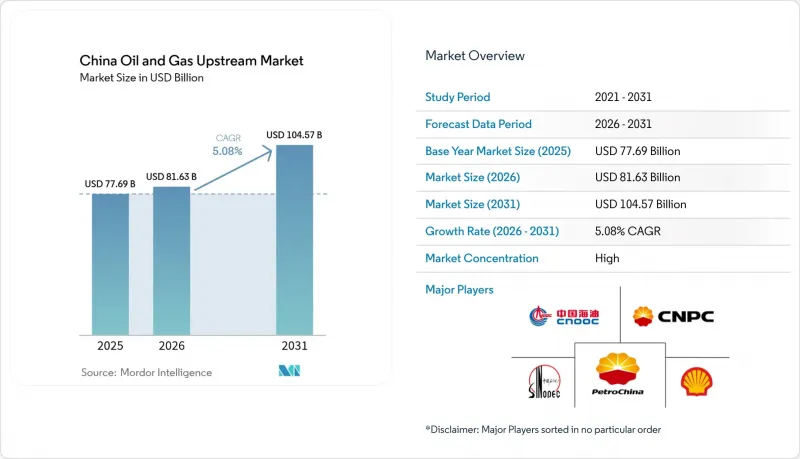
중국의 석유 및 가스 업스트림 시장 규모는 2025년에 776억 9,000만 달러로 평가되며, 2026년 816억 3,000만 달러에서 2031년까지 1,045억 7,000만 달러에 달할 것으로 예측되며, 예측 기간(2026-2031년) 동안 CAGR은 5.08%가 될 전망입니다.
본 보고서는 개발 지역(육상 및 해상), 자원 유형(원유 및 천연가스), 유정 유형(전통형 및 비전통형), 서비스(탐사, 개발·생산 및 폐광 조치)별로 분류되어 있습니다. 시장 규모 및 전망은 금액(달러)으로 표시되어 있습니다.
중국 석유 및 가스 업스트림 시장의 동향 및 분석
새로운 초심해 석유·가스전 발견
수심 6,000미터를 초과하는 지층에서 대규모 발견이 이루어짐에 따라, 중국의 석유 및 가스 업스트림 시장에 대한 전망이 재평가되었습니다. 중국석유천연가스그룹(CNPC)의 푸만(Fuman) 유전은 탈림 분지의 수심 8,400미터 지점의 유정에서 하루 2,000배럴의 생산을 달성하여, 극심부 저류층에서의 상업적 타당성 가능성을 입증했습니다. 쓰촨성의 안위에(Anyue) 가스전은 2024년에 5,000억 m³의 확인 매장량을 추가하며, 국내 최대의 비전통적 가스 자산이 되었습니다. 이러한 발견으로 2030년까지 수입 의존도를 10분의 1 수준으로 낮출 가능성이 있으며, 동시에 고압 시추 전문 기술을 해외 시장에 수출하는 계기가 될 것입니다. 규제 측면에서도 상당한 진전이 있습니다. 2024년에는 중국 서부에서 15개의 탐사 블록이 개설되어, 예측 기간 동안 자원 수익화가 더욱 진행될 것으로 보입니다. 장비 공급업체들은 고성능 시추 장비에 대한 수요 증가의 혜택을 누리고 있으며, 지방 정부는 지역 경제를 뒷받침할 새로운 로열티 수입을 기대하고 있습니다.
중국 국영 석유 기업(NOC)의 업스트림 부문 투자 확대
2024년에는 국영 석유 기업(NOC)들이 지정학적 충격으로부터 공급망을 보호하기 위해 설비 투자를 급격히 늘렸습니다. 중국석유화공(Sinopec)은 업스트림 부문 지출을 15% 증가한 380억 달러로 늘려, 증산 기술의 시범 사업과 디지털 인프라에 자금을 투입했습니다. 중국해양석유(CNOOC)는 남중국해 및 보하이만 심해 프로젝트에 220억 달러를 투자하며, 해양 분야 성장에 대한 의지를 강조했습니다. 2024년에 승인된 총 950억 달러 규모의 국가 프로젝트는 국내 생산 확대에 대한 정책적 지원을 더욱 뒷받침하고 있습니다. 비용 관리도 개선되어, 표준화된 시추 플랫폼과 모듈식 육상 시설의 도입으로 배럴당 개발 비용이 최대 18% 절감되었습니다. 현금 흐름의 증가는 재투자 주기를 가속화하여, 중국의 석유 및 가스 업스트림 시장의 성장 패턴을 공고히 하고 있습니다.
가격 변동과 OPEC+의 공급 조치
원유 가격 변동은 예산 편성의 불확실성을 야기하고, 최종 투자 결정을 지연시키며, 자유 현금 흐름에 압박을 가하고 있습니다. 2024년 하반기 OPEC+의 감산 조치로 브렌트 원유 가격은 배럴당 95달러 가까이 상승하여 수익은 증가했으나, 국내 정제 마진은 축소되었습니다. 심해 프로젝트에는 여전히 과제가 남아 있습니다. 12건의 개발 프로젝트가 배럴당 70달러를 넘는 가격 안정화를 기다리고 있습니다. 중국의 국영 석유 회사(NOC)는 생산량의 40-60%를 헤지하고 있지만, 파생상품 시장이 미성숙하여 그 효과는 제한적입니다. 충격을 완화하기 위해 규제 당국은 국내산 원유에 대해 배럴당 60달러의 최저 가격을 의무화하고 있으며, 이를 통해 고비용 자산에 미치는 영향을 완화하고 있습니다. 그럼에도 불구하고 경기 사이클의 불확실성은 프론티어 플레이에 대한 지출을 억제하고 있으며, 중국의 석유 및 가스 업스트림 시장에서 신중한 자본 배분 접근 방식이 형성되고 있습니다.
부문별 분석
2025년, 중국 석유 및 가스 업스트림 시장에서 육상 자산이 63.02%의 점유율을 차지했습니다. 이는 확립된 인프라와 배럴당 평균 35-45달러라는 낮은 채굴 비용에 힘입은 결과입니다. 다칭 및 랴오허에서 진행된 증산 기술 시범 사업을 통해 생산 정점 기간을 연장하는 한편, 수거 시스템의 개편으로 손실률이 감소하고 있습니다. 한편, 심해 기술의 성숙과 정책 당국의 에너지 다각화 추진에 따라, 해양 부문은 2031년까지 연평균 성장률(CAGR) 5.92%라는 견조한 성장세를 보일 것으로 전망됩니다. 중국해양석유(CNOOC)의 ‘보중 19-6’ 콘덴세이트 유전은 수심 1,500미터라는 조건에서도 경제성이 입증되었으며, 이를 계기로 보하이만 전역에서 후속 탐사 프로그램이 전개되고 있습니다. 디지털 모니터링 및 무인 플랫폼 도입으로 해양 부문의 운영 비용이 25% 절감되어, 육상 유전과 오랫동안 지속되어 온 비용 격차가 해소되고 프로젝트 승인률이 향상되고 있습니다.
중국 석유 및 가스 업스트림 시장에서는 현재 해양 광구가 대규모 석유·가스 발견의 주요 개척지로 간주되고 있습니다. 2024년에 할당된 8개의 신규 광구는 유망한 남중국해 광구 25,000 km²에 걸쳐 있습니다. 부유식 생산·저장·하역선(FPSO)의 광범위한 활용을 통해 장거리 해저 파이프라인 연결을 피할 수 있으며, 첫 원유 생산까지의 기간이 단축됩니다. 한편, 육상 사업에서는 생산량 감소를 막기 위해 기존 시설의 디지털화와 화학 약품 주입이 중시되고 있습니다. 예측 기간 동안 성숙한 육상 자산이 저위험 현금 흐름을 제공하고, 해양 프로젝트가 생산량 증가를 가져옴으로써 균형 잡힌 자본 배분이 형성되어, 이를 통해 중국 석유 및 가스 업스트림 시장 전체의 확대가 지속될 것입니다.
2025년, 중국의 석유 및 가스 업스트림 시장 규모 중 56.15%를 원유가 차지했습니다. 이는 정유사들이 가동률을 최적화하기 위해 국내산 스위트 블렌드 원유에 의존했기 때문입니다. 다칭(大慶)과 승리(勝利)에서의 CO2 주입으로 회수율이 12-15% 향상되어 유전 수명이 연장되었습니다. 가스는 뚜렷한 성장 동력이며, 2031년까지 연평균 성장률(CAGR)은 5.74%를 기록하고 있는데, 이는 국가 1차 에너지 믹스에서 가스의 점유율 확대를 추구하는 정부의 정책을 반영한 것입니다. 2024년에는 ‘서기동송 파이프라인’을 통해 150억 m3의 수송 능력이 증강되어, 신장 위구르 자치구의 탈림 분지에서 생산된 가스가 연안 지역의 LNG 수입을 대체하게 되었습니다. 쓰촨성과 오르도스 지역의 셰일가스 및 타이트가스 신규 공급이 공급 증가분의 40%를 차지하며, 증가하는 도시 가스 및 석유화학제품 수요를 충족시키고 있습니다.
환경 규제 측면에서는 석탄보다 천연가스 연소가 우선시되고 있으며, 이는 가격 투명성을 높이고 업스트림 부문에 대한 투자를 촉진하고 있습니다. 또한 사업자들에게는 잉여량을 역송할 수 있는 중앙아시아로의 국경을 넘는 파이프라인 사업도 호재가 되고 있습니다. 장기적으로는 다각화된 자원 구성이 에너지 안보 목표를 뒷받침하여, 중국의 석유 및 가스 업스트림 시장이 원유 시장의 변동에 덜 영향을 받도록 합니다. 그렇긴 하지만, 액체 연료는 여전히 국내 정유소 및 석유화학 단지에 필수적이며, 석유와 가스 포트폴리오 간의 균형 잡힌 자본 배분을 보장하고 있습니다.
기타 혜택:
- 엑셀 형식의 시장 예측(ME) 시트
- 3개월간의 애널리스트 지원
자주 묻는 질문
목차
제1장 소개
제2장 조사 방법
제3장 주요 요약
제4장 시장 구도
제5장 시장 규모와 성장 예측
제6장 경쟁 구도
제7장 시장 기회와 향후 전망
KSM 26.09.02According to Mordor Intelligence, the China oil and gas upstream market size was valued at USD 77.69 billion in 2025 and estimated to grow from USD 81.63 billion in 2026 to reach USD 104.57 billion by 2031, at a CAGR of 5.08% during the forecast period (2026-2031).
This report is Segmented by Location of Deployment (Onshore and Offshore), Resource Type (Crude Oil and Natural Gas), Well Type (Conventional and Unconventional), and Service (Exploration, Development and Production, and Decommissioning). The Market Sizes and Forecasts are Provided in Terms of Value (USD).
China Oil And Gas Upstream Market Trends and Insights
Discovery of New Ultra-Deep Oil & Gas Fields
Large-scale discoveries in formations deeper than 6,000 meters have recalibrated the China oil and gas upstream market outlook. CNPC's Fuman field achieved 2,000 barrels per day from 8,400-meter wells in the Tarim Basin, validating commercial recovery in extreme-depth reservoirs. Sichuan's Anyue gas field added 500 billion m3 proven reserves in 2024, becoming the country's single-largest unconventional gas asset. Together, these findings could reduce import dependence by nearly one-tenth by 2030, while exporting high-pressure drilling expertise to overseas markets. Regulatory momentum is visible: 15 exploration blocks were opened in Western China in 2024, signaling deeper resource monetization over the forecast horizon. Equipment suppliers benefit from higher-spec rig demand, and regional governments anticipate new royalties that bolster local economies.
Rising Upstream Investment by Chinese NOCs
Capital outlays surged in 2024 as NOCs shield supply chains against geopolitical shocks. Sinopec lifted upstream spending 15% to USD 38 billion, channeling funds into enhanced-recovery pilots and digital infrastructure. CNOOC committed USD 22 billion to deepwater South China Sea and Bohai Bay projects, underscoring offshore growth ambitions. National project approvals worth USD 95 billion in 2024 further underscore policy support for domestic production expansion. Cost discipline is improving: standardized drilling platforms and modular surface facilities are lowering per-barrel development costs by up to 18%. The cash-flow uplift accelerates reinvestment cycles, reinforcing the growth pattern of the Chinese oil and gas upstream market.
Price Volatility & OPEC+ Supply Actions
Oil-price swings create budgeting uncertainty, delay final-investment decisions, and pressure free cash flow. OPEC+ cuts in late-2024 lifted Brent toward USD 95 per barrel, boosting revenues but tightening domestic refining margins. Deepwater project hurdles remain: 12 developments await price stability above USD 70 per-barrel breakevens. Chinese NOCs hedge 40-60% of their production, yet shallow derivative markets limit their effectiveness. To soften shocks, regulators enforce a USD 60 per-barrel floor for domestic barrels, cushioning high-cost assets. Even so, cyclical uncertainty restrains spending on frontier plays and shapes a measured capital-allocation approach within the China oil and gas upstream market.
Other drivers and restraints analyzed in the detailed report include:
- Government Push for Energy Security & Import Substitution
- Digital-Drilling & AI Well-Optimization Programs
- Stricter National Methane-Emission Regulations
For complete list of drivers and restraints, kindly check the Table Of Contents.
Segment Analysis
Onshore assets held 63.02% of the China oil and gas upstream market share in 2025, backed by entrenched infrastructure and lower lifting costs averaging USD 35-45 per barrel. Enhanced-recovery pilots in Daqing and Liaohe prolong plateau output, while revamped gathering systems shrink loss rates. In tandem, the offshore segment is projected to post a robust 5.92% CAGR to 2031 as deepwater technologies mature and policymakers encourage energy diversification. CNOOC's Bozhong 19-6 condensate field proved economically viable at a 1,500-meter water depth and led to follow-up exploration programs across Bohai Bay. Digital monitoring and unmanned platforms are cutting offshore operating costs by 25%, closing the historic cost gap with onshore fields and bolstering project sanction rates.
The Chinese oil and gas upstream market now views offshore acreage as the core frontier for large-scale oil and gas discoveries. Eight new blocks awarded in 2024 span 25,000 km2 of prospective South China Sea acreage. Wider use of floating production storage and offloading (FPSO) units avoids long subsea tie-backs and accelerates first-oil timelines. Meanwhile, onshore operations bank on brownfield digitalization and chemical flooding to arrest decline. Over the forecast period, a balanced capital allocation emerges, with mature land assets providing low-risk cash flow and offshore projects delivering volume growth, thereby sustaining the broader China oil and gas upstream market's expansion.
Crude oil accounted for 56.15% of the Chinese oil and gas upstream market size in 2025, as refiners relied on domestic sweet blends to optimize their run rates. CO2 injection in Daqing and Shengli lifted recovery by 12-15% and extended field life cycles. Gas is the clear growth pillar, registering a 5.74% CAGR through 2031, mirroring government mandates to increase the fuel's share in the national primary energy mix. The West-East Pipeline added 15 billion m3 capacity in 2024, enabling Xinjiang's Tarim output to displace coastal LNG imports. Shale and tight-gas additions in Sichuan and Ordos underpin 40% of the incremental supply, feeding rising city-gas and petrochemical demand.
Environmental regulation prioritizes gas burnout over coal, driving higher pricing transparency that incentivizes upstream investments. Operators also benefit from cross-border pipeline opportunities in Central Asia, which allow for back-hauling surplus volumes. Over the long term, a diversified resource mix underpins security targets and keeps the Chinese oil and gas upstream market less exposed to crude market shocks. Nonetheless, liquids remain indispensable to domestic refineries and petrochemical complexes, ensuring balanced capital allocations between oil and gas portfolios.
Complete Report Scope:
- By Location of Deployment
- Onshore
- Offshore
- By Resource Type
- Crude Oil
- Natural Gas
- By Well Type
- Conventional
- Unconventional
- By Service
- Exploration
- Development and Production
- Decommissioning
List of Companies Covered in this Report:
- China National Petroleum Corporation (CNPC)
- China Petroleum & Chemical Corporation (Sinopec)
- China National Offshore Oil Corporation (CNOOC)
- PetroChina Co. Ltd.
- ExxonMobil Corporation
- Chevron Corporation
- BP plc
- Shell plc
- TotalEnergies SE
- ConocoPhillips Co.
- Eni S.p.A.
- Equinor ASA
- Husky Oil China Ltd.
- China National United Oil Corp.
- Yanchang Petroleum Group
- Shaanxi Yanchang Petroleum (Group) Co. Ltd.
- Zhejiang Petrochemical Co. Ltd.
- Sinochem Group
- OVL (ONGC Videsh Ltd.)
- Mitsubishi Corporation (Bohai JV)
- COSL - China Oilfield Services Ltd.
Additional Benefits:
- The market estimate (ME) sheet in Excel format
- 3 months of analyst support
TABLE OF CONTENTS
1 Introduction
- 1.1 Study Assumptions & Market Definition
- 1.2 Scope of the Study
2 Research Methodology
3 Executive Summary
4 Market Landscape
- 4.1 Market Overview
- 4.2 Market Drivers
- 4.2.1 Discovery of new ultra-deep oil & gas fields (Tarim, Sichuan)
- 4.2.2 Rising upstream investment by Chinese NOCs
- 4.2.3 Government push for energy-security & import substitution
- 4.2.4 CO2-EOR & CCS integration improving field economics
- 4.2.5 Digital-drilling & AI well-optimization programs
- 4.3 Market Restraints
- 4.3.1 Price volatility & OPEC+ supply actions
- 4.3.2 Stricter national methane-emission regulations
- 4.3.3 Seismic-safety curbs in earthquake-prone basins
- 4.3.4 Water scarcity for fracturing in arid Northwest China
- 4.4 Supply-Chain Analysis
- 4.5 Technological Outlook
- 4.6 Regulatory Landscape
- 4.7 Crude-Oil Production & Consumption Outlook
- 4.8 Natural-Gas Production & Consumption Outlook
- 4.9 Unconventional Resources CAPEX Outlook (tight oil, oil sands, deep-water)
- 4.10 Porter's Five Forces
- 4.10.1 Threat of New Entrants
- 4.10.2 Bargaining Power of Suppliers
- 4.10.3 Bargaining Power of Buyers
- 4.10.4 Threat of Substitutes
- 4.10.5 Competitive Rivalry
- 4.11 PESTLE Analysis
5 Market Size & Growth Forecasts
- 5.1 By Location of Deployment
- 5.1.1 Onshore
- 5.1.2 Offshore
- 5.2 By Resource Type
- 5.2.1 Crude Oil
- 5.2.2 Natural Gas
- 5.3 By Well Type
- 5.3.1 Conventional
- 5.3.2 Unconventional
- 5.4 By Service
- 5.4.1 Exploration
- 5.4.2 Development and Production
- 5.4.3 Decommissioning
6 Competitive Landscape
- 6.1 Market Concentration
- 6.2 Strategic Moves (M&A, Partnerships, PPAs)
- 6.3 Market Share Analysis (Market Rank/Share for key companies)
- 6.4 Company Profiles (includes Global level Overview, Market level overview, Core Segments, Financials as available, Strategic Information, Products & Services, and Recent Developments)
- 6.4.1 China National Petroleum Corporation (CNPC)
- 6.4.2 China Petroleum & Chemical Corporation (Sinopec)
- 6.4.3 China National Offshore Oil Corporation (CNOOC)
- 6.4.4 PetroChina Co. Ltd.
- 6.4.5 ExxonMobil Corporation
- 6.4.6 Chevron Corporation
- 6.4.7 BP plc
- 6.4.8 Shell plc
- 6.4.9 TotalEnergies SE
- 6.4.10 ConocoPhillips Co.
- 6.4.11 Eni S.p.A.
- 6.4.12 Equinor ASA
- 6.4.13 Husky Oil China Ltd.
- 6.4.14 China National United Oil Corp.
- 6.4.15 Yanchang Petroleum Group
- 6.4.16 Shaanxi Yanchang Petroleum (Group) Co. Ltd.
- 6.4.17 Zhejiang Petrochemical Co. Ltd.
- 6.4.18 Sinochem Group
- 6.4.19 OVL (ONGC Videsh Ltd.)
- 6.4.20 Mitsubishi Corporation (Bohai JV)
- 6.4.21 COSL - China Oilfield Services Ltd.
7 Market Opportunities & Future Outlook
- 7.1 White-space & Unmet-Need Assessment