|
시장보고서
상품코드
2113822
아시아태평양의 일반의약품(OTC) : 시장 점유율 분석, 업계 동향 및 통계, 성장 예측(2026-2031년)Asia-Pacific Over-the-counter (OTC) Drugs - Market Share Analysis, Industry Trends & Statistics, Growth Forecasts (2026 - 2031) |
||||||
 Mordor Intelligence
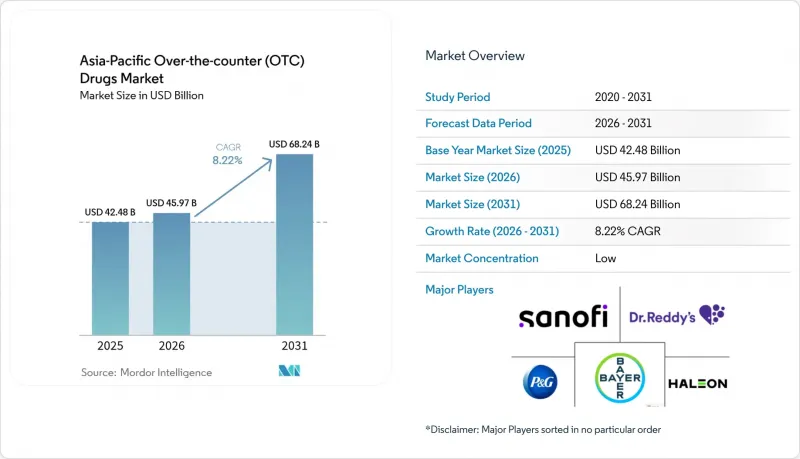
Mordor Intelligence에 의하면, 2026년 아시아태평양의 일반의약품(OTC) 시장 규모는 459억 7,000만 달러로 추정되고 2025년 424억 8,000만 달러에서 성장하여 2031년에는 682억 4,000만 달러에 이를 것으로 예측됩니다.
2026-2031년 동안 연평균 성장률(CAGR) 8.22%로 성장할 것으로 전망됩니다.
본 보고서는 제품 유형별(기침·감기·독감약, 진통제, 피부과용 OTC 의약품, 기타), 제형별(정제 및 캡슐, 액제·시럽, 기타), 유통 채널별(병원 약국, 소매 약국 및 드럭스토어, 기타),국가별(중국, 일본, 인도, 기타)로 분류되어 있습니다. 시장 예측은 금액(달러)으로 표시되어 있습니다.
아시아태평양의 일반의약품(OTC) 시장 동향과 인사이트
아시아태평양 신흥 시장의 높은 보급률과 OTC 승인 건수 증가
신흥 경제국에서는 관료적인 병목 현상이 해소되고, 표준화된 디지털 신청을 통해 브랜드의 신속한 확장이 가능해졌으며, 안전성 모니터링 체계도 개선되고 있습니다. 필리핀에 도입된 새로운 결제 포털 덕분에 승인까지의 리드타임이 수개월에서 수주일로 단축되었으며, 다국적 기업들은 기존의 서유럽 시장 진출보다 아시아 시장 출시를 우선시하고 있습니다. 베트남과 인도네시아로의 투자 유입 증가는 기술 이전을 촉진하여 국내 기업의 제제 기술 향상을 이끌고 있습니다. 우수한 약사 양성과 소매망 확충을 통해 자가 치료에 대한 소비자의 신뢰가 높아지면서, 저소득층을 중심으로 아시아태평양의 일반의약품 시장이 확대되고 있습니다.
다국적 및 국내 제약 기업의 처방약에서 일반의약품으로의 전환
특히 일본에서 시행된 체계적인 전환 프로그램을 통해 알레르기용 스프레이나 양성자 펌프 억제제가 일반의약품으로 전환되면서, 접근성을 확대하는 동시에 실적이 입증된 유효 성분에 대한 프리미엄 가격 확보로 이어지고 있습니다. 사토 제약의 1일 1회 투여 코 스프레이 ‘나존섹’은 적절한 시기의 전환을 통해 새로운 카테고리를 창출하고, 독점 판매 기간을 확보하며, 브랜드 가치를 지켜낸 좋은 사례가 되고 있습니다. 아시아태평양의 일반의약품 시장이 확대되는 가운데, 현지 제조업체들은 맛, 용량, 포장 크기를 문화적 특성에 맞추어 조정함으로써 세계 대기업들과 대등한 경쟁을 펼치고 있습니다.
소비자의 낮은 인지도와 약물 오남용 위험
지방 지역의 낮은 건강 문해력은 오용 위험을 높이고 있으며, 당국은 포장 크기 제한 및 경고 라벨 표시를 의무화하고 있지만, 이는 시장 침투를 둔화시키고 있습니다. 기업은 다국어 홍보 캠페인에 예산을 할당해야 하며, 그 결과,아시아태평양의 일반의약품(OTC) 시장에서 수익원가율이 상승하고 있습니다. 약국은 법적 책임에 대한 우려로 인해 취급 품목 확대를 주저하고 있으며, 또한 전통 의학에 대한 믿음이 표준 투여량과 충돌하는 경우도 있습니다.
부문 분석
비타민, 미네랄, 건강보조식품은 면역, 뼈, 대사 기능 지원에 대한 지속적인 수요를 반영하여 2025년에는 29.02%의 점유율을 차지하며 아시아태평양의 일반의약품(OTC) 시장의 핵심 축이 되었습니다. 한편, 수면 보조제는 도시 지역의 화면 노출 및 교대 근무로 인한 생체 리듬의 교란을 배경으로 연평균 성장률(CAGR) 9.88%로 확대되고 있습니다. 아시아태평양의 일반의약품(OTC) 시장에서 수면 보조제 시장 규모는 천연 유래 이미지와 복용하기 쉬운 형태를 겸비한 ‘멜라토닝 미(Melatonin Me)’의 인기에 힘입어 2031년까지 한 자릿수 후반대의 점유율에 도달할 것으로 예측됩니다. 기침·감기·독감용 제제는 대기 오염이 가장 심한 시기와 연동되어 안정적인 판매량을 유지하고 있으며, 진통제는 활동적인 생활을 중시하는 고령자와 피트니스 지향적인 밀레니얼 세대 수요를 충족시키고 있습니다. 피부과용 일반의약품은 K-뷰티의 영향을 활용하고 있으며, 프로바이오틱스와 제산제는 이 지역의 다양한 식문화로 인한 식이성 소화기 문제를 해결하고 있습니다.
프리미엄 오메가-3, 콜라겐, 관절용 건강기능식품의 진열 공간이 확대되고 있는 것은 중산층 가구의 구매력이 향상되고 있음을 반영합니다. 소매업체들은 면역 강화 세트를 엔드캡에서 프로모션하고, 기능성 음료와의 크로스 머천다이징을 통해 예방 의료 습관을 정착시키려 하고 있습니다. 온라인 약국 검색 분석에 따르면, ‘자연스러운 수면’이나 ‘허브를 통한 스트레스 해소’와 같은 키워드의 검색 횟수가 급증하고 있으며, 이를 바탕으로 타겟을 좁힌 SKU 도입이 진행되고 있습니다. 체중 감량 보조제에 대한 규제 당국의 모니터링은 계속되고 있지만, 허브 유래 효능 표기에 부합하는 제품에 대한 수요는 여전히 뿌리 깊게 이어지고 있습니다. 화면 사용으로 인한 안구건조증 사례가 증가하는 가운데, 안과용 일반의약품 시장 점유율이 확대되고 있어, 아시아태평양의 일반의약품 시장이 라이프스타일 변화에 유연하게 대응하고 있음을 뒷받침하고 있습니다.
기타 혜택
- 엑셀 형식 시장 예측(ME) 시트
- 3개월간 애널리스트의 지원
자주 묻는 질문
목차
제1장 서론
제2장 조사 방법
제3장 주요 요약
제4장 시장 구도
제5장 시장 규모 및 성장 예측
제6장 경쟁 구도
제7장 시장 기회 및 향후 전망
KTH 26.08.26According to Mordor Intelligence, the Asia-Pacific over-the-Counter (OTC) drugs market size in 2026 is estimated at USD 45.97 billion, growing from 2025 value of USD 42.48 billion with 2031 projections showing USD 68.24 billion, growing at 8.22% CAGR over 2026-2031.
This report is Segmented by Product Type (Cough, Cold, and Flu Medicines, Analgesics, Dermatology OTC, and More), Formulation Type (Tablets & Capsules, Liquids & Syrups, and More), Distribution Channel (Hospital Pharmacies, Retail Pharmacies & Drugstores, and More), and Country (China, Japan, India, and More). The Market Forecasts are Provided in Terms of Value (USD).
Asia-Pacific Over-the-counter (OTC) Drugs Market Trends and Insights
High Penetration in Emerging APAC Markets with Increasing OTC Approvals
Emerging economies remove bureaucratic bottlenecks, enabling faster brand rollouts and improving safety oversight through harmonized digital submissions. The Philippines' new payment portal has trimmed approval lead-times from months to weeks, prompting multinationals to prioritize Asia-first launches over traditional Western rollouts. Rising investment inflows in Vietnam and Indonesia facilitate technology transfer that equips domestic firms with improved formulation skills. Superior pharmacist training and upgraded retail footprints nurture consumer trust in self-medication, boosting the Asia-Pacific Over-the-Counter (OTC) Drugs market across lower-income cohorts.
Rx-to-OTC Switches by Multinational & Local Pharma
Structured switch programs, notably in Japan, have shifted allergy sprays and proton-pump inhibitors to OTC status, enlarging access while securing premium pricing for proven actives. Sato Pharmaceutical's once-daily Nazoncek nasal spray exemplifies how timely switches create fresh categories, generate exclusivity windows and protect brand equity. Local manufacturers exploit cultural nuance by tailoring flavor, dosage and pack size, running neck-and-neck with global giants as the Asia-Pacific Over-the-Counter (OTC) Drugs market widens.
Low Consumer Awareness & Risk of Drug Abuse
Limited health literacy in rural zones elevates misuse risks, prompting authorities to restrict pack sizes and enforce warning labels that dampen market uptake. Companies must allocate budget to education campaigns in multiple languages, raising cost-of-sales ratios within the Asia-Pacific Over-the-Counter (OTC) Drugs market. Pharmacies hesitate to widen assortments when liability fears loom, and traditional medicine beliefs sometimes clash with dosage norms.
Other drivers and restraints analyzed in the detailed report include:
- Rapid Growth of Self-Medication Among Ageing Population
- Cross-Border E-Pharmacy Platforms Accelerating Regional Access
- Stringent, Non-Harmonised OTC Regulations Across APAC
For complete list of drivers and restraints, kindly check the Table Of Contents.
Segment Analysis
Vitamins, Minerals & Supplements anchored the Asia-Pacific Over-the-Counter (OTC) Drugs market with a 29.02% slice in 2025, reflecting persistent demand for immune, bone and metabolic support. Sleep Aids, however, are scaling at a 9.88% CAGR as urban screen exposure and shift-work cycles disrupt circadian rhythms. The Asia-Pacific Over-the-Counter (OTC) Drugs market size for Sleep Aids is forecast to reach a high-single-digit share by 2031, aided by melatonin gummies that combine natural positioning with palatable formats. Cough, Cold & Flu preparations maintain steady baseline volumes tied to pollution peaks, and analgesics cater to mobility-focused seniors and fitness-minded millennials. Dermatology OTCs capitalize on K-beauty influence, while probiotics and antacids address diet-driven digestive issues across the region's diverse cuisines.
Extended shelf space for premium omega-3, collagen and joint formulas reflects growing affordability among middle-income households. Retailers deploy end-cap promotions for immunity bundles, cross-merchandising with functional beverages to reinforce preventive care behavior. E-pharmacy search analytics reveal surging keyword queries for "natural sleep" and "herbal stress relief," informing targeted SKU introductions. Regulatory scrutiny around weight-loss aids persists, yet demand endures through herbal claims compliance. Ophthalmic OTCs gain ground as screen-induced dry-eye cases climb, confirming the Asia-Pacific Over-the-Counter (OTC) Drugs market's adaptability to lifestyle shifts.
Complete Report Scope:
- By Product Type
- Cough, Cold & Flu Medicines
- Analgesics
- Non-opioid
- Opioid-based
- Dermatology OTC
- Topical Antifungals
- Acne Treatments
- Gastrointestinal OTC
- Antacids & Anti-ulcerants
- Laxatives & Antidiarrheals
- Vitamins, Minerals & Supplements (VMS)
- Weight-loss & Dietary Products
- Ophthalmic OTC
- Sleep Aids
- By Formulation Type
- Tablets & Capsules
- Liquids & Syrups
- Topicals (Creams, Ointments, Gels)
- Sprays & Inhalers
- Gummies & Chewables
- By Distribution Channel
- Hospital Pharmacies
- Retail Pharmacies & Drugstores
- Convenience & Grocery Stores
- Online Pharmacies & Marketplaces
- By Country
- China
- Japan
- India
- Australia
- South Korea
- Rest of South-East Asia
List of Companies Covered in this Report:
- Abbott Laboratories
- Aurobindo Pharma
- Bayer
- Cipla
- Dabur India Ltd.
- Dr. Reddy's Laboratories
- Haleon PLC
- Johnson & Johnson
- Mitsuya Holdings
- Nichiban Co. Ltd.
- Otsuka Holdings Co.
- Prestige Consumer Healthcare
- Procter & Gamble
- PT Kalbe Farma Tbk
- Reckitt Benckiser Group
- Rohto Pharmaceutical Co.
- Sanofi
- Taisho Pharmaceutical Holdings
- Takeda Pharmaceutical Co.
- Zuellig Pharma
Additional Benefits:
- The market estimate (ME) sheet in Excel format
- 3 months of analyst support
TABLE OF CONTENTS
1 Introduction
- 1.1 Study Assumptions & Market Definition
- 1.2 Scope of the Study
2 Research Methodology
3 Executive Summary
4 Market Landscape
- 4.1 Market Overview
- 4.2 Market Drivers
- 4.2.1 High Penetration In Emerging APAC Markets with Increasing OTC Approvals
- 4.2.2 Rx-To-OTC Switches by Multinational & Local Pharma
- 4.2.3 Rapid Growth of Self-Medication Among Ageing Population
- 4.2.4 Cross-Border E-Pharmacy Platforms Accelerating Regional Access
- 4.2.5 AI-Based Self-Diagnosis Tools Driving Impulse OTC Purchases
- 4.3 Market Restraints
- 4.3.1 Low Consumer Awareness & Risk of Drug Abuse
- 4.3.2 Stringent, Non-Harmonised OTC Regulations Across APAC
- 4.3.3 API Supply-Chain Concentration Creating Stock-Out Risks
- 4.3.4 Growth Of Counterfeit OTC Products on E-Commerce Sites
- 4.4 Supply-Chain Analysis
- 4.5 Regulatory Landscape
- 4.6 Porter's Five Forces Analysis
- 4.6.1 Threat of New Entrants
- 4.6.2 Bargaining Power of Buyers/Consumers
- 4.6.3 Bargaining Power of Suppliers
- 4.6.4 Threat of Substitute Products
- 4.6.5 Intensity of Competitive Rivalry
5 Market Size & Growth Forecasts (Value, USD)
- 5.1 By Product Type
- 5.1.1 Cough, Cold & Flu Medicines
- 5.1.2 Analgesics
- 5.1.2.1 Non-opioid
- 5.1.2.2 Opioid-based
- 5.1.3 Dermatology OTC
- 5.1.3.1 Topical Antifungals
- 5.1.3.2 Acne Treatments
- 5.1.4 Gastrointestinal OTC
- 5.1.4.1 Antacids & Anti-ulcerants
- 5.1.4.2 Laxatives & Antidiarrheals
- 5.1.5 Vitamins, Minerals & Supplements (VMS)
- 5.1.6 Weight-loss & Dietary Products
- 5.1.7 Ophthalmic OTC
- 5.1.8 Sleep Aids
- 5.2 By Formulation Type
- 5.2.1 Tablets & Capsules
- 5.2.2 Liquids & Syrups
- 5.2.3 Topicals (Creams, Ointments, Gels)
- 5.2.4 Sprays & Inhalers
- 5.2.5 Gummies & Chewables
- 5.3 By Distribution Channel
- 5.3.1 Hospital Pharmacies
- 5.3.2 Retail Pharmacies & Drugstores
- 5.3.3 Convenience & Grocery Stores
- 5.3.4 Online Pharmacies & Marketplaces
- 5.4 By Country
- 5.4.1 China
- 5.4.2 Japan
- 5.4.3 India
- 5.4.4 Australia
- 5.4.5 South Korea
- 5.4.6 Rest of South-East Asia
6 Competitive Landscape
- 6.1 Market Concentration
- 6.2 Market Share Analysis
- 6.3 Company Profiles (includes Global-level Overview, Market-level Overview, Core Segments, Financials as available, Strategic Information, Market Rank/Share, Products & Services, Recent Developments)
- 6.3.1 Abbott Laboratories
- 6.3.2 Aurobindo Pharma
- 6.3.3 Bayer AG
- 6.3.4 Cipla Ltd.
- 6.3.5 Dabur India Ltd.
- 6.3.6 Dr. Reddy's Laboratories
- 6.3.7 Haleon PLC
- 6.3.8 Johnson & Johnson
- 6.3.9 Mitsuya Holdings
- 6.3.10 Nichiban Co. Ltd.
- 6.3.11 Otsuka Holdings Co.
- 6.3.12 Prestige Consumer Healthcare
- 6.3.13 Procter & Gamble Co.
- 6.3.14 PT Kalbe Farma Tbk
- 6.3.15 Reckitt Benckiser Group PLC
- 6.3.16 Rohto Pharmaceutical Co.
- 6.3.17 Sanofi SA
- 6.3.18 Taisho Pharmaceutical Holdings
- 6.3.19 Takeda Pharmaceutical Co.
- 6.3.20 Zuellig Pharma
7 Market Opportunities & Future Outlook
- 7.1 White-space & Unmet-need Assessment