|
시장보고서
상품코드
2113892
인도의 심혈관 기기 : 시장 점유율 분석, 업계 동향 및 통계, 성장 예측(2026-2031년)India Cardiovascular Devices - Market Share Analysis, Industry Trends & Statistics, Growth Forecasts (2026 - 2031) |
||||||
 Mordor Intelligence
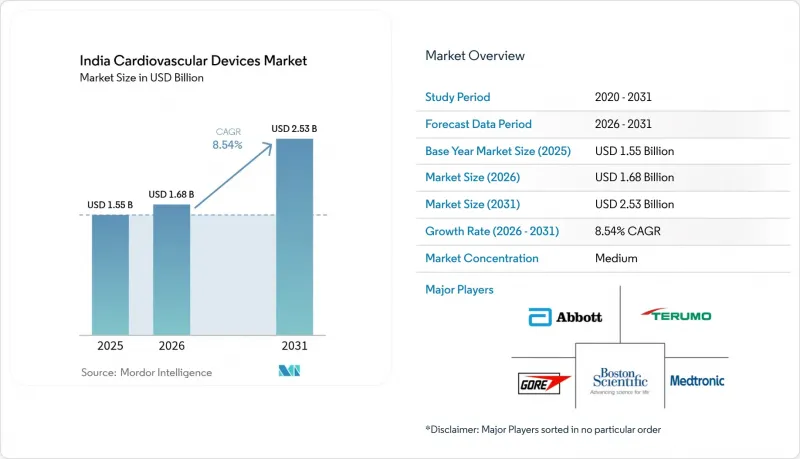
Mordor Intelligence에 의하면, 인도의 심혈관 기기 시장 규모는 2025년에 15억 5,000만 달러로 평가되었습니다. 2026년 16억 8,000만 달러에서 2031년까지 25억 3,000만 달러에 이를 것으로 예상되며, 예측 기간(2026-2031년) CAGR은 8.54%를 나타낼 전망입니다.
본 보고서는 제품 유형별(진단·모니터링 기기, 치료·수술용 기기), 용도별(허혈성 심장질환, 부정맥·전도 장애, 심부전·심근증, 기타), 최종 사용자별(병원·심장 센터, 외래수술센터(ASC), 기타)로 분류되어 있습니다. 시장 예측은 금액(달러) 기준으로 제시되어 있습니다.
인도의 심혈관 기기 시장 동향 및 인사이트
심혈관 질환(CVD) 유병률 증가 및 고령화
2051년까지 인도의 고령 인구는 전체 인구의 22.5%를 차지할 것으로 추정되며, 심혈관 질환(CVD)은 이미 국내 DALY(장애 조정 생명년)의 14.1%를 차지하고 있는데, 이는 1990년 수준의 2배에 해당합니다. 허혈성 심장 질환 및 뇌졸중 사례 수는 1990년 이후 2.3배 증가하여 스텐트, 이식편, 부정맥 치료 기기에 대한 지속적인 수요를 창출하고 있습니다. 도시 지역의 생활 방식은 고혈압과 비만을 통해 위험을 증가시켜, 인도의 심혈관 기기 시장에서 치료 건수 증가를 가속화하고 있습니다. 남아시아 특유의 관상동맥 해부학적 특징(혈관이 가늘고 병변이 광범위하게 퍼져 있음)으로 인해 외과적 이식술에 대한 의존도가 높아지고 있습니다. 원격 모니터링 플랫폼은 병원 밖에서 정기적인 경과 관찰을 수행함으로써 증가하는 환자 수를 관리하는 데 도움을 주며, 3차 의료기관의 혼잡을 완화하고 있습니다.
의료비 증가와 보험 보급률 향상
2014년부터 2022년에 걸쳐 중앙 정부의 의료 지출은 1인당 3,169루피로 3배 증가했으며, 총 의료 지출에서 공공 지출이 차지하는 비율은 48%로 상승했습니다. ‘아유슈만 바라트’ 제도는 현재 5억 9,400만 명의 국민에게 최대 50만 루피의 보험 혜택을 제공하며, 심장 치료 본인 부담 비용을 21% 절감하고 있습니다. 이 제도 하에서 관상동맥 성형술 입원 건수는 47만 1,000건을 넘어, 인도의 심혈관 기기 시장을 직접적으로 확대시켰습니다. 2·3급 병원의 병상당 운영 비용은 불과 100만-150만 루피인 반면, 대도시권에서는 1,500만 루피에 달하기 때문에 중소도시에서도 카테터실의 신속한 도입이 가능해졌습니다. 투자자들이 1,460만 루피 상당의 민간 병상 1만 7,800개를 추가할 계획인 점은 자금 조달의 탄력을 뒷받침하고 있습니다.
고도 이식형 의료기기의 높은 비용
국가의약품가격관리국은 약물 방출형 스텐트의 가격을 3만 8,933 루피까지 인상하는 것을 승인했습니다. 브랜드 심부전 치료제는 제네릭 의약품보다 최대 15.8배 높은 가격에 판매되고 있습니다. 의료기기에 대한 관세는 5-7.5%로 여전히 세계 최고 수준이며, 여기에 5%의 의료세가 추가로 부과됩니다. 주요 이식형 의료기기의 80% 이상이 여전히 수입에 의존하고 있어 환율 변동이 최종 사용자의 가격에 직접 반영됩니다. 수술에 필요한 교통비와 숙박비를 부담해야 하는 농촌 지역 가족들은 치료를 미루는 경향이 있으며, 이는 인도의 심혈관 기기 시장 수요 증가를 억제하고 있습니다.
부문 분석
2025년, 인도의 심혈관 기기 시장 규모의 61.55%는 치료 및 외과용 시스템이 차지했습니다. 이는 ‘아유슈만 바라트’ 제도 하에서 보험 적용을 받은 약 50만 건의 혈관 성형술에 힘입은 결과입니다. 약물 방출형 스텐트는 가격 상한선이 설정되어 있음에도 불구하고, 높은 효능이 요구되는 코팅이 필요한 해부학적 복잡성으로 인해 여전히 주력 제품으로 자리 잡고 있습니다. 애보트(Abbott)사의 AVEIR 듀얼 챔버 리드리스 시스템과 같은 심박조율기 업그레이드는 주머니 감염 감소를 목적으로 하며, 인도의 심혈관 기기 시장에서 리듬 관리 기기의 매출을 견인하고 있습니다. 경카테터 판막은 급속히 발전하고 있으며, 마이발(Myval)사의 풍선 확장형 플랫폼은 최근 TAVI-in-TAVI를 통한 구제 치료를 가능하게 하여 그 내구성을 입증하고 있습니다.
진단 및 모니터링 기기는 연평균 성장률(CAGR) 9.62%로 성장하여, 향후 10년 말까지 인도의 심혈관 기기 시장 내 점유율을 끌어올릴 전망입니다. 국내에서 MRI와 CT를 생산함으로써 설비 투자 비용을 50% 절감할 수 있어, 지방 도시에서의 도입이 촉진될 것입니다. 원격 의료 앱과 연동되는 웨어러블 심전도 패치는 부정맥을 조기에 감지하여 예방적 경과 관찰 진료를 증가시킬 것입니다. 디지털 트윈을 활용한 계획 수립에는 고해상도 이미지 데이터 세트가 필수적이며, 가상 모델링의 전제조건으로서 256슬라이스 CT와 3테슬라 MRI에 대한 수요가 증가하고 있습니다.
기타 혜택
- 엑셀 형식 시장 예측(ME) 시트
- 3개월간의 애널리스트 지원
목차
제1장 서론
제2장 조사 방법
제3장 주요 요약
제4장 시장 구도
제5장 시장 규모 및 성장 예측
제6장 경쟁 구도
제7장 시장 기회 및 향후 전망
KTHAccording to Mordor Intelligence, the India cardiovascular devices market size was valued at USD 1.55 billion in 2025 and estimated to grow from USD 1.68 billion in 2026 to reach USD 2.53 billion by 2031, at a CAGR of 8.54% during the forecast period (2026-2031).
This report is Segmented by Product Type (Diagnostic & Monitoring Devices, Therapeutic & Surgical Devices), Application (Coronary Artery Disease, Arrhythmia & Conduction Disorders, Heart Failure & Cardiomyopathy, and More), End User (Hospitals & Cardiac Centres, Ambulatory Surgical Centres, and More). The Market Forecasts are Provided in Terms of Value (USD).
India Cardiovascular Devices Market Trends and Insights
Rising CVD Prevalence & Ageing Population
India's elderly will account for 22.5% of residents by 2051, and CVDs already contribute 14.1% of national DALYs, double 1990 levels. Ischemic heart disease and stroke cases have risen 2.3-fold since 1990, creating sustained demand for stents, grafts, and rhythm devices. Urban lifestyles compound risk via hypertension and obesity, accelerating procedural volumes in the India cardiovascular devices market. The South-Asian coronary anatomy-smaller vessels and diffuse lesions-drives reliance on surgical grafting technologies. Remote monitoring platforms help manage the rising caseload by shifting routine follow-ups outside hospitals, easing congestion in tertiary centers.
Increasing Healthcare Expenditure & Insurance Penetration
Central health spending tripled to INR 3,169 per capita between 2014-2022, lifting the public share of total health outlays to 48%. Ayushman Bharat now insures 594 million citizens for up to INR 500,000, slashing out-of-pocket cardiac procedure costs by 21%. Coronary angioplasty admissions surpassed 471,000 under the scheme, directly enlarging the India cardiovascular devices market. Tier-2/3 hospitals operate at just INR 10-15 lakh per bed versus INR 1.5 crore in metros, enabling rapid cath-lab rollouts in smaller cities. Investor plans to add 17,800 private beds worth INR 14,600 crore underscore the financing momentum.
High Cost of Advanced Implantables
The National Pharmaceutical Pricing Authority allowed stent prices to rise to INR 38,933 for drug-eluting models. Branded heart-failure drugs sell at up to 15.8 times generic rates. Customs duties on devices remain among the world's highest at 5-7.5% and a 5% health cess. With more than 80% of critical implantables still imported, currency volatility transmits directly to end-user prices. Rural families, who shoulder travel and lodging expenses for surgery, delay care, tempering volume growth for the India cardiovascular devices market.
Other drivers and restraints analyzed in the detailed report include:
- Expansion of Cath-Labs in Tier-2/3 Indian Cities
- Government PLI Scheme Boosting Local Device Manufacturing
- Limited Reimbursement Coverage
For complete list of drivers and restraints, kindly check the Table Of Contents.
Segment Analysis
Therapeutic and surgical systems generated 61.55% of India cardiovascular devices market size in 2025 on the back of almost half-a-million angioplasties reimbursed under Ayushman Bharat. Drug-eluting stents remain flagship items despite price ceilings, supported by anatomical complexity that demands high efficacy coatings. Pacemaker upgrades such as Abbott's AVEIR dual-chamber leadless system target pocket-infection reduction, driving rhythm-device sales in the India cardiovascular devices market. Transcatheter valves advance quickly; Myval's balloon-expandable platform recently enabled a TAVI-in-TAVI rescue, indicating durability.
Diagnostic and monitoring devices will grow at 9.62% CAGR, lifting their India cardiovascular devices market share by the decade's end. Domestic MRI and CT production can lower capital prices by 50%, unlocking installations in secondary cities. Wearable ECG patches that sync with telemedicine apps identify arrhythmias early, increasing preventative follow-up visits. Digital-twin planning relies on high-definition imaging datasets, reinforcing demand for 256-slice CT and 3-Tesla MRI as prerequisites for virtual modeling.
Complete Report Scope:
- By Product Type
- Diagnostic & Monitoring Devices
- ECG Systems
- Remote Cardiac Monitor
- Cardiac MRI
- Cardiac CT
- Echocardiography / Ultrasound
- Fractional Flow Reserve (FFR) Systems
- Therapeutic & Surgical Devices
- Coronary Stents
- Drug-Eluting Stents
- Bare-Metal Stents
- Bioresorbable Stents
- Catheters
- PTCA Balloon Catheters
- IVUS/OCT Catheters
- Cardiac Rhythm Management
- Pacemakers
- Implantable Cardioverter Defibrillators
- Cardiac Resynchronization Therapy Devices
- Heart Valves
- TAVR/TAVI
- Mechanical Valves
- Tissue/Bioprosthetic Valves
- Ventricular Assist Devices
- Artificial Hearts
- Grafts & Patches
- Other Cardiovascular Surgical Devices
- Coronary Stents
- Diagnostic & Monitoring Devices
- By Application
- Coronary Artery Disease
- Arrhythmia & Conduction Disorders
- Heart Failure & Cardiomyopathy
- Structural & Congenital Heart Defects
- Peripheral Vascular Disease
- By End User
- Hospitals & Cardiac Centres
- Ambulatory Surgical Centres
- Cardiology/EP Clinics
- Home-care & Remote Monitoring Programs
List of Companies Covered in this Report:
- Medtronic
- Abbott Laboratories
- Boston Scientific
- Edward Lifesciences
- Terumo
- Meril Life Science
- Sahajanand Medical Technologies Ltd.
- Opto Circuits (India) Ltd.
- Translumina Therapeutics LLP
- BIOTRONIK
- LivaNova
- W. L. Gore & Associates
- Getinge AB (Maquet)
- Merit Medical Systems
- Nipro
- Corin Group PLC
- Envision Scientific Pvt. Ltd.
- Relisys Medical Devices
- Innvolution Healthcare (IITPL)
Additional Benefits:
- The market estimate (ME) sheet in Excel format
- 3 months of analyst support
TABLE OF CONTENTS
1 Introduction
- 1.1 Study Assumptions & Market Definition
- 1.2 Scope of the Study
2 Research Methodology
3 Executive Summary
4 Market Landscape
- 4.1 Market Overview
- 4.2 Market Drivers
- 4.2.1 Rising CVD prevalence & ageing population
- 4.2.2 Increasing healthcare expenditure & insurance penetration
- 4.2.3 Expansion of cath-labs in tier-2/3 Indian cities
- 4.2.4 Government PLI scheme boosting local device manufacturing
- 4.2.5 Digital-twin based cardiac surgery planning adoption
- 4.3 Market Restraints
- 4.3.1 High cost of advanced implantables
- 4.3.2 Limited reimbursement coverage
- 4.3.3 Dependence on imported critical components
- 4.4 Value/ Supply-Chain Analysis
- 4.5 Regulatory Landscape
- 4.6 Technological Outlook
- 4.7 Porter's Five Forces
- 4.7.1 Threat of New Entrants
- 4.7.2 Bargaining Power of Suppliers
- 4.7.3 Bargaining Power of Buyers
- 4.7.4 Threat of Substitutes
- 4.7.5 Competitive Rivalry
5 Market Size & Growth Forecasts (Value)
- 5.1 By Product Type
- 5.1.1 Diagnostic & Monitoring Devices
- 5.1.1.1 ECG Systems
- 5.1.1.2 Remote Cardiac Monitor
- 5.1.1.3 Cardiac MRI
- 5.1.1.4 Cardiac CT
- 5.1.1.5 Echocardiography / Ultrasound
- 5.1.1.6 Fractional Flow Reserve (FFR) Systems
- 5.1.2 Therapeutic & Surgical Devices
- 5.1.2.1 Coronary Stents
- 5.1.2.1.1 Drug-Eluting Stents
- 5.1.2.1.2 Bare-Metal Stents
- 5.1.2.1.3 Bioresorbable Stents
- 5.1.2.2 Catheters
- 5.1.2.2.1 PTCA Balloon Catheters
- 5.1.2.2.2 IVUS/OCT Catheters
- 5.1.2.3 Cardiac Rhythm Management
- 5.1.2.3.1 Pacemakers
- 5.1.2.3.2 Implantable Cardioverter Defibrillators
- 5.1.2.3.3 Cardiac Resynchronization Therapy Devices
- 5.1.2.4 Heart Valves
- 5.1.2.4.1 TAVR/TAVI
- 5.1.2.4.2 Mechanical Valves
- 5.1.2.4.3 Tissue/Bioprosthetic Valves
- 5.1.2.5 Ventricular Assist Devices
- 5.1.2.6 Artificial Hearts
- 5.1.2.7 Grafts & Patches
- 5.1.2.8 Other Cardiovascular Surgical Devices
- 5.1.2.1 Coronary Stents
- 5.1.1 Diagnostic & Monitoring Devices
- 5.2 By Application
- 5.2.1 Coronary Artery Disease
- 5.2.2 Arrhythmia & Conduction Disorders
- 5.2.3 Heart Failure & Cardiomyopathy
- 5.2.4 Structural & Congenital Heart Defects
- 5.2.5 Peripheral Vascular Disease
- 5.3 By End User
- 5.3.1 Hospitals & Cardiac Centres
- 5.3.2 Ambulatory Surgical Centres
- 5.3.3 Cardiology/EP Clinics
- 5.3.4 Home-care & Remote Monitoring Programs
6 Competitive Landscape
- 6.1 Market Concentration
- 6.2 Market Share Analysis
- 6.3 Company Profiles {(includes Global level Overview, Market level overview, Core Segments, Financials as available, Strategic Information, Market Rank/Share for key companies, Products & Services, and Recent Developments)}
- 6.3.1 Medtronic plc
- 6.3.2 Abbott Laboratories
- 6.3.3 Boston Scientific Corporation
- 6.3.4 Edwards Lifesciences Corporation
- 6.3.5 Terumo Corporation
- 6.3.6 Meril Life Sciences Pvt. Ltd.
- 6.3.7 Sahajanand Medical Technologies Ltd.
- 6.3.8 Opto Circuits (India) Ltd.
- 6.3.9 Translumina Therapeutics LLP
- 6.3.10 Biotronik SE & Co. KG
- 6.3.11 LivaNova PLC
- 6.3.12 W. L. Gore & Associates Inc.
- 6.3.13 Getinge AB (Maquet)
- 6.3.14 Merit Medical Systems Inc.
- 6.3.15 Nipro Corporation
- 6.3.16 Corin Group PLC
- 6.3.17 Envision Scientific Pvt. Ltd.
- 6.3.18 Relisys Medical Devices
- 6.3.19 Innvolution Healthcare (IITPL)
7 Market Opportunities & Future Outlook
- 7.1 White-Space & Unmet-Need Assessment