

|
시장보고서
상품코드
2099906
심장학 분야 의료기기 소프트웨어(SaMD) 시장 : 시장 점유율 분석, 업계 동향 및 통계, 성장 예측(2026-2031년)Software As A Medical Device (SaMD) For Cardiology - Market Share Analysis, Industry Trends & Statistics, Growth Forecasts (2026 - 2031) |
||||||
 Mordor Intelligence
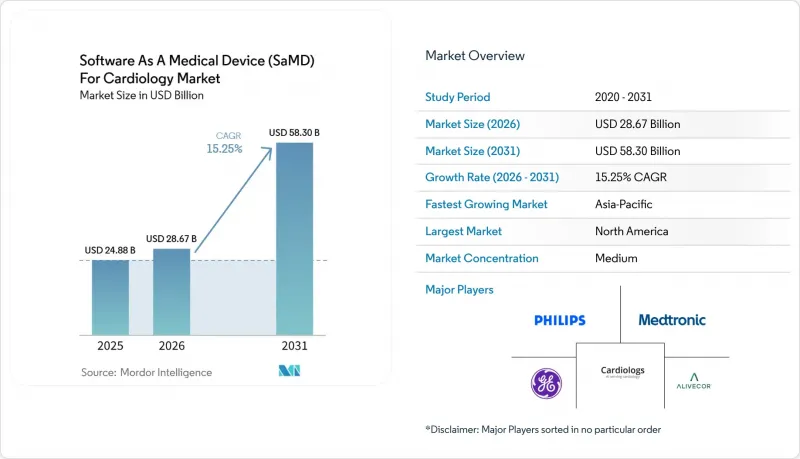
Mordor Intelligence에 의하면, 심장학 분야 의료기기 소프트웨어 시장 규모는 2025년 248억 8,000만 달러로 평가되었고, 2026년에는 286억 7,000만 달러로 확대될 것으로 추정되고, 2031년까지 583억 달러에 이를 것으로 예상되며, 2026-2031년 CAGR 15.25%로 성장할 전망입니다.
본 보고서는 제품 유형별(진단, 모니터링, 임상 의사결정 지원, 치료), 임상 용도별(부정맥 감지, 관상동맥질환(CAD) 평가, 심부전 관리 등), 도입 모델별(클라우드 기반, 온프레미스형, 하이브리드형), 최종 사용자별(병원, 심혈관 클리닉, 외래 진료 등), 지역별(북미, 유럽 등)로 분류되어 있습니다. 시장 전망(금액, 달러).
세계의 심장학 분야 의료기기 소프트웨어(SaMD) 동향 및 인사이트
규제 추진에 힘입어, 선점자 우위를 바탕으로 한 보험 급여의 ‘격차’가 형성되고 있습니다.
규제 측면의 모멘텀에 힘입어, 심장학 분야 의료기기 소프트웨어(SaMD) 시장은 승인부터 수익화까지의 과정이 가속화되고 있습니다. FDA의 심혈관 분야 AI 및 ML 승인 건수는 2024년 62건에서 2025년 92건으로 증가하여, 도입 준비가 완료된 도구의 선택 폭이 넓어지고 있습니다. 2025년 승인 건 중 8건에는 ‘사전 결정 변경 관리 계획(Predetermined Change Control Plan)’이 포함되어 있어, 이를 통해 승인된 프레임워크 내에서 시판 후 알고리즘 업데이트가 가능해집니다. 이를 통해 조기에 승인을 받은 공급업체는 승인된 규제 절차를 준수하면서도 실제 임상 데이터를 활용해 성능을 향상시킬 수 있는 우위를 확보할 수 있습니다.
보상 범위 확대는 시장이 고대해 온 수요 창출 요인입니다.
보험 보상 범위의 확대는 심장학 분야 의료기기 소프트웨어(SaMD) 시장에서 남아 있던 주요 장벽 중 하나를 제거하고 있습니다. CMS는 2026년 1월 1일부터 CPT 코드 75577을 시행하여, CCTA를 통한 AI 기반 관상동맥 플라크 분석에 대해 병원 외래 진료 보수로 950.50달러를 책정했습니다. 또한, CMS는 흉부 CT에서 AI 기반의 관상동맥 석회화 및 대동맥판막 석회화 분석을 위한 코드 G0680을 신설했습니다. 한편, 업계 보고서에 따르면 CPT 코드 0764T 및 0765T에 기반한 AI를 활용한 심전도(ECG) 분석에 대한 전미 메디케어 지급액은 128.90달러입니다. 예측 가능한 지급액은 병원 및 외래 진료 시설이 소프트웨어 도입을 명확한 상환 경로와 연계하는 데 도움이 되고 있습니다.
'승인'이라는 표제 뒤에 숨겨진 구조적 취약성 : 불충분한 임상적 근거
근거의 질은 심장학 분야 의료기기 소프트웨어(SaMD) 시장에서 여전히 주요 제약 요인으로 작용하고 있습니다. 2026년에 실시된 FDA 승인을 받은 277건의 심혈관용 AI 및 ML 기기 검토에 따르면, 검증 연구 중 실험실 연구가 69.3%를 차지하는 반면, 전향적 다기관 임상시험은 고작 3.2%에 그치는 것으로 나타났습니다. 동 조사에 따르면, 승인된 심혈관 AI 기기의 52.2%에서 ‘프레디케이트 크립(적응증 범위 확대)’ 위험이 높은 것으로 보고되어, 새로운 적응증 주장이 당초 검증된 이용 사례에서 어느 정도 벗어나는지에 대한 우려가 제기되고 있습니다. CMS는 AI를 활용한 관상동맥 플라크 분석에 관한 LCD L39881에서 이미 엄격한 절차 기준을 적용하고 있으며, 증거 기준의 상향 조정에 따라 보험 급여 조건이 더욱 엄격해질 가능성이 있음을 시사하고 있습니다. 보다 광범위한 다기관 검증과 더 높은 품질의 임상 데이터 세트를 보유한 벤더는 심사가 엄격해지는 상황에서 보험 적용 범위 및 가격 책정을 옹호하는 데 유리한 입장에 있습니다.
부문 분석
2025년, 진단용 SaMD는 심장학 분야 의료기기 소프트웨어(SaMD) 시장 점유율의 38.65%를 차지했으며, 현재 수익의 기반을 형성하고 있습니다. 이러한 선도적 지위는 특히 영상 진단을 주축으로 하는 병원 환경에서 진단 결과가 확립된 심장학 워크플로우에 원활하게 통합되어 있음을 반영합니다. 2025년, 미국에서는 관상동맥 CT 도구만으로도 플라크 정량화에 관한 승인 9건, 칼슘 점수 산출에 관한 승인 7건, FFR(관상동맥 혈류 예비 능력)에 기반한 승인 3건을 차지했습니다. 이러한 집중 현상으로 인해 진단용 소프트웨어는 일상적인 검사 의뢰 패턴, 보험 환급 이용 현황, 그리고 의사의 수용도와 계속해서 밀접하게 연동되고 있습니다.
SaMD(의료기기 소프트웨어) 모니터링 분야는 2026-2031년 연평균 성장률(CAGR) 18.93%를 나타낼 것으로 예측되며, 심혈관 분야의 프로그램형 의료기기(SaMD) 시장 규모 내에서 가장 빠르게 성장하는 제품 유형이 될 전망입니다. 이러한 성장은 단순한 휴대용 심전도 패치에 그치지 않고, 심전도, 임피던스, 활동 데이터를 단일 모니터링 스트림으로 통합하는 소프트웨어로 확대되고 있습니다. 또한, 지불 모델이 단순한 원시 신호 검토뿐만 아니라 AI를 활용한 심전도 해석과 같은 구체적인 성과에 대해 보상을 제공하는 방식으로 바뀌면서, 임상 의사결정 지원 도구도 주목을 받고 있습니다. 규제 당국이 폐쇄 루프형 및 치료 조정형 심장 용도에 대해 여전히 신중한 태도를 취하고 있기 때문에 치료용 소프트웨어는 여전히 가장 규모가 작은 제품군으로 남아 있습니다.
2025년에는 부정맥 감지가 전체 임상 용도의 35.23%를 차지했으며, 현재 지출의 중심적인 위치를 계속 유지할 전망입니다. 이 부문은 미진단 환자 수가 많고, 부정맥 진단 도구의 승인 실적이 오래되었으며, 많은 새로운 심장 용도에 비해 보험 급여 전망이 명확하다는 장점이 있었습니다. 병원 및 외래 심전도 프로그램에서는 이미 심전도(ECG) 기반 소프트웨어의 사용 방법이 잘 알려져 있었기 때문에 도입 장벽이 낮아졌습니다. 또한 이러한 도입 실적이 있었기 때문에 부정맥 진단 도구는 보다 광범위한 디지털 심장학 전략에서 첫 번째 소프트웨어 계층이 될 수 있었습니다.
심부전 관리 시장은 2031년까지 연평균 성장률(CAGR) 19.67%를 나타낼 것으로 예측되며, 심장학 분야 의료기기 소프트웨어(SaMD) 시장에서 가장 빠른 확장이 예상됩니다. 원격 혈역학 모니터링, AI를 활용한 위험 계층화, 그리고 의료 시스템 전반에 걸친 재입원율 저하에 대한 지속적인 수요가 이러한 성장을 뒷받침하고 있습니다. 또한, AI를 활용한 플라크 분석에 대한 보험 급여 지원에 힘입어 관상동맥 질환 평가도 진전되고 있습니다. 다만, HeartFlow사와 Cleerly사 간의 특허 분쟁은 이 하위 부문에서 경쟁이 격화되고 있음을 보여줍니다. 구조적 심장 질환 평가 및 심장 영상 분석은 수동 판독 시간을 단축하고 표준화된 해석을 지원하는 자동화의 혜택을 지속적으로 누리고 있습니다.
지역별 분석
2025년, 북미는 심장학 분야 의료기기 소프트웨어(SaMD) 시장 점유율의 40.56%를 차지했으며, 세계적 주도적 지위를 유지했습니다. 미국은 보험 지급 제도 정비에 있어 다른 국가보다 신속하게 움직였으며, AI를 활용한 관상동맥 플라크 분석, 심전도 분석 및 칼슘 분석에 대해 메디케어 고유의 지급 경로가 마련되어 있습니다. 이러한 지급 제도의 명확성은 순수 소프트웨어 벤더와 기존 영상 진단 기업에게 상업적 규모 확대를 뒷받침하는 요인이 되었습니다. 또한, 해당 지역은 병원 도입 기반이 광범위하다는 점도 호재로 작용했으나, 캐나다와 멕시코도 미국에 비해 보험 지급 체계 정비가 뒤처져 있음에도 불구하고 시장을 확대되고 있습니다.
아시아태평양은 2026-2031년 연평균 성장률(CAGR) 17.56%를 나타낼 것으로 예측되며, 심장학 분야 의료기기 소프트웨어(SaMD) 시장에서 가장 빠르게 성장하는 지역 블록이 될 전망입니다. 이러한 성장은 심혈관 질환의 부담, 각국의 디지털화 추진, 그리고 주요 국가 간 규제 조화 강화에 의해 주도되고 있습니다. 일본과 한국에서는 제품 승인 절차가 명확해지고 있으며, 중국에서는 시술용 하드웨어와 소프트웨어를 활용한 심장 워크플로우를 연계하는 투자가 주목받고 있습니다. 인도와 동남아시아에서는 도입이 아직 초기 단계에 있으며, 민간 상환 제도보다는 공중보건 디지털화 프로그램이 단기적인 수요를 형성하고 있습니다.
2025년, 유럽은 지역별 점유율에서 3위를 차지했으며, 독일, 영국, 프랑스가 주요 수요 기반을 형성하고 있습니다. 규정 준수 환경이 엄격해짐에 따라 시장 진입 및 제품 유지 요건이 높아지는 한편, 규제 대응 능력이 뛰어난 공급업체가 우위를 점하고 있습니다. 중동 및 아프리카에서는 도입이 아직 초기 단계에 있지만, 걸프 국가들에서는 현지 등록 및 조기 조달 과정에서 FDA 및 CE 승인 절차를 참고 기준으로 활용하고 있습니다. 남미에서는 브라질과 아르헨티나가 AI 진단에 대한 보험 급여 체계를 정비하고 있어 점차 그 입지를 확립해 가고 있습니다.
기타 혜택 :
- 엑셀 형식 시장 예측(ME) 시트
- 3개월간의 애널리스트 지원
자주 묻는 질문
목차
제1장 서론
제2장 조사 방법
제3장 주요 요약
제4장 시장 구도
제5장 시장 규모 및 성장 예측
제6장 경쟁 구도
제7장 시장 기회 및 향후 전망
AJY 26.08.11According to Mordor Intelligence, the software as a medical device for cardiology market size is expected to increase from USD 24.88 billion in 2025 to USD 28.67 billion in 2026 and reach USD 58.30 billion by 2031, growing at a CAGR of 15.25% over 2026-2031.
This report is Segmented by Product Type (Diagnostic, Monitoring, Clinical Decision Support, Therapeutic), Clinical Application (Arrhythmia Detection, CAD Assessment, Heart Failure Management, and More), Deployment Model (Cloud-Based, On-Premise, Hybrid), End User (Hospitals, Cardiology Clinics, Ambulatory Care, and More), and Geography (North America, Europe, and More). Market Forecasts in Value (USD).
Global Software As A Medical Device (SaMD) For Cardiology Market Trends and Insights
Regulatory Push Is Creating a First-Mover Reimbursement Moat
Regulatory momentum is giving the Software as a Medical Device (SaMD) for Cardiology market a faster route from approval to revenue. FDA cardiology AI and ML clearances rose to 92 in 2025 from 62 in 2024, widening the pool of tools ready for deployment. Eight of the 2025 clearances included a Predetermined Change Control Plan, which allows post-market algorithm updates within an approved framework. This gives early-cleared vendors an advantage in improving performance with live clinical data while staying within the approved regulatory pathway.
Reimbursement Expansion Is the Demand Unlock the Market Was Waiting For
Payment expansion is removing one of the last major barriers in the Software as a Medical Device (SaMD) for Cardiology market. CMS made CPT code 75577 effective on January 1, 2026, with a USD 950.50 hospital outpatient payment for AI-enabled coronary plaque analysis from CCTA. CMS also created code G0680 for AI-based coronary artery calcium and aortic valve calcium analysis on chest CT, while trade reporting showed a USD 128.90 national Medicare payment rate for AI-enabled ECG analysis under CPT codes 0764T and 0765T. Predictable payment is helping hospitals and outpatient sites link software adoption to a defined reimbursement pathway.
Thin Clinical Evidence Is the Structural Vulnerability Beneath the Clearance Headline
Evidence quality remains a key constraint in the Software as a Medical Device (SaMD) for Cardiology market. A 2026 review of 277 FDA-cleared cardiology AI and ML devices found that bench studies accounted for 69.3% of validation studies, while prospective multicenter clinical trials accounted for only 3.2%. The same review reported a high risk of predicate creep in 52.2% of cleared cardiology AI devices, raising concerns over how far newer claims had moved from the original validated use case. CMS had already applied strict procedural criteria in LCD L39881 for AI-enabled coronary plaque analysis, showing that reimbursement can tighten as evidence standards rise. Vendors with broader multi-site validation and cleaner clinical datasets are better positioned to defend coverage and pricing as scrutiny increases.
Other drivers and restraints analyzed in the detailed report include:
- The Arrhythmia Detection Burden Is Larger Than Reported Incidence Suggests
- Remote Cardiac Monitoring Is Shifting Clinical Gravity from Hospitals to the Home
- Cybersecurity Incidents Are Reshaping the Risk Calculus for Payers and Providers
For complete list of drivers and restraints, kindly check the Table Of Contents.
Segment Analysis
Diagnostic SaMD held 38.65% of the Software as a Medical Device (SaMD) for Cardiology market share in 2025, making it the foundation of current revenue. Its leadership reflected the smooth integration of diagnostic outputs into established cardiology workflows, especially in imaging-led hospital settings. In 2025, coronary CT tools alone accounted for 9 plaque quantification clearances, 7 calcium scoring clearances, and 3 FFR-derived clearances in the United States. This concentration kept diagnostic software closely aligned with routine ordering patterns, reimbursement use, and physician acceptance.
Monitoring SaMD is projected to grow at a CAGR of 18.93% from 2026 to 2031, making it the fastest-growing product type in the Software as a Medical Device (SaMD) for Cardiology market size. Growth is moving beyond simple ambulatory ECG patches toward software that combines ECG, impedance, and activity data in a single monitoring stream. Clinical decision support tools are also gaining traction as payment models begin to reward specific outputs, such as AI-enabled ECG interpretation, rather than only raw signal review. Therapeutic software remains the smallest product group as regulators continue to take a cautious approach to closed-loop or therapy-adjusting cardiac applications.
Arrhythmia detection accounted for 35.23% of the clinical application mix in 2025, keeping it at the center of current spending. The segment benefited from a large undiagnosed population, a longer history of cleared rhythm tools, and clearer reimbursement visibility than many newer cardiac applications. Hospitals and ambulatory rhythm programs already understood how to use ECG-based software, which reduced adoption friction. This installed base also allowed arrhythmia tools to become the first software layer within broader digital cardiology strategies.
Heart failure management is forecast to grow at a CAGR of 19.67% through 2031, giving it the fastest expansion profile within the Software as a Medical Device (SaMD) for Cardiology market. Remote hemodynamic monitoring, AI-driven risk stratification, and the ongoing need to reduce readmissions across health systems support this growth. Coronary artery disease assessment is also advancing after reimbursement support for AI-enabled plaque analysis, although the patent dispute between HeartFlow and Cleerly showed intensifying competition in this sub-segment. Structural heart disease assessment and cardiac imaging analysis continue to benefit from automation that reduces manual review time and supports standardized interpretation.
Complete Report Scope:
- By Product Type
- Diagnostic SaMD
- Monitoring SaMD
- Clinical Decision Support SaMD
- Therapeutic SaMD
- By Clinical Application
- Arrhythmia Detection
- Coronary Artery Disease Assessment
- Heart Failure Management
- Structural Heart Disease Assessment
- Cardiac Imaging Analysis
- By Deployment Model
- Cloud-Based
- On-Premise
- Hybrid
- By End User
- Hospitals and Health Systems
- Cardiology Clinics
- Ambulatory Care Centers
- Home Healthcare and Remote Monitoring Providers
- Diagnostic Imaging Centers
- By Geography
- North America
- United States
- Canada
- Mexico
- Europe
- Germany
- United Kingdom
- France
- Italy
- Spain
- Rest of Europe
- Asia-Pacific
- China
- India
- Japan
- Australia
- South Korea
- Rest of Asia-Pacific
- Middle East and Africa
- GCC
- South Africa
- Rest of Middle East and Africa
- South America
- Brazil
- Argentina
- Rest of South America
- North America
Geography Analysis
North America held 40.56% of the Software as a Medical Device (SaMD) for Cardiology market share in 2025, maintaining its global lead. The United States moved faster than other countries on reimbursement, with separate Medicare payment pathways in place for AI-enabled coronary plaque analysis, ECG analysis, and calcium analysis. This payment clarity supported commercial scale for pure-play vendors and imaging incumbents. The region also benefited from a large installed hospital base, while Canada and Mexico advanced despite reimbursement frameworks trailing the United States.
Asia-Pacific is projected to grow at a 17.56% CAGR from 2026 to 2031, making it the fastest-growing regional bloc in the Software as a Medical Device (SaMD) for Cardiology market. Growth is being driven by cardiovascular disease burden, national digitization efforts, and stronger regulatory alignment across major countries. Japan and South Korea are advancing with clearer product approvals, while China is attracting investment that links procedural hardware with software-enabled cardiac workflows. India and Southeast Asia remain earlier in adoption, where public health digitization programs are shaping near-term demand more than private reimbursement.
Europe held the third-largest regional share in 2025, with Germany, the United Kingdom, and France forming the main demand base. A stricter compliance environment is raising entry and product maintenance requirements while favoring vendors with stronger regulatory depth. The Middle East and Africa are still earlier in adoption, but Gulf markets are using FDA and CE pathways as reference points for local registration and early procurement. South America is gradually building its position as Brazil and Argentina work on reimbursement frameworks for AI diagnostics.
- AliveCor
- Anumana, Inc.
- Apple
- Boston Scientific
- Canon
- Cardiac Insight, Inc.
- Cardiologs Technologies SAS
- Cleerly, Inc.
- Eko Health, Inc.
- GE HealthCare Technologies Inc.
- HeartBeam, Inc.
- HeartFlow, Inc.
- iRhythm Technologies
- Koninklijke Philips
- Medicalgorithmics S.A.
- Medtronic
- Samsung Group
- Siemens Healthineers
- Ultromics Limited
- Viz.ai, Inc.
Additional Benefits:
- The market estimate (ME) sheet in Excel format
- 3 months of analyst support
TABLE OF CONTENTS
1 INTRODUCTION
- 1.1 Study Assumptions and Market Definition
- 1.2 Scope of the Study
2 RESEARCH METHODOLOGY
3 EXECUTIVE SUMMARY
4 MARKET LANDSCAPE
- 4.1 Market Overview
- 4.2 Market Drivers
- 4.2.1 Regulatory Push for AI-Enabled Cardiovascular Decision Support
- 4.2.2 Rising Burden of Arrhythmia and Coronary Imaging Workloads
- 4.2.3 Shift to Remote, Software-Led Cardiac Monitoring Pathways
- 4.2.4 Reimbursement Expansion for Evidence-Backed Cardiac Samd
- 4.2.5 Edge-to-Cloud Interoperability with EHR and Imaging Systems
- 4.2.6 Real-World Evidence Loops Improving Algorithm Performance and Adoption
- 4.3 Market Restraints
- 4.3.1 Clinical Validation Burden Across Heterogeneous Cardiology Populations
- 4.3.2 Cybersecurity, Privacy, and Data Governance Risk
- 4.3.3 Workflow Resistance and Liability Concerns Among Providers
- 4.3.4 Fragmented Reimbursement and Coding Pathways Across Markets
- 4.4 Supply/Value Chain Analysis
- 4.5 Regulatory Landscape
- 4.6 Technological Outlook
- 4.7 Porter's Five Forces Analysis
- 4.7.1 Bargaining Power of Buyers
- 4.7.2 Bargaining Power of Suppliers
- 4.7.3 Threat of New Entrants
- 4.7.4 Threat of Substitutes
- 4.7.5 Intensity of Competitive Rivalry
5 MARKET SIZE AND GROWTH FORECASTS (VALUE, USD)
- 5.1 By Product Type
- 5.1.1 Diagnostic SaMD
- 5.1.2 Monitoring SaMD
- 5.1.3 Clinical Decision Support SaMD
- 5.1.4 Therapeutic SaMD
- 5.2 By Clinical Application
- 5.2.1 Arrhythmia Detection
- 5.2.2 Coronary Artery Disease Assessment
- 5.2.3 Heart Failure Management
- 5.2.4 Structural Heart Disease Assessment
- 5.2.5 Cardiac Imaging Analysis
- 5.3 By Deployment Model
- 5.3.1 Cloud-Based
- 5.3.2 On-Premise
- 5.3.3 Hybrid
- 5.4 By End User
- 5.4.1 Hospitals and Health Systems
- 5.4.2 Cardiology Clinics
- 5.4.3 Ambulatory Care Centers
- 5.4.4 Home Healthcare and Remote Monitoring Providers
- 5.4.5 Diagnostic Imaging Centers
- 5.5 By Geography
- 5.5.1 North America
- 5.5.1.1 United States
- 5.5.1.2 Canada
- 5.5.1.3 Mexico
- 5.5.2 Europe
- 5.5.2.1 Germany
- 5.5.2.2 United Kingdom
- 5.5.2.3 France
- 5.5.2.4 Italy
- 5.5.2.5 Spain
- 5.5.2.6 Rest of Europe
- 5.5.3 Asia-Pacific
- 5.5.3.1 China
- 5.5.3.2 India
- 5.5.3.3 Japan
- 5.5.3.4 Australia
- 5.5.3.5 South Korea
- 5.5.3.6 Rest of Asia-Pacific
- 5.5.4 Middle East and Africa
- 5.5.4.1 GCC
- 5.5.4.2 South Africa
- 5.5.4.3 Rest of Middle East and Africa
- 5.5.5 South America
- 5.5.5.1 Brazil
- 5.5.5.2 Argentina
- 5.5.5.3 Rest of South America
- 5.5.1 North America
6 COMPETITIVE LANDSCAPE
- 6.1 Market Concentration
- 6.2 Market Share Analysis
- 6.3 Company Profiles (includes Global Level Overview, Market Level Overview, Core Segments, Financials as available, Strategic Information, Market Rank/Share, Products and Services, Recent Developments)
- 6.3.1 AliveCor, Inc.
- 6.3.2 Anumana, Inc.
- 6.3.3 Apple Inc.
- 6.3.4 Boston Scientific Corporation
- 6.3.5 Canon Medical Systems Corporation
- 6.3.6 Cardiac Insight, Inc.
- 6.3.7 Cardiologs Technologies SAS
- 6.3.8 Cleerly, Inc.
- 6.3.9 Eko Health, Inc.
- 6.3.10 GE HealthCare Technologies Inc.
- 6.3.11 HeartBeam, Inc.
- 6.3.12 HeartFlow, Inc.
- 6.3.13 iRhythm Technologies, Inc.
- 6.3.14 Koninklijke Philips N.V.
- 6.3.15 Medicalgorithmics S.A.
- 6.3.16 Medtronic plc
- 6.3.17 Samsung Electronics Co., Ltd.
- 6.3.18 Siemens Healthineers AG
- 6.3.19 Ultromics Limited
- 6.3.20 Viz.ai, Inc.
7 MARKET OPPORTUNITIES AND FUTURE OUTLOOK
- 7.1 White-Space and Unmet-Need Assessment


