|
시장보고서
상품코드
2114160
장기요양 소프트웨어 시장 : 시장 점유율 분석, 업계 동향 및 통계, 성장 예측(2026-2031년)Long Term Care Software - Market Share Analysis, Industry Trends & Statistics, Growth Forecasts (2026 - 2031) |
||||||
 Mordor Intelligence
Mordor Intelligence에 의하면, 장기요양 소프트웨어 시장 규모는 2025년 56억 2,000만 달러로 평가되었고, 2026년에는 61억 3,000만 달러로 추정되고, 2026-2031년 CAGR 9.13%로 성장을 지속할 전망이며, 2031년에는 94억 9,000만 달러에 이를 것으로 예측됩니다.
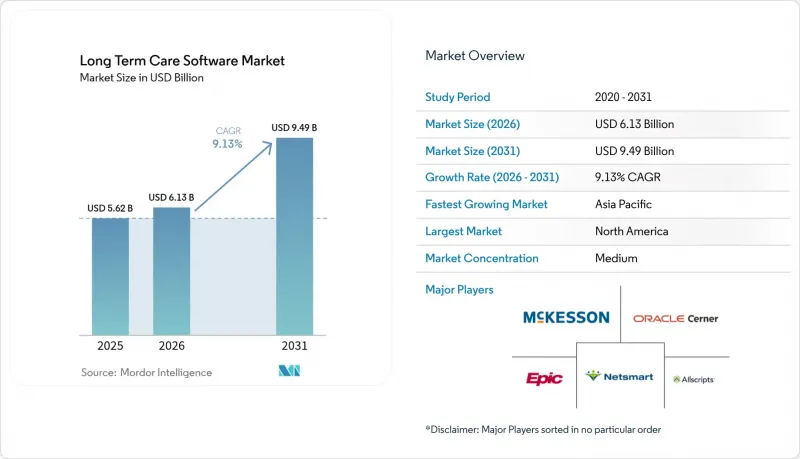
본 보고서에서는 업계를 제품별(전자차트, 전자처방, 임상 의사결정 지원 시스템 등), 도입 형태별(클라우드 기반, 온프레미스형), 최종 사용자별(재택치료 기관, 호스피스 시설, 요양 시설, 요양 지원 주택), 그리고 지역별로 분류하고 있습니다.
세계의 장기요양 소프트웨어 시장 동향 및 인사이트
고령화와 만성 질환의 부담
고령층의 확대와 동반 질환 증가에 따라 장기 요양 수요가 높아지고 있으며, 시설들은 기록 관리, 예측 분석, 원격 모니터링을 통합한 소프트웨어 도입을 불가피하게 하고 있습니다. 브라질의 고령 인구는 2050년까지 3배로 증가할 것으로 예상되며, 정부의 기술 보조금을 통해 자립적인 생활을 유지하기 위한 IoT 기반 모니터링 시범 사업에 이미 자금이 지원되고 있습니다. 독일에서는 2040년까지 190만 명 이상의 요양 인력 부족이 예상되며, 인력을 비례적으로 늘리지 않고도 요양 수준을 유지하기 위해서는 기술을 활용한 업무 흐름이 필수적입니다. 전 세계 시설에서는 낙상 감지 센서, 웨어러블 기기, AI 분류 도구를 도입하고 있으며, 이러한 장치들은 경보를 전자 차트에 직접 전송함으로써 대응 시간을 단축하는 동시에 법적 책임의 위험을 줄이고 있습니다. 미국의 HIPAA나 유럽의 GDPR(EU 개인정보보호규정)과 같은 규제 체계에서는 안전하고 상호 운용 가능한 시스템이 요구되고 있으며, 장기요양 소프트웨어 시장은 안전하고 규정 준수를 충족하는 케어 관리를 실현하는 중요한 요소가 되고 있습니다. 지속적인 인구 동향은 수년에 걸친 투자 주기를 뒷받침하고 있으며, 소프트웨어 업그레이드를 미루는 것을 억제하고 있습니다.
급성기 이후 EHR 상호운용성에 대한 정부의 인센티브
HTI-1 최종 규정에 따라 장기 요양 시설은 2026년 1월까지 USCDI v3를 지원하는 인증된 의료 IT 모듈을 도입해야 하며, 규정 준수 압박이 설비 투자 우선순위 결정으로 이어지고 있습니다. 정보 차단에 대한 제재로 인해 폐쇄형 시스템에 의존하는 사업자들 사이에서 플랫폼 교체가 가속화되고 있습니다. TEFCA의 신뢰할 수 있는 교환 프레임워크는 데이터 공유에 대한 인센티브를 확대하며, 견고한 API와 단일 테넌트형 보안 아키텍처를 갖춘 공급업체를 우대하고 있습니다. CMS의 품질 향상 이니셔티브는 입증 가능한 상호 운용성을 평가하고 있으며, EHR 도입은 단순한 행정적 부담이 아닌 직접적인 수익원이 되고 있습니다. 주 메디케이드 제도의 조정으로 인해 인증된 기술을 사용하는 이용자에 대한 환급액이 인상되어, 특히 이익률이 극히 낮은 메디케이드 의존도가 높은 요양 시설에서 도입이 더욱 촉진되고 있습니다.
사이버 보안 및 데이터 개인정보 보호에 대한 우려
2024년에는 의료 분야의 랜섬웨어 피해가 증가하여, 장기 요양 기관은 현재 벌금 및 브랜드 가치 하락을 포함해 정보 유출로 인한 평균 비용이 1,000만 달러를 초과하는 상황에 직면해 있습니다. NIST의 2024년 지침에는 더욱 엄격한 암호화 및 감사 로그 기준이 명시되어 있어, 구식 웹 기반 용도의 통합이 더욱 복잡해지고 있습니다. 국경을 넘는 데이터 전송에 관한 GDPR(EU 개인정보보호규정) 규정은 다국적 체인 기업들에게 법적 불확실성을 높이고 있습니다. 전담 보안 담당자가 없는 소규모 시설의 경우, SaaS가 개선되고 있음에도 불구하고 업그레이드를 미루는 경우가 많아 레거시 시스템이 취약한 상태로 방치되고 있습니다. 그 결과 발생하는 위험 회피 성향으로 인해, 공급업체가 턴키 방식의 규정 준수 도구를 제시할 때까지는 단기적인 장기요양 소프트웨어 시장의 도입이 주춤할 것입니다.
부문 분석
2025년 웹 기반 장기요양 소프트웨어 시장 규모는 25억 3,000만 달러에 달하여 총 매출의 45.10%를 차지했습니다. 그러나 클라우드 플랫폼은 연평균 성장률(CAGR) 9.41%로 확대될 것으로 예측되며, 향후 10년 말까지 SaaS 서비스가 장기요양 소프트웨어 시장에서 점유율을 높일 것으로 전망됩니다. 사업자들은 업그레이드에 따른 다운타임 단축, AI 모듈 이용, 여러 시설에 걸친 보고의 일원화를 목표로 클라우드로의 전환을 추진하고 있습니다. PointClickCare의 Azure로의 전환과 WellSky와 Google Cloud의 제휴는 하이퍼스케일 리소스가 기능 배포를 어떻게 가속화하는지를 보여줍니다. 보호 대상 의료 정보(PHI) 서버를 분리하는 한편, 익명화된 데이터 세트에 대해 클라우드 분석을 활용하는 기업 체인 사이에서는 하이브리드 배포가 여전히 지속되고 있습니다. 예측 기간 동안 벤더의 로드맵에서는 컨테이너화된 마이크로서비스가 우선시되어, 배포 옵션 간 기능의 균일성이 확보되는 동시에 대역폭이 제한된 사이트에서의 전환 경로가 원활해질 것입니다.
클라우드의 부상은 영구 라이선스를 매월 지속되는 수익으로 대체함으로써 벤더의 경제 구조를 재편하고 예측 가능성을 높이는 동시에, 고객 이탈 위험도 가중시키고 있습니다. 클라우드 재개발 자금을 조달할 수 없는 소규모 공급업체는 인수 대상이 되어 업계 통합이 가속화되고 있습니다. 시설 측에서는 모바일 접근성과 보안 패치의 자동 적용을 가장 큰 장점으로 꼽고 있지만, 여전히 회의적인 입장을 취하는 사람들은 인터넷 연결 장애나 데이터 주권에 관한 규제를 우려하고 있습니다. 퍼블릭 클라우드 제공업체 시장 인식 제고 캠페인과 지역별 광대역 확장 프로그램을 통해 오랫동안 남아 있던 많은 우려가 해소되면서, SaaS 보급을 향한 흐름이 더욱 강해지고 있습니다.
지역별 분석
북미는 2025년, 인증된 전자건강기록(EHR)의 이용을 장려하는 메디케어 및 메디케이드의 인센티브에 힘입어 장기요양 소프트웨어 시장의 41.80% 점유율을 차지했습니다. 2026년 1월 HTI-1 적용 기한으로 인해 갱신 주기가 가속화되었으며, 정보 차단 규제의 시행으로 인해 여러 주에 걸쳐 있는 체인 기업들은 API 우선 플랫폼으로의 표준화를 강요받고 있습니다. 인력 부족을 배경으로 가상 간호 대시보드의 도입이 진행되고 있습니다. 현재 병원 경영자의 74%가 원격 모니터링을 미래 의료 서비스 제공에 필수적인 요소로 인식하고 있습니다. 캐나다에서는 보상 최적화보다 업무 효율을 우선시하는 반면, 멕시코에서는 중산층을 배경으로 민간 장기 요양에 대한 수요가 확대되고 있어, 공급업체들의 현지화 노력을 뒷받침하고 있습니다.
아시아태평양은 주요 지역 중 가장 높은 연평균 성장률(CAGR) 9.74%를 나타낼 것으로 예측됩니다. 일본 후생노동성은 2040년까지 예상되는 57만 명의 요양 인력 부족을 완화하기 위해 센서가 장착된 침대나 로봇 리프트에 대한 보조금을 지급하고 있습니다. 중국의 장기 요양 시설에서는 평균 요양 서비스 필요도 점수가 162.15로 보고되고 있으며, 이에 따라 입소자 평가 및 인력 배치 도구를 위한 소프트웨어 예산이 증가하고 있습니다. 호주의 디지털 헬스 전략은 2027년까지 전자 투약 기록의 전면 도입을 목표로 하고 있으며, 이에 따라 장기요양 소프트웨어 시장은 더욱 확대될 전망입니다.
유럽에서는 투자자들의 신뢰가 지속되고 있으며, 2024년에는 요양 시설의 부동산 거래액이 23억 유로에 달했습니다. GDPR(EU 개인정보보호규정)(일반 데이터 보호 규정)에 따른 엄격한 데이터 처리 규정이 국경을 넘는 도입을 지연시키고 있지만, 표준화 노력에 힘입어 공급업체들은 사용자 정의가 가능한 동의 관리 모듈 개발을 촉진하고 있습니다. 독일의 병원 자금 조달 개혁으로 디지털 인프라에 대한 보조금이 확대되었으며, 프랑스의 ‘Ma Sante’ 전략에서는 상호 운용 가능한 급성기 후 솔루션에 자금이 배정되고 있습니다. 스위스의 재택 간호 동향은 강화되고 있으며, 비용 대비 효율이 높은 SaaS에 대한 수요가 증가하고 있습니다.
남미, 중동, 아프리카 등 신흥 지역은 두 자릿수 성장 잠재력을 지니고 있으나, 환율 변동과 인프라 부족이라는 과제에 직면해 있습니다. 벤더들은 통신 사업자와 제휴하여 연결 서비스와 호스팅을 번들로 제공하는 경우가 많으며, 이를 통해 초기 도입자의 진입 장벽을 낮추고 있습니다.
기타 혜택 :
- 엑셀 형식 시장 예측(ME) 시트
- 3개월간 애널리스트 지원
자주 묻는 질문
목차
제1장 서론
제2장 조사 방법
제3장 주요 요약
제4장 시장 구도
제5장 시장 규모 및 성장 예측
제6장 경쟁 구도
제7장 시장 기회 및 향후 전망
AJY 26.08.26According to Mordor Intelligence, the long term care software market size is expected to grow from USD 5.62 billion in 2025 to USD 6.13 billion in 2026 and is forecast to reach USD 9.49 billion by 2031 at 9.13% CAGR over 2026-2031.
This report Segments the Industry Into by Product (Electronic Health Records, E-Prescribing, Clinical Decision Support Systems, and More), by Deployment (Cloud-Based, On-Premise Based), by End-User (Home Healthcare Agencies, Hospice Care Facilities, Nursing Homes and Assisted Living Facilities), and Geography.
Global Long Term Care Software Market Trends and Insights
Ageing Population & Chronic-Disease Burden
Long-term care demand magnifies as older cohorts expand and comorbidities rise, forcing facilities to adopt software that unites documentation, predictive analytics, and remote monitoring. Brazil's older-adult population is set to triple by 2050, and government technology grants already fund IoT-enabled monitoring pilots to sustain independent living. Germany anticipates a nursing shortfall exceeding 1.9 million professionals by 2040, making technology-assisted workflows indispensable for maintaining care standards without proportional head-count growth. Facilities worldwide deploy fall-detection sensors, wearables, and AI triage tools that escalate alerts directly into Electronic Health Records, improving response times while reducing liability exposure. Regulatory frameworks such as HIPAA in the United States and GDPR in Europe require secure, interoperable systems, making the long term care software market a critical enabler of safe, compliant care management. Sustained demographic momentum underpins multi-year investment cycles and discourages deferral of software upgrades.
Government Incentives for Post-Acute EHR Interoperability
The HTI-1 final rule obliges long-term care facilities to implement certified health IT modules supporting USCDI v3 by January 2026, converting compliance pressure into capex prioritization. Information-blocking penalties accelerate platform replacement among operators reliant on closed systems. TEFCA's trusted exchange framework broadens data-sharing incentives, favoring vendors with robust APIs and single-tenant security architectures. CMS quality initiatives reward demonstrable interoperability, making EHR adoption a direct revenue driver rather than an administrative chore. State Medicaid adjustments further stimulate purchases by boosting reimbursement for certified technology users, especially among high-Medicaid nursing homes confronting razor-thin margins.
Cyber-Security & Data-Privacy Concerns
Healthcare ransomware events grew in 2024, and long-term care organizations now face average breach costs surpassing USD 10 million, including penalties and brand erosion. NIST's 2024 guide sets stricter encryption and audit-log standards, raising integration complexity for older web-based applications. GDPR provisions on cross-border data transfers add legal uncertainty for multinational chains. Smaller facilities lacking full-time security personnel often postpone upgrades despite SaaS improvements, leaving legacy systems exposed. The resulting risk aversion tempers near-term long term care software market adoption until vendors demonstrate turnkey compliance tooling.
Other drivers and restraints analyzed in the detailed report include:
- Shift to Cloud-Based SaaS Lowering IT Barriers
- Value-Based Reimbursement Models Demanding Analytics
- High Implementation & Maintenance Cost for Smaller Operators
For complete list of drivers and restraints, kindly check the Table Of Contents.
Segment Analysis
The long term care software market size for web-based deployments stood at USD 2.53 billion in 2025, representing 45.10% share of total revenue. Cloud platforms, however, are forecast to expand at a 9.41% CAGR, elevating the long term care software market share of SaaS offerings by the end of the decade. Operators migrate to cloud to reduce upgrade downtime, access AI modules, and centralize multi-facility reporting. PointClickCare's Azure migration and WellSky's partnership with Google Cloud showcase how hyperscale resources accelerate feature rollouts. Hybrid deployments persist among enterprise chains that segregate protected health information servers while leveraging cloud analytics for de-identified data sets. Over the forecast horizon, vendor roadmaps prioritize containerized microservices, ensuring feature parity across deployment options and smoothing transition pathways for bandwidth-limited sites.
Cloud dominance reshapes vendor economics by replacing perpetual licenses with recurring monthly revenue, improving predictability yet intensifying churn risk. Smaller suppliers unable to finance cloud redevelopment become acquisition candidates, accelerating consolidation. Facilities cite mobile accessibility and automatic security patching as top benefits, while remaining skeptics worry about internet outages and data-sovereignty rules. Market education campaigns from public cloud providers and regional broadband expansion programs alleviate many lingering objections, reinforcing the trajectory toward SaaS penetration.
Complete Report Scope:
- By Deployment Model
- Cloud-based
- Web-based
- On-premises
- By Product Module
- Electronic Health Record (EHR)
- eMAR / Medication Management
- Revenue-Cycle & Financial Management
- Workforce & Scheduling
- Analytics & Business Intelligence
- By End-User Facility Type
- Nursing Homes / Skilled-Nursing Facilities
- Assisted-Living Facilities
- Home-Health & Hospice Agencies
- By Geography (Value)
- North America
- United States
- Canada
- Mexico
- Europe
- Germany
- United Kingdom
- France
- Italy
- Spain
- Rest of Europe
- Asia-Pacific
- China
- India
- Japan
- South Korea
- Australia
- Rest of Asia-Pacific
- South America
- Brazil
- Argentina
- Rest of South America
- Middle East and Africa
- GCC
- South Africa
- Rest of Middle East and Africa
- North America
Geography Analysis
North America captured 41.80% share of the long term care software market in 2025, anchored by Medicare and Medicaid incentives that reward certified EHR use. The January 2026 HTI-1 deadline accelerates refresh cycles, and information-blocking enforcement drives multi-state chains to harmonize on API-first platforms. Labor shortages propel adoption of virtual-nursing dashboards; 74% of hospital leaders now view remote monitoring as integral to future care delivery. Canada prioritizes operational efficiency over reimbursement optimization, whereas Mexico's mid-income segment expands private long-term care demand, stimulating vendor localization efforts.
Asia-Pacific is projected to record a 9.74% CAGR, the fastest among major regions. Japan's health ministry subsidizes sensor-equipped beds and robotic lifts to mitigate the projected 570,000 caregiver deficit by 2040. China's long-term care facilities report an average nursing-service need score of 162.15, translating into rising software budgets for resident assessment and staffing tools. Australia's digital-health strategy targets full electronic medication chart coverage by 2027, further enlarging the long term care software market.
Europe demonstrates sustained investor confidence, with EUR 2.3 billion in nursing-home property transactions during 2024. GDPR imposes strict data-processing rules that slow cross-border deployments, yet standardization efforts spur vendors to develop configurable consent-management modules. Germany's hospital-funding reform boosts digital infrastructure grants, and France's Ma Sante strategy earmarks funding for interoperable post-acute solutions. Switzerland's trend toward home-based care intensifies demand for cost-effective SaaS.
Emerging regions such as South America and the Middle East & Africa exhibit double-digit growth potential but face currency volatility and infrastructure gaps. Vendors often partner with telecom operators to bundle connectivity and hosting, reducing hurdles for early adopters.
- PointClickCare
- MatrixCare (ResMed)
- WellSky
- Cerner
- Epic Systems
- Allscripts (Veradigm)
- Mckesson
- Omnicare (CVS Health)
- AlayaCare
- American HealthTech
- Netsmart Technologies
- Experience Care
- August Health
- CareCenta
- Eldermark
- SigmaCare
- Yardi Senior Living Suite
- Medtelligent (Alis)
- Optimus EMR
- AccuPoint
Additional Benefits:
- The market estimate (ME) sheet in Excel format
- 3 months of analyst support
TABLE OF CONTENTS
1 Introduction
- 1.1 Study Assumptions & Market Definition
- 1.2 Scope of the Study
2 Research Methodology
3 Executive Summary
4 Market Landscape
- 4.1 Market Overview
- 4.2 Market Drivers
- 4.2.1 Ageing population & chronic-disease burden
- 4.2.2 Government incentives for post-acute EHR interoperability
- 4.2.3 Shift to cloud-based SaaS lowering IT barriers
- 4.2.4 Value-based reimbursement models demanding analytics
- 4.2.5 AI-driven fall/readmission risk prediction
- 4.2.6 Workforce shortages accelerating mobile workflow adoption
- 4.3 Market Restraints
- 4.3.1 Cyber-security & data-privacy concerns
- 4.3.2 High implementation & maintenance cost for smaller operators
- 4.3.3 Fragmented state-level regulations raising integration complexity
- 4.3.4 Limited interoperability standards versus acute-care EHRs
- 4.4 Value / Supply-Chain Analysis
- 4.5 Regulatory Landscape
- 4.6 Technological Outlook
- 4.7 Porter's Five Forces
- 4.7.1 Threat of New Entrants
- 4.7.2 Bargaining Power of Suppliers
- 4.7.3 Bargaining Power of Buyers
- 4.7.4 Threat of Substitutes
- 4.7.5 Competitive Rivalry
5 Market Size & Growth Forecasts (Value)
- 5.1 By Deployment Model
- 5.1.1 Cloud-based
- 5.1.2 Web-based
- 5.1.3 On-premises
- 5.2 By Product Module
- 5.2.1 Electronic Health Record (EHR)
- 5.2.2 eMAR / Medication Management
- 5.2.3 Revenue-Cycle & Financial Management
- 5.2.4 Workforce & Scheduling
- 5.2.5 Analytics & Business Intelligence
- 5.3 By End-User Facility Type
- 5.3.1 Nursing Homes / Skilled-Nursing Facilities
- 5.3.2 Assisted-Living Facilities
- 5.3.3 Home-Health & Hospice Agencies
- 5.4 By Geography (Value)
- 5.4.1 North America
- 5.4.1.1 United States
- 5.4.1.2 Canada
- 5.4.1.3 Mexico
- 5.4.2 Europe
- 5.4.2.1 Germany
- 5.4.2.2 United Kingdom
- 5.4.2.3 France
- 5.4.2.4 Italy
- 5.4.2.5 Spain
- 5.4.2.6 Rest of Europe
- 5.4.3 Asia-Pacific
- 5.4.3.1 China
- 5.4.3.2 India
- 5.4.3.3 Japan
- 5.4.3.4 South Korea
- 5.4.3.5 Australia
- 5.4.3.6 Rest of Asia-Pacific
- 5.4.4 South America
- 5.4.4.1 Brazil
- 5.4.4.2 Argentina
- 5.4.4.3 Rest of South America
- 5.4.5 Middle East and Africa
- 5.4.5.1 GCC
- 5.4.5.2 South Africa
- 5.4.5.3 Rest of Middle East and Africa
- 5.4.1 North America
6 Competitive Landscape
- 6.1 Market Concentration
- 6.2 Strategic Moves
- 6.3 Market Share Analysis
- 6.4 Company Profiles (includes Global-level Overview, Market-level Overview, Core Segments, Financials as available, Strategic Information, Market Rank/Share for key companies, Products & Services, and Recent Developments)
- 6.4.1 PointClickCare
- 6.4.2 MatrixCare (ResMed)
- 6.4.3 WellSky
- 6.4.4 Cerner Corporation
- 6.4.5 Epic Systems
- 6.4.6 Allscripts (Veradigm)
- 6.4.7 McKesson
- 6.4.8 Omnicare (CVS Health)
- 6.4.9 AlayaCare
- 6.4.10 American HealthTech
- 6.4.11 NetSmart Technologies
- 6.4.12 Experience Care
- 6.4.13 August Health
- 6.4.14 CareCenta
- 6.4.15 Eldermark
- 6.4.16 SigmaCare
- 6.4.17 Yardi Senior Living Suite
- 6.4.18 Medtelligent (Alis)
- 6.4.19 Optimus EMR
- 6.4.20 AccuPoint
7 Market Opportunities & Future Outlook
- 7.1 White-space & Unmet-Need Assessment