|
시장보고서
상품코드
2115831
중동 및 아프리카의 ADAS : 시장 점유율 분석, 업계 동향 및 통계, 성장 예측(2026-2031년)Middle East And Africa ADAS - Market Share Analysis, Industry Trends & Statistics, Growth Forecasts (2026 - 2031) |
||||||
 Mordor Intelligence
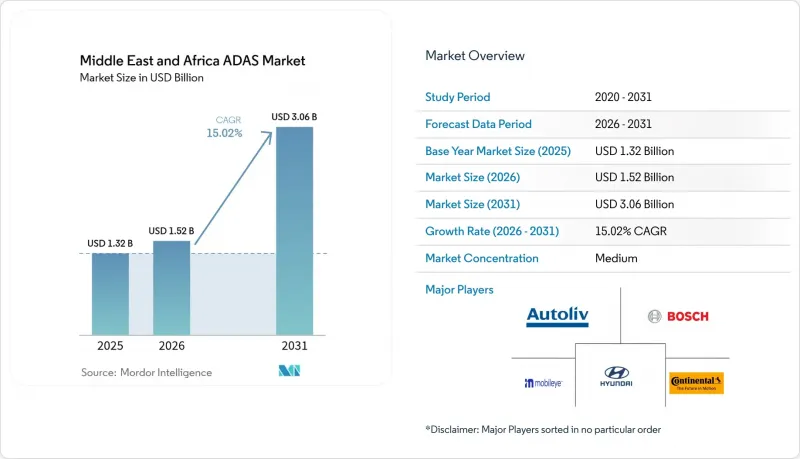
Mordor Intelligence에 의하면, 중동 및 아프리카의 ADAS 시장 규모는 2025년 13억 2,000만 달러로 평가되었습니다. 2026년에는 15억 2,000만 달러로 확대되어 2026년부터 2031년에 걸쳐 CAGR 15.02%로 성장을 지속하여, 2031년에는 30억 6,000만 달러에 이를 것으로 예측됩니다.
본 보고서는 시스템 유형(주차 보조 시스템 등), 센서 기술(레이더, 카메라, 라이다 등), 차량 유형(승용차, 소형 상용차 등), 자율주행 수준(L1, L2, L2+),제공 방식(하드웨어 등), 판매 채널(OEM 순정, 애프터마켓), 국가별로 분류되어 있습니다. 시장 전망은 금액(미 달러) 및 수량(대)으로 제시되어 있습니다.
중동 및 아프리카의 ADAS 시장 동향 및 인사이트
NCAP 방식의 안전 규제 의무화 및 차량 함대 탑재 의무
각 지역의 교통부는 현재 형식 인증 체계에 Euro-NCAP과 동등한 안전 기능군을 포함시키고 있습니다. 두바이 도로교통청(RTA)은 대형 트럭에 텔레매틱스 탑재를 의무화하기 시작했으며, 유엔 유럽경제위원회(UN ECE)의 운전자 제어 지원 시스템에 관한 규제는 조화로운 기술 규칙집을 제공합니다. 영업 허가 취득이 규제 준수에 점점 더 좌우되게 되면서, 차량 운영 사업자들은 ADAS 도입 일정을 앞당기고 있으며, 이로 인해 1차 공급업체들에게 예측 가능한 수익원이 창출되고 있습니다.
고급차의 보급이 L2+ 기능의 확산을 뒷받침
걸프 지역 국가의 부유층 소비자들은 충돌 회피 기능이나 고속도로 주행 보조 기능을 라이프스타일을 상징하는 요소로 중요하게 여기고 있습니다. 현대자동차의 아이오닉(IONIQ) 시리즈나 창안(Changan) 등 중국 브랜드는 현재 최상위 트림에 고속도로 주행 보조 및 차선 변경 기능을 기본 사양으로 탑재하고 있습니다. 이러한 시연 효과로 인해 보급 주기가 단축되면서, 중급 부문의 자동차 제조업체들도 더 저렴한 가격대에 기능이 제한된 L2 패키지를 제공하기 시작했습니다.
아프리카 시장의 높은 시스템 비용과 가처분 소득 간의 균형
사하라 이남 아프리카 시장에서는 ADAS 가격 상승분이 신차 가격의 5-10%에 달하는 경우가 있으며, 평균적인 자동차 보유 비용이 이미 가계를 압박하고 있는 상황에서 이는 큰 장벽이 되고 있습니다. 과거에는 사후 장착 키트가 이 격차를 메워주었으나, Mobileye가 2024년에 애프터마켓 사업에서 철수함에 따라 중요한 저비용 판매 경로가 사라졌습니다. 현지 신용 보조금이나 추가적인 관세 우대 조치가 없는 한, 아프리카에서의 ADAS 보급은 걸프 국가들에 비해 뒤처지게 될 것입니다.
부문별 분석
자동 긴급 제동 시스템은 규제 당국이 차량 검사 항목에 전방 충돌 완화 기능을 추가함에 따라 연평균 성장률(CAGR) 18.74%로 확대되고 있으며, 가장 높은 부가가치를 창출하고 있습니다. 이미 주류가 된 주차 지원 기술도 두바이나 리야드의 밀집된 도심 지역에서는 저속 충돌에 대한 우려가 높아지고 있어 여전히 29.12%의 점유율을 차지하고 있습니다. Tier 1 공급업체들은 이러한 기능을 묶어 채택률을 높이고 있으며, 이는 ADAS 시장의 성장세를 더욱 강화하고 있습니다.
통합형 안전 시스템에서는 사각지대 감지, 어댑티브 프론트 라이팅, 운전자 모니터링 카메라를 결합하는 사례가 늘고 있습니다. Bosch와 같은 Tier 1 공급업체는 모듈식 하드웨어에 AI 인식 알고리즘을 통합함으로써, OEM이 비용이 많이 드는 재설계를 거치지 않고도 맞춤형 패키지를 도입할 수 있도록 하고 있습니다.
카메라는 여전히 경제적인 주력 제품으로, 2025년 매출의 42.75%를 차지했습니다. 그러나 걸프 지역 자동차 제조업체들은 눈부심과 먼지 문제에 직면해 있으며, 솔리드 스테이트형 장치의 가격이 채널당 500달러 아래로 떨어지면서 LiDAR의 연평균 성장률(CAGR) 18.96%를 견인하고 있습니다. 레이더가 4D 이미징 구성으로 업그레이드됨에 따라 기상 조건에 구애받지 않는 물체 분류가 가능해진 반면, 초음파 센서는 저속의 도시 주행에서 여전히 필수적인 역할을 수행하고 있습니다.
소프트웨어 정의 아키텍처를 통해 OEM 각사는 무선으로 알고리즘을 개선하고, 지역의 운전 특성에 맞춘 센서 융합을 최적화할 수 있습니다. 이 기능 덕분에 차별화 요인은 하드웨어 비용 곡선에서 업데이트 빈도 및 데이터 사이언스 전문 지식으로 이동하고 있으며, 이것이 ADAS 업계의 특징이 되고 있습니다.
기타 혜택 :
- 엑셀 형식 시장 예측(ME) 시트
- 3개월간의 애널리스트 지원
자주 묻는 질문
목차
제1장 서론
제2장 조사 방법
제3장 개요
제4장 시장 구도
제5장 시장 규모 및 성장 예측
제6장 경쟁 구도
제7장 시장 기회 및 향후 전망
KTH 26.08.31According to Mordor Intelligence, the Middle East and Africa Advanced Driver Assistance Systems market size is expected to grow from USD 1.32 billion in 2025 to USD 1.52 billion in 2026 and is forecast to reach USD 3.06 billion by 2031 at 15.02% CAGR over 2026-2031.
This report is Segmented by System Type (Parking Assist System, and More), Sensor Technology (Radar, Camera, Li-Dar, and More), Vehicle Type (Passenger Cars, Light Commercial Vehicles and More), Level of Autonomy (L1, L2 and L2+), Offering (Hardware, and More), Distribution Channel ( OEM-Fit and Aftermarket), and Country. The Market Forecasts are Provided in Terms of Value (USD) and Volume (Units).
Middle East And Africa ADAS Market Trends and Insights
Mandatory NCAP-style Safety Regulations & Fleet-fit Mandates
Regional transport ministries now embed Euro-NCAP-equivalent safety suites into type-approval frameworks. Dubai's Roads and Transport Authority began requiring telematics in heavy trucks, and UN ECE's Driver Control Assistance Systems regulation offers a harmonized technical rulebook . Because operating licences increasingly hinge on compliance, fleet operators accelerate ADAS installation schedules, creating a predictable revenue stream for Tier 1 suppliers.
Premium-vehicle Uptake Boosting L2+ Feature Penetration
Affluent Gulf consumers value collision-avoidance and highway-pilot functions as lifestyle statements. Hyundai's IONIQ range and Chinese brands like Changan now bundle Highway Driving Assist and automated lane-change features as standard on top trims. The demonstration effect shortens diffusion cycles, prompting mid-segment OEMs to offer stripped-down L2 packages at lower price points.
High System Cost Versus Disposable Income in Africa
In Sub-Saharan markets, the price uplift for ADAS can equal 5-10% of a new-vehicle invoice, a hurdle when average car-ownership costs already strain household budgets. Retrofit kits once addressed this gap, but Mobileye's 2024 exit from aftermarket programs removed a key low-cost channel. Without local credit subsidies or deeper duty breaks, mass adoption lags behind Gulf peers.
Other drivers and restraints analyzed in the detailed report include:
- Sensor Cost Declines & Local Assembly Incentives
- Smart-city Corridors Enabling ADAS-ready V2X Infrastructure
- Sparse Calibration and Servicing Networks
For complete list of drivers and restraints, kindly check the Table Of Contents.
Segment Analysis
Automatic emergency braking contributes the highest incremental value, expanding at 18.74% CAGR as regulators add forward-collision mitigation to inspection checklists. While already mainstream, parking-assist technology still holds a 29.12% share because dense urban cores in Dubai and Riyadh heighten low-speed collision anxiety. Tier 1 suppliers bundle these features to encourage higher take-rates, reinforcing the advanced driver assistance systems market's momentum.
Integrated safety suites increasingly combine blind-spot detection, adaptive front lighting, and driver-monitoring cameras. Tier 1s such as Bosch overlay AI perception algorithms on modular hardware, enabling OEMs to deploy tailored packages without costly redesigns.
Cameras remain the economic workhorse, controlling 42.75% of 2025 revenue. Yet Gulf operators contend with glare and dust, catalyzing LiDAR's 18.96% CAGR as solid-state units drop below USD 500 per channel. Radar upgrades to 4D-imaging configurations add weather-resilient object classification, while ultrasonic rings stay vital for low-speed urban maneuvers.
Software-defined architectures let OEMs refine algorithms over the air, optimizing sensor fusion for regional driving idiosyncrasies. This capability shifts differentiation from hardware cost curves toward update cadence and data-science expertise, a hallmark of the advanced driver assistance systems industry.
Complete Report Scope:
- By System Type
- Parking Assist Systems
- Adaptive Front-lighting
- Night Vision
- Blind-Spot Detection
- Lane Departure Warning
- Automatic Emergency Braking
- Driver Monitoring & Drowsiness Detection
- By Sensor Technology
- Radar (24 / 77 / 79 GHz)
- Camera (Mono, Stereo, Surround)
- LiDAR (Solid-state, Mechanical)
- Ultrasonic & Infra-red
- By Vehicle Type
- Passenger Cars
- Light Commercial Vehicles
- Medium & Heavy Commercial Vehicles & Buses
- By Level of Autonomy
- L1 (Driver Assistance)
- L2 (Partial Automation)
- L2+ (Enhanced Partial Automation)
- By Offering
- Hardware (ECU, Sensors)
- Software & Algorithms
- Integration & Calibration Services
- By Distribution Channel
- OEM-fit
- Aftermarket Retrofit
- By Country
- Saudi Arabia
- United Arab Emirates
- Qatar
- Kuwait
- South Africa
- Egypt
- Morocco
- Nigeria
- Rest of Middle East and Africa
List of Companies Covered in this Report:
- Autoliv AB
- Robert Bosch GmbH
- Continental AG
- Hyundai Mobis Co.
- Aptiv PLC
- Mobileye (Intel)
- ZF Friedrichshafen AG
- DENSO Corporation
- Valeo SA
- Magna International
- HELLA GmbH & Co. KGaA
- Veoneer
Additional Benefits:
- The market estimate (ME) sheet in Excel format
- 3 months of analyst support
TABLE OF CONTENTS
1 Introduction
- 1.1 Study Assumptions & Market Definition
- 1.2 Scope of the Study
2 Research Methodology
3 Executive Summary
4 Market Landscape
- 4.1 Market Overview
- 4.2 Market Drivers
- 4.2.1 Mandatory NCAP-style safety regulations & fleet-fit mandates
- 4.2.2 Premium-vehicle uptake boosting L2+ feature penetration
- 4.2.3 Sensor cost declines & local assembly incentives
- 4.2.4 Smart-city corridors enabling ADAS-ready V2X infrastructure
- 4.2.5 Ride-hailing & leasing fleets standardising safety packs
- 4.2.6 Vision-2030 diversification funds channelled into mobility tech
- 4.3 Market Restraints
- 4.3.1 High system cost vs disposable income in Africa
- 4.3.2 Sparse calibration & servicing networks
- 4.3.3 Harsh dust-heat environment degrading sensor uptime
- 4.3.4 Tariff swings & localisation rules disrupting supply chains
- 4.4 Value/Supply-Chain Analysis
- 4.5 Regulatory Landscape
- 4.6 Technological Outlook
- 4.7 Porter's Five Forces Analysis
- 4.7.1 Threat of New Entrants
- 4.7.2 Bargaining Power of Buyers
- 4.7.3 Bargaining Power of Suppliers
- 4.7.4 Threat of Substitutes
- 4.7.5 Intensity of Competitive Rivalry
5 Market Size & Growth Forecasts (Value (USD) and Volume (Units))
- 5.1 By System Type
- 5.1.1 Parking Assist Systems
- 5.1.2 Adaptive Front-lighting
- 5.1.3 Night Vision
- 5.1.4 Blind-Spot Detection
- 5.1.5 Lane Departure Warning
- 5.1.6 Automatic Emergency Braking
- 5.1.7 Driver Monitoring & Drowsiness Detection
- 5.2 By Sensor Technology
- 5.2.1 Radar (24 / 77 / 79 GHz)
- 5.2.2 Camera (Mono, Stereo, Surround)
- 5.2.3 LiDAR (Solid-state, Mechanical)
- 5.2.4 Ultrasonic & Infra-red
- 5.3 By Vehicle Type
- 5.3.1 Passenger Cars
- 5.3.2 Light Commercial Vehicles
- 5.3.3 Medium & Heavy Commercial Vehicles & Buses
- 5.4 By Level of Autonomy
- 5.4.1 L1 (Driver Assistance)
- 5.4.2 L2 (Partial Automation)
- 5.4.3 L2+ (Enhanced Partial Automation)
- 5.5 By Offering
- 5.5.1 Hardware (ECU, Sensors)
- 5.5.2 Software & Algorithms
- 5.5.3 Integration & Calibration Services
- 5.6 By Distribution Channel
- 5.6.1 OEM-fit
- 5.6.2 Aftermarket Retrofit
- 5.7 By Country
- 5.7.1 Saudi Arabia
- 5.7.2 United Arab Emirates
- 5.7.3 Qatar
- 5.7.4 Kuwait
- 5.7.5 South Africa
- 5.7.6 Egypt
- 5.7.7 Morocco
- 5.7.8 Nigeria
- 5.7.9 Rest of Middle East and Africa
6 Competitive Landscape
- 6.1 Market Concentration
- 6.2 Strategic Moves
- 6.3 Market Share Analysis
- 6.4 Company Profiles (Includes Global Level Overview, Market Level Overview, Core Segments, Financials as Available, Strategic Information, Market Rank/Share for Key Companies, Products and Services, and Recent Developments)
- 6.4.1 Autoliv AB
- 6.4.2 Robert Bosch GmbH
- 6.4.3 Continental AG
- 6.4.4 Hyundai Mobis Co.
- 6.4.5 Aptiv PLC
- 6.4.6 Mobileye (Intel)
- 6.4.7 ZF Friedrichshafen AG
- 6.4.8 DENSO Corporation
- 6.4.9 Valeo SA
- 6.4.10 Magna International
- 6.4.11 HELLA GmbH & Co. KGaA
- 6.4.12 Veoneer
7 Market Opportunities & Future Outlook
- 7.1 White-space & Unmet-Need Assessment