|
시장보고서
상품코드
2116596
인도의 자동차용 첨단 운전자 보조 시스템(ADAS) 시장 : 점유율 분석, 업계 동향과 통계, 성장 예측(2026-2031년)India Automotive Advanced Driver Assistance Systems - Market Share Analysis, Industry Trends & Statistics, Growth Forecasts (2026 - 2031) |
||||||
 Mordor Intelligence
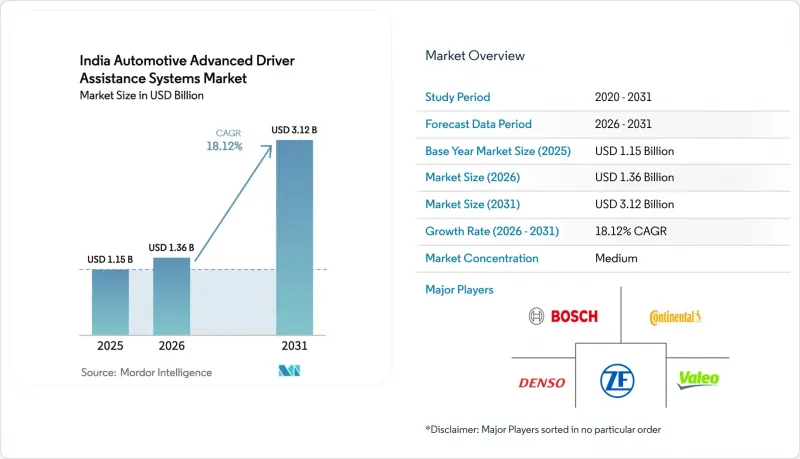
Mordor Intelligence에 의하면, 인도의 자동차용 첨단 운전자 보조 시스템(ADAS) 시장 규모는 2025년에 11억 5,000만 달러로 평가되었고 2026년 13억 6,000만 달러에서 2031년까지 31억 2,000만 달러에 이를 것으로 예측되며, 예측 기간(2026-2031년) CAGR은 18.12%를 나타낼 전망입니다.
본 보고서는 시스템 유형(주차 지원 시스템, 어댑티브 프론트 라이팅 등), 센서 기술(레이더, 라이더,카메라, 초음파 등), 차량 유형(이륜차, 승용차 등), 자율주행 레벨(L1, L2, L3 등), 판매 채널(OEM 순정 장착 및 애프터마켓용 사후 장착)별로 분류되어 있습니다. 시장 예측은 금액(달러) 기준으로 제시되어 있습니다.
인도 자동차용 ADAS(첨단 운전자 보조 시스템) 시장 동향 및 인사이트
Bharat-NCAP 안전 기준에 따라 OEM 기본 사양 적용 가속화
새로운 Bharat-NCAP 프로토콜에 따라 ADAS는 프리미엄 차량의 차별화 요소에서 승용차 및 상용차의 모든 플랫폼에 대한 법적 요건으로 전환되었으며, 자동차 제조업체들은 충돌 경고 및 자동 제동 기능을 표준 사양으로 탑재해야만 합니다. 혼다는 이미 ADAS를 탑재한 여러 차량을 인도 도로에 출시하여, 업계가 더욱 엄격한 별점 평가 기준을 충족할 준비가 되어 있음을 보여주고 있습니다. 안전 평가가 소비자의 구매 결정에 중요한 요소가 됨에 따라, 각 OEM 업체들은 연구개발 예산의 우선순위를 재검토하며, 수동적인 하드웨어보다 능동적인 안전 기능에 중점을 두고 있습니다. 도로운송·고속도로부에서는 버스 및 대형 트럭에도 ADAS 의무화를 확대하는 제안이 병행하여 제기되고 있어, 대상 시장 기회는 개인용 모빌리티의 범위를 넘어 확장되고 있습니다. 조기 규제 준수는 규제상의 불확실성을 완화하고, 공급업체가 수년에 걸친 생산량을 확보할 수 있게 해줍니다.
ADAS 도입과 연계된 주행 거리 기반 보험 할인
텔레매틱스를 활용한 ‘주행 거리에 따른 보험료(Pay As You Drive)’나 ‘운전 스타일에 따른 보험료(Pay How You Drive)’와 같은 보험 플랜에서는 현재 운전자에게 최대 15-25%의 보험료 할인이 제공되고 있어, ADAS 탑재 차량에는 직접적인 경제적 이점이 주어지고 있습니다. 타타 AIG, 바티 AXA, ICICI 롬바드 등 대형 보험사들은 실시간 운전 행동 점수를 인수 심사에 반영하고 있으며, 이를 통해 보험금 청구 빈도와 손해액을 줄이는 동시에 더 안전한 운전 습관을 장려하고 있습니다. 자동차 제조업체들은 이러한 비용 절감 효과를 쇼룸의 판촉 메시지에 활용하여, 특히 월별 지출을 중시하는 첫 구매자들에게 ADAS 탑재로 인한 가격 인상을 정당화하고 있습니다. 차량 대여 업체의 경우, 사고율 감소가 예상치 못한 수리 비용의 감소와 배송 차량의 가동 중단 시간 단축으로 이어지기 때문에 이는 이익률 향상을 위한 새로운 수단이 됩니다. 또한, 보험사와 자동차 제조업체 간의 데이터 공유 협정에 따라 익명화된 사고 데이터베이스가 구축되어, 향후 ADAS 알고리즘의 정확도 향상으로 이어집니다. 이를 통해 기능의 보급을 더욱 가속화하는 선순환이 만들어지고 있습니다.
차량 가격의 대폭적인 상승(7만-9만 루피)
ADAS 하드웨어를 추가하면 쇼룸 가격이 70,000-90,000 루피(약 789-1,015 달러) 상승하여, 일반 차량의 경우 약 7-9%의 가격 인상이 됩니다. 이는 월별 상환액(EMI)을 중요시하는 구매자들을 더 저렴한 트림으로 유도하기에 충분한 금액입니다. 가성비를 중시하는 A부문 및 B부문 소비자들은 보험료 절감이 초기 비용을 상쇄할 수 있을지에 대해 여전히 회의적입니다. 텔레매틱스가 사고 비용을 직접적으로 절감한다는 사실이 입증되지 않는 한, 차량 대여 업체들도 비슷한 신중함을 보이고 있습니다. 자동차 제조업체들은 쇼룸 방문객 유치를 유지하기 위해 ADAS를 최상위 트림에만 묶어 제공하거나 기능이 제한된 패키지를 제공하고 있어, 대도시권 이외 지역에서의 보급이 지연되고 있습니다. 향후에는 규모의 경제와 중고차 잔존 가치 상승으로 인해 높은 가격이 초래하는 장벽이 해소될 것으로 예측됩니다.
부문 분석
2025년에도 어댑티브 크루즈 컨트롤(ACC)은 델리-뭄바이 및 하이데라바드-방갈로르 고속도로를 이용하는 운전자들에게 지지를 받아, 인도 자동차 ADAS 시장 점유율에서 가장 큰 비중인 28.62%를 계속 차지했습니다. 충돌 경고 시스템에 기인한 인도의 자동차 ADAS 시장 규모는 편의성을 중시한 모듈보다 빠르게 확대되고 있으며, 이는 능동적인 개입을 중시하는 정책 경향을 뒷받침하고 있습니다. 부가 기능인 ‘운전자 졸음 경고’,‘주차 보조’, ‘나이트 비전’은 동일한 센서 스택을 공유하기 때문에 각 OEM 업체는 소프트웨어 전환을 통해 업셀링이 가능해집니다. OTA(Over-the-Air) 업데이트를 통해 기능 로드맵은 유연하게 갱신되며, 규제 당국의 승인을 받는 대로 제조업체는 애프터서비스 업그레이드를 통해 수익화를 도모할 수 있습니다.
자동 긴급 제동(AEB)은 규제 당국과 보험사가 전방 충돌 경보 기준에 대해 입장을 조율해 나가고 있어, 2031년까지 연평균 성장률(CAGR) 20.10%로 성장할 전망입니다. 카메라 중심의 차선 이탈 경고 시스템은 포장 상태가 새로운 도로에서는 최고의 성능을 발휘하지만, 보수 구간이 많은 교외 구간에서는 성능이 저하되기 때문에 횡방향 커버리지를 확보하기 위해 단거리 레이더와 융합하는 듀얼 센서 방식이 채택되고 있습니다. 최근 『ICTACT Journal』의 연구에서 인도 교통 표지판에 대해 98%의 정확도가 입증된 교통 표지판 인식(TSR)은 과속 단속 카메라가 밀집된 지역에서 규칙 준수를 통한 벌금 회피를 목적으로 보급이 확대되고 있습니다. 충돌 회피에 대한 관심이 높아지는 가운데, 지역 교통 상황에 관한 독자적인 데이터 세트를 보유한 공급업체가 우위를 점하고 있으며, 선점자의 우위가 더욱 강화되고 있습니다.
카메라 모듈은 스마트폰 수준의 양산 체제의 혜택을 받아, 2025년에는 인도 자동차용 ADAS 시장 규모의 42.70%를 차지할 전망입니다. 레이더의 전천후 성능은 몬순 시즌의 신뢰성에 필수적인 센서 퓨전 스택 내에서의 입지를 공고히 하고 있습니다. 한때 4자리 수의 단가로 인해 출하가 저해되었던 라이다(LiDAR)는 솔리드 스테이트 아키텍처의 가격이 500달러 아래로 떨어짐에 따라 2031년까지 연평균 성장률(CAGR) 20.55%로 성장할 것으로 전망됩니다. 인도의 자동차용 ADAS 시장에서는 저조도나 장애물이 많은 상황에서도 차선 가장자리나 취약한 도로 이용자를 식별할 수 있는 LiDAR의 고밀도 포인트 클라우드에 가치를 두고 있습니다. 혼다가 IIT 델리 및 IIT 실린더이와 공동으로 진행하는 프로젝트에서는 LiDAR를 카메라 및 레이더와 결합하여, 리키샤, 자전거 이용자, 신호를 무시하는 보행자 등이 혼재된 교통 상황을 매핑하고 있습니다. 초음파 센서는 장거리 감지보다 센티미터 단위의 해상도가 중시되는 근거리 주차 지원 분야에서 여전히 필수적인 역할을 수행하고 있습니다.
지속적으로 진화하는 ECU 설계에는 전용 AI 가속기가 내장되어 있어 차량용 센서 융합을 실현하고 있습니다. 이를 통해 클라우드에 업로드하기 전에 중복 신호를 필터링하여 대역폭을 절약할 수 있습니다. 각 공급업체들은 능동 냉각 없이도 인도의 고온 환경에 대응할 수 있는 전력 효율이 최적화된 ASIC을 통해 차별화를 꾀하고 있으며, 이는 좁은 엔진룸에서 주요 비용 요인으로 작용하고 있습니다.
기타 혜택:
- 엑셀 형식 시장 예측(ME) 시트
- 3개월간의 애널리스트 지원
자주 묻는 질문
목차
제1장 서론
제2장 조사 방법
제3장 개요
제4장 시장 구도
제5장 시장 규모와 성장 예측
제6장 경쟁 구도
제7장 시장 기회와 향후 전망
JHSAccording to Mordor Intelligence, the indian automotive advanced driver assistance systems market size was valued at USD 1.15 billion in 2025 and estimated to grow from USD 1.36 billion in 2026 to reach USD 3.12 billion by 2031, at a CAGR of 18.12% during the forecast period (2026-2031).
This report is Segmented by System Type (Parking Assist Systems, Adaptive Front-Lighting, and More), Sensor Technology (Radar, Lidar, Camera, Ultrasonic, and More), Vehicle Type (Two-Wheelers, Passenger Cars, and More), Level of Autonomy (L1, L2, L3, and More), and Sales Channel (OEM-Fitted and Aftermarket Retrofit). The Market Forecasts are Provided in Terms of Value (USD).
India Automotive Advanced Driver Assistance Systems Market Trends and Insights
Bharat-NCAP Safety Mandate Accelerates OEM Fitment
The new Bharat NCAP protocol converts ADAS from a premium differentiator into a legal requirement across passenger and commercial platforms, forcing automakers to embed collision warning and automatic braking as standard equipment. Honda has already placed several ADAS-equipped vehicles on Indian roads, signaling industry readiness to meet stricter star-rating thresholds. Because safety scores now figure prominently in consumer purchase decisions, OEMs re-prioritize R&D budgets toward active-safety content rather than passive hardware. Parallel proposals from the Ministry of Road Transport and Highways to broaden ADAS obligations to buses and heavy trucks extend the addressable opportunity beyond personal mobility. Early compliance also mitigates regulatory uncertainty, allowing suppliers to lock in multi-year production volumes.
Usage-Based-Insurance Discounts Tied to ADAS Adoption
Telematics-enabled "Pay As You Drive" and "Pay How You Drive" policies now offer motorists premium reductions that can reach 15-25%, providing a direct financial return on ADAS-equipped vehicles. Leading insurers such as Tata AIG, Bharti AXA, and ICICI Lombard embed real-time driving-behavior scores into underwriting, which lowers claim frequency and severity while motivating safer habits. OEMs leverage these savings in showroom messaging to justify the ADAS price uplift, particularly for first-time buyers focused on monthly outlay. Fleet operators gain an additional margin lever because lower accident ratios translate into fewer unplanned repairs and reduced downtime for delivery vehicles. Data-sharing agreements between insurers and automakers also build anonymized crash databases that refine future ADAS algorithms, creating a virtuous circle that further accelerates feature penetration.
High Incremental Vehicle Price (INR 70-90k)
Adding ADAS hardware inflates ex-showroom prices by INR 70,000-90,000 (~USD 789-1,015) or roughly 7-9% on a typical car, enough to push EMI-focused buyers toward lower trims. Consumers in value-driven A- and B-segment categories remain skeptical that insurance savings will offset the upfront outlay. Fleet operators display similar caution unless telematics proves direct accident-cost reductions. OEMs bundle ADAS only on top grades or offer limited-function packs to maintain showroom traffic, slowing penetration outside metro clusters. Over time, scale economies and stronger used-car residuals are expected to neutralize the sticker-shock barrier.
Other drivers and restraints analyzed in the detailed report include:
- PLI Incentives for Local ADAS Component Manufacturing
- Falling Radar and Camera Costs Reach Sub-USD 20/Vehicle
- Shortage of Certified ADAS-Calibration Workshops
For complete list of drivers and restraints, kindly check the Table Of Contents.
Segment Analysis
Adaptive Cruise Control still held the largest slice of the Indian automotive ADAS market share at 28.62% in 2025, favored by motorists traveling the Delhi-Mumbai and Hyderabad-Bangalore expressways. The Indian automotive ADAS market size attributable to collision-warning suites is expanding faster than comfort-oriented modules, underscoring a policy tilt toward active intervention. Secondary functions-Driver Drowsiness Alerts, Parking Assist, and Night Vision-ride on the same sensor stack, enabling OEMs to upsell via software toggles. Over-the-air updates keep feature roadmaps fluid, allowing manufacturers to monetize after-sales upgrades once regulatory approvals are secured.
Automatic Emergency Braking is on course for a 20.10% CAGR to 2031 as regulators and insurers converge on forward-collision mitigation metrics. Camera-centric lane departure warnings perform best on newly resurfaced corridors but struggle in patchy suburban stretches, prompting dual-sensor approaches that fuse short-range radar for lateral coverage. Traffic Sign Recognition, validated at 98% accuracy on Indian signage in a recent ICTACT Journal study, gains traction in speed-camera-dense zones where compliance avoids fines . The heightened emphasis on crash avoidance favors suppliers with proprietary datasets of local traffic idiosyncrasies, reinforcing first-mover advantages.
Camera modules benefited from smartphone-scale production, grabbing 42.70% of the Indian automotive ADAS market size in 2025. Radar's all-weather capability secures its place in sensor fusion stacks indispensable for monsoon-season reliability. LiDAR shipments, once hampered by four-figure unit pricing, now pursue a 20.55% CAGR to 2031 as solid-state architectures drop below USD 500. The Indian automotive ADAS market finds value in LiDAR's dense point clouds that resolve lane edges and vulnerable road users even in low-light or debris-laden conditions. Honda's joint project with IIT Delhi and IIT Bombay pairs LiDAR with cameras and radar to map mixed-traffic layers involving rickshaws, cyclists, and jaywalkers. Ultrasonic sensors remain essential for close-range parking assistance where centimeter-level resolution trumps long-range reach.
Evolving ECU designs integrate dedicated AI accelerators, enabling in-vehicle sensor fusion. This filter redundant signals before cloud upload, conserving bandwidth. Suppliers differentiate through power-optimized ASICs that meet India's high-temperature thresholds without active cooling, a key spend driver in compact engine bays.
Complete Report Scope:
- By System Type
- Parking Assist Systems
- Adaptive Front-Lighting
- Night Vision Systems
- Blind-Spot Detection
- Automatic Emergency Braking
- Forward Collision Warning
- Driver Drowsiness Alert
- Traffic Sign Recognition
- Lane Departure Warning
- Adaptive Cruise Control
- By Sensor Technology
- Radar
- LiDAR
- Camera
- Ultrasonic
- Infra-red
- By Vehicle Type
- Two-Wheelers
- Passenger Cars
- Medium and Heavy Commercial Vehicles
- By Level of Autonomy
- L1
- L2
- L3
- L4
- L5
- By Sales Channel
- OEM-Fitted
- Aftermarket Retrofit
List of Companies Covered in this Report:
- Robert Bosch GmbH
- Continental AG
- DENSO Corporation
- ZF Friedrichshafen AG
- Aptiv PLC
- Magna International Inc.
- Hella GmbH & Co. KGaA (FORVIA Hella)
- HL Mando Corporation
- Valeo SA
- Autoliv Inc.
- Mobileye (Intel Corporation)
- KPIT Technologies
- LeddarTech
Additional Benefits:
- The market estimate (ME) sheet in Excel format
- 3 months of analyst support
TABLE OF CONTENTS
1 Introduction
- 1.1 Study Assumptions & Market Definition
- 1.2 Scope of the Study
2 Research Methodology
3 Executive Summary
4 Market Landscape
- 4.1 Market Overview
- 4.2 Market Drivers
- 4.2.1 Bharat-NCAP Safety Mandate Accelerates OEM Fitment
- 4.2.2 Usage-Based-Insurance Discounts Tied to ADAS Adoption
- 4.2.3 PLI Incentives for Local ADAS Component Manufacturing
- 4.2.4 Falling Radar and Camera Costs Reach Sub-USD 20/Vehicle
- 4.2.5 Level 2+ ADAS Trickles to Mid-Segment Cars
- 4.2.6 Radar-Based Rider-Assistance for 2-Wheelers Emerges
- 4.3 Market Restraints
- 4.3.1 High Incremental Vehicle Price (INR 70-90k)
- 4.3.2 Shortage of Certified ADAS-Calibration Workshops
- 4.3.3 Poor Road Markings and Infrastructure Noise Sensors
- 4.3.4 AIS-189 Cybersecurity Compliance Adds ECU Cost
- 4.4 Value / Supply-Chain Analysis
- 4.5 Regulatory Landscape
- 4.6 Technological Outlook
- 4.7 Porter's Five Forces
- 4.7.1 Threat of New Entrants
- 4.7.2 Bargaining Power of Buyers
- 4.7.3 Bargaining Power of Suppliers
- 4.7.4 Threat of Substitutes
- 4.7.5 Competitive Rivalry
5 Market Size & Growth Forecasts (Value (USD))
- 5.1 By System Type
- 5.1.1 Parking Assist Systems
- 5.1.2 Adaptive Front-Lighting
- 5.1.3 Night Vision Systems
- 5.1.4 Blind-Spot Detection
- 5.1.5 Automatic Emergency Braking
- 5.1.6 Forward Collision Warning
- 5.1.7 Driver Drowsiness Alert
- 5.1.8 Traffic Sign Recognition
- 5.1.9 Lane Departure Warning
- 5.1.10 Adaptive Cruise Control
- 5.2 By Sensor Technology
- 5.2.1 Radar
- 5.2.2 LiDAR
- 5.2.3 Camera
- 5.2.4 Ultrasonic
- 5.2.5 Infra-red
- 5.3 By Vehicle Type
- 5.3.1 Two-Wheelers
- 5.3.2 Passenger Cars
- 5.3.3 Medium and Heavy Commercial Vehicles
- 5.4 By Level of Autonomy
- 5.4.1 L1
- 5.4.2 L2
- 5.4.3 L3
- 5.4.4 L4
- 5.4.5 L5
- 5.5 By Sales Channel
- 5.5.1 OEM-Fitted
- 5.5.2 Aftermarket Retrofit
6 Competitive Landscape
- 6.1 Market Concentration
- 6.2 Strategic Moves
- 6.3 Market Share Analysis
- 6.4 Company Profiles (Includes Global Level Overview, Market Level Overview, Core Segments, Financials as Available, Strategic Information, Market Rank/Share for Key Companies, Products and Services, SWOT Analysis, and Recent Developments)
- 6.4.1 Robert Bosch GmbH
- 6.4.2 Continental AG
- 6.4.3 DENSO Corporation
- 6.4.4 ZF Friedrichshafen AG
- 6.4.5 Aptiv PLC
- 6.4.6 Magna International Inc.
- 6.4.7 Hella GmbH & Co. KGaA (FORVIA Hella)
- 6.4.8 HL Mando Corporation
- 6.4.9 Valeo SA
- 6.4.10 Autoliv Inc.
- 6.4.11 Mobileye (Intel Corporation)
- 6.4.12 KPIT Technologies
- 6.4.13 LeddarTech
7 Market Opportunities & Future Outlook
- 7.1 White-space & Unmet-need Assessment