

|
시장보고서
상품코드
2115845
ASEAN의 렌터카 : 시장 점유율 분석, 업계 동향 및 통계, 성장 예측(2026-2031년)ASEAN Car Rental - Market Share Analysis, Industry Trends & Statistics, Growth Forecasts (2026 - 2031) |
||||||
 Mordor Intelligence
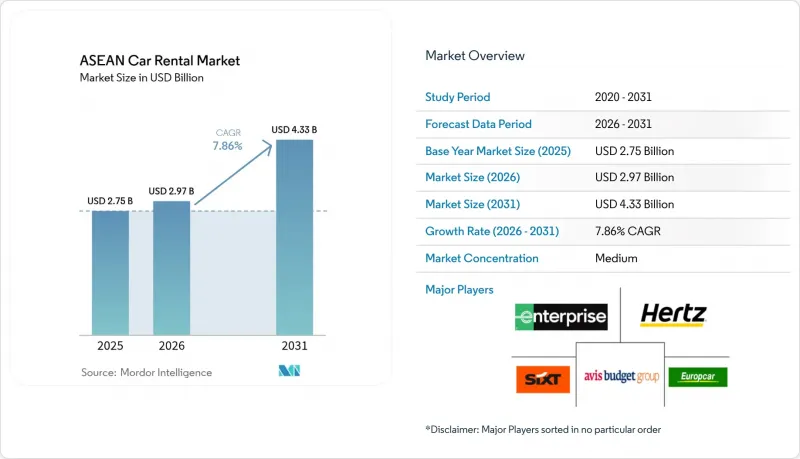
Mordor Intelligence에 의하면, 2026년 ASEAN의 렌터카 시장 규모는 29억 7,000만 달러로 추정되고 2025년 27억 5,000만 달러에서 확대해, 2031년에는 43억 3,000만 달러에 이를 것으로 예측됩니다.
2026년부터 2031년까지 연평균 성장률(CAGR) 7.86%로 성장할 것으로 전망됩니다.
본 보고서는 예약 유형(오프라인, 온라인), 렌탈 기간(단기, 장기/구독형), 서비스 유형(자가 운전, 운전기사 포함, 기타), 차량 유형(이코노미·소형차, 컴팩트·중형차, 기타),용도(관광, 출장, 기타), 최종 사용자(개인, 대기업·중소기업, 기타), 국가별로 분류되어 있습니다. 시장 예측은 금액(미 달러) 기준으로 제시되어 있습니다.
ASEAN의 렌터카 시장 동향 및 인사이트
관광 수요 회복이 차량 대수 증가를 앞지릅니다.
2023년 국제 관광객 수는 1억 명을 돌파하여 팬데믹 이전 수준의 70%에 도달했으나, 렌터카 대수는 그보다 현저히 완만한 속도로 증가했습니다. 성수기 가동률은 팬데믹 이전의 65%에서 현재 85%를 넘어섰으며, 사업자 입장에서는 동적 가격 책정(다이나믹 프라이싱) 도입과 수익 최적화를 위한 국경을 초월한 차량 재배치가 가능해졌습니다. 태국의 지방 도시들을 연결하는 새로운 철도·도로 회랑은 특히 라오스로 향하는 관광 노선에서 제한된 차량 대수에 대한 부담을 더욱 가중시키고 있습니다. 그 결과, 기존 차량을 보유한 유서 깊은 사업자들은 더 높은 이익률을 확보하고 있으며, 신차에 대한 투자 회수 기간도 단축되고 있습니다. 투자자들은 차량 확충을 위해 자금을 투입하고 있지만, 신차, 특히 전기차(EV)의 수주 잔고가 장기화되면서 공급이 즉각적으로 완화되지는 않고 있습니다.
OTA/슈퍼 앱을 통한 예약 급증
스마트폰 보급률이 높고 결제 환경이 잘 갖춰진 디지털 경제가 온라인 예약 건수를 끌어올리고 있습니다. Grab, Traveloka, Agoda는 항공권이나 호텔 정보 옆에 렌터카 상품을 게재하고, 할인이나 포인트 세트 제공을 통해 전환율을 높이고 있습니다. 사업자 입장에서는 플랫폼을 통한 판매를 통해 지점 운영 비용을 절감하고, 실시간 수익 관리를 지원하고 있습니다. 재무 부서가 통합된 경비 관리 워크플로우를 요구하는 가운데, 기업의 자체 예약 포털이 디지털화의 확산을 더욱 가속화하고 있습니다. ASEAN의 렌터카 시장에서 웹 및 앱을 통한 예약 비율은 2024년에 42.7%에 달했으며, 2028년까지는 오프라인 거래를 넘어설 것으로 예측됩니다. 데이터 가시성이 향상됨에 따라 보험사는 이용량에 따른 상품 가격 책정이 가능해졌으며, 단기 이용자의 보험 가입 기회가 확대되고 있습니다.
라이선싱과 보험의 파편화
아세안 국가들에서는 허가 유형, 배상 책임 한도, 과세 기준이 여전히 서로 달라 사업자들은 관할 구역별로 별도의 법인을 운영할 수밖에 없습니다. 말레이시아에서는 2025년 7월부터 렌터카에 8%의 매출·서비스세가 부과되게 되어, 면세인 싱가포르와 비교해 표시 가격이 상승하고, 지역 내 요금 투명성이 저하되고 있습니다. 보험사마다 면책 금액 기준이 달라 국경을 넘는 렌터카 이용이 제한되고, 관광객의 편의성이 저하되고 있습니다. 중소기업은 대형 기존 사업자와 같은 규정 준수 대응 자원이 부족하여, 특히 소비자의 선택지가 이미 제한된 지방 도시에서 신규 진출기업의 확대나 지역 내 경쟁이 둔화되고 있습니다.
부문별 분석
2025년 아세안 렌터카 시장에서 오프라인 채널을 통한 예약은 매출 점유율의 56.74%를 차지했으나, 온라인 채널은 연평균 성장률(CAGR) 8.31%로 성장할 것으로 전망됩니다. 지방 시장이나 기존 법인 고객에게는 여전히 오프라인 지점이 주류를 이루고 있지만, 지점 수를 최소화한 모델은 고정비를 절감하고, 공항이나 쇼핑몰에 설치된 픽업 로커를 통해 지리적 커버리지를 확대되고 있습니다. 슈퍼 앱은 음식 배달 및 결제 서비스와 쿠폰을 묶어 트래픽을 집약하고, 높은 참여도를 확보하고 있습니다. 기업용 셀프 예약 도구에는 규정 준수를 강화하고 경비 정산을 자동화하는 정책 관리 기능이 통합되어 있습니다. 사업자의 경우, 더욱 풍부한 데이터 흐름을 통해 예측 유지보수 일정 수립 및 AI를 활용한 가격 탄력성 테스트가 가능해져 가동률과 수익률 모두 향상됩니다.
ASEAN의 렌터카 시장에서 앱을 통한 예약 점유율은 디지털 네이티브 세대의 젊은 층이 소비력이 높은 계층으로 성장함에 따라 2031년까지 54.60%를 넘어설 것으로 예측됩니다. 여행사는 직접 커넥트 API를 도입하여 예약 절차를 두 번의 탭으로 단축하고 있습니다. 블록체인으로 보호되는 스마트 계약은 P2P 거래에서 보급이 확대되고 있으며, 결제 신속화와 변조 방지가 가능한 손해 기록이 기대되고 있습니다. 디지털 사기를 줄이기 위해 업계 단체들은 블랙리스트 공유에 협력하여 플랫폼에 대한 신뢰를 높이고, 차지백을 최소화하고 있습니다.
2025년에는 단기 렌탈이 매출 점유율의 80.62%를 차지하며 ASEAN의 렌터카 시장을 휩쓸었습니다. 한편, 구독 모델은 관광 산업의 회복과 산발적인 지역 수요에 힘입어 연평균 성장률(CAGR) 7.75%로 성장하고 있습니다. 각 사업자는 항공편 도착 패턴 및 호텔 객실 점유율 데이터에 즉각 대응하는 변동 요금 엔진을 도입하고 있습니다. 기업들은 여러 차종을 묶은 플랜을 채택하여 잔존 가치의 위험을 감수하지 않고도 유연한 차량 대수 최적화를 실현하고 있습니다.
싱가포르에서는 Certificate of Entitlement(소유권 증명서) 제도로 인해 소유 비용이 급등하고 있어, 구독 서비스가 경제적으로 현실적인 대안으로 자리 잡고 있습니다. 소비자들은 보험, 정비, 도로 긴급 지원, 그리고 많은 경우 전기차(EV)의 가정용 충전까지 포함하는 올인원 월정액을 중요하게 여깁니다. 제공업체는 텔레메트리 기술을 활용해 운전 습관을 모니터링하고, 이에 따라 갱신 조건을 조정함으로써 손해율을 낮추고 안전한 이용을 장려하고 있습니다. 지역 은행들은 플릿 사업자와 제휴하여 재고 금융 한도를 확대하고, 고정된 구독형 서비스의 현금 흐름을 담보로 한 자산 임베디드을 인수하고 있습니다.
기타 혜택 :
- 엑셀 형식 시장 예측(ME) 시트
- 3개월간의 애널리스트 지원
자주 묻는 질문
목차
제1장 서론
제2장 조사 방법
제3장 개요
제4장 시장 구도
제5장 시장 규모 및 성장 예측
제6장 경쟁 구도
제7장 시장 기회 및 향후 전망
KTH 26.08.31According to Mordor Intelligence, the ASEAN car rental market size in 2026 is estimated at USD 2.97 billion, growing from 2025 value of USD 2.75 billion with 2031 projections showing USD 4.33 billion, growing at 7.86% CAGR over 2026-2031.
This report is Segmented by Booking Type (Offline and Online), Rental Duration (Short Term and Long Term), Service Type (Self-Drive, Chauffeur-Drive, and More), Vehicle Type (Economy and Mini, Compact and Mid-Size, and More), Application (Tourism, Business Travel, and More), End-Customer (Individuals, Corporates and SMEs, and More), and Country. The Market Forecasts are Provided in Terms of Value (USD).
ASEAN Car Rental Market Trends and Insights
Tourism Rebound Out-Paces Fleet Growth
International arrivals surpassed 100 million in 2023, equal to 70% of pre-pandemic flows, yet rental fleets grew at a markedly slower pace. Utilization now exceeds 85% at peak seasons, compared with 65% before the pandemic, allowing operators to implement dynamic pricing and redeploy vehicles across borders for yield optimization. Thailand's new rail and road corridors connecting secondary cities magnify the strain on limited fleets, particularly in Laos-bound tourist circuits. Established providers with existing inventory therefore enjoy higher margins and faster payback on new vehicles. Investors channel capital toward fleet expansion, but lengthy order backlogs for new cars, especially EVs, curtail immediate supply relief.
Surge in OTA / Super-App Bookings
Heavy smartphone penetration and a payment-ready digital economy propel online reservation volumes. Grab, Traveloka, and Agoda embed rental offers next to flights and hotels, raising conversion by bundling discounts and loyalty points. For operators, platform distribution trims branch overheads and supports real-time revenue management. Corporate self-booking portals further widen digital adoption as finance teams demand integrated expense workflows. The share of web- and app-based reservations in the ASEAN car rental market climbed to 42.7% in 2024 and is on course to overtake offline transactions before 2028.Enhanced data visibility empowers insurers to price usage-based products, improving coverage availability for short-term renters.
Fragmented Licensing and Insurance
ASEAN nations retain divergent permit classes, liability ceilings, and taxation triggers, forcing operators to run discrete legal entities for each jurisdiction. Malaysia's July 2025 8% sales and service tax on rentals raises headline prices compared with duty-free Singapore, complicating regional rate transparency. Insurance carriers apply different excess thresholds, limiting cross-border rentals and curbing tourist convenience. Smaller firms lack the compliance resources of larger incumbents, slowing new-entrant expansion and local competition, especially in secondary cities where consumer choice is already thin.
Other drivers and restraints analyzed in the detailed report include:
- Corporate Demand for Mobility-as-a-Service Contracts
- EV-Ready Government Incentives
- Ride-Hailing Substitutes
For complete list of drivers and restraints, kindly check the Table Of Contents.
Segment Analysis
Offline Channel reservations contributed 56.74% of 2025 revenues share in the ASEAN car Rental Market, whereas Online Channel is set to grow at 8.31% CAGR. Offline branches still dominate rural markets and legacy corporate accounts, but branch-light models lower fixed costs and extend geographic reach via pickup lockers at airports and malls. Super-apps funnel traffic by bundling vouchers with food delivery and payments, ensuring high engagement. Corporate self-booking tools integrate policy controls that improve compliance and automate expense reconciliation. For operators, richer data flows enable predictive maintenance scheduling and AI-driven price elasticity testing, boosting both uptime and yield.
The share of app-based reservations in the ASEAN car rental market is expected to surpass 54.60% by 2031 as younger digital-native travelers mature into higher-spending cohorts. Travel resellers embed direct-connect APIs, shortening booking flows to two taps. Blockchain-secured smart contracts gain traction for P2P transactions, promising faster settlements and tamper-proof damage logs. To mitigate digital fraud, industry associations collaborate on shared blacklists, enhancing platform trust and minimizing chargebacks.
Short-term rentals dominated the ASEAN car rental market with 80.62% revenue share in 2025, while subscription models are climbing at 7.75% CAGR, buoyed by tourism rebounds and sporadic local demand. Operators deploy variable-rate engines that adjust instantly to flight arrival patterns and hotel occupancy data. Corporations adopt plans that bundle multiple car classes, enabling flexible fleet rightsizing without residual-value risk.
In Singapore, the Certificate of Entitlement system inflates ownership costs, making subscriptions an economically viable substitute. Consumers value all-inclusive monthly pricing that covers insurance, servicing, roadside assistance, and often home charging for EVs. Providers leverage telemetry to monitor driving behavior and vary renewal terms accordingly, reducing loss ratios and rewarding safe usage. Regional banks partner with fleets to extend inventory financing lines, underwriting asset purchases backed by locked-in subscription cash flows.
Complete Report Scope:
- By Booking Type
- Offline
- Online
- By Rental Duration
- Short-term (Less than 30 days)
- Long-term / Subscription (More than or equal to 30 days)
- By Service Type
- Self-Drive
- Chauffeur-Drive
- Peer-to-Peer Car-Sharing
- Corporate Fleet Leasing
- By Vehicle Type
- Economy & Mini
- Compact & Mid-size
- Sport Utility Vehicle
- Multi-Purpose Vehicle
- Luxury & Premium
- By Application
- Tourism / Leisure
- Business Travel
- Daily Commuting
- Airport Transport
- Ride-hail Driver Rentals
- By End-Customer
- Individuals
- Corporates & SMEs
- Government & Public Sector
- Expat / Diplomat
- By Country
- Indonesia
- Thailand
- Malaysia
- Singapore
- Vietnam
- Philippines
- Rest of the ASEAN Countries
List of Companies Covered in this Report:
- Avis Budget Group
- Hertz Global Holdings
- Enterprise Holdings Inc.
- Sixt SE
- Europcar Mobility Group
- GrabRentals (Grab Holdings)
- SOCAR Mobility Malaysia
- Tribecar Pte Ltd
- Thai Rent a Car
- Bluebird Group / IndoRent
- Asco Car Rent
- Hawk Rent A Car
- DriveLah
- Carro Leasing
- GoCar Malaysia
Additional Benefits:
- The market estimate (ME) sheet in Excel format
- 3 months of analyst support
TABLE OF CONTENTS
1 Introduction
- 1.1 Study Assumptions & Market Definition
- 1.2 Scope of the Study
2 Research Methodology
3 Executive Summary
4 Market Landscape
- 4.1 Market Overview
- 4.2 Market Drivers
- 4.2.1 Tourism rebound out-paces fleet growth
- 4.2.2 Surge in OTA / super-app bookings
- 4.2.3 Corporate demand for mobility-as-a-service contracts
- 4.2.4 EV-ready government incentives
- 4.2.5 P2P platforms unlock idle supply
- 4.2.6 Harmonising ASEAN digital trade & insurance rules
- 4.3 Market Restraints
- 4.3.1 Fragmented licensing & insurance
- 4.3.2 Ride-hailing substitutes
- 4.3.3 Vehicle supply & financing constraints
- 4.3.4 Slow charger roll-out
- 4.4 Value / Supply-Chain Analysis
- 4.5 Regulatory Landscape
- 4.6 Technological Outlook
- 4.7 Porter's Five Forces
- 4.7.1 Threat of New Entrants
- 4.7.2 Bargaining Power of Buyers
- 4.7.3 Bargaining Power of Suppliers
- 4.7.4 Threat of Substitutes
- 4.7.5 Competitive Rivalry
5 Market Size & Growth Forecasts (Value (USD))
- 5.1 By Booking Type
- 5.1.1 Offline
- 5.1.2 Online
- 5.2 By Rental Duration
- 5.2.1 Short-term (Less than 30 days)
- 5.2.2 Long-term / Subscription (More than or equal to 30 days)
- 5.3 By Service Type
- 5.3.1 Self-Drive
- 5.3.2 Chauffeur-Drive
- 5.3.3 Peer-to-Peer Car-Sharing
- 5.3.4 Corporate Fleet Leasing
- 5.4 By Vehicle Type
- 5.4.1 Economy & Mini
- 5.4.2 Compact & Mid-size
- 5.4.3 Sport Utility Vehicle
- 5.4.4 Multi-Purpose Vehicle
- 5.4.5 Luxury & Premium
- 5.5 By Application
- 5.5.1 Tourism / Leisure
- 5.5.2 Business Travel
- 5.5.3 Daily Commuting
- 5.5.4 Airport Transport
- 5.5.5 Ride-hail Driver Rentals
- 5.6 By End-Customer
- 5.6.1 Individuals
- 5.6.2 Corporates & SMEs
- 5.6.3 Government & Public Sector
- 5.6.4 Expat / Diplomat
- 5.7 By Country
- 5.7.1 Indonesia
- 5.7.2 Thailand
- 5.7.3 Malaysia
- 5.7.4 Singapore
- 5.7.5 Vietnam
- 5.7.6 Philippines
- 5.7.7 Rest of the ASEAN Countries
6 Competitive Landscape
- 6.1 Market Concentration
- 6.2 Strategic Moves
- 6.3 Market Share Analysis
- 6.4 Company Profiles (includes Global Level Overview, Market Level Overview, Core Segments, Financials as Available, Strategic Information, Market Rank/Share for Key Companies, Products and Services, SWOT Analysis, and Recent Developments)
- 6.4.1 Avis Budget Group
- 6.4.2 Hertz Global Holdings
- 6.4.3 Enterprise Holdings Inc.
- 6.4.4 Sixt SE
- 6.4.5 Europcar Mobility Group
- 6.4.6 GrabRentals (Grab Holdings)
- 6.4.7 SOCAR Mobility Malaysia
- 6.4.8 Tribecar Pte Ltd
- 6.4.9 Thai Rent a Car
- 6.4.10 Bluebird Group / IndoRent
- 6.4.11 Asco Car Rent
- 6.4.12 Hawk Rent A Car
- 6.4.13 DriveLah
- 6.4.14 Carro Leasing
- 6.4.15 GoCar Malaysia
7 Market Opportunities & Future Outlook
- 7.1 White-space & Unmet-Need Assessment


