

|
시장보고서
상품코드
2116552
리포솜 약물전달 : 시장 점유율 분석, 산업 동향 및 통계 데이터, 성장 예측(2026-2031년)Liposome Drug Delivery - Market Share Analysis, Industry Trends & Statistics, Growth Forecasts (2026 - 2031) |
||||||
 Mordor Intelligence
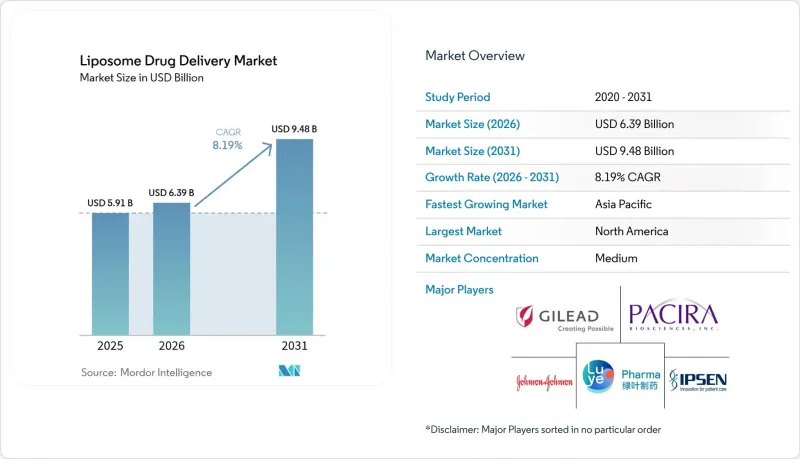
Mordor Intelligence에 의하면, 2026년 리포솜 약물전달 시장 규모는 63억 9,000만 달러로 추정되고 2025년 59억 1,000만 달러에서 성장하여 2031년에는 94억 8,000만 달러에 이를 것으로 예측됩니다.
2026년부터 2031년까지의 연평균 성장률(CAGR)은 8.19%를 나타낼 전망입니다.
본 보고서는 제품별(리포솜형 파클리탁셀, 리포솜형 독소루비신, 리포솜형 암포테리신 B, 기타),기술(PEG화(스텔스), 비PEG화 기존, 데포 제형 등), 적응증(암 치료제, 진균 감염증 등), 투여 경로(정맥 내, 안구 내 등) 및 지역별로 분류되어 있습니다. 시장 예측은 금액(달러)으로 제시되어 있습니다.
세계의 리포솜 약물전달 시장 동향 및 인사이트
암 및 진균 감염증 유병률 증가
표적 지향성 리포솜이 항암제를 종양 부위에 집중시키고 전신 독성을 완화하기 때문에 암 발병률의 상승이 리포솜 약물전달 시장의 성장을 뒷받침하고 있습니다. PEG화 리포솜 독소루비신은 55시간 동안 혈중 순환을 유지하지만, 유리 독소루비신의 경우 10분 미만입니다. 또한, 면역 결핍 환자의 진균 감염증 치료에서도 신독성을 줄이면서 항진균 효과를 유지하는 리포솜형 암포테리신 B가 선호되고 있습니다. 이 두 가지 부담이 큰 질환군이 장기적인 판매량 성장을 뒷받침하며, 파이프라인에 대한 투자를 촉진하고 있습니다.
입증된 안전성 및 기존 제형과의 비교
전체 생존 기간의 연장 및 심각한 독성의 감소를 보여주는 데이터가 축적됨에 따라, 규제 당국은 리포솜 제제를 더욱 적극적으로 승인하고 있습니다. 2024년 FDA가 이리노테칸 리포솜에 대해 내린 결정은 표준 치료의 생존 기간 중앙값이 9.2개월인 데 반해 11.1개월이라는 결과를 바탕으로, 해당 약물의 위험-이익 프로파일이 널리 인정받고 있음을 보여줍니다. 현재 의사들은 많은 리포솜 제제를 1차 선택으로 처방하고 있으며, 이는 수요를 끌어올려 안전성에 대한 선순환을 더욱 강화하고 있습니다.
엄격한 CMC 및 무균성 규제
FDA는 입자 직경, 포집률, 방출 프로파일에 관한 완전한 데이터 세트를 요구하고 있으며, 이로 인해 개발 기간과 예산이 압박받고 있습니다. 리포솜은 최종 멸균을 견디지 못하기 때문에 무균 처리가 비용 증가로 이어집니다. 중소규모 기업의 경우, 규정 준수에 필요한 분석 플랫폼이나 GMP 대응 시설이 부족한 경우가 많아, 그 결과 리포솜 약물전달 시장은 대형 기존 기업들에 편중된 상황입니다.
부문별 분석
리포솜 약물전달 시장 규모는 2025년에 21억 2,000만 달러에 달하여 총 매출의 35.92%를 차지했습니다. 심장 독성을 감소시킨다는 오랜 실적을 바탕으로, 특히 난소암 및 다발성 골수종 분야에서 이 브랜드는 확고한 입지를 계속해서 다지고 있습니다. 최근 개발된 온열 요법에 의해 방출이 유도되는 제제는 전신 약동학 프로파일을 변화시키지 않으면서 국소적인 약물 방출을 높여 임상적 의의를 유지하고 있습니다. 리포솜형 파클리탁셀은 고형암 치료 센터들이 크레모폴과 관련된 과민 반응을 피하기 위해 이 나노 제제를 채택함에 따라 11.09%라는 가장 높은 연평균 성장률(CAGR)을 기록했습니다. 암포테리신 B 리포솜은 감염증 치료 분야에서 안정적인 수요를 유지하고 있으며, 새로 승인된 이리노테칸 리포솜은 전이성 췌장암에 대한 새로운 1차 치료제로서의 선택지를 제공합니다. 개발 중인 후보 약물은 온도에 민감한 소포 내에 세포 독성 물질을 봉입하여, 높은 적재량(89.5%의 봉입률)과 온디맨드 방출을 동시에 달성하는 것을 목표로 하고 있습니다.
현재 진행 중인 제형 개선 프로그램을 통해 성숙한 항암제의 특허 기간이 연장되어 가격 하락을 피하고 있습니다. 그 결과, 리포솜 약물전달 시장은 여전히 암 치료가 주류를 이루고 있지만, 제형 개발자들은 내성균 증가를 억제하기 위해 항균제를 이중으로 탑재한 리포솜에 대한 실험을 진행하고 있습니다. 성장률을 고려할 때, 현재의 확산 추세가 지속된다면 2030년 이후 파클리탁셀 리포솜이 독소루비신을 1위 자리에서 밀어낼 가능성이 있습니다.
리포솜 약물전달 시장에서는 2025년에 PEG화 스텔스 코팅이 매출의 60.65%를 차지하며, 30년에 걸친 안전성 데이터와 충분히 확립된 GMP 기법의 혜택을 받았습니다. 그러나 과민증 사례 보고가 잇따르면서 임상의들의 경계심이 높아지고 있어, 각 제조업체들은 보체 활성화를 회피할 수 있는 강글리오사이드나 양성 이온성 대체 소재로의 전환을 추진하고 있습니다. CAGR 10.42%로 성장하고 있는 큐보좀 기반 LNP는 뛰어난 엔도좀 탈출 능력과 유전자 편집용 페이로드 전달을 약속합니다.
DepoFoam의 다소포 구조는 부피바카인을 최대 96시간 동안 방출하여, 수술 후 통증 관리에서 서방형 제제의 가치를 입증하고 있습니다. 연속 흐름 제조는 비용 절감 수단으로 부상하고 있으며, AI가 지질 비율을 선택함으로써 배치 간 편차를 줄이고 있습니다. 예측 기간 동안 기술 구성은 큐보좀 및 기타 첨단 입자에 유리하게 재조정될 전망이지만, 대량 생산되는 종양학 브랜드의 경우 PEG화가 여전히 주력 기술로 자리매김할 것입니다.
지역별 분석
북미는 나노 의약품의 보험 급여에 대한 평등한 대우와 탄탄한 임상시험 네트워크를 배경으로, 2025년 리포솜 약물전달 시장에서 40.78%를 차지했습니다. 승인 절차는 여전히 예측 가능하며, 혁신적인 기업은 독성 감소나 생존 기간 연장을 입증할 수 있다면 프리미엄 가격을 책정할 수 있습니다. 제조업체들은 국내 공급을 확보하고, 국내 생산을 요구하는 정치적 압력에 부응하기 위해 미국의 연속 생산 설비에 막대한 투자를 하고 있습니다.
유럽에서는 EMA(유럽의약품청) 절차를 통해 27개국을 아우르는 집중형 판매 승인이 가능하기 때문에 꾸준한 확산세가 이어지고 있습니다. 독일, 프랑스, 영국에서는 리포솜 병용 요법을 시범적으로 도입하고 있는 전문 암 치료 센터들이 주도적인 역할을 하고 있습니다. 또한 EU 정책에서는 콜드체인이 필요 없는 지질 나노입자 백신을 대상으로 한 ‘호라이즌 유럽(Horizon Europe)’ 보조금이 제공되고 있어, 기술적 이정표를 달성하면 양산으로 가는 길이 원활해집니다.
아시아태평양은 2031년까지 10.57%라는 가장 높은 연평균 성장률(CAGR)을 달성할 전망입니다. 중국의 위탁 개발 기관(CDO)은 다국적 기업과 협력하여 저비용으로 GMP 준수 배치를 생산하고 있는 반면, 싱가포르와 한국은 첨단 치료제 제조 단지에 대한 지원을 실시했습니다. 위암, 간암, 폐암의 지역별 높은 발병률이 수요를 견인하고 있으며, 관민 보험 제도를 통해 의료 서비스 접근성이 확대되고 있습니다. 인도와 인도네시아는 특허 만료 후의 제네릭 리포솜 항암제에 주력하고 있으며, 이것이 지역 내 판매량 성장을 뒷받침하고 있습니다.
라틴아메리카, 중동 및 아프리카에서는 보험 적용 목록이 제한적이고 콜드체인 물류 체계가 취약하여 보급 속도가 완만합니다. 다만, 걸프협력회의(GCC) 회원국에서는 이리노테칸 리포솜을 도입한 표적 항암 치료 센터의 시범 운영이 진행되고 있습니다. 브라질에서는 연속 유동식 생산 라인을 임대하여 수입 비용을 대폭 절감하기 위한 민관 협력 방안을 검토 중이며, 남아프리카공화국에서는 학술 기관에서 흡입형 리포솜 결핵 치료제의 임상시험이 진행되고 있습니다.
기타 혜택 :
- 엑셀 형식 시장 예측(ME) 시트
- 3개월간의 애널리스트 지원
자주 묻는 질문
목차
제1장 서론
제2장 분석 방법
제3장 개요
제4장 시장 구도
제5장 시장 규모 및 성장률 예측
제6장 경쟁 구도
제7장 시장 기회 및 향후 전망
KTH 26.08.31According to Mordor Intelligence, liposome drug delivery market size in 2026 is estimated at USD 6.39 billion, growing from 2025 value of USD 5.91 billion with 2031 projections showing USD 9.48 billion, growing at 8.19% CAGR over 2026-2031.
This report is Segmented by Product (Liposomal Paclitaxel, Liposomal Doxorubicin, Liposomal Amphotericin B, and More), Technology (PEGylated (Stealth), Non-PEGylated Conventional, Depofoam and More), Indication ( Cancer Therapeutics, Fungal Infections and More), Route of Administration (Intravenous, Ocular and More) and Geograpy. The Market Forecasts are Provided in Terms of Value (USD).
Global Liposome Drug Delivery Market Trends and Insights
Rising Prevalence of Cancer & Fungal Infections
Cancer incidence keeps the liposome drug delivery market growing, as targeted liposomes concentrate chemotherapies at tumor sites and reduce systemic toxicity. Pegylated liposomal doxorubicin retains circulation for 55 hours, versus under 10 minutes for free doxorubicin. Fungal infections in immunocompromised populations also favor liposomal amphotericin B, which lowers nephrotoxicity yet maintains antifungal strength.These two high-burden disease groups anchor long-term volume growth and underwrite pipeline investment.
Proven Safety Bias vs. Conventional Formulations
Regulators approve liposomal versions more readily as data accumulate showing longer overall survival and lower severe toxicities. The FDA's 2024 irinotecan liposome decision illustrates the accepted benefit-risk profile, with median survival of 11.1 months versus 9.2 months for standard therapy. Physicians now prescribe many liposomal drugs first line, boosting demand and reinforcing a virtuous safety-perception cycle.
Stringent CMC & Sterility Regulations
The FDA demands full particle-size, encapsulation, and release-profile datasets, which stretch timelines and budgets. Aseptic processing adds cost because liposomes cannot tolerate terminal sterilization. Smaller firms often lack the analytic platforms and GMP suites needed for compliance, leaving the liposome drug delivery market weighted toward large incumbents.
Other drivers and restraints analyzed in the detailed report include:
- Rapid Adoption of PEGylation & Stealth Technologies
- Expiring Patents Pushing Liposomal Reformulations
- Anti-PEG Antibody-Driven Hypersensitivity Events
For complete list of drivers and restraints, kindly check the Table Of Contents.
Segment Analysis
The liposome drug delivery market size for liposomal doxorubicin reached USD 2.12 billion in 2025, equal to 35.92% of total revenue. Its long record of reduced cardiotoxicity keeps the brand entrenched, especially in ovarian cancer and multiple myeloma. Recent hyperthermia-triggered variants raise local drug release without altering systemic profiles, sustaining clinical relevance. Liposomal paclitaxel posted the quickest 11.09% CAGR as solid tumor treatment centers adopt the nanoformulation to avoid Cremophor-related hypersensitivity. Amphotericin B liposomes hold stable infectious-disease demand, and newly approved irinotecan liposome presents a fresh first-line option for metastatic pancreatic cancer. Pipeline candidates bundle cytotoxics inside temperature-sensitive vesicles, aiming to combine high loading (89.5% encapsulation) with on-demand release.
Ongoing reformulation programs extend patent life for mature chemotherapies and avert pricing erosion. The liposome drug delivery market therefore remains dominated by cancer care, yet formulators are experimenting with antimicrobial dual-payload liposomes to slow resistance growth. Growth rates suggest paclitaxel liposomes may nudge doxorubicin from the top spot beyond 2030 if current uptake persists.
The liposome drug delivery market saw PEGylated stealth coatings account for 60.65% revenue in 2025, capitalizing on three decades of safety data and well-characterised GMP methods. Yet clinicians grow cautious after hypersensitivity case series, so manufacturers are pivoting to ganglioside or zwitterionic alternatives that evade complement activation. Cubosome-based LNPs, advancing at 10.42% CAGR, promise superior endosomal escape and gene-editing payload delivery.
DepoFoam multivesicular structures deliver bupivacaine for up to 96 hours, proving controlled-release value in post-surgical pain. Continuous-flow manufacture emerges as a cost lever, and AI selects lipid ratios that cut batch variability. Over the forecast, tech mix will likely rebalance in favor of cubosomes and other advanced particles, though PEGylation remains the commercial workhorse for large-volume oncology brands.
Complete Report Scope:
- By Product
- Liposomal Paclitaxel
- Liposomal Doxorubicin
- Liposomal Amphotericin B
- Vyxeos (Daunorubicin + Cytarabine)
- Liposomal Irinotecan
- Others
- By Technology
- PEGylated (Stealth)
- Non-PEGylated Conventional
- DepoFoam
- Cubosome-based LNPs
- By Indication
- Cancer Therapeutics
- Fungal Infections
- Pain Management
- Viral Vaccines
- CNS Disorders
- By Route of Administration
- Intravenous
- Intrathecal / Intraventricular
- Topical / Dermal
- Ocular
- Pulmonary / Inhalation
- By Geography
- North America
- United States
- Canada
- Mexico
- Europe
- Germany
- United Kingdom
- France
- Italy
- Spain
- Rest of Europe
- Asia-Pacific
- China
- Japan
- India
- Australia
- South Korea
- Rest of Asia-Pacific
- Middle East and Africa
- GCC
- South Africa
- Rest of Middle East and Africa
- South America
- Brazil
- Argentina
- Rest of South America
- North America
Geography Analysis
North America represented 40.78% of the liposome drug delivery market in 2025 on the strength of reimbursement parity for nanomedicines and deep clinical trial networks. The approval pathway remains predictable, letting innovators price at a premium when they can prove toxicity savings or extended survival. Manufacturers invest heavily in U.S. continuous-manufacturing suites to secure on-shore supply and satisfy rising political pressure for domestic production.
Europe maintains robust adoption as EMA procedures allow centralized marketing authorizations that cover 27 states. Germany, France, and the United Kingdom champion specialist oncology centers piloting combination liposome regimens. EU policy also funds Horizon Europe grants aimed at cold-chain-free lipid nanoparticle vaccines, smoothing path to scale once technical milestones clear.
Asia-Pacific achieves the fastest 10.57% CAGR to 2031. China's contract development organizations align with multinational sponsors to produce GMP batches at lower cost, while Singapore and South Korea subsidize advanced therapy manufacturing parks. Local incidence of stomach, liver, and lung cancers fuels demand, and healthcare access expands via public-private insurance plans. India and Indonesia focus on generic liposomal anticancer drugs after expiries, anchoring regional volume growth.
Latin America and the Middle East & Africa show slower uptake because of shorter reimbursement lists and weaker cold-chain logistics. Nonetheless, Gulf Cooperation Council states pilot targeted oncology centers adopting irinotecan liposome. Brazil explores public-private partnerships to lease continuous-flow lines and slash import costs, and South Africa tests inhalable liposomal TB therapy at academic centers.
- Gilead Sciences
- Pacira BioSciences
- Spectrum Pharmaceuticals
- Takeda Pharma
- Luye Pharma
- Johnson & Johnson
- Ipsen
- Celsion
- Teva Pharmaceutical Industries
- Novartis
- Sun Pharmaceuticals Industries
- Acrotech Biopharma
- Bristol-Myers Squibb
- Pfizer
- Merck
- Astellas Pharma
- Acuitas Therapeutics
- Arcturus Therapeutics
- Evonik Health Care
- NanoCarrier Co.
Additional Benefits:
- The market estimate (ME) sheet in Excel format
- 3 months of analyst support
TABLE OF CONTENTS
1 Introduction
- 1.1 Study Assumptions and Market Definition
- 1.2 Scope of the Study
2 Research Methodology
3 Executive Summary
4 Market Landscape
- 4.1 Market Overview
- 4.2 Market Drivers
- 4.2.1 Rising Prevalence Of Cancer & Fungal Infections
- 4.2.2 Proven Safety-Bias Vs. Conventional Formulations
- 4.2.3 Rapid Adoption Of Pegylation & Stealth Technologies
- 4.2.4 Expiring Patents Pushing Liposomal Reformulations
- 4.2.5 Cubosome & Other Non-Spherical LNPs Boosting Uptake
- 4.2.6 AI/ML-Guided Lipid Composition Optimisation
- 4.3 Market Restraints
- 4.3.1 Stringent CMC / Sterility Regulations
- 4.3.2 High Manufacturing CAPEX & Scale-Up Complexity
- 4.3.3 Short Shelf-Life & Cold-Chain Dependence
- 4.3.4 Anti-PEG Antibody-Driven Hypersensitivity Events
- 4.4 Value / Supply-Chain Analysis
- 4.5 Regulatory Landscape
- 4.6 Technology Outlook
- 4.7 Porter's Five Forces Analysis
- 4.7.1 Bargaining Power of Suppliers
- 4.7.2 Bargaining Power of Buyers
- 4.7.3 Threat of New Entrants
- 4.7.4 Threat of Substitutes
- 4.7.5 Intensity of Competitive Rivalry
5 Market Size and Growth Forecasts (Value-USD)
- 5.1 By Product
- 5.1.1 Liposomal Paclitaxel
- 5.1.2 Liposomal Doxorubicin
- 5.1.3 Liposomal Amphotericin B
- 5.1.4 Vyxeos (Daunorubicin + Cytarabine)
- 5.1.5 Liposomal Irinotecan
- 5.1.6 Others
- 5.2 By Technology
- 5.2.1 PEGylated (Stealth)
- 5.2.2 Non-PEGylated Conventional
- 5.2.3 DepoFoam
- 5.2.4 Cubosome-based LNPs
- 5.3 By Indication
- 5.3.1 Cancer Therapeutics
- 5.3.2 Fungal Infections
- 5.3.3 Pain Management
- 5.3.4 Viral Vaccines
- 5.3.5 CNS Disorders
- 5.4 By Route of Administration
- 5.4.1 Intravenous
- 5.4.2 Intrathecal / Intraventricular
- 5.4.3 Topical / Dermal
- 5.4.4 Ocular
- 5.4.5 Pulmonary / Inhalation
- 5.5 By Geography
- 5.5.1 North America
- 5.5.1.1 United States
- 5.5.1.2 Canada
- 5.5.1.3 Mexico
- 5.5.2 Europe
- 5.5.2.1 Germany
- 5.5.2.2 United Kingdom
- 5.5.2.3 France
- 5.5.2.4 Italy
- 5.5.2.5 Spain
- 5.5.2.6 Rest of Europe
- 5.5.3 Asia-Pacific
- 5.5.3.1 China
- 5.5.3.2 Japan
- 5.5.3.3 India
- 5.5.3.4 Australia
- 5.5.3.5 South Korea
- 5.5.3.6 Rest of Asia-Pacific
- 5.5.4 Middle East and Africa
- 5.5.4.1 GCC
- 5.5.4.2 South Africa
- 5.5.4.3 Rest of Middle East and Africa
- 5.5.5 South America
- 5.5.5.1 Brazil
- 5.5.5.2 Argentina
- 5.5.5.3 Rest of South America
- 5.5.1 North America
6 Competitive Landscape
- 6.1 Market Concentration
- 6.2 Market Share Analysis
- 6.3 Company profiles (includes Global level Overview, Market level overview, Core Segments, Financials as available, Strategic Information, Market Rank/Share for key companies, Products and Services, and Recent Developments)
- 6.3.1 Gilead Sciences
- 6.3.2 Pacira BioSciences
- 6.3.3 Spectrum Pharmaceuticals
- 6.3.4 Takeda Pharma
- 6.3.5 Luye Pharma
- 6.3.6 Johnson & Johnson
- 6.3.7 Ipsen Pharma
- 6.3.8 Celsion Corporation
- 6.3.9 Teva Pharmaceutical
- 6.3.10 Novartis AG
- 6.3.11 Sun Pharma
- 6.3.12 Acrotech Biopharma
- 6.3.13 Bristol Myers Squibb
- 6.3.14 Pfizer Inc.
- 6.3.15 Merck KGaA
- 6.3.16 Astellas Pharma
- 6.3.17 Acuitas Therapeutics
- 6.3.18 Arcturus Therapeutics
- 6.3.19 Evonik Health Care
- 6.3.20 NanoCarrier Co.
7 Market Opportunities and Future Outlook
- 7.1 White-Space and Unmet-Need Assessment


