

|
시장보고서
상품코드
2107337
의약품 재조제 시스템 시장 : 재조제 시스템별, 제조 원료별, 주사기 및 카트리지 내 의약품의 물리적 상태별, 수액백별, 용량별 - 동향 및 예측(-2035년)Drug Reconstitution Systems Market by Type of Reconstitution System, Fabrication Material, Physical State of Drug in Syringe and Cartridge, Infusion Bag, Volume, and Geographical Regions - Trends and Forecast Till 2035 |
||||||

의약품 재조제 시스템 시장 : 개요
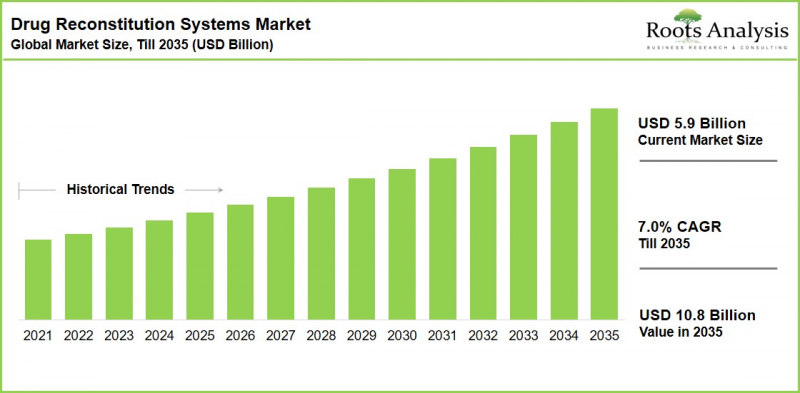
세계의 의약품 재조제 시스템 시장 규모는 올해 59억 달러에서 2035년까지 108억 달러로 확대될 것으로 추정되며, 예측 기간 동안 CAGR은 약 7.0%를 기록할 전망입니다.
의약품 재조제 시스템 시장 : 성장 및 동향
바이오의약품 및 저분자 API의 증가에 따라, 이러한 의약품들이 의약품 시장에 진입하고 있습니다. 그러나 이러한 약물의 대부분은 액상 제제로서 안정성이 낮아 시간이 지남에 따라 효능을 잃는 경향이 있습니다. 따라서 안정된 건조 바이오의약품 제제를 제조하기 위한 바람직한 방법으로 동결건조가 부상하고 있으며, 현재 FDA 승인을 받은 비경구용 약물의 30% 가까이가 동결건조 형태로 공급되고 있습니다. 이처럼 동결건조 제제의 기반이 확대됨에 따라, 사용 현장에서 약제와 희석액을 혼합하는 재조제 시스템에 대한 수요가 직접적으로 증가하고 있습니다.
기존의 의약품 재조제 방식에서는 주사기와 피펫을 사용하여 수동으로 희석액을 추출하고 이송해야 합니다. 이러한 수작업은 투약 오류, 오염, 바늘 찔림 사고의 위험을 높여, 동결건조 제제의 투여가 감독 하의 임상 현장에 국한되는 경우가 많아지고 있습니다. 이러한 상황을 반영하여 의료기기 개발 기업들은 약제와 희석액을 미리 계량해 둔 듀얼 챔버형이나 멀티 챔버형 등 첨단 재조제 시스템을 도입하고 있습니다. 이러한 첨단 재조제 시스템을 통해 환자와 간병인은 의료진의 직접적인 개입 없이도 치료를 진행할 수 있게 됩니다.
또한, 재택 치료나 자가 투여로의 전환이 진행되고 있는 점도 이러한 변화를 뒷받침하고 있습니다. 제약사들이 안정성을 확보하기 위해 동결건조가 필요한 생물학적 제제, 백신, 특수 주사제의 파이프라인을 확대함에 따라, 정밀하게 설계되고 대개 온도에 민감한 투여 장치를 취급할 수 있는 능력을 갖춘 유통 파트너는 밸류체인에서 점점 더 중요한 역할을 담당하게 되고 있습니다.
성장의 원동력 : 시장 확대를 뒷받침하는 요인
의약품 재조제 시스템 시장은 전 세계적으로 확대되는 바이오의약품 및 바이오시밀러 파이프라인에 의해 견인되고 있습니다. 이들 중 상당수는 복잡한 분자 구조로 인해 안정성, 유효성 및 유통 기한을 유지하기 위해 동결건조를 필요로 합니다. 동시에 재택 치료 및 자가 투여로의 전환이 진행됨에 따라, 약제 조제를 간소화하고 수작업을 줄여주는 사용하기 쉬운 의약품 재조제 시스템에 대한 수요가 증가하고 있습니다. 이러한 시스템은 투여 오류나 오염 위험을 최소화하는 동시에, 주사기, 바늘, 어댑터 등 별도의 이송 기구를 필요로 하지 않음으로써 치료의 편의성과 환자 안전성을 향상시킵니다. 이러한 장점 덕분에 치료의 편의성이 향상되고 환자 안전이 확보되어, 임상 현장과 재택 의료 모두에서 보다 광범위한 도입이 촉진되고 있습니다.
시장의 과제 : 발전을 저해하는 중대한 장벽
양호한 성장 전망에도 불구하고, 시장은 확장을 저해할 수 있는 특정 과제에 직면해 있습니다. 동결건조 장비 및 에너지를 대량으로 소비하는 동결건조 공정에 따른 높은 제조 비용은 여전히 시장에 있어 중요한 과제로 남아 있습니다. 이러한 장벽은 개발도상국 시장이나 자원이 제한된 의료 현장에서 특히 두드러지며, 이러한 곳에서는 의료진이 약물 조제 오류 위험이 높음에도 불구하고 여전히 기존의 수작업 재조제 방법에 의존하는 경우가 많습니다. 또한, 희석액의 양 오류, 개봉된 바이알의 오염, 라벨 오기재로 인한 투약 오류나 오염 위험은 여전히 뿌리 깊은 우려 사항으로, 조제 공정을 복잡하게 만들고 규제 당국의 감시를 더욱 엄격하게 하고 있습니다.
의약품 재조제 시스템 시장 : 주요 인사이트
본 보고서는 의약품 재조제 시스템 시장의 현황을 상세히 분석하고, 특히 판매 대리점 및 채널 파트너의 관점에서 업계 내 잠재적인 성장 기회를 파악하고 있습니다. 주요 조사 결과는 다음과 같습니다:
- 재택 의료, 외래 수액 센터 및 분산형 케어 모델의 보급이 확대됨에 따라, 치료의 편의성을 높이는 동시에 의료 자원 사용을 절감하는 즉시 사용 가능한 환자 중심의 조제 기기에 대한 수요가 증가하고 있습니다.
- 각 제조사는 기초가 되는 치료용 제제를 변경하지 않으면서 주사제 제품의 차별화, 사용자 경험 향상, 제품 가치 제고를 도모하는 라이프사이클 관리 전략의 일환으로 의약품 재조제 시스템을 점점 더 많이 활용하고 있습니다.
- 지적재산권 체계가 확대되고 있는 것을 배경으로, 시장 전반에서 활발한 혁신 활동이 관찰되고 있습니다. 의약품 재조제 시스템 및 관련 기술과 관련하여 1,800건 이상의 특허 출원이 이루어지거나 특허가 허가되었으며, 이는 기기 공학 및 투여 메커니즘 분야의 지속적인 진보를 반영하고 있습니다.
- 제약 기업, 약물전달 기술 개발 기업, 수탁 제조업체 및 포장 전문 기업 간의 전략적 제휴를 통해 통합형 재조제 플랫폼의 상용화가 가속화되고 있으며, 개발 기간 단축과 세계 시장 진출 확대가 진행되고 있습니다.
- 온도에 민감한 바이오의약품에 대한 수요가 증가함에 따라, 정밀하게 설계되고 무균이며 콜드체인을 지원하는 재조제 기기를 취급할 수 있는 전문 유통 네트워크의 중요성이 커지고 있으며, 이는 물류 및 판매 채널 파트너들에게 새로운 기회를 창출하고 있습니다.
- 재료 과학, 용기·밀폐 시스템 및 기기 설계 분야의 지속적인 발전으로 고부가가치 바이오의약품과의 호환성이 향상될 뿐만 아니라, 다양한 치료 용도에 걸쳐 제품의 무결성, 사용 편의성 및 제조 유연성이 강화되고 있습니다.
- 이러한 경쟁 구도는 Baxter, B. Braun, ICU Medical, Vetter Pharma, Nipro, SCHOTT-KAISHA와 같은 유서 깊은 의료기기 및 제약 기업들의 지속적인 투자로 특징지어지며, 이들 기업은 혁신, 전략적 제휴, 차세대 재조제 기술을 통해 포트폴리오를 확장하고 있습니다.
- 의료 시스템에서 약물의 안전성, 워크플로우 최적화, 환자 중심 치료가 우선시되는 가운데, 첨단 약물 재조제 시스템은 주사제 투여의 필수 요소가 될 것으로 기대되며, 제조사, 유통업체, 기술 제공업체에게 장기적인 비즈니스 기회가 창출될 것으로 전망됩니다.
의약품 재조제 시스템 시장의 세분화
Roots Analysis는 전 세계 의약품 재조제 시스템 시장을 다음 매개변수에 따라 분류하고 있습니다:
재조제 시스템 유형별
- 카트리지
- 수액백
- 사전 충전 주사기
제조 재료별
- 유리
- 플라스틱
주사기 및 카트리지 내 약제의 물리적 상태별
- 액체/분말
- 액체/액체
주입백 내 약제의 물리적 상태별
- 액체 혼합물
- 동결 혼합물
주사기 및 카트리지 내 용량별
- <1 mL
- 1-2.5 mL
- 2.5-5 mL
- >5 mL
수액백 내 용량별
- <250 mL
- 250-500 mL
- 500-1000 mL
- >1000 mL
지역별
- 북미
- 유럽
- 아시아태평양
- 라틴아메리카
- 중동 및 북아프리카
의약품 재조제 시스템 시장 : 주요 부문 분석
카트리지 부문이 시장을 주도
Roots Analysis의 시장 평가에 따르면, 카트리지는 현재 시장 전체 매출의 50% 가까이를 차지하고 있습니다. 이러한 높은 점유율은 의약품과 의료기기를 결합한 제품, 자동 주사기, 펜형 주사기 등에서 광범위하게 활용되고 있음을 반영하며, 이러한 제품들은 밀폐형 통합 방식을 채택함으로써 투여 정확도를 높이고 오염 위험을 줄이고 있습니다.
한편, 프리필드 주사기 부문은 즉시 사용 가능하고 투여 실수가 없는 약물 투여 형식에 대한 수요 증가에 힘입어, 예측 기간 동안 비교적 높은 연평균 성장률(CAGR)을 기록할 것으로 예상됩니다. 또한, 주사기 설계의 지속적인 발전, 바이오의약품 및 전문 치료제의 사용 확대, 그리고 제약 업계가 환자의 복약 순응도, 약제 안전성, 의료 효율성 향상을 중시하고 있는 점도 요인으로 작용합니다. 이러한 발전으로 인해 예측 기간 동안 프리필드 주사기를 활용한 의약품 재조제 시스템의 도입이 촉진될 것으로 전망됩니다.
액체/분말이 시장을 독점
Roots Analysis의 시장 보고서에 따르면, 액체/분말 부문은 주사기 및 카트리지 시장 전체의 약 65%를 차지하고 있습니다. 이러한 우위는 완전한 액체 상태에서는 안정성이 제한적인 바이오의약품, 백신, 항생제 분야에서 해당 부문이 널리 사용되고 있음을 반영합니다. 제약 파이프라인이 더욱 복잡하고 안정성에 민감한 분자로 계속 확대됨에 따라, 이 부문은 예측 기간 동안 최대 점유율을 기록할 것으로 예상됩니다.
또한, 다양한 치료 분야에서 동결건조 제제의 광범위한 사용에 더해, 안전하고 신뢰할 수 있으며 표준화된 재조제 솔루션에 대한 수요가 증가함에 따라 해당 부문의 시장 지배적 지위가 더욱 공고해지고 있습니다.
액상 혼합 제제가 시장을 주도
현재, 점적백 부문에서 가장 큰 점유율을 차지하고 있는 것은 액상 혼합 제제입니다. 이는 정맥내 요법의 상당 부분이 즉시 사용 가능한 액상 혼합 제제로 투여되고 있기 때문입니다. 의료진은 조제 작업을 최소화하고, 약물 조제 오류의 위험을 줄이며, 임상 워크플로우의 효율을 높이기 위해 미리 조제된 액상 제제를 점점 더 많이 채택하고 있습니다. 또한, 외래 및 재택 수액 서비스의 보급 확대와 더불어, 약제의 안정성, 적합성 및 보관 기간을 향상시키는 수액백 기술의 발전이 맞물려, 예측 기간 동안 액상 혼합 제제 부문의 성장을 더욱 촉진할 것으로 예상됩니다.
1-2.5 mL 용량 부문이 주사기 및 카트리지 시장을 주도
현재 1-2.5 mL 용량 부문이 시장에서 가장 큰 점유율을 차지하고 있으며, 이는 광범위한 생물학적 제제, 백신, 및 전문 의약품의 투여 요건과 부합합니다. 2.5-5 mL 부문은 예측 기간 동안 비교적 높은 연평균 성장률(CAGR)을 기록할 것으로 예상됩니다. 이러한 성장은 더 큰 재조제 용량이 필요한 고농도 제제 및 병용요법의 이용 증가에 의해 주도되고 있습니다.
500-1000 mL가 시장을 독점
현재 500-1000 mL 부문이 세계 시장에서 가장 큰 점유율을 차지하고 있습니다. 이러한 우위는 정맥내 수액 요법, 비경구 영양 및 전해질 보충 분야에서 병원 내 표준 규격으로서의 위상을 반영합니다. 그러나 1,000 mL를 초과하는 부문은 예측 기간 동안 높은 연평균 성장률(CAGR)을 기록하며 더 빠른 속도로 확대될 것으로 예상됩니다. 이러한 유망한 성장은 중환자 치료 및 장기 요양 현장에서 대용량 수액 요법에 대한 수요가 증가함에 따라 뒷받침되고 있습니다.
북미가 선두를 유지하는 한편, 아시아태평양이 가장 빠르게 성장하는 지역으로 부상
당사의 시장 예측에 따르면, 현재 북미가 세계 시장의 대부분을 차지하고 있습니다. 이러한 높은 점유율은 확립된 의료 인프라, 주요 제약 및 생명공학 기업의 강력한 입지, 그리고 유리한 보험 환급 정책에 의해 뒷받침되고 있습니다.
아시아태평양은 예측 기간 동안 가장 높은 연평균 성장률(CAGR)을 기록할 것으로 전망됩니다. 이러한 성장은 주로 중국, 인도, 일본, 한국에서의 의료 인프라 확충, 의료비 증가, 그리고 첨단 주사 요법의 보급 확대에 의해 주도되고 있습니다.
의약품 재조제 시스템 시장의 주요 기업 예시
- Baxter
- ICU Medical
- B. Braun
- Vetter Pharma
- Nipro
- SCHOTT-KAISHA
전문가 인터뷰 및 업계 인사이트
본 조사에서 제시된 견해와 인사이트는 밸류체인 전반에 걸친 다수의 이해관계자들과의 논의를 통해 형성되었습니다. 본 조사 보고서에는 다음 업계 관계자들과의 인터뷰에 대한 상세한 기록이 수록되어 있습니다:
- 일본의 한 초대형 기업, 복합 의료기기 부문 이사
- 미국 중소기업의 공동 창업자 겸 최고사업책임자
- 미국 대기업, 복합 제품 개발 담당 부사장
- 미국 대기업, 엔지니어링 담당 이사
- 스위스 초대형 기업, 포트폴리오 전략 책임자
- 미국 중소기업, 공동 최고경영자
- 이스라엘 중견 기업에서 총괄 매니저 겸 사장을 역임했습니다.
- 미국 초대형 기업, 선임 인적 요인 엔지니어
- 독일 대기업, 폴리머 솔루션 부문 제품 관리 책임자
- 스위스 초대형 기업, 세계 제품 매니저
의약품 재조제 시스템 시장 : 조사 범위
- 시장 규모 및 기회 분석 : 의약품 재조제 시스템에 대한 상세한 개요. 여기에는 의약품 재조제 시 주요 고려 사항, 동결건조의 역할, 듀얼 챔버/멀티 챔버 및 원스텝 재조제 시스템, 기존 재조제 시스템, 그리고 제약 기업과 환자에게 각각 제공하는 이점이 포괄적으로 다루어집니다.
- 시장 동향(신규 의약품 재조제 시스템) : 장치 유형, 챔버 유형, 의약품의 물리적 상태, 용기 제조 재료, 장치의 사용 편의성 및 용기 용량을 기준으로 신규 재조제 시스템의 현재 제품 파이프라인과 개발 기업의 동향을 상세히 평가합니다.
- 시장 동향(기타 재조제 시스템) : 원스텝 재조제 시스템 및 기존 재조제 기기에 대해 제품 파이프라인, 개발 기업의 동향, 개발 현황을 포괄적으로 다루는 상세한 평가를 수행합니다.
- 기업 개요 : 의약품 재조제 시스템 시장에 참여하는 주요 기업의 상세한 프로필입니다. 설립 연도, 본사 소재지, 기업 규모, 재무 정보, 제품 포트폴리오, 최근 동향 및 향후 전망을 포괄하고 있습니다.
- 승인된 의약품의 포장 동향 분석 : 분자 유형, 생물학적 제제 유형, 1차 포장 용기 및 밀봉부, 보관 온도 범위, 제형, 투여 경로를 바탕으로 승인된 의약품을 포괄적으로 분석합니다.
- 특허 분석 : 신규 의약품 재조제 시스템과 관련된 출원 및 등록 특허에 대해 공개 연도, 출원 연도, 지리적 위치, CPC 코드, 조직 유형, 평가액 및 인용 횟수를 기준으로 주요 기업과 특허를 평가합니다.
- 기업 경쟁력 분석 : 관련 공급업체 및 제품 관련 매개변수를 바탕으로 북미, 유럽, 아시아태평양 및 기타 세계 지역의 신규 의약품 재조제 시스템 제조업체에 대한 벤치마킹을 수행합니다.
- 세계 이벤트 분석 : 의약품 재조제 시스템과 관련된 업계 이벤트, 정상회의, 포럼, 회의에 대해 개최 연도, 이벤트 플랫폼, 이벤트 유형, 지역, 그리고 가장 활발한 주최자, 참가자, 연사를 바탕으로 분석을 수행합니다.
- SWOT 분석 : 의약품 재조제 시스템 시장에 대한 전략적 평가로, 주요 강점, 약점, 기회, 위협을 평가하고 각 요인의 상대적 영향을 비교합니다.
- 수요 분석 : 약제의 물리적 상태, 제조 재료, 용량, 지역을 기준으로 듀얼 챔버 프리필드 주사기, 듀얼 챔버 카트리지 및 듀얼/멀티 챔버 수액백에 대한 전 세계 수요를 포괄적으로 평가합니다.
- 시장 예측 및 기회 분석 : 약제의 물리적 상태, 제조 재료, 용량, 지역별로 세분화된 듀얼 챔버 프리필드 주사기, 듀얼 챔버 카트리지 및 듀얼/멀티 챔버 수액백에 대한 상세한 시장 규모 추정 및 기회 분석을 보수적, 기본, 낙관적인 시나리오에 따라 제시합니다.
목차
제1장 서문
제2장 주요 요약
제3장 소개
제4장 시장 구도 : 신규 의약품 재조제 시스템
제5장 시장 구도 : 기타 재조제 시스템
제6장 기업 개요
제7장 승인된 의약품 포장 동향 분석
제8장 특허 분석
제9장 기업 경쟁력 분석
제10장 세계의 이벤트 분석
제11장 SWOT 분석
제12장 수요 분석
제13장 시장 예측과 기회 분석
제14장 의약품 포장의 향후 동향
제15장 결론
제16장 부록 1 : 표형식 데이터
제17장 부록 2 : 기업 및 조직 리스트
KSM 26.08.13DRUG RECONSTITUTION SYSTEMS MARKET: OVERVIEW
As per Roots Analysis, the global drug reconstitution systems market is estimated to grow from USD 5.9 billion in the current year to USD 10.8 billion by 2035, reflecting a compound annual growth rate (CAGR) of approximately 7.0% during the forecast period.
Drug Reconstitution Systems Market: Growth and Trends
With the growing number of biologics and small molecule APIs have made their way into the drugs market. However, many of these drugs are not stable as liquid formulations and tend to lose efficacy over time. Lyophilization has therefore emerged as the preferred route for producing stable, dry biopharmaceutical formulations, with close to 30% of FDA-approved parenteral drugs currently supplied in lyophilized form. This rising base of freeze-dried therapeutics is directly increasing demand for reconstitution systems that combine the drug with its diluent at the point of use.
Conventional drug reconstitution relies on the manual extraction and transfer of the diluent using a syringe and transfer needle. Thisuperviseincreases the risk of medication errors, contamination, and needlestick injuries, often limiting the administration of lyophilized drugs to supervised clinical settings. This has prompted device developers to introduce advanced reconstitution systems, including dual-chamber and multi-chamber formats, that pre-measure the drug and diluent. These advanced reconstitution systems allow patients and caregivers to administer therapies without direct healthcare provider involvement.
Additionally, the growing shift toward home-based and self-administered therapy is reinforcing this transition. As pharmaceutical companies expand pipelines of biologics, vaccines and specialty injectables that require lyophilization for stability, distribution partners with the ability to handle precision-engineered, often temperature-sensitive delivery devices are becoming an increasingly important part of the value chain.
Growth Drivers: Factors Fueling Market Expansion
The drug reconstitution systems market is being driven by the expanding global pipeline of biologics and biosimilars, many of which require lyophilization to preserve stability, potency, and shelf life due to their complex molecular structure. At the same time, the growing shift toward home-based care and self-administration is driving demand for user-friendly drug reconstitution systems that simplify medication preparation and reduce manual handling. These systems also minimize dosing and contamination risks while eliminating the need for separate transfer devices, such as syringes, needles, and adaptors, thereby improving treatment convenience and patient safety. These advantages are improving treatment convenience, enhancing patient safety, and supporting broader adoption across both clinical and home healthcare settings.
Market Challenges: Critical Barriers Hindering Progress
Despite favourable growth prospects, the market faces certain challenges that could impede its expansion. High manufacturing costs associated with lyophilization equipment and energy-intensive freeze-drying processes remain a key challenge for the market. This barrier is particularly pronounced in developing markets and resource-constrained healthcare settings, where healthcare providers often continue to rely on conventional manual reconstitution methods despite their higher risk of medication preparation errors. Additionally, medication errors and contamination risks, arising from incorrect diluent volume, open-vial contamination, and mislabelling, remain persistent concerns that add complexity and regulatory scrutiny to the reconstitution process.
.Drug Reconstitution Systems Market: Key Insights
The report delves into the current state of the drug reconstitution systems market and identifies potential growth opportunities within the industry, particularly from a distributor and channel-partner perspective. Some key findings include:
- Rising adoption of home healthcare, ambulatory infusion centers, and decentralized care models is increasing demand for ready-to-use, patient-centric reconstitution devices that improve treatment convenience while reducing healthcare resource utilization.
- Manufacturers are increasingly leveraging drug reconstitution systems as a lifecycle management strategy to differentiate injectable products, improve user experience, and enhance product value without altering the underlying therapeutic formulation.
- Strong innovation activity is evident across the market, supported by an expanding intellectual property landscape. More than 1,800 patent applications have been filed or granted for drug reconstitution systems and related technologies, reflecting continuous advancements in device engineering and delivery mechanisms.
- Strategic collaborations between pharmaceutical companies, drug delivery technology developers, contract manufacturers, and packaging specialists are accelerating the commercialization of integrated reconstitution platforms, shortening development timelines and expanding global market access.
- Growing demand for temperature-sensitive biologics is increasing the importance of specialized distribution networks capable of handling precision-engineered, sterile, and cold-chain-compatible reconstitution devices, creating new opportunities for logistics and channel partners.
- Continuous advancements in materials science, container-closure systems, and device design are improving compatibility with high-value biologics while enhancing product integrity, usability, and manufacturing flexibility across diverse therapeutic applications.
- The competitive landscape is characterized by sustained investments from established medical device and pharmaceutical companies, including Baxter, B. Braun, ICU Medical, Vetter Pharma, Nipro, and SCHOTT-KAISHA, which are expanding their portfolios through innovation, strategic partnerships, and next-generation reconstitution technologies.
- As healthcare systems prioritize medication safety, workflow optimization, and patient-centric care, advanced drug reconstitution systems are expected to become an integral component of injectable drug delivery, creating long-term opportunities for manufacturers, distributors, and technology providers.
Drug Reconstitution Systems Market Segments
Roots Analysis segments the global Drug Reconstitution Systems opportunity across the following parameters:
By Type of Reconstitution System
- Cartridges
- Infusion Bags
- Prefilled Syringes
By Fabrication Material
- Glass
- Plastic
By Physical State of Drug in Syringe and Cartridge
- Liquids / Powders
- Liquids / Liquids
By Physical State of Drug in Infusion Bag
- Liquid Mixtures
- Frozen Mixtures
By Volume in Syringe and Cartridge
- <1 mL
- 1 - 2.5 mL
- 2.5 - 5 mL
- >5 mL
By Volume in Infusion Bag
- <250 mL
- 250 - 500 mL
- 500 - 1000 mL
- >1000 mL
By Geographical Regions
- North America
- Europe
- Asia-Pacific
- Latin America
- Middle East and North Africa
Drug Reconstitution Systems Market: Key Segments Insight
Cartridge Segment Leads the Market
Based on Roots Analysis market assessment, cartridges currently secure close to 50% of overall market revenue. This leading share reflects their widespread use in combination drug-device products, autoinjectors, and pen injectors, which offer a closed, integrated format that enhances dosing accuracy and reduces contamination risk.
On the other hand, the prefilled syringe segment is expected to register a comparatively higher CAGR during the forecast period, supported by rising demand for ready-to-use, error-free drug administration formats. Moreover, continuous advancements in syringe design, the growing use of biologics and specialty therapies, and the pharmaceutical industry's emphasis on enhancing patient adherence, medication safety, and healthcare efficiency. These advancements are expected to drive the adoption of prefilled syringe-based drug reconstitution systems during the forecast period.
Liquid / Powder Dominates the Market
Based on the Roots Analysis market report, the liquid / powder segment holds close to 65% of the overall market for syringes and cartridges. This dominance reflects its widespread use for biologics, vaccines and antibiotics that exhibit limited stability in fully liquid form. This segment is expected to register the highest share during the forecast period as pharmaceutical pipelines continue to expand toward more complex, stability-sensitive molecules.
Additionally, the widespread use of lyophilized drugs across diverse therapeutic areas, combined with the growing demand for safe, reliable, and standardized reconstitution solutions, has reinforced the segment's dominant position in the market.
Liquid Mixture Formulations Leads the Market
Liquid mixture formulations currently hold the largest share of the infusion bag segment, as a significant proportion of intravenous therapies are administered as ready-to-use liquid admixtures. Healthcare providers are increasingly adopting pre-prepared liquid formulations to minimize compounding requirements, reduce the risk of medication preparation errors, and enhance clinical workflow efficiency. Additionally, the expanding adoption of outpatient and home infusion services, coupled with advancements in infusion bag technologies that improve drug stability, compatibility, and shelf life, is expected to further drive the growth of the liquid mixture segment during the forecast period.
1-2.5 mL Volume Segment Leads Syringes and Cartridges
The 1-2.5 mL container volume segment currently holds the largest share of the market, aligning with the dosing requirements of a wide range of biologics, vaccines and specialty pharmaceuticals. The 2.5-5 mL segment is expected to grow at a comparatively higher CAGR during the forecast period. This growth is driven by rising use of high-concentration formulations and combination therapies that require larger reconstitution volumes.
500-1000 mL Dominates the Market
The 500-1000 mL segment currently accounts for the largest share of the global market. This dominance reflects its status as the standard hospital format for intravenous fluid therapy, parenteral nutrition and electrolyte replacement. However, the segment above 1000 mL is expected to expand at a faster pace, registering a higher CAGR during the forecast period. This lucrative growth is supported by rising demand for high-volume infusion therapies in critical and long-duration care settings.
North America Leads, While Asia-Pacific Emerges as the Fastest-Growing Region
According to our market projections, North America currently captures the majority share of the global market. This highest share is supported by well-established healthcare infrastructure, strong presence of leading pharmaceutical and biotechnology companies, and favourable reimbursement policies.
Asia-Pacific is projected to grow at the highest CAGR over the forecast period. This growth is primarily driven by expanding healthcare infrastructure, rising healthcare expenditure and growing adoption of advanced injectable therapies across China, India, Japan and South Korea.
Example Players in Drug Reconstitution Systems Market
- Baxter
- ICU Medical
- B. Braun
- Vetter Pharma
- Nipro
- SCHOTT-KAISHA
Expert Interview and Industry Insights
The opinions and insights presented in this study were shaped by discussions with multiple stakeholders across the value chain. The research report features detailed transcripts of interviews held with the following industry participants:
- Director, Combination Product Medical Device, Very Large Company, Japan
- Co-Founder and Chief Business Officer, Small Company, US
- Vice President, Combination Product Development, Very Large Company, US
- Director of Engineering, Very Large Company, US
- Head of Portfolio Strategy, Very Large Company, Switzerland
- Co-Chief Executive Officer, Small Company, US
- General Manager and President, Mid-Sized Company, Israel
- Senior Human Factors Engineer, Very Large Company, US
- Head of Product Management, Polymer Solutions, Very Large Company, Germany
- Global Product Manager, Very Large Company, Switzerland
DRUG RECONSTITUTION SYSTEMS MARKET: RESEARCH COVERAGE
- Market Size and Opportunity Analysis: A detailed overview of drug reconstitution systems, covering key considerations in drug reconstitution, the role of lyophilization, dual-chamber / multi-chamber and one-step reconstitution systems, conventional reconstitution systems, and the respective benefits to pharmaceutical players and patients.
- Market Landscape (Novel Drug Reconstitution Systems): An in-depth assessment of the current product pipeline and developer landscape for novel reconstitution systems, based on type of device, type of chamber, physical state of drug, container fabrication material, device usability and volume of container.
- Market Landscape (Other Reconstitution Systems): A detailed assessment of one step reconstitution systems and conventional reconstitution devices, covering product pipeline, developer landscape and status of development.
- Company Profiles: In-depth profiles of prominent players engaged in the drug reconstitution systems market, covering year of establishment, headquarters location, company size, financial information, product portfolio, and recent developments and future outlook.
- Packaging Trend Analysis for Approved Drugs: A comprehensive analysis of approved drugs, based on type of molecule, type of biologic, primary packaging container and closure, holding temperature range, dosage form and route of administration.
- Patent Analysis: An assessment of patents filed / granted related to novel drug reconstitution systems, based on publication year, application year, geographical location, CPC symbols, type of organization, and leading players and patents by valuation and citations.
- Company Competitiveness Analysis: A benchmarking of novel drug reconstitution system manufacturers across North America, Europe and Asia-Pacific and Rest of the World, based on relevant supplier and product-related parameters.
- Global Event Analysis: An analysis of relevant industry events, summits, forums and conferences related to drug reconstitution systems, based on year, event platform, type of event, geography and most active organizers, participants and speakers.
- SWOT Analysis: A strategic assessment of the drug reconstitution systems market, evaluating its key strengths, weaknesses, opportunities and threats, along with a comparison of the relative impact of each factor.
- Demand Analysis: A comprehensive evaluation of global demand for dual chamber prefilled syringes, dual chamber cartridges and dual / multi chamber infusion bags, based on physical state of drug, fabrication material, volume and geography.
- Market Forecast and Opportunity Analysis: A detailed market sizing and opportunity analysis for dual chamber prefilled syringes, dual chamber cartridges and dual / multi chamber infusion bags, segmented by physical state of drug, fabrication material, volume and geography, presented under conservative, base and optimistic scenarios.
Key Questions Answered in this Report
- Which are the leading companies in the drug reconstitution systems market?
- Which region dominates the market, and which is growing the fastest?
- What are the key trends observed in this market?
- What factors are likely to influence the evolution of this market?
- What are the primary challenges faced by drug reconstitution system developers?
- What is the current and future market size?
- What is the CAGR of this market through 2035?
- How is current and future market opportunity distributed across key segments?
- What opportunities exist for distributors and channel partners entering this space?
Reasons to Buy this Report
This report has been specifically developed to support distributors, channel partners, and business development teams evaluating entry into the Drug Reconstitution Systems market.
- Provides comprehensive revenue projections for the overall market and each sub-segment, useful to both incumbents and new entrants.
- Gives stakeholders a clear view of drivers, restraints, opportunities, and challenges to support data-driven decision-making.
- Helps businesses identify and evaluate emerging opportunities across drug reconstitution systems-adjacent sectors.
- Supports demand assessment by clarifying end-user needs, preferences, and adoption behavior.
- Equips new entrants with the market context needed to build credible go-to-market strategies.
- Strengthens stakeholder communication through a shared, quantified view of the opportunity.
Additional Benefits
- Complementary Insights Pack
- Complementary PPT Insights Pack
- Complementary Excel Data Packs for all Analytical Modules in the Report
- 15% Free Content Customization
- Detailed Report Walkthrough Session with Research Team
- Free Updated report if the report is 6-12 months old or older
TABLE OF CONTENTS
1. PREFACE
- 1.1. Scope of the Report
- 1.2. Research Methodology
- 1.3. Key Questions Answered
- 1.4. Chapter Outlines
2. EXECUTIVE SUMMARY
3. INTRODUCTION
- 3.1. Chapter Overview
- 3.2. Overview of Reconstitution Systems
- 3.2.1. Key Considerations in Drug Reconstitution
- 3.3. Lyophilization of Pharmaceuticals
- 3.3.1. Need for Reconstitution Systems
- 3.3.2. Dual Chamber / Multi Chamber Systems
- 3.3.3. One Step Reconstitution Systems
- 3.3.4. Conventional Reconstitution Systems
- 3.4. Advantages of Drug Reconstitution Systems
- 3.4.1. Benefits to Pharmaceutical Players
- 3.4.2. Benefits to Patients
- 3.5. Concluding Remarks
4. MARKET LANDSCAPE: NOVEL DRUG RECONSTITUTION SYSTEMS
- 4.1. Chapter Overview
- 4.2. Novel Drug Reconstitution Systems: Product Pipeline
- 4.2.1. Analysis by Type of Device
- 4.2.2. Analysis by Type of Chamber
- 4.2.3. Analysis by Type of Device and Type of Chamber
- 4.2.4. Analysis by Physical State of Drug
- 4.2.5. Analysis by Container Fabrication Material
- 4.2.6. Analysis by Device Usability
- 4.2.7. Analysis by Container Fabrication Material and Device Usability
- 4.2.8. Analysis by Volume of Container
- 4.3. Novel Drug Reconstitution Systems: Developer Landscape
- 4.3.1. Analysis by Year of Establishment
- 4.3.2. Analysis by Company Size
- 4.3.3. Analysis by Region of Headquarters
- 4.3.4. Analysis by Company Size and Region of Headquarters
- 4.3.5. Analysis by Location of Headquarters
- 4.3.6. Leading Players: Analysis by Number of Novel Drug Reconstitution Systems Manufactured
5. MARKET LANDSCAPE: OTHER RECONSTITUTION SYSTEMS
- 5.1. Chapter Overview
- 5.2. One Step Reconstitution Systems: Product Pipeline
- 5.2.1. Analysis by Type of Primary Container
- 5.2.2. Analysis by Volume of Primary Container
- 5.2.3. Analysis by Physical State of Drug
- 5.2.4. Analysis by Device Usability
- 5.2.5. Analysis by Type of Primary Container and Physical State of Drug
- 5.3. One Step Reconstitution Systems: Developer Landscape
- 5.3.1. Analysis by Year of Establishment
- 5.3.2. Analysis by Company Size
- 5.3.3. Analysis by Location of Headquarters
- 5.3.4. Leading Players: Analysis by Number of One Step Reconstitution Systems Manufactured
- 5.4. Conventional Reconstitution Devices: Development Pipeline
- 5.4.1. Analysis by Status of Development
- 5.4.2. Analysis by Type of Device
- 5.4.3. Analysis by Type of Primary Container
- 5.4.4. Analysis by Physical State of Drug
- 5.4.5. Analysis by Type of Primary Container and Physical State of Drug
- 5.5. Conventional Reconstitution Devices: Developer Landscape
- 5.5.1. Analysis by Year of Establishment
- 5.5.2. Analysis by Company Size
- 5.5.3. Analysis by Location of Headquarters
- 5.5.4. Analysis by Region of Headquarters
- 5.5.5. Leading Players: Analysis by Number of Conventional Reconstitution Devices Manufactured
6. COMPANY PROFILES
- 6.1. Chapter Overview
- 6.2. Key Players based in North America
- 6.2.1. Baxter
- 6.2.1.1. Company Overview
- 6.2.1.2. Financial Information
- 6.2.1.3. Product Portfolio
- 6.2.1.4. Recent Developments and Future Outlook
- 6.2.2. ICU Medical
- 6.2.2.1. Company Overview
- 6.2.2.2. Financial Information
- 6.2.2.3. Product Portfolio
- 6.2.2.4. Recent Developments and Future Outlook
- 6.2.1. Baxter
- 6.3. Key Players based in Europe
- 6.3.1. B. Braun
- 6.3.1.1. Company Overview
- 6.3.1.2. Financial Information
- 6.3.1.3. Product Portfolio
- 6.3.1.4. Recent Developments and Future Outlook
- 6.3.2. Vetter Pharma
- 6.3.2.1. Company Overview
- 6.3.2.2. Product Portfolio
- 6.3.2.3. Recent Developments and Future Outlook
- 6.3.1. B. Braun
- 6.4. Key Players based in Asia-Pacific
- 6.4.1. Nipro
- 6.4.1.1. Company Overview
- 6.4.1.2. Financial Information
- 6.4.1.3. Product Portfolio
- 6.4.1.4. Recent Developments and Future Outlook
- 6.4.2. SCHOTT-KAISHA
- 6.4.2.1. Company Overview
- 6.4.2.2. Product Portfolio
- 6.4.2.3. Recent Developments and Future Outlook
- 6.4.1. Nipro
7. PACKAGING TREND ANALYSIS FOR APPROVED DRUGS
- 7.1. Chapter Overview
- 7.2. Scope and Methodology
- 7.3. List of Approved Drugs (2014-H1 2021)
- 7.3.1. Analysis by Type of Molecule and Approval Year
- 7.3.2. Analysis by Type of Molecule
- 7.3.3. Analysis by Type of Biologic
- 7.3.4. Analysis by Type of Molecule and Holding Temperature
- 7.3.5. Analysis by Type of Biologic and Dosage Form
- 7.4. Primary Packaging Containers for Approved Drugs
- 7.4.1. Analysis by Type of Primary Packaging Container
- 7.4.2. Analysis by Type of Primary Packaging Container and Approval Year
- 7.4.3. Analysis by Type of Primary Packaging Container and Type of Molecule
- 7.4.4. Analysis by Type of Primary Packaging Container and Holding Temperature Range
- 7.4.5. Analysis by Type of Primary Packaging Container and Dosage Form
- 7.4.6. Analysis by Type of Primary Packaging Container and Route of Administration
- 7.4.7. Most Popular Materials Used for Containers: Analysis by Number of Drugs
- 7.5. Primary Packaging Closures for Approved Drugs
- 7.5.1. Analysis by Type of Primary Packaging Closure
- 7.5.2. Analysis by Type of Primary Packaging Closure and Approval Year
- 7.5.3. Analysis by Type of Primary Packaging Closure and Type of Molecule
- 7.5.4. Analysis by Type of Primary Packaging Closure and Holding Temperature Range
- 7.5.5. Analysis by Type of Primary Packaging Closure and Dosage Form
- 7.5.6. Analysis by Type of Primary Packaging Closure and Route of Administration
- 7.5.7. Most Popular Materials Used for Closures: Analysis by Number of Drugs
- 7.6. Packaging Trend Analysis for Approved Drugs: Developer Landscape
- 7.6.1. Analysis by Year of Establishment
- 7.6.2. Analysis by Company Size
- 7.6.3. Analysis by Location of Headquarters
- 7.6.4. Analysis by Type of Molecules and Company Size
- 7.6.5. Analysis by Type of Molecule and Geographical Location of Developers
- 7.6.6. Analysis by Type of Biologics and Geographical Location of Developers
- 7.6.7. Most Active Players: Analysis by Type of Molecule
- 7.6.8. Most Active Players: Analysis by Number of Biologics Developed
- 7.6.9. Most Active Players: Analysis by Type of Biologic
- 7.6.10. Most Active Players: Analysis by Number of Small Molecules Developed
- 7.7. Concluding Remarks
8. PATENT ANALYSIS
- 8.1. Chapter Overview
- 8.2. Scope and Methodology
- 8.3. Novel Drug Reconstitution Systems: Patent Analysis
- 8.3.1. Analysis by Publication Year
- 8.3.2. Analysis by Application Year
- 8.3.3. Analysis by Geographical Location
- 8.3.4. Analysis by CPC Symbols
- 8.3.5. Word Cloud: Emerging Focus Areas
- 8.3.6. Analysis by Type of Organization
- 8.3.7. Leading Players: Analysis by Number of Patents
- 8.4. Novel Drug Reconstitution Systems: Patent Benchmarking Analysis
- 8.4.1. Analysis by Patent Characteristics
- 8.5. Novel Drug Reconstitution Systems: Patent Valuation Analysis
- 8.6. Leading Patents by Number of Citations
9. COMPANY COMPETITIVENESS ANALYSIS
- 9.1. Chapter Overview
- 9.2. Assumptions / Key Parameters
- 9.3. Methodology
- 9.4. Company Competitiveness Analysis: Novel Drug Reconstitution System Manufacturers in North America
- 9.5. Company Competitiveness Analysis: Novel Drug Reconstitution System Manufacturers in Europe
- 9.6. Company Competitiveness Analysis: Novel Drug Reconstitution System Manufacturers in Asia-Pacific and Rest of the World
10. GLOBAL EVENT ANALYSIS
- 10.1. Chapter Overview
- 10.2. Scope and Methodology
- 10.3. Global Events related to Novel Drug Reconstitution Systems
- 10.3.1. Analysis by Year of Event
- 10.3.2. Analysis by Event Platform
- 10.3.3. Analysis by Type of Event
- 10.3.4. Analysis by Geography
- 10.3.5. Word Cloud: Evolutionary Trends in Event Agenda / Key Focus Area
- 10.3.6. Most Active Event Organizers
- 10.3.7. Most Active Participants: Analysis by Number of Events
- 10.3.8. Analysis by Seniority Level of Participants
- 10.3.9. Most Active Speakers: Analysis by Number of Events
- 10.3.10. Geographical Mapping of Upcoming Events
11. SWOT ANALYSIS
- 11.1. Chapter Overview
- 11.2. Novel Drug Reconstitution Systems: SWOT Analysis
- 11.2.1. Comparison of SWOT Factors
12. DEMAND ANALYSIS
- 12.1. Chapter Overview
- 12.2. Scope and Methodology
- 12.3. Global Demand for Dual Chamber Prefilled Syringes, Since 2021
- 12.3.1. Analysis by Physical State of Drug
- 12.3.1.1. Global Demand of Dual Chamber Prefilled Syringes for Liquid / Powder Drugs, Since 2021
- 12.3.1.2. Global Demand of Dual Chamber Prefilled Syringes for Liquid / Liquid Drugs, Since 2021
- 12.3.2. Analysis by Type of Fabrication Material
- 12.3.2.1. Global Demand for Glass Dual Chamber Prefilled Syringes, Since 2021
- 12.3.2.2. Global Demand for Plastic Dual Chamber Prefilled Syringes, Since 2021
- 12.3.3. Analysis by Volume
- 12.3.3.1. Global Demand for <1 mL Dual Chamber Prefilled Syringes, Since 2021
- 12.3.3.2. Global Demand for 1-2.5 mL Dual Chamber Prefilled Syringes, Since 2021
- 12.3.3.3. Global Demand for 2.5-5 mL Dual Chamber Prefilled Syringes, Since 2021
- 12.3.3.4. Global Demand for >5 mL Dual Chamber Prefilled Syringes, Since 2021
- 12.3.4. Analysis by Geography
- 12.3.4.1. Global Demand of Dual Chamber Prefilled Syringes in North America, Since 2021
- 12.3.4.2. Global Demand of Dual Chamber Prefilled Syringes in Europe, Since 2021
- 12.3.4.3. Global Demand of Dual Chamber Prefilled Syringes in Asia-Pacific, Since 2021
- 12.3.4.4. Global Demand of Dual Chamber Prefilled Syringes in Latin America, Since 2021
- 12.3.4.5. Global Demand of Dual Chamber Prefilled Syringes in Middle East and Africa, Since 2021
- 12.3.1. Analysis by Physical State of Drug
- 12.4. Global Demand for Dual Chamber Cartridges, Since 2021
- 12.4.1. Analysis by Physical State of Drug
- 12.4.1.1. Global Demand of Dual Chamber Cartridges for Liquid / Powder Drugs, Since 2021
- 12.4.1.2. Global Demand of Dual Chamber Cartridges for Liquid / Liquid Drugs, Since 2021
- 12.4.2. Analysis by Type of Fabrication Material
- 12.4.2.1. Global Demand for Glass Dual Chamber Cartridges, Since 2021
- 12.4.2.2. Global Demand for Plastic Dual Chamber Cartridges, Since 2021
- 12.4.3. Analysis by Volume
- 12.4.3.1. Global Demand for <1 mL Dual Chamber Cartridges, Since 2021
- 12.4.3.2. Global Demand for 1-2.5 mL Dual Chamber Cartridges, Since 2021
- 12.4.3.3. Global Demand for 2.5-5 mL Dual Chamber Cartridges, Since 2021
- 12.4.3.4. Global Demand for >5 mL Dual Chamber Cartridges, Since 2021
- 12.4.4. Analysis by Geography
- 12.4.4.1. Global Demand of Dual Chamber Cartridges in North America, Since 2021
- 12.4.4.2. Global Demand of Dual Chamber Cartridges in Europe, Since 2021
- 12.4.4.3. Global Demand of Dual Chamber Cartridges in Asia-Pacific, Since 2021
- 12.4.4.4. Global Demand of Dual Chamber Cartridges in Latin America, Since 2021
- 12.4.4.5. Global Demand of Dual Chamber Cartridges in Middle East and Africa, Since 2021
- 12.4.4.6. Global Demand of Dual Chamber Cartridges in Rest of the World, Since 2021
- 12.4.1. Analysis by Physical State of Drug
- 12.5. Global Demand for Dual / Multi Chamber Infusion Bags, Since 2021
- 12.5.1. Analysis by Physical State of Drug
- 12.5.1.1. Global Demand of Dual / Multi Chamber Infusion Bags for Liquid Mixture, Since 2021
- 12.5.1.2. Global Demand of Dual / Multi Chamber Infusion Bags for Frozen Mixture, Since 2021
- 12.5.2. Analysis by Type of Plastic
- 12.5.2.1. Global Demand of Ethylene Vinyl Acetate made Dual / Multi Chamber Infusion Bags, Since 2021
- 12.5.2.2. Global Demand of Polypropylene made Dual / Multi Chamber Infusion Bags, Since 2021
- 12.5.2.3. Global Demand of Polyvinyl Chloride made Dual / Multi Chamber Infusion Bags, Since 2021
- 12.5.2.4. Global Demand of Other Plastic made Dual / Multi Chamber Infusion Bags, Since 2021
- 12.5.3. Analysis by Volume
- 12.5.3.1. Global Demand for 0-250 mL Dual / Multi Chamber Infusion Bags, Since 2021
- 12.5.3.2. Global Demand for 250-500 mL Dual / Multi Chamber Infusion Bags, Since 2021
- 12.5.3.3. Global Demand for 500-1,000 mL Dual / Multi Chamber Infusion Bags, Since 2021
- 12.5.3.4. Global Demand for >1,000 mL Dual / Multi Chamber Infusion Bags, Since 2021
- 12.5.4. Analysis by Geography
- 12.5.4.1. Global Demand of Dual / Multi Chamber Infusion Bags in North America, Since 2021
- 12.5.4.2. Global Demand of Dual / Multi Chamber Infusion Bags in Europe, Since 2021
- 12.5.4.3. Global Demand of Dual / Multi Chamber Infusion Bags in Asia-Pacific, Since 2021
- 12.5.4.4. Global Demand of Dual / Multi Chamber Infusion Bags in Latin America, Since 2021
- 12.5.4.5. Global Demand of Dual / Multi Chamber Infusion Bags in Middle East and Africa, Since 2021
- 12.5.1. Analysis by Physical State of Drug
- 12.6. Concluding Remarks
13. MARKET FORECAST AND OPPORTUNITY ANALYSIS
- 13.1. Chapter Overview
- 13.2. Methodology and Key Assumptions
- 13.3. Global Dual Chamber Prefilled Syringes Market, Since 2021
- 13.3.1. Dual Chamber Prefilled Syringes Market, Since 2021: Distribution by Physical State of Drug
- 13.3.1.1. Dual Chamber Prefilled Syringes Market for Liquid / Powder Drugs, Since 2021
- 13.3.1.2. Dual Chamber Prefilled Syringes Market for Liquid / Liquid Drugs, Since 2021
- 13.3.2. Dual Chamber Prefilled Syringes Market, Since 2021: Distribution by Type of Fabrication Material Used
- 13.3.2.1. Glass Dual Chamber Prefilled Syringes Market, Since 2021
- 13.3.2.2. Plastic Dual Chamber Prefilled Syringes Market, Since 2021
- 13.3.3. Dual Chamber Prefilled Syringes Market, Since 2021: Distribution by Volume
- 13.3.3.1. Dual Chamber Prefilled Syringes Market for <1 mL Syringes, Since 2021
- 13.3.3.2. Dual Chamber Prefilled Syringes Market for 1-2.5 mL Syringes, Since 2021
- 13.3.3.3. Dual Chamber Prefilled Syringes Market for 2.5-5 mL Syringes, Since 2021
- 13.3.3.4. Dual Chamber Prefilled Syringes Market for >5 mL Syringes, Since 2021
- 13.3.4. Dual Chamber Prefilled Syringes Market, Since 2021: Distribution by Geography
- 13.3.4.1. Dual Chamber Prefilled Syringes Market in North America, Since 2021
- 13.3.4.2. Dual Chamber Prefilled Syringes Market in Europe, Since 2021
- 13.3.4.3. Dual Chamber Prefilled Syringes Market in Asia-Pacific, Since 2021
- 13.3.4.4. Dual Chamber Prefilled Syringes Market in Latin America, Since 2021
- 13.3.4.5. Dual Chamber Prefilled Syringes Market in Middle East and Africa, Since 2021
- 13.3.1. Dual Chamber Prefilled Syringes Market, Since 2021: Distribution by Physical State of Drug
- 13.4. Global Dual Chamber Cartridges Market, Since 2021
- 13.4.1. Dual Chamber Cartridges Market, Since 2021: Distribution by Physical State of Drug
- 13.4.1.1. Dual Chamber Cartridges Market for Liquid / Powder Drugs, Since 2021
- 13.4.1.2. Dual Chamber Cartridges Market for Liquid / Liquid Drugs, Since 2021
- 13.4.2. Dual Chamber Cartridges Market, Since 2021: Distribution by Type of Fabrication Material Used
- 13.4.2.1. Glass Dual Chamber Cartridges Market, Since 2021
- 13.4.2.2. Plastic Dual Chamber Cartridges Market, Since 2021
- 13.4.3. Dual Chamber Cartridges Market, Since 2021: Distribution by Volume
- 13.4.3.1. Dual Chamber Cartridges Market for <1 mL Cartridges, Since 2021
- 13.4.3.2. Dual Chamber Cartridges Market for 1-2.5 mL Cartridges, Since 2021
- 13.4.3.3. Dual Chamber Cartridges Market for 2.5-5 mL Cartridges, Since 2021
- 13.4.3.4. Dual Chamber Cartridges Market for >5 mL Cartridges, Since 2021
- 13.4.4. Dual Chamber Cartridges Market, Since 2021: Distribution by Geography
- 13.4.4.1. Dual Chamber Cartridges Market in North America, Since 2021
- 13.4.4.2. Dual Chamber Cartridges Market in Europe, Since 2021
- 13.4.4.3. Dual Chamber Cartridges Market in Asia-Pacific, Since 2021
- 13.4.4.4. Dual Chamber Cartridges Market in Latin America, Since 2021
- 13.4.4.5. Dual Chamber Cartridges Market in Middle East and Africa, Since 2021
- 13.4.4.6. Dual Chamber Cartridges Market in Rest of the World, Since 2021
- 13.4.1. Dual Chamber Cartridges Market, Since 2021: Distribution by Physical State of Drug
- 13.5. Global Dual / Multi Chamber Infusion Bags Market, Since 2021
- 13.5.1. Dual / Multi Chamber Infusion Bags Market, Since 2021: Distribution by Physical State of Drug
- 13.5.1.1. Dual / Multi Chamber Infusion Bags Market for Liquid Mixture, Since 2021
- 13.5.1.2. Dual / Multi Chamber Infusion Bags Market for Frozen Mixture, Since 2021
- 13.5.2. Dual / Multi Chamber Infusion Bags Market, Since 2021: Distribution by Type of Plastic
- 13.5.2.1. Dual / Multi Chamber Infusion Bags Market for Ethylene Vinyl Acetate, Since 2021
- 13.5.2.2. Dual / Multi Chamber Infusion Bags Market for Polypropylene, Since 2021
- 13.5.2.3. Dual / Multi Chamber Infusion Bags Market for Polyvinyl Chloride, Since 2021
- 13.5.2.4. Dual / Multi Chamber Infusion Bags Market for Other Plastic Materials, Since 2021
- 13.5.3. Dual / Multi Chamber Infusion Bags Market, Since 2021: Distribution by Volume
- 13.5.3.1. Dual / Multi Chamber Infusion Bags Market for 0-250 mL Infusion Bags, Since 2021
- 13.5.3.2. Dual / Multi Chamber Infusion Bags Market for 250-500 mL Infusion Bags, Since 2021
- 13.5.3.3. Dual / Multi Chamber Infusion Bags Market for 500-1,000 mL Infusion Bags, Since 2021
- 13.5.3.4. Dual / Multi Chamber Infusion Bags Market for >1,000 mL Infusion Bags, Since 2021
- 13.5.4. Dual / Multi Chamber Infusion Bags Market, Since 2021: Distribution by Geography
- 13.5.4.1. Dual / Multi Chamber Infusion Bags Market in North America, Since 2021
- 13.5.4.2. Dual / Multi Chamber Infusion Bags Market in Europe, Since 2021
- 13.5.4.3. Dual / Multi Chamber Infusion Bags Market in Asia-Pacific, Since 2021
- 13.5.4.4. Dual / Multi Chamber Infusion Bags Market in Latin America, Since 2021
- 13.5.4.5. Dual / Multi Chamber Infusion Bags Market in Middle East and Africa, Since 2021
- 13.5.1. Dual / Multi Chamber Infusion Bags Market, Since 2021: Distribution by Physical State of Drug
14. UPCOMING TRENDS IN PHARMACEUTICAL PACKAGING
- 14.1. Chapter Overview
- 14.2. Preference for Self-Medication of Drugs using Modern Drug Delivery Devices
- 14.3. Development of Innovative Packaging Containers
- 14.4. Growing Demand for Personalized Therapies
- 14.5. Integrating Dual Chamber Systems with Other Platforms
- 14.6. Increase in Initiatives Undertaken by Industry Stakeholders in Developing Regions
- 14.7. Concluding Remarks


