

|
시장보고서
상품코드
2154348
고온 용융염 펌프 : 시장 점유율 분석, 업계 동향과 통계, 성장 예측(2026-2031년)High-Temperature Molten-Salt Pumps - Market Share Analysis, Industry Trends & Statistics, Growth Forecasts (2026 - 2031) |
||||||
 Mordor Intelligence
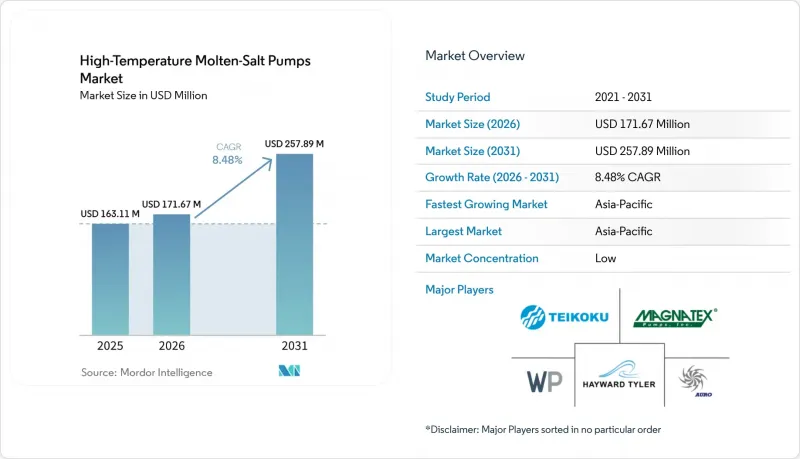
에 따르면 고온 용융염 펌프 시장 규모는 2025년 1억 6,311만 달러에서 2026년에는 1억 7,167만 달러로 확대하며, 2031년까지 2억 5,789만 달러에 달할 것으로 예상되고 있으며, 2026-2031년에 CAGR은 8.48%에 달할 전망입니다.
전 세계 고온 용융염 펌프 시장의 동향 및 인사이트
CSP 및 축열 용량 증가가 펌프 조달을 견인
중국에서는 2025년에 총 900MW 규모의 집광형 태양열발전(CSP) 프로젝트 9건이 계통 연계되었으며, 누적 설비 용량은 1,738.2 MW에 달했습니다. 한편, 연말 기준으로 총 3,000MW에 달하는 25건의 프로젝트가 건설 중이었습니다. 이러한 건설 파이프라인은 고온 용융염 펌프 시장에 있으며, 가장 확실한 단기 수요 기반이 되고 있습니다. 타워형 프로젝트는 중국 기술 구성의 71%를 차지하며, 고온용과 저온용 펌프 세트를 별도로 필요로 합니다. 따라서 동등한 발전 용량을 가진 트로프형 프로젝트에 비해 필요한 설비 수가 더 많을 가능성이 있습니다. 중국의 2030년 목표인 15,000MW는 2025년 기준에서 13,300MW를 추가로 증설해야 함을 의미합니다. 또한 2025년 말에는 2개의 독립형 350MW 태양열발전소 건설도 시작되었습니다. 이러한 신규 도입으로 인해 고온 용융염 펌프 시장에는 설비 및 서비스 수요와 관련된 명확한 파이프라인이 형성되고 있습니다. 2026년 6월에 가동을 시작한 350MW 규모의 CGN 칭하이 프로젝트는 15시간·11,747 MWh의 용융염 축열 용량을 갖추고 있으며, 펌프 시스템 분야에서 현재 주요 조달 사례로 자리 잡고 있습니다.
조절 가능한 재생 가능 전력 수요로 인해 펌프 수요는 태양광발전의 범위를 넘어 확대되고 있습니다.
계통 운영 사업자는 잉여 전력을 흡수하고 수요가 증가했을 때 에너지를 방출하기 위해 열 저장을 활용하고 있습니다. 이에 따라 고온 용융염 펌프 시장은 태양광발전 설비의 범위를 넘어 확장되고 있습니다. 과거에 집광형 태양열발전 실적이 있는 펌프 시스템은 독립적인 계통 균형 조정이나 산업용 열 공급 설비에도 적용할 수 있습니다. 기존의 설계 노하우를 활용함으로써, 새로운 열저장 구성을 위한 펌프 사양 결정에 필요한 작업을 줄일 수 있습니다. 이를 통해 고온 용융염 펌프 시장의 공급업체는 핵심 유압 플랫폼을 교체하지 않고도 인접한 용도로 사업을 확장할 수 있게 됩니다. 술저(Sulzer)와 하임 에너지(Haim Energy)는 2025년 4월, 기존 산업 인프라 내에서 소금 이송에 수직 터빈 펌프를 사용하는 600°C 용융 수산화물 축열 시스템을 개발하기 위한 제휴를 발표했습니다. 중국에서는 2026년 7월, 600MW 규모의 석탄 화력 발전 설비를 개조한 증기 추출식 용융염 축열 시설이 가동을 시작했습니다. 이 시설은 100MW의 피크 절감 용량을 갖추고 있으며, 6시간 이상 지원할 수 있습니다. 이러한 용도를 통해 용융염 순환 설비는 보다 광범위한 전력 시스템의 유연성 향상 프로젝트의 일환으로 자리매김하고 있습니다.
염화물 염 사용시 발생하는 부식이 차세대 성능을 제한
3세대 집광형 태양열발전 및 첨단 원자로 응용 분야에서 600°C를 초과하는 펌프 운전에는 염화물 염이 필요합니다. 그 부식 작용은 가동중인 대부분의 상용 시스템에서 사용되는 질산염 염의 부식 작용보다 훨씬 더 강력합니다. 2024년에 보고된 미국 에너지부 및 오크리지 국립연구소의 프로젝트에 따르면 시판되는 베어링 재료는 재설계 없이는 염화물 염 펌프에 사용할 수 없는 것으로 밝혀졌습니다. 이 프로젝트에서는 헤인즈 244 및 이트리아 부분 안정화 지르코니아를 사용한 시험 인프라가 개발되었으나, 실규모 베어링 시험이 완료되기 전에 종료되었습니다. 에너지부의 또 다른 연구에 따르면 800°C의 염화물 용융염에서 IN625의 부식 속도가 연간 1.1인치를 초과하는 것으로 보고되었습니다. 이러한 미해결 소재 문제는 가장 가혹한 고온 용도에 대응할 수 있는 고온 용융염 펌프 시장에서 단기적인 확장을 제한하고 있습니다. 또한 이러한 문제들로 인해 독자적인 공급 제약을 수반하는 독자 개발 코팅 및 서멧 복합재료에 대한 관심이 높아지고 있습니다. 따라서 상업적으로 검증된 염화물 용액 솔루션이 프로젝트 실행 가능한 규모에 도달하기까지는 3년 5년이 소요될 가능성이 있습니다.
부문 분석
2025년 시점에 원심 펌프는 고온 용융염 펌프 시장 규모의 57.4%를 차지했습니다. 이러한 우위는 북아프리카, 중동 및 중국의 파라볼릭 트로프형 및 초기 타워형 프로젝트에서 고온 및 저온 염 루프에 대한 확립된 사용 실적을 반영합니다. 성숙한 유압 설계와 ISO 13709 및 API 610 표준에 대한 폭넓은 준수로 인해 이러한 펌프는 상업용 질산염 플랜트의 조달 팀에게 친숙한 제품입니다. 이 펌프들은 프로젝트 운영자가 검증된 주조 재료와 유지보수 관행을 중시하는 상황에서 사용되고 있으며, 이러한 도입 실적이 플랜트의 긴 가동 기간 중 교체 수요와 유지보수 작업을 지원하고 있습니다.
수직 터빈 펌프는 2031년까지 연평균 성장률(CAGR) 10.2%로 성장할 것으로 예상되며, 이는 펌프 유형 중 가장 높은 성장률입니다. 이 펌프들은 깊은 침수를 통해 안정적인 흡입이 보장되고, 흡입 기둥에서의 동결 위험이 감소되는 2탱크식 저장 시스템에 적합합니다. 이러한 구성에서는 펌프를 염수면보다 12-20미터 아래에 설치해야 하는 경우가 있습니다. 술저(Sulzer)사는 2024년, 중국내 100MW 타워형 프로젝트의 열 회로 및 냉매 회로를 위해 18미터 높이의 수직 터빈 유닛을 공급했습니다. 용융염 원자로의 경우, 제로 리크 설계 요건으로 인해 기존의 샤프트 실을 사용할 수 없는 경우가 있으며, 캔형 모터 펌프가 소규모이긴 하지만 프리미엄 틈새 시장을 담당하고 있습니다. 또한 고온 용융염 펌프 업계에서 산업 사용자가 누출 방지 및 유지보수의 용이성을 우선시할 경우, 수중 설치형, 자기 구동형 및 캐니스터형 모터 설계의 중요성도 높아지고 있습니다.
지역별 분석
아시아태평양은 2025년 고온 용융염 펌프 시장의 42.6%를 차지하고 있으며, 2031년까지 연평균 성장률(CAGR) 10.5%로 성장할 것으로 예측됩니다. 중국은 2025년에 9개의 집광형 태양열발전 프로젝트를 통해 총 900MW를 계통 연계했으며, 누적 용량은 1,738.2 MW에 달했습니다. 또한 2030년 목표인 15,000MW는 2025년 기준 대비 대규모 증설이 이루어질 것임을 시사합니다. 또한 중국의 조달 동향도 인증을 받은 국내 공급업체로 점차 전환되고 있습니다. 장쑤솽다(Jiangsu Shuangda)의 RY(L) 시리즈는 칭하이성 플랜트에서 24개월간 가동을 거친 후, 2025년 7월에 중국기계공업연합회의 인증을 받았습니다. 또한 카이촨(Kaiquan)은 쇼항(Shou Hang) 둔황(Dunhuang) 프로젝트에서 고온·저온 및 온도 조절 펌프의 가동을 입증한 후, 2025년 3월에 동 연합회의 인증을 획득했습니다. 인도, 일본, 한국에서는 산업용 축열 및 소형 모듈 원자로의 도입으로 수요가 증가하고 있지만, 2025년 이 3개국을 합친 점유율은 해당 지역 전체 공급량의 10% 미만에 그쳤습니다.
북미 및 유럽에서는 새로운 태양열발전 설비의 증설보다는 원자로 실증, 집중형 태양열발전 시설의 가동, 그리고 산업 부문의 탈탄소화가 주요 원동력이 되고 있습니다. 미국 에너지부는 카이로스 파워(Kairos Power)사의 ‘헤르메스(Hermes)’ 원자로를 지원하고 있으며, 인가 절차를 추진하기 위한 ‘원자로 시범 프로그램’을 설립했습니다. 유럽에서는 스페인과 모로코의 태양열발전 유지보수 업무 외에도, 2025년 10월 헝가리에서 가동을 시작한 교토 그룹의 56 MWh ‘히트 큐브’를 포함한 새로운 산업용 축열 프로젝트가 진행되고 있습니다. 술저(Sulzer)사는 2027년 3월 가동이 예정된 하이뷰 파워(Highview Power)사의 캐링턴(Carrington) 액체 공기 에너지 저장 프로젝트를 위해 용융염 펌프 8대를 공급하고 있습니다. 이러한 프로젝트들로 인해 고온 용융염 펌프 시장은 기존의 태양열발전 설비의 범위를 넘어 확대되고 있습니다.
남미, 중동 및 아프리카는 규모는 작지만 독자적인 수요처로 자리 잡고 있습니다. 사우디아라비아와 아랍에미리트(UAE)는 보다 광범위한 에너지 다각화 계획의 일환으로 집광형 태양열발전을 활용하고 있으며, 칠레의 아타카마 지역은 풍부한 직사 일사량을 바탕으로 집광형 태양열발전 및 열 저장 개발이 진행되고 있습니다. 모로코에서는 누르 와르자자트 III의 고온 용융염 저장 탱크 업그레이드가 진행 중이며, 남아프리카공화국에서는 2024년에 레드스톤 집중형 태양열발전 프로젝트가 송전망로 연결되었습니다. REN21의 보고서에 따르면 2024년에는 중국 및 일부 성숙한 시장을 제외하고는 새로운 집광형 태양열발전 프로젝트의 건설이 시작되지 않았습니다. 이로 인해 고온 용융염 펌프 시장의 조달은 활동이 활발한 제한된 지역에 집중된 상태를 유지하고 있습니다.
기타 혜택:
- 엑셀 형식의 시장 예측(ME) 시트
- 3개월간의 애널리스트 지원
자주 묻는 질문
목차
제1장 서론
- 조사 전제조건과 시장 정의
- 조사 범위
제2장 조사 방법
제3장 개요
제4장 시장 구도
- 시장 개요
- 시장 성장 촉진요인
- 시장 성장 억제요인
- 공급망 분석
- Porter's Five Forces 분석
- 기술 동향
- 규제 상황
- 투자 분석
제5장 시장 규모와 성장 예측
- 펌프 유형별
- 최종사용자별
- 지역별
- 북미
- 미국
- 캐나다
- 멕시코
- 유럽
- 독일
- 프랑스
- 이탈리아
- 스페인
- 영국
- 폴란드
- 러시아
- 기타 유럽 국가
- 아시아태평양
- 중국
- 인도
- 일본
- 한국
- 호주
- 인도네시아
- 베트남
- 태국
- 기타 아시아태평양 국가
- 남미
- 브라질
- 아르헨티나
- 칠레
- 기타 남미 국가
- 중동 및 아프리카
- 사우디아라비아
- 아랍에미리트
- 이집트
- 남아프리카공화국
- 모로코
- 기타 중동 및 아프리카 국가
- 북미
제6장 경쟁 구도
- 시장 집중도
- 전략적 동향
- 시장 점유율 분석
- 기업 개요
- Arvind Corrotech Ltd.
- AURO PUMPS Pvt. Ltd.
- Ebara Corporation
- Flowrox Oy
- Flowserve Corporation
- Hayward Tyler
- Hebei Tobee Pump Co., Ltd.
- ITT Inc./Goulds Pumps
- Jinan Huayang New Material Co., Ltd.
- Jinan Warwick Pump Co., Ltd.
- KSB SE & Co. KGaA
- Magnatex Pumps, Inc.
- Nagle Pumps, Inc.
- Process Pumps Corporation
- Pump-Aid Corporation
- Sulzer Ltd.
- Teikoku Electric Mfg. Co., Ltd.
- The Weir Group PLC
- WEM Pumps, LLC
- Wenesco, Inc.
제7장 시장 기회와 향후 전망
KSA 26.10.23According to Mordor Intelligence, the High-Temperature Molten-Salt pumps market size is expected to increase from USD 163.11 million in 2025 to USD 171.67 million in 2026 and reach USD 257.89 million by 2031, at a CAGR of 8.48% over 2026-2031.
Global High-Temperature Molten-Salt Pumps Market Trends and Insights
CSP And Thermal Storage Capacity Additions Pull Pump Procurement Forward
China connected 9 concentrated solar power projects totaling 900 MW in 2025, taking cumulative installed capacity to 1,738.2 MW, while 25 projects totaling 3,000 MW remained under construction at year-end. This construction pipeline provides the clearest near-term demand base for the high-temperature molten salt pumps market. Tower projects represented 71% of China's technology mix and require separate hot and cold pump sets. Their equipment needs can therefore exceed those of trough projects with similar power capacity. China's 2030 target of 15,000 MW implies 13,300 MW of additions beyond the 2025 base. Two standalone 350 MW solar thermal plants also began construction at the end of 2025. These additions give the high-temperature molten salt pumps market a visible pipeline for equipment and service demand. The 350 MW CGN Qinghai project, commissioned in June 2026, includes 15 hours and 11,747 MWh of molten salt storage, making it a major current procurement reference for pump systems.
Dispatchable Renewable Power Requirements Extend Pump Demand Beyond Solar
Grid operators use thermal storage to absorb surplus electricity and release energy when demand is higher. This broadens the high-temperature molten salt pumps market beyond solar generation equipment. Pump systems with earlier concentrated solar power references can be adapted for standalone grid balancing and industrial heat installations. The same installed design knowledge can reduce the work required to specify pumps for new storage configurations. This gives suppliers in the high-temperature molten salt pumps market a route to adjacent applications without replacing their core hydraulic platforms. Sulzer and Hyme Energy announced a partnership in April 2025 to develop 600°C molten hydroxide storage, using vertical turbine pumps for salt movement within existing industrial infrastructure. China commissioned a steam-extraction molten salt thermal storage facility in July 2026 that retrofits a 600 MW coal unit and provides 100 MW of peak-shaving capacity with more than 6 hours of support. These uses place molten salt circulation equipment within broader power-system flexibility projects.
Corrosion In Chloride Salt Service Limits Next Generation Performance
Chloride salts are needed for pump service above 600°C in Generation 3 concentrated solar power and advanced reactor applications. Their corrosive effect is much greater than that of the nitrate salts used in most operating commercial systems. A Department of Energy and Oak Ridge National Laboratory project reported in 2024 that commercially available bearing materials could not be used in chloride-salt pumps without redesign. The project developed test infrastructure using Haynes 244 and yttria partially stabilized zirconia, but it ended before full-scale bearing tests were completed. Separate Department of Energy research reported corrosion of IN625 in chloride salts at 800°C at rates exceeding 1.1 inches per year. These unresolved material issues limit the near-term portion of the high-temperature molten salt pumps market that can serve the most demanding thermal applications. They also shift attention toward proprietary coatings and cermet composites, which introduce their own supply constraints. Commercially validated chloride-salt solutions may therefore take 3 to 5 years to reach project-ready scale.
Other drivers and restraints analyzed in the detailed report include:
- Industrial Heat Decarbonization Opens A New Demand Channel
- Advanced Reactor Programs Create A High Value Pump Niche
- Long Qualification Cycles Delay Access To High Value Projects
For complete list of drivers and restraints, kindly check the Table Of Contents.
Segment Analysis
Centrifugal pumps accounted for 57.4% of the high-temperature molten salt pumps market size in 2025. Their lead reflects established use in hot and cold salt loops at parabolic trough and early tower projects across North Africa, the Middle East, and China. Mature hydraulic designs and broad ISO 13709 and API 610 alignment make these pumps familiar to procurement teams at commercial nitrate-salt plants. They are used where project operators value established casting materials and maintenance practices, and this installed base supports replacement demand and service work through long plant operating lives.
Vertical turbine pumps are forecast to grow at a 10.2% CAGR through 2031, the highest rate among pump types. They fit two-tank storage systems where deep submergence supports stable suction and reduces freeze risk in the suction column. These configurations can require the pump to sit 12 to 20 meters below the salt surface. Sulzer supplied 18-meter vertical turbine units for the hot and cold circuits of a 100 MW Chinese tower project in 2024. Canned motor pumps serve a smaller premium niche in molten salt reactors because zero-leakage design requirements can exclude conventional shaft seals. Submerged, magnetic-drive, and canned motor designs also gain relevance where industrial users prioritize leak prevention and simpler maintenance access in the high-temperature molten salt pumps industry.
Complete Report Scope:
- By Pump Type
- Centrifugal Pumps
- Vertical Turbine Pumps
- Canned Motor Pumps
- Submerged Pumps
- Other Pump Types
- By End User
- Concentrated Solar Power Plants
- Thermal Energy Storage Systems
- Molten-Salt Reactors
- Industrial Heat and Process Applications
- Other End Users
- By Geography
- North America
- United States
- Canada
- Mexico
- Europe
- Germany
- France
- Italy
- Spain
- United Kingdom
- Poland
- Russia
- Rest of Europe
- Asia-Pacific
- China
- India
- Japan
- South Korea
- Australia
- Indonesia
- Vietnam
- Thailand
- Rest of Asia-Pacific
- South America
- Brazil
- Argentina
- Chile
- Rest of South America
- Middle East and Africa
- Saudi Arabia
- United Arab Emirates
- Egypt
- South Africa
- Morocco
- Rest of Middle East and Africa
- North America
Geography Analysis
Asia-Pacific held 42.6% of the high-temperature molten salt pumps market in 2025 and is forecast to grow at a 10.5% CAGR through 2031. China connected 900 MW across 9 concentrated solar power projects in 2025, taking cumulative capacity to 1,738.2 MW, while its 2030 target of 15,000 MW signals large additions from the 2025 base. China's procurement pattern is also shifting toward qualified domestic suppliers. Jiangsu Shuangda's RY(L) series received a China General Machinery Industry Association appraisal in July 2025 after 24 months of operation at a Qinghai plant. Kaiquan received association certification in March 2025 after demonstrating hot, cold, and temperature-adjustment pump operation at the Shou Hang Dunhuang project. India, Japan, and South Korea add demand through industrial thermal storage and small modular reactor preparation, although their combined 2025 share was below 10% of regional volume.
North America and Europe are driven more by reactor demonstrations, operating concentrated solar power fleets, and industrial decarbonization than by new solar thermal capacity. The U.S. Department of Energy is supporting Kairos Power's Hermes reactor and has established the Reactor Pilot Program to advance authorization pathways. Europe combines solar thermal service work in Spain and Morocco with new industrial storage projects, including Kyoto Group's 56 MWh Heatcube that began operating in Hungary in October 2025. Sulzer is supplying 8 molten salt pumps for Highview Power's Carrington liquid air energy storage project, which is expected to operate in March 2027. These projects widen the high-temperature molten salt pumps market beyond conventional solar thermal equipment.
South America and the Middle East and Africa contribute smaller but distinct demand pools. Saudi Arabia and the United Arab Emirates use concentrated solar power within wider energy diversification plans, while Chile's Atacama region supports concentrated solar power and thermal storage development because of its high direct solar resource. Morocco is upgrading the hot molten salt storage tank at Noor Ouarzazate III, and South Africa connected the Redstone concentrated solar power project to the grid in 2024. REN21 reported that no new concentrated solar power projects began construction outside China and a limited group of established markets in 2024. This keeps procurement in the high-temperature molten salt pumps market concentrated in a limited number of active locations.
- Arvind Corrotech Ltd.
- AURO PUMPS Pvt. Ltd.
- Ebara Corporation
- Flowrox Oy
- Flowserve Corporation
- Hayward Tyler
- Hebei Tobee Pump Co., Ltd.
- ITT Inc. / Goulds Pumps
- Jinan Huayang New Material Co., Ltd.
- Jinan Warwick Pump Co., Ltd.
- KSB SE & Co. KGaA
- Magnatex Pumps, Inc.
- Nagle Pumps, Inc.
- Process Pumps Corporation
- Pump-Aid Corporation
- Sulzer Ltd.
- Teikoku Electric Mfg. Co., Ltd.
- The Weir Group PLC
- WEM Pumps, LLC
- Wenesco, Inc.
Additional Benefits:
- The market estimate (ME) sheet in Excel format
- 3 months of analyst support
TABLE OF CONTENTS
1 INTRODUCTION
- 1.1 Study Assumptions and Market Definition
- 1.2 Scope of the Study
2 RESEARCH METHODOLOGY
3 EXECUTIVE SUMMARY
4 MARKET LANDSCAPE
- 4.1 Market Overview
- 4.2 Market Drivers
- 4.2.1 CSP and Thermal-Storage Capacity Additions
- 4.2.2 Dispatchable Renewable Power and Grid Flexibility Requirements
- 4.2.3 Expansion of High-Temperature Industrial Heat Applications
- 4.2.4 Advanced Reactor Demonstration Programs
- 4.2.5 Demand for Sealless and Leak-Prevention Pump Designs
- 4.2.6 Regional Localization of Molten-Salt Pump Manufacturing
- 4.3 Market Restraints
- 4.3.1 Corrosion and Erosion in Chloride-Salt Service
- 4.3.2 Freeze-Protection and Thermal-Cycling Complexity
- 4.3.3 Specialty-Alloy and Ceramic-Bearing Supply Constraints
- 4.3.4 Long Qualification Cycles for Nuclear and CSP Projects
- 4.4 Supply-Chain Analysis
- 4.5 Porter's Five Forces Analysis
- 4.5.1 Bargaining Power of Suppliers
- 4.5.2 Bargaining Power of Buyers
- 4.5.3 Threat of New Entrants
- 4.5.4 Threat of Substitutes
- 4.5.5 Competitive Rivalry
- 4.6 Technology Outlook
- 4.7 Regulatory Landscape
- 4.8 Investment Analysis
5 MARKET SIZE AND GROWTH FORECASTS
- 5.1 By Pump Type
- 5.1.1 Centrifugal Pumps
- 5.1.2 Vertical Turbine Pumps
- 5.1.3 Canned Motor Pumps
- 5.1.4 Submerged Pumps
- 5.1.5 Other Pump Types
- 5.2 By End User
- 5.2.1 Concentrated Solar Power Plants
- 5.2.2 Thermal Energy Storage Systems
- 5.2.3 Molten-Salt Reactors
- 5.2.4 Industrial Heat and Process Applications
- 5.2.5 Other End Users
- 5.3 By Geography
- 5.3.1 North America
- 5.3.1.1 United States
- 5.3.1.2 Canada
- 5.3.1.3 Mexico
- 5.3.2 Europe
- 5.3.2.1 Germany
- 5.3.2.2 France
- 5.3.2.3 Italy
- 5.3.2.4 Spain
- 5.3.2.5 United Kingdom
- 5.3.2.6 Poland
- 5.3.2.7 Russia
- 5.3.2.8 Rest of Europe
- 5.3.3 Asia-Pacific
- 5.3.3.1 China
- 5.3.3.2 India
- 5.3.3.3 Japan
- 5.3.3.4 South Korea
- 5.3.3.5 Australia
- 5.3.3.6 Indonesia
- 5.3.3.7 Vietnam
- 5.3.3.8 Thailand
- 5.3.3.9 Rest of Asia-Pacific
- 5.3.4 South America
- 5.3.4.1 Brazil
- 5.3.4.2 Argentina
- 5.3.4.3 Chile
- 5.3.4.4 Rest of South America
- 5.3.5 Middle East and Africa
- 5.3.5.1 Saudi Arabia
- 5.3.5.2 United Arab Emirates
- 5.3.5.3 Egypt
- 5.3.5.4 South Africa
- 5.3.5.5 Morocco
- 5.3.5.6 Rest of Middle East and Africa
- 5.3.1 North America
6 COMPETITIVE LANDSCAPE
- 6.1 Market Concentration
- 6.2 Strategic Moves
- 6.3 Market Share Analysis
- 6.4 Company Profiles (includes Global Level Overview, Market Level Overview, Core Segments, Financials as available, Strategic Information, Market Rank/Share, Products and Services, Recent Developments)
- 6.4.1 Arvind Corrotech Ltd.
- 6.4.2 AURO PUMPS Pvt. Ltd.
- 6.4.3 Ebara Corporation
- 6.4.4 Flowrox Oy
- 6.4.5 Flowserve Corporation
- 6.4.6 Hayward Tyler
- 6.4.7 Hebei Tobee Pump Co., Ltd.
- 6.4.8 ITT Inc. / Goulds Pumps
- 6.4.9 Jinan Huayang New Material Co., Ltd.
- 6.4.10 Jinan Warwick Pump Co., Ltd.
- 6.4.11 KSB SE & Co. KGaA
- 6.4.12 Magnatex Pumps, Inc.
- 6.4.13 Nagle Pumps, Inc.
- 6.4.14 Process Pumps Corporation
- 6.4.15 Pump-Aid Corporation
- 6.4.16 Sulzer Ltd.
- 6.4.17 Teikoku Electric Mfg. Co., Ltd.
- 6.4.18 The Weir Group PLC
- 6.4.19 WEM Pumps, LLC
- 6.4.20 Wenesco, Inc.
7 MARKET OPPORTUNITIES AND FUTURE OUTLOOK
- 7.1 White-Space and Unmet-Need Assessment


