
|
시장보고서
상품코드
2116922
베트남의 금속 포장 시장 : 점유율 분석, 업계 동향과 통계, 성장 예측(2026-2031년)Vietnam Metal Packaging - Market Share Analysis, Industry Trends & Statistics, Growth Forecasts (2026 - 2031) |
||||||
 Mordor Intelligence
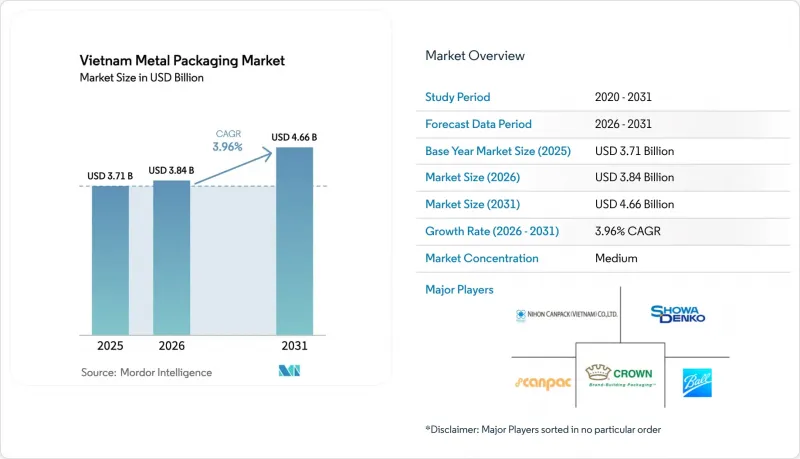
Mordor Intelligence에 의하면, 베트남 금속 포장 시장 규모는 2025년 37억 1,000만 달러에서 2026년에는 38억 4,000만 달러로 확대되어 2031년까지 46억 6,000만 달러에 이를 것으로 예상되고 있어 2026년부터 2031년까지 CAGR 3.96%로 성장할 전망입니다.
본 보고서는 소재별(알루미늄 및 강철), 제품 유형별(캔, 벌크 컨테이너, 운송용 배럴 및 드럼, 캡 및 밀봉 부품 등),용량별(1리터 이하, 1리터 초과-25리터, 25리터 초과-200리터, 200리터 초과), 그리고 최종 이용 산업별(음료, 식품, 도료·화학, 산업, 기타)로 분류되어 있습니다. 시장 전망은 금액(달러) 기준으로 제시됩니다.
베트남 금속 포장 시장 동향 및 인사이트
국내 음료 캔 생산 능력 확대
베트남에서는 2024년부터 2025년까지 맥주 및 청량음료 생산 라인 업그레이드에 6억 달러 이상이 투자되어 캔 가공의 총 처리 능력이 실질적으로 두 배로 증가했으며, 베트남은 동남아시아 알루미늄 캔 허브로서의 입지를 확고히 했습니다. 하이네켄만 해도 빈즈온의 생산 능력 증강에 5억 4,000만 달러를 투자했으며, 산토리 펩시코는 생산량을 65% 증가한 연간 8억 2,500만 리터로 확대했습니다. 2025년 3월 선라이즈 패키징(Sunrise Packaging)사가 도입한 분당 2,000캔 생산 라인을 대표적으로 볼 때, 라인 속도 향상으로 단위 비용이 12% 절감되어 주류 맥주 시장에서 유리병에서 캔으로의 전환이 촉진되었습니다. 마루베니의 ‘NM2 알루미늄 재활용’ 프로젝트가 연간 5만 톤의 코일을 목표로 하고 있는 것처럼, 생산 능력 확대는 업스트림 공정에도 파급되어 수입 의존도를 완화하고 있습니다. 그 결과, 공급 안정성과 비용 안정성이 확보되어 베트남 금속 포장 시장의 잠재적 시장 규모가 확대되고 있습니다.
도시 중산층의 소비력 확대
2025년, 베트남 도시 중산층은 3,600만 명을 넘어설 전망이며, 1인당 연소득은 5,000달러 이상이 되어 고급 수제 맥주, 즉석 음용 커피, 수입 증류주를 선호하여 소비하고 있습니다. 금속 용기는 냉장 보관이 필요 없고 유통 기한을 연장할 수 있다는 장점이 있어, 콜드체인 인프라가 미비한 상황에서는 중요한 강점이 됩니다. TBC-Ball사가 빈즈엉에 보유한 8억 5,000만 캔 규모의 공장은 이러한 고급 지향적 수요에 부응하여 매장 내 존재감을 높이고, 알루미늄 스튜어드십 이니셔티브(ASI) 기준을 충족하는 세련된 캔을 공급하고 있습니다. 이와 유사한 소비자층이 가압식 가정용 에어로졸 제품의 붐을 주도하고 있으며, 2024년부터 2025년까지 47개의 신규 SKU가 금속 용기로 시장에 출시될 전망입니다. 이러한 라이프스타일의 향상으로 인해 거시경제의 변동에도 불구하고 베트남의 금속 포장 시장은 꾸준한 성장 궤도를 유지하고 있습니다.
수입 알루미늄 코일 가격 변동
알루미늄 현물 가격은 2024년에 톤당 2,700달러로 정점을 찍은 후, 2026년 초에는 2,500달러 전후로 추이했습니다. 이러한 가격 변동으로 인해 연간 공급 계약을 체결한 캔 제조업체의 EBITDA 마진은 8-12% 축소되었습니다. 쇼와 알루미늄은 2026년 수요의 40%를 헤지했음에도 불구하고, 2024년 유가증권보고서에서 코일 원가가 수익원가의 68%로 상승했다고 보고했는데, 이는 2022년의 62%에서 증가한 수치입니다. 2024년에는 동 가격 하락으로 인해 비용 부담이 3.2% 더 증가했습니다. 국내 제련소가 가동을 시작할 때까지는 베트남의 금속 포장 시장이 수익성을 급격히 훼손할 가능성이 있는 세계 상품 사이클의 영향을 계속 받게 될 것입니다.
부문별 분석
2025년, 주요 음료 기업들이 연간 32억 캔의 생산 능력을 도입함에 따라 알루미늄은 베트남 금속 포장 시장에서 61.17%의 점유율을 확보했습니다. 한편, 수산 가공업체와 도료 제조업체들이 플라스틱 제리캔에서 위험물 규정을 준수하는 강철 양동이로 전환함에 따라, 강철은 2031년까지 연평균 성장률(CAGR) 4.86%를 기록하며 알루미늄의 성장률을 상회할 것으로 예측됩니다. 베트남 금속 포장 시장에서 알루미늄 시장 규모는 소비 후 회수율이 75%에 달하고, 철강에 비해 화물 중량이 18% 가벼운 이점에 힘입어, 확대되는 ‘생산자 책임 확대(EPR)’ 목표가 더욱 엄격해지는 가운데 다국적 기업들을 뒷받침하고 있습니다. 한편, 호아팟(Hoa Phat)사의 다크락(Dak Lak) 복합 단지를 통한 국내 철강 생산 능력은 가격 안정성과 리드타임 단축을 가져와, 공급 안정성을 중시하는 산업용 구매자들을 끌어들이고 있습니다.
알루미늄의 향후 동향은 마루베니의 5만 톤 규모 재활용 라인에 달려 있습니다. 이 라인은 탄소 발자국을 95% 줄이고, 음료 캔 재활용률을 75% 이상으로 끌어올릴 가능성이 있습니다. 철강의 약진을 뒷받침하고 있는 것은 전자상거래입니다. 배송 시 충격으로 인해 연질 플라스틱 용기가 파손되는 반면, 양동이는 ‘라스트 원 마일’ 배송 시의 충격을 견딜 수 있어 주문 처리 업체들은 금속 재질을 선호하는 추세입니다. 두 소재의 적용 분야가 확대되는 가운데, 베트남의 금속 포장 시장은 제로섬 게임이 아닌, 두 주요 소재의 건전한 성장을 보이고 있습니다.
2025년에는 음료 및 식품 캔이 시장 점유율의 58.52%를 차지하며, 베트남 금속 포장 시장에서 주도적인 입지를 확고히 했습니다. 92억 달러 규모의 수산물 수출과 450억 달러 규모의 화학제품 출하에 힘입은 운송용 배럴 및 드럼통은 2031년까지 연평균 성장률(CAGR) 5.33%를 기록하며, 다른 모든 제품군을 능가하는 성장을 보일 것으로 전망됩니다. 베트남 금속 포장 시장에서 캔의 점유율은 탄산음료에 대한 수요와 금속이 주는 신선도에 대한 신뢰와 같은 소비자 선호 덕분에 파우치 제품의 진출에도 영향을 받지 않고 있습니다. 한편, 에어로졸 캔은 퍼스널케어 브랜드가 가압식 디스펜서를 채택함에 따라 2025년 생산량의 8%를 차지했습니다.
그레이프(Graef)사의 바리아-붕타우 공장에서는 EU 식품 접촉 규정을 준수하는 어장 수출업체로부터 200리터 강철 드럼통에 대한 수요가 예상에 따라 2024년 생산량이 18% 증가했습니다. 드럼의 내구성은 IMO(국제해사기구) 승인을 받은 배럴을 찾는 화학제품 운송업체들에게도 호평을 받고 있습니다. 크라운 홀딩스의 엠보싱 가공이 적용된 세련된 캔은 출시 후 6개월 이내에 지역 맥주 양조장의 22%에서 채택되었으며, 이는 높은 수익률을 유지하는 캔 디자인의 프리미엄화가 진행되고 있음을 보여줍니다. 이 두 가지 동향은 베트남 금속 포장 시장 전체의 다양한 성장을 뒷받침하고 있습니다.
기타 혜택:
- 엑셀 형식 시장 예측(ME) 시트
- 3개월간의 애널리스트 지원
자주 묻는 질문
목차
제1장 서론
제2장 조사 방법
제3장 주요 요약
제4장 시장 구도
제5장 시장 규모와 성장 예측
제6장 경쟁 구도
제7장 시장 기회와 향후 전망
JHS 26.09.03According to Mordor Intelligence, the vietnam metal packaging market size is expected to increase from USD 3.71 billion in 2025 to USD 3.84 billion in 2026 and reach USD 4.66 billion by 2031, growing at a CAGR of 3.96% over 2026-2031.
This report is Segmented by Material (Aluminium, and Steel), Product Type (Cans, Bulk Containers, Shipping Barrels and Drums, Caps and Closures, and More), Capacity (Up To 1 L, More Than 1L To 25L, More Than 25L To 200L, and Above 200L), and End-Use Industry (Beverage, Food, Paint and Chemical, Industrial, and More). The Market Forecasts are Provided in Terms of Value (USD).
Vietnam Metal Packaging Market Trends and Insights
Expansion of Domestic Beverage Canning Capacity
Vietnam recorded more than USD 600 million of brewery and soft-drink line upgrades between 2024 and 2025, effectively doubling aggregate canning throughput and positioning the country as Southeast Asia's aluminum-can hub. Heineken alone committed USD 540 million to boosting capacity in Binh Duong, while Suntory PepsiCo increased output by 65% to 825 million liters per year. Faster line speeds, exemplified by Sunrise Packaging's 2,000-cans-per-minute installation in March 2025, have trimmed unit costs by 12% and encouraged a switch from glass to cans for mainstream beers. Capacity additions are cascading upstream as Marubeni's NM2 Aluminum Recycling project targets 50,000 tonnes of coil per year, easing reliance on imports. The resulting supply security and cost stability are expanding the addressable market for Vietnam's metal packaging market.
Rising Urban Middle-Class Consumption Power
Vietnam's urban middle class surpassed 36 million citizens in 2025, each earning more than USD 5,000 annually and favoring premium craft beers, ready-to-drink coffee, and imported spirits. Metal containers offer extended shelf life without refrigeration, a key advantage given the uneven cold-chain infrastructure. TBC-Ball's 850-million-can plant in Binh Duong fulfills this upscale demand, supplying sleek cans that enhance shelf presence and meet Aluminium Stewardship Initiative standards. The same demographic is fueling a boom in pressurized household-care aerosols, with 47 new SKUs arriving in metal formats during 2024-2025. These lifestyle upgrades keep the Vietnam metal packaging market on a steady growth footing despite macro-economic volatility.
Price Volatility of Imported Aluminum Coil
Spot aluminum hovered near USD 2,500 per tonne in early 2026 after peaking at USD 2,700 in 2024, a swing that compressed 8-12% EBITDA margins for can makers locked into annual supply contracts. Showa Aluminum reported coil costs climbing to 68% of cost of goods sold in its 2024 filing, up from 62% in 2022, despite hedging 40% of 2026 needs. Dong depreciation added a further 3.2% cost burden in 2024. Until domestic smelters come online, the Vietnam metal packaging market remains exposed to global commodity cycles that can abruptly erode profitability.
Other drivers and restraints analyzed in the detailed report include:
- Government Push toward Circular Economy Targets
- Surging Demand for Convenient Ready-to-Eat Meals
- Intensifying Competition from Flexible Plastics
For complete list of drivers and restraints, kindly check the Table Of Contents.
Segment Analysis
Aluminum secured 61.17% share of the Vietnam metal packaging market in 2025 as beverage giants installed 3.2 billion cans of annual capacity. In parallel, steel is expected to log a 4.86% CAGR through 2031, surpassing aluminum's pace as seafood processors and paint makers migrate from plastic jerrycans to steel pails compliant with hazardous-goods rules. The Vietnam metal packaging market size for aluminum remains anchored by its 75% post-consumer collection rate and 18% freight-weight advantage versus steel, aiding multinationals under tightening Extended Producer Responsibility targets. Conversely, domestic steel capacity from Hoa Phat's Dak Lak complex offers price stability and shorter lead times, tempting industrial buyers who prize supply security.
Aluminum's future trajectory hinges on Marubeni's 50,000-tonne recycling line, which slashes carbon footprints 95% and could elevate recycled content in beverage cans beyond 75%. Steel's leap is spurred by e-commerce, where pails survive last-mile courier knocks that puncture flexible plastics, driving order-fulfillment providers to favor metal. With both substrates widening their addressable niches, the Vietnam metal packaging market shows healthy dual-material growth rather than a zero-sum battle.
Beverage and food cans contributed 58.52% of market share in 2025, cementing their primacy in the Vietnam metal packaging market. Shipping barrels and drums, buoyed by USD 9.2 billion in seafood exports and USD 45 billion in chemical shipments, are forecast to outpace every other product group at a 5.33% CAGR through 2031. The Vietnam metal packaging market share for cans remains insulated from pouch incursion, thanks to carbonation needs and consumer preference for metal freshness cues. Meanwhile, aerosol cans captured 8% of 2025 output as personal-care brands embraced pressurized dispensers.
Greif's Ba Ria-Vung Tau facility reported 18% volume gains in 2024 as 200-liter steel drums found takers among fish-sauce exporters complying with EU food-contact rules. Drum durability also resonates with chemical shippers seeking IMO-approved barrels. Crown Holdings' embossed sleek can, adopted by 22% of microbreweries within six months, illustrates the ongoing premiumization in can design that sustains higher margins. These dual trends reinforce diversified growth across the Vietnam metal packaging market.
Complete Report Scope:
- By Material
- Aluminium
- Steel
- By Product Type
- Cans
- Food Cans
- Beverage Cans
- Aerosol Cans
- Bulk Containers
- Shipping Barrels and Drums
- Caps and Closures
- Other Product Types
- Cans
- By Capacity
- Upto 1 L
- More than 1L to 25L
- More than 25L to 200L
- Above 200L
- By End-use Industry
- Beverage
- Food
- Paint and Chemical
- Industrial
- Other End-use Industries
List of Companies Covered in this Report:
- Canpac Vietnam Co., Ltd.
- Nihon Canpack Vietnam Co., Ltd.
- Crown Holdings, Inc.
- Showa Aluminum Can Corporation
- Metal Printing and Packaging Ltd.
- Greif, Inc.
- My Chau Printing and Packaging Corporation
- TMB Corporation
- Superior Multi-Packaging Limited
- Ardagh Group S.A.
- Toyo Seikan Group Holdings, Ltd.
- Ball Corporation
- Hanacans Vietnam Co., Ltd.
- Silgan Holdings Inc.
- Kian Joo Can Factory Berhad
- Thai Beverage Can Ltd.
- Ton Poh Thai Group
- Sunrise Packaging Vietnam
- Daiwa Can Company
Additional Benefits:
- The market estimate (ME) sheet in Excel format
- 3 months of analyst support
TABLE OF CONTENTS
1 INTRODUCTION
- 1.1 Study Assumptions and Market Definition
- 1.2 Scope of the Study
2 RESEARCH METHODOLOGY
3 EXECUTIVE SUMMARY
4 MARKET LANDSCAPE
- 4.1 Market Overview
- 4.2 Market Drivers
- 4.2.1 Surging Demand for Convenient, Ready-to-Eat Meals
- 4.2.2 Rising Urban Middle-Class Consumption Power
- 4.2.3 Government Push toward Circular Economy Targets
- 4.2.4 Expansion of Domestic Beverage Canning Capacity
- 4.2.5 Growth of Export-Oriented Seafood Processing
- 4.2.6 E-commerce Adoption Requiring Robust Transit Packaging
- 4.3 Market Restraints
- 4.3.1 Intensifying Competition from Flexible Plastics
- 4.3.2 Price Volatility of Imported Aluminum Coil
- 4.3.3 Environmental Opposition to Bauxite Mining
- 4.3.4 Skill Gaps in High-Speed Can-Making Operations
- 4.4 Industry Value Chain Analysis
- 4.5 Impact of Macroeconomic Factors on the Market
- 4.6 Regulatory Landscape
- 4.7 Technological Outlook
- 4.8 Porter's Five Forces Analysis
- 4.8.1 Bargaining Power of Suppliers
- 4.8.2 Bargaining Power of Consumers
- 4.8.3 Threat of New Entrants
- 4.8.4 Threat of Substitute Products
- 4.8.5 Intensity of Competitive Rivalry
5 MARKET SIZE AND GROWTH FORECASTS (VALUE)
- 5.1 By Material
- 5.1.1 Aluminium
- 5.1.2 Steel
- 5.2 By Product Type
- 5.2.1 Cans
- 5.2.1.1 Food Cans
- 5.2.1.2 Beverage Cans
- 5.2.1.3 Aerosol Cans
- 5.2.2 Bulk Containers
- 5.2.3 Shipping Barrels and Drums
- 5.2.4 Caps and Closures
- 5.2.5 Other Product Types
- 5.2.1 Cans
- 5.3 By Capacity
- 5.3.1 Upto 1 L
- 5.3.2 More than 1L to 25L
- 5.3.3 More than 25L to 200L
- 5.3.4 Above 200L
- 5.4 By End-use Industry
- 5.4.1 Beverage
- 5.4.2 Food
- 5.4.3 Paint and Chemical
- 5.4.4 Industrial
- 5.4.5 Other End-use Industries
6 COMPETITIVE LANDSCAPE
- 6.1 Market Concentration
- 6.2 Strategic Moves
- 6.3 Market Share Analysis
- 6.4 Company Profiles (Includes Global Level Overview, Market Level Overview, Core Segments, Financials as Available, Strategic Information, Market Rank/Share, Products and Services, and Recent Developments)
- 6.4.1 Canpac Vietnam Co., Ltd.
- 6.4.2 Nihon Canpack Vietnam Co., Ltd.
- 6.4.3 Crown Holdings, Inc.
- 6.4.4 Showa Aluminum Can Corporation
- 6.4.5 Metal Printing and Packaging Ltd.
- 6.4.6 Greif, Inc.
- 6.4.7 My Chau Printing and Packaging Corporation
- 6.4.8 TMB Corporation
- 6.4.9 Superior Multi-Packaging Limited
- 6.4.10 Ardagh Group S.A.
- 6.4.11 Toyo Seikan Group Holdings, Ltd.
- 6.4.12 Ball Corporation
- 6.4.13 Hanacans Vietnam Co., Ltd.
- 6.4.14 Silgan Holdings Inc.
- 6.4.15 Kian Joo Can Factory Berhad
- 6.4.16 Thai Beverage Can Ltd.
- 6.4.17 Ton Poh Thai Group
- 6.4.18 Sunrise Packaging Vietnam
- 6.4.19 Daiwa Can Company
7 MARKET OPPORTUNITIES AND FUTURE OUTLOOK
- 7.1 White-Space and Unmet-Need Assessment