|
시장보고서
상품코드
2117239
독일의 금속 포장 시장 : 시장 점유율 분석, 업계 동향 및 통계, 성장 예측(2026-2031년)Germany Metal Packaging - Market Share Analysis, Industry Trends & Statistics, Growth Forecasts (2026 - 2031) |
||||||
 Mordor Intelligence
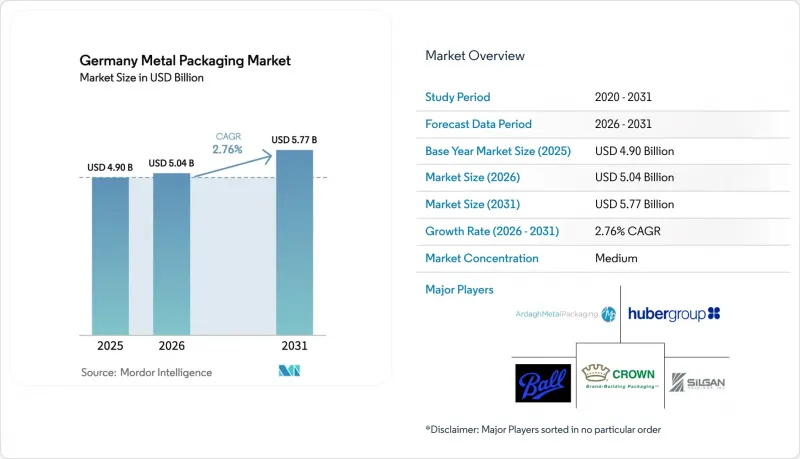
Mordor Intelligence에 의하면, 독일의 금속 포장 시장 규모는 2025년에 49억 달러로 평가되었고, 2026년 50억 4,000만 달러에서 2031년까지 57억 7,000만 달러에 이를 것으로 예측되며, 예측 기간(2026-2031년) CAGR은 2.76%를 나타낼 전망입니다.
본 보고서는 소재 유형별(알루미늄, 강철, 주석), 제품 유형별(캔, 벌크 컨테이너, 드럼통·배럴,캡·밀봉 부품 등), 최종 사용자 산업별(식품, 음료 등), 코팅 유형별(에폭시-페놀계, 아크릴계, 폴리에스터계, BPA 프리 대체품 등)로 분류되어 있습니다. 시장 예측은 금액(달러) 기준으로 제시되어 있습니다.
독일의 금속 포장 시장 동향 및 인사이트
독일 FMCG 브랜드의 지속가능성 목표
독일의 식품 및 음료 다국적 기업들은 2027년까지 재활용률 100%를 달성하겠다고 공언하고 있으며, 재활용률이 83%에 달하고, 폐쇄형 순환 경제(closed-loop) 구현 가능성이 있는 금속 포장재로의 결정적인 전환이 진행되고 있습니다. 각 브랜드 소유사는 복합 라미네이트 소재 대신, VerpackG의 에코모듈레이션 요금 요건을 충족하고 사용 후 분리 수거를 간소화하는 알루미늄 또는 강철 용기로 전환하고 있습니다. 특히 음료 충전 업체들은 적극적인 태도를 보이며, 프리미엄 즉석 음용(RTD) SKU를 무한히 재활용 가능함을 강조하는 선명한 인쇄가 적용된 알루미늄 캔으로 전환하고 있습니다. 소매업체들은 이러한 전환에 대해 진열 공간 우대 조치로 보답하고 있으며, 한편으로 보증금 환불을 통한 수익은 제련소로 향하는 고철 회수를 촉진하고, 자재 순환을 완성하며, 미사용 금속에 대한 의존도를 줄이는 데 기여하고 있습니다.
금속 캔 생산 라인의 자동화
독일 내 각 시설에서 진행 중인 ‘인더스트리 4.0’ 개조 작업에서는 디지털 트윈을 통해 코일 공급, 컵 성형, 넥 성형 각 공정을 동기화함으로써 스크랩이 25% 감소하고, 톤당 약 10kWh의 에너지 절감 효과가 입증되었습니다. 프레스기에 내장된 센서가 고주파 진동 패턴을 감지하고, 그 데이터를 AI 모델에 공급함으로써 폐기물이 발생하기 전에 금형의 위치 편차를 파악합니다. 예지 보전을 통한 유지보수 주기 연장으로 기계 가동 시간이 향상되었으며, 클라우드 기반 SPC 대시보드를 통해 작업자는 판 두께 공차를 ±3µm 범위 내에서 미세 조정할 수 있게 되었습니다. ‘Manufacturing-X’ 프레임워크는 OEM, 바니시 공급업체, 충전 업체 간의 안전하고 표준화된 데이터 교환을 촉진하여 배치 출시 지연을 줄이고, 로트 수준의 추적성을 실현합니다.
비철금속 가격 변동
지정학적 혼란의 여파로 2025년 초 런던 금속 거래소(LME)의 알루미늄 프리미엄이 27% 급등하면서 캔용 시트 1,000 단위당 비용이 직접적으로 상승했습니다. 대형 가공업체들은 12개월 계약을 체결하여 헤지하고 있지만, 중소기업들은 신용 한도가 부족하여 이익률 압박과 기계 교체 연기로 이어지고 있습니다. 가격 변동으로 인해 브랜드 고객에 대한 견적 가격 책정이 복잡해지고 있으며, 일부 고객은 하이브리드 포장이나 판 두께를 얇게 하는 등의 대안을 모색하고 있어 캔에 대한 전반적인 수요는 감소하고 있습니다. 재활용 소재로의 대체는 부분적인 완화를 가져오지만, 회수율 및 용해 손실 제한으로 인해 상한선이 설정되어 있어 가격에 대한 압박은 여전히 높은 수준을 유지하고 있습니다.
부문별 분석
2025년, 알루미늄은 경량성, 내식성, 폐쇄형 재활용 가능성 등의 장점에 힘입어 독일 금속 포장 시장 점유율의 63.48%를 차지했습니다. 이러한 우위는 유리한 운송 비용과 Scope 3 배출량 감축으로 이어져, 독일의 탄소국경조정메커니즘(CBAM) 하에서 알루미늄 수출업체의 경쟁력을 높이고 있습니다. 한편, 철강은 연평균 성장률(CAGR) 3.55%로 성장을 지속하고 있으며, 이는 단위 중량당 비용보다 부피당 비용을 중시하는 산업용 벌크 컨테이너 사용자들 수요를 시사합니다. 주요 제철소들은 향후 시행될 REACH 규정을 준수하는 크롬 프리 양철을 도입하여, 충전업체들의 규정 준수 부담을 경감시키고 있습니다.
철강의 부상은 회수율 85% 이상의 고철 흐름에 의해 공급되는 독일의 밀집된 전기 아크로 네트워크에 혜택을 가져다주고 있습니다. 각 제조업체는 특히 핫필(hot-fill) 식품 용도의 경우, 캔 본체의 두께가 0.18mm 미만이 되면 철강과 알루미늄의 수명 주기 비용이 동등해진다고 주장하고 있습니다. 또한, 강재의 자기적 특성으로 인해 지자체 쓰레기 처리 시설에서의 자동 선별이 간소화되어 회수의 경제성이 강화되고 있습니다. 알루미늄은 고급 음료 마케팅에서 여전히 ‘할로 효과’를 유지하고 있지만, 강재의 견고한 기계적 강도 덕분에 에어로졸 및 화학약품용 드럼통 분야에서 확고한 입지를 다지고 있어, 독일 금속 포장 시장의 수익 회복력을 다각화하고 있습니다.
2025년, 독일 금속 포장 시장 규모 중 캔이 42.25%를 차지했습니다. 이는 기밀 밀봉과 광고 공간으로서의 브랜드 노출을 중시하는 음료, 식품, 퍼스널케어 제품의 SKU에 의해 주도된 결과입니다. 에너지 드링크용 슬림 캔의 유형가 늘어나고 SKU가 확대됨에 따라, 주문 수익성을 높이기 위해서는 가동 중지 시간을 5분 미만으로 줄일 수 있는 신속한 전환이 가능한 장식 가공 업체가 요구되고 있습니다. 대용량 컨테이너, 특히 500리터 및 1,000리터 IBC 라이너는 고부가가치 액체의 무오염 운송에 대한 화학·제약 부문의 의존도를 반영하여 연평균 성장률(CAGR) 3.95%를 나타낼 것으로 예측됩니다. Ring Metal SE의 라이너 사업 인수는 이러한 성장세를 활용하기 위한 것으로, 독일 금속 포장 시장이 전문적이고 수익성이 높은 틈새 시장으로 기울고 있는 추세를 반영하고 있습니다.
전자상거래에서 팔레트 적재가 증가함에 따라, 미끄럼 방지 비드 형상을 갖춘 적층 가능한 금속 드럼의 설계가 요구되고 있으며, 이를 통해 운송 중 손상 및 보험 청구 건수가 감소할 것으로 보입니다. 한편, 에어로졸 캔의 출하량은 추진제에 대한 규제 당국의 감시가 강화되는 가운데 정체세를 보이고 있지만, 각 브랜드 소유사는 금속 사용량을 20% 줄이면서도 동등한 분사 시간을 확보할 수 있는 압축 유형을 채택함으로써 자재비 리스크를 경감하고 있습니다. 계절 한정 과자용 장식 캔은 리소그래피 기술의 발전을 활용하여 사진처럼 사실적인 인쇄를 구현함으로써 선물로서의 매력을 높이고, 독일의 디자인과 장인 정신을 돋보이게 하고 있습니다.
기타 혜택 :
- 엑셀 형식 시장 예측(ME) 시트
- 3개월간의 애널리스트 지원
자주 묻는 질문
목차
제1장 서론
제2장 조사 방법
제3장 개요
제4장 시장 구도
제5장 시장 규모 및 성장 예측
제6장 경쟁 구도
제7장 시장 기회 및 향후 전망
AJY 26.09.01According to Mordor Intelligence, the Germany metal packaging market size was valued at USD 4.90 billion in 2025 and estimated to grow from USD 5.04 billion in 2026 to reach USD 5.77 billion by 2031, at a CAGR of 2.76% during the forecast period (2026-2031).
This report is Segmented by Material Type (Aluminum, Steel, and Tin), Product Type (Cans, Bulk Containers, Drums and Barrels, Caps and Closures, and More), End-User Industry (Food, Beverage, and More), Coating Type (Epoxy Phenolic, Acrylic, Polyester, BPA-Free Alternatives, and More). The Market Forecasts are Provided in Terms of Value (USD).
Germany Metal Packaging Market Trends and Insights
Sustainability Targets of German FMCG Brands
German food and beverage multinationals have pledged to achieve 100% recyclability rates by 2027, prompting a decisive shift toward metal packaging due to its 83% recycling rate and closed-loop potential. Brand owners are replacing composite laminates with Aluminum or steel containers that meet VerpackG eco-modulation fees and simplify end-of-life sorting. Beverage fillers are particularly aggressive, switching premium ready-to-drink SKUs into brightly printed Aluminum cans that underscore infinite recyclability. Retailers reward this shift by granting shelf-space premiums, while deposit-return gains help reclaim scrap for smelters, closing material loops, and offsetting reliance on virgin metal.
Automation in Metal Can Production Lines
Industry 4.0 retrofits across German facilities have demonstrated scrap declines of 25% and energy savings of nearly 10 kWh per ton when digital twins synchronize coil feed, cupping, and necking stations. Sensors embedded in presses capture high-frequency vibration patterns, feeding AI models that identify die misalignment before it generates waste. Predictive maintenance intervals lengthen machine uptime, and cloud-based SPC dashboards let operators fine-tune sheet-thickness tolerances within +-3 µm. The Manufacturing-X framework promotes secure, standardized data exchange among OEMs, varnish suppliers, and fillers, reducing batch-release delays and enabling lot-level traceability.
Price Volatility of Base Metals
London Metal Exchange Aluminum premiums spiked 27% in early 2025 following geopolitical disruptions, directly increasing the cost per thousand units of can sheet. Large converters hedge by locking 12-month contracts, yet SMEs lack credit headroom, leading to squeezed margins and deferred machine upgrades. Volatility complicates quoted pricing to brand clients, some of whom experiment with hybrid packaging or down-gauging options, reducing overall can demand. Recycled-content substitution offers partial relief but is capped by collection yield and melt-loss limits, keeping price pressure elevated.
Other drivers and restraints analyzed in the detailed report include:
- Growth of Ready-to-Drink Beverage Segment
- Expansion of Germany's Craft-Beer Exports
- Rising Adoption of High-Barrier Plastics
For complete list of drivers and restraints, kindly check the Table Of Contents.
Segment Analysis
Aluminum commanded 63.48% of Germany metal packaging market share in 2025, buoyed by its lightweight profile, corrosion resistance, and closed-loop recyclability advantages. This supremacy translates into favorable freight economics and reduced scope-3 emissions, positioning Aluminum exporters competitively under Germany's Carbon Border Adjustment Mechanism. Steel, however, is pacing at a 3.55% CAGR, signaling demand from industrial bulk-container users who weigh cost per volume over grams per unit. Major mills have introduced chrome-free tinplate that meets upcoming REACH mandates, lowering compliance overhead for fillers.
Steel's ascent benefits Germany's dense network of electric-arc furnaces supplied by scrap streams exhibiting >85% recovery rates. Producers tout life-cycle cost parity with Aluminum when can-body thickness drops below 0.18 mm, especially for hot-fill food applications. Furthermore, steel's magnetic properties simplify automated sorting in municipal plants, reinforcing collection economics. Although Aluminum retains halo effects in premium beverage marketing, steel's robust mechanical strength secures its foothold in aerosols and chemical drums, diversifying revenue resilience for the Germany metal packaging market.
Cans retained 42.25% of Germany metal packaging market size in 2025, propelled by beverage, food, and personal-care SKUs that value hermetic sealing and billboard branding real estate. Sleek-can variants for energy drinks multiply SKUs, demanding fast-changeover decorators capable of <5 min downtime to push order profitability. Bulk containers, notably 500 L and 1,000 L IBC liners, are forecast to log a 3.95% CAGR, reflecting chemical and pharma sector reliance on contamination-free transport of high-value liquids. Ringmetall SE's liner acquisitions aim to exploit this pocket of momentum, mirroring the Germany metal packaging market's tilt toward specialized, higher-margin niches.
Growing e-commerce palletization calls for stackable metal drum designs with anti-slip bead geometry, reducing transit damage and insurance claims. Meanwhile, aerosol can volumes stabilize amidst regulatory scrutiny of propellants, but brand owners counter with compressed formats that achieve equal spray duration using 20% less metal, alleviating material cost exposure. Decorative tins for seasonal confectionery leverage lithographic advances to deliver photo-realistic prints, extending gifting appeal and showcasing German design craftsmanship.
Complete Report Scope:
- By Material Type
- Aluminium
- Steel
- Tin
- By Product Type
- Cans
- Food Cans
- Beverage Cans
- Aerosol Cans
- Decorative Cans
- Bulk Containers
- Drums and Barrels
- Caps and Closures
- Other Product Types
- Cans
- By End-User Industry
- Food
- Beverage
- Paints, Coatings and Chemicals
- Pharmaceuticals and Healthcare
- Industrial
- Other End-user Industries
- By Coating Type
- Epoxy Phenolic
- Acrylic
- Polyester
- BPA-Free Alternatives
- Other Coating Types
List of Companies Covered in this Report:
- Ardagh Metal Packaging S.A.
- Ball Corporation
- Crown Holdings Inc.
- Silgan Holdings Inc.
- HUBER Packaging Group GmbH
- Trivium Packaging B.V.
- Greif Inc.
- Mauser Packaging Solutions Holding Company
- Sonoco Products Company
- Envases Europe A/S
- Nussbaum Matzingen AG
- Sarten Ambalaj Sanayi ve Ticaret A.S.
- Colep Packaging S.A.
- Emballator Metal Group AB
- P. Wilkinson Containers Ltd.
- Nefab AB
- Toyo Seikan Group Holdings Ltd.
- Can One Berhad
- Kian Joo Can Factory Berhad
- Crown Van Gelder N.V.
Additional Benefits:
- The market estimate (ME) sheet in Excel format
- 3 months of analyst support
TABLE OF CONTENTS
1 INTRODUCTION
- 1.1 Study Assumptions and Market Definition
- 1.2 Scope of the Study
2 RESEARCH METHODOLOGY
3 EXECUTIVE SUMMARY
4 MARKET LANDSCAPE
- 4.1 Market Overview
- 4.2 Market Drivers
- 4.2.1 Sustainability Targets of German FMCG Brands
- 4.2.2 Shift Toward Lightweight Recyclable Packaging
- 4.2.3 Growth of Ready-to-Drink Beverage Segment
- 4.2.4 Expansion of Germany's Craft Beer Exports
- 4.2.5 Automation in Metal Can Production Lines
- 4.2.6 OEM Preference for Monomaterial Packaging
- 4.3 Market Restraints
- 4.3.1 Price Volatility of Base Metals
- 4.3.2 Rising Adoption of High-Barrier Plastics
- 4.3.3 Regulatory Scrutiny of BPA-Based Coatings
- 4.3.4 High Capex for Advanced Coating Equipment
- 4.4 Industry Value Chain Analysis
- 4.5 Impact of Macroeconomic Factors
- 4.6 Regulatory Landscape
- 4.7 Technological Outlook
- 4.8 Porter's Five Forces Analysis
- 4.8.1 Threat of New Entrants
- 4.8.2 Bargaining Power of Suppliers
- 4.8.3 Bargaining Power of Buyers
- 4.8.4 Threat of Substitutes
- 4.8.5 Intensity Competitive Rivalry
5 MARKET SIZE AND GROWTH FORECASTS (VALUE)
- 5.1 By Material Type
- 5.1.1 Aluminium
- 5.1.2 Steel
- 5.1.3 Tin
- 5.2 By Product Type
- 5.2.1 Cans
- 5.2.1.1 Food Cans
- 5.2.1.2 Beverage Cans
- 5.2.1.3 Aerosol Cans
- 5.2.1.4 Decorative Cans
- 5.2.2 Bulk Containers
- 5.2.3 Drums and Barrels
- 5.2.4 Caps and Closures
- 5.2.5 Other Product Types
- 5.2.1 Cans
- 5.3 By End-User Industry
- 5.3.1 Food
- 5.3.2 Beverage
- 5.3.3 Paints, Coatings and Chemicals
- 5.3.4 Pharmaceuticals and Healthcare
- 5.3.5 Industrial
- 5.3.6 Other End-user Industries
- 5.4 By Coating Type
- 5.4.1 Epoxy Phenolic
- 5.4.2 Acrylic
- 5.4.3 Polyester
- 5.4.4 BPA-Free Alternatives
- 5.4.5 Other Coating Types
6 COMPETITIVE LANDSCAPE
- 6.1 Market Concentration
- 6.2 Strategic Moves
- 6.3 Market Share Analysis
- 6.4 Company Profiles (includes Global Level Overview, Market Level Overview, Core Segments, Financials as Available, Strategic Information, Market Rank/Share for Key Companies, Products and Services, and Recent Developments)
- 6.4.1 Ardagh Metal Packaging S.A.
- 6.4.2 Ball Corporation
- 6.4.3 Crown Holdings Inc.
- 6.4.4 Silgan Holdings Inc.
- 6.4.5 HUBER Packaging Group GmbH
- 6.4.6 Trivium Packaging B.V.
- 6.4.7 Greif Inc.
- 6.4.8 Mauser Packaging Solutions Holding Company
- 6.4.9 Sonoco Products Company
- 6.4.10 Envases Europe A/S
- 6.4.11 Nussbaum Matzingen AG
- 6.4.12 Sarten Ambalaj Sanayi ve Ticaret A.S.
- 6.4.13 Colep Packaging S.A.
- 6.4.14 Emballator Metal Group AB
- 6.4.15 P. Wilkinson Containers Ltd.
- 6.4.16 Nefab AB
- 6.4.17 Toyo Seikan Group Holdings Ltd.
- 6.4.18 Can One Berhad
- 6.4.19 Kian Joo Can Factory Berhad
- 6.4.20 Crown Van Gelder N.V.
7 MARKET OPPORTUNITIES AND FUTURE OUTLOOK
- 7.1 White-Space and Unmet-Need Assessment