
|
시장보고서
상품코드
2121529
금속 포장 : 시장 점유율 분석, 산업 동향 및 통계 데이터, 성장 예측(2026-2031년)Metal Packaging - Market Share Analysis, Industry Trends & Statistics, Growth Forecasts (2026 - 2031) |
||||||
 Mordor Intelligence
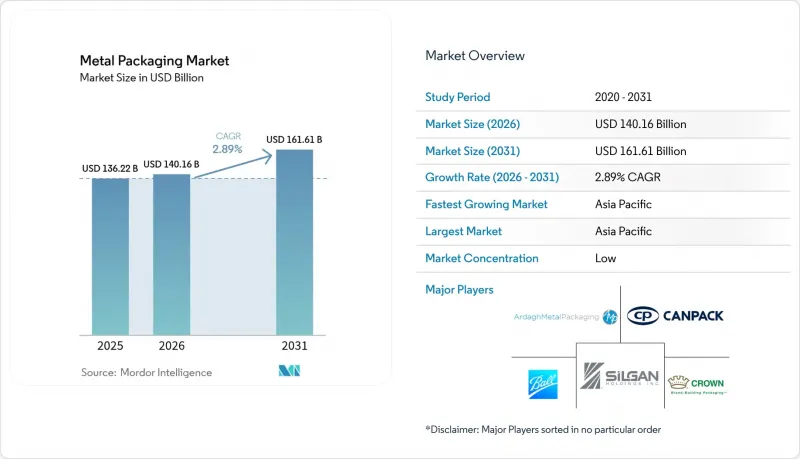
Mordor Intelligence에 의하면, 금속 포장 시장 규모는 2025년 1,362억 2,000만 달러에서 2026년에는 1,401억 6,000만 달러로 성장하고, 2026-2031년 CAGR 2.89%로 성장을 지속하여 2031년에는 1,616억 1,000만 달러에 달할 것으로 예측됩니다.
본 보고서는 재료 유형별(알루미늄, 강철), 제품 유형별(벌크 컨테이너, 운송용 배럴 및 드럼, 뚜껑 및 마개 등), 최종 사용자 산업(음료, 식품 등),코팅/라이닝 유형(BPA계 에폭시, BPA-NI 에폭시 등), 용기 용량(250밀리리터 미만, 251-500밀리리터, 기타), 지역(북미 등)별로 분류되어 있습니다. 시장 전망은 금액(달러) 기준으로 제시되어 있습니다.
세계 금속 포장 시장 동향 및 인사이트
순환 경제 규제가 ‘캔에서 캔으로’의 재활용 루프를 뒷받침
규제 강화로 인해 밸류체인의 경제 구조가 재편되고 있습니다. 알루미늄 캔은 이미 최소 재활용 함유율 기준을 상회하고 있어, 이를 통해 금속 포장 시장은 규제 준수 측면에서 우위를 점하고 있습니다. EU의 PPWR(포장 및 포장 폐기물 규정)에서는 2030년까지 음료 용기에 30%의 재활용 소재 사용을 의무화하고 있으나, 알루미늄 캔의 재활용 함량은 평균 71%에 달할 전망입니다. 보증금 반환 제도를 통해 2029년까지 회수율은 90%를 향해 가고 있습니다. 이를 통해 예측 가능한 스크랩 공급이 확보되어 미사용 금속에 대한 의존도가 낮아지고 있습니다. Ball사 등 세계 제조업체들은 재활용 소재 함유율 85%를 목표로 하고 있으며, 이를 통해 폐쇄형 순환 체계의 효율성이 강화되고 원자재 비용에 대한 리스크가 완화되고 있습니다. 호주에서는 2040년까지 식품용 캔의 소비 후 재활용 소재 함유율을 80%로 하겠다는 EU 규제를 준수한 기준이 마련되어 있습니다. 규제의 기세가 지속됨에 따라, 특히 음료 분야에서 알루미늄이 PET에 비해 갖는 경쟁 우위가 확고해지고 있습니다. 현재 음료 업계의 조달에서는 공급업체의 입찰 평가에 순환성 점수가 반영되고 있습니다.
신흥 아시아 시장의 RTD 음료 프리미엄화
프리미엄 캔 음료에 대한 수요 급증으로 아시아태평양의 금속 포장 시장 성장이 가속화되고 있습니다. 일본에서는 소비자들이 저칼로리·저알코올 제품을 선호하는 가운데, 2018년부터 2023년에 걸쳐 캔 주하이(츄하이) 시장 규모가 3배로 확대되었습니다. 아사히의 ‘나마조키’와 같은 브랜드는 패키지 혁신을 통해 가정에서도 음식점과 같은 경험을 재현할 수 있음을 입증하고 있습니다. 중국과 인도에서 가처분 소득이 증가함에 따라 프리미엄 RTD 커피,콤부차, 기능성 식사 대체 음료가 일반 소매 시장에 침투하고 있으며, 이들 모두는 풍미 유지와 단열 성능을 위해 캔에 의존하고 있습니다. 이러한 프리미엄화 흐름에 힘입어 제조업체들은 원자재비 상승분을 소비자에게 전가할 수 있어, 알루미늄 가격 변동에도 불구하고 이익률을 유지하고 있습니다.
LME 알루미늄 및 철강 가격 변동
에너지 가격에 기인한 가격 변동은 이익률을 압박하고 있습니다. 이는 금속 포장 시장이 여전히 현물 가격 변동에 뒤늦게 반영되는 전가 조항이 포함된 계약에 의존하고 있기 때문입니다. 북미의 관세 조치가 상황을 더욱 복잡하게 만들고 있어, 생산자들은 경쟁력을 유지하기 위해 헤지 수단과 지역별 조달을 병행할 수밖에 없는 실정입니다. 유럽의 제련소들은 지속적인 에너지 비용 압박에 직면해 있으며, 이것이 세계 가격의 급등락에 기여하고 있습니다. 대기업들은 고철을 원료로 한 공급이나 다년 계약을 통해 가격 변동의 영향을 상쇄하고 있지만, 중소 가공업체들은 여전히 위험에 노출되어 있으며, 이는 설비 투자 주기의 둔화로 이어질 가능성이 있습니다.
부문별 분석
알루미늄은 2025년에 금속 포장 시장 점유율의 42.80%를 차지할 것으로 예상되며, PPWR(포장 및 포장 폐기물 규제) 요건을 충족하는 폐쇄형 재활용 시스템의 혜택을 받아 2031년까지 연평균 성장률(CAGR) 3.57%로 성장할 것으로 전망됩니다. 철강은 대형 식품용 및 산업용 드럼통 분야에서 여전히 중요한 위치를 차지하고 있지만, 무게와 에너지 소비 측면에서 성장 속도는 둔화되고 있습니다. 노벨리스(Novelis)가 캔 재활용 능력을 두 배로 늘리기 위해 9,000만 달러를 투자하여 영국에서 사업을 확장하고 있다는 사실은 이 소재의 전략적 중요성을 여실히 보여줍니다. 알루미늄의 경량성은 물류에 따른 배출량을 줄이고, ESG 스코어카드와의 부합성을 높이며, 음료 브랜드에 대한 고객 충성도를 강화하고 있습니다. 시장 진출기업들은 재용해 기술에 대한 투자를 지속하고 있으며, 이로 인해 재생 알루미늄과 관련된 금속 포장 시장 규모는 꾸준히 확대되고 있습니다.
재활용 알루미늄의 가격적 우위는 브랜드가 신금속에 비해 원자재 비용을 관리하고 조달 위험을 줄이는 데 도움이 되고 있습니다. 힌달코(Hindalco)의 100억 달러 규모의 생산 능력 확대 계획은 제련과 재활용을 통합한 허브가 공급망을 단축하고, 야심찬 재생 재료 함유율 목표 달성을 지원하는 모습을 보여주고 있습니다. 철강의 자기적 회수 가능성은 혼합 폐기물 흐름에서 여전히 장점이지만, 탄소세 도입에 따라 용기의 무게 증가가 운송 비용 상승을 초래하고 있습니다. 종합적으로 볼 때, 알루미늄의 비용, 재활용성 및 무게 측면에서의 우위가 그 주도적 지위를 공고히 하고 있지만, 한편으로 철강은 기계적 강도와 내천자성을 우선시하는 견고한 틈새 시장에서 입지를 유지하고 있습니다.
2025년 현재, 캔은 금속 포장 시장의 41.12%를 차지하고 있으며, 전 세계 편의점 채널에서 RTD 커피, 하드 셀처, 기능성 음료의 프리미엄화가 가속화됨에 따라 연평균 성장률(CAGR) 6.08%로 성장할 전망입니다. 볼(Ball)사의 ‘Dynamark Advanced Pro’ 가변 그래픽 시스템은 대규모 캔 맞춤화를 가능하게 하여, 마케터가 소비자 참여도와 매장 내 어필력을 높일 수 있도록 지원합니다. 식품용 캔은 안정적인 기반을 유지하고 있으며, 토마토 페이스트, 수프, 반려동물사료의 세계 무역을 뒷받침하는 높은 차단성을 제공합니다. 에어로졸 캔은 팬데믹 이후 누적된 수요로 인해 신흥 시장에서 헤어 스타일링, 데오도란트, 가정용 세정 제품 카테고리가 확대되는 가운데 퍼스널케어 시장의 성장을 주도하고 있습니다.
경량화 노력을 통해 강도를 저하시키지 않으면서 단위당 알루미늄 사용량을 줄여, 비용 절감과 Scope 3 탄소 발자국 감축에 기여하고 있습니다. 캡, 마개 및 라그리드는 위조 개봉 방지 기능과 편의성을 제공함으로써 틈새 시장에서 입지를 유지하고 있습니다. 대용량 드럼 및 중간 크기의 강철 용기는 재사용성과 유엔 운송 인증이 필수적인 농약 및 식용유 분야에서 여전히 인기를 유지하고 있습니다. 이러한 동향들이 맞물리면서 캔은 금속 포장 시장에서 주력 제품으로 남을 것이 보장되는 한편, 관련 부문은 재료 과학과 디자인 혁신을 통해 진화를 거듭하고 있습니다.
지역별 분석
아시아태평양은 2025년에 금속 포장 시장의 38.21%를 차지할 것으로 예상되며, 중국의 급성장하는 RTD(즉석 음료) 부문과 인도의 중산층 부상을 배경으로 2031년까지 연평균 성장률(CAGR) 5.89%를 기록할 전망입니다. 현지 캔용 강판 공급에 더해, 힌달코(Hindalco)사의 수십억 달러 규모 제련소 및 재활용 시설 확장은 비용 리더십과 순환 경제에 대한 노력을 뒷받침하며, 이는 세계 브랜드 소유 기업들에게 매력적인 요소로 작용하고 있습니다. 일본은 디자인 측면에서 리더십을 발휘하며, 지역 내 채택 패턴에 영향을 미치는 고품질의 ‘츄하이’용 캔을 수출하고 있는 반면, 동남아시아 국가들은 관광에 힘입은 음료 수요와 새롭게 도입되고 있는 보증금 반환 제도의 시범 운영을 활용하고 있습니다.
북미는 성숙한 시장으로, 주요 맥주 및 청량음료 충전 업체들과의 장기 공급 계약에 힘입어 국내 캔 생산 라인은 거의 풀가동되고 있습니다. 관세 제도로 인해 캔 제조업체는 국내에서 금속을 조달할 수밖에 없으며, 이로 인해 스크랩을 원료로 하는 빌렛 제조 시설 및 창고 자동화에 대한 투자가 촉진되어 단위당 비용 절감이 이루어지고 있습니다. 주 차원에서 널리 도입된 병 재활용 법에 따라 알루미늄 회수율은 60% 이상으로 유지되고 있으며, 2차 생산을 위한 원료의 안정적인 공급이 확보되고 있습니다.
유럽에서는 엄격한 PPWR(포장재 재활용 의무) 요건과 정교한 재활용 네트워크가 결합되어, 코팅 기술의 혁신과 디지털 워터마크 기술의 시범 도입을 위한 시금석이 되고 있습니다. 스페인과 이탈리아에 위치한 크라운(Crown)사의 확장성이 뛰어난 공장에서는 최근 크래프트 맥주 수출업체를 위한 고속 생산 라인이 추가되었습니다. 이는 포화 상태에 있는 시장에서도 지속적인 기회가 존재함을 보여줍니다. 브라질을 필두로 한 남미에서는 맥주 브랜드 소유주들이 프리미엄 포지셔닝과 물류 효율화를 목적으로 캔으로의 전환을 추진하는 가운데, 판매량이 힘차게 증가하고 있습니다.
중동 및 아프리카는 인프라 면에서 뒤처져 있지만, 인구 증가와 소득 향상으로 인해 에어로졸형 데오드란트 및 통조림 식품 시장 침투를 위한 새로운 가능성이 열리고 있으며, 전 세계 금속 포장 시장에서 이 지역 전체가 성장에 기여할 것으로 확실히 전망됩니다.
기타 혜택:
- Excel 형식 시장 예측(ME) 시트
- 3개월간의 애널리스트 지원
자주 묻는 질문
목차
제1장 서론
제2장 분석 방법
제3장 주요 요약
제4장 시장 구도
제5장 시장 규모·성장률 예측
제6장 경쟁 구도
제7장 시장 기회와 향후 전망
LSHAccording to Mordor Intelligence, the metal packaging market size is expected to grow from USD 136.22 billion in 2025 to USD 140.16 billion in 2026 and is forecast to reach USD 161.61 billion by 2031 at 2.89% CAGR over 2026-2031.
This report is Segmented by Material Type (Aluminum, Steel), Product Type (Bulk Containers, Shipping Barrels and Drums, Caps and Closures, and More), End-User Industry (Beverage, Food, and More), Coating/Lining Type (BPA-Based Epoxy, BPA-NI Epoxy and More), Container Capacity (less Than 250 Ml, 251-500, and More), Geography (North America, and More). The Market Forecasts are Provided in Terms of Value (USD).
Global Metal Packaging Market Trends and Insights
Circular-Economy Mandates Boost Can-to-Can Recycling Loops
Tighter legislation is reshaping value-chain economics by mandating minimum recycled-content thresholds that aluminium cans already exceed, giving the metal packaging market a compliance edge. The EU's PPWR requires 30% recycled material in beverage containers by 2030, yet aluminium cans average 71% recycled content. Deposit-return schemes are driving collection rates toward 90% by 2029, supporting predictable scrap flows and reducing virgin-metal dependency. Global producers such as Ball target 85% recycled content, reinforcing closed-loop efficiencies that temper raw-material cost risk. Australia mirrors EU rules with an 80% post-consumer threshold for food-grade cans by 2040.Sustained regulatory momentum cements aluminium's moat over PET, particularly in beverages where procurement now factors circularity scores into supplier bids.
Premiumization of RTD Beverages in Emerging Asia
Surging demand for premium canned drinks is accelerating the metal packaging market growth in Asia-Pacific. Japan's canned chuhai segment tripled in the United States between 2018 and 2023 as consumers seek low-calorie, low-alcohol options. Brands like Asahi's Nama Jokki can demonstrate how packaging innovations replicate on-premise experiences in at-home settings. Rising disposable incomes in China and India push premium RTD coffee, kombucha, and functional meal-replacement beverages into mainstream retail, all of which rely on cans for flavor protection and thermal performance. The premiumisation wave enables manufacturers to pass higher material costs through to consumers, sustaining margins despite aluminium volatility.
Price Volatility of LME Aluminium and Steel
Energy-driven price swings strain margins because the metal packaging market still relies on contracts with pass-through clauses that lag spot fluctuations. North American tariffs add complexity, forcing producers to blend hedging tools with regional sourcing to protect competitiveness.European smelters face persistent energy-cost pressure, contributing to global price turbulence. While large players offset volatility through scrap-based feedstocks and multi-year agreements, smaller converters remain exposed, which can slow capital investment cycles.
Other drivers and restraints analyzed in the detailed report include:
- Retailers' Plastic-to-Metal Substitution Pledges
- High Scrap Recovery Rates Lower True Cost vs. PET
- Brand-Owner Push-Back on Scope-3 CO2 Footprint
For complete list of drivers and restraints, kindly check the Table Of Contents.
Segment Analysis
Aluminium generated 42.80% of the metal packaging market share in 2025 and is projected to grow at a 3.57% CAGR through 2031, benefiting from closed-loop recycling systems that meet PPWR mandates. Steel maintains relevance in large-format food and industrial drums but grows more slowly due to weight and energy considerations. Novelis's USD 90 million UK expansion to double can-recycling capacity underscores the material's strategic importance. Aluminium's light weight reduces logistics emissions, aligning with ESG scorecards and deepening customer loyalty among beverage brands. Market participants continue to invest in remelt technology, enabling the metal packaging market size associated with secondary aluminium to expand steadily.
Secondary aluminium pricing advantages help brands manage raw-material costs relative to virgin metal, mitigating procurement risk. Hindalco's USD 10 billion capacity plan illustrates how integrated smelting and recycling hubs shorten supply chains and support aggressive recycled-content targets. Steel's magnetic recoverability remains a plus in mixed-waste streams, yet higher container weight raises transport costs as carbon taxes spread. Altogether, aluminium's cost, circularity, and weight advantages cement its leadership position, even as steel serves resilient niches that prioritize mechanical strength and puncture resistance.
Cans represented 41.12% of the metal packaging market in 2025 and are set to grow at a 6.08% CAGR, propelled by the premiumisation of RTD coffee, hard seltzer, and functional beverages across global convenience channels. Ball's Dynamark Advanced Pro variable-graphics system personalizes cans at scale, allowing marketers to boost engagement and shelf appeal. Food cans hold a stable base, supplying high-barrier protection that underwrites global trade in tomato paste, soups, and pet food. Aerosol cans tap personal-care growth as pent-up post-pandemic demand lifts hair styling, deodorant, and household-cleaning categories in emerging markets.
Light-weighting initiatives reduce aluminium per unit without compromising integrity, helping contain costs and shrink scope-3 footprints. Caps, closures, and lug lids maintain niche relevance by providing tamper evidence and convenience. Bulk drums and intermediate steel containers retain popularity for agrochemicals and edible oils, where reusability and UN transport certifications are critical. Collectively, these dynamics guarantee that cans remain the metal packaging market's flagship product while ancillary segments evolve through material science and design innovation.
Complete Report Scope:
- By Material Type
- Aluminium
- Steel
- By Product Type
- Cans
- Food Cans
- Beverage Cans
- Aerosol Cans
- Bulk Containers
- Shipping Barrels and Drums
- Caps and Closures
- Cans
- By End-user Industry
- Beverage
- Food
- Cosmetics and Personal Care
- Household
- Other End-user Industry
- By Coating / Lining Type
- BPA-Based Epoxy
- BPA-NI Epoxy
- Polyester / PET
- Other Coating / Lining Type
- By Container Capacity
- Less than 250 ml
- 251 - 500 ml
- 501 - 1000 ml
- More than 1000 ml
- By Geography
- North America
- United States
- Canada
- Mexico
- Europe
- Germany
- United Kingdom
- France
- Italy
- Spain
- Russia
- Rest of Europe
- Asia-Pacific
- China
- India
- Japan
- South Korea
- Australia and New Zealand
- Rest of Asia-Pacific
- Middle East and Africa
- Middle East
- United Arab Emirates
- Saudi Arabia
- Turkey
- Rest of Middle East
- Africa
- South Africa
- Nigeria
- Egypt
- Rest of Africa
- Middle East
- South America
- Brazil
- Argentina
- Rest of South America
- North America
Geography Analysis
Asia-Pacific held 38.21% of the metal packaging market in 2025 and is tracking a 5.89% CAGR through 2031, anchored by China's burgeoning RTD sector and India's rising middle class. Localised can-sheet supply, combined with Hindalco's multi-billion-dollar smelter-plus-recycling build-out, underpins cost leadership and circular credentials that appeal to global brand owners. Japan contributes design leadership, exporting high-quality chuhai formats that influence regional adoption patterns, while Southeast Asian nations leverage tourism-driven beverage demand and emerging deposit-return pilots.
North America represents a mature arena where domestic can lines run near full utilisation, cushioned by long-term supply contracts with major beer and soft-drink fillers. Tariff regimes compel canmakers to source metal domestically, spurring investment in scrap-based billet facilities and warehouse automation to drive down per-unit costs. Widespread state-level bottle bills keep aluminium recovery rates above 60%, bolstering feedstock security for secondary production.
Europe combines rigorous PPWR requirements with sophisticated recycling networks, making it a crucible for coating innovations and digital watermark pilots. Crown's scalable plants in Spain and Italy recently added high-speed lines to serve craft-beer exporters, evidencing sustained opportunity even within a saturated market. South America, spearheaded by Brazil, exhibits strong volume growth as beer brand owners convert to cans for premium positioning and logistics efficiency.
The Middle East and Africa trail on infrastructure, yet population expansion and rising incomes provide greenfield prospects for aerosol deodorant and canned-food penetration, ensuring region-wide growth contributions to the global metal packaging market.
- Ardagh Metal Packaging S.A.
- Ball Corporation
- Crown Holdings Inc.
- CANPACK S.A.
- Silgan Holdings Inc.
- Greif Inc.
- TUBEX Packaging GmbH
- Mauser Packaging Solutions
- Nampak Limited
- Colep Packaging
- CPMC Holdings Ltd.
- Toyo Seikan Group Holdings
- Amcor plc (Metal division)
- AptarGroup Inc.
- Alcoa Corporation
- Sherwin-Williams (Can Coatings)
- Novelis Inc.
- Hindalco Industries Ltd.
- RPC Group plc
- BWAY Corporation
- Berlin Packaging
Additional Benefits:
- The market estimate (ME) sheet in Excel format
- 3 months of analyst support
TABLE OF CONTENTS
1 INTRODUCTION
- 1.1 Study Assumptions and Market Definition
- 1.2 Scope of the Study
2 RESEARCH METHODOLOGY
3 EXECUTIVE SUMMARY
4 MARKET LANDSCAPE
- 4.1 Market Overview
- 4.2 Market Drivers
- 4.2.1 Circular-economy mandates boost can-to-can recycling loops
- 4.2.2 Premiumisation of RTD beverages in emerging Asia
- 4.2.3 Retailers' plastic-to-metal substitution pledges
- 4.2.4 High scrap recovery rates lower true cost vs. PET
- 4.2.5 In-can QR/NFC tech unlocking consumer-data monetisation
- 4.2.6 Expansion of e-commerce and DTC beverage retailing
- 4.3 Market Restraints
- 4.3.1 Price volatility of LME aluminium and steel
- 4.3.2 Brand-owner push-back on scope-3 CO? footprint
- 4.3.3 Rise of mono-material paper bottles
- 4.3.4 High production and operational costs of metal packaging
- 4.4 Supply-Chain Analysis
- 4.5 Regulatory Landscape
- 4.6 Technological Outlook
- 4.7 Porter's Five Forces Analysis
- 4.7.1 Bargaining Power of Suppliers
- 4.7.2 Bargaining Power of Buyers
- 4.7.3 Threat of New Entrants
- 4.7.4 Threat of Substitutes
- 4.7.5 Intensity of Competitive Rivalry
- 4.8 Impact of Geopolitical Scenario on the Market
- 4.9 Investment Analysis
5 MARKET SIZE AND GROWTH FORECASTS (VALUE)
- 5.1 By Material Type
- 5.1.1 Aluminium
- 5.1.2 Steel
- 5.2 By Product Type
- 5.2.1 Cans
- 5.2.1.1 Food Cans
- 5.2.1.2 Beverage Cans
- 5.2.1.3 Aerosol Cans
- 5.2.2 Bulk Containers
- 5.2.3 Shipping Barrels and Drums
- 5.2.4 Caps and Closures
- 5.2.1 Cans
- 5.3 By End-user Industry
- 5.3.1 Beverage
- 5.3.2 Food
- 5.3.3 Cosmetics and Personal Care
- 5.3.4 Household
- 5.3.5 Other End-user Industry
- 5.4 By Coating / Lining Type
- 5.4.1 BPA-Based Epoxy
- 5.4.2 BPA-NI Epoxy
- 5.4.3 Polyester / PET
- 5.4.4 Other Coating / Lining Type
- 5.5 By Container Capacity
- 5.5.1 Less than 250 ml
- 5.5.2 251 - 500 ml
- 5.5.3 501 - 1000 ml
- 5.5.4 More than 1000 ml
- 5.6 By Geography
- 5.6.1 North America
- 5.6.1.1 United States
- 5.6.1.2 Canada
- 5.6.1.3 Mexico
- 5.6.2 Europe
- 5.6.2.1 Germany
- 5.6.2.2 United Kingdom
- 5.6.2.3 France
- 5.6.2.4 Italy
- 5.6.2.5 Spain
- 5.6.2.6 Russia
- 5.6.2.7 Rest of Europe
- 5.6.3 Asia-Pacific
- 5.6.3.1 China
- 5.6.3.2 India
- 5.6.3.3 Japan
- 5.6.3.4 South Korea
- 5.6.3.5 Australia and New Zealand
- 5.6.3.6 Rest of Asia-Pacific
- 5.6.4 Middle East and Africa
- 5.6.4.1 Middle East
- 5.6.4.1.1 United Arab Emirates
- 5.6.4.1.2 Saudi Arabia
- 5.6.4.1.3 Turkey
- 5.6.4.1.4 Rest of Middle East
- 5.6.4.2 Africa
- 5.6.4.2.1 South Africa
- 5.6.4.2.2 Nigeria
- 5.6.4.2.3 Egypt
- 5.6.4.2.4 Rest of Africa
- 5.6.4.1 Middle East
- 5.6.5 South America
- 5.6.5.1 Brazil
- 5.6.5.2 Argentina
- 5.6.5.3 Rest of South America
- 5.6.1 North America
6 COMPETITIVE LANDSCAPE
- 6.1 Market Concentration
- 6.2 Strategic Moves
- 6.3 Market Share Analysis
- 6.4 Company Profiles (includes Global level Overview, Market level overview, Core Segments, Financials as available, Strategic Information, Market Rank/Share for key companies, Products and Services, and Recent Developments)
- 6.4.1 Ardagh Metal Packaging S.A.
- 6.4.2 Ball Corporation
- 6.4.3 Crown Holdings Inc.
- 6.4.4 CANPACK S.A.
- 6.4.5 Silgan Holdings Inc.
- 6.4.6 Greif Inc.
- 6.4.7 TUBEX Packaging GmbH
- 6.4.8 Mauser Packaging Solutions
- 6.4.9 Nampak Limited
- 6.4.10 Colep Packaging
- 6.4.11 CPMC Holdings Ltd.
- 6.4.12 Toyo Seikan Group Holdings
- 6.4.13 Amcor plc (Metal division)
- 6.4.14 AptarGroup Inc.
- 6.4.15 Alcoa Corporation
- 6.4.16 Sherwin-Williams (Can Coatings)
- 6.4.17 Novelis Inc.
- 6.4.18 Hindalco Industries Ltd.
- 6.4.19 RPC Group plc
- 6.4.20 BWAY Corporation
- 6.4.21 Berlin Packaging
7 MARKET OPPORTUNITIES AND FUTURE OUTLOOK
- 7.1 White-space and Unmet-need Assessment