
|
시장보고서
상품코드
2116955
이탈리아의 금속 포장 시장 : 시장 점유율 분석, 업계 동향 및 통계, 성장 예측(2026-2031년)Italy Metal Packaging - Market Share Analysis, Industry Trends & Statistics, Growth Forecasts (2026 - 2031) |
||||||
 Mordor Intelligence
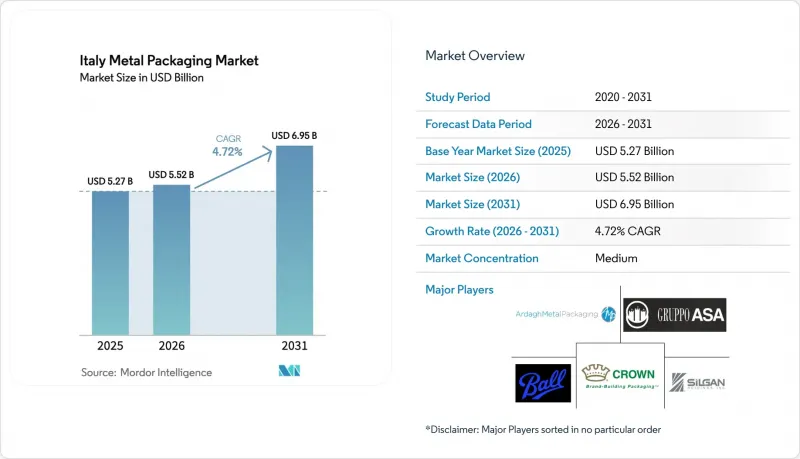
Mordor Intelligence에 의하면, 이탈리아의 금속 포장 시장 규모는 2025년에 52억 7,000만 달러로 평가되었고, 2026년 55억 2,000만 달러에서 2031년까지 69억 5,000만 달러에 이를 것으로 예측되며, 예측 기간(2026-2031년) CAGR은 4.72%를 나타낼 전망입니다.
본 보고서는 소재 유형별(알루미늄, 강철, 주석), 제품 유형별(캔, 벌크 컨테이너, 드럼통·배럴, 캡·밀봉 부품 등), 최종 사용자 산업별(식품, 음료 등), 코팅 유형별(에폭시-페놀계, 아크릴계, 폴리에스터계, BPA 프리 대체품 등)로 분류되어 있습니다. 시장 예측은 금액(달러) 기준으로 제시되어 있습니다.
이탈리아의 금속 포장 시장 동향 및 인사이트
즉석 식품 소비 급증
즉석 식품은 편의성과 분량 관리를 중시하는 도시 지역 가구 사이에서 여전히 인기를 끌고 있습니다. 2024년에는 냉동 식품 매출이 102만 톤, 58억 유로(64억 달러)에 달한 반면, 가공 채소 수출액은 25억 유로(27억 달러)로 증가했습니다. 금속 캔은 이러한 고급 제품에 긴 유통 기한을 보장함으로써, 멀리 떨어진 시장에서 브랜드의 명성을 지켜줍니다. 또한, 경질 캔은 유연한 필름보다 소포 취급에 대한 내성이 높기 때문에 전자상거래가 또 다른 호재로 작용하고 있습니다. 이탈리아 생산자들이 물류 신뢰도가 낮은 지역으로의 판매를 확대함에 따라, 차단 성능 유지는 구매 시 필수 조건이 되고 있습니다. 이러한 추세로 인해 1인 가구에 적합한 소형 금속 용기에 대한 수요도 가속화되고 있습니다.
이탈리아 크래프트 음료 생산의 확대
2024년, 이탈리아에는 1,326개의 크래프트 양조장이 있으며, 생산량은 1,760만 헥토리터, 시장 규모는 102억 유로(112억 달러)에 달했습니다. 크래프트 맥주 양조업자들은 차광성과 높은 운송 효율성 때문에 압도적으로 알루미늄 캔을 선호합니다. 디지털 인쇄 기술 덕분에 소량 생산이라도 다채로운 그래픽을 적용할 수 있어 한정판 출시에도 적합합니다. 크래프트 증류주 틈새 시장도 비슷한 경향을 보이며, 소량 생산되는 진이나 아마로는 수출용으로 디자인된 세련된 금속 병에 담겨 있습니다. 북부의 집적지는 캔 제조업체와의 근접성을 활용하여 리드 타임을 단축하고 있습니다. 독립 양조업체에게 브랜드 스토리텔링이 중요하기 때문에 신속한 디자인 변경에 대응할 수 있는 공급업체는 경쟁 우위를 점하고 있습니다.
1차 알루미늄 공급 변동
2024년, 에너지 충격과 지정학적 긴장을 배경으로 1차 알루미늄 가격은 15-20% 변동했습니다. 이탈리아는 잉곳의 약 95%를 수입에 의존하고 있어, 가공업체들은 환율 위험과 운임 할증료의 영향을 받기 쉬운 상황에 놓여 있습니다. 하이드로(Hydro)사가 아테사(Atessa)사의 재활용 능력을 연간 1만 톤 증설하기 위해 1,480만 유로(1,630만 달러)를 투자했음에도 불구하고, 식품 등급 스크랩은 여전히 부족합니다. 생산자들은 장기 계약을 통해 헤지하고 있지만, 여전히 이익률 압박에 직면해 있습니다. 이러한 가격 변동으로 인해 일부 구매자들은 비핵심 용도에서 일시적으로 강재나 복합 소재로의 전환을 검토하게 되었으며, 알루미늄 캔의 단기적인 성장세가 둔화되고 있습니다.
부문별 분석
2025년, 알루미늄은 이탈리아 금속 포장 시장에서 63.35%의 점유율을 차지했으며, 이는 음료 및 상온 보관 가능한 식품 분야에서 알루미늄이 확고한 입지를 차지하고 있음을 반영합니다. 한편, 철강은 자동차용 액체, 농약, 윤활유용 드럼통, 페일통, IBC(중간 벌크 컨테이너)에 대한 수요를 바탕으로 연평균 성장률(CAGR) 5.63%로 성장할 전망입니다. 알루미늄에 힘입어 이탈리아 금속 포장 시장 규모는 2031년까지 45억 5,000만 달러에 육박할 것으로 예상되는 반면, 철강은 20억 5,000만 달러를 넘어설 가능성이 있습니다. 알루미늄의 성장은 수제 맥주 및 에너지 드링크 생산 증가에 힘입고 있지만, 높은 전력 소비량은 비용 리스크를 초래하고 있어 폐쇄형 스크랩 시스템이 유리하게 작용하고 있습니다. 강철은 롬바르디아 주 주변에 집중된 이탈리아의 업스트림 코일 생산 능력의 혜택을 받고 있으며, 산업용 충전 업체에 짧은 리드타임을 제공합니다.
첨단 코팅 기술 덕분에 두 금속 모두 EU의 식품 접촉 규정을 준수하고 있습니다. Accelshield 700과 같은 BPA 프리 제품 덕분에 유아용 분유 캔에 알루미늄 사용이 확대되고 있는 반면, 폴리에스테르-에폭시 하이브리드 소재는 용제를 많이 함유한 헤어 스프레이용 스틸 에어로졸 캔의 실현을 가능하게 하고 있습니다. 재활용률 목표(알루미늄 용기의 경우 2030년까지 75%)는 성형성을 저해하지 않으면서 합금의 최적화를 촉진하고 있습니다. 동시에, 미량 합금화 기술을 활용한 경량 강철 설계로 판 두께를 최대 8%까지 줄일 수 있어, 산업용 포장 업체들이 환경세 기준치를 충족하는 데 도움이 되고 있습니다. 조달 팀이 총 소유 비용을 평가함에 따라, 가치 제안의 초점은 초기 재료 가격이 아닌 순환성에 대한 실적으로 이동하고 있습니다.
2025년에는 캔이 매출의 39.65%를 차지했으며, 소비자용 포장의 주력 제품으로 자리매김하고 있습니다. 그러나 수출 비중이 높은 화학 및 제약 산업이 확대됨에 따라 벌크 컨테이너는 2031년까지 연평균 4.86%의 성장률을 보일 것으로 전망됩니다. 캔 부문에서는 혼잡한 소매점 진열대에서 차별화를 꾀하는 수제 맥주 제조업체들 사이에서 세련된 250ml 음료용 캔이 인기를 끌고 있습니다. 한편, 이탈리아의 금속 포장 시장에서 벌크 컨테이너가 차지하는 시장 규모는 산업 물류의 변화를 반영하여 2031년까지 11억 4,000만 달러에 달할 가능성이 있습니다. 경질 IBC, 타이트 헤드 드럼, 대형 페일은 전기차 부품 제조에 따른 윤활유 블렌드 수요 증가에 대응하고 있습니다.
디지털 인쇄 기술 덕분에 고액의 판대금을 부담하지 않고도 캔 제품의 SKU를 확대할 수 있게 되었습니다. EMEA 전역에서 재출시된 Ball사의 ‘Dynamark’ 플랫폼은 상업 수준의 속도로 가변 그래픽을 인쇄할 수 있어, 시즌 한정 맥주 제품 라인에 최적입니다. 한편, 벌크 컨테이너 제조업체들은 UN 인증 설계, 내식성 라이닝, 그리고 공급망 투명성을 높이기 위한 RFID 태그 도입에 주력하고 있습니다. 에어로졸 캔 수요도 증가하고 있으며, 이는 남부 이탈리아 관광객을 대상으로 판매되는 선크림 스프레이의 두 자릿수 성장에 힘입은 바 큽니다. 올리브 오일 및 과자류용 장식용 양철 캔은 이 나라의 선물을 중시하는 미식 문화를 활용하여, 규모는 작지만 안정적인 틈새 시장을 유지하고 있습니다.
기타 혜택 :
- 엑셀 형식 시장 예측(ME) 시트
- 3개월간의 애널리스트 지원
자주 묻는 질문
목차
제1장 서론
제2장 조사 방법
제3장 개요
제4장 시장 구도
제5장 시장 규모 및 성장 예측
제6장 경쟁 구도
제7장 시장 기회 및 향후 전망
AJY 26.09.01According to Mordor Intelligence, the italy metal packaging market size was valued at USD 5.27 billion in 2025 and estimated to grow from USD 5.52 billion in 2026 to reach USD 6.95 billion by 2031, at a CAGR of 4.72% during the forecast period (2026-2031).
This report is Segmented by Material Type (Aluminum, Steel, and Tin), Product Type (Cans, Bulk Containers, Drums and Barrels, Caps and Closures, and More), End-User Industry (Food, Beverage, and More), and Coating Type (Epoxy Phenolic, Acrylic, Polyester, BPA-Free Alternatives, and More). The Market Forecasts are Provided in Terms of Value (USD).
Italy Metal Packaging Market Trends and Insights
Surge in Ready-to-Eat Food Consumption
Ready-to-eat meals remain popular with urban households that value convenience and portion control. Frozen goods hit 1.02 million t and EUR 5.8 billion (USD 6.4 billion) turnover in 2024, while processed vegetable exports rose to EUR 2.5 billion (USD 2.7 billion). Metal cans ensure a long shelf life for these premium items, thereby protecting the brand's reputation in distant markets. E-commerce adds momentum because rigid cans withstand parcel handling better than flexible films. As Italian producers increasingly sell to regions with less-reliable logistics, barrier integrity becomes a non-negotiable purchase criterion. The trend also accelerates demand for smaller metal formats that suit single-person households.
Growing Craft Beverage Production in Italy
The country counted 1,326 craft breweries with 17.6 million hl output valued at EUR 10.2 billion (USD 11.2 billion) in 2024. Artisanal brewers overwhelmingly favor aluminum cans for light protection and shipping efficiency. Digital printing enables colorful graphics in low volumes, aligning with limited-edition releases. The craft spirits niche follows a similar path, placing small-batch gin or amaro in sleek metal bottles designed for export. Northern clusters benefit from proximity to can makers, shortening lead times. Because brand storytelling matters to independent brewers, suppliers offering rapid design changes gain a competitive edge.
Supply Volatility of Primary Aluminum
Primary aluminum prices swung 15-20% during 2024 amid energy shocks and geopolitical strains. Italy imports roughly 95% of its ingots, exposing converters to exchange-rate risk and freight surcharges. Although Hydro invested EUR 14.8 million (USD 16.3 million) to lift Atessa's recycling capacity by 10,000 t yr-1, food-grade scrap remains scarce. Producers hedge with long-term contracts yet still face margin compression. The volatility briefly prompts some buyers to consider steel or composite solutions for non-critical uses, tempering near-term growth in aluminum cans.
Other drivers and restraints analyzed in the detailed report include:
- Mandatory EU Recycling Targets for Metal
- Rising Demand for Aerosol Personal-Care Products
- Consumer Shift Toward Lightweight Plastics in Paints
For complete list of drivers and restraints, kindly check the Table Of Contents.
Segment Analysis
Aluminum held 63.35% Italy metal packaging market share in 2025, mirroring its entrenched role in beverages and shelf-stable foods. Steel, however, is poised for a 5.63% CAGR on the back of drum, pail, and IBC demand from automotive fluids, agrochemicals, and lubricants. Italy metal packaging market size, attributed to aluminum, is projected to approach USD 4.55 billion by 2031, while steel could surpass USD 2.05 billion. Aluminum's growth stays tethered to increasing craft beer and energy drink production, but its high electricity intensity poses cost risks that favor closed-loop scrap systems. Steel benefits from Italy's upstream coil capacity clustered around Lombardy, offering short lead times for industrial fillers.
Advanced coatings ensure both metals comply with EU food-contact regulations. BPA-free variants such as Accelshield 700 widen aluminum's use in infant formula cans, whereas polyester-epoxy hybrids enable steel aerosol cans for solvent-heavy hair sprays. High recycled content targets-75% by 2030 for aluminum containers-encourage alloy optimization without sacrificing drawability. Simultaneously, lightweight steel designs using micro-alloying technologies lower gauge by up to 8%, helping industrial packers meet eco-tax thresholds. As procurement teams evaluate total cost of ownership, value propositions pivot on circularity credentials rather than upfront material price.
Cans retained 39.65% of the revenue in 2025 and remain the face of consumer-contact applications; yet, bulk containers are forecast to grow at a rate of 4.86% annually through 2031 as the export-heavy chemical and pharmaceutical industries scale. Within cans, sleek 250ml beverage formats are gaining favor among craft brewers seeking differentiation on crowded retail shelves. Meanwhile, Italy metal packaging market size generated by bulk containers could hit USD 1.14 billion by 2031, reflecting shifting industrial logistics. Rigid IBCs, tight-head drums, and large pails cater to the increasing volumes of lubricant blends associated with electric-vehicle part manufacturing.
Digital printing unlocks SKU proliferation for cans without prohibitive plate costs. Ball's Dynamark platform, relaunched across EMEA, prints variable graphics at commercial speed, ideal for seasonal beer lines. Conversely, bulk container manufacturers focus on UN-certified designs, corrosion-resistant linings, and RFID tagging for supply chain transparency. Demand for aerosol cans also advances, buoyed by double-digit growth in sun-care sprays marketed to tourists in Southern Italy. Decorative tins for olive oil and confectionery maintain a small but stable niche, capitalizing on the nation's gift-oriented gourmet culture.
Complete Report Scope:
- By Material Type
- Aluminum
- Steel
- Tin
- By Product Type
- Cans
- Food Cans
- Beverage Cans
- Aerosol Cans
- Decorative Cans
- Bulk Containers
- Drums and Barrels
- Caps and Closures
- Other Product Types
- Cans
- By End-User Industry
- Food
- Beverage
- Paints, Coatings and Chemicals
- Pharmaceuticals and Healthcare
- Industrial
- Other End-user Industries
- By Coating Type
- Epoxy Phenolic
- Acrylic
- Polyester
- BPA-Free Alternatives
- Other Coating Types
List of Companies Covered in this Report:
- Ardagh Metal Packaging Italy S.r.l.
- Ball Beverage Packaging Italia S.r.l.
- Crown Packaging Manufacturing UK Limited - Italian Operations
- Silgan Holdings Inc.
- Gruppo ASA S.p.A.
- Tecnocap S.p.A.
- Nespak S.p.A.
- Trivium Packaging Italy S.p.A.
- Verallia Italia S.p.A.
- Envases Group Italy S.r.l.
- Massilly Italia S.r.l.
- Emballator Metal Group Italy
- Berlin Packaging Italy S.p.A.
- Colep Packaging Italia S.p.A.
- I.M.C. S.p.A.
- Nuova Sansone S.r.l.
- Contital S.p.A.
- C.T.S. Italia S.r.l.
- Metalpack S.r.l.
Additional Benefits:
- The market estimate (ME) sheet in Excel format
- 3 months of analyst support
TABLE OF CONTENTS
1 INTRODUCTION
- 1.1 Study Assumptions and Market Definition
- 1.2 Scope of the Study
2 RESEARCH METHODOLOGY
3 EXECUTIVE SUMMARY
4 MARKET LANDSCAPE
- 4.1 Market Overview
- 4.2 Market Drivers
- 4.2.1 Surge in Ready-to-Eat Food Consumption
- 4.2.2 Growing Craft Beverage Production in Italy
- 4.2.3 Mandatory EU Recycling Targets for Metal
- 4.2.4 Rising Demand for Aerosol Personal-Care Products
- 4.2.5 Advanced Digital Printing on Metal Packaging
- 4.2.6 Expansion of Italian Export-Oriented Gourmet Foods
- 4.3 Market Restraints
- 4.3.1 Supply Volatility of Primary Aluminum
- 4.3.2 Consumer Shift Toward Lightweight Plastics in Paints
- 4.3.3 Regulatory Uncertainty Around BPA Substitutes
- 4.3.4 High Initial Capital for Metal Can Manufacturing
- 4.4 Industry Value Chain Analysis
- 4.5 Regulatory Landscape
- 4.6 Technological Outlook
- 4.7 Impact of Macroeconomic Factors
- 4.8 Porter's Five Forces Analysis
- 4.8.1 Threat of New Entrants
- 4.8.2 Bargaining Power of Buyers
- 4.8.3 Bargaining Power of Suppliers
- 4.8.4 Threat of Substitutes
- 4.8.5 Intensity Competitive Rivalry
5 MARKET SIZE AND GROWTH FORECASTS (VALUE)
- 5.1 By Material Type
- 5.1.1 Aluminum
- 5.1.2 Steel
- 5.1.3 Tin
- 5.2 By Product Type
- 5.2.1 Cans
- 5.2.1.1 Food Cans
- 5.2.1.2 Beverage Cans
- 5.2.1.3 Aerosol Cans
- 5.2.1.4 Decorative Cans
- 5.2.2 Bulk Containers
- 5.2.3 Drums and Barrels
- 5.2.4 Caps and Closures
- 5.2.5 Other Product Types
- 5.2.1 Cans
- 5.3 By End-User Industry
- 5.3.1 Food
- 5.3.2 Beverage
- 5.3.3 Paints, Coatings and Chemicals
- 5.3.4 Pharmaceuticals and Healthcare
- 5.3.5 Industrial
- 5.3.6 Other End-user Industries
- 5.4 By Coating Type
- 5.4.1 Epoxy Phenolic
- 5.4.2 Acrylic
- 5.4.3 Polyester
- 5.4.4 BPA-Free Alternatives
- 5.4.5 Other Coating Types
6 COMPETITIVE LANDSCAPE
- 6.1 Market Concentration
- 6.2 Strategic Moves
- 6.3 Market Share Analysis
- 6.4 Company Profiles (includes Global level Overview, Market level overview, Core Segments, Financials as available, Strategic Information, Market Rank/Share for key companies, Products and Services, and Recent Developments)
- 6.4.1 Ardagh Metal Packaging Italy S.r.l.
- 6.4.2 Ball Beverage Packaging Italia S.r.l.
- 6.4.3 Crown Packaging Manufacturing UK Limited - Italian Operations
- 6.4.4 Silgan Holdings Inc.
- 6.4.5 Gruppo ASA S.p.A.
- 6.4.6 Tecnocap S.p.A.
- 6.4.7 Nespak S.p.A.
- 6.4.8 Trivium Packaging Italy S.p.A.
- 6.4.9 Verallia Italia S.p.A.
- 6.4.10 Envases Group Italy S.r.l.
- 6.4.11 Massilly Italia S.r.l.
- 6.4.12 Emballator Metal Group Italy
- 6.4.13 Berlin Packaging Italy S.p.A.
- 6.4.14 Colep Packaging Italia S.p.A.
- 6.4.15 I.M.C. S.p.A.
- 6.4.16 Nuova Sansone S.r.l.
- 6.4.17 Contital S.p.A.
- 6.4.18 C.T.S. Italia S.r.l.
- 6.4.19 Metalpack S.r.l.
7 MARKET OPPORTUNITIES AND FUTURE OUTLOOK
- 7.1 White-space and unmet-need assessment