

|
시장보고서
상품코드
2116966
지혈제 및 조직 봉합제 시장 : 시장 점유율 분석, 업계 동향 및 통계, 성장 예측(2026-2031년)Hemostasis And Tissue Sealing Agents - Market Share Analysis, Industry Trends & Statistics, Growth Forecasts (2026 - 2031) |
||||||
 Mordor Intelligence
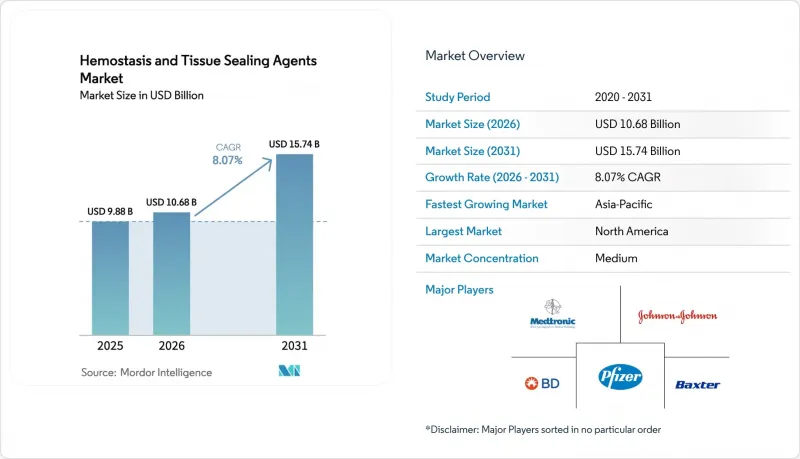
Mordor Intelligence에 의하면, 지혈제 및 조직 봉합제 시장 규모는 2025년 98억 8,000만 달러로 평가되었고, 2026년에는 106억 8,000만 달러로 추정되고, 2026-2031년 CAGR 8.07%로 성장을 지속할 전망이며, 2031년에는 157억 4,000만 달러에 이를 것으로 예측됩니다.
본 보고서는 제품 유형별(국소용 지혈제(기계식 지혈제 등), 조직 봉합제, 접착제), 소재별(젤라틴계, 콜라겐계 등), 용도별(일반외과, 저침습 수술 등), 최종 사용자별(병원 등), 지역별(북미, 유럽 등)로 분류되어 있습니다. 시장 예측은 금액(달러) 기준으로 제시되어 있습니다.
세계의 지혈제 및 조직 봉합제 시장 동향과 인사이트
만성 혈액 질환 유병률 증가
A형 혈우병은 전 세계적으로 남성 10만 명당 17.1명이 앓고 있고, 2024년에는 진단받은 혈우병 환자 수가 27만 3,000명을 넘어섰으며, 수십만 명은 아직 진단받지 못한 상태입니다. 환자 1인당 연간 직접 의료비는 86만 9,940달러를 초과하기도 하여, 이에 따라 병원들은 수술 시간을 단축하고 출혈량을 줄일 수 있는 첨단 실런트의 도입을 촉진하고 있습니다. 폰 빌레브란트병은 인구통계학적 그룹별로 수술 전후 출혈 위험이 다르기 때문에 수요의 다양성을 더욱 높이고 있습니다. 현재 B형 혈우병 분야에서 상용화가 진행 중인 유전자 치료 프로토콜의 경우, 카테터를 이용한 간 주입이 필요한 경우가 많아 수술의 복잡성이 증가하고, 정밀한 출혈 제어의 필요성이 높아지고 있습니다. 이러한 환자 집단의 총체가 지혈 및 조직 실런트 시장의 장기적인 시장 규모 확대를 확실하게 하고 있습니다.
외과 수술 건수 및 외상 사례 증가
관통성 복부 외상은 외상으로 인한 입원 환자의 24%를 차지하며, 군과 민간을 불문하고 신속한 지혈이 생존의 결정적 요인이 되고 있습니다. 연구 결과에 따르면, 병원 이송 전 트라넥사믹산 투여를 통해 외상 환자의 24시간 사망률을 19.6% 낮출 수 있는 것으로 나타났으며, 전신 요법을 보완하는 국소용 또는 유동성 실런트의 수술 전 사용 확대가 지지되고 있습니다. 외상 외에도 팬데믹 기간 동안 누적된 전 세계적인 수술 지연이 지속적으로 해소되고 있으며, 이에 따라 선택적 정형외과 및 심혈관 수술 건수가 증가하여 지혈제 및 조직 봉합제 시장에 대한 꾸준한 수요를 뒷받침하고 있습니다.
높은 제품 가격
고급 실란트는 1단위당 350달러를 초과하기도 하여, 보험 지급액이 정체된 반면 인건비와 자재비가 상승하고 있는 의료기관에게는 부담이 되고 있습니다. 병원 측에서는 높은 구매 가격과 수혈 및 재입원 감소 간의 연관성을 보여주는 의료경제학적 자료 제출을 요구하는 목소리가 늘고 있습니다. 신흥 바이오시밀러와 합성 대체품으로 인해 가격 차이는 줄어들기 시작했지만, 저소득 지역의 약제 선정 위원회에서는 여전히 산화 셀룰로오스 거즈가 선택되고 있어, 지혈·조직 봉합제 시장의 일부에서 도입을 억제하는 요인이 되고 있습니다.
부문 분석
외용 지혈제는 외과의사들이 수십 년간 익숙해져 온 점과 폭넓은 수술 적응증 덕분에 2025년에는 지혈제 및 조직 봉합제 시장의 42.78% 점유율을 차지했습니다. 이러한 제품들은 신속한 기계적 압박 지혈로 충분한 경우가 많은 정형외과나 일반외과 분야에서 여전히 대표적인 제품으로 자리 잡고 있습니다. 그러나 이 부문의 제제는 성숙기에 접어들어 상품화(commoditization)에 직면함에 따라 성장 속도가 둔화되고 있습니다. 대조적으로, 조직 봉합제는 출혈을 멈추는 동시에 조직 표면을 접착하는 이중 기능을 갖추고 있어 봉합 시간을 단축할 수 있기 때문에 연평균 성장률(CAGR) 9.98%로 확대될 것으로 예측됩니다. 유동성 피브린 실란트는 4분 이내에 92.4%의 지혈 효과를 발휘하는 반면, 합성 폴리에틸렌글리콜계 접착제는 혈류가 심한 부위에서도 씻겨 나가기 어렵기 때문에 적응증이 심혈관 복원 분야까지 확대되고 있습니다. ‘헤모패치’ 등의 제품은 상온 보관이 가능하여 물류상의 장벽이 해소됨에 따라 지방이나 군에서 채택이 확대되고 있습니다.
대량으로 사용되는 외상용 키트에서는 여전히 기계식 스폰지가 주류를 이루고 있지만, 생체공학 기반의 실란트에는 현재 감염 위험을 줄이기 위한 항균제가 배합되어 있어 그 가치 제안이 높아지고 있습니다. 조달 부서가 이러한 실란트를 스테이플러나 에너지 기기와 세트로 조달함으로써 크로스셀링의 시너지가 발생하고, 지혈제 및 조직 봉합제 시장이 그 혜택을 보고 있습니다. 앞으로 혈액과 접촉하면 중합되는 식물 유래 겔은 즉효성과 폐기 용이성을 겸비하고 있어, 응급 대응 키트 내의 선반 공간을 확보할 것으로 예측됩니다. 이러한 동향이 보다 광범위한 지혈·조직 봉합제 시장에서 조직 봉합제의 지속적인 두 자릿수 성장을 뒷받침하고 있습니다.
콜라겐 제제는 장기적인 안전성 실적과 자연스러운 흡수 특성을 강점으로 삼아 2025년 매출의 36.10%를 차지했습니다. 외과의사들은 불규칙한 표면의 패치 처리가 가능한 그 유연성을 높이 평가했습니다. 젤라틴 폼은 일상적인 사례에서 저비용 대체재가 되지만, 부피가 수 배로 팽창하기 때문에 해부학적 공간이 제한된 곳에서의 사용에는 제약이 있습니다. 산화 재생 셀룰로오스(ORC)는 산성 pH가 정균 작용에 기여하는 틈새 요구 사항을 충족합니다.
현재 다당류 기반 플랫폼이 12.41%라는 가장 높은 연평균 성장률(CAGR)을 기록하고 있으며, 이러한 추세는 59.4 g/g의 혈액을 흡수하고 30초 만에 돼지의 상처를 밀봉하는 알데히드 변형 리크린 스폰지와 같은 획기적인 기술에 의해 주도되고 있습니다. 반월판 복구를 위해 평가가 진행 중인 키토산 유래 접착 필름은 정형외과 및 스포츠 의학 분야에서 소재의 다용도성을 보여주고 있습니다. 성능 측면뿐만 아니라, 이러한 생물 유래 원료는 혈장 공급의 변동을 피할 수 있어 병원의 지속가능성 목표에도 부합합니다. 그 결과, 다당류는 지혈 및 조직 봉합제 시장에서 꾸준히 입지를 넓혀가고 있으며, 특히 문화적 및 규제적 이유로 식물 유래 소모품을 선호하는 아시아태평양의 의료 시스템에서 두드러지게 나타나고 있습니다.
지역별 분석
북미는 2025년 지혈 및 조직 봉합제 시장 매출의 39.55%를 차지했습니다. 이 지역은 많은 수술 건수, 충실한 보험 환급 제도, 그리고 적극적인 규제 환경의 혜택을 받고 있습니다. 사지 외상을 위한 최초의 무세포 조직 공학 혈관이 FDA 승인을 획득한 것은 FDA가 혁신을 지원하고 있음을 보여 주며, 현지 개발 기업들에게 홈그라운드에서의 우위를 가져다주고 있습니다. 혈장 부족으로 인해 수입 원자재에 대한 의존도가 부각됨에 따라, 피브리노겐 정제를 위한 국내 시설에 대한 투자가 촉진되고 있으며, 공급망의 회복탄력성은 여전히 최우선 과제입니다.
아시아태평양은 병원 인프라 확충과 의료 관광에 힘입어 9.38%라는 최고 수준의 연평균 성장률(CAGR)을 기록하고 있습니다. 인도의 병원 시장은 2032년까지 1930억 달러에 달할 것으로 예상되며, 이는 2024년 수준보다 2배 이상 증가한 수치입니다. 이러한 인프라 확충은 소모품 수요를 직접적으로 끌어올리고 있습니다. 중국에서는 조달 개혁으로 인해 가격 측면의 압박이 커지고 있어, 각 공급업체들은 고가의 실란트 채택을 정당화하기 위해 수혈률 감소나 입원 일수 단축과 같은 실증 데이터를 강조하고 있습니다. 일본, 한국, 싱가포르에서는 로봇 수술실 및 하이브리드 수술실 도입이 계속해서 선도적으로 진행되고 있으며, 이는 당연히 첨단 출혈 관리 도구에 의존하고 있어 지혈제 및 조직 봉합제 시장의 추가 성장을 뒷받침하고 있습니다.
유럽에서는 MDR(의료기기 규정) 준수 비용과 원자재 제약으로 인해 시장 점유율은 여전히 크지만 성장 속도는 둔화되고 있습니다. 이 대륙에서는 미국산 공급에 대한 의존도를 낮추기 위해 200만 명의 신규 혈장 기증자 확보를 추진하고 있습니다. 또한, 지속가능성에 관한 규제도 생분해성 패치 수요를 뒷받침하고 있으며, 유럽의 폴리머 연구센터에 혁신 측면에서의 우위를 가져다주고 있습니다. 한편, 치료 성과를 평가하는 보험 급여 제도는 궁극적으로 재수술률 감소를 입증할 수 있는 고성능 실런트를 우대하게 되어, 전 세계 지혈·조직 봉합제 시장에 꾸준한 기여를 뒷받침할 것입니다.
기타 혜택 :
- 엑셀 형식 시장 예측(ME) 시트
- 3개월간의 애널리스트 지원
자주 묻는 질문
목차
제1장 서론
제2장 조사 방법
제3장 개요
제4장 시장 구도
제5장 시장 규모 및 성장 예측
제6장 경쟁 구도
제7장 시장 기회 및 향후 전망
AJY 26.09.01According to Mordor Intelligence, the hemostasis & tissue sealing agents market size is expected to grow from USD 9.88 billion in 2025 to USD 10.68 billion in 2026 and is forecast to reach USD 15.74 billion by 2031 at 8.07% CAGR over 2026-2031.
This report is Segmented by Product Type (Topical Hemostats [Mechanical Hemostats, and More], Tissue Sealing Agents, and Adhesives), Material (Gelatin Based, Collagen-Based, and More), Application (General Surgery, Minimally Invasive Surgery, and More), End-User (Hospitals, and More), and Geography (North America, Europe and More). The Market Forecasts are Provided in Terms of Value (USD).
Global Hemostasis And Tissue Sealing Agents Market Trends and Insights
Increasing Prevalence of Chronic Blood Disorders
Hemophilia A affects 17.1 per 100,000 males worldwide, and the total diagnosed hemophilia population surpassed 273,000 in 2024, leaving hundreds of thousands more undiagnosed. Annual direct care costs for a single patient can rise beyond USD 869,940, motivating hospitals to adopt advanced sealants that shorten procedures and reduce blood loss. Von Willebrand disease adds further demand diversity, as peri-operative bleeding risks differ across demographic groups. Gene-therapy protocols now reaching commercialization in hemophilia B often require catheter-based liver infusion, increasing surgical complexity and the need for precision bleeding control. Collectively, these patient pools ensure long-term volume growth for the hemostasis & tissue sealing agents market.
Rising Number of Surgical Procedures & Trauma Cases
Penetrating abdominal trauma represents 24% of trauma admissions, making rapid hemostasis a determinant of survival in both military and civilian settings. Evidence shows that pre-hospital tranexamic acid can cut 24-hour mortality by 19.6% in trauma victims, supporting broader pre-operative use of topical or flowable sealants that augment systemic therapies. Beyond trauma, the global surgical backlog created during the pandemic continues to unwind, lifting elective orthopedic and cardiovascular procedure counts and bolstering steady demand for the hemostasis & tissue sealing agents market.
High Product Cost
Premium sealants can exceed USD 350 per unit, a burden for facilities where reimbursements trend flat while labor and supply costs climb. Hospitals increasingly request health-economic dossiers that link higher acquisition prices to reductions in transfusions or readmissions. Emerging biosimilars and synthetic alternatives are beginning to narrow price gaps, yet formulary committees in lower-income regions still opt for oxidized cellulose gauze, tempering adoption in part of the hemostasis & tissue sealing agents market.
Other drivers and restraints analyzed in the detailed report include:
- Broader Applicability Across Multiple Specialties
- Growing Adoption of Minimally Invasive Surgery
- Stringent Regulatory & Approval Pathways
For complete list of drivers and restraints, kindly check the Table Of Contents.
Segment Analysis
Topical Hemostats captured 42.78% of the hemostasis & tissue sealing agents market share in 2025 thanks to decades of surgeon familiarity and broad procedural coverage. They remain staples in orthopedics and general surgery, where quick mechanical tamponade is often sufficient. Yet growth is slower because the segment's formulations are mature and face commoditization. Tissue Sealing Agents, by contrast, are forecast to advance at a 9.98% CAGR as they introduce dual-function capabilities that both halt bleeding and bond tissue planes, shortening suturing time. Flowable fibrin sealants deliver 92.4% hemostasis within 4 minutes, while synthetic polyethylene glycol glues resist washout in high-flow fields, extending indications to cardiovascular repairs. Room-temperature storage in products such as Hemopatch removes logistical barriers, widening rural and military adoption.
Mechanical sponges still dominate high-volume trauma kits, yet bio-engineered sealants now integrate antibacterial agents to lower infection risk, lifting their value proposition. The hemostasis & tissue sealing agents market benefits as procurement teams bundle these sealants with staplers and energy devices, creating cross-selling momentum. Looking forward, plant-based gels that polymerize on contact with blood are expected to win shelf space in emergency response bags because they combine rapid action with easy disposal. These dynamics underpin the sustained double-digit expansion of tissue sealing agents within the broader hemostasis & tissue sealing agents market.
Collagen formulations commanded 36.10% of 2025 revenue on the strength of long-term safety records and natural resorption profiles. Surgeons appreciate their pliability, which allows patching of irregular surfaces. Gelatin foams provide lower-cost alternatives for routine cases, but they swell several times their volume, limiting use in constrained anatomy. Oxidized regenerated cellulose (ORC) fills niche requirements where acidic pH helps with bacteriostasis.
Polysaccharide-based platforms now record the fastest 12.41% CAGR, a trend driven by breakthroughs such as aldehyde-modified riclin sponges that absorb 59.4 g/g of blood and seal porcine wounds in 30 seconds. Chitosan-derived adhesive films under evaluation for meniscus repair illustrate material versatility across orthopedic sports medicine. Beyond performance, these bio-sourced inputs sidestep plasma-supply volatility and align with hospital sustainability targets. As a result, polysaccharides are steadily expanding their foothold in the hemostasis & tissue sealing agents market, particularly within Asia-Pacific systems that prefer plant-origin consumables for cultural and regulatory reasons.
Complete Report Scope:
- By Product Type
- Topical Hemostats
- Mechanical Hemostats
- Active Hemostats
- Flowable Hemostats
- Tissue Sealing Agents
- Fibrin Sealants
- Synthetic Sealants
- Adhesives
- Cyanoacrylate
- Albumin & Glutaraldehyde
- Topical Hemostats
- By Material
- Gelatin-based
- Collagen-based
- ORC-based
- Polysaccharide-based
- By Application
- General Surgery
- Minimally-Invasive Surgery
- Trauma
- Hemophilia
- Other Applications
- By End-User
- Hospitals
- Ambulatory Surgical Centers
- Other End-Users
- Geography
- North America
- United States
- Canada
- Mexico
- Europe
- Germany
- United Kingdom
- France
- Italy
- Spain
- Rest of Europe
- Asia-Pacific
- China
- Japan
- India
- South Korea
- Australia
- Rest of Asia-Pacific
- Middle East and Africa
- GCC
- South Africa
- Rest of Middle East and Africa
- South America
- Brazil
- Argentina
- Rest of South America
- North America
Geography Analysis
North America captured 39.55% of 2025 revenue for the hemostasis & tissue sealing agents market. The region benefits from high procedural intensity, robust reimbursement, and a proactive regulatory environment. FDA clearance of the first acellular tissue-engineered vessel for extremity trauma underscores the agency's support for innovation, giving local developers a home-field advantage. Supply chain resilience remains top of mind after plasma shortages highlighted reliance on imported raw materials, prompting investments in domestic facilities for fibrinogen purification.
Asia-Pacific delivers the highest 9.38% CAGR, driven by expanding hospital infrastructure and medical tourism. India's hospital market is forecast to reach USD 193 billion by 2032, more than doubling 2024 levels, and this infrastructure build-out directly boosts consumable requirements. In China, procurement reforms are pressuring price points, so vendors emphasize evidence of reduced transfusion rates and shorter stays to justify premium sealants. Japan, South Korea, and Singapore continue to pioneer robotic and hybrid OR installations that naturally rely on advanced bleeding management tools, feeding further growth in the hemostasis & tissue sealing agents market.
Europe sustains a substantial but slower-growing share amid MDR compliance costs and raw-material constraints. The continent's push for 2 million new plasma donors aims to lower dependence on US supply. Sustainability mandates also spur demand for biodegradable patches, giving European polymer research centers an innovation edge. Meanwhile, reimbursement systems that reward outcomes should eventually favor higher-performance sealants able to document reductions in re-operation rates, supporting a steady contribution to the global hemostasis & tissue sealing agents market.
- Baxter
- B. Braun Holding GmbH & Co. KG
- Beckton Dickinson
- Integra LifeSciences Corp.
- Johnson & Johnson
- Medtronic
- Pfizer
- Smiths Group
- Terumo Corp.
- CSL Behring
- Grifols
- Artivion (CryoLife)
- Teleflex
- Adhezion Biomedical
- Hemostasis
- Arch Therapeutics
- Marine Polymer Technologies
- Betatech Medical
- Aegis LifeSciences
Additional Benefits:
- The market estimate (ME) sheet in Excel format
- 3 months of analyst support
TABLE OF CONTENTS
1 Introduction
- 1.1 Study Assumptions & Market Definition
- 1.2 Scope of the Study
2 Research Methodology
3 Executive Summary
4 Market Landscape
- 4.1 Market Overview
- 4.2 Market Drivers
- 4.2.1 Increasing Prevalence Of Chronic Blood Disorders
- 4.2.2 Rising Number Of Surgical Procedures & Trauma Cases
- 4.2.3 Broader Applicability Across Multiple Specialties
- 4.2.4 Growing Adoption Of Minimally-Invasive Surgery
- 4.2.5 Outpatient ASC Boom Boosting Single-Use Flowables
- 4.2.6 Fast-Track FDA Approvals For Bio-Engineered Plant Agents
- 4.3 Market Restraints
- 4.3.1 High Product Cost
- 4.3.2 Stringent Regulatory & Approval Pathways
- 4.3.3 Plasma-Derived Fibrinogen Supply Constraints
- 4.3.4 Eco-Disposal Concerns For Synthetic Adhesives
- 4.4 Porter's Five Forces
- 4.4.1 Threat of New Entrants
- 4.4.2 Bargaining Power of Buyers/Consumers
- 4.4.3 Bargaining Power of Suppliers
- 4.4.4 Threat of Substitute Products
- 4.4.5 Intensity of Competitive Rivalry
5 Market Size & Growth Forecasts (Value, USD)
- 5.1 By Product Type
- 5.1.1 Topical Hemostats
- 5.1.1.1 Mechanical Hemostats
- 5.1.1.2 Active Hemostats
- 5.1.1.3 Flowable Hemostats
- 5.1.2 Tissue Sealing Agents
- 5.1.2.1 Fibrin Sealants
- 5.1.2.2 Synthetic Sealants
- 5.1.3 Adhesives
- 5.1.3.1 Cyanoacrylate
- 5.1.3.2 Albumin & Glutaraldehyde
- 5.1.1 Topical Hemostats
- 5.2 By Material
- 5.2.1 Gelatin-based
- 5.2.2 Collagen-based
- 5.2.3 ORC-based
- 5.2.4 Polysaccharide-based
- 5.3 By Application
- 5.3.1 General Surgery
- 5.3.2 Minimally-Invasive Surgery
- 5.3.3 Trauma
- 5.3.4 Hemophilia
- 5.3.5 Other Applications
- 5.4 By End-User
- 5.4.1 Hospitals
- 5.4.2 Ambulatory Surgical Centers
- 5.4.3 Other End-Users
- 5.5 Geography
- 5.5.1 North America
- 5.5.1.1 United States
- 5.5.1.2 Canada
- 5.5.1.3 Mexico
- 5.5.2 Europe
- 5.5.2.1 Germany
- 5.5.2.2 United Kingdom
- 5.5.2.3 France
- 5.5.2.4 Italy
- 5.5.2.5 Spain
- 5.5.2.6 Rest of Europe
- 5.5.3 Asia-Pacific
- 5.5.3.1 China
- 5.5.3.2 Japan
- 5.5.3.3 India
- 5.5.3.4 South Korea
- 5.5.3.5 Australia
- 5.5.3.6 Rest of Asia-Pacific
- 5.5.4 Middle East and Africa
- 5.5.4.1 GCC
- 5.5.4.2 South Africa
- 5.5.4.3 Rest of Middle East and Africa
- 5.5.5 South America
- 5.5.5.1 Brazil
- 5.5.5.2 Argentina
- 5.5.5.3 Rest of South America
- 5.5.1 North America
6 Competitive Landscape
- 6.1 Market Concentration
- 6.2 Market Share Analysis
- 6.3 Company Profiles (includes Global level Overview, Market level overview, Core Segments, Financials as available, Strategic Information, Market Rank/Share for key companies, Products & Services, and Recent Developments)
- 6.3.1 Baxter International Inc.
- 6.3.2 B. Braun Holding GmbH & Co. KG
- 6.3.3 Becton, Dickinson & Company
- 6.3.4 Integra LifeSciences Corp.
- 6.3.5 Johnson & Johnson
- 6.3.6 Medtronic plc
- 6.3.7 Pfizer Inc.
- 6.3.8 Smith & Nephew plc
- 6.3.9 Terumo Corp.
- 6.3.10 CSL Behring
- 6.3.11 Grifols S.A.
- 6.3.12 Artivion (CryoLife)
- 6.3.13 Teleflex Inc.
- 6.3.14 Adhezion Biomedical
- 6.3.15 Hemostasis LLC
- 6.3.16 Arch Therapeutics
- 6.3.17 Marine Polymer Technologies
- 6.3.18 Betatech Medical
- 6.3.19 Aegis LifeSciences
7 Market Opportunities & Future Outlook
- 7.1 White-space & Unmet-Need Assessment


