|
시장보고서
상품코드
2117208
아프리카의 건설용 화학제품 시장 : 시장 점유율 분석, 업계 동향 및 통계, 성장 예측(2026-2031년)Africa Construction Chemicals - Market Share Analysis, Industry Trends & Statistics, Growth Forecasts (2026 - 2031) |
||||||
 Mordor Intelligence
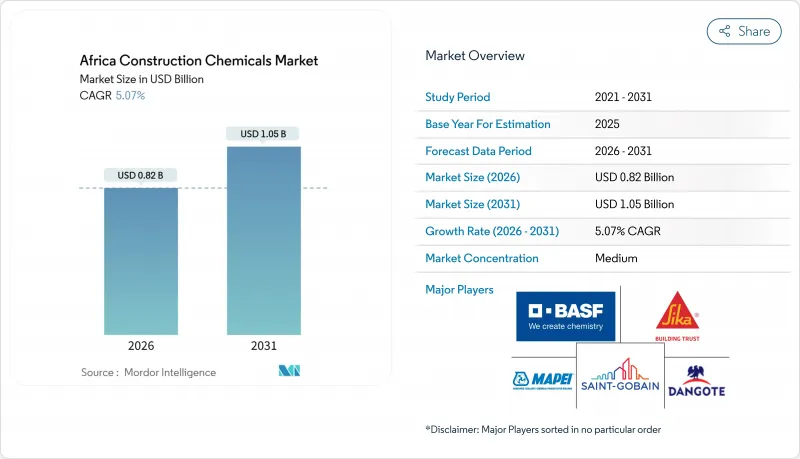
Mordor Intelligence에 의하면, 아프리카의 건설용 화학제품 시장 규모는 2026년에 8억 2,000만 달러로 추정되고, 예측 기간(2026-2031년) CAGR 5.07%로 성장을 지속할 전망이며, 2031년까지 10억 5,000만 달러에 이를 전망입니다.
본 보고서는 제품 유형별(접착제, 앵커 및 그라우트, 콘크리트 혼화제, 콘크리트 보호 코팅, 바닥용 수지, 실란트 등), 최종 사용자 산업별(인프라 및 유틸리티, 상업, 산업, 주택), 지역별(남아프리카, 이집트, 나이지리아, 모로코 및 기타 아프리카 국가)로 분류되어 있습니다. 시장 전망은 금액(달러) 기준으로 제시되어 있습니다.
아프리카의 건설용 화학제품 시장 동향 및 인사이트
인프라 및 메가 프로젝트 파이프라인 확대
이집트는 2025년에 인프라 구축에 180억 달러를 투자하기로 결정했으며, 새로운 행정 수도만 해도 2030년까지 4,500만 m³의 콘크리트가 필요할 것으로 예측됩니다. 나이지리아에서도 유사한 추세가 나타나고 있으며, 당고트 정유시설에서는 콘크리트를 탄화수소로부터 보호하기 위해 특수 모르타르와 코팅재가 사용되어 산업 시설을 위한 새로운 조달 기준이 설정되었습니다. 아프리카개발은행의 융자를 통해 진행되는 모로코 마라케시 고속철도 연장 프로젝트에서는 슬래브의 균열을 억제하기 위한 저수축성 혼화제가 요구되고 있어, 기술적 진입 장벽이 높아지고 있습니다. 케냐의 람 항구·남수단·에티오피아 회랑 프로젝트에서는 ISO 9001 인증을 취득한 화학약품 공급업체가 요구되고 있으며, 이는 최저 비용이 아닌 수명 주기 가치가 중시되는 경향이 강해지고 있음을 보여줍니다. 건설업체들은 우기 전에 방수막이나 그라우트를 재고로 확보하는 경향이 있으며, 이로 인해 리드타임이 단축되어 국내에 창고를 보유한 판매업체에게는 이점이 되고 있습니다. 이러한 메가 프로젝트들은 전반적으로, 주목도가 높은 인프라 프로젝트의 고품질 사양을 일반 주택 및 상업 프로젝트로 확산시킴으로써 아프리카의 건설용 화학제품 시장을 확대되고 있습니다.
저렴한 주택 정책의 도입과 도시의 고밀도화
남아프리카공화국의 ‘Breaking New Ground’ 프로그램은 2025년에 12만 호의 보조 주택을 공급했습니다. 각 주택에는 국가 주택 건설업자 등록 위원회가 의무화한 50년 내구성 목표를 충족하는 폴리머 개질 모르타르가 사용되었습니다. 이집트의 ‘사회주택 이니셔티브’는 2030년까지 100만 호 공급을 목표로 하고 있으며, 현장에서의 혼합 오류를 방지하기 위해 미리 혼합된 타일용 접착제를 지정함으로써 인증 공급업체에 대한 발주량을 집중시키고 있습니다. 나이지리아의 ‘국가 주택 기금’은 자금 부족에도 불구하고, 라고스와 아부자의 민간 개발업자들에게 인도 일정을 앞당길 수 있는 셀프 레벨링 바닥재의 채택을 촉진하고 있습니다. 아크라와 나이로비에서는 현재 수직적인 도시 고밀도화가 진행되고 있으며, 단층의 무분별한 확산형 개발에 비해 프로젝트당 앵커 시스템 및 파사드용 실란트의 소비량이 증가하고 있습니다. 수년에 걸친 예측 가능한 수요 덕분에 화학 제조업체들은 성장 회랑 근처에 혼합 공장을 설치할 수 있게 되어, 운송 비용을 절감하고 환율 변동 위험을 헤지할 수 있습니다. 따라서 아프리카의 건설용 화학제품 시장은 더 광범위한 생산 능력에 대한 투자를 뒷받침하는 신뢰할 수 있는 주택 수요 기반을 확보하고 있습니다.
VOC 및 유해 화학물질 규제 강화
남아프리카공화국에서는 현재 ‘국가환경관리법’에 따라 실란트 및 도료 내 VOC를 50 g/L로 제한하고 있어, 이에 따라 수성 화학제품으로의 전환이 요구되고 있습니다. 다국적 기업은 시험 및 인증 비용을 전 세계적으로 분산하여 부담할 수 있지만, 지역 기업은 수익성이 나지 않는 단위 비용에 직면하여 제품 생산 중단을 피할 수 없게 되었습니다. 이집트의 ‘산업 배출 지침’은 바닥재용 수지 내 특정 프탈레이트 에스테르를 금지하고 있어, 이로 인해 상업용 부문 공급이 일시적으로 감소하고 있습니다. 나이지리아도 유사한 규정을 마련 중이지만, 집행 미비로 인해 규제 준수 수준이 낮은 수입품이 프리미엄 제품과 혼재되어 건설업자의 신뢰를 훼손하고 있습니다. 규제가 EU 기준에 가까워짐에 따라, 배합 변경 능력이 없는 기업은 제3자 인증을 의무화하는 기부금 기반 인프라 프로젝트에서 배제될 위험이 있습니다. 이러한 규정 준수 압박이 아프리카 건설용 화학제품 시장의 성장률을 끌어내리고 있습니다.
부문 분석
콘크리트 혼화제는 아프리카 대륙 전역의 레디믹스 콘크리트 제조업체에게 여전히 표준 원자재로 사용되고 있어, 2025년에는 아프리카 건설용 화학제품 시장 점유율의 24.78%를 차지했습니다. 한편, 방수 솔루션은 2031년까지 연평균 성장률(CAGR) 5.72%로 확대되고 있으며, 이는 라고스나 케이프타운과 같이 홍수 피해를 입기 쉬운 도시에서 기후 변화에 대한 내성을 강화하려는 전환을 반영합니다. 카이로 지하철 터널을 포함한 대규모 인프라 프로젝트에서는 현재 SikaProof와 같은 통합형 막 시스템이 지정되고 있습니다. 이는 타설 시 방습층을 매립하여 콘크리트 1세제곱미터당 화학물질 사용량을 증가시키는 방식입니다. 또한 미세한 균열을 자가 치유하는 결정성 혼화제에 대한 수요가 증가하고 있는 점도 표면 코팅에서 내부 방수로의 전환을 뒷받침하고 있습니다.
1970년대부터 1990년대에 걸쳐 건설된 교량과 수처리 시설이 교체 주기를 맞이함에 따라, 보수 및 개보수용 제품에 대한 수요가 증가하고 있습니다. 남아프리카공화국에서 200억 ZAR 규모의 미처리 교량 유지관리 사업은 자산 수명을 15년 연장하는 폴리머 개질 모르타르의 채택을 가속화하고 있습니다. 하이퍼스케일러에 의한 데이터센터 건설은 정전기 소산성 바닥용 수지 수요를 뒷받침하고 있습니다. 이 틈새 시장은 세계 기업이나 지역 기업 어느 쪽도 지배하지 못하고 있어, 아프리카 건설용 화학제품 시장에서 미개척 영역을 창출하고 있습니다. 한편, VOC(휘발성 유기 화합물) 규제로 인해 용제형 보호 도료가 난관에 직면해 있습니다. 시공업체들은 동등한 내구성 데이터가 없는 한 수성 도료로의 완전한 전환에 소극적이며, 이로 인해 대체 주기가 지연되고 있습니다.
기타 혜택 :
- 엑셀 형식 시장 예측(ME) 시트
- 3개월간의 애널리스트 지원
자주 묻는 질문
목차
제1장 서론
제2장 조사 방법
제3장 개요
제4장 시장 구도
제5장 시장 규모 및 성장 예측
제6장 경쟁 구도
제7장 시장 기회 및 향후 전망
AJY 26.09.01According to Mordor Intelligence, the Africa construction chemicals market size is estimated at USD 0.82 billion in 2026, and is expected to reach USD 1.05 billion by 2031, at a CAGR of 5.07% during the forecast period (2026-2031).
This report is Segmented by Product Type (Adhesives, Anchors and Grouts, Concrete Admixtures, Concrete Protective Coatings, Flooring Resins, Sealants, and More), End-User Industry (Infrastructure and Public Works, Commercial, Industrial, and Residential), and Geography (South Africa, Egypt, Nigeria, Morocco, and the Rest of Africa). The Market Forecasts are Provided in Terms of Value (USD).
Africa Construction Chemicals Market Trends and Insights
Infrastructure Megaproject Pipeline Expansion
Egypt committed USD 18 billion to infrastructure in 2025, with its New Administrative Capital alone requiring 45 million m3 of concrete through 2030. Similar momentum is visible in Nigeria, where the Dangote Refinery consumed specialty mortars and coatings to protect concrete from hydrocarbons and set new procurement standards for industrial facilities. Morocco's high-speed rail extension to Marrakech, financed by the African Development Bank, demands low-shrinkage admixtures to curb slab cracking, raising technical entry barriers. Kenya's Lamu Port-South Sudan-Ethiopia Corridor requires ISO 9001-certified chemical vendors, signaling a growing preference for lifecycle value rather than lowest cost. Contractors tend to stockpile membranes and grouts ahead of rainy seasons, shortening lead times and rewarding distributors with in-country warehousing. Collectively, these megaprojects enlarge the Africa construction chemicals market by channeling premium specifications from marquee infrastructure into mainstream residential and commercial projects.
Affordable-Housing Policy Roll-Outs and Urban Densification
South Africa's Breaking New Ground program delivered 120,000 subsidized units in 2025, each using polymer-modified mortars that satisfy 50-year durability targets mandated by the National Home Builders Registration Council. Egypt's Social Housing Initiative seeks 1 million units by 2030 and specifies pre-blended tile adhesives to avoid on-site mixing errors, consolidating volume among accredited suppliers. Nigeria's National Housing Fund, despite funding gaps, stimulates private developers in Lagos and Abuja to adopt self-leveling floors that accelerate handover schedules. Accra and Nairobi now pursue vertical densification that consumes more anchoring systems and facade sealants per project than single-level sprawl. Predictable multi-year demand allows chemical producers to site blending plants nearer to growth corridors, cutting freight costs and hedging currency swings. The Africa construction chemicals market, therefore, gains a reliable residential volume base that underpins broader capacity investments.
Tightening VOC and Hazardous-Chemicals Limits
South Africa now caps VOCs in sealants and coatings at 50 g/L under the National Environmental Management Act, forcing a pivot to water-borne chemistries. Multinationals amortize testing and certification globally, but regionals face unworkable unit costs, prompting product discontinuation. Egypt's Industrial Emissions Directive bans select phthalates in flooring resins, temporarily cutting supply in the commercial segment. Nigeria drafts similar rules, yet enforcement gaps allow low-compliance imports to coexist with premium lines, eroding contractor confidence. As regulations converge toward EU standards, firms without reformulation capacity risk exclusion from donor-funded infrastructure that mandates third-party certification. This compliance squeeze subtracts growth points from the Africa construction chemicals market.
Other drivers and restraints analyzed in the detailed report include:
- Demand for High-Strength, Energy-Efficient Structures
- Green-Cement Tax Incentives and Embodied-Carbon Regulation
- Import-Dependent Raw-Material Price Volatility
For complete list of drivers and restraints, kindly check the Table Of Contents.
Segment Analysis
Concrete admixtures captured 24.78% of Africa construction chemicals market share in 2025 because they remain standard inputs for ready-mix producers across the continent. Yet waterproofing solutions are expanding at a 5.72% CAGR through 2031, reflecting a pivot toward climate resilience in flood-prone cities such as Lagos and Cape Town. Large infrastructure projects, including the Cairo Metro tunnels, now specify integrated membrane systems like SikaProof, which embed moisture barriers during casting and elevate chemical intensity per cubic meter of concrete. Growing preference for crystalline admixtures that self-seal micro-cracks also pushes substitution away from surface coatings toward internal waterproofing.
Repair and rehabilitation products gain momentum as bridges and water plants built during the 1970s-1990s reach renewal cycles. South Africa's ZAR 20 billion bridge maintenance backlog accelerates uptake of polymer-modified mortars that extend asset life by 15 years. Data-center construction by hyperscalers fuels demand for electrostatic-dissipative flooring resins, a niche that neither global nor regional players dominate, creating whitespace within the Africa construction chemicals market. Meanwhile, VOC limits challenge solvent-borne protective coatings; contractors remain hesitant to transition fully to water-borne alternatives without equivalent durability data, slowing the replacement cycle.
Complete Report Scope:
- By Product Type
- Adhesives
- Anchors and Grouts
- Concrete Admixtures
- Concrete Protective Coatings
- Flooring Resins
- Repair and Rehabilitation Chemicals
- Sealants
- Surface Treatment Chemicals
- Waterproofing Solutions
- By End-user Industry
- Infrastructure and Public Works
- Commercial
- Industrial
- Residential
- By Geography
- South Africa
- Egypt
- Nigeria
- Morocco
- Rest of Africa
List of Companies Covered in this Report:
- BASF
- AfriSam
- Arkema
- CMB
- Conmix
- Dangote Industries Limited
- Dow
- EAMIC
- Portland Cement Plc
- Hemts
- Lafarge
- Mapei
- PPC Ltd
- RowChem Industries Ltd
- Saint-Gobain
- Sika AG
- SOCHEM
Additional Benefits:
- The market estimate (ME) sheet in Excel format
- 3 months of analyst support
TABLE OF CONTENTS
1 Introduction
- 1.1 Study Assumptions and Market Definition
- 1.2 Scope of the Study
2 Research Methodology
3 Executive Summary
4 Market Landscape
- 4.1 Market Overview
- 4.2 Market Drivers
- 4.2.1 Infrastructure megaproject pipeline expansion
- 4.2.2 Affordable-housing policy roll-outs and urban densification
- 4.2.3 Demand for high-strength, energy-efficient structures
- 4.2.4 Green-cement tax incentives and embodied-carbon regulation
- 4.2.5 Valorisation of mining tailings into supplementary cementitious materials
- 4.3 Market Restraints
- 4.3.1 Tightening VOC and hazardous-chemicals limits
- 4.3.2 Import-dependent raw-material price volatility
- 4.3.3 Counterfeit / sub-spec products eroding contractor confidence
- 4.4 Value Chain Analysis
- 4.5 Porter's Five Forces
- 4.5.1 Bargaining Power of Suppliers
- 4.5.2 Bargaining Power of Buyers
- 4.5.3 Threat of New Entrants
- 4.5.4 Threat of Substitutes
- 4.5.5 Competitive Rivalry
5 Market Size and Growth Forecasts (Value)
- 5.1 By Product Type
- 5.1.1 Adhesives
- 5.1.2 Anchors and Grouts
- 5.1.3 Concrete Admixtures
- 5.1.4 Concrete Protective Coatings
- 5.1.5 Flooring Resins
- 5.1.6 Repair and Rehabilitation Chemicals
- 5.1.7 Sealants
- 5.1.8 Surface Treatment Chemicals
- 5.1.9 Waterproofing Solutions
- 5.2 By End-user Industry
- 5.2.1 Infrastructure and Public Works
- 5.2.2 Commercial
- 5.2.3 Industrial
- 5.2.4 Residential
- 5.3 By Geography
- 5.3.1 South Africa
- 5.3.2 Egypt
- 5.3.3 Nigeria
- 5.3.4 Morocco
- 5.3.5 Rest of Africa
6 Competitive Landscape
- 6.1 Market Concentration
- 6.2 Strategic Moves
- 6.3 Market Share(%)/Ranking Analysis
- 6.4 Company Profiles (includes Global level Overview, Market level overview, Core Segments, Financials as available, Strategic Information, Market Rank/Share for key companies, Products and Services, and Recent Developments)
- 6.4.1 BASF
- 6.4.2 AfriSam
- 6.4.3 Arkema
- 6.4.4 CMB
- 6.4.5 Conmix
- 6.4.6 Dangote Industries Limited
- 6.4.7 Dow
- 6.4.8 EAMIC
- 6.4.9 Portland Cement Plc
- 6.4.10 Hemts
- 6.4.11 Lafarge
- 6.4.12 Mapei
- 6.4.13 PPC Ltd
- 6.4.14 RowChem Industries Ltd
- 6.4.15 Saint-Gobain
- 6.4.16 Sika AG
- 6.4.17 SOCHEM
7 Market Opportunities and Future Outlook
- 7.1 White-space and Unmet-need Assessment
- 7.2 Data-centre boom to drive demand for specialty flooring and coatings