
|
시장보고서
상품코드
2117282
프랑스의 전기자동차 : 시장 점유율 분석, 업계 동향과 통계, 성장 예측(2026-2031년)France Electric Vehicles - Market Share Analysis, Industry Trends & Statistics, Growth Forecasts (2026 - 2031) |
||||||
 Mordor Intelligence
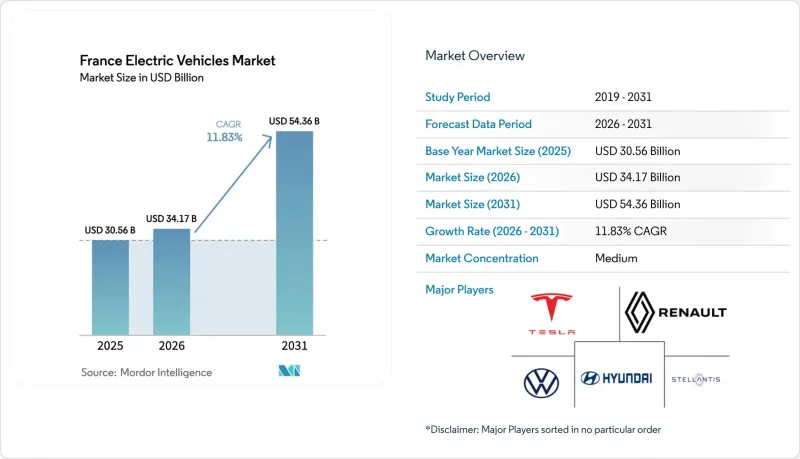
Mordor Intelligence에 따르면 프랑스의 전기자동차 시장 규모는 2025년 305억 6,000만 달러에서 2026년에는 341억 7,000만 달러로 확대되고, 2026년부터 2031년까지 CAGR 11.83%를 기록하며 2031년에는 543억 6,000만 달러에 달할 것으로 예측됩니다.
본 보고서는 구동 방식(배터리식 전기자동차, 플러그인 하이브리드 전기자동차 등), 차종(승용차 및 상용차), 충전 방식(AC 22kW 이하(일반) 등), 최종 용도(개인 소유 등), 그리고 배터리 용량(50kWh 미만 등)별로 분류되어 있습니다. 시장 규모 및 전망은 금액(달러) 및 수량(대)으로 제시되어 있습니다.
프랑스 전기자동차 시장의 동향 및 분석
넉넉한 구매 지원 및 세제 혜택
2025년, 대상 배터리식 전기자동차에 대한 정부의 환급 제도 덕분에 실질적인 초기 비용이 절감되어 등록 대수가 증가했습니다.월 100유로(117.87달러)로 설정된 소셜 리스 제도를 통해, 특히 도시 지역에서 5만 가구의 저소득층이 전기자동차를 이용할 수 있게 되었습니다. 스텔란티스(Stellantis)의 ACC 공장 및 베르코르(Verkor) 공장에서 이루어지는 현지 배터리 생산은 인센티브의 ‘원산지 요건’을 충족할 뿐만 아니라 공급망 강화에도 기여하고 있습니다. 2026년 이후에는 보조금 규모가 감소할 전망이지만, 배터리 가격 하락이 보조금 감소분을 상쇄할 것으로 예상됩니다. 이 정책 체계는 당장의 판매를 촉진할 뿐만 아니라, 장기적으로는 시장을 지속가능한 비용 경쟁력 수준으로 이끌어갈 것입니다.
전국적인 급속 충전기 확충
민관 보조금을 통해 주요 간선 도로와 직장 내 충전 인프라가 정비되어, 2025년 말까지 설치 포트 수는 약 14만 7,000개에 달할 전망입니다. 모빌라이즈(Mobilize) 및 기타 네트워크가 제공하는 초고속 DC 충전 허브는 75kWh 배터리 팩의 충전 속도를 3배로 높여 장거리 이동의 편의성을 향상시킵니다. 지역 간 격차는 여전히 존재하지만, 2030년까지 계획된 2만 5,000기의 초고속 충전 포트를 통해 대서양 연안 및 지중해 연안 고속도로를 따라 나타나는 격차는 줄어들 것으로 전망됩니다. 파리 근교의 A10번 고속도로에서 진행 중인 동적 노면 매립형 무선 충전 시범 사업은 고속도로 주행 중인 대형 트럭을 위한 솔루션의 실용성을 입증하고 있습니다. 지속적인 확충을 통해 보급률이 높은 지역에서 충전 대기 줄이 차량 대수 증가를 저해하는 상황을 방지할 것입니다.
전기자동차(EV)의 초기 구매 가격과 내연기관 차량 간의 가격 차이
배터리식 전기자동차(BEV)의 평균 소매 가격은 동급 내연기관차(ICE)에 비해 상당한 가격 프리미엄이 붙어 있었습니다. 소득 중앙값이 전국 평균보다 10% 이상 낮은 지역의 가구에게 있어 인센티브는 그 가격 차이의 일부만을 메워주고 있습니다. 2만 5,000유로(2만 9,467달러) 미만의 보급형 모델이 차지하는 비중은 제한적이며, 구매자의 대다수는 더 고가인 모델에 집중되어 있습니다. 자동차 제조사의 가격 인하는 경쟁 압력을 시사하는 한편, 이익률을 위협하는 요인이 되고 있습니다. 배터리 가격이 1kWh당 100달러 가까이 떨어지지 않는 한, 가격에 민감한 소비자, 특히 지방에 거주하는 사람들은 구매를 미루게 될 것입니다.
부문 분석
대도시권의 충전 네트워크 확충을 배경으로, 2025년에는 배터리 전기자동차(BEV)가 67.65%의 점유율을 차지했습니다. 연료전지차(FCEV)는 90억 유로의 수소 관련 자금과 2030년까지 1,000곳의 충전소 설치라는 목표에 힘입어 연평균 성장률(CAGR) 18.37%로 확대되고 있습니다. 홀단(Hordan)사의 연료전지 밴 모델은 국내에서 생산되며, 주행 거리 400km, 5분 충전이 가능해 물류 사업자에게 적합합니다. 인프라에 대한 우려가 완화됨에 따라 구매자들이 순수 전기자동차로 전환함에 따라 플러그인 하이브리드 차량의 점유율은 하락하고 있습니다.
연료전지 도입은 적재량 유지를 위해 수소 비용이 상쇄되는 대형 차량이나 가동률이 높은 차량군에 집중되고 있습니다. 승용차용 연료전지 모델은 여전히 적지만, 스택 및 탱크 공급업체의 생산능력은 성숙 단계에 접어들었습니다. 정부가 제시한 충전소 목표는 1개소당 300만-500만 유로(354만-589만 달러)의 투자를 의미하지만, 전해조 프로젝트가 잉여 재생에너지 발전과 연계된다면 어려움이 있기는 하겠지만 달성 가능합니다. 따라서 수소는 프랑스 전기자동차 시장에서 주류를 이루는 배터리 부문을 대체하기보다는 보완하는 역할을 하고 있습니다.
2025년 신규 등록 대수의 95.26%를 승용차가 차지했는데, 이는 폭넓은 차종 라인업, 배터리 가격 하락, 그리고 가정용 충전에 대한 소비자의 익숙함 등이 요인으로 작용했습니다. 대형 트럭은 2,000대라는 낮은 수준에서 출발했으나, 파리, 리옹, 마르세유의 저배출 구역을 운행하는 화물 운송 회사들이 디젤 차량의 단계적 폐지를 강요받는 가운데 연평균 성장률(CAGR) 17.03%를 기록하고 있습니다. A7번 및 A10번 고속도로 연선에 60-80킬로미터 간격으로 설치된 대용량 충전기 덕분에 충전 소요 시간이 45분으로 단축되어, 400킬로미터 주행이 가능한 전기 트럭을 이용한 단거리 운송이 상업적으로 실현 가능해졌습니다. 전기 쓰레기 수거차, 건설 차량, 배송 차량에 대한 지방자치단체의 보조금으로 인해 대상 시장은 더욱 확대되고 있습니다. 그 결과, 화물 운송의 전동화로 인해 프랑스 전기자동차 시장에서 상용차와 승용차의 수요량 간에 오랫동안 존재해 온 격차가 줄어들기 시작했습니다.
르노 ‘캉구 E-Tech’나 시트로엥 ‘e-벨링고’와 같은 소형 상용차는 오드프랑스 지역권 및 누벨아키텐 지역권의 거점에서 야간에 밴을 충전할 수 있는 장인 계층으로부터 지지를 받고 있습니다. 알스톰의 ‘Aptis’나 이베코의 ‘E-Way’ 플랫폼을 채택한 시내버스 및 시외버스는, 지자체가 무공해 대중교통 목표를 추진함에 따라 시장 점유율 0.8%에 도달했습니다. 트럭의 급속한 보급에 따라, 설비 투자 비용을 운송업체의 대차대조표에서 분리하고, 사용 종료 시 가치 회수를 보장하는 배터리 리스 모델이 주목받고 있습니다. 트럭 제조사 스카니아는 자사의 전기 트럭이 2026년 초에 상용 메가와트 충전 시스템(MCS)을 이용하기 시작할 전망이라고 밝혔습니다. 한편, 2026년에 예정된 MCS 전용 실증 실험에서는 정차 시간을 30분 미만으로 단축하는 것을 목표로 하고 있으며, 이는 본격적인 장거리 운송의 전동화로 가는 길을 열게 될 것입니다. 이러한 진전은 프랑스 전기자동차 시장의 화물 운송 부문이 크게 확대될 것임을 시사합니다.
기타 혜택:
- 엑셀 형식의 시장 예측(ME) 시트
- 3개월간의 애널리스트 지원
자주 묻는 질문
목차
제1장 소개
제2장 조사 방법
제3장 주요 요약
제4장 시장 구도
제5장 시장 규모와 성장 예측
제6장 경쟁 구도
제7장 시장 기회와 향후 전망
KSM 26.08.26According to Mordor Intelligence, the french electric vehicle market size is expected to grow from USD 30.56 billion in 2025 to USD 34.17 billion in 2026 and is forecast to reach USD 54.36 billion by 2031 at 11.83% CAGR over 2026-2031.
This report is Segmented by Propulsion Type (Battery Electric Vehicles, Plug-In Hybrid Electric Vehicles, and More), Vehicle Type (Passenger Cars and Commercial Vehicles), Charging Type (AC <= 22 KW (Normal), and More), End-Use (Private Ownership, and More) and Battery Capacity (Less Than 50 KWh and More). The Market Sizes and Forecasts are Provided in Terms of Value (USD) and Volume (Units).
France Electric Vehicles Market Trends and Insights
Robust Purchase and Tax Incentives
In 2025, government rebates for qualifying battery electric cars effectively reduced up-front costs and boosted registrations. A social-leasing initiative, set at EUR 100 (USD 117.87) monthly, enabled 50,000 low-income households to access electric vehicles, especially in urban areas. Localized cell production at Stellantis ACC and Verkor plants not only satisfies the incentive's origin stipulation but also strengthens supply chains. Although bonus amounts will decrease post-2026, falling battery prices are expected to counterbalance the diminishing subsidies. This policy framework not only propels immediate sales but also steers the market towards sustainable cost competitiveness in the long run.
Nationwide Fast-Charger Roll-Out
Public-private grants underpin corridor and workplace charging, lifting installed ports to roughly 147,000 by late 2025. Ultra-fast DC hubs from Mobilize and other networks triple charging speed for 75 kWh packs, improving convenience for long-distance travel. Regional disparities persist, yet the planned 25,000 ultra-rapid ports by 2030 will narrow gaps along the Atlantic and Mediterranean highways. Dynamic in-road wireless charging pilots on the A10 near Paris validate solutions for heavy trucks at highway speed. Sustained expansion prevents charging queues from constraining fleet growth in high-penetration zones.
Higher Up-Front EV Sticker Price vs ICE
Average battery-electric cars retailed a significant price premium over internal-combustion equivalents. Incentives close only part of the gap for households in regions where the median income trails the national average by more than 10%. Entry-level models priced below EUR 25,000 (USD 29,467) capture a limited share, leaving most buyers in higher price bands. Automaker price cuts signal competitive pressure yet threaten margins. Until battery prices fall near USD 100/kWh, price-sensitive consumers, especially in rural departments, will postpone purchases.
Other drivers and restraints analyzed in the detailed report include:
- Lithium-Ion Battery Cost Curve Compression
- Corporate Fleet Electrification Mandates
- Uneven Rural Charging Coverage
For complete list of drivers and restraints, kindly check the Table Of Contents.
Segment Analysis
Battery-electric vehicles commanded a 67.65% share in 2025, on the back of dense charging grids in metropolitan areas. Fuel-cell electric vehicles scale at an 18.37% CAGR, supported by EUR 9 billion in hydrogen funding and a target of 1,000 refueling stations by 2030. Domestic production of fuel-cell van models at Hordain offers a 400-kilometer range with five-minute refueling, making it suitable for logistics operators. Plug-in hybrids decline as buyers migrate to pure-battery formats once infrastructure anxiety subsides.
Fuel-cell adoption centers on heavy-duty and high-utilization fleets where payload preservation outweighs hydrogen costs. Passenger fuel-cell models remain scarce, yet supplier capacity for stacks and tanks has matured. Government station targets imply investment of EUR 3-5 million (USD 3.54-5.89 million) per site, challenging but achievable if electrolyzer projects align with surplus renewable generation. Hydrogen, therefore, supplements rather than displaces the dominant battery segment in the French electric vehicle market.
Passenger cars accounted for 95.26% of 2025 registrations, driven by broad model variety, falling battery prices, and consumer familiarity with home charging. Heavy trucks, starting from a low 2,000-unit base, post a 17.03% CAGR as freight companies navigate low-emission zones in Paris, Lyon, and Marseille, triggering mandatory diesel phase-outs. High-capacity chargers sited every 60-80 kilometers along the A7 and A10 corridors reduce dwell times to 45 minutes, making 400-kilometer electric drayage runs commercially viable. Municipal subsidies for electric refuse, construction, and delivery vehicles further widen the addressable market. As a result, freight electrification begins to narrow the historical gap in volume between commercial and passenger demand in the French electric vehicle market.
Light commercial vehicles, including the Renault Kangoo E-Tech and Citroen e-Berlingo, appeal to artisans who can charge vans overnight at depots in Hauts-de-France and Nouvelle-Aquitaine. City and inter-city buses, powered by Alstom's Aptis and Iveco's E-Way platforms, reached 0.8% share as municipalities enforced zero-emission public-transport targets. Rapid truck uptake is attracting battery-leasing models that capex-shift packs off carrier balance sheets and guarantee end-of-life value recovery. Truck manufacturer Scania has revealed that its electric trucks are expected to start using the commercially available Megawatt Charging System (MCS) in early 2026. Meanwhile, dedicated pilots for the MCS, set for 2026, aim to reduce dwell times to under 30 minutes, paving the way for genuine long-haul electrification. Together, these developments hint at a significant boost for the freight segments in France's electric vehicle market.
Complete Report Scope:
- By Propulsion Type
- Battery Electric Vehicles (BEV)
- Plug-in Hybrid Electric Vehicles (PHEV)
- Fuel-Cell Electric Vehicles (FCEV)
- By Vehicle Type
- Passenger Cars
- Hatchback
- Sedan
- SUV (Sports Utility Vehicle)
- MUV (Multi Utility Vehicle)
- Commercial Vehicles
- Light Commercial Vehicles (LCV)
- Heavy Trucks
- City & Inter-city Buses
- Passenger Cars
- By Charging Type
- AC (greater than equals) 22 kW (Normal)
- DC 22-150 kW (Fast)
- DC Less than 150 kW (Ultra-fast)
- By End-use
- Private Ownership
- Corporate & Leasing Fleets
- Government & Municipal Fleets
- Shared Mobility (Car-share/Ride-hail)
- By Battery Capacity
- Less than 50 kWh
- 50-75 kWh
- Above 75 kWh
List of Companies Covered in this Report:
- Renault S.A.
- Tesla Inc.
- Stellantis N.V.
- Volkswagen AG
- Hyundai Motor Group
- BMW AG
- Mercedes-Benz Group AG
- BYD Co Ltd
- MG Motor (SAIC)
- Nissan Motor Co., Ltd.
- Toyota Motor Corporation
- Volvo Car AB
- Polestar Automotive
Additional Benefits:
- The market estimate (ME) sheet in Excel format
- 3 months of analyst support
TABLE OF CONTENTS
1 Introduction
- 1.1 Study Assumptions & Market Definition
- 1.2 Scope of the Study
2 Research Methodology
3 Executive Summary
4 Market Landscape
- 4.1 Market Overview
- 4.2 Market Drivers
- 4.2.1 Robust Purchase and Tax Incentives
- 4.2.2 Nationwide Fast-Charger Roll-Out (Afitf/Ademe Grants)
- 4.2.3 Lithium-Ion Battery Cost Curve Compression
- 4.2.4 Corporate Fleet Electrification Mandates (LOM 2025 Quotas)
- 4.2.5 Second-Life Battery Resale Boosting Total-Cost Economics
- 4.2.6 Vehicle-To-Grid Revenue Streams Via RTE Flexibility Markets
- 4.3 Market Restraints
- 4.3.1 Higher Upfront EV Sticker Price Vs. ICE
- 4.3.2 Uneven Rural Charging Coverage
- 4.3.3 Critical-Mineral Supply Bottlenecks Curbing OEM Allocation
- 4.3.4 Dealership Capability Gap On EV After-Sales & Education
- 4.4 Value / Supply-Chain Analysis
- 4.5 Regulatory Landscape
- 4.6 Technological Outlook
- 4.7 Porter's Five Forces
- 4.7.1 Threat of New Entrants
- 4.7.2 Bargaining Power of Suppliers
- 4.7.3 Bargaining Power of Buyers
- 4.7.4 Threat of Substitutes
- 4.7.5 Competitive Rivalry
5 Market Size & Growth Forecasts (Value (USD) and Volume (Units))
- 5.1 By Propulsion Type
- 5.1.1 Battery Electric Vehicles (BEV)
- 5.1.2 Plug-in Hybrid Electric Vehicles (PHEV)
- 5.1.3 Fuel-Cell Electric Vehicles (FCEV)
- 5.2 By Vehicle Type
- 5.2.1 Passenger Cars
- 5.2.1.1 Hatchback
- 5.2.1.2 Sedan
- 5.2.1.3 SUV (Sports Utility Vehicle)
- 5.2.1.4 MUV (Multi Utility Vehicle)
- 5.2.2 Commercial Vehicles
- 5.2.2.1 Light Commercial Vehicles (LCV)
- 5.2.2.2 Heavy Trucks
- 5.2.2.3 City & Inter-city Buses
- 5.2.1 Passenger Cars
- 5.3 By Charging Type
- 5.3.1 AC (greater than equals) 22 kW (Normal)
- 5.3.2 DC 22-150 kW (Fast)
- 5.3.3 DC Less than 150 kW (Ultra-fast)
- 5.4 By End-use
- 5.4.1 Private Ownership
- 5.4.2 Corporate & Leasing Fleets
- 5.4.3 Government & Municipal Fleets
- 5.4.4 Shared Mobility (Car-share/Ride-hail)
- 5.5 By Battery Capacity
- 5.5.1 Less than 50 kWh
- 5.5.2 50-75 kWh
- 5.5.3 Above 75 kWh
6 Competitive Landscape
- 6.1 Market Concentration
- 6.2 Strategic Moves
- 6.3 Market Share Analysis
- 6.4 Company Profiles (includes Global Level Overview, Market Level Overview, Core Segments, Financials as Available, Strategic Information, Market Rank/Share for Key Companies, Products and Services, SWOT Analysis, and Recent Developments)
- 6.4.1 Renault S.A.
- 6.4.2 Tesla Inc.
- 6.4.3 Stellantis N.V.
- 6.4.4 Volkswagen AG
- 6.4.5 Hyundai Motor Group
- 6.4.6 BMW AG
- 6.4.7 Mercedes-Benz Group AG
- 6.4.8 BYD Co Ltd
- 6.4.9 MG Motor (SAIC)
- 6.4.10 Nissan Motor Co., Ltd.
- 6.4.11 Toyota Motor Corporation
- 6.4.12 Volvo Car AB
- 6.4.13 Polestar Automotive
7 Market Opportunities & Future Outlook
- 7.1 White-space & unmet-need assessment