

|
시장보고서
상품코드
2117257
싱가포르의 전기자동차 시장 : 시장 점유율 분석, 업계 동향 및 통계, 성장 예측(2026-2031년)Singapore Electric Vehicle - Market Share Analysis, Industry Trends & Statistics, Growth Forecasts (2026 - 2031) |
||||||
 Mordor Intelligence
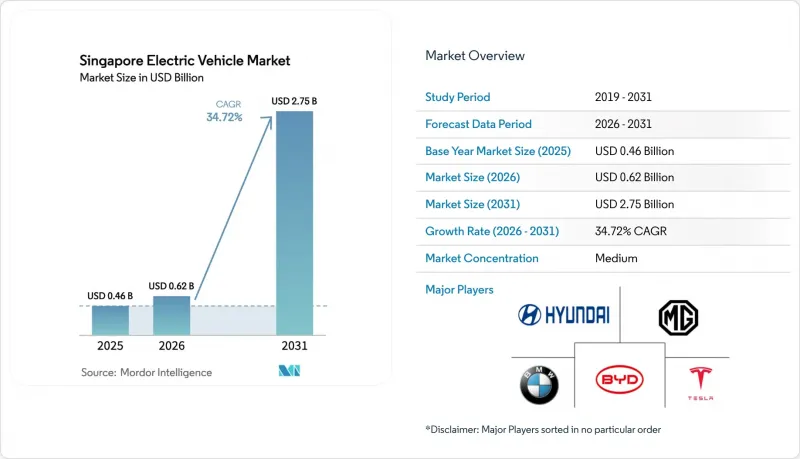
Mordor Intelligence에 의하면, 싱가포르의 전기자동차(EV) 시장 규모는 2025년 4억 6,000만 달러로 평가되었고, 2026년에는 6억 2,000만 달러로 추정되며, 2031년까지 27억 5,000만 달러에 이를 것으로 예측됩니다.
이는 예측 기간(2026-2031년) 연평균 성장률(CAGR)이 34.72%임을 나타낼 전망입니다.
본 보고서는 차량 유형별(승용차 및 상용차), 구동 방식별(배터리 전기자동차(BEV), PHEV 등), 배터리 용량별(50kWh 이하 및 그 이상), 최종 사용자별(개인 소유자, 상용 차량 운영사 등)로 분류되어 있습니다. 시장 전망은 금액(달러) 및 수량(대수)으로 제시됩니다.
싱가포르의 전기자동차 시장 동향 및 인사이트
TCO 평등을 촉진하는 정부의 인센티브 제도
‘조기 전기자동차 도입 인센티브’와 ‘차량 배기가스 규제(VES) A1 티어’를 통합한 이중 리베이트 제도를 통해 정가 격차가 대폭 축소되었습니다. 이러한 리베이트는 즉각적인 비용 절감을 우선시하고 있으며, 엔트리급 배터리 전기 세단은 세후 가격 측면에서 가솔린 차량을 앞지르고 있습니다. 대상 모델에 대한 추가 등록비 면제(0달러)로 인해 BYD Atto 3 등 중급 수입차에 대한 수요가 지속적으로 증가하고 있습니다. 도입이 급증하고 있으며, 이중 리베이트의 혜택을 받는 전기자동차와 택시의 수도 증가하고 있습니다. 정책 입안자들은 밴드 A2의 지원금을 축소함으로써 과도기적인 하이브리드 차량에서 완전 무공해 모델로의 전환을 시사하고 있으며, 이는 발전하는 충전 네트워크와 부합합니다. 이러한 인센티브는 주행 빈도가 높은 운전자의 투자 회수 기간을 단축할 뿐만 아니라, 전기자동차의 더 광범위한 보급을 촉진하고 있습니다.
6만 기 목표 달성을 위한 공공 및 분양 아파트용 충전기의 급속한 확대
싱가포르에서는 충전소 네트워크가 확대되고 있으며, 향후 몇 년 동안 이 인프라를 대폭 확충하기 위한 법적 구속력이 있는 로드맵에 따라 진행되고 있습니다. 현재 규정에 따르면 민간 분양 아파트의 경우, 부지 일부에 가동 중인 충전기를 설치하고, 추가 공간에 배선을 사전에 설치해야 할 의무가 있으며, 이를 통해 주민들이 향후 개보수를 진행할 때의 어려움을 줄이고 있습니다. 주택개발청(HDB) 단지의 대부분에는 최소 1대의 충전기가 설치되어 있습니다. 그러나 이용 현황을 살펴보면 직장이나 공공 급속 충전소가 선호되는 것으로 나타나, 아파트 거주자들에게 야간 충전이 여전히 과제로 남아 있음을 여실히 보여주고 있습니다. 에너지시장청(EMA)의 V2G 샌드박스 이니셔티브를 통해 운전자는 피크 시간대에 전력을 전력망에 환원할 수 있어 에너지 비용 절감에 기여하고 있습니다. 고밀도이며 신뢰할 수 있는 충전 인프라 구축으로 주행 거리에 대한 불안감이 줄어들었고, 전용 차고가 없는 소비자들에게도 전기자동차를 더 쉽게 이용할 수 있게 되었습니다.
여전히 높은 전기자동차 초기 비용과 COE의 변동
COE 입찰 가격이 사상 최고치를 기록하며, 보급형 전기자동차 시장 가격을 상회하는 사례도 곳곳에서 나타나고 있어, 리베이트 제도의 효과가 약화되고 가계에 부담을 주고 있습니다. 밴드 A2의 VES 리베이트가 삭감됨에 따라 고출력 모델에 대한 지원이 축소되었고, 고급차를 구매하는 소비자들은 추가적인 세금 부담을 떠안고 있습니다. 차량 도입 계획 담당자들은 장기적인 조달 주기에서 COE의 변동을 관리해야 하는 과제에 직면해 있으며, 청정 에너지 도입 의무가 임박했음에도 불구하고 일괄 발주가 지연될 가능성이 있습니다. 높은 초기 비용은 여전히 싱가포르 전기자동차 시장 성장의 가장 큰 장벽으로 남아 있으며, 특히 리스 이용 옵션이 없는 중산층 가구의 경우 그 영향이 두드러집니다.
부문 분석
2025년 싱가포르 전기자동차 시장에서 승용차가 시장 점유율의 79.67%를 차지했습니다. 한편, 상용차는 라이드셰어, 택배, 대중교통 사업자들의 적극적인 움직임에 힘입어 2031년까지 연평균 성장률(CAGR) 37.21%를 기록할 전망입니다. 해치백과 세단은 특정 가격대의 모델에 대한 우대 정책에 힘입어, 입문급 구매자들에게 여전히 인기 있는 선택지로 자리 잡고 있습니다. 동시에 기아 EV5와 같은 소형 SUV는 합리적인 가격대에서 더 넓은 공간을 원하는 구매자들 사이에서 지지를 넓혀가고 있습니다.
소형 상용차는 상업 분야에서의 도입을 주도하고 있으며, 페덱스의 전기 모델 도입 사례가 보여주듯이 기존 디젤 차량에 비해 상당한 비용 절감을 실현하고 있습니다. 버스 부문은 급속한 전기화가 진행 중이며, 차고 내 충전 인프라 투자를 촉진하는 대규모 입찰이 이를 뒷받침하고 있습니다. 이는 야간 트럭 충전에도 이점을 가져다주고 있습니다. 중형 및 대형 트럭은 적재량과 주행 거리 제한에 더해, 모델 선택의 폭이 좁다는 점으로 인해 과제에 직면해 있습니다. 그러나 주요 제조업체들의 전기 트럭 도입은 도시 지역 화물 운송에서 그 경제성이 점점 더 인정받고 있음을 보여줍니다. 전반적으로, 차량 운용 전략이 싱가포르의 전기자동차 시장을 재편하고 있으며, 연료 절감 효과를 극대화하는 높은 가동률을 갖춘 운용 주기로 초점이 이동하고 있습니다.
2025년 싱가포르 전기자동차 시장 점유율 중 배터리 전기자동차(BEV)는 82.23%를 차지했으며, 2031년까지 연평균 성장률(CAGR) 35.78%를 나타낼 것으로 예측됩니다. 이를 통해 싱가포르 전기자동차 시장에서 사실상 표준 플랫폼으로서의 입지를 공고히할 것입니다. 말레이시아로 자주 국경을 넘는 운전자들 사이에서는 여전히 플러그인 하이브리드 차량이 선호되고 있지만, VES(차량 에너지 시스템)에 대한 인센티브 축소와 규제 요건으로 인해 이 부문의 성장은 제한되고 있습니다. 연료전지에 대한 노력은 여전히 검토 단계에 있지만, 현대자동차가 경제개발청(EDB)과 체결한 수소 관련 양해각서(MoU)가 그 토대를 마련하고 있습니다. 다만, 그 성공 여부는 충전 인프라에 대한 동시 투자에 달려 있습니다.
공공 충전 인프라 확충과 중형 BEV의 실제 주행 거리 향상으로 인해 실용적인 측면의 큰 과제는 점차 해소되고 있습니다. 자동차 제조업체의 판매 데이터를 보면, 구매자들이 과도기적인 하이브리드차를 완전히 외면하는 추세가 강해지고 있음을 알 수 있습니다. 이러한 변화는 BYD가 토요타를 제치고 브랜드 순위 1위에 오른 사실에서도 분명하게 드러납니다. BEV 가격이 지속적으로 하락하고 규제가 강화됨에 따라 시장의 관심은 점점 더 순수 전기자동차로 쏠리고 있습니다.
기타 혜택 :
- 엑셀 형식 시장 예측(ME) 시트
- 3개월간의 애널리스트 지원
자주 묻는 질문
목차
제1장 서론
제2장 조사 방법
제3장 개요
제4장 시장 구도
제5장 시장 규모 및 성장 예측-금액(달러) 및 수량
제6장 경쟁 구도
제7장 시장 기회 및 향후 전망
AJY 26.09.01According to Mordor Intelligence, the Singapore electric vehicle market size is expected to grow from USD 0.46 billion in 2025 to USD 0.62 billion in 2026 and is forecast to reach USD 2.75 billion by 2031, reflecting a 34.72% CAGR over the forecast period (2026-2031).
This report is Segmented by Vehicle Type (Passenger Cars and Commercial Vehicles), Drive Train Technology (Battery Electric Vehicles (BEV), Plug-In Hybrid Electric Vehicles (PHEV), and More), Battery Capacity (Up To 50 KWh and More), and End User (Private Individual Owners, Commercial Fleet Operators, and More). The Market Forecasts are Provided in Terms of Value (USD) and Volume (Units).
Singapore Electric Vehicle Market Trends and Insights
Government Incentive Schemes Driving TCO Parity
By integrating the Early EV Adoption Incentive with the Vehicle Emissions Scheme A1 tier, a dual-rebate architecture significantly reduces sticker-price disparities. These rebates prioritize immediate savings, allowing entry-level battery-electric sedans to surpass their gasoline counterparts in post-tax price. The zero-dollar Additional Registration Fee for eligible models continues to boost demand for mid-range imports, such as the BYD Atto 3. Adoption has surged, with a growing number of electric cars and taxis benefiting from the dual rebates. By reducing Band A2 benefits, policymakers indicate a shift from transitional hybrids to fully zero-emission models, aligning with the evolving charging network. These incentives not only shorten payback periods for frequent drivers but also support a broader acceptance of electric vehicles.
Rapid Roll-Out of Public and Condo Chargers Toward 60 k Target
The island has a growing network of charge points and is following a legally binding roadmap to significantly expand this infrastructure in the coming years . Regulations now require private condominiums to include active chargers in a portion of their lots and pre-install wiring in additional spaces, reducing future retrofitting challenges for residents. A majority of Housing & Development Board estates are equipped with at least one charger. However, usage patterns indicate a preference for workplace and public fast-charging sites, highlighting ongoing challenges with overnight charging for apartment residents. The Energy Market Authority's V2G sandbox initiative enables motorists to return power to the grid during peak periods, helping reduce energy costs. The development of a dense, reliable charging infrastructure has helped alleviate range anxiety, making electric vehicles more accessible to consumers without private garages.
Persistently High EV Upfront Price and COE Volatility
Record COE bids have occasionally surpassed the open-market value of entry-level electric cars, undermining rebates and straining household budgets. Band A2 VES rebates have been reduced, diminishing support for high-power models and forcing premium buyers to bear additional taxes. Fleet planners face challenges managing COE fluctuations across extended procurement cycles, which can delay bulk orders despite the impending cleaner-energy mandate. High upfront costs remain the most significant barrier to the growth of the Singapore electric vehicle market, particularly for middle-income households without access to leasing options.
Other drivers and restraints analyzed in the detailed report include:
- COE and VES Reforms Penalizing ICE Ownership
- Battery-Pack Cost Road-map Below USD 80/kWh by 2028
- Limited HDB Parking Upgrade Capacity for Chargers
For complete list of drivers and restraints, kindly check the Table Of Contents.
Segment Analysis
Passenger cars accounted for 79.67% of the 2025 Singapore electric vehicle market share. Commercial vehicles, however, are slated to post a 37.21% CAGR through 2031, buoyed by decisive moves from ride-hailing, parcel, and public-transport operators. Hatchbacks and sedans remain popular choices for entry-level buyers, supported by favorable policies for models within specific price thresholds. At the same time, compact SUVs, such as the Kia EV5, are gaining traction among buyers seeking additional space at competitive price points.
Light vans are driving commercial adoption, with examples like FedEx's deployment of electric models demonstrating significant cost savings compared to traditional diesel vehicles. The bus segment is electrifying at a rapid pace, supported by large-scale tenders that are fostering investments in depot-charging infrastructure, which also benefits nighttime truck charging. Medium and heavy trucks face challenges due to payload and range limitations, as well as fewer model options. However, the introduction of electric trucks by leading manufacturers highlights the growing validation of their economic viability in urban freight. Overall, fleet strategies are reshaping the electric vehicle market in Singapore, shifting focus toward high-utilization duty cycles that maximize fuel-saving benefits.
Battery electric vehicles accounted for 82.23% of the 2025 Singapore electric vehicle market share and are forecast to grow at a 35.78% CAGR to 2031, solidifying their status as the de facto platform in the Singapore electric vehicle market. Drivers who frequently cross into Malaysia still favor plug-in hybrids, but dwindling VES incentives and regulatory mandates are limiting the segment's growth. While fuel-cell initiatives are still in the exploratory phase, Hyundai's hydrogen MoU with the Economic Development Board sets the stage. Still, its success is contingent on simultaneous investments in refueling infrastructure.
With expanded public charging and improved real-world ranges for mid-tier BEVs, significant practical challenges are being addressed. Sales data from OEMs reveal a growing trend: buyers are bypassing transitional hybrids altogether. This shift is highlighted by BYD's rise to the top of the brand rankings, surpassing Toyota. As BEV prices continue to decline and regulations tighten, the market's focus is increasingly leaning towards pure electric options.
Complete Report Scope:
- By Vehicle Type
- Passenger Cars
- Hatchback
- Sedan
- Sport-Utility Vehicle
- Multi-Purpose Vehicle
- Commercial Vehicles
- Light Commercial Vehicles
- Medium Commercial Vehicles
- Heavy Commercial Vehicles
- Buses & Coaches
- Passenger Cars
- By Drive Train Technology
- Battery Electric Vehicles (BEV)
- Plug-in Hybrid Electric Vehicles (PHEV)
- Fuel Cell Electric Vehicles (FCEV)
- By Battery Capacity
- Up to 50 kWh
- 51 to 75 kWh
- Above 75 kWh
- By End User
- Private Individual Owners
- Commercial Fleet Operators
- Ride-hailing & Car-sharing
- Logistics & Delivery
- Government & Public-Sector Fleets
List of Companies Covered in this Report:
- Tesla Inc.
- BYD Co. Ltd
- Hyundai Motor Company
- Kia Corporation
- MG Motor (SAIC Motor)
- BMW AG
- Mercedes-Benz Group AG
- Audi AG
- Nissan Motor Co. Ltd.
- Toyota Motor Corporation
- Mitsubishi Motors Corporation
- AB Volvo
- Renault Group
- Xpeng Inc
Additional Benefits:
- The market estimate (ME) sheet in Excel format
- 3 months of analyst support
TABLE OF CONTENTS
1 Introduction
- 1.1 Study Assumptions & Market Definition
- 1.2 Scope of the Study
2 Research Methodology
3 Executive Summary
4 Market Landscape
- 4.1 Market Overview
- 4.2 Market Drivers
- 4.2.1 Government incentive schemes driving TCO parity
- 4.2.2 Rapid roll-out of public & condo chargers toward 60k target
- 4.2.3 COE & VES reforms penalising ICE ownership
- 4.2.4 Battery-pack cost road-map below USD 80/kWh by 2028
- 4.2.5 Fleet decarbonisation pledges by ride-hailing & logistics firms
- 4.2.6 Nation-wide V2G pilot unlocking ancillary-services revenue
- 4.3 Market Restraints
- 4.3.1 Persistently high EV upfront price & COE volatility
- 4.3.2 Limited HDB parking upgrade capacity for chargers
- 4.3.3 Scarce RHD model allocations for Singapore's small volume
- 4.3.4 Grid upgrade capex for Above 150 kW fast-charge corridors
- 4.4 Value / Supply-Chain Analysis
- 4.5 Regulatory Landscape
- 4.6 Technological Outlook
- 4.7 Porter's Five Forces
- 4.7.1 Threat of New Entrants
- 4.7.2 Bargaining Power of Buyers
- 4.7.3 Bargaining Power of Suppliers
- 4.7.4 Threat of Substitute Products
- 4.7.5 Intensity of Competitive Rivalry
5 Market Size & Growth Forecasts - Value (USD) and Volume (Units)
- 5.1 By Vehicle Type
- 5.1.1 Passenger Cars
- 5.1.1.1 Hatchback
- 5.1.1.2 Sedan
- 5.1.1.3 Sport-Utility Vehicle
- 5.1.1.4 Multi-Purpose Vehicle
- 5.1.2 Commercial Vehicles
- 5.1.2.1 Light Commercial Vehicles
- 5.1.2.2 Medium Commercial Vehicles
- 5.1.2.3 Heavy Commercial Vehicles
- 5.1.2.4 Buses & Coaches
- 5.1.1 Passenger Cars
- 5.2 By Drive Train Technology
- 5.2.1 Battery Electric Vehicles (BEV)
- 5.2.2 Plug-in Hybrid Electric Vehicles (PHEV)
- 5.2.3 Fuel Cell Electric Vehicles (FCEV)
- 5.3 By Battery Capacity
- 5.3.1 Up to 50 kWh
- 5.3.2 51 to 75 kWh
- 5.3.3 Above 75 kWh
- 5.4 By End User
- 5.4.1 Private Individual Owners
- 5.4.2 Commercial Fleet Operators
- 5.4.2.1 Ride-hailing & Car-sharing
- 5.4.2.2 Logistics & Delivery
- 5.4.3 Government & Public-Sector Fleets
6 Competitive Landscape
- 6.1 Market Concentration
- 6.2 Strategic Moves
- 6.3 Market Share Analysis
- 6.4 Company Profiles (Includes Global Level Overview, Market Level Overview, Core Segments, Financials as Available, Strategic Information, Market Rank/Share for Key Companies, Products and Services, SWOT Analysis, and Recent Developments)
- 6.4.1 Tesla Inc.
- 6.4.2 BYD Co. Ltd
- 6.4.3 Hyundai Motor Company
- 6.4.4 Kia Corporation
- 6.4.5 MG Motor (SAIC Motor)
- 6.4.6 BMW AG
- 6.4.7 Mercedes-Benz Group AG
- 6.4.8 Audi AG
- 6.4.9 Nissan Motor Co. Ltd.
- 6.4.10 Toyota Motor Corporation
- 6.4.11 Mitsubishi Motors Corporation
- 6.4.12 AB Volvo
- 6.4.13 Renault Group
- 6.4.14 Xpeng Inc


