

|
시장보고서
상품코드
2116791
아프리카의 전기차 시장 : 점유율 분석, 업계 동향과 통계, 성장 예측(2026-2031년)Africa Electric Vehicle - Market Share Analysis, Industry Trends & Statistics, Growth Forecasts (2026 - 2031) |
||||||
 Mordor Intelligence
아프리카의 전기차 시장 규모는 2026년 6억 9,000만 달러로 추정되고 있어 2025년 4억 5,000만 달러에서 성장하여 2031년에는 59억 9,000만 달러에 이를 것으로 예측됩니다.
2026년부터 2031년까지 연평균 성장률(CAGR) 53.9%로 성장할 것으로 전망됩니다.
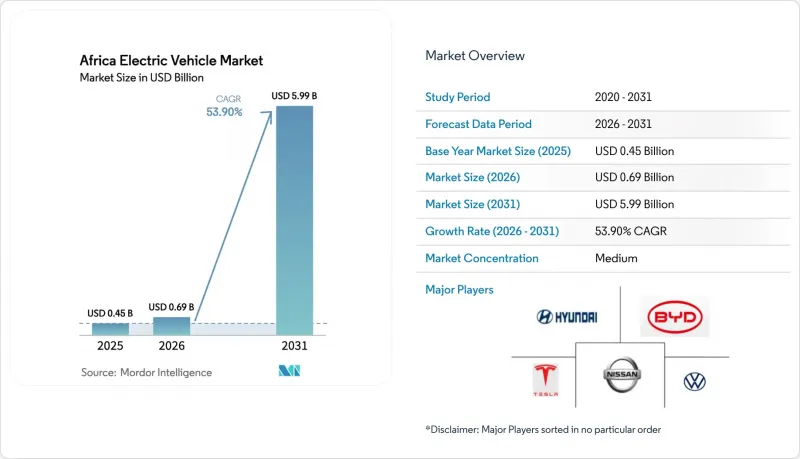
본 보고서는 추진 방식(배터리식 전기차 등), 차종(승용차 등), 구동 방식(전륜 구동 등), 배터리 화학 성분(인산철 리튬, 니켈·망간·코발트 등), 충전 방식(AC 저속 충전 및 DC 급속 충전), 그리고 국가별로 분류되어 있습니다. 시장 전망은 금액(달러) 및 대수로 제시되어 있습니다.
아프리카 전기차 시장 동향 및 인사이트
정부의 인센티브와 관세 면제에 따른 수입이 전기차의 가격 경쟁력을 높임
에티오피아가 2024년에 내연기관 차량의 수입을 금지함에 따라, 2025년 초에는 신차 판매 대수에서 전기차 등록 대수가 60%를 넘어섰습니다. 가나에서는 8년간의 무관세 조치로 순수 전기차 수입에 대한 관세가 면제되어, 전 세계 OEM 업체들의 조립 투자 약속이 촉진되고 있습니다. 남아프리카공화국의 인센티브 체계안에서는 생산 리베이트가 제안되고 있으며, 정책의 중점을 소비에서 제조로 전환함으로써 아프리카 전기차 시장 내 지역적 공급망의 심화를 도모하고 있습니다. 케냐의 부가가치세(VAT) 면제와 e-모빌리티용 할인 전기요금의 조합으로 2023년 등록 대수는 5배로 증가했으며, 이는 수요의 가격 탄력성을 입증했습니다. 르완다의 면세 조치와 재생에너지 비중 향상으로 인해 합리적인 가격이 확보되어, 폭스바겐의 ‘GenFarm’ e-트랙터 도입이 가능해졌습니다.
배터리 팩 가격의 급락이 양산 모델의 보급을 뒷받침
셀 가격의 급격한 하락에 더해, 모로코에 위치한 65억 달러 규모의 Gotion 기가팩토리와 BTR의 3억 6,600만 달러 규모의 양극재 공장이 가동됨에 따라, 지역 내 조립 제조업체들의 착륙 비용 구조가 낮아지고 있습니다. 배터리 생산의 현지화를 통해 환율 리스크와 물류 비용의 추가 부담을 피할 수 있게 되어, 차량 정가를 인하하고 아프리카 전기차 시장의 총 소유 비용을 개선하고 있습니다. COBCO사의 70GWh 전구체 제조 시설은 서아프리카, 중앙아프리카, 북아프리카의 수출 회랑 전체에 파급되는 규모의 경제를 여실히 보여주고 있습니다. 모로코의 재생에너지 보급률 상승으로 에너지 투입 비용이 더욱 절감되어, 대륙 전체에서 경쟁력 있는 배터리 가격을 실현하고 있습니다. 규모의 경제가 공급망 전반으로 확산됨에 따라, 2027년까지 1만 5,000달러 미만의 양산 모델이 보급되고, 카셰어링 및 배송용 차량 수요층이 확대될 것으로 예측됩니다.
충전 인프라 및 송전망 업그레이드에 따른 막대한 설비 투자
대륙 전역에 걸친 급속 충전 회랑 구축에는 막대한 자본 투자가 필요하며, 이는 보건 및 교육과 같은 우선 과제와 경쟁하는 형태로 공공 예산에 부담을 주고 있습니다. 남아프리카공화국에서는 하우텡 주 주변에 약 316기의 공공 충전기가 집중되어 운영되고 있지만, 이는 가장 선진적인 자동차 허브라 할지라도 인프라 격차가 존재함을 여실히 보여줍니다. 나이지리아의 대표적 초대형 충전소는 민간 부문의 의지를 보여주고 있지만, 전력망에 대한 자금 투자가 부족한 경우가 많은 다른 53개국에서는 자금 조달 요건이 여전히 큰 과제로 남아 있습니다. 충전소 구축과 병행하여 전력망 현대화를 추진해야 하며, 이러한 이중 투자 접근 방식은 개발업자의 투자 회수 기간을 장기화시킵니다. 많은 아프리카 국가에서 차입 비용이 높은 수준을 유지하고 있는 점도 프로젝트의 내부수익률(IRR) 산정을 더욱 낮추고 있습니다. 그 결과, 아프리카 전기차 시장의 지속 가능한 성장을 뒷받침할 충전 네트워크를 확대하기 위해서는 혼합형 자금 조달 구조나 우대 조건이 적용된 기후 기금이 필수적일 것입니다.
부문 분석
2025년 매출의 78.65%를 배터리식 전기차가 차지하며, 아프리카 전기차 시장의 기반을 형성하고 있습니다. 연료전지차는 남아프리카공화국이 자국의 백금 매장량을 활용한 47억 유로 규모의 그린 수소 프로그램의 지원을 받아 2031년까지 연평균 성장률(CAGR) 56.40%로 성장을 가속화할 전망입니다. 2027년 이후 그린 수소 허브가 상용화되면, 아프리카의 연료전지 플랫폼용 전기차 시장 규모는 급격히 확대될 것으로 예측됩니다. 한편, 플러그인 하이브리드 차량은 수입 연료에 대한 의존을 피하기 위해 대부분의 정부가 완전 전기화를 장려하고 있기 때문에 여전히 틈새 시장으로 남아 있습니다. 기존 내연기관(ICE) 공급망에 얽매이지 않고, 아프리카의 조립 제조업체들은 BEV 아키텍처에 전적으로 집중하며, 제한된 자본을 단일 기술 스택에 집중할 수 있습니다. 현지 배터리 공장의 규모가 확대됨에 따라 BEV의 정가는 하락할 것으로 예상되며, 연료전지 생태계가 병행하여 성숙해감에 따라 BEV 시장 우위는 더욱 공고해질 것입니다.
아프리카 전기차 시장에서 BEV의 점유율은 2031년까지 70.00%를 상회할 것으로 예측됩니다. 이는 수소의 장거리 주행 특성을 중시하는 화물 운송, 광업, 도시 간 버스 노선에 FCEV가 보급되는 상황에서도 변함없을 것입니다. 수소 인프라 구축에 관한 정책의 명확성이 트럭 차량이 디젤에서 연료전지로 전환되는 속도를 결정짓게 될 것입니다. 그때까지는 충전 네트워크의 확대가 수소 충전소보다 빠르기 때문에 BEV는 승용차 및 소형 상용차 부문에서 계속해서 지배적인 지위를 유지할 것입니다. 따라서 추진 시스템의 전망은 BEV를 주축으로 하고, 이용률이 높은 대형 차량의 틈새 시장에서 FCEV가 선택적으로 도입되는 방향으로 기울고 있습니다.
2025년 매출액 비중에서는 승용차가 61.25%로 1위를 차지했으나, 이륜차 및 삼륜차는 연평균 성장률(CAGR) 57.90%를 나타낼 것으로 예측되며, 이는 해당 대륙의 차량 공유 및 화물 배송 동향을 반영한 것입니다. 마이크로모빌리티 기업들이 배터리 교환 네트워크를 확대함에 따라, 아프리카 이륜차용 전기차 시장 규모는 2025년부터 2027년까지 3배로 증가할 것으로 예측됩니다. 사업자들이 전기 오토바이를 선호하는 이유는 하루당 연료비 절감액이 배터리 이용료를 상회하여 순수익을 직접적으로 끌어올리기 때문입니다. 라이드셰어 플랫폼은 오토바이에 보험 및 디지털 지갑을 통한 상환 계획을 패키지로 제공함으로써, 정식 신용 기록이 없는 운전자의 접근성을 확대되고 있습니다.
상용 밴과 버스는 여전히 시장 점유율이 작지만, 전략적 중요성을 유지하고 있습니다. Roam Kenya가 도입한 전기 버스는 사업자의 에너지 비용을 50% 절감하고 도시의 대기질 지표를 개선한 덕분에, 나이로비 카운티는 무공해 차량에 대한 면허 수수료를 면제하는 조치를 취했습니다. 장거리 버스나 대형 트럭의 경우, 대용량 충전 회랑이나 수소를 연료로 하는 대체 수단의 구축이 기대되고 있습니다. 그럼에도 불구하고, 시내버스 전기화 프로젝트가 확대됨에 따라 차고를 거점으로 한 직류 급속 충전 허브가 구축되고, 이것이 일반인이 이용할 수 있는 급속 충전기로 확산됨에 따라 아프리카 전기차 시장의 인프라 기반이 강화될 것입니다.
기타 혜택:
- 엑셀 형식 시장 예측(ME) 시트
- 3개월간의 애널리스트 지원
자주 묻는 질문
목차
제1장 서론
제2장 조사 방법
제3장 개요
제4장 시장 구도
제5장 시장 규모와 성장 예측(금액 : 달러, 수량 : 단위)
제6장 경쟁 구도
제7장 시장 기회와 향후 전망
JHS 26.09.01According to Mordor Intelligence, Africa electric vehicle market size in 2026 is estimated at USD 0.69 billion, growing from 2025 value of USD 0.45 billion with 2031 projections showing USD 5.99 billion, growing at 53.9% CAGR over 2026-2031.
This report is Segmented by Propulsion Type (Battery Electric Vehicles, and More), Vehicle Type (Passenger Cars, and More), Vehicle Drive Type (Front-Wheel Drive, and More), Battery Chemistry (Lithium-Iron-Phosphate, Nickel-Manganese-Cobalt, and More), Charging Method (AC Slow and DC Fast), and Country. The Market Forecasts are Provided in Terms of Value (USD) and Volume in Units.
Africa Electric Vehicle Market Trends and Insights
Government Incentives and Zero-Duty Imports Surge EV Affordability
Ethiopia's 2024 ban on internal-combustion vehicle imports lifted electric-vehicle registrations above 60% of new sales by early 2025. Ghana's eight-year zero-tariff window eliminates customs duties on fully electric imports, stimulating assembly investment commitments by global OEMs. South Africa's draft incentive framework proposes production rebates that pivot the policy mix from consumption to manufacturing, enhancing the Africa electric vehicle market's regional supply-chain depth. Kenya's VAT exemption, combined with a discounted e-mobility electricity tariff, drove a five-fold rise in 2023 registrations, confirming price elasticity of demand. Rwanda's tax holiday and renewable power share reinforce affordability, enabling Volkswagen's GenFarm e-tractor rollout.
Plummeting Battery-Pack Prices Unlock Mass-Market Models
Rapid cell-price declines, coupled with Morocco's USD 6.5 billion Gotion gigafactory and BTR's USD 366 million cathode plant, are lowering landed-cost structures for regional assemblers. Localizing battery production sidesteps forex risk and logistics premiums, trimming vehicle sticker prices and improving the Africa electric vehicle market's total cost of ownership. COBCO's 70 GWh precursor facility illustrates economies of scale cascading across West, Central, and North African export corridors. With rise of renewable energy penetration in Morocco, further cuts energy input costs, translating into competitive battery pricing across the continent. As scale advantages stretch across supply chains, sub-USD 15,000 mass-market models are expected to proliferate by 2027, widening addressable demand among ride-hailing and delivery fleets.
High Cap-Ex for Charging and Grid Upgrades
Rolling out continent-wide fast-charging corridors entails heavy capital intensity that strains public budgets competing with health and education priorities. South Africa runs roughly 316 public chargers, concentrated around Gauteng, underscoring the infrastructure gap even in the most advanced auto hub. Nigeria's flagship charging super-station signals private-sector appetite, but financing requirements remain daunting for the 53 other countries where electricity networks are often under-funded. Grid modernization must occur in tandem with charger deployment, a dual investment track extending developers' payback periods. Elevated borrowing costs across many African economies further depress project internal-rate-of-return calculations. Consequently, blended-finance structures and concessional climate funds will be essential to scale charging networks that can support sustained growth in the Africa electric vehicle market.
Other drivers and restraints analyzed in the detailed report include:
- Pan-African Mineral Value-Chain Push Fuels Local EV/Battery Investment
- Leap-Frogging to E-Motorcycles and Tuk-Tuks for Last-Mile Logistics
- Weak Grid Reliability and Low Electrification Outside Metros
For complete list of drivers and restraints, kindly check the Table Of Contents.
Segment Analysis
Battery-electric vehicles generated 78.65% of 2025 revenue, anchoring the Africa electric vehicle market. Fuel-cell vehicles will accelerate at 56.40% CAGR through 2031, underpinned by South Africa's EUR 4.7 billion green-hydrogen program that leverages the nation's platinum reserves. The Africa electric vehicle market size for fuel-cell platforms is projected to rise sharply once green-hydrogen hubs reach commercialization after 2027. Plug-in hybrids remain niche because most governments incentivize full electrification to bypass imported fuel dependencies. Unencumbered by legacy ICE supply chains, African assemblers can commit entirely to BEV architectures, channeling limited capital toward a single technology stack. As local battery plants scale, BEV sticker prices are set to fall, reinforcing their market supremacy while fuel-cell ecosystems mature in parallel.
The Africa electric vehicle market share of BEVs is expected to remain above 70.00% through 2031, even as FCEVs penetrate freight, mining, and inter-city bus routes that value hydrogen's long-range attributes. Policy clarity around hydrogen infrastructure roll-out will determine the pace at which truck fleets pivot from diesel to fuel cells. Until then, BEVs will continue dominating passenger and light-commercial categories because charging networks expand faster than hydrogen refueling stations. The propulsion landscape, therefore, tilts toward a BEV-first trajectory with selective FCEV uptake in high-utilization heavy-duty niches.
Passenger cars led the 2025 revenue pool at 61.25%, yet two- and three-wheelers will chalk up a 57.90% CAGR, mirroring the continent's ride-hail and cargo-delivery dynamics. The Africa electric vehicle market size for two-wheelers is projected to triple between 2025 and 2027 as micro-mobility companies expand battery-swap networks. Operators prefer electric bikes because daily fuel savings exceed battery-subscription fees, directly boosting take-home income. Ride-hailing platforms bundle bikes with insurance and digital-wallet repayment plans, broadening access for drivers lacking formal credit histories.
Commercial vans and buses remain smaller slices but hold strategic relevance. Electric buses employed by Roam Kenya cut operator energy costs by 50% and improve urban air-quality metrics, prompting Nairobi County to waive route-licensing fees for zero-emission fleets. Long-distance coaches and heavy trucks await higher-capacity charging corridors or hydrogen alternatives. Nevertheless, growing city-bus electrification projects will anchor depot-based DC fast-charging hubs that spill over into public-access fast-chargers, strengthening the Africa electric vehicle market infrastructure base.
Complete Report Scope:
- By Propulsion Type
- Battery Electric Vehicles (BEV)
- Plug-in Hybrid Electric Vehicles (PHEV)
- Hybrid Electric Vehicles (HEV)
- Fuel-Cell Electric Vehicles (FCEV)
- By Vehicle Type
- Passenger Cars
- Commercial Vehicles
- Two- and Three-Wheelers
- Buses and Coaches
- By Vehicle Drive Type
- Front-Wheel Drive
- Rear-Wheel Drive
- All-Wheel Drive
- By Battery Chemistry
- Lithium-Iron-Phosphate (LFP)
- Nickel-Manganese-Cobalt (NMC)
- Sodium-ion
- Solid-State
- Other Emerging Chemistries (Li-S, Li-Air)
- By Charging Method
- AC Slow (Below 22 kW)
- DC Fast (Above50 kW)
- By Country
- South Africa
- Morocco
- Nigeria
- Egypt
- Ethiopia
- Ghana
- Kenya
- Rest of Africa
List of Companies Covered in this Report:
- Tesla Inc.
- BYD Co. Ltd.
- Nissan Motor Co. Ltd.
- Volkswagen AG
- Hyundai Motor Co. (incl. Kia)
- BMW AG
- Toyota Motor Corporation
- Mercedes-Benz Group AG
- Volvo Car AB
- Groupe Renault
- Rivian Automotive Inc.
- Ampersand Rwanda
- Roam (Kenya)
- Phoenix Mobility (Egypt)
- Katanka Automobile (Ghana)
- Jet Motor Company (Nigeria)
- Oryx Motors (Morocco)
Additional Benefits:
- The market estimate (ME) sheet in Excel format
- 3 months of analyst support
TABLE OF CONTENTS
1 Introduction
- 1.1 Study Assumptions & Market Definition
- 1.2 Scope of the Study
2 Research Methodology
3 Executive Summary
4 Market Landscape
- 4.1 Market Overview
- 4.2 Market Drivers
- 4.2.1 Government Incentives and Zero-Duty Imports Surge EV Affordability.
- 4.2.2 Plummeting Battery-Pack Prices Unlock Mass-Market Models
- 4.2.3 Pan-African Mineral Value-Chain Push Fuels Local EV/Battery Investment
- 4.2.4 Leap-Frogging To E-Motorcycles and Tuk-Tuks for Last-Mile Logistics
- 4.2.5 Battery-Swap and Pay-Per-Use Models Mitigate Upfront-Cost Barrier
- 4.2.6 OEM Fin-Tech Micro-Leasing Widens Access for Informal-Sector Drivers
- 4.3 Market Restraints
- 4.3.1 High Capex for Charging and Grid Upgrades
- 4.3.2 Weak Grid Reliability and Low Electrification Outside Metros
- 4.3.3 Flood Of Cheap Used ICE Imports Undercuts New-EV Demand
- 4.3.4 Nascent Second-Hand EV Market Hurts Residual-Value Confidence
- 4.4 Value / Supply-Chain Analysis
- 4.5 Regulatory Landscape
- 4.6 Technological Outlook (solid-state, sodium-ion, H2-FCEV)
- 4.7 Porter's Five Forces
- 4.7.1 Threat of New Entrants
- 4.7.2 Bargaining Power of Buyers
- 4.7.3 Bargaining Power of Suppliers
- 4.7.4 Threat of Substitutes
- 4.7.5 Competitive Rivalry
5 Market Size & Growth Forecasts (Value in USD, Volume in Units)
- 5.1 By Propulsion Type
- 5.1.1 Battery Electric Vehicles (BEV)
- 5.1.2 Plug-in Hybrid Electric Vehicles (PHEV)
- 5.1.3 Hybrid Electric Vehicles (HEV)
- 5.1.4 Fuel-Cell Electric Vehicles (FCEV)
- 5.2 By Vehicle Type
- 5.2.1 Passenger Cars
- 5.2.2 Commercial Vehicles
- 5.2.3 Two- and Three-Wheelers
- 5.2.4 Buses and Coaches
- 5.3 By Vehicle Drive Type
- 5.3.1 Front-Wheel Drive
- 5.3.2 Rear-Wheel Drive
- 5.3.3 All-Wheel Drive
- 5.4 By Battery Chemistry
- 5.4.1 Lithium-Iron-Phosphate (LFP)
- 5.4.2 Nickel-Manganese-Cobalt (NMC)
- 5.4.3 Sodium-ion
- 5.4.4 Solid-State
- 5.4.5 Other Emerging Chemistries (Li-S, Li-Air)
- 5.5 By Charging Method
- 5.5.1 AC Slow (Below 22 kW)
- 5.5.2 DC Fast (Above50 kW)
- 5.6 By Country
- 5.6.1 South Africa
- 5.6.2 Morocco
- 5.6.3 Nigeria
- 5.6.4 Egypt
- 5.6.5 Ethiopia
- 5.6.6 Ghana
- 5.6.7 Kenya
- 5.6.8 Rest of Africa
6 Competitive Landscape
- 6.1 Market Concentration
- 6.2 Strategic Moves
- 6.3 Market Share Analysis
- 6.4 Company Profiles (Includes Global level Overview, Market level overview, Core Segments, Financials as available, Strategic Information, Market Rank/Share for key companies, Products & Services, and Recent Developments)
- 6.4.1 Tesla Inc.
- 6.4.2 BYD Co. Ltd.
- 6.4.3 Nissan Motor Co. Ltd.
- 6.4.4 Volkswagen AG
- 6.4.5 Hyundai Motor Co. (incl. Kia)
- 6.4.6 BMW AG
- 6.4.7 Toyota Motor Corporation
- 6.4.8 Mercedes-Benz Group AG
- 6.4.9 Volvo Car AB
- 6.4.10 Groupe Renault
- 6.4.11 Rivian Automotive Inc.
- 6.4.12 Ampersand Rwanda
- 6.4.13 Roam (Kenya)
- 6.4.14 Phoenix Mobility (Egypt)
- 6.4.15 Katanka Automobile (Ghana)
- 6.4.16 Jet Motor Company (Nigeria)
- 6.4.17 Oryx Motors (Morocco)


