

|
시장보고서
상품코드
2117355
전기자동차 배터리 재활용 시장 : 시장 점유율 분석, 업계 동향 및 통계, 성장 예측(2026-2031년)Electric Vehicle Battery Recycling - Market Share Analysis, Industry Trends & Statistics, Growth Forecasts (2026 - 2031) |
||||||
 Mordor Intelligence
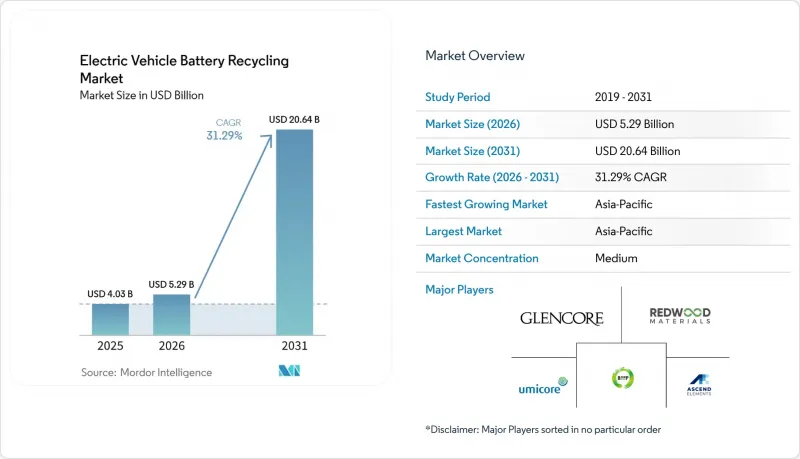
Mordor Intelligence에 의하면, 전기자동차 배터리의 재활용 시장 규모는 2025년에 40억 3,000만 달러로 평가되었고, 2026년에 52억 9,000만 달러로 추정되고, 2031년까지 206억 4,000만 달러에 이를 것으로 예상되며, 2026-2031년 CAGR 31.29%로 성장할 전망입니다.
본 보고서는 배터리 화학 성분별(리튬 이온, 니켈-수소, 기타), 공급원별(EV 생산 스크랩, 기타), 재활용 공정별(습식 야금법, 기타), 차종별(이륜차, 삼륜차, 승용차, 기타), 회수 재료별(리튬, 코발트,니켈, 기타), 지역별로 분류되어 있습니다. 시장 전망은 금액(달러) 기준으로 제시되어 있습니다.
세계의 전기자동차 배터리 재활용 시장 동향 및 인사이트
전기자동차 판매 대수의 급증으로 인한 폐배터리 ‘쓰나미’
전기자동차(EV) 판매 대수는 크게 증가하고 있으며, 향후 10년 동안 전례 없는 규모의 배터리 폐기 물결이 밀려올 것임을 시사합니다. 초기 급증기에 판매된 차량은 현재 수명 주기의 끝자락에 다다르고 있습니다. 그 결과, 연간 이용 가능한 스크랩 양은 크게 증가할 것으로 예측됩니다. 그러나 처리 능력 확충이 진행되고 있음에도 불구하고, 일부 지역에서는 심각한 공급 부족에 직면해 있습니다. 한 주요 시장에서는 재활용 업체들이 대량의 배터리 팩을 처리했음에도 불구하고 블랙매스 결제 비용을 충당하는 데 어려움을 겪고 있어, 공급이 압박받는 상황이 부각되고 있습니다. 테슬라와 레드우드 머티리얼즈의 제휴는 이러한 추세를 상징합니다. 양사의 폐쇄형 파트너십을 통해 생산 스크랩과 사용 후 배터리 팩 모두 음극 포일과 양극 전구체 생산 라인에 재투입되어, 신규 원료에 대한 의존도가 낮아지고 있습니다. 전기자동차 도입의 선구자인 노르웨이와 캘리포니아주 일부 지역 등은 향후 과제에 직면하게 될 것으로 보입니다. 초기 도입자들이 일제히 차량을 폐차함에 따라, 이들 지역에서는 재활용 능력의 지역적 부족에 직면하게 될 것으로 예측됩니다.
엄격한 확대 생산자 책임(EPR) 규제
2025년 8월에 발효된 EU의 배터리 규정에서는 2027년까지 코발트와 니켈의 회수율 90%, 리튬의 회수율 50%를 의무화하고 있으며, 2031년까지는 더욱 엄격한 기준이 설정되어 있습니다. 중국에서는 개정된 추적성 규정에 따라 출하되는 모든 배터리 셀을 인증된 재활용 업체에 연계해야 할 의무가 있으며, 인도에서는 배터리 폐기물의 회수율을 단계적으로 높여야 할 의무가 있습니다. 한편, 현재 소매 산업의 거의 전 분야를 아우르고 있는 호주의 배터리 스튜어드십 위원회(Battery Stewardship Council)는 향후 회수율을 더욱 높이는 것을 목표로 하고 있습니다. 규정 준수의 경제성은 매우 중요한 역할을 합니다. 대량의 처리를 수행하는 습식 재활용 플랜트는 규제가 없는 지역에 비해 유럽의 재활용 함량 크레딧을 활용함으로써 더 높은 내부수익률(IRR)을 달성할 수 있습니다. 각 OEM(원천 장비 제조업체)은 분해 속도를 높이기 위한 설계 혁신을 추진하고 있습니다. 예를 들어, BMW의 스냅핏 방식 모듈은 기존의 접착제 접합 설계에 비해 작업 시간을 대폭 단축하고 있습니다.
하이드로메트 플랜트의 높은 설비 투자(CAPEX)와 긴 회수 기간
표준 처리 능력을 갖춘 하이드로메트 생산 라인 건설에는 막대한 설비 투자(CAPEX)가 필요하며, 높은 운영비(OPEX)도 발생합니다. 이러한 재무 구조로 인해, 특히 보조금이 없는 경우 투자 회수 기간이 대폭 길어집니다. Li-Cycle의 로체스터 거점은 상당한 예산 초과를 겪은 후 파산 보호를 신청했습니다. 이는 이 사업에 내재된 실행상의 위험을 여실히 드러내는 사례입니다. 주요 광업 지역 이외의 지역에서는 화학 공학 전문가가 현저히 부족합니다. 이러한 인력 부족으로 인해 북미와 유럽의 인건비는 중국에 비해 상당히 높습니다. EU의 산업 배출 지침에 따라 환경 영향 허가를 취득하는 과정에서 프로젝트 일정이 크게 지연될 가능성이 있습니다. 그 결과, Umicore나 CATL Brunp와 같은 자금력이 풍부한 산업 진출기업들은 시장에서 입지를 적극적으로 강화하고 있습니다. 대조적으로, 신생 스타트업 기업들은 OEM의 지원을 받아 판매 보장을 확보하거나, 설비 투자가 적게 드는 직접 재활용 방식으로 전환하고 있습니다.
부문 분석
리튬 이온 배터리의 화학 조성은 2025년 매출의 76.07%를 차지했으며, 연평균 성장률(CAGR) 32.07%를 나타낼 것으로 예측되어 전기자동차 배터리 재활용 시장의 기반을 형성하고 있습니다. 니켈 함량이 높은 NMC 계열 배터리는 고급 승용차에서 주류를 이루는 반면, 인산철리튬(LFP)은 현재 상용차 및 저가 모델에서 주도적인 위치를 차지하고 있습니다. CATL Brunp는 대량의 리튬 이온 배터리 스크랩을 처리하고 놀라운 리튬 회수율을 달성함으로써 습식 제련법의 효율성을 입증했습니다. 회수된 NMC 스크랩은 LFP에 비해 금속 가치가 높기 때문에 처리 업체들은 LFP의 직접 재생산을 선호하는 경향이 있습니다. 기술의 다양화에 따라 NMC용 전기자동차(EV) 배터리 재활용 시장은 성장이 예상되는 반면, LFP의 점유율은 처리 톤수는 증가하겠지만 가치 밀도는 하락할 것으로 전망됩니다. 각 OEM 업체들은 모듈식 팩, 신속한 분해, 화학 성분 QR 코드 등 ‘재활용을 고려한 설계(Design-for-Recycling)’ 노력을 통해 전기자동차 배터리 재활용 시장에서 실질적인 점유율을 확대하고 있으며, 이로 인해 자동화 시설에서의 처리가 더욱 용이해지고 있습니다. 세컨드 라이프 에너지 저장 시장에서는 고정형 시장에서 LFP가 점점 더 선호됨에 따라, 고니켈 팩과의 궁합은 예전만큼 높지 않게 되었습니다. LFP는 한 번의 재생 정비를 거친 후 재활용 업체로 되돌아오기 때문입니다. 재활용 리튬 함유율 기준 상향을 의무화하는 유럽의 향후 정책에 따라, NMC의 용액 야금법과 LFP의 직접 재활용법 간의 수익성 격차는 더욱 확대될 전망입니다.
리튬 망간 산화물이나 니켈 금속 수소화물 등의 원료는 롱테일 흐름을 만들어내지만, 그 양은 제한적이며, 보통 구형 하이브리드 차량 프로그램과 관련되어 있어 현물 가격에 영향을 미치는 일은 거의 없습니다. BASF, Umicore, Northvolt의 지속적인 확장은 특히 고니켈 스크랩에 대한 습식 정제 능력에 대한 지속적인 노력을 부각시키고 있습니다. 업계가 니켈이 풍부하고 코발트 함량이 낮은 솔루션으로 전환함에 따라, 가공업체들은 톤당 평균 수익 감소를 대비하여 양극재의 결정 구조를 손상시키지 않는 저에너지 직접법에 대한 노력을 강화하고 있습니다.
2025년에는 생산 스크랩이 원료의 58.37%를 차지했으며, 화학 성분의 균일성을 보장하는 폐쇄형 루프 계약의 기반이 될 것입니다. 레드우드 머티리얼즈(Redwood Materials)는 미국 내 모든 스크랩을 테슬라, 파나소닉, 포드에서 조달하고 있으며, 다수의 전기자동차(EV)에 충분한 양의 재생 구리박을 생산했습니다. 기가팩토리의 생산 확대기에는 스크랩 발생률이 정점에 달하고, 단기적인 공급 과잉이 발생하고 전기자동차용 배터리 재활용 시장 규모가 확대될 가능성이 있지만, 생산 라인의 수율 향상을 통해 궁극적으로는 이러한 공급 과잉이 해소될 것으로 예측됩니다.
사용 후 배터리의 양은 연간 32.15%의 속도로 증가하고 있으며, 생산 스크랩량을 초과할 것으로 예측됩니다. 인도에서는 향후 대량의 배터리 팩이 폐기될 것으로 예측됩니다. 그러나 이러한 팩 중 공식적으로 회수되는 것은 일부에 불과합니다. 이 부족분은 비공식 해체업자들에 의해 보충되고 있지만, 이들은 종종 귀중한 양극 재료를 폐기해 버립니다. 한편, EU에서는 회수 목표 상향을 위한 노력이 진행되고 있습니다. 이러한 움직임에 따라 QR 코드가 부착된 ‘배터리 여권’의 도입이 가속화되고 있으며, 배터리 팩이 인증된 재활용 업체로 확실하게 전달되도록 하고 있습니다. 그 결과, 전기자동차 배터리 재활용 부문에서 규제를 준수하는 사업자 시장 점유율이 확대되고 있습니다. 아시아의 이륜차 부문에서는 집중형 교환 스테이션을 통한 물류 체계 덕분에 소형 배터리 팩의 대규모 회수가 효율화되어, 단위당 운송 비용이 대폭 절감되고 있습니다.
지역별 분석
2025년, 아시아태평양은 전기자동차 배터리 재활용 시장 점유율의 72.87%를 차지했습니다. 이 지역의 전기자동차 배터리 재활용 시장 규모는 중국의 생산 규모와 인도의 이륜차 전기화에 힘입어 2026년부터 2031년까지 연평균 성장률(CAGR) 33.12%로 확대될 것으로 예측됩니다. 중국에서는 대량의 폐배터리가 처리되고 있으며, CATL의 자회사인 Brunp는 방대한 양의 원료에서 니켈, 코발트, 망간, 리튬의 높은 회수율을 달성하고 있습니다. Brunp는 ‘화이트리스트’ 인증 제도를 주도함으로써 국내 재활용 기준의 상당 부분에 영향력을 행사하고 있으며, 제한된 수의 인가 공장에 기술적 전문 지식과 원료 흐름을 집중시키고 있습니다. 한편, 인도의 ‘배터리 폐기물 관리 규정’에서는 향후 몇 년간의 야심찬 회수 목표가 설정되어 있습니다. 그러나 심각한 처리 능력 부족이 이미 드러나고 있어, 아테로 리사이클링, 타타 케미컬스, 엑사이드 인더스트리즈와 같은 주요 기업들의 투자를 유치하고 있습니다.
유럽은 2025년 전기자동차 배터리 재활용 시장 점유율에서 2위를 차지했으며, 그 원동력은 독일의 OEM 거점과 2031년까지 코발트 16%, 리튬 6%, 니켈 6%의 재활용률을 의무화하는 EU 배터리 규정입니다. 포르툼(Fortum)사는 2025년 4,000만 유로의 혁신 기금 보조금을 확보하여, 할야바르타 공장의 처리 능력을 두 배로 늘려 연간 2만 톤으로 확대할 예정입니다. 또한, 폭스바겐은 잘츠기터의 기가팩토리를 위해 도이젠펠트의 하이브리드 라인에서 재활용 전구체를 조달하고 있습니다. 스페인과 이탈리아는 회수 거점으로 자리 잡고 있으며, 스테나 리사이클링(Stena Recycling)의 바르셀로나 신규 허브에서는 북아프리카에서 유입되는 스크랩을 집약하여 북유럽의 수용액 정련 업체에 공급하고 있습니다. 현재 신차 판매의 상당 부분을 차지하는 노르웨이의 차량들은 지역 내 스크랩 수요의 급증으로 이어질 전망입니다. 국경을 넘는 물류가 확대되지 않는 한, 이는 지역 처리 능력에 부담을 줄 가능성이 있습니다.
북미 전기자동차 배터리 재활용 시장은 재활용 소재를 사용한 셀에 세액 공제를 부여하는 미국의 ‘인플레이션 억제법’에 따른 인센티브에 힘입어 급속히 확대되고 있습니다. 레드우드 머티리얼즈(Redwood Materials)는 사우스캐롤라이나주에 음극박 공장을 설립하고, 생산 스크랩과 딜러가 회수한 배터리 팩을 원료로 연간 상당한 양의 생산을 목표로 하고 있습니다. 어센드 엘리먼츠(Ascend Elements)도 켄튀르키예주에서 ‘하이드로투카소드(Hydro-Cathode)’ 시설을 가동했습니다. 그러나 Li-Cycle은 로체스터 거점에서 비용 초과 문제에 직면해 있으며, 이에 따라 글렌코어(Glencore)가 개입하게 되었습니다. 캐나다에서는 연방 정부가 광업 클러스터와의 협력을 활용하여 주요 주의 재활용 인프라 강화에 사용할 자금을 배분하고 있습니다. 주요 지역 외에도 브라질, 사우디아라비아, 아랍에미리트(UAE) 등의 국가들이 시범 프로젝트나 타당성 조사를 실시하고 있어 지리적 다각화의 가능성을 시사하고 있지만, 현시점에서의 기여도는 여전히 제한적입니다.
기타 혜택
- 엑셀 형식 시장 예측(ME) 시트
- 3개월간의 애널리스트 지원
자주 묻는 질문
목차
제1장 서론
제2장 조사 방법
제3장 개요
제4장 시장 구도
제5장 시장 규모 및 성장 예측
제6장 경쟁 구도
제7장 시장 기회 및 향후 전망
AJY 26.09.01According to Mordor Intelligence, the electric vehicle battery recycling market size is expected to be USD 4.03 billion in 2025, USD 5.29 billion in 2026, and reach USD 20.64 billion by 2031, growing at a CAGR of 31.29% from 2026 to 2031.
This report is Segmented by Battery Chemistry (Lithium-Ion, Nickel-Metal Hydride, and More), Source (EV-Production Scrap and More), Recycling Process (Hydrometallurgical and More), Vehicle Type (Two-Wheelers, Three-Wheelers, Passenger Cars, and More), Recovered Material (Lithium, Cobalt, Nickel, and More), and Geography. The Market Forecasts are Provided in Terms of Value (USD).
Global Electric Vehicle Battery Recycling Market Trends and Insights
Surging EV Sales Creating End-of-Life Battery Tsunami
Sales of electric vehicles (EVs) have increased significantly, signaling an unprecedented wave of battery retirements over the next decade. Vehicles sold during the initial surge are now nearing the end of their duty cycles. Consequently, annual scrap availability is expected to grow substantially. However, despite capacity additions, some regions face a significant shortfall. In one major market, recyclers processed a large volume of battery packs but struggled to cover black-mass payables, highlighting a tight supply scenario. Tesla's collaboration with Redwood Materials exemplifies the trend: their closed-loop partnership channels both production scrap and post-consumer packs back into anode-foil and cathode-precursor lines, reducing reliance on virgin materials. Regions like Norway and certain areas of California, pioneers in EV adoption, are set to face challenges. As early adopters retire their vehicles en masse, these regions will grapple with a localized undersupply of recycling capacity.
Stringent Extended-Producer-Responsibility (EPR) Mandates
The EU Battery Regulation, which entered into force in August 2025, requires 90% recovery of cobalt and nickel and 50% recovery of lithium by 2027, with sharper thresholds by 2031. China's updated traceability code forces every shipped cell to be linked to an approved recycler, while India mandates increased collection rates for battery waste over time. Meanwhile, Australia's Battery Stewardship Council, which now encompasses almost the entire retail sector, aims for higher collection rates in the future. The economics of compliance play a pivotal role: a hydromet plant processing significant volumes can achieve a higher internal rate of return (IRR) with European recycled-content credits than in areas without regulation. Original Equipment Manufacturers (OEMs) are innovating designs for quicker disassembly; for instance, BMW's snap-fit modules have significantly reduced labor time when compared to traditional adhesive-bonded designs.
High CAPEX and Long Payback for Hydromet Plants
Building a hydromet line with typical capacity requires significant capital expenditures (capex) and incurs high operational expenses (opex). This financial setup significantly extends the payback period, especially in the absence of subsidies. Li-Cycle's Rochester hub faced substantial budget overruns and subsequently sought bankruptcy protection, underscoring the inherent execution risks. Outside prominent mining regions, there's a notable shortage of chemical engineering professionals. This shortage has led to labor costs in North America and Europe being significantly higher than in China. Under the EU Industrial Emissions Directive, obtaining environmental impact permits can significantly extend project timelines. As a result, well-funded industry players like Umicore and CATL Brunp are aggressively consolidating their market presence. In contrast, emerging startups are either securing offtake guarantees backed by OEMs or shifting towards direct recycling methods that require lower capital expenditures.
Other drivers and restraints analyzed in the detailed report include:
- Escalating Critical-Mineral Prices Boosting Recycled-Material ROI
- OEM Drive for Low-Carbon, Localized Supply Chains
- Volatile Black-Mass Spot Prices
For complete list of drivers and restraints, kindly check the Table Of Contents.
Segment Analysis
Lithium-ion chemistries accounted for 76.07% of 2025 revenue and are forecast to grow at a 32.07% CAGR, anchoring the electric vehicle battery recycling market. Nickel-rich NMC variants dominate high-end passenger cars, while lithium-iron-phosphate (LFP) now leads in commercial fleets and budget models. CATL Brunp processed significant volumes of lithium-ion scrap, achieving notable lithium recovery, underscoring the efficiency of hydrometallurgy. Recovered NMC scrap commands a higher metal value compared to LFP, prompting processors to favor direct regeneration for LFP. With technology diversification, the Electric Vehicle (EV) battery recycling market for NMC is set to grow, while LFP's share will see increased tonnage output but at a diminished value density. OEMs are enhancing the effective EV battery recycling market share through design-for-recycling initiatives-like modular packs, rapid disassembly, and chemistry QR codes-making them more amenable to automated facilities. The second-life energy-storage market is now less aligned with high-nickel packs, as stationary markets are increasingly favoring LFP, which returns to recyclers after a single refurbishment. Upcoming European policies mandating higher recycled-lithium thresholds are poised to amplify the profitability divide between NMC hydrometallurgy and LFP's direct routes.
Inputs like lithium-manganese-oxide and nickel-metal-hydride create a long-tail flow but seldom influence spot prices due to their limited volumes, typically associated with legacy hybrid programs. The ongoing expansions by BASF, Umicore, and Northvolt highlight a sustained commitment to hydrometallurgical capacities, especially for high-nickel scrap. As the industry gravitates towards nickel-rich and cobalt-lean solutions, processors brace for a dip in average revenue per tonne, intensifying their pursuit of low-energy direct pathways that preserve cathode crystal integrity.
Production scrap accounted for 58.37% of feedstock in 2025 and anchors closed-loop contracts that guarantee chemistry homogeneity. Redwood Materials, receiving all of its United States scrap from Tesla, Panasonic, and Ford, produced recycled copper foil sufficient for a significant number of electric vehicles (EVs). While scrap rates can peak during gigafactory ramp-ups, leading to short-term surpluses that inflate the size of the electric vehicle battery recycling market, it's anticipated that rising line yields will eventually reduce this surplus stream.
End-of-life volumes are growing 32.15% per year and are forecast to overtake production scrap. India expects to retire a significant volume of battery packs in the future. However, only a portion of these packs is formally collected. This shortfall is being addressed by informal dismantlers, who often discard valuable cathode materials. Meanwhile, the EU is working towards higher collection targets. This push is hastening the adoption of QR-code battery passports, ensuring packs are directed to certified recyclers. As a result, compliant operators in the electric vehicle battery recycling sector are seeing their market share expand. In Asia's two-wheeler sector, centralized swap-station logistics are streamlining the large-scale collection of smaller battery packs, slashing transport costs per unit.
Complete Report Scope:
- By Battery Chemistry
- Lithium-ion (NMC, NCA, LFP, LMO, LCO)
- Nickel-metal Hydride
- Lead-acid
- By Source
- EV-production scrap
- End-of-life EV batteries
- By Recycling Process
- Hydrometallurgical
- Pyrometallurgical
- Direct / Mechanical and Other Emerging
- By Vehicle Type
- Two-Wheelers
- Three-Wheelers
- Passenger Cars
- Light Commercial Vehicles
- Medium and Heavy Commercial Vehicles
- Buses and Coaches
- By Recovered Material
- Lithium
- Cobalt
- Nickel
- Manganese
- Graphite and Others
- By Geography
- North America
- United States
- Canada
- Rest of North America
- South America
- Brazil
- Argentina
- Rest of South America
- Europe
- Germany
- France
- United Kingdom
- Italy
- Spain
- Norway
- Netherlands
- Russia
- Rest of Europe
- Asia Pacific
- China
- Japan
- India
- South Korea
- Australia
- Indonesia
- Thailand
- Rest of Asia Pacific
- Middle East and Africa
- Saudi Arabia
- United Arab Emirates
- Rest of Middle East and Africa
- North America
Geography Analysis
Asia-Pacific held 72.87% of the Electric vehicle battery recycling market share in 2025. The Electric vehicle battery recycling market size in the region is projected to expand at a 33.12% CAGR between 2026 and 2031, supported by China's manufacturing scale and India's two-wheeler electrification. China processes significant volumes of spent batteries, with CATL's Brunp subsidiary achieving high recovery rates for nickel, cobalt, manganese, and lithium from substantial feedstock quantities. By leading the white-list certification scheme, Brunp influences a majority of the national recycling standards, consolidating technical expertise and feedstock flows within a limited number of licensed plants. Meanwhile, India's Battery Waste Management Rules set ambitious collection targets for the coming years. However, a notable capacity shortfall is already attracting investments from key players such as Attero Recycling, Tata Chemicals, and Exide Industries.
Europe ranked second in the electric vehicle battery recycling market share in 2025, anchored by Germany's OEM base and the EU Battery Regulation, which mandates 16% cobalt, 6% lithium, and 6% nickel recycled content by 2031. Fortum secured a EUR 40 million Innovation Fund grant in 2025 to double its Harjavalta plant to 20,000 t/y, and Volkswagen sources recycled precursors for its Salzgitter gigafactory from Duesenfeld's hybrid line . Spain and Italy are positioning as collection gateways, with Stena Recycling's new Barcelona hub aggregating scrap from North Africa for hydromet refiners in northern Europe. Norway's fleet, now accounting for a significant share of new sales, is set to create a localized scrap pulse. This could strain regional capacity unless cross-border logistics expand.
North America's electric vehicle battery recycling market is expanding rapidly, supported by incentives under the U.S. Inflation Reduction Act, which provides credits for cells utilizing recycled content. Redwood Materials has established an anode-foil plant in South Carolina, targeting significant annual output sourced from production scrap and dealer-collected packs. Ascend Elements has also launched a Hydro-to-Cathode facility in Kentucky. However, Li-Cycle has faced cost overruns at its Rochester hub, prompting Glencore to intervene. In Canada, the federal government has allocated funding to enhance recycling infrastructure in key provinces, leveraging its connections to mining clusters. Beyond the primary regions, countries such as Brazil, Saudi Arabia, and the UAE are conducting pilot projects and feasibility studies, indicating potential geographic diversification, though their current contributions remain limited.
- ACCUREC Recycling GmbH
- American Manganese Inc. (RecycLiCo Battery Materials Inc.)
- Aqua Metals, Inc.
- Ascend Elements, Inc.
- Call2Recycle, Inc.
- Eco-Bat Technologies Ltd.
- Fortum Battery Recycling (Fortum Oyj)
- Glencore
- Redwood Materials, Inc.
- Umicore
- Guangdong Brunp Recycling Technology Co., Ltd.
- GEM Co., Ltd.
- Duesenfeld GmbH
- Retriev Technologies Inc.
- Veolia Environnement S.A.
- Ganfeng Lithium Group Co., Ltd.
- RecyBat (Societe Nouvelle d'Affinage des Metaux - SNAM)
- TES-AMM Pte Ltd. (TES Sustainable Technology Solutions)
Additional Benefits:
- The market estimate (ME) sheet in Excel format
- 3 months of analyst support
TABLE OF CONTENTS
1 Introduction
- 1.1 Study Assumptions and Market Definition
- 1.2 Scope of the Study
2 Research Methodology
3 Executive Summary
4 Market Landscape
- 4.1 Market Overview
- 4.2 Market Drivers
- 4.2.1 Surging EV Sales Creating End-of-Life Battery Tsunami
- 4.2.2 Stringent Extended-Producer-Responsibility (EPR) Mandates
- 4.2.3 Escalating Critical-Mineral Prices Boosting Recycled-Material ROI
- 4.2.4 OEM Drive for Low-Carbon, Localized Supply Chains
- 4.2.5 LFP-Specific Lithium-Recovery Economics
- 4.2.6 AI-Enabled Automated Pack Disassembly
- 4.3 Market Restraints
- 4.3.1 High CAPEX and Long Payback for Hydromet Plants
- 4.3.2 Volatile Black-Mass Spot Prices
- 4.3.3 Safety and Logistics Risks in HV-Battery Collection
- 4.3.4 Patent Thicket Around Direct-Recycling IP
- 4.4 Value/Supply-Chain Analysis
- 4.5 Regulatory Landscape
- 4.6 Technological Outlook
- 4.7 Porter's Five Forces
- 4.7.1 Bargaining Power of Suppliers
- 4.7.2 Bargaining Power of Consumers
- 4.7.3 Threat of New Entrants
- 4.7.4 Threat of Substitutes
- 4.7.5 Intensity of Competitive Rivalry
- 4.8 Overview of Battery-Recycling Capacity
- 4.8.1 Existing Plant Locations and Capacities
- 4.8.2 Announced Plants and Expansions
- 4.9 Overview of Battery-Recycling Technologies
- 4.9.1 Pyrometallurgical
- 4.9.2 Hydrometallurgical
- 4.9.3 Direct / Mechanical
- 4.10 Cost-Benefit Evaluation of Recycling Technologies
- 4.11 Futuristic Technology Shifts and Likely Beneficiaries
5 Market Size and Growth Forecasts (Value (USD))
- 5.1 By Battery Chemistry
- 5.1.1 Lithium-ion (NMC, NCA, LFP, LMO, LCO)
- 5.1.2 Nickel-metal Hydride
- 5.1.3 Lead-acid
- 5.2 By Source
- 5.2.1 EV-production scrap
- 5.2.2 End-of-life EV batteries
- 5.3 By Recycling Process
- 5.3.1 Hydrometallurgical
- 5.3.2 Pyrometallurgical
- 5.3.3 Direct / Mechanical and Other Emerging
- 5.4 By Vehicle Type
- 5.4.1 Two-Wheelers
- 5.4.2 Three-Wheelers
- 5.4.3 Passenger Cars
- 5.4.4 Light Commercial Vehicles
- 5.4.5 Medium and Heavy Commercial Vehicles
- 5.4.6 Buses and Coaches
- 5.5 By Recovered Material
- 5.5.1 Lithium
- 5.5.2 Cobalt
- 5.5.3 Nickel
- 5.5.4 Manganese
- 5.5.5 Graphite and Others
- 5.6 By Geography
- 5.6.1 North America
- 5.6.1.1 United States
- 5.6.1.2 Canada
- 5.6.1.3 Rest of North America
- 5.6.2 South America
- 5.6.2.1 Brazil
- 5.6.2.2 Argentina
- 5.6.2.3 Rest of South America
- 5.6.3 Europe
- 5.6.3.1 Germany
- 5.6.3.2 France
- 5.6.3.3 United Kingdom
- 5.6.3.4 Italy
- 5.6.3.5 Spain
- 5.6.3.6 Norway
- 5.6.3.7 Netherlands
- 5.6.3.8 Russia
- 5.6.3.9 Rest of Europe
- 5.6.4 Asia Pacific
- 5.6.4.1 China
- 5.6.4.2 Japan
- 5.6.4.3 India
- 5.6.4.4 South Korea
- 5.6.4.5 Australia
- 5.6.4.6 Indonesia
- 5.6.4.7 Thailand
- 5.6.4.8 Rest of Asia Pacific
- 5.6.5 Middle East and Africa
- 5.6.5.1 Saudi Arabia
- 5.6.5.2 United Arab Emirates
- 5.6.5.3 Rest of Middle East and Africa
- 5.6.1 North America
6 Competitive Landscape
- 6.1 Market Concentration
- 6.2 Strategic Moves
- 6.3 Market Share Analysis
- 6.4 Company Profiles (Includes Global Level Overview, Market Level Overview, Core Segments, Financials as Available, Strategic Information, Market Rank/Share for Key Companies, Products and Services, SWOT Analysis, and Recent Developments)
- 6.4.1 ACCUREC Recycling GmbH
- 6.4.2 American Manganese Inc. (RecycLiCo Battery Materials Inc.)
- 6.4.3 Aqua Metals, Inc.
- 6.4.4 Ascend Elements, Inc.
- 6.4.5 Call2Recycle, Inc.
- 6.4.6 Eco-Bat Technologies Ltd.
- 6.4.7 Fortum Battery Recycling (Fortum Oyj)
- 6.4.8 Glencore
- 6.4.9 Redwood Materials, Inc.
- 6.4.10 Umicore
- 6.4.11 Guangdong Brunp Recycling Technology Co., Ltd.
- 6.4.12 GEM Co., Ltd.
- 6.4.13 Duesenfeld GmbH
- 6.4.14 Retriev Technologies Inc.
- 6.4.15 Veolia Environnement S.A.
- 6.4.16 Ganfeng Lithium Group Co., Ltd.
- 6.4.17 RecyBat (Societe Nouvelle d'Affinage des Metaux - SNAM)
- 6.4.18 TES-AMM Pte Ltd. (TES Sustainable Technology Solutions)
7 Market Opportunities and Future Outlook
- 7.1 White-Space and Unmet-Need Assessment


