

|
시장보고서
상품코드
2117444
항공우주 부품 제조 시장 : 점유율 분석, 업계 동향과 통계, 성장 예측(2025-2030년)Aerospace Parts Manufacturing - Market Share Analysis, Industry Trends & Statistics, Growth Forecasts (2025 - 2030) |
||||||
 Mordor Intelligence
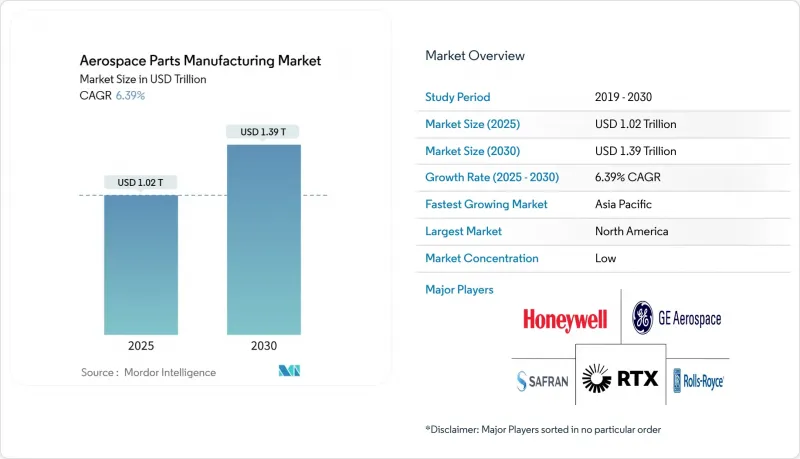
Mordor Intelligence에 의하면, 항공우주 부품 제조 시장 규모는 2025년에 1조 200억 달러가 되고, 2030년까지 1조 3,900억 달러에 이를 것으로 예측되며, 이것은 예측 기간 중 CAGR이 6.39%인 것을 의미합니다.
본 보고서는 제품 유형(엔진, 항공기 구조 부품, 객실 내장재, 항공전자 장비, 단열 부품 등), 소재(금속·합금, 복합재료, 플라스틱·폴리머 등), 항공기 유형(민간 항공기 등), 최종 사용자(OEM 및 애프터마켓),지역(북미, 유럽 등)별로 분류되어 있습니다. 시장 예측은 금액(달러) 기준으로 제시되어 있습니다.
전 세계 항공우주 부품 제조 시장 동향 및 인사이트
전 세계 항공 여객 수송량 증가
여객 수송량은 2024년에 급격히 회복되었으며, 2025년에도 상승세를 이어가고 있어 각 항공사는 수송 능력 확충과 기종 갱신을 불가피하게 추진하고 있습니다. 에어버스는 2024년에 766대의 항공기를 출하했으며, 여전히 6,290억 유로(7,461억 5,000만 달러)의 수주 잔고를 보유하고 있어, 장기적인 수요 전망의 확실성을 뒷받침하고 있습니다. 한편, B737 MAX 생산 라인은월25대 생산으로 안정세를 보이고 있으며, 공급 병목 현상이 해소되면 추가 증산이 계획되어 있습니다. 아시아태평양은 계속해서 성장의 핵심으로 자리 잡고 있으며, 중국에서만 2042년까지 운항 중인 항공기 수가 3배로 늘어날 것으로 예측됩니다. 이러한 확대는 엔진, 항공기 구조, 객실 시스템 등 관련 분야 전반에 파급될 것입니다. 높은 가동률은 애프터마켓을 활성화시킵니다. 왜냐하면 운항 주기가 늘어날수록 정비·수리·오버홀 작업량이 증가하여 항공우주 부품 제조 시장을 뒷받침하게 되기 때문입니다.
연료 효율 향상을 위한 기체 현대화 노력
각 항공사는 고바이패스비 엔진, 첨단 복합재료, 그리고 전동화가 진전된 아키텍처를 갖춘 차세대 모델로의 전환을 추진하며 구형 기체를 퇴역시키고 있습니다. 고온 부위에 세라믹 매트릭스 복합재료를 채택함으로써 허용 온도가 향상되고 중량이 감소하여, 기존 플랫폼에 비해 두 자릿수의 효율 향상이 가능해집니다. 항공사들이 이용 가능 좌석 마일당 비용 절감에 힘쓰는 가운데, 첨단 세라믹을 포함한 경량 소재는 연평균 성장률(CAGR) 7.75%를 기록하며 항공우주 부품 제조 시장 전체를 상회하는 성장세를 보이고 있습니다. 상용 항공기 함대의 약 4분의 3은 6-7년마다 기내 개조가 필요하기 때문에 신규 인도 항공기가 증가하는 상황에서도 객실용 부품에 대한 지속적인 수요가 발생하고 있습니다. 또한, 각 항공사가 승객 1인당 탄소 강도를 줄이려고 노력하는 가운데, 환경 규제로 인해 교체 주기가 더욱 가속화되고 있습니다.
국제적인 프로그램 전반에 걸쳐 증가하는 인증 및 규정 준수 비용
FAA, EASA 및 기타 규제 당국의 승인을 획득하기까지의 과정은 점점 더 길어지고 있으며, 비용도 치솟고 있습니다. 복잡한 조립품의 경우 FAA 파트 21 승인을 획득하는 데 100만 달러 이상의 비용이 소요될 수 있으며, 이와 병행하여 진행되는 EASA 및 캐나다 교통부 신청으로 인해 문서 작성 및 시험 요건이 더욱 증가하고 있습니다. 최근 발생한 안전 사고로 인해 심사가 엄격해지면서 일반적인 승인 주기에 수개월의 지연이 발생하고 있으며, 이러한 지연은 중소 공급업체의 현금 흐름에 부담을 주고 있습니다. 또한, 규정 준수 비용은 혁신의 걸림돌이 되고 있습니다. 새로운 설계는 점점 더 높아지는 검증 장벽에 직면하고 있어, 항공우주 부품 제조 시장에서 유망한 기술 시장 출시 시기가 지연될 가능성이 있습니다.
부문 분석
항공사 및 방위 기관이 추진 시스템의 효율성과 신뢰성을 우선시한 결과, 엔진은 항공우주 부품 제조 시장 규모에서 가장 큰 점유율을 차지하며 2024년 매출의 36.52%를 차지했습니다. 단일 통로 항공기 프로그램의 정비 입고 대수가 많고 정비 비용이 인상됨에 따라 안정적인 예비 부품 수요가 뒷받침되고 있습니다. 한편, 차세대 기어드 터보팬이나 오픈 팬과 같은 개념은 기체당 부품 명세서(BOM)의 확충을 약속하고 있습니다. 이 부문은 수십 년에 걸친 서비스 계약의 혜택을 받고 있어 지속적인 수익이 확보되며, 공급업체는 단기적인 수요 변동의 충격으로부터 보호받고 있습니다.
절대값으로는 훨씬 작은 규모인 단열 부품은 연평균 성장률(CAGR) 7.94%를 기록하며, 업계 전체 성장률을 크게 상회하고 있습니다. 이러한 수요는 국소적인 발열을 수반하는 ‘모어 일렉트릭(More Electric)’ 아키텍처와 엄격한 소음 규제가 요구되는 도시형 항공 모빌리티의 설계에서 기인합니다. TIGHITCO와 같은 전문 기업들은 배터리 컴파트먼트 및 항공전자 장비 베이용으로 경량이며 내화성이 뛰어난 단열 블랭킷을 출시하고 있습니다. 규제 당국이 기내 소음 및 열 성능에 관한 규제를 강화함에 따라, 단열재 제조업체가 차지하는 항공우주 부품 제조 시장 점유율은 확대될 전망입니다.
2024년 매출에서 금속 제품이 차지하는 비율은 46.23%로, 이는 엔진에 티타늄이 광범위하게 사용되고, 주 구조물에 알루미늄이 보급되며, 착륙 장치에 고장력 강철이 사용되고 있음을 반영합니다. 하우메트 에어로스페이스(Haumet Aerospace)는 2024년 엔진 제품 매출이 37억 3,500만 달러에 달했다고 보고했으며, 이는 단조 및 정밀 주조 합금 시장 규모를 여실히 보여줍니다. 금속은 필수적이지만, 각 공급업체들은 티타늄 공급 부족과 가격 변동에 어려움을 겪고 있어, 지역 차원의 가공 및 재활용 노력에 대한 관심이 높아지고 있습니다.
첨단 세라믹 및 세라믹 매트릭스 복합재료(CMC)는 연평균 성장률(CAGR) 7.75%로 가장 빠른 성장세를 보이고 있으며, 이는 GE 에어로스페이스가 더 높은 온도에서 운전이 가능한 CMC 터빈 슈라우드 및 노즐의 양산을 추진함에 따라 뒷받침되고 있습니다. 이러한 소재로 인한 항공우주 부품 제조 시장 규모는 여전히 소규모이지만, 설계 팀이 더 높은 추력 대 중량비를 추구함에 따라 빠르게 확대되고 있습니다.
지역별 분석
북미는 2024년 매출의 36.54%를 차지하고 있으며, 보잉, 록히드 마틴, 그리고 워싱턴주, 캘리포니아주, 남동부에 집적된 시스템 통합사업자들의 밀집된 네트워크가 이를 뒷받침하고 있습니다. 비용 경쟁력이 있는 니어쇼어링 거점으로서 멕시코의 부상은 지역의 자급자족을 심화시키고, USMCA(미국·멕시코·캐나다 협정)에 따른 무역상의 이점을 보완하는 동시에 물류 루프를 단축시키고 있습니다. 설비 투자는 계속해서 견조한 양상을 보이고 있으며, 하우멧 에어로스페이스의 고온 합금 생산 확대를 위한 3억 2,100만 달러 규모의 프로그램이 그 대표적인 예입니다. FAA의 인증 체계와 ITAR 규제는 업무 흐름의 복잡성을 형성하며, 수출 경쟁력을 유지하는 성숙한 품질 보증 문화를 조성하고 있습니다.
아시아태평양은 연평균 성장률(CAGR) 7.01%로 가장 빠르게 성장하는 지역이며, 2042년까지 항공기 보유 대수를 3배로 늘리겠다는 중국의 야심과 항공우주 제조의 현지화를 추진하는 인도의 정책에 힘입고 있습니다. 싱가포르의 고부가가치 MRO 생태계와 한국의 부품 제조 전문 지식이 깊이를 더하는 한편, 동남아시아 국가들은 세제 혜택을 활용하여 Tier 3 공급업체 유치를 위해 노력하고 있습니다. AVIC이나 힌두스탄 에어로노틱스와 같은 국내 유력 기업들은 기술 이전을 흡수하고 업계 최고 수준의 공정을 도입함으로써, 세계 공급망에서 지역 내 조달 비율을 점차 높이고 있습니다. 인력 부족과 규제 환경의 변화는 여전히 실행상의 장벽으로 남아 있습니다.
유럽은 에어버스, 엔진 분야의 사프란, 추진 장치 분야의 롤스로이스, 내장 분야의 딜 등 수많은 전문 기업을 통해 여전히 큰 존재감을 유지하고 있습니다. 에어버스 단독으로도 2024년 매출액은 692억 유로(821억 달러)에 달하며, A320의 생산량을월75대로 확대되고 있습니다. EASA(유럽항공안전청)의 환경 규제는 소재 혁신과 수명 주기 분석을 촉진하고 있지만, 브렉시트로 인해 영국과 유럽 대륙공급업체 간 무역 협정이 재편되고 있습니다. 중동 및 아프리카에서는 특히 걸프 지역 항공사들의 기단 확충 및 관련 MRO 사업에서 선택적인 강점을 보이고 있으나, 정치적·재정적 불확실성이 더 광범위한 확산을 억제하고 있습니다.
기타 혜택:
- 엑셀 형식 시장 예측(ME) 시트
- 3개월간의 애널리스트 지원
자주 묻는 질문
목차
제1장 서론
제2장 조사 방법
제3장 개요
제4장 시장 구도
제5장 시장 규모와 성장 예측
제6장 경쟁 구도
제7장 시장 기회와 향후 전망
JHS 26.09.01According to Mordor Intelligence, the aerospace parts manufacturing market size stood at USD 1.02 trillion in 2025 and is projected to reach USD 1.39 trillion by 2030, translating into a 6.39% CAGR over the forecast period.
This report is Segmented by Product Type (Engines, Aerostructures, Cabin Interiors, Avionics, Insulation Components, and More), Material (Metals and Alloys, Composites, Plastics and Polymers, and More), Aircraft Type (Commercial Aviation, and More), End User (OEM and Aftermarket), and Geography (North America, Europe, and More). The Market Forecasts are Provided in Terms of Value (USD).
Global Aerospace Parts Manufacturing Market Trends and Insights
Growth in Worldwide Air Passenger Traffic
Passenger traffic rebounded sharply in 2024 and continues climbing in 2025, forcing airlines to add capacity and upgrade fleets. Airbus shipped 766 aircraft in 2024 and still holds a EUR 629 billion (USD 746.15 billion) backlog, underscoring long-dated demand visibility. Meanwhile, the B737 MAX line is stabilizing at 25 units per month, with further upside planned as supply bottlenecks clear. Asia-Pacific remains the pivot for incremental growth, as China alone is expected to triple its active fleet by 2042-an expansion that cascades across engines, aerostructures, and cabin systems. High utilization also lifts the aftermarket because more cycles translate into heavier maintenance, repair, and overhaul workloads, supporting the Aerospace Parts Manufacturing Market.
Fleet Modernization Efforts to Enhance Fuel Efficiency
Airlines are retiring older airframes in favor of next-generation models equipped with high-bypass engines, advanced composites, and more-electric architectures. Ceramic matrix composites in hot sections elevate allowable temperatures and trim weight, enabling double-digit efficiency gains over legacy platforms. Lightweight materials, including advanced ceramics, are registering a 7.75% CAGR growth-outpacing the broader aerospace parts manufacturing market as operators strive to lower cost per available seat-mile. Around three-quarters of commercial fleets will require interior refits every six to seven years, creating sustained pull for cabin components even as new deliveries rise. Environmental regulations further accelerate replacement cycles as carriers look to cut carbon intensity per passenger.
Escalating Certification and Compliance Costs Across International Programs
The path to FAA, EASA, and other regulatory approvals is becoming longer and costlier. Achieving FAA Part 21 clearance on a complex assembly can exceed USD 1 million, while parallel EASA and Transport Canada submissions multiply documentation and testing requirements. Greater scrutiny after recent safety incidents has added several months to typical approval cycles, a delay that strains smaller suppliers' cash flows. Compliance costs also weigh on innovation because new designs face an increasingly expensive validation hurdle, potentially stalling time-to-market for promising technologies in the Aerospace Parts Manufacturing Market.
Other drivers and restraints analyzed in the detailed report include:
- Expansion of Global Defense Procurement Programs
- Rising Adoption of Lightweight and Advanced Materials
- Global Shortages of Skilled Labor and Associated Capital Investment Burdens
For complete list of drivers and restraints, kindly check the Table Of Contents.
Segment Analysis
Engines generated the largest slice of the aerospace parts manufacturing market size, delivering 36.52% of 2024 sales as airlines and defense forces prioritized propulsion efficiency and reliability. High shop-visit volumes and rate hikes on single-aisle programs support a steady spare-parts stream, while next-generation geared turbofan and open-fan concepts promise richer bill-of-materials per unit. The segment benefits from multi-decade service agreements that lock in recurring revenue and shield suppliers from short-term traffic shocks.
Though much smaller in absolute value, insulation components are on track for a 7.94% CAGR-well ahead of industry growth. Demand stems from more-electric architectures that generate localized heat and urban air-mobility designs requiring tight acoustic footprints. Specialized players like TIGHITCO have introduced lightweight, fire-resistant blankets for battery compartments and avionics bays. As regulatory bodies tighten cabin noise and thermal performance rules, the aerospace parts manufacturing market share captured by insulation providers will likely increase.
Metallic content accounted for 46.23% of 2024 revenue, reflecting titanium's ubiquity in engines, aluminum's prevalence in primary structures, and high-strength steels in landing gear. Howmet Aerospace reported USD 3.735 billion in 2024 engine-product sales, exemplifying the scale in forged and precision-cast alloys. While metals are indispensable, suppliers grapple with titanium bottlenecks and price volatility, sparking interest in regional processing and recycling initiatives.
Advanced ceramics and ceramic matrix composites exhibit the fastest expansion at a 7.75% CAGR, leveraged by GE Aerospace's serial production of CMC turbine shrouds and nozzles that permit hotter operating temperatures. The aerospace parts manufacturing market size attributed to these materials is still modest but rising swiftly as design teams chase higher thrust-to-weight ratios.
Complete Report Scope:
- By Product Type
- Engines
- Aerostructures
- Cabin Interiors
- Support Equipment
- Avionics
- Insulation Components
- By Material
- Metals and Alloys
- Composites
- Plastics and Polymers
- Advanced Ceramics and Ceramic Matrix Composites (CMCs)
- By Aircraft Type
- Commercial Aviation
- Military Aviation
- General Aviation
- Unmanned Aerial Systems (UAS)
- Advanced Air Mobility (AAM)
- By End User
- Original Equipment Manufacturer (OEM)
- Aftermarket
- By Geography
- North America
- United States
- Canada
- Mexico
- Europe
- United Kingdom
- France
- Germany
- Italy
- Spain
- Rest of Europe
- Asia-Pacific
- China
- India
- Japan
- South Korea
- Australia
- Rest of Asia-Pacific
- South America
- Brazil
- Rest of South America
- Middle East and Africa
- Middle East
- Saudi Arabia
- United Arab Emirates
- Rest of Middle East
- Africa
- South Africa
- Rest of Africa
- Middle East
- North America
Geography Analysis
North America accounted for 36.54% of 2024 revenue, underpinned by Boeing, Lockheed Martin, and a dense network of systems integrators clustered in Washington, California, and the Southeast.Mexico's emergence as a cost-competitive nearshoring hub deepens regional self-sufficiency, complementing USMCA trade benefits and shortening logistics loops. Capital spending remains robust, exemplified by Howmet Aerospace's USD 321 million program to expand high-temperature alloy production. FAA certification frameworks and ITAR regulations shape workflow complexity and nurture a mature quality-assurance culture that sustains export competitiveness.
Asia-Pacific is the fastest-growing region at 7.01% CAGR, anchored by China's ambition to triple its fleet by 2042 and India's policy push to localize aerospace manufacturing. Singapore's high-value MRO ecosystem and South Korea's component expertise add depth, while Southeast Asian nations court Tier-3 suppliers with tax incentives. Domestic champions such as AVIC and Hindustan Aeronautics absorb technology transfers and replicate best-in-class processes, gradually boosting regional content in global supply chains. Talent shortages and evolving regulatory alignments remain execution hurdles.
Europe maintains significant weight through Airbus and an array of specialty houses-Safran in engines, Rolls-Royce in propulsion, and Diehl in interiors. Airbus alone delivered EUR 69.2 billion (USD 82.10 billion) in 2024 revenue and is scaling A320 output to 75 units monthly. EASA environmental mandates spur material innovation and life-cycle analyses, while Brexit reshapes trade protocols between the UK and continental suppliers. The Middle East and Africa show selective strength, most notably in Gulf carrier fleet additions and associated MRO ventures, yet political and fiscal uncertainties temper broader uptake.
- RTX Corporation
- Safran SA
- GE Aerospace (General Electric Company)
- Rolls-Royce Holdings plc
- Honeywell International Inc.
- GKN Aerospace (Melrose Industries plc)
- Parker-Hannifin Corporation
- Mitsubishi Heavy Industries, Ltd.
- Leonardo S.p.A.
- Triumph Group, Inc.
- ATI Inc.
- Hexcel Corporation
- Toray TCAC Holding B.V
- Eaton Corporation plc
- Moog Inc.
- Panasonic Avionics Corporation (Panasonic Corporation)
- Liebherr-International Deutschland GmbH
- RBC Bearings Incorporated
Additional Benefits:
- The market estimate (ME) sheet in Excel format
- 3 months of analyst support
TABLE OF CONTENTS
1 INTRODUCTION
- 1.1 Study Assumptions and Market Definition
- 1.2 Scope of the Study
2 RESEARCH METHODOLOGY
3 EXECUTIVE SUMMARY
4 MARKET LANDSCAPE
- 4.1 Market Overview
- 4.2 Market Drivers
- 4.2.1 Growth in worldwide air passenger traffic
- 4.2.2 Fleet modernization efforts to enhance fuel efficiency
- 4.2.3 Expansion of global defense procurement programs
- 4.2.4 Rising adoption of lightweight and advanced materials
- 4.2.5 Establishment of additive manufacturing hubs across aerospace supply chains
- 4.2.6 Nearshoring incentives for critical alloys
- 4.3 Market Restraints
- 4.3.1 Escalating certification and compliance costs across international programs
- 4.3.2 Global shortages of skilled labor and associated capital investment burdens
- 4.3.3 Volatility in worldwide supply of critical minerals
- 4.3.4 Long-term reduction in parts demand due to aircraft electrification trends
- 4.4 Supply Chain Analysis
- 4.5 Regulatory Landscape
- 4.6 Technological Outlook
- 4.7 Porter's Five Forces Analysis
- 4.7.1 Bargaining Power of Buyers
- 4.7.2 Bargaining Power of Suppliers
- 4.7.3 Threat of New Entrants
- 4.7.4 Threat of Substitutes
- 4.7.5 Intensity of Competitive Rivalry
5 MARKET SIZE AND GROWTH FORECASTS (VALUE)
- 5.1 By Product Type
- 5.1.1 Engines
- 5.1.2 Aerostructures
- 5.1.3 Cabin Interiors
- 5.1.4 Support Equipment
- 5.1.5 Avionics
- 5.1.6 Insulation Components
- 5.2 By Material
- 5.2.1 Metals and Alloys
- 5.2.2 Composites
- 5.2.3 Plastics and Polymers
- 5.2.4 Advanced Ceramics and Ceramic Matrix Composites (CMCs)
- 5.3 By Aircraft Type
- 5.3.1 Commercial Aviation
- 5.3.2 Military Aviation
- 5.3.3 General Aviation
- 5.3.4 Unmanned Aerial Systems (UAS)
- 5.3.5 Advanced Air Mobility (AAM)
- 5.4 By End User
- 5.4.1 Original Equipment Manufacturer (OEM)
- 5.4.2 Aftermarket
- 5.5 By Geography
- 5.5.1 North America
- 5.5.1.1 United States
- 5.5.1.2 Canada
- 5.5.1.3 Mexico
- 5.5.2 Europe
- 5.5.2.1 United Kingdom
- 5.5.2.2 France
- 5.5.2.3 Germany
- 5.5.2.4 Italy
- 5.5.2.5 Spain
- 5.5.2.6 Rest of Europe
- 5.5.3 Asia-Pacific
- 5.5.3.1 China
- 5.5.3.2 India
- 5.5.3.3 Japan
- 5.5.3.4 South Korea
- 5.5.3.5 Australia
- 5.5.3.6 Rest of Asia-Pacific
- 5.5.4 South America
- 5.5.4.1 Brazil
- 5.5.4.2 Rest of South America
- 5.5.5 Middle East and Africa
- 5.5.5.1 Middle East
- 5.5.5.1.1 Saudi Arabia
- 5.5.5.1.2 United Arab Emirates
- 5.5.5.1.3 Rest of Middle East
- 5.5.5.2 Africa
- 5.5.5.2.1 South Africa
- 5.5.5.2.2 Rest of Africa
- 5.5.5.1 Middle East
- 5.5.1 North America
6 COMPETITIVE LANDSCAPE
- 6.1 Market Concentration
- 6.2 Strategic Moves
- 6.3 Market Share Analysis
- 6.4 Company Profiles (includes Global level Overview, Market level overview, Core Segments, Financials as available, Strategic Information, Market Rank/Share, Products and Services, Recent Developments)
- 6.4.1 RTX Corporation
- 6.4.2 Safran SA
- 6.4.3 GE Aerospace (General Electric Company)
- 6.4.4 Rolls-Royce Holdings plc
- 6.4.5 Honeywell International Inc.
- 6.4.6 GKN Aerospace (Melrose Industries plc)
- 6.4.7 Parker-Hannifin Corporation
- 6.4.8 Mitsubishi Heavy Industries, Ltd.
- 6.4.9 Leonardo S.p.A.
- 6.4.10 Triumph Group, Inc.
- 6.4.11 ATI Inc.
- 6.4.12 Hexcel Corporation
- 6.4.13 Toray TCAC Holding B.V
- 6.4.14 Eaton Corporation plc
- 6.4.15 Moog Inc.
- 6.4.16 Panasonic Avionics Corporation (Panasonic Corporation)
- 6.4.17 Liebherr-International Deutschland GmbH
- 6.4.18 RBC Bearings Incorporated
7 MARKET OPPORTUNITIES AND FUTURE OUTLOOK
- 7.1 White-space and Unmet-Need Assessment


