

|
시장보고서
상품코드
2117446
태국의 타이어 시장 : 점유율 분석, 산업 동향 및 통계 데이터, 성장 예측(2026-2031년)Thailand Tire - Market Share Analysis, Industry Trends & Statistics, Growth Forecasts (2026 - 2031) |
||||||
 Mordor Intelligence
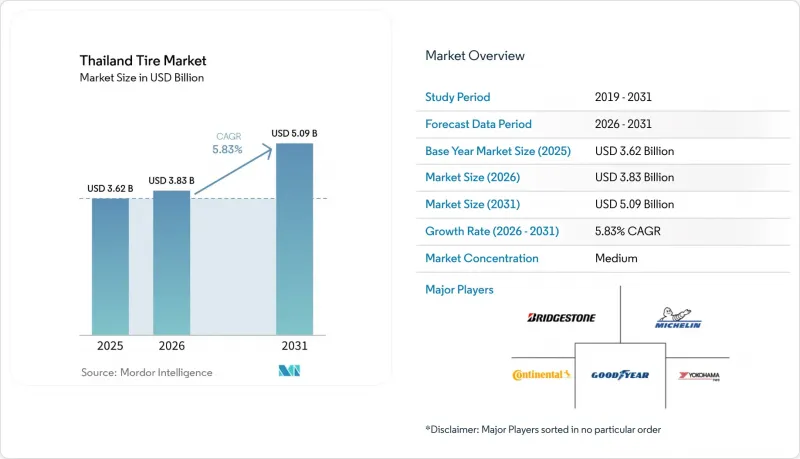
Mordor Intelligence에 의하면, 태국 타이어 시장 규모는 2025년에 36억 2,000만 달러로 평가되었고 2026년에는 38억 3,000만 달러로 추정되고 있습니다.
또한 2031년까지 50억 9,000만 달러에 달할 것으로 예측되며, 2026년부터 2031년까지 연평균 성장률(CAGR) 5.83%로 성장할 것으로 전망됩니다.
본 보고서는 계절별(여름용, 기타), 타이어 구조별(레이디얼, 바이애스, 기타), 차종별(이륜차, 승용차, 기타),용도(온로드, 오프로드), 최종 사용자(OEM, 애프터마켓), 림 크기(15인치 미만, 15-20인치, 20인치 이상), 구동 방식(내연기관 차량 등)별로 분류되어 있습니다. 시장 예측은 금액(미 달러) 및 수량(단위)으로 제시되어 있습니다.
태국 타이어 시장 동향 및 인사이트
정부의 전기차(EV) 보조금 프로그램이 BEV용 타이어 수요를 견인
50,000바트(약 1,500달러)에서 100,000바트(약 3,000달러)의 보조금을 지급하고, 소비세를 최저 수준으로 인하하는 태국의 ‘EV 3.5’정책에 따라 전기차 등록 대수는 40% 증가할 것으로 전망됩니다. 배터리 팩의 무게 증가에 따라 자동차 제조업체들은 성능 및 효율성 요건을 충족하기 위해 하중 정격이 40% 높은 타이어나 초저회전저항 컴파운드를 채택할 수밖에 없게 되었습니다. 또한, 2026년 12월까지 수입차 1대당 여러 대의 차량을 국내에서 제조하도록 의무화하는 현지 조립 요건에 따라 BYD와 GAC Aion 같은 주요 기업들이 시장에 진입하고 있습니다. 이들 기업은 태국 내에서 총 약 20만 대의 생산 능력을 확보하고 있습니다. 촘부리 주와 라용 주에 생산 시설이 집중되어 있어, 인근 타이어 제조 공장들은 안정적이고 예측 가능한 수요를 확보하고 있습니다. 또한, 공공 급속 충전 인프라의 지속적인 확충은 방콕 이외 지역에서의 전기차 보급률을 좌우하는 중요한 요인이 되어, 전국적인 전기차 보급에 큰 영향을 미칠 것으로 전망됩니다.
전자상거래의 급속한 성장이 라스트 마일용 LCV 타이어 판매량을 견인
태국의 전자상거래 매출은 두 자릿수 성장률을 유지하고 있으며, Grab이나 Skootar와 같은 플랫폼은 오토바이와 소형 밴을 도입하여 사업을 확장하고 있습니다. 이러한 차량은 보통 하루 8-12시간 가동되며, 방콕의 정체된 교통 상황에서 평균 43킬로미터를 주행합니다. 이러한 높은 가동률로 인해 타이어 교체 주기가 빨라지고, 그 결과 소형 상용차 및 이륜차용 타이어 수요가 증가하고 있습니다. 플릿 운영 사업자들은 운영 효율을 최적화하기 위해 내구성이 뛰어난 타이어 컴파운드와 주행 거리 연장 보증을 점차 중요시하고 있습니다. 그러나 사업자 측의 가격 민감도로 인해 초고급 타이어의 보급에는 한계가 있습니다. 그 결과, 도시 물류는 중견 레이디얼 타이어 제조업체들에게 큰 성장 기회를 제공합니다. 동시에, 프리미엄 타이어 브랜드에게는 차량 관리 서비스 계약을 시범 운영할 기회가 되어, 차량 관리 사업자에게 총소유비용(TCO) 절감 효과를 효과적으로 입증할 수 있게 됩니다.
천연고무 가격 변동성 증가
2025년 초, 생산자들이 새로 개간된 토지에서 생산된 원료의 수입을 제한하는 유럽연합(EU)의 산림 파괴 규제를 준수하기 위한 노력을 가속화함에 따라, 벤치마크인 RSS-3 고무 가격은 12년 만에 최고치를 기록했습니다. 태국의 타이어 제조업체들은 고무 농장과 지리적으로 가까운 점을 강점으로 삼고 있지만, 여전히 원자재 비용 급등에 직면해 있습니다. 이러한 문제가 발생하는 이유는 특히 대형 트럭이나 항공기 분야와 같은 주요 용도에서 합성 대체재가 천연 고무를 완전히 대체할 수 없기 때문입니다. 주요 프리미엄 브랜드들은 장기 공급 계약 체결 및 첨단 디지털 추적성 도구 도입을 통해 이러한 위험을 완화하고 있습니다. 이러한 대책에도 불구하고, 가격에 민감한 국내 시장에서는 비용 상승분을 소비자에게 전가할 여지가 제한적이기 때문에 이익률에 대한 압박은 여전히 큰 상태입니다. 게다가 환율 변동이 시장의 변동성을 가중시키고 있습니다. 바트화 약세로 인해 달러로 표시된 원자재 청구서 비용이 증가하면서, 공급망 동향에 더욱 복잡성이 더해지고 있습니다.
부문별 분석
2025년, 태국 타이어 시장에서 사계절용 타이어는 53.24%를 차지했습니다. 이는 계절마다 타이어를 교체할 필요가 없는 태국의 안정적인 열대 기후에 힘입은 결과입니다. 한편, 겨울용 타이어 출하량은 2031년까지 연평균 성장률(CAGR) 5.85%로 증가할 것으로 예측됩니다. 이러한 성장은 주로 유럽 및 북미 시장을 겨냥한 수출 계약에 기인합니다. 생산량 증가는 태국 타이어 시장 규모 확대에 기여할 뿐만 아니라, 공장 가동률을 높이고 첨단 전문 가황 프레스에 대한 투자를 촉진하고 있습니다. 특히 콘티넨탈은 라용 공장을 확장하여 EU 규제 요건을 준수하는 스터드 장착 가능 겨울용 타이어 생산에 여러 가황 라인을 할당하고 있습니다.
수출 중심의 겨울용 타이어 생산은 태국의 제조 시설이 규모의 경제를 얼마나 효과적으로 활용하고 있는지를 여실히 보여주고 있지만, 반면 국내 소비자들은 여전히 사계절용 타이어를 선호하고 있습니다. 자동차 애호가와 고급 수입차 소유자로 구성된 틈새 시장에서는 여름용 고성능 타이어가 선택되고 있으며, 규모는 작지만 수익성이 높은 시장 채널을 형성하고 있습니다. 또한, 태국산 사계절용 타이어는 높은 실리카 함량을 특징으로 하는 몬순 대응 컴파운드를 통해 기름으로 미끄러운 노면에서도 뛰어난 젖은 노면 그립 성능을 발휘함으로써 차별화를 꾀하고 있습니다. 이러한 안정적인 내수 수요와 수출 다각화의 조합이 다양한 계절용 타이어 카테고리에 걸친 생산 능력의 회복력과 효율적인 활용을 뒷받침하고 있습니다.
2025년, 태국 타이어 시장에서 레이디얼 카카스가 87.65%를 차지하고 있으며, 이는 태국이 스틸 벨트, 코드 패브릭, 정밀 성형 분야에서 견고한 인프라를 보유하고 있음을 뒷받침합니다. 비공기식(에어리스) 타이어는 2031년까지 연평균 성장률(CAGR) 5.87%를 나타낼 것으로 예측됩니다. 브리지스톤은 방콕의 BRT 노선에서 에어리스 버스용 타이어 시범 프로그램을 시작했으며, 미쉐린은 농업용 ‘Tweel’ 플랫폼을 시험하고 있습니다. 바이애스 플라이 구조의 타이어는 고속 성능보다 비용 효율성과 수리 용이성이 여전히 중요시되는 틈새 시장인 농업 및 광업 분야에서 계속해서 그 존재 가치를 유지하고 있습니다.
고강도 아라미드 및 친환경 수지 매트릭스에 대한 투자를 통해, 태국의 제조 시설은 현재의 상용화 장벽을 극복할 수만 있다면 차세대 에어리스 타이어 생산을 확대할 수 있는 태세를 갖추고 있습니다. 동시에, 각 레이디얼 타이어 제조업체들은 OEM(Original Equipment Manufacturer)의 탄소 배출 감축 목표에 부응하여, 구름 저항을 최대 15%까지 줄일 수 있는 더 가볍고 친환경적인 복합 소재 개발에 주력하고 있습니다. 대학과 공급업체 간의 국내 연구개발(R&D) 협력에서는 태국의 라텍스 수출을 원료로 한 바이오 엘라스토머의 개발이 중점적으로 다루어지고 있습니다. 이러한 노력은 공급망의 자립성을 높이는 동시에, 전체 수명 주기 동안의 배출량을 대폭 감축하는 것을 목표로 하고 있습니다.
2025년 태국 타이어 시장에서 승용차용 타이어의 점유율은 45.54%로 큰 비중을 차지했습니다. 이 부문은 2031년까지 연평균 성장률(CAGR) 5.91%를 나타낼 것으로 예측되며, 시장 확대의 주요 원동력으로서의 입지를 강화할 전망입니다. 이 부문은 은행의 대출 정책 긴축으로 인해 2024년 자동차 조립 대수가 20% 감소한 상황에서도 뚜렷한 회복력을 보여주었습니다. 전자상거래의 부상으로 소형 상용차 수요가 크게 증가한 반면, 대형 트럭은 말레이시아 및 캄보디아와의 국경 간 무역 활동 회복의 혜택을 받고 있습니다.
오토바이용 타이어는 태국의 이륜차 생산 확대에 힘입어 계속해서 중요한 부문으로 남아 있으며, 2025년에는 비약적인 성장이 예상됩니다. 오프로드용 타이어 수요는 계속해서 상품 주기의 동향과 연동되고 있습니다. 피칫 주의 광업 회복과 나콘사완 주의 농업 기계화 진전이 이러한 특수 부문의 성장을 뒷받침하고 있습니다. 각 타이어 제조업체들은 대량 생산되는 승용차용 타이어 라인업과 수익성이 높은 특수 제품 간의 균형을 맞추면서 제품 포트폴리오를 전략적으로 재검토하고 있습니다. 이러한 접근 방식을 통해 시장이 침체된 시기에도 수익을 안정화하고 수익성을 유지할 수 있습니다.
기타 혜택:
- Excel 형식 시장 예측(ME) 시트
- 3개월간의 애널리스트 지원
자주 묻는 질문
목차
제1장 서론
제2장 분석 방법
제3장 주요 요약
제4장 시장 구도
제5장 시장 규모·성장률 예측
제6장 경쟁 구도
제7장 시장 기회와 향후 전망
JHS 26.09.03According to Mordor Intelligence, the Thailand tire market size was valued at USD 3.62 billion in 2025 and is estimated at USD 3.83 billion in 2026, and is projected to reach USD 5.09 billion by 2031, growing at a CAGR of 5.83% from 2026 to 2031.
This report is Segmented by Season (Summer and More), Tire Design (Radial, Bias, and More), Vehicle Type (Two-Wheelers, Passenger Cars and More), Application (On-Road and Off-Road), End User (OEM and Aftermarket), Rim Size (Below 15 Inches, 15 To 20 Inches, and Above 20 Inches), and Propulsion (Internal-Combustion Vehicles and More). The Market Forecasts are Provided in Terms of Value (USD) and Volume (Units).
Thailand Tire Market Trends and Insights
Government EV-Subsidy Program Boosting BEV Tire Demand
Thailand's EV 3.5 policy, which provides subsidies ranging from THB 50,000 (approximately USD 1,500) to THB 100,000 (approximately USD 3,000) and reduces excise taxes to their minimum levels, is anticipated to drive a 40% increase in EV registrations. The growing weight of battery packs has compelled automakers to adopt tires with a 40% higher load rating and ultra-low rolling resistance compounds to meet performance and efficiency requirements. Additionally, the local-assembly mandate, which stipulates that multiple vehicles must be manufactured domestically for every imported unit by December 2026, has attracted key players such as BYD and GAC Aion. These companies have collectively established a production capacity of nearly 200,000 units in Thailand. The concentration of production facilities in Chonburi and Rayong ensures a steady and predictable demand for nearby tire manufacturing plants. Furthermore, the ongoing expansion of public fast-charging infrastructure will be a critical factor in determining the extent of EV penetration beyond Bangkok, influencing the broader adoption of electric vehicles across the country.
Rapid E-Commerce Growth Driving Last-Mile LCV Tire Volumes
Thailand's e-commerce turnover continues to grow at double-digit rates, driving platforms such as Grab and Skootar to expand their operations by deploying motorcycles and small vans. These vehicles typically operate for 8-12 hours daily and cover an average of 43 kilometers in Bangkok's congested traffic conditions. This high level of utilization accelerates replacement cycles, thereby increasing demand for light commercial and two-wheeler tires. Fleet operators are progressively prioritizing high-durability tire compounds and extended mileage warranties to optimize operational efficiency. However, price sensitivity among operators limits the widespread adoption of ultra-premium tire options. As a result, urban logistics provides substantial growth opportunities for medium-tier radial tire manufacturers. Simultaneously, it enables premium tire brands to test fleet-service contracts, effectively demonstrating potential savings in total cost-of-ownership to fleet operators.
Elevated Natural-Rubber Price Volatility
In early 2025, benchmark RSS-3 rubber prices reached a 12-year high as producers accelerated efforts to comply with the European Union's deforestation regulations, which restrict imports sourced from newly cleared lands. Thai tire manufacturers benefit from their geographical proximity to rubber plantations; however, they continue to face elevated feedstock costs. This challenge arises because synthetic alternatives are unable to fully replace natural rubber, particularly in critical applications such as heavy-duty truck and aviation sectors. Leading premium brands mitigate these risks through long-term supply contracts and the implementation of advanced digital traceability tools. Despite these measures, margin pressures remain significant in price-sensitive domestic markets, where the ability to pass on increased costs to consumers is limited. Furthermore, currency fluctuations exacerbate market volatility, as a weakening baht inflates the cost of dollar-denominated raw material invoices, adding another layer of complexity to the supply chain dynamics.
Other drivers and restraints analyzed in the detailed report include:
- Tourism Rebound Accelerating Rental-Car Fleet Renewals
- OEM Shifts to Larger Rim Sizes for SUVs and Pickups
- Counterfeit and Grey-Market Tires Eroding Branded Sales
For complete list of drivers and restraints, kindly check the Table Of Contents.
Segment Analysis
In 2025, all-season tires accounted for 53.24% of the Thailand tire market, driven by the country's consistent tropical climate, which eliminates the necessity for seasonal tire changes. Conversely, winter tire shipments are projected to grow at a CAGR of 5.85% through 2031. This growth is primarily attributed to export contracts targeting markets in Europe and North America. The increase in production not only contributes to the expansion of Thailand's tire market size but also enhances factory load factors and supports investments in advanced, specialized curing presses. Notably, Continental has expanded its Rayong facility, dedicating multiple curing lines to the production of studdable winter tire designs that comply with EU regulatory mandates.
Export-driven winter tire production highlights how Thai manufacturing facilities effectively leverage economies of scale, while domestic consumers continue to favor all-season tires. A niche segment comprising automotive enthusiasts and luxury import owners opts for summer performance tires, representing a small yet profitable market channel. Additionally, Thai all-season tires distinguish themselves with monsoon-grade compounds featuring high silica content, which deliver superior wet grip performance on oil-slick roads. This combination of stable domestic demand and export diversification underpins the resilience and efficient utilization of production capacity across various seasonal tire categories.
In 2025, radial casings accounted for 87.65% of Thailand's tire market, underscoring the country's robust infrastructure in steel belts, cord fabric, and precision molding. Non-pneumatic airless designs are anticipated to grow at a CAGR of 5.87% through 2031. Bridgestone has initiated pilot programs for airless bus tires on Bangkok's BRT routes, while Michelin is conducting tests on Tweel platforms for agricultural applications. Bias-ply formats continue to maintain relevance in niche agriculture and mining sectors, where cost-effectiveness and repairability remain more critical than high-speed performance.
Investments in high-strength aramid and eco-friendly resin matrices are positioning Thai manufacturing facilities to scale up production of next-generation airless tires, contingent on overcoming current commercialization barriers. Simultaneously, radial tire producers are focusing on developing lighter, environmentally friendly composites that can reduce rolling resistance by up to 15%, aligning with the carbon-reduction objectives of original equipment manufacturers (OEMs). Domestic R&D collaborations between universities and suppliers are emphasizing the development of bio-based elastomers derived from Thailand's latex exports. These initiatives aim to enhance supply chain independence while significantly reducing lifecycle emissions.
In 2025, passenger-car fitments accounted for a significant 45.54% share of Thailand's tire market. The segment is projected to grow at a 5.91% CAGR through 2031, reinforcing its position as the primary contributor to the market's expansion. This segment has demonstrated notable resilience, even amidst a 20% decline in auto assemblies in 2024, driven by tightened credit policies from banks. The rise of e-commerce has significantly boosted demand for light commercial vehicles, while heavy trucks have benefited from the recovery of cross-border trade activities with Malaysia and Cambodia.
Motorcycle tires remain a critical segment, supported by Thailand's growing two-wheeler production, which is anticipated to experience exponential growth in 2025. The demand for off-the-road tires continues to align with commodity cycles; the mining recovery in Phichit and increased agricultural mechanization in Nakhon Sawan are sustaining growth in these specialty segments. Tire manufacturers are strategically refining their product portfolios, balancing high-volume passenger tire lines with higher-margin specialty products. This approach enables them to stabilize earnings and maintain profitability during periods of market downturns.
Complete Report Scope:
- By Season
- Summer
- Winter
- All-Season
- By Tire Design
- Radial
- Bias
- Non-pneumatic/Airless
- By Vehicle Type
- Two-Wheelers
- Passenger Cars
- Light Commercial Vehicles
- Heavy Commercial Trucks and Buses
- Off-the-Road and Specialty (OTR, Agriculture, Mining, Racing)
- By Application
- On-Road
- Off-Road
- By End User
- OEM
- Aftermarket
- By Rim Size
- Below 15 inches
- 15 - 20 inches
- Above 20 inches
- By Propulsion
- Internal-Combustion Vehicles
- Battery-Electric Vehicles
- Hybrid and Fuel-Cell Vehicles
List of Companies Covered in this Report:
- Bridgestone Corp.
- Michelin SCA
- Goodyear Tire & Rubber Co.
- Yokohama Rubber Co.
- Sumitomo Rubber Industries (Dunlop/Falken)
- Pirelli & C. S.p.A.
- Continental AG
- Hankook Tire & Technology
- Kumho Tire Co.
- Toyo Tire Corp.
- Maxxis International (Cheng Shin)
- Giti Tire Pte.
- Apollo Tyres Ltd.
- Nokian Tyres
- Triangle Tyre Co.
- Linglong Tire
- CEAT Ltd.
- Balkrishna Industries (BKT)
- Titan International
- Zhongce Rubber (Westlake)
- PT Multistrada Arah Sarana (Achilles)
Additional Benefits:
- The market estimate (ME) sheet in Excel format
- 3 months of analyst support
TABLE OF CONTENTS
1 Introduction
- 1.1 Study Assumptions and Market Definition
- 1.2 Scope of the Study
2 Research Methodology
3 Executive Summary
4 Market Landscape
- 4.1 Market Overview
- 4.2 Market Drivers
- 4.2.1 Government EV-Subsidy Program Boosting BEV Tire Demand
- 4.2.2 Rapid E-Commerce Growth Driving Last-Mile LCV Tire Volumes
- 4.2.3 Tourism Rebound Accelerating Rental-Car Fleet Renewals
- 4.2.4 OEM Shift to Larger Rim Sizes for SUVs and Pickups
- 4.2.5 Rise of Ride-Hailing Two-Wheeler Fleets Demanding High-Durability Tires
- 4.2.6 Mandatory Tire-Labeling Regulations (2025) Favoring Premium Radials
- 4.3 Market Restraints
- 4.3.1 Elevated Natural-Rubber Price Volatility
- 4.3.2 Counterfeit and Grey-Market Tires Eroding Branded Sales
- 4.3.3 High Import Duty on Specialty OTR Tires
- 4.3.4 Slow Deployment of Public Fast-Charging Limiting BEV Tire Uptake
- 4.4 Value/Supply-Chain Analysis
- 4.5 Regulatory Landscape
- 4.6 Technological Outlook
- 4.7 Porter's Five Forces
- 4.7.1 Threat of New Entrants
- 4.7.2 Bargaining Power of Suppliers
- 4.7.3 Bargaining Power of Buyers
- 4.7.4 Threat of Substitutes
- 4.7.5 Competitive Rivalry
5 Market Size and Growth Forecasts (Value (USD) and Volume (Units))
- 5.1 By Season
- 5.1.1 Summer
- 5.1.2 Winter
- 5.1.3 All-Season
- 5.2 By Tire Design
- 5.2.1 Radial
- 5.2.2 Bias
- 5.2.3 Non-pneumatic/Airless
- 5.3 By Vehicle Type
- 5.3.1 Two-Wheelers
- 5.3.2 Passenger Cars
- 5.3.3 Light Commercial Vehicles
- 5.3.4 Heavy Commercial Trucks and Buses
- 5.3.5 Off-the-Road and Specialty (OTR, Agriculture, Mining, Racing)
- 5.4 By Application
- 5.4.1 On-Road
- 5.4.2 Off-Road
- 5.5 By End User
- 5.5.1 OEM
- 5.5.2 Aftermarket
- 5.6 By Rim Size
- 5.6.1 Below 15 inches
- 5.6.2 15 - 20 inches
- 5.6.3 Above 20 inches
- 5.7 By Propulsion
- 5.7.1 Internal-Combustion Vehicles
- 5.7.2 Battery-Electric Vehicles
- 5.7.3 Hybrid and Fuel-Cell Vehicles
6 Competitive Landscape
- 6.1 Market Concentration
- 6.2 Strategic Moves
- 6.3 Market Share Analysis
- 6.4 Company Profiles (Includes Global Level Overview, Market Level Overview, Core Segments, Financials as Available, Strategic Information, Market Rank/Share for Key Companies, Products and Services, SWOT Analysis, and Recent Developments)
- 6.4.1 Bridgestone Corp.
- 6.4.2 Michelin SCA
- 6.4.3 Goodyear Tire & Rubber Co.
- 6.4.4 Yokohama Rubber Co.
- 6.4.5 Sumitomo Rubber Industries (Dunlop/Falken)
- 6.4.6 Pirelli & C. S.p.A.
- 6.4.7 Continental AG
- 6.4.8 Hankook Tire & Technology
- 6.4.9 Kumho Tire Co.
- 6.4.10 Toyo Tire Corp.
- 6.4.11 Maxxis International (Cheng Shin)
- 6.4.12 Giti Tire Pte.
- 6.4.13 Apollo Tyres Ltd.
- 6.4.14 Nokian Tyres
- 6.4.15 Triangle Tyre Co.
- 6.4.16 Linglong Tire
- 6.4.17 CEAT Ltd.
- 6.4.18 Balkrishna Industries (BKT)
- 6.4.19 Titan International
- 6.4.20 Zhongce Rubber (Westlake)
- 6.4.21 PT Multistrada Arah Sarana (Achilles)
7 Market Opportunities and Future Outlook
- 7.1 White-space and Unmet-Need Assessment


