

|
시장보고서
상품코드
2117449
아프리카의 타이어 시장 : 점유율 분석, 산업 동향 및 통계 데이터, 성장 예측(2026-2031년)Africa Tire - Market Share Analysis, Industry Trends & Statistics, Growth Forecasts (2026 - 2031) |
||||||
 Mordor Intelligence
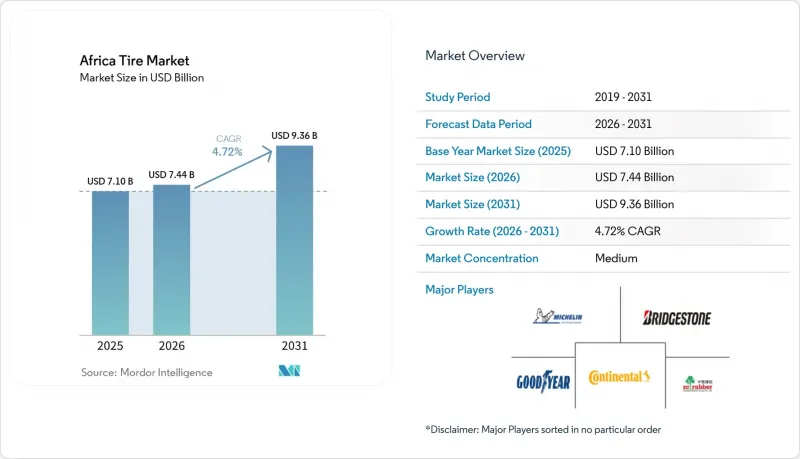
Mordor Intelligence에 의하면, 아프리카 타이어 시장 규모는 2025년에 71억 달러로 평가되었고 2026년에는 74억 4,000만 달러로 추정되고 있어 2026년부터 2031년까지 CAGR 4.72%로 성장을 지속하여, 2031년까지 93억 6,000만 달러에 이를 것으로 예측됩니다.
본 보고서는 계절(여름용, 겨울용 등), 타이어 구조(레이디얼, 바이애스 등), 차종(이륜차, 승용차 등), 용도(온로드, 오프로드), 최종 사용자(OEM, 애프터마켓), 림 크기(15인치 미만 등),구동 방식(내연기관 차량 등), 그리고 국가별로 분류되어 있습니다. 시장 전망은 금액(미 달러) 및 수량(단위)으로 제시되어 있습니다.
아프리카 타이어 시장 동향 및 인사이트
아프리카 전역의 차량 보유 대수 및 자동차 보급률 증가
나이지리아는 2025년에 1조 5,800억 나이라(약 10억 4,000만 달러) 상당의 자동차를 수입하고 있으며, 이러한 수요 격차를 메우기 위해 교체용 타이어 공급업체들이 빠른 속도로 대응을 추진하고 있습니다. 알제리나 앙골라와 같은 산유국에서는 소득 증가에 따라 승용차 보유 대수가 증가하고 있으며, 이는 저가 및 중가 타이어에 대한 큰 수요를 견인하고 있습니다. 라이드셰어 서비스와 비공식 택시 사업의 확대도 타이어 교체에 대한 일상적인 수요 증가에 더욱 기여하고 있습니다. 또한, 인구 밀도가 높은 도시 지역에서는 이륜차의 보급이 확대되면서 소형 림 사이즈 타이어에 대한 수요가 크게 증가하고 있습니다. 도시 지역의 모빌리티가 지속적으로 발전함에 따라, 과거 두드러졌던 타이어 수요의 계절성은 점차 약화되고 있으며, 창고에서는 연중 안정적인 재고 수준을 유지할 수 있게 되었습니다. 재고 관리 방침을 효과적으로 운영하는 유통업체들은 이처럼 끊임없이 변화하는 시장 환경에서 경쟁 우위를 확보하고 있습니다.
중국 타이어 제조업체의 유통 네트워크 확대(가격 경쟁력)
칭다오 센추리 타이어와 링롱(Linglong)의 케냐 공장, 그리고 모로코 공장은 순수한 수출에서 지역 내 생산으로 전환하고 있습니다. 이러한 전략적 전환은 운송 비용을 절감할 뿐만 아니라 환율 변동으로 인한 위험도 최소화합니다. 현지 생산 거점을 설립함으로써, 이들 기업은 지역 무역 협정에 따른 관세 면제 혜택을 받을 수 있어, 유럽산 경쟁 제품에 비해 더욱 경쟁력 있는 가격 책정이 가능해집니다. 이러한 시설이 가동되면 세네갈이나 우간다와 같은 인근 시장에 효율적으로 공급할 수 있게 됩니다. 이러한 접근 방식을 통해 현지 도로 상황에 맞춘 트레드 패턴을 맞춤 제작할 수 있을 뿐만 아니라, 리드 타임도 대폭 단축되어 시장에 대한 전반적인 대응력이 향상됩니다.
통화 약세와 수입 관세 변동
나이지리아 나이라와 이집트 파운드는 2024년 이후 각각 50% 이상의 가치를 잃었으며, 이로 인해 타이어 입고 비용이 상승하고 소비자의 구매력이 위축되고 있습니다. 재고를 유지하기 위해 판매업자들은 더 많은 운전 자금을 확보할 수밖에 없게 되었으며, 그 결과 자금 조달 능력에 큰 부담이 가해지고 있습니다. 이러한 재정적 압박으로 인해 여러 수입업체들은 일부를 현지에서 조립하는 전략적 접근 방식을 채택하기 시작했습니다. 이러한 움직임은 기업들이 위험을 완화하고 효율성을 최적화하기 위해 현지 사업 운영을 점점 더 우선시하는 가운데, 공급망 내에서 서서히 그러나 피할 수 없이 진행되고 있는 변화를 여실히 드러내고 있습니다. 이러한 변화는 재무적 및 운영상의 과제에 직면했을 때 필요한 적응력과 회복탄력성에 의해 주도되며, 공급망의 구도가 끊임없이 변화하고 있음을 강조합니다.
부문 분석
아프리카 타이어 시장에서 2025년에는 사계절용 타이어가 55.13%라는 압도적인 시장 점유율을 차지하고 있습니다. 그러나 알제리와 모로코의 차량 관리자들은 사막 고속도로가 가져오는 가혹한 과제를 견딜 수 있도록 특별히 설계된 내열성 컴파운드를 점점 더 많이 선택하고 있습니다. 이러한 극한 온도 환경에 대응하는 전문 지식을 갖춘 공급업체는 프리미엄 가격을 책정할 수 있으며, 이를 통해 특수 고무 배합에 따른 비용 증가를 효과적으로 상쇄하고 있습니다. 또한, 여름용 타이어는 연평균 성장률(CAGR) 5.64%를 나타낼 것으로 예측되며, 이는 예측 기간 동안 아프리카 타이어 시장 전체의 성장률을 상회할 것으로 보입니다.
다른 지역에서는 열대 기후 하에서 산발적인 강우를 견딜 수 있는 유연성이 높은 사계절용 고무가 선호되고 있습니다. 그 결과, 다국적 유통업체들은 두 가지 서로 다른 제품군의 재고를 전략적으로 유지하고 있습니다. 여기에는 마그레브 지역을 위해 특별히 조정된 고실리카 함유 여름용 타이어 시리즈와 사하라 이남 지역의 도로 요구 사항을 충족하도록 설계된 다목적 타이어가 포함됩니다. 이러한 계절별 세분화 접근 방식은 경제적 계층보다 기후대와의 일치를 더 강하게 반영하며, 시장에서 경쟁 우위를 확보하고자 하는 기업들에게 지역 특화 연구개발 활동의 중요성을 강조하고 있습니다.
2025년, 레이디얼 타이어는 낮은 구름 저항과 긴 트레드 수명이라는 장점 덕분에 아프리카 타이어 시장에서 91.25%의 시장 점유율을 차지하며 시장을 휩쓸었습니다. 한편, 남아프리카공화국과 콩고민주공화국(DRC)의 광업 대기업들은 비공기식(에어리스) 타이어의 시범 도입을 추진하고 있으며, 이 시장은 2031년까지 연평균 성장률(CAGR) 6.71%를 나타낼 것으로 예측됩니다. 이러한 에어리스 타이어는 펑크로 인한 가동 중단 시간을 없앨 수 있다는 큰 이점을 제공합니다. 이는 시간당 장비 임대 비용이 매우 높은 이 업계에서 매우 중요한 요소입니다. 이러한 동향은 광업 부문에서 혁신적인 타이어 솔루션에 대한 관심이 높아지고 있음을 보여줍니다.
일반 승용차 및 트럭 운영 사업자의 경우, 확립된 서비스 네트워크와 재타이어(재생) 인프라에 힘입어 레이디얼 타이어가 여전히 선호되고 있습니다. 그러나 OEM과 채석장용 트럭 제조업체간의 제휴 사례에서 알 수 있듯이, 규모의 경제가 향상됨에 따라 에어리스 기술의 적용 범위는 다른 작업용 차량으로 확대될 가능성이 있습니다. 현재 폴리머 링크 구조에 투자하고 있는 기업들은 얼리 어답터를 유치하고, 사상적 리더십 측면에서 경쟁 우위를 확보하기 위한 전략적 입지에 있습니다. 이러한 동향은 에어리스 기술이 향후 몇 년 동안 기존 타이어 시장에 큰 변화를 가져올 가능성을 강조하고 있습니다.
2025년, 아프리카 타이어 시장 점유율 중 승용차용 타이어가 39.44%를 차지하며, 개인 이동 수단 증가를 배경으로 연평균 성장률(CAGR)은 4.97%를 나타낼 것으로 전망됩니다. 또한, 전자상거래 및 건설 활동의 활성화가 소형 상용차 및 대형 트럭 판매 대수 증가를 견인하고 있습니다. 축중량 증가에 따라 타이어 교체 빈도도 높아지고 있어, 이 부문공급업체들에게 더 큰 성장 기회가 창출되고 있습니다.
라고스, 나이로비, 캄팔라 등의 도시에서는 라이드셰어 기업들이 오토바이 택시의 차량 수를 확대함에 따라 이륜차 수요가 크게 증가했습니다. 굴삭기나 로더용 오프로드 타이어는 판매량은 틈새 시장 수준이지만, 매력적인 이익률을 가져다주고 있습니다. 제조업체는 이러한 분야로 사업을 다각화함으로써 승용차의 교체 주기 둔화에 따른 위험을 완화하고, 더 빈번한 상용차의 교체 주기를 활용할 수 있습니다.
기타 혜택:
- Excel 형식 시장 예측(ME) 시트
- 3개월간의 애널리스트 지원
자주 묻는 질문
목차
제1장 서론
제2장 분석 방법
제3장 주요 요약
제4장 시장 구도
제5장 시장 규모·성장률 예측
제6장 경쟁 구도
제7장 시장 기회와 향후 전망
JHS 26.09.03According to Mordor Intelligence, the african tire market size was valued at USD 7.10 billion in 2025 and is estimated at USD 7.44 billion in 2026, and is projected to reach USD 9.36 billion by 2031 at a 4.72% CAGR over 2026-2031.
This report is Segmented by Season (Summer, Winter, and More), Tire Design (Radial, Bias, and More), Vehicle Type (Two-Wheelers, Passenger Cars, and More), Application (On-Road, Off-Road), End User (OEM, Aftermarket), Rim Size (Below 15 Inches, and More), Propulsion (Internal-Combustion Vehicles and More), and Country. The Market Forecasts are Provided in Terms of Value (USD) and Volume (Units).
Africa Tire Market Trends and Insights
Increasing Vehicle Parc and Motorization Rate Across Africa
Nigeria imported automobiles valued at NGN 1.58 trillion (approximately USD 1.04 billion) in 2025, signaling a gap that replacement tire suppliers are rushing to fill . In oil-rich nations such as Algeria and Angola, increasing incomes have resulted in higher passenger-car ownership, which is driving significant demand for budget and mid-tier tires. The expansion of ride-hailing services and informal taxi operations is further contributing to the growing daily requirement for tire replacements. Furthermore, in densely populated urban areas, the rising adoption of two-wheelers is significantly boosting the demand for smaller rim sizes. As urban mobility continues to develop, the previously pronounced seasonality of tire demand is becoming less evident, enabling warehouses to maintain consistent stock levels throughout the year. Distributors who effectively manage their inventory policies are gaining a competitive advantage in this evolving market environment.
Expansion of Chinese Tire Makers' Distribution Networks (Price Competitiveness)
Qingdao Sentury Tire Co., Ltd. and Linglong's Kenya plant, along with a facility in Morocco, are transitioning from solely exporting to manufacturing regionally. This strategic shift not only reduces shipping costs but also minimizes exposure to currency fluctuations. By establishing local production facilities, these companies gain access to duty exemptions provided under regional trade agreements, enabling their products to be priced more competitively compared to European alternatives. Once these facilities become operational, they can efficiently supply nearby markets such as Senegal or Uganda. This approach allows for the customization of tread patterns to meet specific local road conditions while also significantly reducing lead times, thereby enhancing overall market responsiveness.
Currency Depreciation and Import-Duty Fluctuations
The Nigerian naira and Egyptian pound have each lost more than 50% of value since 2024, inflating landed tire costs and curbing consumer purchasing power . To maintain stock, distributors are compelled to hold higher working capital, which in turn places significant strain on their financing capabilities. This financial pressure has prompted several importers to adopt a strategic approach by committing to partial local assembly. This development highlights a gradual yet inevitable transformation within the supply chain, as companies increasingly prioritize localized operations to mitigate risks and optimize efficiency. Such a shift underscores the evolving dynamics of the supply chain landscape, driven by the need for adaptability and resilience in the face of financial and operational challenges.
Other drivers and restraints analyzed in the detailed report include:
- Rapid Road-Infrastructure Development Programs (e.g., AfCFTA Corridors)
- Growing Demand for Affordable Replacement Tires Through Informal Channels
- Volatile Natural-Rubber and Synthetic-Rubber Prices
For complete list of drivers and restraints, kindly check the Table Of Contents.
Segment Analysis
In the African tire market, all-season products hold a commanding 55.13% market share in 2025. However, fleet managers in Algeria and Morocco are increasingly opting for heat-resistant compounds that are specifically designed to endure the challenges posed by desert highways. Suppliers with expertise in addressing these temperature extremes are able to command premium prices, which effectively offset the higher costs associated with their specialized rubber mixes. Furthermore, summer tires are anticipated to grow at a CAGR of 5.64%, surpassing the overall growth rate of the African tire market during the forecast period.
In other regions, tropical climates exhibit a preference for flexible all-season rubbers that are capable of withstanding sporadic rainfall. Consequently, multinational distributors are strategically maintaining inventories of two distinct product assortments. These include high-silica summer tire lines that are specifically tailored for the Maghreb region and versatile multi-purpose treads that are designed to meet the demands of sub-Saharan roads. This approach to seasonal segmentation reflects a stronger alignment with climatic zones rather than economic tiers, thereby emphasizing the importance of regionalized research and development efforts for companies aiming to achieve a competitive advantage in the market.
In 2025, radials dominated the African tire market, accounting for 91.25% of the market share, owing to their advantages of lower rolling resistance and extended tread life. Meanwhile, mining conglomerates in South Africa and the DRC are experimenting with non-pneumatic or airless tire formats, which are projected to grow at a CAGR of 6.71% through 2031. These airless tires provide a significant advantage by eliminating downtime caused by punctures, a critical factor in an industry where equipment rental costs are substantially high on an hourly basis. This trend highlights the increasing focus on innovative tire solutions within the mining sector.
Mainstream passenger and truck operators continue to prefer radials, supported by well-established service networks and retreading infrastructure. However, partnerships between OEMs and quarry trucks indicate that as economies of scale improve, airless technology could expand its application to other utility vehicles. Companies investing in polymer link architectures at present are strategically positioned to attract early adopters and gain a competitive edge in thought leadership. This development emphasizes the potential for airless technology to significantly disrupt traditional tire markets in the coming years.
In 2025, passenger car fitments accounted for 39.44% of Africa's tire market share, with a projected CAGR of 4.97%, driven by increasing personal mobility. Additionally, e-commerce and construction activities are driving growth in light commercial and heavy-duty truck volumes. As axle loads increase, the frequency of replacements rises, creating larger value opportunities for suppliers in this segment.
In cities such as Lagos, Nairobi, and Kampala, the demand for two-wheelers grew significantly as ride-hailing companies expanded their motorcycle taxi fleets. Off-the-road lines catering to excavators and loaders, while niche in volume, offer attractive margins. By diversifying into these areas, manufacturers mitigate risks from slowing passenger car turnover and capitalize on higher-frequency commercial cycles.
Complete Report Scope:
- By Season
- Summer
- Winter
- All-Season
- By Tire Design
- Radial
- Bias
- Non-pneumatic/Airless
- By Vehicle Type
- Two-Wheelers
- Passenger Cars
- Light Commercial Vehicles
- Heavy Commercial Trucks and Buses
- Off-the-Road and Specialty (OTR, Agriculture, Mining, Racing)
- By Application
- On-Road
- Off-Road (Construction, Mining, Agriculture)
- By End User
- OEM
- Aftermarket (Replacement and Retread)
- By Rim Size
- Below 15 inches
- 15 to 20 inches
- Above 20 inches
- By Propulsion
- Internal-Combustion Vehicles
- Battery-Electric Vehicles
- Hybrid and Fuel-Cell Vehicles
- By Country
- South Africa
- Algeria
- Nigeria
- Morocco
- Egypt
- Kenya
- Democratic Republic of Congo
- Rest of Africa
List of Companies Covered in this Report:
- Michelin
- Bridgestone Corporation
- The Goodyear Tire & Rubber Company
- Continental AG
- Pirelli & C. S.p.A.
- Sumitomo Rubber Industries
- Hankook Tire & Technology Co., Ltd.
- Zhongce Rubber Group Co., Ltd.
- Sailun Group
- Triangle Tyre Co., Ltd
- Apollo Tyres Limited
- MRF Tyres
- Kumho Tire
- Nokian Tyres
- Toyo Tire Corporation
- Yokohama Rubber Co., Ltd.
- Cheng Shin Rubber Industry Co.
- Qingdao Doublestar Group
- CEAT Limited
Additional Benefits:
- The market estimate (ME) sheet in Excel format
- 3 months of analyst support
TABLE OF CONTENTS
1 Introduction
- 1.1 Study Assumptions and Market Definition
- 1.2 Scope of the Study
2 Research Methodology
3 Executive Summary
4 Market Landscape
- 4.1 Market Overview
- 4.2 Market Drivers
- 4.2.1 Increasing Vehicle Parc and Motorization Rate Across Africa
- 4.2.2 Expansion of Chinese Tire Makers' Distribution Networks (Price Competitiveness)
- 4.2.3 Rapid Road-Infrastructure Development Programs (e.g., AfCFTA Corridors)
- 4.2.4 Growing Demand for Affordable Replacement Tires Through Informal Channels
- 4.2.5 Government Incentives for Local Tire Manufacturing Capacity (Nigeria, Egypt)
- 4.2.6 Digital Fleet-Management Adoption in Mining/Logistics Driving Premium TBR Uptake
- 4.3 Market Restraints
- 4.3.1 Currency Depreciation and Import-Duty Fluctuations
- 4.3.2 Volatile Natural-Rubber and Synthetic-Rubber Prices
- 4.3.3 Fragmented Rubber Supply Chain Limiting Local Sourcing
- 4.3.4 Regulatory Clamp-Down on Used-Tire Imports in Key Countries
- 4.4 Value/Supply-Chain Analysis
- 4.5 Regulatory Landscape
- 4.6 Technological Outlook (Low-rolling-resistance, smart and airless tires)
- 4.7 Porter's Five Forces
- 4.7.1 Bargaining Power of Suppliers
- 4.7.2 Bargaining Power of Buyers
- 4.7.3 Threat of New Entrants
- 4.7.4 Threat of Substitutes
- 4.7.5 Competitive Rivalry
5 Market Size and Growth Forecasts (Value (USD) and Volume (Units))
- 5.1 By Season
- 5.1.1 Summer
- 5.1.2 Winter
- 5.1.3 All-Season
- 5.2 By Tire Design
- 5.2.1 Radial
- 5.2.2 Bias
- 5.2.3 Non-pneumatic/Airless
- 5.3 By Vehicle Type
- 5.3.1 Two-Wheelers
- 5.3.2 Passenger Cars
- 5.3.3 Light Commercial Vehicles
- 5.3.4 Heavy Commercial Trucks and Buses
- 5.3.5 Off-the-Road and Specialty (OTR, Agriculture, Mining, Racing)
- 5.4 By Application
- 5.4.1 On-Road
- 5.4.2 Off-Road (Construction, Mining, Agriculture)
- 5.5 By End User
- 5.5.1 OEM
- 5.5.2 Aftermarket (Replacement and Retread)
- 5.6 By Rim Size
- 5.6.1 Below 15 inches
- 5.6.2 15 to 20 inches
- 5.6.3 Above 20 inches
- 5.7 By Propulsion
- 5.7.1 Internal-Combustion Vehicles
- 5.7.2 Battery-Electric Vehicles
- 5.7.3 Hybrid and Fuel-Cell Vehicles
- 5.8 By Country
- 5.8.1 South Africa
- 5.8.2 Algeria
- 5.8.3 Nigeria
- 5.8.4 Morocco
- 5.8.5 Egypt
- 5.8.6 Kenya
- 5.8.7 Democratic Republic of Congo
- 5.8.8 Rest of Africa
6 Competitive Landscape
- 6.1 Market Concentration
- 6.2 Strategic Moves
- 6.3 Market Share Analysis
- 6.4 Company Profiles (Includes Global Level Overview, Market Level Overview, Core Segments, Financials as Available, Strategic Information, Market Rank/Share for Key Companies, Products and Services, SWOT Analysis, and Recent Developments)
- 6.4.1 Michelin
- 6.4.2 Bridgestone Corporation
- 6.4.3 The Goodyear Tire & Rubber Company
- 6.4.4 Continental AG
- 6.4.5 Pirelli & C. S.p.A.
- 6.4.6 Sumitomo Rubber Industries
- 6.4.7 Hankook Tire & Technology Co., Ltd.
- 6.4.8 Zhongce Rubber Group Co., Ltd.
- 6.4.9 Sailun Group
- 6.4.10 Triangle Tyre Co., Ltd
- 6.4.11 Apollo Tyres Limited
- 6.4.12 MRF Tyres
- 6.4.13 Kumho Tire
- 6.4.14 Nokian Tyres
- 6.4.15 Toyo Tire Corporation
- 6.4.16 Yokohama Rubber Co., Ltd.
- 6.4.17 Cheng Shin Rubber Industry Co.
- 6.4.18 Qingdao Doublestar Group
- 6.4.19 CEAT Limited
7 Market Opportunities and Future Outlook
- 7.1 White-space and Unmet-Need Assessment


