|
시장보고서
상품코드
2117456
전기 오토바이 시장 : 점유율 분석, 업계 동향과 통계, 성장 예측(2026-2031년)Electric Motorcycle - Market Share Analysis, Industry Trends & Statistics, Growth Forecasts (2026 - 2031) |
||||||
 Mordor Intelligence
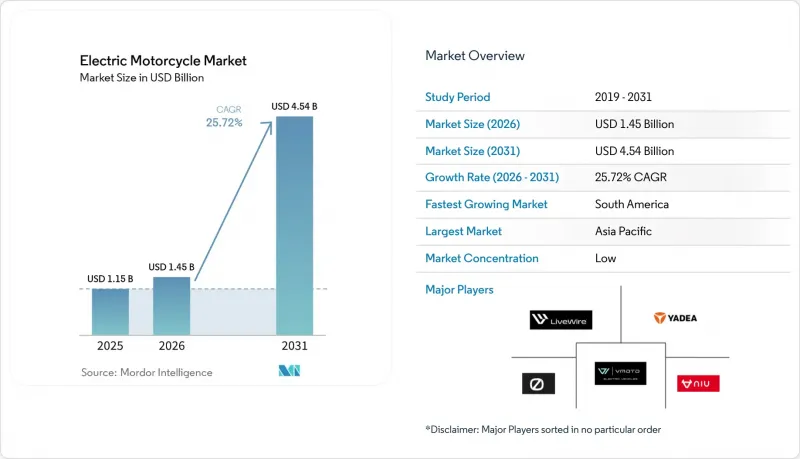
Mordor Intelligence에 의하면, 전기 오토바이 시장 규모는 2025년에 11억 5,000만 달러, 2026년에 14억 5,000만 달러가 되고, 2031년까지 45억 4,000만 달러에 이를 것으로 예측되며, 2026년부터 2031년까지 CAGR 25.72%로 성장할 전망입니다.
본 보고서는 배터리 유형(납산, 리튬이온, 리튬이온 폴리머, 나트륨이온 및 신흥 화학 계열), 출력(3.6kW 미만, 3.6-7.2kW 이상),모터 유형(허브 모터, 벨트 구동, 체인 구동, 미드 드라이브 모터), 용도(개인용, 상업용 등), 지역별로 분류되어 있습니다. 시장 전망은 금액(미 달러) 및 수량(대수)으로 제시되어 있습니다.
세계 전기 오토바이 시장 동향 및 인사이트
리튬 이온 배터리의 비용 하락 및 에너지 밀도 향상
배터리 셀 공급업체들은 2024년 이후 1kW시당 가격을 지속적으로 인하하고 있으며, 이에 따라 1Kg당 와트시 수도 꾸준히 증가하고 있습니다. 그 결과, 섀시 크기를 확대하지 않고도 라이더를 더 먼 곳까지 이동시킬 수 있는 소형 배터리 팩이 실현되었습니다. 보증 기간이 5년을 넘어서면서 재판매 가치가 향상되었고, 가솔린 차량과의 감가상각 차이가 줄어들고 있습니다. 또한, 밸류체인은 가격 변동이 심한 코발트를 피하고 철을 풍부하게 함유한 화학 성분으로 다각화되어 비용 곡선을 더욱 안정화시키고 있습니다. 이러한 진전들이 결합되어, 가격에 민감한 통근자들에게 전기 구동계가 기본 선택지가 되고 있습니다.
정부의 구매 장려책과 제로 배출 규제
국가 및 주 차원의 프로그램을 통해, 과거 전기 오토바이를 고가의 사치품으로 여겼던 구매자들에게 구매 비용은 지속적으로 낮아지고 있습니다. 인도는 ‘PM E-DRIVE’ 제도를 갱신하는 동시에, 향후 2-3년 동안 보조금을 지속할 ‘FAME-III’ 예산안을 제시했습니다. 캘리포니아주는 판매 시점 리베이트 제도를 유지하고 있으며, 브라질의 ‘MOVER’ 체계는 세제 혜택과 현지 조립 장려책을 결합하고 있습니다. 이러한 조치로 인해, 특히 일일 주행 거리가 긴 상용 차량 함대에서 투자 회수 기간이 단축됩니다. 또한, 이러한 정책의 기세는 국내 제조업 확장을 뒷받침하는 수요 신호로도 작용하고 있습니다.
내연기관(ICE) 오토바이에 비해 높은 초기 가격 프리미엄
보조금을 적용한 후에도 많은 보급형 전기 오토바이는 동급 가솔린 모델에 비해 정가가 거의 2배에 달할 전망입니다. 대출 선택지가 제한적이고 가계 형편이 어려운 상황에서는 이러한 가격 차이가 여전히 장벽으로 작용하고 있습니다. 라틴아메리카 국가들의 수입 관세로 인해 수입 후 총 비용은 여전히 높은 수준을 유지하고 있습니다. 각 제조업체들은 사용량에 따른 과금제 배터리나 리스-투-오너(Lease-to-Own) 플랜의 시범 도입을 추진하고 있지만, 이러한 방식은 신용 평가나 잔존 가치의 확실성에 의존하고 있어 아직 널리 보급되지는 않았습니다. 이러한 격차를 해소하기 위해서는 현지 조립을 더욱 확대하고 배터리 비용을 지속적으로 낮추는 것이 핵심입니다.
부문 분석
2025년, 리튬 이온 배터리는 전기 오토바이 시장 점유율의 64.52%를 차지하며, 가격과 성능에 대한 주류 기대에 부응하는 표준 배터리 기술로서의 입지를 확고히 했습니다. 연평균 성장률(CAGR) 26.92%로 확대될 것으로 예상되는 나트륨 이온 배터리 팩은 리튬 공급 제약과 코발트 가격 변동에서 벗어나고자 하는 제조업체들에게 매력적인 선택지가 되고 있습니다. 소규모 제조업체들은 나트륨 이온 배터리가 깊은 방전을 견디는 특성을 활용하여, 보증 기간 연장을 통해 신뢰성을 높이고 있습니다. 또한 부품의 표준화를 통해 모델 간 호환성이 향상되어 고정형 에너지 저장 시스템으로의 세컨드 라이프 활용이 가능해집니다.
화학 조성의 선택지가 넓어짐에 따라 각 브랜드는 배터리의 특성을 라이더의 우선순위에 맞추어 조정할 수 있게 됩니다. 비용을 중시하는 통근자는 내구성이 높고 충전 속도가 느린 배터리 팩을 선택하는 반면, 성능을 중시하는 애호가는 엄격한 열 관리가 적용된 고출력 유형을 선호하는 경향이 있습니다. 이러한 다양한 구성의 등장은 시스템 전체공급 리스크를 낮추고, 나트륨이나 철 원료가 풍부한 지역에 유리하게 작용하여 현지에서의 셀 생산을 촉진합니다. 화학 성분의 다양화에 따라 애프터서비스 모델도 진화하여, 혼합 재활용 흐름이나 화학 성분에 따른 진단에 대응할 수 있게 됩니다.
2025년에는 3.6kW 미만의 전기 오토바이가 시장 점유율의 44.21%를 차지하며, 도시 지역 라이더와 이를 경량 오토바이 면허 규정에 포함시키는 규제 당국의 지지를 받았습니다. 10kW 이상 등급은 연평균 성장률(CAGR) 28.39%를 나타낼 것으로 예측되며, 이는 전동 구동계가 타협 없이 스릴을 추구하는 라이더의 요구를 충족시킬 수 있음을 보여줍니다. 프리미엄 브랜드는 강력한 가속력과 서킷 주행 성능을 자랑하며, 전기 이륜차를 중배기량 스포츠 오토바이의 정당한 대안으로 자리매김하고 있습니다.
에너지 밀도가 점차 향상됨에 따라, 7.2-10 kW의 중출력 등급 모델은 일상적인 통근과 주말 고속도로 주행을 모두 소화하고 있습니다. 라이더들은 순간적인 토크 덕분에 도심 내 경사길을 쉽게 오르고, 교통 흐름에 매끄럽게 합류할 수 있다는 점을 깨닫고 있습니다. 판매점에 따르면, 구매자가 조용한 출발과 회생 제동을 체험하면 시승 시 회의적이었던 사람들의 수가 줄어든다고 합니다. 이러한 질적인 장점은 단순한 출력(kW)만큼이나 중요하며, 구매를 망설이던 사람들이 전기 오토바이로 전환하도록 뒷받침하고 있습니다.
지역별 분석
아시아태평양은 전기 오토바이 시장을 독점하고 있으며, 2025년에는 전 세계 판매 대수의 73.28%를 차지할 전망입니다. 인구 밀도가 높은 도시, 뿌리 깊은 이륜차 문화, 그리고 강력한 재정적 인센티브가 맞물려 가솔린에서 배터리 구동으로의 전환을 가속화하고 있습니다. 중국, 대만, 인도네시아의 배터리 교환 생태계 덕분에 충전으로 인한 가동 중단 시간은 가솔린 차량과 동등한 경쟁력을 유지하고 있는 반면, 인도에서는 보조금의 단계적 축소에도 불구하고 정책을 통해 높은 판매량 증가세가 유지되고 있습니다. 일본과 한국은 국내 산업 보호와 탈탄소화 목표 사이의 균형을 맞추면서 꾸준한 속도로 진전을 보이고 있습니다. 이 지역의 생태계는 현재 차량 공장 근처에 배터리 팩 조립 거점을 설치하려는 부품 공급업체들을 유치하고 있습니다.
남미는 브라질의 ‘MOVER’ 산업 프레임워크와 지속적으로 확대되는 지역 내 조립 거점 네트워크에 힘입어 2031년까지 27.07%라는 가장 높은 연평균 성장률(CAGR)을 나타낼 전망입니다. 현지 조달률에 관한 규제와 세제 혜택이 제조업체의 진출을 촉진하고, 환율 변동에 따른 위험을 줄여주고 있습니다. 아르헨티나의 관세 구조는 단기적인 성장세를 둔화시키고 있지만, 정책 입안자들이 배출 목표와 소비자의 구매력 간의 균형을 모색함에 따라 완화될 가능성이 있습니다. 인프라 구축은 상파울루나 부에노스아이레스와 같은 대도시권에 집중되어 있으며, 이러한 지역에서는 혼잡통행료와 카셰어링 수요가 겹치고 있습니다.
유럽과 북미에서는 국가별 인센티브와 도시 지역의 청정 공기 구역이 모자이크처럼 산재해 있어 도입 속도가 완만합니다. 런던, 파리, 밀라노에서는 도심 내 가솔린 이륜차에 벌칙이 부과되고 있어, 이에 따라 택배 업체들은 전기 오토바이 리스로 전환하고 있습니다. 미국에서는 캘리포니아주와 오리건주가 주 차원의 구매 보조금 제도를 주도하고 있지만, 주말 레저 문화에 적합한 장거리 투어링 모델의 등장을 기다리며 더 광범위한 보급이 진행될 전망입니다. 중동 및 아프리카에서는 아직 도입 초기 단계에 있습니다. 케냐와 르완다에서 진행 중인 스왑 시범 사업은 전력망에 제약이 있는 환경에서 독창적인 해결책을 제시하고 있으며, 걸프 국가들에서는 탄소 중립 로드맵에 부합하기 위해 전기화 의무화와 대규모 충전 인프라 투자를 병행하고 있습니다.
기타 혜택:
- 엑셀 형식 시장 예측(ME) 시트
- 3개월간의 애널리스트 지원
목차
제1장 서론
제2장 조사 방법
제3장 개요
제4장 시장 구도
제5장 시장 규모와 성장 예측
제6장 경쟁 구도
제7장 시장 기회와 향후 전망
JHSAccording to Mordor Intelligence, the electric motorcycle market size is expected to be USD 1.15 billion in 2025, USD 1.45 billion in 2026, and reach USD 4.54 billion by 2031, growing at a CAGR of 25.72% from 2026 to 2031.
This report is Segmented by Battery Type (Lead-Acid, Lithium-Ion, Lithium-Ion Polymer, and Sodium-Ion and Emerging Chemistries), Power Output (Below 3. 6 KW, 3. 6 - 7. 2 KW, and More), Motor Type (Hub Motor, Belt Drive, and Chain Drive, Mid-Drive Motor), End-Use (Personal, Commercial, and More), and Geography. The Market Forecasts are Provided in Terms of Value (USD) and Volume (Units).
Global Electric Motorcycle Market Trends and Insights
Falling Lithium-Ion Battery Costs and Rising Energy Density
Cell suppliers have trimmed per-kilowatt-hour pricing consistently since 2024, a decline matched by consistent gains in watt-hours per kilogram. The result is smaller packs that carry riders farther without enlarging chassis envelopes. As warranties stretch beyond five years, resale values improve, shrinking the depreciation gap with gasoline models. Supply chains are also diversifying into iron-rich chemistries that avoid price-volatile cobalt, further stabilizing cost curves. Together, these advances make electric drivetrains the default choice for price-sensitive commuters.
Government Purchase Incentives and Zero-Emission Mandates
National and state programs continue to lower acquisition costs for buyers who once viewed electric motorcycles as premium luxuries. India renewed its PM E-DRIVE scheme and simultaneously outlined a follow-on FAME-III outlay that keeps subsidies visible for 2-3 years. California retains point-of-sale rebates, and Brazil's MOVER framework pairs tax relief with local-assembly incentives. These measures shorten payback periods, especially for commercial fleets that clock high daily mileage. The policy momentum also sends a demand signal that supports domestic manufacturing expansion.
High Upfront Price Premium vs ICE Motorcycles
Even after subsidies, many entry-level electric motorcycles still list at nearly double the sticker price of comparable gasoline models. The differential remains a hurdle where financing options are sparse, and household budgets are tight. Import tariffs in several Latin American countries keep landed costs elevated. Manufacturers are piloting pay-per-use batteries and lease-to-own plans, but these depend on credit scoring and residual-value certainty that are not yet universal. Bridging this gap hinges on deeper local assembly and continued battery cost declines.
Other drivers and restraints analyzed in the detailed report include:
- Expansion of Two-Wheeler Charging and Swap Networks
- Micromobility Delivery Fleet Adoption (Lower TCO)
- Limited Real-World Range and Slow Charge Above 7 kW
For complete list of drivers and restraints, kindly check the Table Of Contents.
Segment Analysis
Lithium-ion held 64.52% of the electric motorcycle market share in 2025, confirming its role as the default chemistry for mainstream price and performance expectations. Sodium-ion packs, projected to expand at a 26.92% CAGR, appeal to manufacturers seeking relief from lithium supply constraints and cobalt volatility. Smaller players leverage sodium's tolerance for deep discharges to extend warranty confidence. Component standardization also improves cross-model compatibility, enabling second-life deployments in stationary storage.
A broader chemistry toolkit helps brands match battery attributes to rider priorities. Cost-sensitive commuters opt for durable, slower-charging packs, while performance enthusiasts lean toward high-power variants with stringent thermal control. The emerging mosaic reduces systemic supply risk and encourages localized cell production, an advantage for regions with abundant sodium or iron feedstocks. As chemistries proliferate, after-sales models evolve to handle mixed recycling streams and chemistry-specific diagnostics.
Motorcycles below 3.6 kW captured 44.21% of the electric motorcycle market share in 2025, favored by urban riders and regulators that classify them under moped licensing rules. The above-10 kW class, forecasted to grow at a 28.39% CAGR, demonstrates that electric drivetrains can satisfy thrill seekers without compromise. Premium brands showcase brisk acceleration and track-day capability, reframing electric two-wheelers as legitimate substitutes for mid-displacement sport bikes.
As energy density inches upward, mid-range 7.2-10 kW machines bridge daily commutes and weekend highway hops. Riders discover that instant torque flattens city gradients and merges effortlessly into traffic. Dealers report fewer test-ride skeptics once buyers experience silent launches and regenerative braking. These qualitative gains matter as much as raw kilowatts, nudging fence-sitters toward electric adoption.
Complete Report Scope:
- By Battery Type
- Lead-acid
- Lithium-ion
- Lithium-ion Polymer
- Sodium-ion & Emerging Chemistries
- By Power Output
- Below 3.6 kW
- 3.6 - 7.2 kW
- 7.2 - 10 kW
- Above 10 kW
- By Motor / Drive Type
- Hub Motor
- Belt Drive
- Chain Drive
- Mid-drive Motor
- By End-use
- Personal / Individual
- Commercial & Corporate Fleets
- Micromobility Service Providers
- Delivery & Logistics
- By Region
- North America
- United States
- Canada
- Rest of North America
- South America
- Brazil
- Argentina
- Rest of South America
- Europe
- United Kingdom
- Germany
- Spain
- Italy
- France
- Russia
- Rest of Europe
- Asia-Pacific
- India
- China
- Japan
- South Korea
- Rest of Asia-Pacific
- Middle East & Africa
- United Arab Emirates
- Saudi Arabia
- Turkey
- Egypt
- South Africa
- Rest of Middle East & Africa
- North America
Geography Analysis
Asia-Pacific dominates the electric motorcycle market, holding 73.28% of global volume in 2025. Dense cities, established two-wheeler cultures, and strong fiscal incentives combine to accelerate turnover from petrol to battery power. Battery-swap ecosystems in China, Taiwan, and Indonesia keep refueling downtime competitive with gasoline, while India's policies sustain high unit growth despite subsidy tapering. Japan and South Korea progress at a measured pace, balancing domestic industry protection with decarbonization targets. The region's ecosystem now attracts component suppliers looking to colocate pack assembly near vehicle plants.
South America is poised for the fastest CAGR of 27.07% to 2031, supported by Brazil's MOVER industrial framework and a growing network of regional assembly sites. Local content rules and tax waivers entice manufacturers to plant stakes, lowering exposure to currency swings. Argentina's tariff structure tempers near-term momentum but may ease as policymakers weigh emissions goals against consumer affordability. Infrastructure rollouts cluster around megacities such as Sao Paulo and Buenos Aires, where congestion charges and rideshare demand overlap.
Europe and North America adopt at moderate speeds, shaped by a mosaic of national incentives and urban clean-air zones. London, Paris, and Milan penalize gasoline two-wheelers in central districts, pushing couriers toward electric leases. In the U.S., California and Oregon spearhead state-level rebates, while broader uptake waits on long-range touring models that fit into weekend leisure culture. Middle East and Africa remain early-stage: swap pilots in Kenya and Rwanda illustrate creative solutions in grid-constrained settings, and Gulf states couple electric mandates with large-scale charging investments to align with net-zero roadmaps.
- Yadea Group Holdings Ltd.
- NIU Technologies
- Vmoto Limited
- Zero Motorcycles Inc.
- Energica Motor Company S.p.A
- LiveWire EV, LLC
- HORWIN Inc.
- Revolt Intellicorp Private Limited (Revolt Motors)
- Honda Motor Co. Ltd.
- Yamaha Motor Co. Ltd.
- Oben EV SPA
- Verge Motorcycles Oܠ
- Damon Inc.
- LAND Moto
Additional Benefits:
- The market estimate (ME) sheet in Excel format
- 3 months of analyst support
TABLE OF CONTENTS
1 Introduction
- 1.1 Study Assumptions & Market Definition
- 1.2 Scope of the Study
2 Research Methodology
3 Executive Summary
4 Market Landscape
- 4.1 Market Overview
- 4.2 Market Drivers
- 4.2.1 Falling Lithium-ion Battery Costs and Rising Energy Density
- 4.2.2 Government Purchase Incentives and Zero-Emission Mandates
- 4.2.3 Expansion of Two-Wheeler Charging and Swap Networks
- 4.2.4 Micromobility Delivery Fleet Adoption (Lower TCO)
- 4.2.5 Breakthrough Sodium-Ion / Solid-State Chemistries
- 4.2.6 OTA Connectivity and Data-Monetization Revenue Streams
- 4.3 Market Restraints
- 4.3.1 High Upfront Price Premium Vs ICE Motorcycles
- 4.3.2 Limited Real-World Range and Slow Charge Above 7 Kw
- 4.3.3 Thermal-Safety Concerns in Tropical Fleet Duty-Cycles
- 4.3.4 Weak End-Of-Life Battery Collection in Emerging Markets
- 4.4 Value / Supply-Chain Analysis
- 4.5 Regulatory Landscape
- 4.6 Technological Outlook
- 4.7 Porter's Five Forces
- 4.7.1 Threat of New Entrants
- 4.7.2 Bargaining Power of Suppliers
- 4.7.3 Bargaining Power of Buyers
- 4.7.4 Threat of Substitutes
- 4.7.5 Competitive Rivalry
5 Market Size & Growth Forecasts (Value (USD) and Volume (Units))
- 5.1 By Battery Type
- 5.1.1 Lead-acid
- 5.1.2 Lithium-ion
- 5.1.3 Lithium-ion Polymer
- 5.1.4 Sodium-ion & Emerging Chemistries
- 5.2 By Power Output
- 5.2.1 Below 3.6 kW
- 5.2.2 3.6 - 7.2 kW
- 5.2.3 7.2 - 10 kW
- 5.2.4 Above 10 kW
- 5.3 By Motor / Drive Type
- 5.3.1 Hub Motor
- 5.3.2 Belt Drive
- 5.3.3 Chain Drive
- 5.3.4 Mid-drive Motor
- 5.4 By End-use
- 5.4.1 Personal / Individual
- 5.4.2 Commercial & Corporate Fleets
- 5.4.3 Micromobility Service Providers
- 5.4.4 Delivery & Logistics
- 5.5 By Region
- 5.5.1 North America
- 5.5.1.1 United States
- 5.5.1.2 Canada
- 5.5.1.3 Rest of North America
- 5.5.2 South America
- 5.5.2.1 Brazil
- 5.5.2.2 Argentina
- 5.5.2.3 Rest of South America
- 5.5.3 Europe
- 5.5.3.1 United Kingdom
- 5.5.3.2 Germany
- 5.5.3.3 Spain
- 5.5.3.4 Italy
- 5.5.3.5 France
- 5.5.3.6 Russia
- 5.5.3.7 Rest of Europe
- 5.5.4 Asia-Pacific
- 5.5.4.1 India
- 5.5.4.2 China
- 5.5.4.3 Japan
- 5.5.4.4 South Korea
- 5.5.4.5 Rest of Asia-Pacific
- 5.5.5 Middle East & Africa
- 5.5.5.1 United Arab Emirates
- 5.5.5.2 Saudi Arabia
- 5.5.5.3 Turkey
- 5.5.5.4 Egypt
- 5.5.5.5 South Africa
- 5.5.5.6 Rest of Middle East & Africa
- 5.5.1 North America
6 Competitive Landscape
- 6.1 Market Concentration
- 6.2 Strategic Moves
- 6.3 Market Share Analysis
- 6.4 Company Profiles (Includes Global level Overview, Market level overview, Core Segments, Financials as available, Strategic Information, Market Rank/Share for key companies, Products & Services, and Recent Developments)
- 6.4.1 Yadea Group Holdings Ltd.
- 6.4.2 NIU Technologies
- 6.4.3 Vmoto Limited
- 6.4.4 Zero Motorcycles Inc.
- 6.4.5 Energica Motor Company S.p.A
- 6.4.6 LiveWire EV, LLC
- 6.4.7 HORWIN Inc.
- 6.4.8 Revolt Intellicorp Private Limited (Revolt Motors)
- 6.4.9 Honda Motor Co. Ltd.
- 6.4.10 Yamaha Motor Co. Ltd.
- 6.4.11 Oben EV SPA
- 6.4.12 Verge Motorcycles Oܠ
- 6.4.13 Damon Inc.
- 6.4.14 LAND Moto