

|
시장보고서
상품코드
2118091
임플란트 모니터링 소프트웨어 시장 : 점유율 분석, 업계 동향과 통계, 성장 예측(2026-2031년)Implant Monitoring Software - Market Share Analysis, Industry Trends & Statistics, Growth Forecasts (2026 - 2031) |
||||||
 Mordor Intelligence
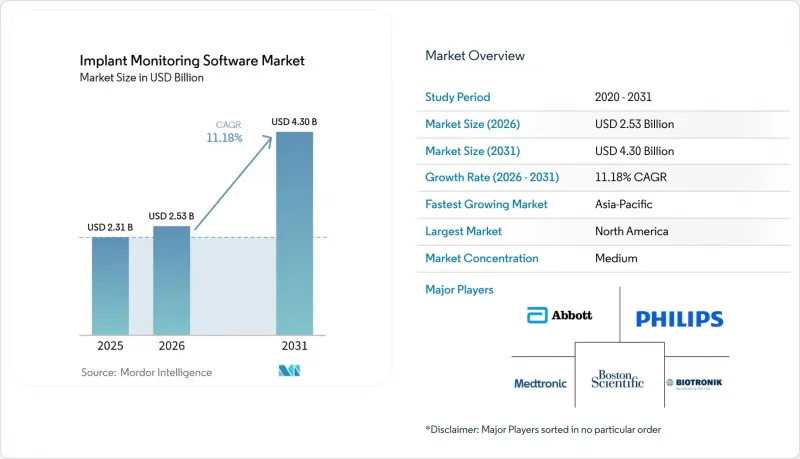
Mordor Intelligence에 의하면, 임플란트 모니터링 소프트웨어 시장 규모는 2025년 23억 1,000만 달러, 2026년 25억 3,000만 달러에서 2031년까지 43억 달러로 확대된다고 예측되고 있어 2026년부터 2031년까지 CAGR 11.18%를 기록하는 전망입니다.
본 보고서는 제품 유형(제조업체 순정 모니터링 플랫폼 등), 모니터링 방식(CIED, 루프 레코더 등), 용도(심부전 모니터링 등), 최종 사용자(병원 등), 도입 모델(클라우드 SaaS, On-Premise, 하이브리드), 지역(북미, 유럽,아시아태평양, 중동 및 아프리카, 남미)별로 분류되어 있습니다.
전 세계 임플란트 모니터링 소프트웨어 시장 동향 및 인사이트
이식형 심장 기기의 보급 확대
이식형 심장 기기의 도입 대수 증가는 임플란트 모니터링 소프트웨어 시장에 지속적인 수요를 창출하고 있습니다. 전 세계적으로 매년 250만 대 이상의 이식형 심장 전자 기기가 이식되고 있습니다. 이식형 제세동기(ICD) 및 심장 재동기화 치료 기기(CRT) 역시, 박출률 저하를 동반한 심부전 환자에서의 예방적 사용 확대에 힘입어, 대수 기준으로 연간 5-6%의 성장을 이어가고 있습니다. 각 임플란트에는 수년에 걸친 추적 관찰 통신이 필요하기 때문에 능동적 모니터링 대상자 수는 연간 시술 총수에서 추산되는 것보다 더 빠르게 증가하고 있습니다. 배터리 노후화에 따른 기기 교체가 업무 부담을 가중시키는 한편, 새로 이식된 기기도 독자적인 모니터링 일정에 들어갑니다. 2023년 HRS, EHRA, APHRS 및 LAHRS의 합의에 따르면, 지속적인 원격 모니터링을 받고 있는 안정된 환자의 경우 대면 진료 간격을 최대 24개월까지 연장할 수 있도록 허용되어, 소프트웨어를 통한 정기적인 추적 관찰이 가능한 기간이 확대되었습니다.
만성 질환 증가와 고령 환자의 모니터링 수요 증가
고령화에 따라 심장용 또는 신경 조절용 임플란트 삽입이나 지속적인 추적 관찰이 필요한 환자 수가 증가하고 있습니다. 심장용 기기를 이식한 성인 환자는 당뇨병, 고혈압, 심방세동, 혹은 이러한 질환을 동시에 여러 개 앓고 있는 경우가 많습니다. 이로 인해 심장, 활동량 및 기타 환자의 생체 신호를 통합하여 의료진에게 제공할 수 있는 플랫폼의 가치가 높아지고 있습니다. 따라서 의료진이 단일 기기 측정값이 아닌 변화하는 환자의 상태를 보다 종합적으로 파악해야 할 필요성이 커짐에 따라, 임플란트 모니터링 소프트웨어 시장은 혜택을 받게 될 것입니다. HeartLogic은 이러한 상황에서 사용되는 다중 매개변수 도구의 한 예로, 34일간의 감지 기간 동안 심부전 발병 징후에 대한 민감도는 70%로 보고되었습니다. 이러한 도구는 임상의가 변화를 조기에 인식하는 데 도움이 되지만, 임플란트 모니터링 소프트웨어 시장에서의 유용성은 여전히 임상적 검증과 명확한 치료 경로에 달려 있습니다.
사이버 보안, 개인정보 보호 및 커넥티드 기기의 책임
무선 연결을 통해 원격 경과 관찰이 가능해지지만, 동시에 사이버 보안 및 개인정보 보호에 대한 책임도 커집니다. FDA가 2025년 6월에 발표한 의료기기 사이버 보안 지침에는 관련 기기에 요구되는 품질 시스템 고려 사항 및 시판 전 신청 내용이 설명되어 있습니다. 2026년 2월 품질 경영 시스템 규제로의 전환에 따라, 미국의 의료기기 품질 요건은 ISO 13485:2016에 부합하게 되었으며, 소프트웨어 공급업체의 문서 작성 업무가 증가했습니다. 유럽에서의 도입에 있어서는 환자의 동의, 데이터 저장 장소, 그리고 전송 정보의 국경을 넘는 취급에 대해서도 대응해야 합니다. 이러한 요건은 대형 의료기기 제조업체와 같이 규정 준수 대응 자원을 갖추지 못한 소규모의 벤더 중립적 공급업체에게 더 큰 부담이 될 수 있습니다. 따라서 임베디드 의료기기 모니터링 소프트웨어 시장에서는 워크플로우 및 분석 기능뿐만 아니라 신뢰할 수 있는 보안 대책에 있어서도 경쟁력이 요구됩니다.
부문 분석
2025년 기준, 제조업체 순정 모니터링 플랫폼은 임플란트 모니터링 소프트웨어 시장 점유율의 42.3%를 차지했습니다. 이러한 위상은 의료기기의 원격 측정(텔레메트리)에 대한 직접적인 접근, 임상의와의 확립된 관계, 그리고 독자적인 프로그래밍 워크플로우와의 통합을 반영한 것입니다. 많은 진료소에서는 수년간의 사용을 통해 이러한 플랫폼을 중심으로 업무 프로세스를 구축해 왔습니다. 익숙한 시스템을 교체하는 것은 의료 제공업체에게 교육, 워크플로우 및 계약상 비용을 발생시킬 가능성이 있습니다. 이러한 도입 실적을 바탕으로 제조업체 독자 플랫폼은 임플란트 모니터링 소프트웨어 시장에서 지속적인 우위를 유지하고 있습니다. 또한 이것이 바로 주요 제조업체들에게 있어 기기의 연결성 자체가 여전히 중요한 경쟁적 특징으로 남아 있는 이유이기도 합니다.
이식 후 관리 및 실세계 증거(REW) 플랫폼은 2031년까지 연평균 성장률(CAGR) 12.5%를 나타낼 것으로 예측됩니다. 이러한 플랫폼은 이식 후 체계적인 증거와 환자 추적 관리를 지원하는 데이터에 대한 수요를 충족시킵니다. 이식형 폐동맥압 센서에 대한 CMS(미국 의료보험서비스센터)의 보험 적용을 받으려면 승인된 증거 개발 연구에 참여해야 하며, 체계적인 데이터 수집이 보험 적용 요건의 일부가 되고 있습니다. 벤더 중립형 시스템은 애보트, 보스턴 사이언티픽, 메드트로닉, BIOTRONIK 등 각 사의 개별 포털을 이용해야만 하는 여러 제조업체의 기기를 취급하는 클리닉의 부담을 경감시킬 수도 있습니다. 규제 당국과 의료 제공업체가 승인 후 기기 성능에 더욱 주목함에 따라 시판 후 조사 도구의 중요성이 높아지고 있습니다. 또한, 센서가 탑재된 임플란트가 보행, 걸음 수, 가동 범위에 관한 장기 데이터를 생성하기 시작함에 따라 정형외과용 회복 관리 플랫폼도 부상하고 있습니다.
2025년 시점에서 모니터링 방식별로 살펴보면, 이식형 심장 전자 기기가 이식형 기기 모니터링 소프트웨어 시장 규모의 58.4%를 차지했습니다. 심박조율기, ICD, 심장 재동기화 치료 기기는 확립된 대규모 도입 기반을 갖추고 있으며, 정기적인 데이터 수집과 경보 관리가 필요합니다. 이러한 소프트웨어 생태계에는 심박 리듬 감지, 배터리 잔량 추적, 리드 모니터링 및 다중 매개변수 심부전 지표가 포함됩니다. 미국에서는 원격 심장 기기 서비스를 위한 확립된 청구 프로세스가 소프트웨어의 지속적인 이용을 뒷받침하고 있습니다. CIED는 임상 및 관리 워크플로가 충분히 성숙해 있어 여전히 핵심 치료 수단으로 자리 잡고 있습니다. 또한, 기기에서 얻어지는 데이터의 폭이 넓기 때문에 임플란트 모니터링 소프트웨어 시장에서 분석 기능 및 분류 기능의 지속적인 개발을 촉진하고 있습니다.
이식형 혈역학 센서는 2031년까지 연평균 성장률(CAGR) 12.1%를 나타낼 것으로 예측됩니다. CardioMEMS 데이터에 기반한 증거에 따르면, 이식 후 90일 이내의 조기 폐동맥압 저하가 심부전을 앓고 있는 메디케어 수급자의 장기 생존율 향상과 관련이 있는 것으로 나타났습니다. 2025년 1월 13일부터 발효되는 CMS의 급여 결정에 따르면, 이식형 폐동맥압 센서의 급여는 CMS가 승인한 근거 개발과 연계되어 있습니다. 따라서 모니터링 정보를 수집·정리하는 소프트웨어는 치료 및 보험 적용 심사 과정에서 중요한 역할을 수행합니다. 심방세동의 검출 범위가 확대됨에 따라 루프 레코더의 사용도 지속적으로 증가하고 있습니다. BIOTRONIK사의 척수 자극 플랫폼이 하루에 200개 이상의 환자 데이터 포인트를 수집하고 있는 만큼, 신경 조절 기기는 새로운 비즈니스 기회를 제공합니다.
지역별 분석
2025년, 북미는 임플란트 모니터링 소프트웨어 시장의 41.1%를 차지했습니다. 이 지역은 성숙한 심장 이식 기기 기반, 확립된 원격 모니터링 워크플로우, 그리고 제조업체 전용 및 벤더 중립 플랫폼 제공업체가 집중되어 있다는 이점을 가지고 있습니다. 미국의 의료 서비스 제공업체들은 원격 CIED(심장 이식형 의료기기) 사후 관리를 위한 체계가 충분히 갖춰져 있어, 이는 모니터링 소프트웨어의 정기적인 사용을 뒷받침하고 있습니다. 또한, 이 지역은 센서가 장착된 정형외과용 임플란트 분야에서도 중요한 위치를 차지하고 있습니다. Zimmer Biomet사의 스마트 무릎 관절 ‘Persona IQ’는 Canary Medical사의 센싱 기술과 mymobility Care Management 플랫폼을 활용하여 수술 후 운동학적 정보를 제공합니다. 캐나다와 멕시코는 지역 전체에서 규모는 작지만, 예방 가능한 심부전으로 인한 재입원에 대한 우려로 인해 원격 케어 모델에 대한 관심이 높아지고 있습니다.
유럽은 본 분석 대상 지역 중 두 번째로 큰 시장입니다. 독일은 원격 CIED 관리를 위한 비교적 선진적인 체계를 갖추고 있으며, 2025년 7월에 도입된 외래 환자용 원격 모니터링 송신기에 관한 GOP 40909 코드를 통해 그 체계가 더욱 강화되었습니다. 영국, 프랑스 및 북유럽 국가들에서는 원격 CIED 관리를 위한 실용적인 요금 체계가 마련되어 있습니다. 이탈리아에서는 20개 지역 중 10개 지역에서 원격 관리에 대한 보험 환급이 이루어지고 있지만, 폴란드와 불가리아에는 요금 체계가 없습니다. 이러한 자금 조달의 불균형으로 인해 소프트웨어 공급업체는 유럽 시장마다 다른 도입 조건 및 지불 조건에 대응해야 합니다. 또한, 의료기기용 소프트웨어 및 개인 데이터에 관한 EU의 요건도 AI 탑재 솔루션 시장 진입 요건을 더욱 엄격하게 만들 가능성이 있습니다.
아시아태평양은 2031년까지 연평균 성장률(CAGR) 12.7%를 나타낼 것으로 예측됩니다. 중국에는 고령의 심혈관 질환 환자가 다수 있으며, 공립 병원에서는 디지털 헬스 인프라의 활용이 확대되고 있습니다. 제공된 자료에 따르면, 인도는 의료 인프라, 민간 병원에 대한 투자 및 원격의료 정책에 힘입어 해당 지역에서 심부전 소프트웨어 도입이 가장 빠르게 진행되고 있는 국가로 꼽히고 있습니다. 일본의 규제 환경은 의료기기 소프트웨어 업데이트와 관련이 있는 반면, 한국과 호주는 해당 지역에서 비교적 성숙한 환경을 갖추고 있습니다. 중동, 남미, 아프리카는 임플란트 모니터링 소프트웨어 시장에서 여전히 도입 초기 단계에 있는 지역입니다. 브라질과 아르헨티나에는 CIED 모니터링을 위한 제도적 기반이 마련되어 있지만, 공적 보험에 의한 보상은 여전히 제한적입니다. GCC 국가들은 3차 의료 수준의 심장 센터에 투자하고 있으며, 엔터프라이즈용 CIED 플랫폼의 새로운 고객 기반을 형성해 나가고 있습니다.
기타 혜택:
- 엑셀 형식 시장 예측(ME) 시트
- 3개월간의 애널리스트 지원
자주 묻는 질문
목차
제1장 서론
제2장 조사 방법
제3장 개요
제4장 시장 구도
제5장 시장 규모 및 성장 예측, 금액 및 수량
제6장 경쟁 구도
제7장 시장 기회와 향후 전망
JHS 26.09.01According to Mordor Intelligence, the implant monitoring software market size is projected to expand from USD 2.31 billion in 2025 and USD 2.53 billion in 2026 to USD 4.30 billion by 2031, registering a CAGR of 11.18% between 2026 to 2031.
This report is Segmented by Product Type (Manufacturer-Native Monitoring Platforms, and More), Monitoring Modality (CIEDs, Loop Recorders, and More), Application (Heart Failure Monitoring, and More), End User (Hospitals, and More), Deployment Model (Cloud SaaS, On-Premise, Hybrid), and Geography (North America, Europe, APAC, MEA, South America).
Global Implant Monitoring Software Market Trends and Insights
Expansion of the Implanted Cardiac Device Base
The growing base of implanted cardiac devices creates recurring demand for the implant monitoring software market. More than 2.5 million cardiac implantable electronic devices are implanted each year globally. Implantable cardioverter-defibrillators and cardiac resynchronization therapy devices have also been growing by 5-6% annually in unit terms, supported partly by broader preventive use in heart failure patients with reduced ejection fraction. Each implant requires years of follow-up transmissions, so the active monitoring population builds more quickly than annual procedure totals suggest. Device replacements from aging battery cohorts add to the workload while newer implants enter their own monitoring schedules. The 2023 HRS, EHRA, APHRS, and LAHRS consensus allows stable patients on continuous remote monitoring to have in-person visits as far as 24 months apart, extending the period in which software supports routine follow-up.
Rising Chronic Disease and Aging-Patient Monitoring Needs
Aging populations are increasing the number of patients who may need cardiac or neuromodulation implants and continuing follow-up. Adults with implanted cardiac devices often have diabetes, hypertension, atrial fibrillation, or several of these conditions at the same time. This raises the value of platforms that can bring together cardiac, activity, and other patient signals for the care team. The implant monitoring software market therefore benefits when providers need a fuller view of changing patient status rather than a single device reading. HeartLogic is an example of a multiparametric tool used in this setting, with reported sensitivity of 70% for impending heart failure events within a 34-day detection window. Such tools can help clinicians recognize changes earlier, although their usefulness in the implant monitoring software market still depends on clinical review and clear care pathways.
Cybersecurity, Privacy, and Connected-Device Liability
Wireless connectivity allows remote follow-up, but it also increases cybersecurity and privacy responsibilities. The FDA's June 2025 guidance on medical-device cybersecurity describes the quality-system considerations and premarket submission content expected for relevant devices. The February 2026 Quality Management System Regulation transition aligned U.S. device quality requirements with ISO 13485:2016, increasing the documentation work for software suppliers. European deployments must also address patient consent, data residency, and cross-border handling of transmitted information. These requirements can place a heavier burden on smaller vendor-neutral providers that do not have the compliance resources of large device manufacturers. The implant monitoring software market must therefore compete on reliable security practices as well as workflow and analytics features.
Other drivers and restraints analyzed in the detailed report include:
- Shift From In-Person Follow-Up to Remote Care and Reimbursement-Linked Monitoring
- Uneven Reimbursement and Budget Ownership Across Care Settings
For complete list of drivers and restraints, kindly check the Table Of Contents.
Segment Analysis
Manufacturer-native monitoring platforms held 42.3% of the implant monitoring software market share in 2025. Their position reflects direct access to device telemetry, established clinician relationships, and integration with proprietary programming workflows. Many clinics have built their processes around these platforms over years of use. Replacing a familiar system can create training, workflow, and contractual costs for providers. This installed base gives manufacturer-native platforms a durable advantage in the implant monitoring software market. It also explains why device connectivity alone remains a meaningful competitive feature for large manufacturers.
Post-implant care-management and real-world evidence platforms are projected to grow at a 12.5% CAGR through 2031. These platforms address demand for structured evidence after implantation and for data that supports patient follow-up. CMS coverage for implantable pulmonary artery pressure sensors requires participation in approved evidence-development studies, making organized data collection part of the coverage pathway. Vendor-neutral systems can also reduce the burden on multi-manufacturer clinics that otherwise use separate portals from Abbott, Boston Scientific, Medtronic, and BIOTRONIK. Post-market surveillance tools gain relevance as regulators and providers pay closer attention to device performance after approval. Orthopedic recovery platforms are also emerging as sensorized implants begin producing long-term data on gait, step count, and range of motion.
Implantable cardiac electronic devices accounted for 58.4% of the implant monitoring software market size by monitoring modality in 2025. Pacemakers, ICDs, and cardiac resynchronization devices have a large established base and require regular interrogation and alert management. Their software ecosystem includes rhythm detection, battery tracking, lead monitoring, and multiparametric heart failure indices. In the United States, established billing pathways for remote cardiac-device services support continuing software use. CIEDs remain the core modality because their clinical and administrative workflows have had time to mature. The wide range of device data also encourages continued development of analytic and triage features in the implant monitoring software market.
Implantable hemodynamic sensors are forecast to grow at a 12.1% CAGR through 2031. Evidence from CardioMEMS data has linked early pulmonary artery pressure reduction within 90 days of implantation with improved long-term survival among Medicare beneficiaries with heart failure. The CMS coverage determination effective January 13, 2025, links coverage for implantable pulmonary artery pressure sensors with CMS-approved evidence development. This makes software that captures and organizes monitoring information important to the care and coverage process. Loop recorders continue to gain use as atrial fibrillation detection expands. Neuromodulation devices present a newer opportunity, as BIOTRONIK's spinal cord stimulation platform collects more than 200 patient data points each day.
Complete Report Scope:
- By Product Type
- Manufacturer-Native Monitoring Platforms
- Vendor-Neutral CIED Management Platforms
- Orthopedic Implant Recovery and Activity Analytics Platforms
- Implantable Hemodynamic and Specialty-Monitoring Platforms
- Post-Implant Care-Management and Real-World-Evidence Platforms
- Post-Market Surveillance and Implant-Vigilance Software
- By Monitoring Modality
- Implantable Cardiac Electronic Devices
- Insertable and Implantable Loop Recorders
- Implantable Hemodynamic Sensors
- Sensorized Orthopedic Implants
- Implantable Glucose and Metabolic Monitors
- Implantable Neuromodulation and Neuromonitoring Devices
- By Application
- Arrhythmia, Battery, and Lead Surveillance
- Heart-Failure and Hemodynamic Monitoring
- Post-Implant Recovery and Functional-Mobility Monitoring
- Chronic Disease and Physiologic Monitoring
- Remote Programming, Interrogation, and Follow-Up
- Patient Connectivity, Engagement, and Adherence
- Billing, Reimbursement, and Clinic Workflow Management
- Post-Market Safety, Recall, and Performance Surveillance
- By End User
- Hospitals and Academic Medical Centers
- Specialty and Device Clinics
- Ambulatory Surgery Centers
- Home Healthcare Providers
- Implant Manufacturers and Clinical-Operations Teams
- Research Organizations and Contract Research Organizations
- By Deployment Model
- Cloud-Based Software as a Service
- On-Premise and Private-Cloud Deployments
- Hybrid Deployments
- By Geography
- North America
- United States
- Canada
- Mexico
- Europe
- Germany
- United Kingdom
- France
- Italy
- Spain
- Rest of Europe
- Asia-Pacific
- China
- Japan
- India
- Australia
- South Korea
- Rest of Asia-Pacific
- Middle East
- GCC
- South Africa
- Rest of Middle East and Africa
- South America
- Brazil
- Argentina
- Rest of South America
- North America
Geography Analysis
North America held 41.1% of the implant monitoring software market share in 2025. The region benefits from a mature cardiac implant base, established remote-monitoring workflows, and a concentration of manufacturer-native and vendor-neutral platform providers. U.S. providers have well-developed pathways for remote CIED follow-up, which supports regular use of monitoring software. The region is also important for sensorized orthopedic implants. Zimmer Biomet's Persona IQ smart knee uses Canary Medical sensing technology and the mymobility Care Management platform to provide postoperative kinematic information. Canada and Mexico are smaller within the regional total, although concern about avoidable heart failure readmissions is encouraging attention to remote care models.
Europe is the second-largest geography in the supplied analysis. Germany has a comparatively advanced framework for remote CIED management, reinforced by the July 2025 GOP 40909 code for outpatient telemonitoring transmitters. The United Kingdom, France, and Nordic countries have functional tariff structures for remote CIED management. Italy reimburses remote management in 10 of 20 regions, while Poland and Bulgaria do not have a tariff. This uneven funding means software vendors must support different implementation and payment conditions across European markets. EU requirements for medical-device software and personal data can also raise entry requirements for AI-enabled solutions.
Asia-Pacific is forecast to grow at a 12.7% CAGR through 2031. China has a large aging cardiovascular population and public hospitals are increasing their use of digital health infrastructure. India is identified in the supplied material as the fastest-growing country in the region for heart failure software adoption, supported by healthcare infrastructure, private hospital investment, and telehealth policy. Japan's regulatory environment is relevant to software updates for medical devices, while South Korea and Australia are comparatively mature regional settings. The Middle East, South America, and Africa remain earlier-stage adoption areas in the implant monitoring software market. Brazil and Argentina have institutional capacity for CIED monitoring, but public reimbursement remains limited. GCC states are investing in tertiary cardiac centers, creating an emerging customer base for enterprise CIED platforms.
- Abbott Laboratories
- Medtronic
- Boston Scientific
- BIOTRONIK
- MicroPort
- Implicity
- Vector Remote Care
- Canary Medical
- Zimmer Biomet
- Stryker
- Smiths Group
- LifeOmic
- Welkin Health
- Koninklijke Philips
- Veeva Systems
- Castor
- Bioexcel Life Sciences
- NeuroPace
- CVRx, Inc.
Additional Benefits:
- The market estimate (ME) sheet in Excel format
- 3 months of analyst support
TABLE OF CONTENTS
1 INTRODUCTION
- 1.1 Study Assumptions and Market Definition
- 1.2 Scope of the Study
2 RESEARCH METHODOLOGY
3 EXECUTIVE SUMMARY
4 MARKET LANDSCAPE
- 4.1 Market Overview
- 4.2 Market Drivers
- 4.2.1 Expansion of the Implanted Cardiac Device Base
- 4.2.2 Rising Chronic Disease and Aging-Patient Monitoring Needs
- 4.2.3 Shift From In-Person Follow-Up to Remote Care and Reimbursement-Linked Monitoring
- 4.2.4 AI-Based Alert Triage and Workflow Automation
- 4.2.5 Vendor-Neutral Interoperability for Multi-Brand Implant Clinics, Under-Reported
- 4.2.6 Objective Recovery Metrics From Sensorized Orthopedic Implants, Under-Reported
- 4.3 Market Restraints
- 4.3.1 Cybersecurity, Privacy, and Connected-Device Liability
- 4.3.2 Uneven Reimbursement and Budget Ownership Across Care Settings
- 4.3.3 False Positives, Alert Fatigue, and Clinical Capacity Constraints
- 4.3.4 Implant-Specific Data Silos and Limited Evidence for Non-Cardiac Workflows, Under-Reported
- 4.4 Value and Supply-Chain Analysis
- 4.5 Regulatory Landscape
- 4.6 Technological Outlook
- 4.7 Porters Five Forces Analysis
- 4.7.1 Bargaining Power of Suppliers
- 4.7.2 Bargaining Power of Buyers
- 4.7.3 Threat of New Entrants
- 4.7.4 Threat of Substitutes
- 4.7.5 Competitive Rivalry
5 MARKET SIZE AND GROWTH FORECASTS, VALUE AND VOLUME
- 5.1 By Product Type
- 5.1.1 Manufacturer-Native Monitoring Platforms
- 5.1.2 Vendor-Neutral CIED Management Platforms
- 5.1.3 Orthopedic Implant Recovery and Activity Analytics Platforms
- 5.1.4 Implantable Hemodynamic and Specialty-Monitoring Platforms
- 5.1.5 Post-Implant Care-Management and Real-World-Evidence Platforms
- 5.1.6 Post-Market Surveillance and Implant-Vigilance Software
- 5.2 By Monitoring Modality
- 5.2.1 Implantable Cardiac Electronic Devices
- 5.2.2 Insertable and Implantable Loop Recorders
- 5.2.3 Implantable Hemodynamic Sensors
- 5.2.4 Sensorized Orthopedic Implants
- 5.2.5 Implantable Glucose and Metabolic Monitors
- 5.2.6 Implantable Neuromodulation and Neuromonitoring Devices
- 5.3 By Application
- 5.3.1 Arrhythmia, Battery, and Lead Surveillance
- 5.3.2 Heart-Failure and Hemodynamic Monitoring
- 5.3.3 Post-Implant Recovery and Functional-Mobility Monitoring
- 5.3.4 Chronic Disease and Physiologic Monitoring
- 5.3.5 Remote Programming, Interrogation, and Follow-Up
- 5.3.6 Patient Connectivity, Engagement, and Adherence
- 5.3.7 Billing, Reimbursement, and Clinic Workflow Management
- 5.3.8 Post-Market Safety, Recall, and Performance Surveillance
- 5.4 By End User
- 5.4.1 Hospitals and Academic Medical Centers
- 5.4.2 Specialty and Device Clinics
- 5.4.3 Ambulatory Surgery Centers
- 5.4.4 Home Healthcare Providers
- 5.4.5 Implant Manufacturers and Clinical-Operations Teams
- 5.4.6 Research Organizations and Contract Research Organizations
- 5.5 By Deployment Model
- 5.5.1 Cloud-Based Software as a Service
- 5.5.2 On-Premise and Private-Cloud Deployments
- 5.5.3 Hybrid Deployments
- 5.6 By Geography
- 5.6.1 North America
- 5.6.1.1 United States
- 5.6.1.2 Canada
- 5.6.1.3 Mexico
- 5.6.2 Europe
- 5.6.2.1 Germany
- 5.6.2.2 United Kingdom
- 5.6.2.3 France
- 5.6.2.4 Italy
- 5.6.2.5 Spain
- 5.6.2.6 Rest of Europe
- 5.6.3 Asia-Pacific
- 5.6.3.1 China
- 5.6.3.2 Japan
- 5.6.3.3 India
- 5.6.3.4 Australia
- 5.6.3.5 South Korea
- 5.6.3.6 Rest of Asia-Pacific
- 5.6.4 Middle East
- 5.6.4.1 GCC
- 5.6.4.2 South Africa
- 5.6.4.3 Rest of Middle East and Africa
- 5.6.5 South America
- 5.6.5.1 Brazil
- 5.6.5.2 Argentina
- 5.6.5.3 Rest of South America
- 5.6.1 North America
6 COMPETITIVE LANDSCAPE
- 6.1 Market Concentration
- 6.2 Market Share Analysis
- 6.3 Company Profiles (includes Global Level Overview, Market Level Overview, Core Segments, Financials as available, Strategic Information, Market Rank/Share, Products and Services, Recent Developments)
- 6.3.1 Abbott Laboratories
- 6.3.2 Medtronic plc
- 6.3.3 Boston Scientific Corporation
- 6.3.4 BIOTRONIK SE & Co. KG
- 6.3.5 MicroPort Scientific Corporation
- 6.3.6 Implicity
- 6.3.7 Vector Remote Care
- 6.3.8 Canary Medical Inc.
- 6.3.9 Zimmer Biomet Holdings, Inc.
- 6.3.10 Stryker Corporation
- 6.3.11 Smith & Nephew plc
- 6.3.12 LifeOmic
- 6.3.13 Welkin Health
- 6.3.14 Koninklijke Philips N.V.
- 6.3.15 Veeva Systems Inc.
- 6.3.16 Castor
- 6.3.17 Bioexcel Life Sciences
- 6.3.18 NeuroPace, Inc.
- 6.3.19 CVRx, Inc.
7 MARKET OPPORTUNITIES AND FUTURE OUTLOOK
- 7.1 White-Space and Unmet-Need Assessment
- 7.2 Future Outlook


