

|
시장보고서
상품코드
2118155
AI 기반 청진기 시장 : 시장 점유율 분석, 업계 동향 및 통계, 성장 예측(2026-2031년)AI-Powered Stethoscope - Market Share Analysis, Industry Trends & Statistics, Growth Forecasts (2026 - 2031) |
||||||
 Mordor Intelligence
Mordor Intelligence에 의하면, AI 기반 청진기 시장은 2025년 1억 3,270만 달러로 평가되었고, 2026년에는 1억 3,963만 달러로 추정되고, 2026-2031년 CAGR 6.32%로 성장을 지속할 전망이며, 2031년까지 1억 8,966만 달러에 이를 것으로 예측됩니다.
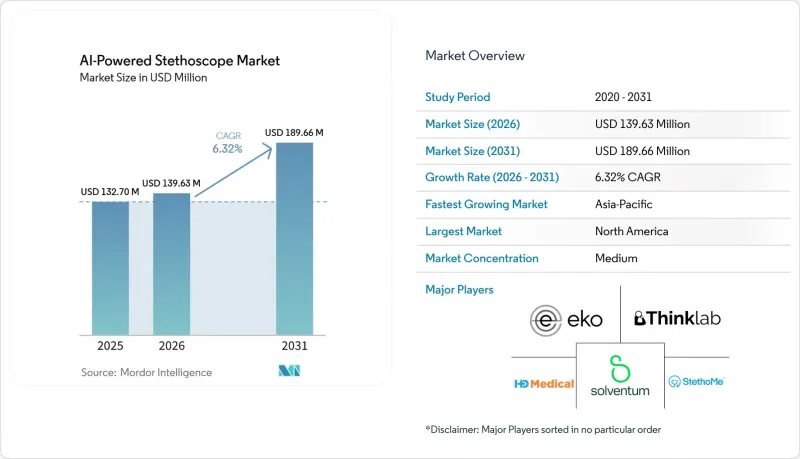
본 보고서는 제품 유형별(무선 AI 청진기, 유선 AI 청진기), 기술별(머신러닝, 딥러닝 등), 용도별(순환기학, 호흡기학 등), 최종 사용자별(병원, 진료소 등), 지역별(북미, 유럽, 아시아태평양, 중동 및 아프리카, 남미)로 분류되어 있습니다. 시장 예측은 금액(달러) 기준으로 제시되어 있습니다.
세계의 AI 기반 청진기 시장 동향 및 인사이트
심혈관 질환 및 호흡기 질환의 부담 증가
많은 의료 현장에서 일상적인 청진이 여전히 첫 번째 선별 절차로 사용되고 있기 때문에 심혈관 질환의 부담은 AI 기반 청진기 시장에 있어 가장 명확한 수요 기반으로 남아 있습니다. 또한 PubMed에 등록된 연구에 따르면, 고령화, 운동 부족, 대사 위험 요인 노출 등을 원인으로 하여 2025-2050년 심혈관 질환 유병률이 90% 증가하고, 조사망률이 73.4% 상승할 것으로 예측됩니다. 2026년 2월,유럽심장학회(European Society of Cardiology)가 소개한 조사에 따르면, 3곳의 1차 진료 기관에서 357명의 환자를 대상으로 한 시험에서 AI 탑재 디지털 청진기는 중등도에서 중증의 심장 판막증에 대해 92.3%의 민감도를 보인 반면, 기존 청진기는 46.2%에 그쳤습니다. 이러한 성능은 일반 진료 의사가 질환이 진행되기 전에 전문의의 진찰이 필요한 환자를 더 많이 식별할 수 있다는 점에서 중요합니다. 이러한 추세는 AI 기반 청진기 시장이 단순한 기기 업그레이드에 그치지 않고, 초진부터 발견, 그리고 의뢰에 이르는 과정을 단축하는 수단으로서의 역할을 수행하고 있음을 뒷받침합니다.
원격의료 및 원격 환자 모니터링의 확대
원격의료는 이미 정착된 의료 제공 채널이 되었으며, 이에 따라 AI 기반 청진기 시장은 병원 밖에서도 공유 가능하고 임상적으로 활용할 수 있는 음성을 기록할 수 있는 기기로 발전하고 있습니다. 인도 정부가 지원하는 ‘eSanjeevani’ 플랫폼에서는 1억 건 이상의 진료가 이루어지고 있으며, 이는 최전선 공중보건 서비스에서 가상 진료 워크플로우가 얼마나 대규모로 자리 잡았는지를 보여줍니다. 이러한 워크플로우에서 기기가 유용하게 활용되기 위해서는 기록이 맥락을 훼손하지 않은 채 원격지의 임상의에게 전송·저장·확인될 수 있는 경우에 한합니다. 따라서 앱 연동 기능, 구조화된 기록, 원활한 파일 전송을 갖춘 무선 플랫폼이 1차 진료,재택 간호, 그리고 지방의 선별 검사 프로그램에서 주목받고 있습니다. 단기적으로는 원격 진료 워크플로우의 최전선에서 실용적인 선별 검사 도구가 필요한 간호사, 응급구조사, 지역 보건 종사자들 수요가 가장 높습니다. 원격의료가 더욱 일상화됨에 따라, AI 기반 청진기 시장은 대면 청진 작업을 거점 간에 공유 가능한 디지털 임상 증거로 변환할 수 있는 능력 덕분에 혜택을 보고 있습니다.
초기 기기 및 알고리즘 통합 비용의 높음
높은 소유 비용은 AI 기반 청진기 시장에서 여전히 가장 뚜렷한 장벽 중 하나로 남아 있으며, 특히 조달 예산이 제한된 소규모 진료소나 지방 의료 시스템에서 두드러지게 나타납니다. Eko Health는 ‘CORE 500’의 가격을 379달러, ‘Eko+’ 멤버십 연회비를 119.99달러로 책정했습니다. 반면, Lapsi Health사는 2025년 10월 출시 당시 ‘Keikku 2.0’의 가격을 375달러로 책정했습니다. 이 가격 차이는 중요한 의미를 지닙니다. 왜냐하면 병원은 개인 개업의, 1차 진료 체인, 혹은 공중보건 프로그램에 비해 구독 비용을 더 쉽게 흡수할 가능성이 있기 때문입니다. 과제는 기기 가격에만 국한되지 않습니다. 정기적인 소프트웨어 사용료, 앱 지원, 교육 시간, 시스템 통합 작업 등이 총 소유 비용을 구성하기 때문입니다. 기기의 일회성 조달에 익숙한 구매자는 명확한 비용 상환 경로가 없는 상태에서 제품에 연간 소프트웨어 사용료가 포함되어 있을 경우, 도입에 신중해지는 경향이 있습니다. 비용 회수나 예산 관리가 더 예측 가능해질 때까지는 AI 기반 청진기 시장의 확산은 비용에 민감한 의료 환경보다는 자금력이 풍부한 의료 시스템에서 더욱 견고하게 이루어질 것입니다.
부문 분석
2025년에는 무선 기기가 매출의 43.18%를 차지하며 AI 기반 청진기 시장의 주요 형태가 되었습니다. 이러한 우위는 스마트폰과 페어링이 가능하고, 유선 연결로 인한 녹음 제한 없이 앱에 연결할 수 있는 블루투스 지원 기기에 대한 임상의들의 뚜렷한 선호도를 반영합니다. 이러한 기기는 기록된 음성을 의료진 간에 신속하게 공유해야 하는 외래 진료, 원격 의료 워크플로우, 재택치료 환경에 최적입니다. 그 가치는 편의성에 그치지 않습니다. 무선 공유를 통해 제2의 소견이나 비동기적 검토도 더욱 실용적으로 이루어질 수 있기 때문입니다. 이것이 바로 AI 기반 청진기 시장에서 기동성과 고음질을 겸비한 플랫폼에 대한 강한 관심이 쏠리고 있는 이유 중 하나입니다.
유선 기기는 가장 빠른 성장이 예상되는 제품 하위 부문이 될 전망이며, AI 기반 청진기 시장 내 유선 플랫폼 시장 규모는 2031년까지 연평균 성장률(CAGR) 7.54%로 확대될 것으로 예측됩니다. 의료 기관의 구매 담당자들은 보다 안정적인 연결, 기기당 비용 절감, 그리고 환자 수가 많은 임상 현장에서의 사용 편의성을 원할 경우 계속해서 유선 시스템을 선호하고 있습니다. 교육 병원이나 학술 기관에서도 여러 명의 청진자가 연수 목적으로 신뢰할 수 있는 재생 기능을 필요로 할 경우, 유선 구성이 중요하게 여겨집니다. 또한 일부 구매자는 관리된 임상 환경에서 무선 통신에 수반되는 보안상의 우려를 완화하는 보다 간편한 수단으로서 유선 전송을 높이 평가했습니다.
2025년에는 머신러닝이 매출의 39.26%를 차지하며 AI 기반 청진기 시장의 중심적인 위치를 차지했습니다. 이 부문은 심음 분류 분야에서 오랜 개발 역사와 초기 선도 기업들이 구축한 대규모 독자 데이터 세트의 혜택을 받고 있습니다. 딥러닝 기법은 소리 특징 추출에서 성능상의 이점을 제공하지만, 더 많은 연산 자원을 필요로 하기 때문에 많은 환경에서 기기에 내장하여 사용하는 데 여전히 한계가 있습니다.
자연어 처리(NLP)는 가장 빠르게 성장하는 기술 부문이 될 것으로 예상되며, NLP 기반 솔루션을 대상으로 하는 AI 기반 청진기 시장은 2031년까지 연평균 성장률(CAGR) 8.12%로 확대될 것으로 전망됩니다. 이러한 성장은 기기가 단순한 청진 도구에서 기록 및 의사결정 지원 플랫폼으로 변화하고 있는 데 기인합니다. ‘Machine Learning for Health’ 커뮤니티를 통해 발표된 연구에 따르면, CaReAQA와 같은 음성 언어 모델은 심음이나 호흡음의 음성 데이터로부터 근거에 기반한 임상적 응답을 생성할 수 있는 것으로 나타났습니다. 이는 단순한 분류가 아닌, 설명 및 워크플로우 지원으로 나아가는 광범위한 추세를 시사합니다. 시스템이 감지한 내용을 정리하여 실용적인 언어로 설명할 수 있다면, 임상의들은 그 결과를 더 신뢰하는 경향이 있으므로 이는 중요한 점입니다.
지역별 분석
2025년, 북미는 매출의 41.73%를 차지하며 AI 기반 청진기 시장에서 가장 규모가 큰 지역 블록이 되었습니다. 이 지역은 조기 FDA 승인, 강력한 기업 구매력, 소프트웨어 지원형 병상용 도구 도입에 대한 높은 수용성 등의 이점을 누리고 있습니다. 미국은 여전히 핵심 시장이며, Eko Health는 2025년까지 전 세계적으로 65만 대 이상의 SENSORA 기기를 판매했다고 보고했습니다. 또한, 이 회사는 2024년 6월 시리즈 D 자금 조달을 통해 4,100만 달러를 조달하여 AI를 활용한 심장 및 폐 질환 감지 범위를 확대되고 있습니다. 이는 북미 공급업체들에게 데이터 세트 구축, 워크플로우 개선, 그리고 일상 진료에서 의료진의 이해를 높이기 위한 추가적인 기회를 제공한다는 점에서 중요한 의미를 지닙니다. 유럽은 AI 기반 청진기 시장에서 여전히 중요한 시장입니다. 이는 엄격한 증거 및 개인정보 보호에 대한 기대가 임상적 타당성과 더욱 견고한 규정 준수 체계를 겸비한 플랫폼에 유리하게 작용하기 때문입니다.
아시아태평양은 AI 기반 청진기 시장에서 가장 빠르게 성장하는 지역이 될 것으로 예상되며, 2031년까지의 연평균 성장률(CAGR)은 8.95%로 전망됩니다. 이러한 성장은 충족되지 않은 선별 검사 수요의 규모, 디지털 헬스케어 제공 확대, 그리고 기술을 활용한 일선 진료를 통해 전문의의 접근성을 확대하려는 정책적 중점화에 의해 주도되고 있습니다. 인도가 특히 주목받는 이유는 NITI Aayog가 전문의 부족과 AI를 활용한 청진이 일선 의료진이 환자를 조기에 선별하는 데 있어 수행하는 역할 모두를 강조했기 때문입니다. 이 지역의 성장 속도가 다른 지역보다 빠른 것은 AI 기반 청진기 시장이 고급 병원의 구매뿐만 아니라, 보다 광범위한 일선 현장에서 사용하기에 적합한 기기를 통해 확대되어 나갈 것임을 시사합니다.
중동 및 아프리카, 남미는 AI 기반 청진기 시장에서 여전히 초기 단계에 있으며, 인프라 격차와 가격에 대한 민감성이 광범위한 보급을 계속해서 저해하고 있습니다. 그럼에도 불구하고, 이 지역에서는 전문의에 대한 접근성 격차와 많은 의료 현장에서의 통신 환경 불균형이 여전히 과제로 남아 있기 때문에 장기적인 수요는 클 것으로 보입니다. 합리적인 가격, 휴대성, 그리고 오프라인 및 저대역폭 환경에서의 이용을 중시하여 설계된 플랫폼은 프리미엄 구독형 모델보다 이러한 지역에서 유리한 입장에 있습니다. Sonavi Labs가 재택 청진과 안전한 정보 공유를 중시하고 있다는 점은 이러한 지역에서 기능의 충실도보다 단순한 도입 모델이 더 중요한 이유를 보여줍니다.
기타 혜택 :
- 엑셀 형식 시장 예측(ME) 시트
- 3개월간의 애널리스트 지원
자주 묻는 질문
목차
제1장 서론
제2장 조사 방법
제3장 개요
제4장 시장 구도
제5장 시장 규모 및 성장 예측
제6장 경쟁 구도
제7장 시장 기회 및 향후 전망
AJY 26.09.01According to Mordor Intelligence, the AI-powered stethoscope market is expected to grow from USD 132.70 million in 2025 to USD 139.63 million in 2026 and is forecasted to reach USD 189.66 million by 2031 at 6.32% CAGR over 2026-2031.
This report is Segmented by Product Type (Wireless AI Stethoscope, Wired AI Stethoscope), Technology (Machine Learning, Deep Learning, and More), Application (Cardiology, Pulmonology, and More), End-User (Hospitals, Clinics, and More), and Geography (North America, Europe, Asia-Pacific, Middle East and Africa, South America). The Market Forecasts are Provided in Terms of Value (USD).
Global AI-Powered Stethoscope Market Trends and Insights
Rising Cardiovascular and Respiratory Disease Burden
The cardiovascular burden remains the clearest demand base for the AI-powered stethoscope market because routine auscultation is still the first screening step in many care settings. A PubMed-indexed study also projected a 90% increase in cardiovascular disease prevalence and a 73.4% rise in crude mortality between 2025 and 2050, driven by aging, inactivity, and metabolic risk exposure. In February 2026, research highlighted by the European Society of Cardiology showed that an AI-enabled digital stethoscope reached 92.3% sensitivity for moderate to severe valvular heart disease, versus 46.2% for a traditional stethoscope, across 357 patients in 3 primary care settings. That performance matters because it allows generalist clinicians to identify more patients who need specialist review before the disease progresses. This pattern supports the AI-powered stethoscope market not just as a device upgrade, but as a way to shorten the path between first contact, detection, and referral.
Expansion of Telemedicine and Remote Patient Monitoring
Telemedicine has become a durable care channel, which is pulling the AI-powered stethoscope market toward devices that can create shareable and clinically usable sound records outside hospitals. India's government-backed eSanjeevani platform delivered more than 100 million consultations, which shows how large virtual care workflows have become in frontline public health delivery. In these workflows, the device is useful only when the recording can be transmitted, stored, and reviewed by a remote clinician without loss of context. That is why wireless platforms with app connectivity, structured recordings, and cleaner file transfer are gaining attention in primary care, homecare, and rural screening programs. The strongest near-term pull is coming from nurses, paramedics, and community health workers who need a practical screening tool at the edge of a teleconsultation workflow. As remote care becomes more routine, the AI-powered stethoscope market gains from its ability to turn an in-person listening task into digital clinical evidence that can travel between sites.
High Upfront Device and Algorithm Integration Cost
High ownership cost remains one of the clearest brakes on the AI-powered stethoscope market, especially in smaller clinics and rural systems with tight procurement budgets. Eko Health listed the CORE 500 at USD 379 and its Eko+ membership at USD 119.99 per year, while Lapsi Health priced the Keikku 2.0 at USD 375 when it launched in October 2025. That pricing gap is meaningful because hospitals may absorb subscription costs more easily than independent physicians, primary care chains, or public health programs can. The challenge is not limited to the device price, since recurring software fees, app support, training time, and integration work all shape the total cost of ownership. Buyers who are used to one-time device procurement often move more slowly when the product includes annual software charges without a clear reimbursement pathway. Until reimbursement and budget treatment become more predictable, adoption in the AI-powered stethoscope market will remain stronger in better-funded health systems than in cost-sensitive care environments.
Other drivers and restraints analyzed in the detailed report include:
- AI-Enabled Diagnostic Decision Support at Point of Care
- Need for Faster Triage in Primary Care and Emergency Settings
- Data Privacy and Cybersecurity Concerns in Connected Devices
For complete list of drivers and restraints, kindly check the Table Of Contents.
Segment Analysis
Wireless devices accounted for 43.18% of revenue in 2025, which made them the leading format in the AI-powered stethoscope market. Their lead reflects clear clinician preference for Bluetooth-enabled devices that can pair with smartphones and connect to apps without tethered recording limits. These devices fit well into outpatient clinics, telemedicine workflows, and home health environments where captured sounds need to move quickly between providers. The value is not only convenience, because wireless sharing also makes second opinions and asynchronous review more practical. This is one reason the AI-powered stethoscope market has seen strong interest in platforms that combine mobility with cleaner recording quality.
Wired devices are expected to be the fastest-growing product sub-segment, with the AI-powered stethoscope market size for wired platforms projected to expand at a 7.54% CAGR through 2031. Institutional buyers continue to favor wired systems when they want more stable connections, lower per-device cost, and easier use in high-volume clinical settings. Teaching hospitals and academic centers also value wired configurations when multiple listeners need reliable playback for training purposes. Some buyers further see wired transmission as a simpler way to reduce exposure to wireless security concerns in controlled clinical spaces.
Machine learning held 39.26% of revenue in 2025, which placed it at the core of the AI-powered stethoscope market. The segment benefits from a longer development history in cardiac sound classification and from the large proprietary datasets built by early leaders. Deep learning methods add performance benefits in sound feature extraction, but they also require heavier compute resources that still limit embedded on-device use in many settings.
Natural language processing is anticipated to be the fastest-growing technology segment, with the AI-powered stethoscope market for NLP-driven solutions forecasted to rise at an 8.12% CAGR through 2031. Growth is tied to the way the device is changing from a listening tool into a documentation and decision support platform. Research presented through the Machine Learning for Health community showed that audio language models such as CaReAQA can generate grounded clinical responses from cardiac and respiratory audio, which signals a broader move toward explanation and workflow support instead of simple classification. This matters because clinicians often trust a result more when the system can organize and describe what it detected in usable language.
Complete Report Scope:
- By Product Type
- Wireless AI Stethoscope
- Wired AI Stethoscope
- By Technology
- Machine Learning
- Deep Learning
- Natural Language Processing
- Other Technologies
- By Application
- Cardiology
- Pulmonology
- Pediatrics
- Primary Care
- Other Applications
- By End-User
- Hospitals
- Clinics
- Ambulatory Surgical Centers
- Homecare Settings
- By Geography
- North America
- United States
- Canada
- Mexico
- Europe
- Germany
- United Kingdom
- France
- Italy
- Spain
- Rest of Europe
- Asia-Pacific
- China
- Japan
- India
- Australia
- South Korea
- Rest of Asia-Pacific
- Middle East and Africa
- GCC
- South Africa
- Rest of Middle East and Africa
- South America
- Brazil
- Argentina
- Rest of South America
- North America
Geography Analysis
North America held 41.73% of revenue in 2025, which made it the largest regional block in the AI-powered stethoscope market. The region benefits from early FDA clearances, stronger enterprise purchasing capacity, and greater readiness to adopt software-supported bedside tools. The United States remains the core country market, with Eko Health reporting more than 650,000 SENSORA devices sold globally by 2025 and raising USD 41 million in Series D funding in June 2024 to scale AI-driven heart and lung disease detection. This leads matters because it gives North American vendors more opportunities to build datasets, refine workflows, and deepen provider familiarity in routine practice. Europe remains important for the AI-powered stethoscope market because strict evidence and privacy expectations can reward platforms that combine clinical validation with stronger compliance discipline.
Asia-Pacific is anticipated to be the fastest-growing region in the AI-powered stethoscope market, with a projected 8.95% CAGR through 2031. Growth is being shaped by large unmet screening needs, expanding digital health delivery, and a stronger policy focus on extending specialist reach through technology-enabled frontline care. India stands out because NITI Aayog highlighted both the specialist shortfall and the role of AI-based auscultation in helping frontline workers screen patients earlier. The region's faster growth suggests that the AI-powered stethoscope market will expand not only through premium hospital purchases but also through devices adapted for wider first-line use.
The Middle East, Africa, and South America remain earlier-stage parts of the AI-powered stethoscope market, where infrastructure gaps and price sensitivity still slow broad adoption. Even so, long-term demand is meaningful because these regions continue to face specialist access gaps and uneven connectivity across many care settings. Platforms designed for affordability, portability, and offline or low-bandwidth use are better positioned here than premium subscription-led models. Sonavi Labs' emphasis on home auscultation and secure sharing shows why simpler deployment models may matter more than feature depth in these geographies.
- A&D Company, Limited
- ADInstruments Pty Ltd
- Aevice Health
- American Diagnostic
- Cardionics, Inc.
- CliniCloud
- Contec Medical Systems
- Eko Health
- eKuore Medical
- HD Medical Group
- Lapsi Health
- M3DICINE Pty Ltd.
- Meditech Equipment
- SensiCardiac
- Solventum
- Sonavi Labs
- StethoMe
- Thinklabs Medical LLC
- Welch Allyn
Additional Benefits:
- The market estimate (ME) sheet in Excel format
- 3 months of analyst support
TABLE OF CONTENTS
1 Introduction
- 1.1 Study Assumptions and Market Definition
- 1.2 Scope of the Study
2 Research Methodology
3 Executive Summary
4 Market Landscape
- 4.1 Market Overview
- 4.2 Market Drivers
- 4.2.1 Rising Cardiovascular and Respiratory Disease Burden
- 4.2.2 Expansion of Telemedicine and Remote Patient Monitoring
- 4.2.3 AI-Enabled Diagnostic Decision Support at Point of Care
- 4.2.4 Need for Faster Triage in Primary Care and Emergency Settings
- 4.2.5 Clinical Workflow Digitization and EHR Integration Demand
- 4.2.6 Specialty-Grade Acoustic Noise Cancellation and Signal Enhancement
- 4.3 Market Restraints
- 4.3.1 High Upfront Device and Algorithm Integration Cost
- 4.3.2 Regulatory Validation and Algorithm Transparency Burden
- 4.3.3 Data Privacy and Cybersecurity Concerns in Connected Devices
- 4.3.4 Low Clinical Change Acceptance in Resource-Constrained Settings
- 4.4 Supply/Value Chain Analysis
- 4.5 Regulatory Landscape
- 4.6 Technological Outlook
- 4.7 Porter's Five Forces Analysis
- 4.7.1 Threat of New Entrants
- 4.7.2 Bargaining Power of Suppliers
- 4.7.3 Bargaining Power of Buyers
- 4.7.4 Threat of Substitutes
- 4.7.5 Competitive Rivalry
5 Market Size & Growth Forecasts (Value, USD)
- 5.1 By Product Type
- 5.1.1 Wireless AI Stethoscope
- 5.1.2 Wired AI Stethoscope
- 5.2 By Technology
- 5.2.1 Machine Learning
- 5.2.2 Deep Learning
- 5.2.3 Natural Language Processing
- 5.2.4 Other Technologies
- 5.3 By Application
- 5.3.1 Cardiology
- 5.3.2 Pulmonology
- 5.3.3 Pediatrics
- 5.3.4 Primary Care
- 5.3.5 Other Applications
- 5.4 By End-User
- 5.4.1 Hospitals
- 5.4.2 Clinics
- 5.4.3 Ambulatory Surgical Centers
- 5.4.4 Homecare Settings
- 5.5 By Geography
- 5.5.1 North America
- 5.5.1.1 United States
- 5.5.1.2 Canada
- 5.5.1.3 Mexico
- 5.5.2 Europe
- 5.5.2.1 Germany
- 5.5.2.2 United Kingdom
- 5.5.2.3 France
- 5.5.2.4 Italy
- 5.5.2.5 Spain
- 5.5.2.6 Rest of Europe
- 5.5.3 Asia-Pacific
- 5.5.3.1 China
- 5.5.3.2 Japan
- 5.5.3.3 India
- 5.5.3.4 Australia
- 5.5.3.5 South Korea
- 5.5.3.6 Rest of Asia-Pacific
- 5.5.4 Middle East and Africa
- 5.5.4.1 GCC
- 5.5.4.2 South Africa
- 5.5.4.3 Rest of Middle East and Africa
- 5.5.5 South America
- 5.5.5.1 Brazil
- 5.5.5.2 Argentina
- 5.5.5.3 Rest of South America
- 5.5.1 North America
6 Competitive Landscape
- 6.1 Market Concentration
- 6.2 Market Share Analysis
- 6.3 Company Profiles (includes Global level Overview, Market level overview, Core Segments, Financials as available, Strategic Information, Market Rank/Share for key companies, Products & Services, Recent Developments)
- 6.3.1 A&D Company, Limited
- 6.3.2 ADInstruments Pty Ltd
- 6.3.3 Aevice Health
- 6.3.4 American Diagnostic Corporation
- 6.3.5 Cardionics, Inc.
- 6.3.6 CliniCloud
- 6.3.7 Contec Medical Systems Co., Ltd.
- 6.3.8 Eko Health
- 6.3.9 eKuore Medical
- 6.3.10 HD Medical Group
- 6.3.11 Lapsi Health
- 6.3.12 M3DICINE Pty Ltd.
- 6.3.13 Meditech Equipment Co., Ltd.
- 6.3.14 SensiCardiac
- 6.3.15 Solventum
- 6.3.16 Sonavi Labs
- 6.3.17 StethoMe
- 6.3.18 Thinklabs Medical LLC
- 6.3.19 Welch Allyn
7 Market Opportunities & Future Outlook
- 7.1 White-space & Unmet-need Assessment


