|
시장보고서
상품코드
2118120
재활용 금속 시장 : 시장 점유율 분석, 업계 동향 및 통계, 성장 예측(2026-2031년)Recycled Metal - Market Share Analysis, Industry Trends & Statistics, Growth Forecasts (2026 - 2031) |
||||||
 Mordor Intelligence
Mordor Intelligence에 의하면, 재활용 금속 시장 규모는 2025년에 1,358억 2,000만 달러로 평가되었고, 2026년 1,431억 7,000만 달러에서 2031년까지 1,918억 6,000만 달러에 이를 것으로 추정되며, 예측 기간(2026-2031년) CAGR은 6.03%를 나타낼 전망입니다.
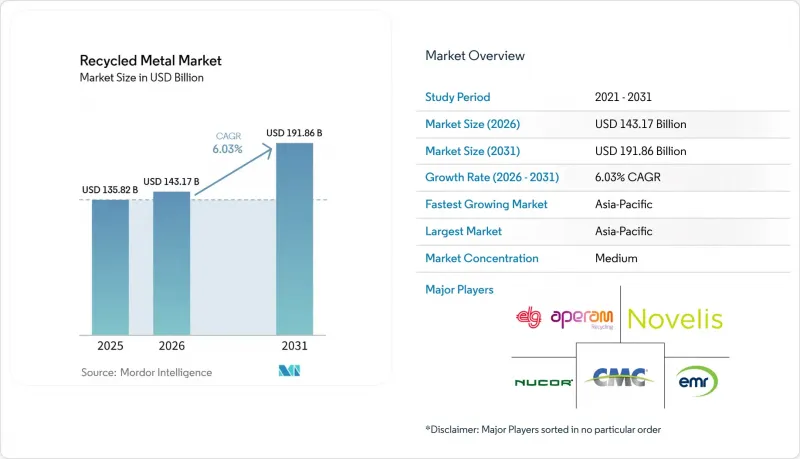
본 보고서는 금속 유형별(철금속 및 비철금속), 스크랩 공급원별(산업용 스크랩 등), 가공 방법별(기계적 가공 등), 제품 형태별(잉곳 등), 최종 사용자 산업별(자동차 산업 등), 지역별(아시아태평양, 북미, 유럽, 남미, 중동 및 아프리카)로 분류되어 있습니다. 시장 예측은 금액(달러) 기준으로 제시되어 있습니다.
세계의 재활용 금속 시장 동향 및 인사이트
주요 최종 사용자 부문에서의 재활용 금속 수요 증가
제조업 구매자들은 비용 관리, 탄소 회계, 그리고 공급원 다각화가 조달 결정에 동시에 영향을 미치는 가운데, 재활용 소재의 함유율에 대한 기대치를 높이고 있습니다. 이러한 추세는 재활용 금속 시장의 자동차 및 전자 분야에서 가장 두드러지며, 이 분야에서는 재료 사양이 점차 엄격해지고 있어 공급업체는 신뢰할 수 있는 2차 정보를 통해 수명 주기 배출량 감축 목표 달성을 지원해야할 것으로 요구되고 있습니다. 자동차 차체용 강판의 유통 경로에 관한 조사에 따르면, 폐쇄형 루프 방식을 통한 알루미늄 및 철강 재활용으로 2050년까지 수명 주기 배출량을 최대 70%까지 감축할 수 있는 것으로 나타나, 자동차 제조업체들에게 재활용 소재의 보다 광범위한 채택을 위한 강력한 근거가 되고 있습니다. 수량 측면뿐만 아니라, 구매자들은 예측 가능한 품질, 문서화된 원산지, 그리고 고부가가치 용도와의 호환성을 점점 더 요구하고 있으며, 이는 재활용 업체들의 경쟁 방식과 계약 구성 방식에 변화를 가져오고 있습니다. 따라서 재활용 금속 시장은 수요 증가뿐만 아니라, 산업 고객들 사이에서 점차 더 체계화되고 사양에 기반한 구매 행태로 전환되고 있다는 점에서도 혜택을 보고 있습니다.
산업의 탈탄소화 및 배출 감축에 대한 관심 고조
산업의 탈탄소화가 진행됨에 따라, 열, 광석 및 대량의 자재 흐름에 크게 의존하는 부문에서 배출량을 줄이기 위한 현실적인 수단으로서 스크랩을 원료로 한 생산의 중요성이 높아지고 있습니다. 2024년 전 세계 철강 생산량은 18억 8,600만 톤에 달했으며, 해당 부문에서는 약 41억 톤의 CO2 환산량이 배출되었습니다. 이에 따라 철강 제조업체들은 실행 가능한 범위 내에서 저배출형 생산 방식을 확대하도록 계속해서 압력을 받고 있습니다. 전기 아크로(EAF)를 이용한 생산은 고철에 대한 의존도가 높으며, 철강 소비 산업 내 ‘내재된 배출량’ 감축을 위한 광범위한 노력과도 부합하기 때문에 재활용 금속 시장은 이러한 압력으로부터 직접적인 혜택을 받고 있습니다. 이러한 영향은 철강 업계에 그치지 않고, 비철금속 용도에서도 저탄소 소재의 선택이 점점 더 중요해지고 있으며, 특히 고객이 미사용 원료와 재활용 원료의 배출 발자국을 비교하는 조달 심사 단계에서 두드러지게 나타납니다. 그 결과, 재활용 금속 시장은 탈탄소화 계획, 공장 투자 결정, 그리고 회수 금속의 배출 프로파일을 더욱 중시하는 공급 계약과 점점 더 밀접하게 연결되고 있습니다.
고철 가격의 변동성과 런던금속거래소(LME)의 차익거래 혼란
가격 변동성은 여전히 제약 요인으로 작용하고 있습니다. 재활용 업체들은 무역 흐름이나 벤치마크 스프레드에 따라 급격히 변화할 수 있는 시장에서 원자재 구매, 가공 비용, 판매 계약을 관리해야 하기 때문입니다. 고철 가격의 급격한 변동은 실물 거래량이 안정적일 때조차 이익률을 압박할 가능성이 있으므로, 이 문제는 철계·비철계를 불문하고 재활용 금속 시장 전체에 영향을 미치고 있습니다. 또한 이러한 불안정성으로 인해 가공업체가 기술 업그레이드나 리드타임이 긴 생산 능력 확충을 계획하기가 어려워집니다. 특히 금융 기관이나 고객이 보다 예측 가능한 수익이나 공급 실적을 요구할 경우 더욱 그렇습니다. 국내와 수출 유통 경로의 균형이 무너지면 이 과제는 더욱 두드러집니다. 가공업체는 수익성을 유지할 충분한 시간적 여유 없이 원자재를 다른 용도로 전용해야 할 수도 있기 때문입니다. 이러한 압박에도 불구하고 재활용 금속 시장은 성장을 지속하고 있지만, 가격 상황이 불안정해지면 수익성이나 투자 속도가 둔화될 가능성이 있습니다.
부문 분석
2025년에는 철금속이 매출의 61.72%를 차지했으나, 비철금속은 2031년까지 연평균 성장률(CAGR) 6.89%를 나타낼 것으로 예측되고 있으며, 이는 재활용 금속 시장에서 취급량과 성장의 주도권이 더 이상 동일한 부문에 집중되어 있지 않음을 보여줍니다. 건설, 인프라, 전기 아크로(EAF)를 통한 제강이 계속해서 대량의 스크랩을 흡수하여 재생 강재에 대한 안정적인 수요를 뒷받침하고 있기 때문에 철계 금속의 재활용은 여전히 재생 금속 시장의 중추를 이루고 있습니다. 한편, 비철금속 수요는 더욱 빠르게 증가하고 있습니다. 이는 운송 수단의 전기화, 전력 설비, 데이터 인프라 분야에서 재생 구리와 재생 알루미늄의 중요성이 높아지고 있으며, 이러한 분야에서는 재료의 성능과 공급 안정성이 중요한 고려 사항이 되고 있기 때문입니다. 2025년 중국의 재생 알루미늄 생산량 1,160만 톤, 재생 구리 생산량 485만 톤이라는 수치는 비철금속 회수가 도달한 규모를 여실히 보여줍니다.
재활용 금속 시장에서 주목할 만한 변화로는 비철금속의 성장 가속화뿐만 아니라, 요구 사항이 까다로운 용도에서 재활용 소재와 1차 원료 간의 적합성이 향상되고 있다는 점도 포함됩니다. 현재 습식 제련 및 관련 정제 공정을 통해 폐인쇄회로기판에서 순도 99.64%-99.84%의 재활용 구리가 생산되고 있으며, 이로 인해 전자기기 관련 용도에서의 대체 가능성이 높아지고 있습니다. 이는 그동안 재생 비철금속을 저품질 대체품으로 취급해 온 구매자들도, 성분 관리가 필수적인 용도에서 재생 구리를 검토할 수 있게 되었습니다는 점에서 중요합니다. 그 결과, 재생 금속 시장은 단순한 스크랩 양 확보보다 공정 능력이나 순도 보증이 더 중요시되는 경쟁 환경의 변화에 직면하고 있습니다.
2025년에는 산업 스크랩이 46.81%를 차지했으나, 노후화된 스크랩 및 소비 후 스크랩은 2031년까지 연평균 성장률(CAGR) 6.32%를 나타낼 것으로 예측되어, 재활용 금속 시장공급 기반이 점차 확대되고 있음을 보여줍니다. 산업 스크랩이 여전히 주도적인 위치를 유지하고 있는 이유는 공장 내 자투리 재료나 생산 잔여물이 일반적으로 품질이 더 안정적이고 오염이 적으며, 높은 수준의 산업 구매자에게 서비스를 제공하는 재활용 업체가 인증을 받기 쉽기 때문입니다. 이러한 일관성 덕분에 용해 시의 화학 성분 및 가공 효율이 엄격하게 관리되는 자동차 공급망, 압연 제품, 철강 용도에서의 활용이 활발해지고 있습니다. 사용 후 제품은 폐자동차, 해체 폐기물, 폐전자기기 등으로 인해 공장 외부에서 입수 가능한 금속의 양이 증가하고 있어 그 중요성이 높아지고 있습니다. 선별 및 회수 시스템이 지속적으로 개선된다면, 이용 가능한 자재의 흐름이 확대되어 장기적인 원료의 안정적 공급을 확보할 수 있으므로, 재활용 금속 시장은 이러한 동향으로부터 혜택을 받고 있습니다.
사용 후 제품에서 유래한 자재의 주요 과제는 일반적인 산업용 스크랩 흐름에 비해 혼합 합금, 코팅, 부속품 및 오염 물질의 함유 수준이 높은 상태로 반입된다는 점에 있습니다. 즉, 사용 후 스크랩을 저품질 재활용 순환이 아닌 더 높은 부가가치를 지닌 최종 용도로 전환하기 위해서는 재활용 금속 시장이 해체, 선별, 파쇄, 분리 및 문서화에 대한 투자를 더욱 늘려야 합니다. 이러한 맥락에서 대만의 ‘자원순환촉진법’은 중요한 의미를 지닙니다. 이 법은 보다 광범위한 수명 주기 추적을 지원하고, 정책 입안자들에게 사용 후 자재의 가시성을 높일 수 있는 공식적인 체계를 제공하기 때문입니다. 이러한 시스템이 개선됨에 따라, 재활용 금속 시장은 사용 후 제품에서 유래한 자재의 더 큰 비율을, 더 엄격한 고객 사양을 충족할 수 있는 신뢰할 수 있는 원료로 전환할 수 있게 될 것입니다.
지역별 분석
아시아태평양은 2025년에 46.36%의 점유율을 차지한 것으로 평가되었으며, 2031년까지 연평균 성장률(CAGR) 6.78%로 확대될 것으로 전망되어, 재활용 금속 시장에서 가장 큰 규모와 가장 빠른 성장을 동시에 달성할 것으로 보입니다. 중국은 이 지위의 중심을 계속 차지하고 있으며, 2025년 비철금속 재활용 회수량은 1,672만 메트르톤에 달할 것으로 보이며, 업계 단체에 따르면 2026년에는 1,700만 메트르톤에 이를 것으로 예측됩니다. 이 지역은 대규모 제조 거점, 풍부한 스크랩 발생량, 그리고 회수와 산업 재사용을 연결하는 체계적인 회수 시스템에 대한 정책적 관심 증가라는 혜택을 누리고 있습니다. 대만의 2025년 ‘자원순환촉진법’은 아시아태평양 각국 정부가 수명 주기 관리 및 사용 후 회수를 위한 보다 체계적인 프레임워크를 확립하고 있다는 광범위한 추세를 반영하고 있습니다.
북미와 유럽은 재활용 금속 시장 중에서도 더 높은 사양의 부문을 차지하고 있으며, 제품 품질, 규제 준수, 그리고 첨단 가공 능력이 경쟁에서 더 큰 비중을 차지하고 있습니다. 미국에 위치한 올루비스(Oluvis)사의 리치먼드 공장은 2025년 9월에 생산을 시작하여, 복잡한 원료에 대응하는 다금속 재활용 능력을 추가함으로써 국내 전략적 금속의 회수를 지원하고 있습니다. 노벨리스(Novelis)의 베이 미넷(Bay Minette) 프로젝트는 2026년에 시운전을 시작할 예정이며, 이는 북미공급망이 재활용 능력과 하류 알루미늄 판재 생산을 얼마나 밀접하게 연결하고 있는지를 다시 한번 보여줍니다. 유럽에서는 2026년 ‘순환 경제법’의 틀과 유럽투자은행(EIB)의 재활용 관련 자금 조달이 재활용 금속 시장의 정책, 자금 조달 및 재료 인증 기준 간의 보다 긴밀한 연계를 뒷받침하고 있습니다.
남미, 중동 및 아프리카에서는 일부 국가에서 철강, 자동차, 산업 분야에서 상당한 수요가 있음에도 불구하고, 재활용 금속 시장은 여전히 초기 단계에 머물러 있습니다. 각 지역의 발전은 고철 발생량 자체보다, 공식적인 수거, 선별, 검사 및 문서 관리 시스템이 얼마나 신속하게 확대될 수 있는지에 크게 좌우됩니다. 이러한 시스템이 미비한 지역에서는 자재의 품질과 추적성에 편차가 나타나며, 우량 구매자에 대한 접근이 제한되어 비공식 수거에서 산업용 재활용으로의 전환이 지연되고 있습니다. 그 결과, 해당 지역의 재활용 금속 시장에는 성장 여지가 있지만, 인프라의 질이야말로 잠재적 가능성과 단기적인 상업적 실현을 가르는 중요한 요인이 되고 있습니다.
기타 혜택 :
- 엑셀 형식 시장 예측(ME) 시트
- 3개월간의 애널리스트 지원
자주 묻는 질문
목차
제1장 서론
제2장 조사 방법
제3장 개요
제4장 시장 구도
제5장 시장 규모 및 성장 예측
제6장 경쟁 구도
제7장 시장 기회 및 향후 전망
AJY 26.09.01According to Mordor Intelligence, the recycled metal market size was valued at USD 135.82 billion in 2025 and is estimated to grow from USD 143.17 billion in 2026 to reach USD 191.86 billion by 2031, at a CAGR of 6.03% during the forecast period (2026-2031).
This report is Segmented by Metal Type (Ferrous Metals and Non-Ferrous Metals), Scrap Source (Industrial Scrap and More), Processing Method (Mechanical Processing and More), Product Form (Ingots and More), End-User Industry (Automotive and More), and Geography (Asia-Pacific, North America, Europe, South America, and Middle-East and Africa). The Market Forecasts are Provided in Terms of Value (USD).
Global Recycled Metal Market Trends and Insights
Rising Demand for Recycled Metals Across Key End-User Sectors
Manufacturing buyers are raising expectations for recycled content as cost discipline, carbon accounting, and supply diversification simultaneously influence sourcing decisions. This trend is most evident in the automotive and electronics segments of the recycled metal market, where material specifications are becoming stricter, and suppliers are expected to support lifecycle emissions goals with reliable secondary inputs. Research on automotive body sheet pathways indicates that closed-loop aluminum and steel recycling can reduce lifecycle emissions by up to 70% by 2050, providing vehicle manufacturers with a strong basis for broader adoption of recycled inputs . Beyond volume, buyers increasingly require predictable quality, documented origin, and compatibility with high-value applications, which is changing how recyclers compete and how contracts are structured. The recycled metal market, therefore, benefits not only from broader demand but also from a gradual shift toward more formalized, specification-driven purchasing behavior among industrial customers.
Increasing Focus on Industrial Decarbonization and Emissions Reduction
Industrial decarbonization is increasing the importance of scrap-based production as a practical route to lower emissions in sectors that depend heavily on heat, ore, and large material flows. Global steel production reached 1,886 million tons in 2024, and the sector generated around 4.1 billion tons of CO2 equivalent, maintaining pressure on steelmakers to expand lower-emission production routes where feasible. The recycled metal market benefits directly from this pressure, as electric arc furnace production relies heavily on scrap and aligns with the broader push to reduce embedded emissions in steel-consuming industries. This effect extends beyond steel, as lower-carbon material choices are becoming increasingly relevant in non-ferrous applications, particularly during procurement reviews when customers compare the emissions footprints of virgin and recycled feedstocks. As a result, the recycled metal market is becoming more closely tied to decarbonization plans, plant investment decisions, and supply contracts that place greater value on the emissions profile of recovered metals.
Volatility in Scrap Metal Prices and London Metal Exchange (LME) Arbitrage Disruptions
Price volatility remains a constraint because recyclers must manage feedstock purchases, processing costs, and sales commitments in a market that can shift quickly with trade flows and benchmark spreads. The recycled metal market is exposed to this issue across ferrous and non-ferrous categories, as sudden changes in scrap values can compress margins even when physical volumes remain stable. This instability also makes it harder for processors to plan technology upgrades and long-lead capacity additions, particularly when lenders and customers require more predictable earnings and supply performance. The challenge becomes more pronounced when domestic and export channels become unbalanced, as processors may need to redirect material without sufficient time to preserve economics. The recycled metal market continues to grow despite this pressure, but profitability and investment pace can weaken when pricing conditions become unsettled.
Other drivers and restraints analyzed in the detailed report include:
- Growing Demand for Urban Mining and Secondary Resource Recovery
- Supportive Government Policies and Incentive Schemes for Recycling
- Stringent Environmental Processing Standards and Compliance Costs
For complete list of drivers and restraints, kindly check the Table Of Contents.
Segment Analysis
Ferrous metals accounted for 61.72% of revenue in 2025, while non-ferrous metals are projected to grow at a 6.89% CAGR through 2031, indicating that volume leadership and growth leadership are no longer concentrated in the same segment of the recycled metal market. Ferrous recovery remains the backbone of the recycled metal market because construction, infrastructure, and electric arc furnace steelmaking continue to absorb large scrap flows and support stable demand for recycled steel inputs. Non-ferrous demand is rising faster because recycled copper and aluminum are becoming more important in transport electrification, power equipment, and data infrastructure, where material performance and supply resilience are key considerations. China's 2025 output of 11.60 million tons of recycled aluminum and 4.85 million tons of recycled copper reflects the scale that non-ferrous recovery has reached.
A notable shift in the recycled metal market involves not only faster non-ferrous growth, but also better alignment between recycled and primary materials in demanding applications. Hydrometallurgical and related refining routes are now producing recycled copper from waste printed circuit boards with purities of 99.64% to 99.84%, which improves its substitution potential in electronics-related applications. This matters because buyers who previously treated recycled non-ferrous feed as a lower-grade option can now consider it for applications where composition control is critical. As a result, the recycled metal market faces a competitive shift in which process capability and purity assurance are becoming more important than simple access to scrap volume alone.
Industrial scrap accounted for 46.81% in 2025, while obsolete and post-consumer scrap is forecast to grow at a 6.32% CAGR through 2031, indicating that the recycled metal market is gradually broadening its supply base. Industrial scrap retains its lead because in-plant offcuts and production residues typically offer more consistent quality, lower contamination, and easier qualification for recyclers serving high-standard industrial buyers. That consistency supports strong use in automotive supply chains, rolled products, and steel applications where melt chemistry and processing efficiency are tightly managed. Post-consumer materials are gaining relevance as end-of-life vehicles, demolition waste, and discarded electronics increase the volume of metal available outside factory gates. The recycled metal market benefits from this trend because a wider stream of available material can support long-term feedstock security if sorting and recovery systems continue to improve.
The main challenge with post-consumer material is that it arrives with greater levels of mixed alloys, coatings, attachments, and contamination than most industrial scrap streams. This means the recycled metal market must invest more in dismantling, sorting, shredding, separation, and documentation if obsolete scrap is to move into higher-value end uses rather than lower-grade recycling loops. Taiwan's Resource Circulation Promotion Act is relevant in this context because it supports broader lifecycle tracking and gives policymakers a formal mechanism to improve end-of-life material visibility. As those systems improve, the recycled metal market will be better positioned to convert a larger share of post-consumer volume into reliable feedstock that can meet stricter customer specifications.
Complete Report Scope:
- By Metal Type
- Ferrous Metals
- Non-Ferrous Metals
- By Scrap Source
- Industrial Scrap
- Obsolete (Post-Consumer) Scrap
- By Processing Method
- Mechanical Processing
- Pyrometallurgical Processing
- Hydrometallurgical Processing
- By Product Form
- Ingots
- Billets
- Sheets and Plates
- Rods and Bars
- Other Forms
- By End-User Industry
- Automotive
- Building and Construction
- Packaging
- Electrical and Electronics
- Industrial Machinery
- Consumer Goods
- Other End-Use Industries
- By Geography
- Asia-Pacific
- China
- India
- Japan
- South Korea
- Rest of Asia-Pacific
- North America
- United States
- Canada
- Mexico
- Europe
- Germany
- United Kingdom
- France
- Italy
- Russia
- Rest of Europe
- South America
- Brazil
- Argentina
- Rest of South America
- Middle-East and Africa
- Saudi Arabia
- South Africa
- Rest of Middle-East and Africa
- Asia-Pacific
Geography Analysis
Asia-Pacific held a 46.36% share in 2025 and is forecast to expand at a 6.78% CAGR through 2031, making it the region with both the largest base and the fastest growth in the recycled metal market. China remains central to this position, with recycled non-ferrous metal recovery reaching 16.72 million metric tons in 2025 and projected by the industry association to reach 17 million metric tons in 2026. The region benefits from a large manufacturing base, strong scrap generation, and growing policy focus on organized recovery systems that connect collection with industrial reuse. Taiwan's 2025 Resource Circulation Promotion Act reflects a broader trend of Asia-Pacific governments establishing more structured frameworks for lifecycle management and post-use recovery.
North America and Europe represent higher-specification segments of the recycled metal market, where product quality, regulatory compliance, and advanced processing capabilities carry greater competitive weight. Aurubis' Richmond plant in the United States began production in September 2025, adding multimetal recycling capacity for complex feed materials that supports domestic strategic metal recovery. Novelis' Bay Minette project is commissioning in 2026, further demonstrating how North American supply chains are linking recycling capacity more closely to downstream aluminum sheet output. In Europe, the 2026 Circular Economy Act framework and the European Investment Bank's recycling-linked financing support closer alignment among policy, capital access, and material qualification in the recycled metal market.
South America, the Middle-East, and Africa remain early-stage parts of the recycled metal market, despite several countries having meaningful steel, automotive, and industrial demand. Regional progress depends less on scrap generation alone and more on how quickly formal collection, sorting, testing, and documentation systems can scale. Where these systems remain underdeveloped, material quality and traceability are uneven, limiting access to premium buyers and slowing the transition from informal recovery to industrial recycling. As a result, the recycled metal market in these regions offers room for growth, but infrastructure quality remains the key factor separating potential from near-term commercial realization.
- ArcelorMittal
- Asahi Holdings, Inc.
- Aurubis AG
- Befesa S.A.
- Chiho Environmental Group Limited
- CMC
- ELG GmbH
- EMR Group Limited
- Hensel Recycling GmbH
- Kuusakoski Group
- Novelis
- Nucor Corporation
- OmniSource Corporation
- SA Recycling LLC
- Schnitzer Steel Industries, Inc.
- Sims Metal
- Toyota Tsusho Corporation
- Triple M Metal LP
Additional Benefits:
- The market estimate (ME) sheet in Excel format
- 3 months of analyst support
TABLE OF CONTENTS
1 Introduction
- 1.1 Study Assumptions and Market Definition
- 1.2 Scope of the Study
2 Research Methodology
3 Executive Summary
4 Market Landscape
- 4.1 Market Overview
- 4.2 Market Drivers
- 4.2.1 Rising Demand for Recycled Metals Driven by Electrification and Renewable Energy Applications
- 4.2.2 Increasing Focus on Decarbonization and Circular Economy Initiatives
- 4.2.3 Growing Demand for Low-Carbon Feedstock in Steel Mills and Metal Foundries
- 4.2.4 Supportive Government Policies and Regulations Promoting Metal Recycling
- 4.2.5 Increasing Recovery of Metals from End-of-Life Vehicles, Batteries, and Electronic Waste
- 4.3 Market Restraints
- 4.3.1 Volatility in Scrap Metal Prices and Primary Metal Markets
- 4.3.2 Stringent Environmental Regulations and High Compliance Costs
- 4.3.3 Inefficient Scrap Collection Infrastructure and Limited Material Traceability
- 4.4 Value Chain Analysis
- 4.5 Porter's Five Forces Analysis
- 4.5.1 Threat of New Entrants
- 4.5.2 Bargaining Power of Suppliers
- 4.5.3 Bargaining Power of Buyers
- 4.5.4 Threat of Substitutes
- 4.5.5 Competitive Rivalry
5 Market Size and Growth Forecasts (Value)
- 5.1 By Metal Type
- 5.1.1 Ferrous Metals
- 5.1.2 Non-Ferrous Metals
- 5.2 By Scrap Source
- 5.2.1 Industrial Scrap
- 5.2.2 Obsolete (Post-Consumer) Scrap
- 5.3 By Processing Method
- 5.3.1 Mechanical Processing
- 5.3.2 Pyrometallurgical Processing
- 5.3.3 Hydrometallurgical Processing
- 5.4 By Product Form
- 5.4.1 Ingots
- 5.4.2 Billets
- 5.4.3 Sheets and Plates
- 5.4.4 Rods and Bars
- 5.4.5 Other Forms
- 5.5 By End-User Industry
- 5.5.1 Automotive
- 5.5.2 Building and Construction
- 5.5.3 Packaging
- 5.5.4 Electrical and Electronics
- 5.5.5 Industrial Machinery
- 5.5.6 Consumer Goods
- 5.5.7 Other End-Use Industries
- 5.6 By Geography
- 5.6.1 Asia-Pacific
- 5.6.1.1 China
- 5.6.1.2 India
- 5.6.1.3 Japan
- 5.6.1.4 South Korea
- 5.6.1.5 Rest of Asia-Pacific
- 5.6.2 North America
- 5.6.2.1 United States
- 5.6.2.2 Canada
- 5.6.2.3 Mexico
- 5.6.3 Europe
- 5.6.3.1 Germany
- 5.6.3.2 United Kingdom
- 5.6.3.3 France
- 5.6.3.4 Italy
- 5.6.3.5 Russia
- 5.6.3.6 Rest of Europe
- 5.6.4 South America
- 5.6.4.1 Brazil
- 5.6.4.2 Argentina
- 5.6.4.3 Rest of South America
- 5.6.5 Middle-East and Africa
- 5.6.5.1 Saudi Arabia
- 5.6.5.2 South Africa
- 5.6.5.3 Rest of Middle-East and Africa
- 5.6.1 Asia-Pacific
6 Competitive Landscape
- 6.1 Market Concentration
- 6.2 Strategic Moves
- 6.3 Market Share (%)/Ranking Analysis
- 6.4 Company Profiles (includes Global Overview, Market Overview, Core Segments, Financials as available, Strategic Information, Products and Services, and Recent Developments)
- 6.4.1 ArcelorMittal
- 6.4.2 Asahi Holdings, Inc.
- 6.4.3 Aurubis AG
- 6.4.4 Befesa S.A.
- 6.4.5 Chiho Environmental Group Limited
- 6.4.6 CMC
- 6.4.7 ELG GmbH
- 6.4.8 EMR Group Limited
- 6.4.9 Hensel Recycling GmbH
- 6.4.10 Kuusakoski Group
- 6.4.11 Novelis
- 6.4.12 Nucor Corporation
- 6.4.13 OmniSource Corporation
- 6.4.14 SA Recycling LLC
- 6.4.15 Schnitzer Steel Industries, Inc.
- 6.4.16 Sims Metal
- 6.4.17 Toyota Tsusho Corporation
- 6.4.18 Triple M Metal LP
7 Market Opportunities and Future Outlook
- 7.1 White-Space and Unmet-Need Assessment