|
시장보고서
상품코드
2118169
복합 슬레이트 지붕 시장 : 시장 점유율 분석, 업계 동향 및 통계, 성장 예측(2026-2031년)Composite Slate Roofing - Market Share Analysis, Industry Trends & Statistics, Growth Forecasts (2026 - 2031) |
||||||
 Mordor Intelligence
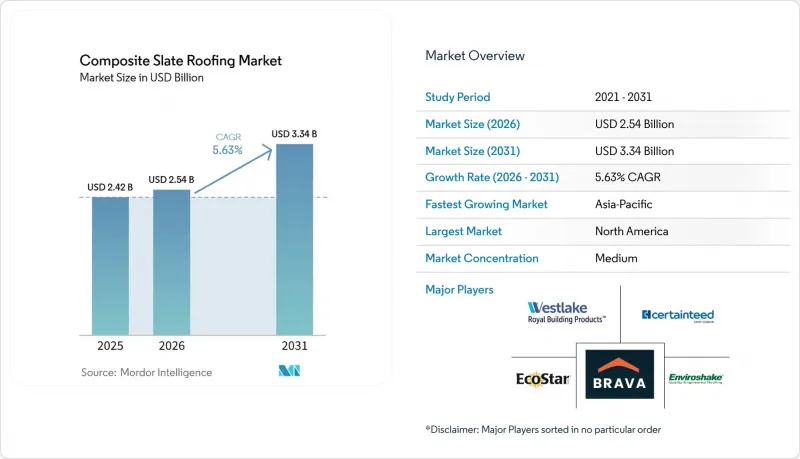
Mordor Intelligence에 의하면, 복합 슬레이트 지붕 시장 규모는 2025년에 24억 2,000만 달러로 평가되었고, 2026년에 25억 4,000만 달러로 추정되고, 2031년까지 33억 4,000만 달러에 이를 것으로 전망되며, 2026-2031년 CAGR 5.63%를 나타낼 것으로 예측되고 있습니다.
본 보고서는 유형별(싱글, 타일, 패널), 소재별(폴리머 복합재, 고무 복합재 등), 최종 사용자별(주택 등), 시공 형태별(신축, 개보수·지붕 교체), 지붕 유형별(평지붕, 경사 지붕), 지역별(아시아태평양, 북미, 유럽, 남미, 중동 및 아프리카)로 분류되어 있습니다. 시장 예측은 금액(달러) 기준으로 제시되어 있습니다.
세계의 복합 슬레이트 지붕 시장 동향 및 인사이트
내구성이 높고 유지보수 부담이 적은 지붕재 솔루션에 대한 수요 증가
복합 슬레이트 지붕 시장은 자산의 수명 주기 전반에 걸쳐 유지보수 주기가 길고 유지 관리 비용이 낮은 지붕 시스템으로의 명확한 전환의 혜택을 받고 있습니다. 제조업체는 일반적으로 이 범주의 제품에 50년 이상의 보증을 제공하며, 이는 표준 아스팔트 지붕의 기대 수명을 크게 상회하여 소유자가 교체 시기와 장기적인 가치를 평가하는 방식에 변화를 가져오고 있습니다. 또한 복합 슬레이트 지붕 시장은 환경 관련 문서화 강화의 혜택도 받고 있습니다. 예를 들어, EcoStar사는 자사의 지붕재 제품에 대해 내재 탄소량 감소와 매립지 부하 경감을 강조하는 UL 인증 환경 제품 선언서(EPD)를 획득했습니다. 그 결과, 구매자들은 지붕을 반복적인 수리가 필요한 항목이라기보다는 방화 성능, 구조적 무결성, 내후성 및 지속가능성 요건을 단일 사양으로 충족해야 하는 수명이 긴 건축자재로 인식하기 시작했습니다. 이러한 변화는 노후화된 주택 재고에서 가장 두드러지며, 이미 건축 외피 결정에 더 긴 수명 주기 계획이 영향을 미치고 있는 공공 기관의 조달에서도 점점 더 두드러지고 있습니다.
폭풍우가 잦은 지역에서의 지붕 재시공 및 개보수 활동 증가
복합 슬레이트 지붕 시장은 노후에 의한 마모가 아니라, 기상 관련 피해로 인한 교체 주기 증가라는 혜택을 받고 있습니다. 2025년에는 주택용 지붕의 평균 교체 비용이 1만 7,631달러에 달한 것으로 평가되었으며, 내구성을 향상시키고 보험 청구 결과를 개선할 수 있는 자재를 선택하는 것의 경제적 중요성이 더욱 커지고 있습니다. 충격 내성 등급 4 시스템은 보험료 할인과 연계되는 사례가 늘어나고 있으며, 지붕 교체 결정은 단순한 수리 범위를 넘어 경제적으로 중요한 의미를 갖게 되었습니다. 개보수나 지붕 교체는 이미 최대의 도입 경로를 차지하고 있는 만큼, 이러한 기상 조건과 보험 동향은 복합 슬레이트 지붕 시장에서 지붕 교체의 구조적 역할을 더욱 공고히 하고 있습니다.
기존 지붕재와 비교한 높은 초기 설치 비용
복합 슬레이트 지붕 시장은 설치 시스템 비용이 표준적인 아스팔트 대체품보다 여전히 상당히 높기 때문에 도입에 있어 큰 장벽에 직면하고 있습니다. 이러한 비용 격차는 가격에 민감한 주택 부문, 저소득층의 교외 주택, 그리고 지붕 공사가 디자인이나 재해 저항성을 중시한 결정이 되기 전에 어디까지나 기능적인 구매로 이루어지는 개발도상 지역에서 특히 중요한 문제로 대두되고 있습니다. 이 과제가 해결되지 않는 배경에는 구매자가 천연 슬레이트와 비교했을 때에만 이 카테고리의 가치 제안이 가장 강력하게 작용하는 반면, 실제로는 많은 고객이 복합 제품과 건축용 아스팔트 슁글 사이에서 선택을 하고 있다는 현실이 있습니다. 2026년 4월 브라바 루프 타일(Brava Roof Tile)사가 ‘멀티와이드 슬레이트 루프 시스템’의 가격을 인하한 것은 공급업체가 성능 중심의 포지셔닝에서 벗어나지 않으면서도 제품의 접근성을 높이기 위해 적극적으로 노력하고 있음을 시사합니다. 이러한 움직임은 또한 재활용 폴리머 공급 상황과 내화성·내후성을 뒷받침하는 특수 첨가제의 비용에 영향을 받는 이 부문에서 이익률 관리가 여전히 어려운 상황임을 시사합니다. 복합 슬레이트 지붕 시장에서 보급을 촉진하기 위해서는 가격 경쟁의 격화에만 의존하기보다는 수명 주기 가치에 대한 인식 제고나 보험 관련 혜택을 통해 추진하는 것이 더 효과적일 것으로 보입니다.
부문별 분석
2025년에는 복합 슬레이트 지붕 시장 규모의 54.72%를 싱글이 차지한 것으로 평가되었습니다. 이는 성숙한 주택 시장에서 주류를 이루고 있는 지붕 재시공 작업 공정에 싱글이 매우 적합하다는 점을 반영합니다. 싱글 형식은 기존 시공업체의 관행과 부합하여 작업 공정을 익숙한 방식으로 유지함으로써, 지붕 교체 공사 시 발생하는 혼란을 줄여줍니다. 이러한 요인은 신축 공사보다 기존 주택이 수요의 대부분을 차지하는 북미에서 특히 중요합니다. 또한, 싱글은 시간적 제약이 엄격한 폭풍우 관련 지붕 교체 공사에서 신속한 견적, 간소화된 작업자 배치, 그리고 주택 소유자의 이해를 얻기 쉬운 점을 뒷받침합니다. 그 결과, 이 형식이 대규모 리노베이션 수요의 운영 요건에 부합하기 때문에 복합 슬레이트 지붕 시장에서 싱글이 계속해서 주도적인 위치를 유지할 것으로 예측됩니다.
패널은 시공 효율과 내후성을 향상시키는 인터로킹 시스템에 대한 관심이 높아지는 것을 배경으로, 2031년까지 연평균 성장률(CAGR) 6.24%로 가장 빠른 성장을 기록할 것으로 예측됩니다. FWAVE사의 XTM 플랫폼은 인터로킹 설계에 클래스 4의 내충격성과 시속 150마일의 내풍 보증을 결합함으로써 이러한 변화를 상징하고 있습니다. 또한, 패널은 상업시설에서도 그 기세를 더하고 있으며, 프로젝트 소유주들은 고급스러운 외관과 더 강력한 풍상 양력 성능을 갖춘 지붕재 솔루션을 원하고 있습니다. 타일은 보다 전통적인 형태가 장기적인 사양 주기에서 여전히 가치를 유지하는 공공시설이나 디자인을 중시하는 용도에서 여전히 중요한 위치를 차지하고 있습니다. 또한, ENERGY STAR 지붕재 제품 기준은 반사 성능에 중점을 둔 제품 개발을 촉진하고 있으며, 코팅 및 설계된 표면 특성을 보다 효과적으로 통합할 수 있는 형식을 지원하고 있습니다. 따라서 복합 슬레이트 지붕 시장에서는 싱글이 판매량 1위를 유지하는 한편, 패널에 대한 수요는 상업시설, 재해 저항성을 중시하는 이용 사례 및 성능을 중시하는 이용 사례에서 확대될 것으로 예측됩니다.
폴리머 복합재는 색상 안정성, 내충격성, 내후성의 확립된 균형에 힘입어 2025년에는 복합 슬레이트 지붕 시장 점유율의 43.57%를 차지한 것으로 평가되었습니다. 주요 제조업체들은 광범위한 지역에서 배합, 품질의 일관성, 제품 인증을 관리함으로써 이 소재 기반을 효과적으로 상품화해 왔습니다. 웨스트레이크 로얄 빌딩 프로덕츠(Westlake Royal Building Products)는 공식 제품 문서 및 현행 건축 기준 준수를 지원함으로써 ‘DaVinci Roofscapes’를 이러한 성능상의 강점을 중심으로 포지셔닝하고 있습니다. 고무 복합재 및 섬유 시멘트 복합재는 우박에 대한 내성, 재생 원료의 사용, 또는 중저가 가격 책정이 구매 결정에 영향을 미치는 특정 틈새 시장에서 계속해서 수요가 있습니다. 복합 슬레이트 지붕 업계는 단일 시스템 내에서 무게, 외관, 내화 성능, 내충격성의 균형을 맞추기 위한 가장 폭넓은 수단을 제공하기 때문에 여전히 고분자 화학에 크게 의존하고 있습니다.
재활용 플라스틱 복합재는 2031년까지 연평균 성장률(CAGR) 6.52%로 가장 높은 성장률을 나타낼 것으로 예상되며, 이는 지속가능성 기준이 복합 슬레이트 지붕 시장에서 자재 선정 경향을 재편하기 시작했음을 보여줍니다. 상업 구매자 및 공공 프로젝트에서는 재생 소재 함유율, 환경 선언, 그리고 전체 수명 주기 동안의 환경 부하 감소를 지원하는 조달 규정에 더욱 주목하고 있습니다. 2026년에 발표될 예정인 폐플라스틱을 통합한 농업 폐기물 유래 지붕재 배합에 관한 동료 심사 연구에서는 이러한 재료가 향후 지붕재 수요에서 상당한 점유율을 확보하는 동시에내재된 탄소 배출을 줄일 수 있을 것으로 논의될 전망이며, 이는 해당 부문에서 이미 확인된 상업적 방향성을 뒷받침해 줄 것입니다. 최대 80%의 업사이클 소재를 사용하고 UL 인증 환경 제품 선언(EPD)을 취득한 EcoStar사의 지붕재 시리즈는 재활용 소재 제안이 개념에서 사양으로 전환되고 있음을 보여주는 구체적인 상업적 사례가 되고 있습니다. 고무나 섬유 시멘트는 그 특정 기술적 특성이 프로젝트의 요구 사항에 부합하는 한 계속해서 중요한 역할을 할 것이지만, 복합 슬레이트 지붕 시장에서는 재활용 플라스틱이 소재 혁신, 차별화, 그리고 지속가능성 주도 성장에서 점점 더 주도적인 역할을 수행하고 있습니다.
지역별 분석
북미는 2025년에 복합 슬레이트 지붕 시장 규모의 41.82%를 차지한 것으로 평가되었으며, 이 지역은 계속해서 세계 수요의 중심지가 될 전망입니다. 미국은 활발한 지붕 교체 공사, 내충격성 자재에 대한 확립된 보험 우대 조치, 그리고 교체 수요를 지속적으로 견인하는 노후화된 주택 재고에 힘입어 여전히 가장 큰 기여를 하는 국가로 남아 있습니다. 미국 내 지붕 수리 및 재시공 비용 총액은 2024년에 310억 달러에 육박했으며, 주택 관련 보험 청구 건수의 절반 이상을 바람 피해 및 우박 피해가 차지하고 있습니다. 2026년 1월에 시행될 캘리포니아주의 2025년 에너지 기준은 해당 기준을 준수하는 경량이며 단열성이 뛰어난 지붕 시스템을 선호하는 법적 규제에 기인한 새로운 수요층을 창출할 것으로 예측됩니다. 캐나다에서는 겨울철 내구성과 우박에 대한 내성을 요구하는 규정을 통해 지역적 수요가 뒷받침되고 있는 반면, 멕시코에서는 규모는 작지만 고급 주택 개발 분야에서 주목할 만한 기회가 여전히 존재합니다.
유럽은 리모델링 공사의 활성화, 건축 외피에 대한 요건의 엄격화, 그리고 고품질 지붕 외관에 대한 지속적인 중시를 바탕으로 복합 슬레이트 지붕 시장에서 2위의 점유율을 차지할 것으로 예측됩니다. EU의 ‘건축물 에너지 성능에 관한 지침’과 독일의 GEG, 프랑스의 RE2020과 같은 각국 기준은 건축 외피에서 자재 성능 증명에 대한 수요 증가를 뒷받침하고 있습니다. 또한, 유럽의 조달 과정에서 환경 제품 선언(EPD)의 중요성이 높아지고 있어, EcoStar와 같이 검증된 수명 주기 관련 문서를 제공할 수 있는 기업들이 혜택을 보고 있습니다. 이 지역에서는 역사적 건축물의 보수 공사에서 복합재 사용에 여전히 구조적인 제약이 있지만, 복합 슬레이트 지붕 시장 입장에서는 고급 주택 및 보수 공사의 중요한 지역으로 남아 있습니다.
아시아태평양은 복합 슬레이트 지붕 시장에서 가장 빠른 성장이 예상되는 지역으로, 2031년까지의 예측 연평균 성장률(CAGR)은 6.34%로 전망됩니다. 중국, 인도, 동남아시아 전역의 건설 활동에 더해, 도시 지역 및 공공시설에서 고급 지붕재에 대한 수용도가 높아지고 있는 점이 이러한 성장을 뒷받침하고 있습니다. 일본과 한국도 중요한 시장으로 자리 잡고 있습니다. 재해에 강한 건축 기준과 기상 조건에 노출되는 경우가 늘어나는 가운데, 경량이며 내충격성이 뛰어난 지붕 시스템의 가치가 높아지고 있기 때문입니다. 남미, 중동 및 아프리카는 현재로서는 시장 규모가 여전히 작지만, 브라질이나 사우디아라비아에서는 고급 주택용 수요와 건설 프로젝트 파이프라인이 틈새 시장의 확장을 뒷받침하고 있어 명확한 진입 기회가 예상됩니다. 일사량이 많고 기상 조건이 혹독한 환경에서 복합 슬레이트 지붕 시장은 유지보수 부담이 적고, 자외선에 대한 안정성, 그리고 내구성과 고급스러운 외관을 겸비하고 있다는 점에서 타사와의 차별화를 꾀할 수 있습니다.
기타 혜택 :
- 엑셀 형식 시장 예측(ME) 시트
- 3개월간의 애널리스트 지원
자주 묻는 질문
목차
제1장 서론
제2장 조사 방법
제3장 주요 요약
제4장 시장 구도
제5장 시장 규모 및 성장 예측
제6장 경쟁 구도
제7장 시장 기회 및 향후 전망
AJY 26.09.03According to Mordor Intelligence, the composite slate roofing market size reached USD 2.42 billion in 2025 and USD 2.54 billion in 2026, before reaching USD 3.34 billion by 2031, and is expected to register a CAGR of 5.63% from 2026 to 2031.
This report is Segmented by Type (Shingles, Tiles, Panels), Material Type (Polymer Composite, Rubber Composite, and More), End User (Residential, and More), Installation Type (New Construction, Renovation and Replacement), Roof Type (Flat Roofs, Sloped Roofs), and Geography (Asia-Pacific, North America, Europe, South America, Middle East and Africa). The Market Forecasts are Provided in Terms of Value (USD).
Global Composite Slate Roofing Market Trends and Insights
Growing Demand for Durable and Low-Maintenance Roofing Solutions
The composite slate roofing market benefits from a clear shift toward roofing systems that offer longer service intervals and lower upkeep over an asset's lifecycle. Manufacturers commonly sell products in this category with warranties of 50 years or more, which significantly exceeds standard asphalt expectations and changes how owners assess replacement timing and long-term value. The composite slate roofing market also gains from stronger environmental documentation. For instance, EcoStar secured a UL-certified Environmental Product Declaration that highlights lower embodied carbon and reduced landfill pressure for its roofing products. As a result, buyers increasingly view roofs less as recurring repair items and more as long-lived building components that must address fire performance, structural integrity, weather exposure, and sustainability requirements within a single specification. This shift is strongest in aging residential stock and is also becoming more visible in institutional procurement, where longer lifecycle planning already influences building envelope decisions.
Increasing Roof Replacement and Renovation Activities in Storm-Prone Regions
The composite slate roofing market benefits from a replacement cycle increasingly linked to weather-related losses rather than age-based wear. In 2025, the average residential roof replacement cost reached USD 17,631, increasing the financial importance of selecting materials that improve durability and claim outcomes. Class 4 impact-rated systems are increasingly associated with insurance premium discounts, making roof replacement decisions financially significant beyond the repair scope alone. Since renovation and replacement already represented the largest installation pathway, this weather and insurance dynamic continues to reinforce the structural role of reroofing in the composite slate roofing market.
Higher Initial Installation Cost Compared to Conventional Roofing Materials
The composite slate roofing market continues to face a significant adoption barrier, as installed system costs remain well above those of standard asphalt alternatives. This cost gap is especially important in price-sensitive residential segments, lower-income suburban applications, and developing regions, where roofing remains a functional purchase before it becomes a design or resilience-driven decision. The challenge persists because the category's value proposition is strongest when buyers compare it with natural slate, while many customers are actually choosing between composite products and architectural asphalt shingles. Brava Roof Tile's price reduction on its Multi-Width Slate Roof System in April 2026 would indicate that suppliers are actively trying to improve accessibility without moving away from performance-based positioning. This move would also suggest that margin management remains tight in a segment influenced by recycled polymer availability and the cost of specialized additives that support fire and weather performance. For the composite slate roofing market, broader adoption is more likely to improve through lifecycle value education and insurance-linked benefits than through price compression alone.
Other drivers and restraints analyzed in the detailed report include:
- Stringent Building Codes and Energy-Efficient Building Envelope Standards
- Rising Preference for Lightweight Alternatives to Natural Slate Roofing
- Performance And Aesthetic Preference For Natural Slate In Premium Applications
For complete list of drivers and restraints, kindly check the Table Of Contents.
Segment Analysis
Shingles are expected to account for 54.72% of the composite slate roofing market size in 2025, reflecting their strong fit with the dominant reroofing workflow across mature residential markets. The shingle format aligns with existing contractor practices, keeps labor processes familiar, and reduces disruption in replacement projects. This factor is especially important in North America, where existing homes account for a large share of demand, rather than greenfield construction. Shingles also support faster quoting, simpler crew planning, and easier homeowner acceptance during time-sensitive, storm-related replacements. As a result, the composite slate roofing market is expected to keep shingles in the leading position, as the format aligns with the operational requirements of high-volume renovation demand.
Panels are projected to record the fastest growth, at a CAGR of 6.24% through 2031, driven by rising interest in interlocking systems that improve installation efficiency and weather performance. FWAVE's XTM platform highlights this shift by combining an interlocking design with Class 4 impact resistance and a 150 mph wind warranty. Panels are also gaining traction in commercial settings, where project owners seek roofing solutions that offer a premium appearance and stronger wind-uplift performance. Tiles remain relevant in institutional and design-led applications, where a more traditional profile continues to hold value over longer specification cycles. ENERGY STAR roof product criteria are also encouraging product development focused on reflective performance, supporting formats that can integrate coatings and engineered surface behavior more effectively. Therefore, the composite slate roofing market is expected to retain shingle volume leadership while panel demand expands across commercial, resilience-led, and performance-sensitive use cases.
Polymer composite is expected to capture 43.57% of the composite slate roofing market share in 2025, supported by its established balance of color stability, impact resistance, and weather durability. Large manufacturers have commercialized this material base effectively by controlling formulation, quality consistency, and product certification across wider geographic footprints. Westlake Royal Building Products has positioned DaVinci Roofscapes around these performance strengths through formal product documentation and current code compliance support. Rubber composite and fiber cement composite continue to serve targeted niches where hail resilience, recycled feedstock use, or mid-market pricing can influence purchasing decisions. The composite slate roofing industry continues to depend heavily on polymer chemistry because it offers the broadest route to balancing weight, appearance, fire performance, and impact resistance in a single system.
Recycled plastic composite is forecast to register the fastest growth, at a CAGR of 6.52% through 2031, indicating that sustainability criteria are beginning to reshape material preferences within the composite slate roofing market. Commercial buyers and public projects are paying closer attention to recycled content, environmental declarations, and procurement rules that support lower lifecycle impact. A 2026 peer-reviewed study on waste plastics-integrated agro-waste roofing formulations is expected to argue that such materials could capture a meaningful share of future roofing demand while reducing embodied carbon, supporting the commercial direction already visible in this segment. EcoStar's roofing range, which uses up to 80% upcycled content and is supported by a UL-certified Environmental Product Declaration, provides a direct commercial example of how the recycled-content proposition is moving from concept to specification. Rubber and fiber cement will remain relevant where their specific technical profiles fit project needs, but recycled plastics are increasingly setting the pace for material innovation, differentiation, and sustainability-led growth within the composite slate roofing market.
Complete Report Scope:
- By Type
- Shingles
- Tiles
- Panels
- By Material Type
- Polymer Composite
- Rubber Composite
- Fiber Cement Composite
- Recycled Plastic Composite
- Other Composite Materials
- By End User
- Residential
- Commercial
- Industrial
- By Installation Type
- New Construction
- Renovation and Replacement
- By Roof Type
- Flat Roofs
- Sloped Roofs
- By Geography
- Asia-Pacific
- China
- India
- Japan
- South Korea
- Rest of Asia-Pacific
- North America
- United States
- Canada
- Mexico
- Europe
- Germany
- United Kingdom
- France
- Italy
- Russia
- Rest of Europe
- South America
- Brazil
- Argentina
- Rest of South America
- Middle-East and Africa
- Saudi Arabia
- South Africa
- Rest of Middle-East and Africa
- Asia-Pacific
Geography Analysis
North America is projected to hold 41.82% of the composite slate roofing market size in 2025, keeping the region at the center of global demand. The United States remains the largest contributor, supported by strong reroofing activity, well-established insurance incentives for impact-rated materials, and aging housing stock that continues to drive replacement demand. The value of roof repair and replacement costs in the United States reached nearly USD 31 billion in 2024, with wind and hail accounting for more than half of all residential claims. California's 2025 energy standards, effective January 2026, are expected to add a code-driven demand layer that favors compliant, lightweight, and thermally efficient roofing systems. Canada supports regional demand through requirements for winter durability and exposure to hail, while Mexico remains a smaller but visible opportunity in upper-tier residential development.
Europe is expected to hold the second-largest share of the composite slate roofing market, supported by renovation activity, stricter building envelope expectations, and the continued relevance of premium roof aesthetics. The EU Energy Performance of Buildings Directive and national standards, such as Germany's GEG and France's RE2020, support stronger demand for documented material performance in the building envelope. Environmental Product Declarations are also becoming more important in European procurement, benefiting companies that can provide verified lifecycle documentation, such as EcoStar. The region still presents structural limitations for composites in heritage work, but it remains an important premium and retrofit geography for the composite slate roofing market.
Asia-Pacific is expected to be the fastest-growing region in the composite slate roofing market, with a forecast CAGR of 6.34% through 2031. Construction activity across China, India, and Southeast Asia, along with rising acceptance of premium roofing materials in urban and institutional applications, supports this growth. Japan and South Korea also add relevance, as disaster-resilient building standards and weather exposure increase the value of lightweight, impact-resistant roofing systems. South America and the Middle East and Africa remain smaller in current scale, but Brazil and Saudi Arabia offer visible entry opportunities where premium residential demand and construction pipelines support niche expansion. In high-solar and weather-stressed settings, the composite slate roofing market can differentiate through lower maintenance needs, UV stability, and the ability to combine resilience with a premium appearance.
- Atlas Roofing Corporation
- Baker Roofing Company
- Boral Roofing
- BRAVA Roof Tile
- CEDUR
- CertainTeed, LLC
- Colorado Roofing Contractors LLC
- Ecostar
- Enviroshake Quality Engineered Roofing
- Euroshield
- FWAVE
- GAF Materials LLC
- IKO Ltd
- Owens Corning
- TAMKO Building Products LLC
- Westlake Royal Building Products
Additional Benefits:
- The market estimate (ME) sheet in Excel format
- 3 months of analyst support
TABLE OF CONTENTS
1 Introduction
- 1.1 Study Assumptions and Market Definition
- 1.2 Scope of the Study
2 Research Methodology
3 Executive Summary
4 Market Landscape
- 4.1 Market Overview
- 4.2 Market Drivers
- 4.2.1 Growing Demand for Durable and Low-Maintenance Roofing Solutions
- 4.2.2 Increasing Roof Replacement and Renovation Activities in Storm-Prone Regions
- 4.2.3 Stringent Building Codes and Energy-Efficient Building Envelope Standards
- 4.2.4 Rising Preference for Lightweight Alternatives to Natural Slate Roofing
- 4.2.5 Growing Investment in Impact-Resistant and Weather-Resilient Roofing Systems
- 4.3 Market Restraints
- 4.3.1 Higher Initial Installation Cost Compared to Conventional Roofing Materials
- 4.3.2 Performance and Aesthetic Preference for Natural Slate in Premium Applications
- 4.3.3 Variations in Regional Building Codes and Product Certification Requirements
- 4.4 Value Chain Analysis
- 4.5 Porter's Five Forces Analysis
- 4.5.1 Threat of New Entrants
- 4.5.2 Bargaining Power of Suppliers
- 4.5.3 Bargaining Power of Buyers
- 4.5.4 Threat of Substitutes
- 4.5.5 Competitive Rivalry
5 Market Size and Growth Forecasts (Value)
- 5.1 By Type
- 5.1.1 Shingles
- 5.1.2 Tiles
- 5.1.3 Panels
- 5.2 By Material Type
- 5.2.1 Polymer Composite
- 5.2.2 Rubber Composite
- 5.2.3 Fiber Cement Composite
- 5.2.4 Recycled Plastic Composite
- 5.2.5 Other Composite Materials
- 5.3 By End User
- 5.3.1 Residential
- 5.3.2 Commercial
- 5.3.3 Industrial
- 5.4 By Installation Type
- 5.4.1 New Construction
- 5.4.2 Renovation and Replacement
- 5.5 By Roof Type
- 5.5.1 Flat Roofs
- 5.5.2 Sloped Roofs
- 5.6 By Geography
- 5.6.1 Asia-Pacific
- 5.6.1.1 China
- 5.6.1.2 India
- 5.6.1.3 Japan
- 5.6.1.4 South Korea
- 5.6.1.5 Rest of Asia-Pacific
- 5.6.2 North America
- 5.6.2.1 United States
- 5.6.2.2 Canada
- 5.6.2.3 Mexico
- 5.6.3 Europe
- 5.6.3.1 Germany
- 5.6.3.2 United Kingdom
- 5.6.3.3 France
- 5.6.3.4 Italy
- 5.6.3.5 Russia
- 5.6.3.6 Rest of Europe
- 5.6.4 South America
- 5.6.4.1 Brazil
- 5.6.4.2 Argentina
- 5.6.4.3 Rest of South America
- 5.6.5 Middle-East and Africa
- 5.6.5.1 Saudi Arabia
- 5.6.5.2 South Africa
- 5.6.5.3 Rest of Middle-East and Africa
- 5.6.1 Asia-Pacific
6 Competitive Landscape
- 6.1 Market Concentration
- 6.2 Strategic Moves
- 6.3 Market Share (%)/Ranking Analysis
- 6.4 Company Profiles (includes Global Overview, Market Overview, Core Segments, Financials as available, Strategic Information, Products and Services, and Recent Developments)
- 6.4.1 Atlas Roofing Corporation
- 6.4.2 Baker Roofing Company
- 6.4.3 Boral Roofing
- 6.4.4 BRAVA Roof Tile
- 6.4.5 CEDUR
- 6.4.6 CertainTeed, LLC
- 6.4.7 Colorado Roofing Contractors LLC
- 6.4.8 Ecostar
- 6.4.9 Enviroshake Quality Engineered Roofing
- 6.4.10 Euroshield
- 6.4.11 FWAVE
- 6.4.12 GAF Materials LLC
- 6.4.13 IKO Ltd
- 6.4.14 Owens Corning
- 6.4.15 TAMKO Building Products LLC
- 6.4.16 Westlake Royal Building Products
7 Market Opportunities and Future Outlook
- 7.1 White-Space and Unmet-Need Assessment