

|
시장보고서
상품코드
2118188
OTT 스트리밍 컨텐츠 보호 시장 : 시장 점유율 분석, 업계 동향 및 통계, 성장 예측(2026-2031년)OTT Streaming Content Protection - Market Share Analysis, Industry Trends & Statistics, Growth Forecasts (2026 - 2031) |
||||||
 Mordor Intelligence
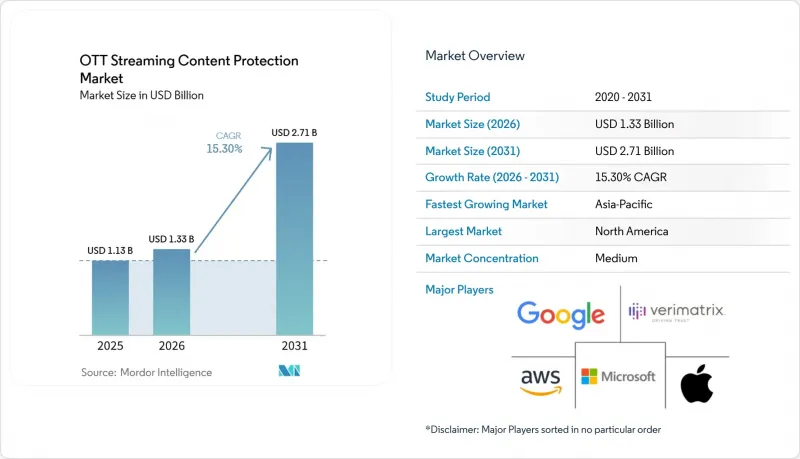
Mordor Intelligence에 의하면, OTT 스트리밍 컨텐츠 보호 시장 규모는 2025년 11억 3,000만 달러로 평가되었고, 2026년 13억 3,000만 달러에서 2031년까지 27억 1,000만 달러로 확대될 전망이며, 2026-2031년 CAGR 15.30%를 나타낼 것으로 예측됩니다.
본 보고서는 스트리밍 서비스 모델별(정기 구독 과금(SVOD), 건당 과금(TVOD/PPV), 하이브리드 수익화 과금), 용도별(컨텐츠 암호화 및 라이선싱, 불법 복제 방지 모니터링 및 삭제 등), 최종 사용자별(미디어 및 엔터테인먼트 기업 등), 그리고 지역별로 분류되어 있습니다. 시장 전망은 금액(달러) 기준으로 제시되어 있습니다.
세계의 OTT 스트리밍 컨텐츠 보호 시장 동향 및 인사이트
증가하는 불법 복제 및 인증 정보의 부정 사용으로 인한 손실
해적판 및 불법 계정 접근으로 인해 OTT 스트리밍 시장에서 컨텐츠 보호는 기술적 기능에서 상업적 우선순위로 전환되고 있습니다. 넷플릭스는 유료 계정 공유 기능을 도입한 후 유료 회원 수가 크게 증가했다고 보고했는데, 이는 가구별 규칙이 단순히 접근을 제한할 뿐만 아니라 구독 전환을 촉진할 수도 있음을 보여줍니다. 다른 플랫폼들도 유사한 관리 기능을 접근을 관리하고, 요금제 조건을 보호하며, 새로운 유료 사용자 확보의 길을 마련하는 수단으로 인식할 가능성이 높습니다. 이로 인해 중규모 서비스 사업자들은 불필요한 고객 불만을 초래하지 않으면서 동시 스트리밍 제한, 기기 제어, 위치 정보 확인, 계정 인증을 도입해야 하는 압박을 받고 있습니다. 플랫폼에는 비정상적인 이용을 식별하고, 일관된 판단을 적용하며, 정당한 시청을 방해하지 않는 시스템이 필요하기 때문에 운영상의 요구 사항은 초기 정책 설정에만 그치지 않습니다. 따라서 이용권 관리와 고객 친화적인 워크플로를 결합할 수 있는 보안 제공업체는 구독 서비스 전반에 걸친 다양한 구매자의 요구를 충족시킬 수 있는 입장에 있습니다.
프리미엄 라이브 스포츠 및 이벤트 스트리밍의 확대
라이브 스포츠는 OTT 스트리밍 컨텐츠 보호 시장에 까다로운 이용 사례를 만들어내고 있습니다. 이벤트의 가치는 라이브 방송 기간이 끝나면 떨어지기 때문입니다. 권리 보유자는 이벤트가 아직 진행 중인 단계에서 유출을 식별하고, 그 발생원을 추적하며, 확산 상황을 평가하고, 개입을 지원할 수 있는 제어 수단이 필요합니다. BuyDRM사는 자사의 KeyOS 플랫폼이 2026년 FIFA 월드컵 공식 스트리밍에서 MultiKey DRM과 MultiMark 포렌식 워터마킹을 결합하여 적용했다고 보고했습니다. 이러한 도입 사례는 다수의 시청자가 있는 상황에서도 정식 시청자에게 지장을 주지 않으면서, 암호화와 워터마킹을 연계하여 운영해야 하는 이유를 보여줍니다. 스트리밍 계약에서는 권리 계약이 체결되기 전에 서비스 제공 후보자가 보호 능력을 입증하도록 요구하는 사례가 늘고 있습니다. 그 결과, 라이브 이벤트 경험이 있는 벤더는 더 이른 단계에서 구매 프로세스에 진입할 수 있으며, 더 짧은 기간 내에 목표에 맞춘 도입 주기를 대응할 가능성이 있습니다.
기기 및 플랫폼 간 상호 운용성의 복잡성
단일 DRM 시스템으로 모든 주요 엔드포인트를 포괄할 수는 없기 때문에 기기의 상호 운용성은 여전히 OTT 스트리밍 컨텐츠 보호 시장에서 실무상의 제약으로 남아 있습니다. Widevine은 Android, Chrome 및 많은 스마트 TV 시스템을 지원하지만, Apple 기기에는 FairPlay가 필요하며, PlayReady는 Windows Edge 및 Xbox 환경을 지원합니다. 사업자는 지원 대상 기기 그룹별로 개별적인 소프트웨어 업데이트, 보안 패치, 기기 인증, 라이선스 서버 설정 및 테스트 절차를 유지해야 합니다. CBCS 모드 암호화를 갖춘 CMAF 패키징은 새로운 기기 그룹에서 중복되는 인코딩 작업을 줄이고, 일부 패키징 작업을 간소화할 수 있습니다. 다만, DRM 정책을 개별적으로 유지해야 할 필요성, 플랫폼 전반에 걸쳐 HD 및 4K 출력 요건을 적용해야 할 필요성이 사라지는 것은 아닙니다. 이로 인해 발생하는 업무 부담은 기존 서비스를 OTT 전송으로 확장하고 있는 방송 사업자나 지역 서비스 제공업체에게 특히 큰 과제가 될 수 있습니다.
부문 분석
2025년에는 정기 구독 과금(SVOD)이 수익의 55.63%를 차지했습니다. 구독 서비스는 일반적으로 고부가가치 컨텐츠 라이브러리를 보유하고 있으며, 하드웨어 기반 복호화, 세션 수준의 워터마킹 처리, 동시 스트림 수 제어, 지원 대상 기기 전반에 걸친 확실한 권리 보호 등 스튜디오 측의 엄격한 요구 사항 하에 운영됩니다. 이러한 요구 사항으로 인해, 이 부문은 OTT 스트리밍 컨텐츠 보호 시장에서 배포 라이프사이클 전반에 걸쳐 보호 서비스를 대규모로 안정적으로 구매하는 고객층이 되었습니다. 넷플릭스의 유료 계정 공유 사례에서 알 수 있듯이, 명확한 고객 정책과 함께 적용될 경우 접근 제어가 구독 전환을 촉진할 수 있음이 입증되었습니다. 이와 유사한 제어는 다수의 기기, 위치, 시청 세션에 걸쳐 가구 요금제 규칙을 보호해야 하는 서비스에게도 중요합니다.
광고 지원형 과금(AVOD/FAST)은 2031년까지 연평균 성장률(CAGR) 16.05%를 나타낼 것으로 예측됩니다. 이 모델은 시청자에게 무료 시청을 제공하는 한편, 광고 수익으로 자금을 조달하며, 신뢰할 수 있는 전송에 의존하고 있습니다. 무단 CDN 재전송은 광고 노출을 서비스가 관리하는 인벤토리 밖으로 유출시켜 캠페인 전달 및 보고의 신뢰성을 저하시킬 우려가 있습니다. 트랜잭션 과금(TVOD/PPV)에서는 조기 공개 작품에 대해 사용자 수준의 추적 가능성이 요구되지만, 하이브리드 모델에서는 무료층과 유료층에 걸친 서로 다른 보호 정책을 관리해야 합니다. 이러한 요구에 대응하기 위해 비즈니스 모델별로 개별 시스템을 구축하는 대신, 하나의 OTT 스트리밍 컨텐츠 보호 시장 서비스 내에서 여러 규칙을 지원하는 통합형 멀티 DRM 오케스트레이션이 요구되고 있습니다.
지역별 분석
2025년, 북미는 매출의 37.86%를 차지했습니다. 이 지역은 프리미엄 권리의 집중, 스튜디오 측의 적극적인 요구 사항, 광범위한 가구 접근 제어, 그리고 확립된 스트리밍 인프라가 결합되어 있습니다. 이 지역의 서비스는 구독형 및 광고 지원형 배포에 크게 의존하고 있으며, 이로 인해 무단 재배포나 인증 정보의 부정 사용으로 인한 영향이 더욱 커집니다. 캐나다와 멕시코에서는 엔터테인먼트 및 스포츠 라이브러리가 국경과 서비스를 넘어 배포되고 있기 때문에 지역별 권리 관리에 대한 수요가 높아지고 있습니다. 또한, 다른 지역의 플랫폼이 현지 시청자를 위해 할리우드 컨텐츠에 대한 라이선스를 취득하고 있기 때문에 북미 스튜디오 계약도 OTT 스트리밍 컨텐츠 보호 시장 전체에 영향을 미치고 있습니다.
유럽은 두 번째로 큰 지역 시장이며, 규정 준수 환경이 복잡합니다. 영국, 독일, 프랑스에서는 북미 이외의 지역에서도 구독형 동영상 서비스 이용이 널리 보급되어 있으며, 중요한 프리미엄 컨텐츠 라이브러리를 보유하고 있습니다. 유럽의 지역별 권리 요건은 프리미엄 영화 라이브러리에 대한 접근 제어, 지역 제한 기능 및 세션 기반 보호에 대한 수요를 뒷받침하고 있습니다. 남미는 OTT 스트리밍 컨텐츠 보호 시장의 신흥 지역으로, 플랫폼이 서비스를 확장하고 현지 스포츠 중계권 가치가 높아짐에 따라 브라질이 OTT 보급, 광고 수익형 스트리밍의 성장 및 투자를 주도하고 있습니다.
아시아태평양은 2031년까지 연평균 성장률(CAGR) 15.98%를 나타낼 것으로 예측됩니다. 인도에서는 커넥티드 TV 시청자층이 확대되고 있으며, 프리미엄급 대형 화면 시청 및 온라인 프로그램에 대한 폭넓은 접근을 실현하기 위한 하드웨어 기반 DRM이 이를 뒷받침하고 있습니다. 한국의 K-컨텐츠 수출과 일본의 프리미엄 현지 컨텐츠 및 스포츠 컨텐츠 제공 역시 권리자들의 보안 관련 지출을 촉진하고 있습니다. DoveRunner의 보고서에 따르면, 불법 플랫폼에서의 K-컨텐츠 무단 배포 건수는 누적 4억 9,400만 건에 달할 전망입니다. 중동 및 아프리카는 OTT 스트리밍 컨텐츠 보호 시장에서 여전히 초기 단계의 기회를 제공하고 있으며, 중동에서는 사우디아라비아와 UAE, 아프리카에서는 남아프리카공화국과 나이지리아가 주도적인 역할을 하고 있습니다.
기타 혜택 :
- 엑셀 형식 시장 전망(ME) 시트
- 3개월간 애널리스트 지원
자주 묻는 질문
목차
제1장 서론
제2장 조사 방법
제3장 주요 요약
제4장 시장 구도
제5장 시장 규모 및 성장 예측
제6장 경쟁 구도
제7장 시장 기회 및 향후 전망
AJY 26.09.03According to Mordor Intelligence, the OTT streaming content protection market size is projected to expand from USD 1.13 billion in 2025 and USD 1.33 billion in 2026 to USD 2.71 billion by 2031, registering a CAGR of 15.30% between 2026 to 2031.
This report is Segmented by Streaming Service Model (Recurring Subscription Billing (SVOD), Transactional Billing (TVOD/PPV), and Hybrid Monetization Billing), Application (Content Encryption and License Management, Anti-Piracy Monitoring and Takedown, and More), End User (Media and Entertainment Companies, and More), and Geography. The Market Forecasts are Provided in Terms of Value (USD).
Global OTT Streaming Content Protection Market Trends and Insights
Rising Piracy and Credential-Abuse Losses
Piracy and unauthorized account access are shifting content protection from a technical function to a commercial priority in the OTT streaming market. Netflix reported strong paid membership growth after introducing paid sharing, showing that household rules can support subscription conversion rather than just restrict access. Other platforms are likely to view similar controls as a way to manage access, protect plan terms, and develop new paid-user paths. This creates pressure on mid-sized services to introduce concurrent-stream limits, device controls, location checks, and account verification without creating unnecessary customer complaints. The operational requirement extends beyond the initial policy because platforms need systems that identify unusual use, apply decisions consistently, and avoid interrupting legitimate viewing. Security providers that can combine entitlement management with customer-friendly workflows are therefore positioned to address a broader buyer need across subscription services.
Expansion of Premium Live Sports and Event Streaming
Live sports create a demanding use case for the OTT streaming content protection market because the value of an event declines once the live window has ended. Rights holders need controls that can identify a leak, trace its source, assess its spread, and support an intervention while the event is still in progress. BuyDRM reported that its KeyOS platform combined MultiKey DRM and MultiMark forensic watermarking for official FIFA World Cup 2026 streams. This type of deployment shows why encryption and watermarking must operate together at high audience volumes without disrupting authorized viewers. Distribution agreements increasingly require a prospective service to demonstrate its protection capabilities before a rights deal is completed. Vendors with live-event experience can consequently enter the buying process earlier and may face shorter, more focused implementation cycles.
Device and Platform Interoperability Complexity
Device interoperability remains a practical restraint for the OTT streaming content protection market because no single DRM system covers every major endpoint. Widevine supports Android, Chrome, and many smart-TV systems, while FairPlay is required for Apple devices, and PlayReady supports Windows Edge and Xbox environments. Operators must maintain separate software updates, security patches, device certifications, license-server configurations, and testing routines for their supported device groups. CMAF packaging with CBCS-mode encryption can reduce duplicate encoding work for newer device fleets and can simplify some packaging operations. It does not remove the need to maintain separate DRM policies or enforce HD and 4K output requirements across platforms. The resulting workload can be especially difficult for broadcasters and regional services that are extending their traditional offerings to OTT distribution.
Other drivers and restraints analyzed in the detailed report include:
- Proliferation of Multi-Device OTT Consumption
- Increasing Studio Compliance Requirements for Premium Content
- Security Investment and Operating-Cost Burden
For complete list of drivers and restraints, kindly check the Table Of Contents.
Segment Analysis
Recurring Subscription Billing (SVOD) captured 55.63% of revenue in 2025. Subscription services typically host high-value libraries and operate under strict studio requirements for hardware-backed decryption, session-level watermarking, concurrent-stream control, and reliable rights enforcement across supported devices. Those requirements make the segment a large and durable buyer of protection services throughout the delivery lifecycle within the OTT streaming content protection market. Netflix's experience with paid sharing showed that access controls can support subscription conversion when applied with a clear customer policy. Similar controls are relevant for services that must protect household plan rules across many devices, locations, and viewing sessions.
Advertising-Supported Billing (AVOD/FAST) is projected to grow at a CAGR of 16.05% through 2031. This model extends free viewing to audiences but is funded by advertising revenue and depends on reliable delivery. Unlicensed CDN redistribution can move advertising impressions outside the service's controlled inventory and reduce confidence in campaign delivery and reporting. Transactional Billing (TVOD/PPV) requires user-level traceability for early-window releases, while hybrid models must manage different protection policies across free and paid tiers. These needs support unified multi-DRM orchestration for several rules within one OTT streaming content protection market service, rather than separate systems for each business model.
Complete Report Scope:
- By Streaming Service Model
- Recurring Subscription Billing (SVOD)
- Transactional Billing (TVOD/PPV)
- Advertising-Supported Billing (AVOD/FAST)
- Hybrid Monetization Billing
- By Application
- Access Control and Entitlement Management
- Credential-Sharing and Concurrent-Stream Control
- Geo-Restriction and Rights Enforcement
- Content Encryption and License Management
- Forensic Watermarking and Leak Attribution
- Anti-Piracy Monitoring and Takedown
- Access Control and Entitlement Management
- By End User
- OTT Streaming Platforms
- Broadcasters
- Telecom and Pay-TV Operators
- Media and Entertainment Companies
- Other End Users
- By Geography
- North America
- United States
- Canada
- Mexico
- South America
- Brazil
- Argentina
- Chile
- Rest of South America
- Europe
- Germany
- United Kingdom
- France
- Italy
- Spain
- Rest of Europe
- Asia-Pacific
- China
- Japan
- India
- South Korea
- Australia
- Rest of Asia-Pacific
- Middle East
- Saudi Arabia
- United Arab Emirates
- Qatar
- Rest of Middle East
- Africa
- South Africa
- Egypt
- Nigeria
- Rest of Africa
- North America
Geography Analysis
North America held 37.86% of revenue in 2025. The region combines a large concentration of premium rights, active studio requirements, widespread household access controls, and established streaming infrastructure. Its services have substantial exposure to subscription and advertising-supported distribution, which increases the consequences of unauthorized redistribution and credential abuse. Canada and Mexico add demand for territorial rights management as entertainment and sports libraries are distributed across borders and services. North American studio contracts also influence the broader OTT streaming content protection market, as platforms in other regions license Hollywood content for local audiences.
Europe is the second-largest regional market and has a complex compliance environment. The United Kingdom, Germany, and France support dense subscription-video use outside North America and have important premium-content libraries. European territorial rights requirements support demand for access controls, geo-restriction functions, and session-based protection for premium film libraries. South America is an emerging region for the OTT streaming content protection market, with Brazil leading OTT adoption, advertising-supported streaming growth, and investment as platforms expand their services and local sports rights become more valuable.
Asia Pacific is projected to grow at a CAGR of 15.98% through 2031. India's expanding connected-TV audience supports hardware-backed DRM for premium large-screen viewing and wider access to online programming. South Korea's K-content exports and Japan's premium local content and sports offerings also support security spending by rights holders. DoveRunner reported 494 million cumulative instances of unauthorized K-content distribution across illegal platforms. The Middle East and Africa remain earlier-stage opportunities for the OTT streaming content protection market, led by Saudi Arabia and the UAE in the Middle East and South Africa and Nigeria in Africa.
- Google LLC
- Microsoft Corporation
- Apple Inc.
- Amazon Web Services, Inc.
- Verimatrix, Inc.
- Irdeto B.V.
- NAGRAVISION S.a r.l.
- Synamedia Limited
- Castlabs GmbH
- NFA Group Inc. dba BuyDRM
- EZDRM, Inc.
- Bitmovin Inc.
- Axinom GmbH
- Brightcove Inc.
- Akamai Technologies, Inc.
- Edgio, Inc.
- Mux, Inc.
- Kaltura, Inc.
Additional Benefits:
- The market estimate (ME) sheet in Excel format
- 3 months of analyst support
TABLE OF CONTENTS
1 INTRODUCTION
- 1.1 Study Assumptions and Market Definition
- 1.2 Scope of The Study
2 RESEARCH METHODOLOGY
3 EXECUTIVE SUMMARY
4 MARKET LANDSCAPE
- 4.1 Market Overview
- 4.2 Market Drivers
- 4.2.1 Expansion of Premium Live Sports and Event Streaming
- 4.2.2 Proliferation of Multi-Device OTT Consumption
- 4.2.3 Rising Piracy and Credential-Abuse Losses
- 4.2.4 Increasing Studio Compliance Requirements for Premium Content
- 4.2.5 Prevention-First Security for CDN Leeching and Live Restreaming
- 4.2.6 Hardware-Backed DRM Adoption for 4K, 8K, and HDR Streaming
- 4.3 Market Restraints
- 4.3.1 Device and Platform Interoperability Complexity
- 4.3.2 Security Investment and Operating-Cost Burden
- 4.3.3 Viewer-Friction and Playback-Quality Tradeoffs
- 4.3.4 Shortened Piracy Response Windows for Live Content
- 4.4 Industry Value Chain Analysis
- 4.5 Regulatory Landscape
- 4.6 Technological Outlook
- 4.7 Porter's Five Forces Analysis
- 4.7.1 Bargaining Power of Buyers
- 4.7.2 Bargaining Power of Suppliers
- 4.7.3 Threat of New Entrants
- 4.7.4 Threat of Substitutes
- 4.7.5 Intensity of Competitive Rivalry
- 4.8 Impact of Macroeconomic Factors on the Market
5 MARKET SIZE AND GROWTH FORECASTS (VALUE)
- 5.1 By Streaming Service Model
- 5.1.1 Recurring Subscription Billing (SVOD)
- 5.1.2 Transactional Billing (TVOD/PPV)
- 5.1.3 Advertising-Supported Billing (AVOD/FAST)
- 5.1.4 Hybrid Monetization Billing
- 5.2 By Application
- 5.2.1 Access Control and Entitlement Management
- 5.2.1.1 Credential-Sharing and Concurrent-Stream Control
- 5.2.1.2 Geo-Restriction and Rights Enforcement
- 5.2.2 Content Encryption and License Management
- 5.2.3 Forensic Watermarking and Leak Attribution
- 5.2.4 Anti-Piracy Monitoring and Takedown
- 5.2.1 Access Control and Entitlement Management
- 5.3 By End User
- 5.3.1 OTT Streaming Platforms
- 5.3.2 Broadcasters
- 5.3.3 Telecom and Pay-TV Operators
- 5.3.4 Media and Entertainment Companies
- 5.3.5 Other End Users
- 5.4 By Geography
- 5.4.1 North America
- 5.4.1.1 United States
- 5.4.1.2 Canada
- 5.4.1.3 Mexico
- 5.4.2 South America
- 5.4.2.1 Brazil
- 5.4.2.2 Argentina
- 5.4.2.3 Chile
- 5.4.2.4 Rest of South America
- 5.4.3 Europe
- 5.4.3.1 Germany
- 5.4.3.2 United Kingdom
- 5.4.3.3 France
- 5.4.3.4 Italy
- 5.4.3.5 Spain
- 5.4.3.6 Rest of Europe
- 5.4.4 Asia-Pacific
- 5.4.4.1 China
- 5.4.4.2 Japan
- 5.4.4.3 India
- 5.4.4.4 South Korea
- 5.4.4.5 Australia
- 5.4.4.6 Rest of Asia-Pacific
- 5.4.5 Middle East
- 5.4.5.1 Saudi Arabia
- 5.4.5.2 United Arab Emirates
- 5.4.5.3 Qatar
- 5.4.5.4 Rest of Middle East
- 5.4.6 Africa
- 5.4.6.1 South Africa
- 5.4.6.2 Egypt
- 5.4.6.3 Nigeria
- 5.4.6.4 Rest of Africa
- 5.4.1 North America
6 COMPETITIVE LANDSCAPE
- 6.1 Market Concentration
- 6.2 Strategic Moves
- 6.3 Vendor Positioning Analysis
- 6.4 Company Profiles (includes Global Level Overview, Market Level Overview, Core Segments, Financials as available, Strategic Information, Market Rank/Share, Products and Services, Recent Developments)
- 6.4.1 Google LLC
- 6.4.2 Microsoft Corporation
- 6.4.3 Apple Inc.
- 6.4.4 Amazon Web Services, Inc.
- 6.4.5 Verimatrix, Inc.
- 6.4.6 Irdeto B.V.
- 6.4.7 NAGRAVISION S.a r.l.
- 6.4.8 Synamedia Limited
- 6.4.9 Castlabs GmbH
- 6.4.10 NFA Group Inc. dba BuyDRM
- 6.4.11 EZDRM, Inc.
- 6.4.12 Bitmovin Inc.
- 6.4.13 Axinom GmbH
- 6.4.14 Brightcove Inc.
- 6.4.15 Akamai Technologies, Inc.
- 6.4.16 Edgio, Inc.
- 6.4.17 Mux, Inc.
- 6.4.18 Kaltura, Inc.
7 MARKET OPPORTUNITIES AND FUTURE OUTLOOK
- 7.1 White-Space and Unmet-Need Assessment


